LESSON OBJECTIVES
To knowhow to
design an exercise
program that is
specifically suited
for an individual
To know the
principles of
exercise training
and the risk
factors that must
be taken into
consideration in
designing an
exercise program
1. PRINCIPLES OFOVERLOAD
STATES THAT THE BODY MUST WORK
HARDER THAN WHAT IT IS USED TO IN
ORDER FOR IT TO ADAPT
IMPLIES THAT EXERCISE IS A CONTROLLED
FORM OF STRESS THAT WILL STIMULATE
THE BODY TO BECOME STRONGER
ASKS “HOW HARD?”
6.
2. PRINCIPLES OFPROGRESSION
STATES THAT THE BODY
SHOULD EXPERIENCE A
GRADUAL INCREASE IN
WORKLOAD
ASKS “HOW SOON?”
7.
3. PRINCIPLES OFSPECIFICITY
STATES THAT THE BODY WILL ADAPT
SPECIFICALLY TO THE WORKLOAD IT
EXPERIENCED
IMPLIES THAT IMPROVEMENTS IN FITNESS
LEVEL WILL BE LIMITED TO THE ACTIVITIES
THAT ONE IS PERFORMING
ASKS “WHAT TYPE?”
8.
4. PRINCIPLES OFINDIVIDUALITY
STATES THAT NO TWO PERSONS ARE THE
SAME AND THEIR RATE OF ADAPTATION TO
THE SAME WORKLOAD DIFFERS
EMPHASIZES THE NEED TO CREATE AN
EXERCISE PROGRAM THAT IS INDIVIDUAL-
SPECIFIC
9.
5.PRINCIPLES OF REVERSIBILITY
ANOTHERWAY OF STATING THE PRINCIPLE OF
DISUSE
STATES THAT YOUR ENERGY SYSTEMS ARE NOT
UTILIZED, THEY DETERIORATE TO A LEVEL THAT
MATCHES YOUR LEVEL OF ACTIVITY
INDICATES THAT DISUSE OR INACTIVITY
RESULTS IN LOSS OF BENEFITS ACHIEVED IN
OVERLOADING
1.WRITE SHORT-TERM ANDLONG-TERM
PERFORMANCE GOALS
A SHORT-TERM GOAL IS SOMETHING THAT CAN BE
ACHIEVED IN 6 TO 8 WEEKS WHILE A LONG-TERM
GOAL IS SOMETHING THAT CAN BE ACHIEVED IN 6
MONTHS OR MORE. A LONG-TERM GOAL IS USUALLY
MADE OF SEVERAL SHORT-TERM GOALS THAT
BUILD ON EACH OTHER.
12.
2.SET REALISTIC GOALS.
ITIS IMPORTANT THAT GOALS ARE ATTAINABLE
IN THE GIVEN PERIOD. REVIEW YOUR CURRENT
FITNESS LEVEL AND DECIDE ON MODEST GAINS.
YOU CAN ALSO ASK YOUR TEACHER OR FRIENDS
WHO EXERCISE FOR A POSSIBLE GOAL. THIS
WILL KEEP YOU FROM GETTING FRUSTRATED.
13.
3.WRITE SPECIFIC GOALS.
WRITEA GOAL FOR EACH FITNESS
COMPONENT INSTEAD OF
WRITING A GENERAL. A SPECIFIC
GOAL HELPS YOU FOCUS ON
WHAT HAS TO BE DONE.
14.
4.WRITE A FITNESSCONTRACT.
A FITNESS CONTRACT IS A CONCRETE
COMMITMENT. IT IS A VISUAL REMINDER OF
THE GOALS YOU HAVE IDENTIFIED, AND IT
STRENGTHENS YOUR RESOLVE TO KEEP YOUR
EXERCISE PROGRAM. IT MAKES YOU
ACCOUNTABLE FOR THE CONSEQUENCES OF
YOUR ACTIONS.
FOR PERSONS WHOARE INACTIVE AND
UNSURE, WHAT SHOULD BE THE FIRST THING
TO DO BEFORE ENGAGING IN AN EXERCISE
PROGRAM?
IT IS ALWAYS BEST TO START ANY UNDERTAKING WITH A PLAN.
IN EXERCISE PROGRAM DESIGN, THE ASSESSMENT PROCESS CAN
PROVIDE RELEVANT INFORMATION ON THE HEALTH RISKS, PHYSICAL
LIMITATIONS, AND MUSCLE WEAKNESSES OF AN INDIVIDUAL.
THE PRE-PARTICIPATION SCREENING IS ESSENTIAL TO RULE OUT THE
PRESENCE OF MEDICAL CONDITIONS WHEREIN STRENUOUS
ACTIVITIES AND CERTAIN TYPES OF EXERCISES ARE
CONTRAINDICATED.
THE PHYSICAL ACTIVITY
READINESSQUESTIONNAIRE
(PAR-Q)
A SUBJECTIVE METHOD IN IDENTIFYING THE RISK OF
CARDIOVASCULAR DISEASES
COMPOSED OF SEVEN QUESTIONS ANSWERABLE BY “YES”
OR “NO”, WITH EACH QUESTION EVALUATING ONE’S HISTORY
FOR MEDICAL CONDITIONS SUCH AS HEART DISEASES,
HYPERTENSION, CHRONIC OBSTRUCTIVE PULMONARY
DISEASE, AND DIABETES MELLITUS
• ONE MILERUN
IT IS A POPULAR TEST TO ASSESS
CARDIOVASCULAR ENDURANCE. IT IS
EASY TO ADMINISTER BECAUSE IT
REQUIRES MINIMAL EQUIPMENT AND
SUPERVISION. ALL THAT IS NEEDED IS A
RUNNING TRACK AND A STOPWATCH.
THE GOAL IS TO FINISH THE DISTANCE
WITH THE FASTEST TIME POSSIBLE.
• SIT ANDREACH
THE ILLUSTRATION ON THE RIGHT SHOWS THE
CORRECT POSITION OF THE BODY WHEN
PERFORMING SIT AND REACH.
26.
BMI IS AWIDELY ACCEPTED TOOL TO EVALUATE BODY
COMPOSITION. THE SCORE REFLECTS HOW HEAVY THE PERSON
IS, RELATIVE TO HIS/HER HEIGHT. TWO MEASUREMENTS NEED
TO BE TAKEN TO COMPUTE THE BMI: HEIGHT AND WEIGHT.
CONVERT THE HEIGHT MEASUREMENT INTO METERS AND THE
WEIGHT INTO KILOGRAMS. DIVIDE THE WEIGHT BY THE
SQUARE OF THE HEIGHT TO OBTAIN THE BODY MASS INDEX
(KG/M2).
27.
• WAIST GIRTH
THEWAIST GIRTH IS AN IMPORTANT TOOL TO ASSESS
THE RELATIVE AMOUNT OF FAT IN THE ABDOMINAL
REGION. THE TAPE MEASURE IS POSITIONED AROUND
THE ABDOMINAL REGION, LEVEL WITH THE NAVEL. THE
MEASUREMENT IS MADE WHILE THE STUDENT IS
STANDING AND WEARING LIGHT CLOTHING.
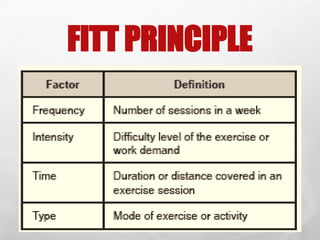
FITT PRINCIPLE
THE FITTPRINCIPLE IS AN ACRONYM FOR FREQUENCY,
INTENSITY, TIME, AND TYPE, WHICH ARE THE KEY FACTORS
IN DESIGNING AN EXERCISE PROGRAM THAT WILL
ADDRESS THE CURRENT FITNESS LEVEL, PROVIDE MEANS
TO OVERLOAD THE BODY, AND TRIGGER POSITIVE
ADAPTATIONS.
THESE VARIABLES CAN BE MODIFIED OCCASIONALLY TO
CONSISTENTLY CHALLENGE THE BODY TO BECOME
STRONGER.
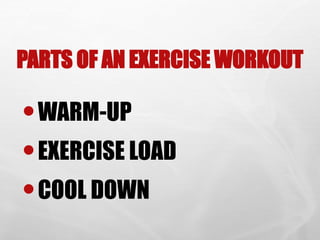
•COOL DOWN
RECOVERY, APERIOD IN WHICH THE BODY STARTS TO MAKE
MICROSCOPIC CHANGES ESSENTIAL FOR ADAPTATION, STARTS
AT THE COOL DOWN.
THE COOL DOWN BRIDGES THE PERIOD BETWEEN WORKOUT AND
REST.
A WELL-PLANNED COOL DOWN CAN QUICKLY CLEAR THE BY-
PRODUCTS OF MUSCLE CONTRACTION AS WELL AS REPLENISH
THE ENERGY AND OXYGEN STORES USED DURING THE WORKOUT.
A GOOD COOL-DOWN ROUTINE TAKES AROUND 10 MINUTES. THE
ROUTINE SHOULD INCLUDE PERFORMING A MULTI-JOINT
ACTIVITY THAT IS LOW IN INTENSITY FOR A PERIOD OF 5
MINUTES.
Editor's Notes
#6 To explain further, you may say: The body will get injured if it experiences a workload that is too hard and too soon. The body should be given an ample time to recover and get used to the new workload. The rate at which the body adapts varies from one individual to another. A reasonable time frame is to increase the load after two weeks. However, it is recommended that you do not increase the workload by more than 10% from the previous week.
#7 To explain further, you may say: The application of this principle is not only on the movement or activity performed but to the intensity at which it is performed. A person who trains for a marathon should not be expected to be able to lift heavy barbells. This principle highlights the importance of performing a variety of activities to improve overall fitness.
#8 To explain further, you may say: All individuals have different performance goals, fitness attributes, lifestyle, and nutritional preferences; they respond to exercise and its physical and social environments in their own unique way. It is therefore essential that the exercise program cater to these individual needs and preferences.
#15 Tell the students that they can also use the SMARTER Objectives in setting their fitness goals.
#17 Tell the students that the table shows the components of a Pre-Participation Screening Program.
#26 Tell the students that BMI calculator can be downloaded for free from various websites.
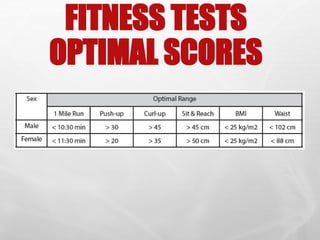
#28 Tell the students that the table below shows the optimal scores for adolescents in various fitness tests.
#29 To explain each variable, you may say: The frequency of an exercise program depends on the current fitness level and the type of activity performed.
The intensity of an exercise refers to the difficulty level of the workout. The time or duration of an exercise session is influenced by the intensity and the type of activity performed. the type of activity is influenced by the fitness goal and the current fitness level.
#30 Tell the students that the table on the slide shows the FITT Principle in Exercise Program Design.
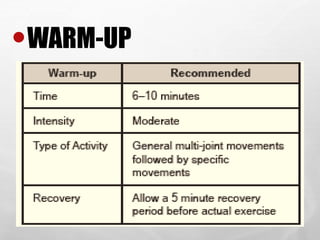
#32 Tell the students that Warm-up is essential prior to the actual workload as it prepares the body for more strenuous activity. It increases blood flow to the working muscles without an abrupt increase in lactic acid accumulation.
Tell the students that the table show the characteristics of a Warm-up.