Pizza Problem
                                 Wong Hang Chi
                                January 19, 2010


1    The Problem
Draw three chords through an arbitrary point inside a circle so that they make
six 60◦ angles at the point and color the resulting “pizza slices” alternately black
and white. Is the black area necessarily equal to the white area? What if four
chords are used, making eight 45◦ angles?


2    Tiffany Lemma
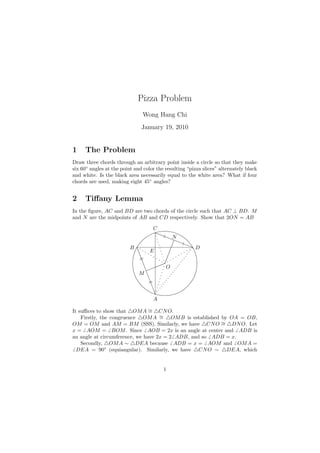
In the figure, AC and BD are two chords of the circle such that AC ⊥ BD. M
and N are the midpoints of AB and CD respectively. Show that 2ON = AB

                                     C
                                      .
                                       .          N
                                           −


                                        .
                                         .
                                          .
                                                     −


                          B ...            .                 .. D
                                . . E ..                 . . ..
                                    .. .             . . ..
                             =         . . . . . . ..
                                             ...       .
                                               . O ...
                                              .   ..
                                             .
                             M              . ...
                                           . .
                                   = .. ...
                                        ..
                                       ..
                                      ..
                                     A

It suffices to show that OM A ∼ CN O.
                                =
    Firstly, the congruence OM A ∼ OM B is established by OA = OB,
                                    =
OM = OM and AM = BM (SSS). Similarly, we have CN O ∼ DN O. Let
                                                        =
x = AOM = BOM . Since AOB = 2x is an angle at center and ADB is
an angle at circumference, we have 2x = 2 ADB, and so ADB = x.
    Secondly, OM A ∼ DEA because ADB = x = AOM and OM A =
  DEA = 90◦ (equiangular). Similarly, we have CN O ∼ DEA, which


                                            1
implies OM A ∼ CN O. But OA = CO is the radii, so the similarity is in
fact congruence (AAS), which is the desired result.
    We then have the following equality as a corollary.

                            AE 2 + BE 2 + CE 2 + DE 2 = 4R2

where R is the radius of the circle.
   The Pythagorean Theorem implies that AE 2 + BE 2 = AB 2 and CE 2 +
DE 2 = CD2 . Applying the Tiffany Lemma, we have

                   AE 2 + BE 2 + CE 2 + DE 2       = AB 2 + CD2
                                                   =   (2ON )2 + (2CN )2
                                                   =   4(ON 2 + CN 2 )
                                                   =   4OC 2
                                                   =   4R2


Therefore, the sum AE 2 + BE 2 + CE 2 + DE 2 is a constant which equals four
times the square of the radius.


3    The Solution
Without loss of generality, suppose that the circle has radius of unit length and
that its interior contains the origin. Using polar coordinates, parametrize the
circle by r(θ), where θ ∈ R. Define the four chords by θ = kπ , where k ∈ N.
                                                                4
By the Tiffany Lemma, we have
                                  π                        3π
                     r(θ)2 + r(     + θ)2 + r(π + θ)2 + r(    + θ)2 = 4
                                  2                         2
and so the required area is
              π                                                                 π
      1       4                 π                        3π             1       4
                  [r(θ)2 + r(     + θ)2 + r(π + θ)2 + r(    + θ)2 ]dθ =             4dθ
      2   0                     2                         2             2   0

which equals, obviously, π . QED.
                           2
    In general, the integral can be taken over any measurable subset A of the
interval [0, π ] such that m(A) = π .
             2                    4


                                               2

Pizza Problem

  • 1.
    Pizza Problem Wong Hang Chi January 19, 2010 1 The Problem Draw three chords through an arbitrary point inside a circle so that they make six 60◦ angles at the point and color the resulting “pizza slices” alternately black and white. Is the black area necessarily equal to the white area? What if four chords are used, making eight 45◦ angles? 2 Tiffany Lemma In the figure, AC and BD are two chords of the circle such that AC ⊥ BD. M and N are the midpoints of AB and CD respectively. Show that 2ON = AB C . . N − . . . − B ... . .. D . . E .. . . .. .. . . . .. = . . . . . . .. ... . . O ... . .. . M . ... . . = .. ... .. .. .. A It suffices to show that OM A ∼ CN O. = Firstly, the congruence OM A ∼ OM B is established by OA = OB, = OM = OM and AM = BM (SSS). Similarly, we have CN O ∼ DN O. Let = x = AOM = BOM . Since AOB = 2x is an angle at center and ADB is an angle at circumference, we have 2x = 2 ADB, and so ADB = x. Secondly, OM A ∼ DEA because ADB = x = AOM and OM A = DEA = 90◦ (equiangular). Similarly, we have CN O ∼ DEA, which 1
  • 2.
    implies OM A∼ CN O. But OA = CO is the radii, so the similarity is in fact congruence (AAS), which is the desired result. We then have the following equality as a corollary. AE 2 + BE 2 + CE 2 + DE 2 = 4R2 where R is the radius of the circle. The Pythagorean Theorem implies that AE 2 + BE 2 = AB 2 and CE 2 + DE 2 = CD2 . Applying the Tiffany Lemma, we have AE 2 + BE 2 + CE 2 + DE 2 = AB 2 + CD2 = (2ON )2 + (2CN )2 = 4(ON 2 + CN 2 ) = 4OC 2 = 4R2 Therefore, the sum AE 2 + BE 2 + CE 2 + DE 2 is a constant which equals four times the square of the radius. 3 The Solution Without loss of generality, suppose that the circle has radius of unit length and that its interior contains the origin. Using polar coordinates, parametrize the circle by r(θ), where θ ∈ R. Define the four chords by θ = kπ , where k ∈ N. 4 By the Tiffany Lemma, we have π 3π r(θ)2 + r( + θ)2 + r(π + θ)2 + r( + θ)2 = 4 2 2 and so the required area is π π 1 4 π 3π 1 4 [r(θ)2 + r( + θ)2 + r(π + θ)2 + r( + θ)2 ]dθ = 4dθ 2 0 2 2 2 0 which equals, obviously, π . QED. 2 In general, the integral can be taken over any measurable subset A of the interval [0, π ] such that m(A) = π . 2 4 2