What is a Cone?
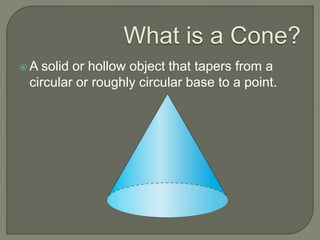
 A solid or hollow object that tapers from a
circular or roughly circular base to a point.
Types of Cones
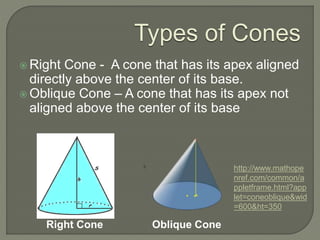
 Right Cone - A cone that has its apex aligned
directly above the center of its base.
 Oblique Cone – A cone that has its apex not
aligned above the center of its base
Right Cone Oblique Cone
http://www.mathope
nref.com/common/a
ppletframe.html?app
let=coneoblique&wid
=600&ht=350
Volume of Cone
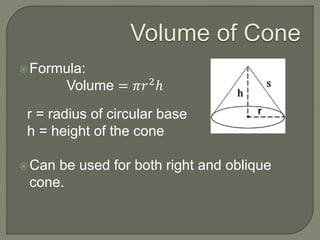
Formula:
Volume = 𝜋𝑟2
ℎ
r = radius of circular base
h = height of the cone
Can be used for both right and oblique
cone.
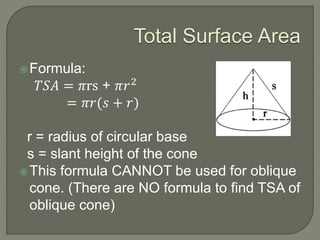
Total Surface Area
Formula:
𝑇𝑆𝐴 = 𝜋rs + 𝜋𝑟2
= 𝜋𝑟(𝑠 + 𝑟)
r = radius of circular base
s = slant height of the cone
This formula CANNOT be used for oblique
cone. (There are NO formula to find TSA of
oblique cone)
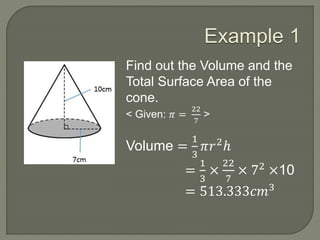
Example 1
Find out the Volume and the
Total Surface Area of the
cone.
< Given: 𝜋 =
22
7
>
Volume =
1
3
𝜋𝑟2
ℎ
=
1
3
×
22
7
× 72
×10
= 513.333𝑐𝑚3
s = 102 + 72
= 149
Total Surface Area
= 𝜋𝑟 𝑠 + 𝑟
=
22
7
× 7( 149 + 7)
= 22 149 + 7
= 422.544𝑐𝑚2
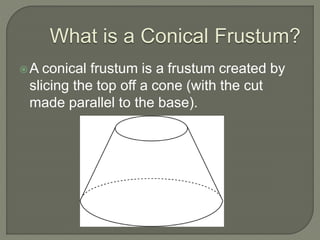
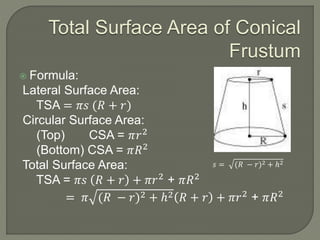
What is a Conical Frustum?
A conical frustum is a frustum created by
slicing the top off a cone (with the cut
made parallel to the base).
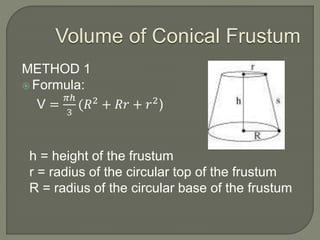
Volume of Conical Frustum
METHOD 1
 Formula:
V =
𝜋ℎ
3
(𝑅2
+ 𝑅𝑟 + 𝑟2
)
h = height of the frustum
r = radius of the circular top of the frustum
R = radius of the circular base of the frustum
Total Surface Area of Conical
Frustum
𝑠 = (𝑅 − 𝑟)2 + ℎ2
 Formula:
Lateral Surface Area:
TSA = 𝜋𝑠 (𝑅 + 𝑟)
Circular Surface Area:
(Top) CSA = 𝜋𝑟2
(Bottom) CSA = 𝜋𝑅2
Total Surface Area:
TSA = 𝜋𝑠 𝑅 + 𝑟 + 𝜋𝑟2 + 𝜋𝑅2
= 𝜋 (𝑅 − 𝑟)2 + ℎ2 𝑅 + 𝑟 + 𝜋𝑟2 + 𝜋𝑅2
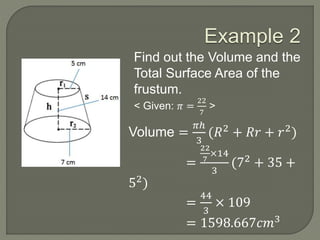
Example 2
Find out the Volume and the
Total Surface Area of the
frustum.
< Given: 𝜋 =
22
7
>
Volume =
𝜋ℎ
3
(𝑅2 + 𝑅𝑟 + 𝑟2)
=
22
7
×14
3
(72
+ 35 +
52)
=
44
3
× 109
= 1598.667𝑐𝑚3
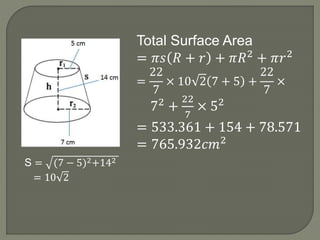
S = (7 − 5)2+142
= 10 2
Total Surface Area
= 𝜋𝑠 𝑅 + 𝑟 + 𝜋𝑅2
+ 𝜋𝑟2
=
22
7
× 10 2 7 + 5 +
22
7
×
72
+
22
7
× 52
= 533.361 + 154 + 78.571
= 765.932𝑐𝑚2
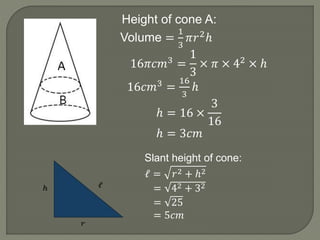
Example 3
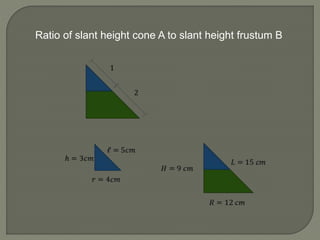
Diagram shows cone A and
frustum B. Ratio of slant height
cone A to slant height frustum
B is 1:2 . Given that radius of
cone A is 4cm and its volume
is 16π𝑐𝑚3
. Find out the
volume and the total surface
area of frustum B in terms of
π.
Height of cone A:
Volume =
1
3
𝜋𝑟2ℎ
16𝜋𝑐𝑚3 =
1
3
× 𝜋 × 42 × ℎ
16𝑐𝑚3 =
16
3
ℎ
ℎ = 16 ×
3
16
ℎ = 3𝑐𝑚
Slant height of cone:
ℓ = 𝑟2 + ℎ2
= 42 + 32
= 25
= 5𝑐𝑚
Ratio of slant height cone A to slant height frustum B
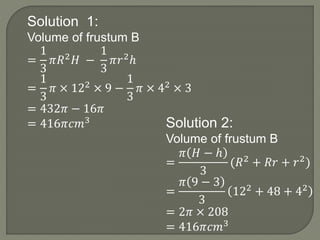
Solution 1:
Volume of frustum B
=
1
3
𝜋𝑅2 𝐻 −
1
3
𝜋𝑟2ℎ
=
1
3
𝜋 × 122 × 9 −
1
3
𝜋 × 42 × 3
= 432𝜋 − 16𝜋
= 416𝜋𝑐𝑚3 Solution 2:
Volume of frustum B
=
𝜋 𝐻 − ℎ
3
(𝑅2
+ 𝑅𝑟 + 𝑟2
)
=
𝜋 9 − 3
3
122 + 48 + 42
= 2𝜋 × 208
= 416𝜋𝑐𝑚3
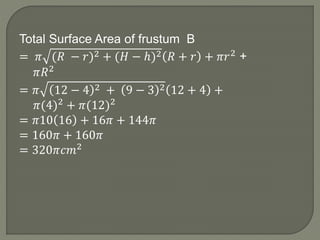
Total Surface Area of frustum B
= 𝜋 (𝑅 − 𝑟)2 + (𝐻 − ℎ)2 𝑅 + 𝑟 + 𝜋𝑟2 +
𝜋𝑅2
= 𝜋 12 − 4 2 + 9 − 3 2 12 + 4 +
𝜋(4)2 + 𝜋(12)2
= 𝜋10 16 + 16𝜋 + 144𝜋
= 160𝜋 + 160𝜋
= 320𝜋𝑐𝑚2

Cones and frustum slides

  • 2.
    What is aCone?  A solid or hollow object that tapers from a circular or roughly circular base to a point.
  • 3.
    Types of Cones Right Cone - A cone that has its apex aligned directly above the center of its base.  Oblique Cone – A cone that has its apex not aligned above the center of its base Right Cone Oblique Cone http://www.mathope nref.com/common/a ppletframe.html?app let=coneoblique&wid =600&ht=350
  • 4.
    Volume of Cone Formula: Volume= 𝜋𝑟2 ℎ r = radius of circular base h = height of the cone Can be used for both right and oblique cone.
  • 5.
    Total Surface Area Formula: 𝑇𝑆𝐴= 𝜋rs + 𝜋𝑟2 = 𝜋𝑟(𝑠 + 𝑟) r = radius of circular base s = slant height of the cone This formula CANNOT be used for oblique cone. (There are NO formula to find TSA of oblique cone)
  • 6.
    Example 1 Find outthe Volume and the Total Surface Area of the cone. < Given: 𝜋 = 22 7 > Volume = 1 3 𝜋𝑟2 ℎ = 1 3 × 22 7 × 72 ×10 = 513.333𝑐𝑚3
  • 7.
    s = 102+ 72 = 149 Total Surface Area = 𝜋𝑟 𝑠 + 𝑟 = 22 7 × 7( 149 + 7) = 22 149 + 7 = 422.544𝑐𝑚2
  • 8.
    What is aConical Frustum? A conical frustum is a frustum created by slicing the top off a cone (with the cut made parallel to the base).
  • 9.
    Volume of ConicalFrustum METHOD 1  Formula: V = 𝜋ℎ 3 (𝑅2 + 𝑅𝑟 + 𝑟2 ) h = height of the frustum r = radius of the circular top of the frustum R = radius of the circular base of the frustum
  • 10.
    Total Surface Areaof Conical Frustum 𝑠 = (𝑅 − 𝑟)2 + ℎ2  Formula: Lateral Surface Area: TSA = 𝜋𝑠 (𝑅 + 𝑟) Circular Surface Area: (Top) CSA = 𝜋𝑟2 (Bottom) CSA = 𝜋𝑅2 Total Surface Area: TSA = 𝜋𝑠 𝑅 + 𝑟 + 𝜋𝑟2 + 𝜋𝑅2 = 𝜋 (𝑅 − 𝑟)2 + ℎ2 𝑅 + 𝑟 + 𝜋𝑟2 + 𝜋𝑅2
  • 11.
    Example 2 Find outthe Volume and the Total Surface Area of the frustum. < Given: 𝜋 = 22 7 > Volume = 𝜋ℎ 3 (𝑅2 + 𝑅𝑟 + 𝑟2) = 22 7 ×14 3 (72 + 35 + 52) = 44 3 × 109 = 1598.667𝑐𝑚3
  • 12.
    S = (7− 5)2+142 = 10 2 Total Surface Area = 𝜋𝑠 𝑅 + 𝑟 + 𝜋𝑅2 + 𝜋𝑟2 = 22 7 × 10 2 7 + 5 + 22 7 × 72 + 22 7 × 52 = 533.361 + 154 + 78.571 = 765.932𝑐𝑚2
  • 13.
    Example 3 Diagram showscone A and frustum B. Ratio of slant height cone A to slant height frustum B is 1:2 . Given that radius of cone A is 4cm and its volume is 16π𝑐𝑚3 . Find out the volume and the total surface area of frustum B in terms of π.
  • 14.
    Height of coneA: Volume = 1 3 𝜋𝑟2ℎ 16𝜋𝑐𝑚3 = 1 3 × 𝜋 × 42 × ℎ 16𝑐𝑚3 = 16 3 ℎ ℎ = 16 × 3 16 ℎ = 3𝑐𝑚 Slant height of cone: ℓ = 𝑟2 + ℎ2 = 42 + 32 = 25 = 5𝑐𝑚
  • 15.
    Ratio of slantheight cone A to slant height frustum B
  • 16.
    Solution 1: Volume offrustum B = 1 3 𝜋𝑅2 𝐻 − 1 3 𝜋𝑟2ℎ = 1 3 𝜋 × 122 × 9 − 1 3 𝜋 × 42 × 3 = 432𝜋 − 16𝜋 = 416𝜋𝑐𝑚3 Solution 2: Volume of frustum B = 𝜋 𝐻 − ℎ 3 (𝑅2 + 𝑅𝑟 + 𝑟2 ) = 𝜋 9 − 3 3 122 + 48 + 42 = 2𝜋 × 208 = 416𝜋𝑐𝑚3
  • 17.
    Total Surface Areaof frustum B = 𝜋 (𝑅 − 𝑟)2 + (𝐻 − ℎ)2 𝑅 + 𝑟 + 𝜋𝑟2 + 𝜋𝑅2 = 𝜋 12 − 4 2 + 9 − 3 2 12 + 4 + 𝜋(4)2 + 𝜋(12)2 = 𝜋10 16 + 16𝜋 + 144𝜋 = 160𝜋 + 160𝜋 = 320𝜋𝑐𝑚2