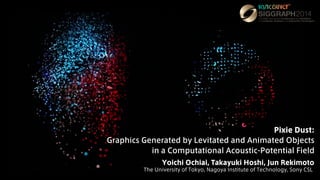
Pixie Dust:
Graphics Generated by Levitated and Animated Objects
in a Computational Acoustic-Potential Field
Yoichi Ochiai, Takayuki Hoshi, Jun Rekimoto
The University of Tokyo, Nagoya Institute of Technology, Sony CSL
Pixie Dust	

Beyond the “Pixels”, like a “Magic”	

Small “Pixies” are Animated and Levitated in the air.
Pixie Dust:
Graphics Generated by Levitated and Animated Objects
in a Computational Acoustic-Potential Field
!
Yoichi Ochiai
Media Artist
PhD candidate at
The University of Tokyo
Microsoft Research
Colloidal Display: BRDF Bubble Screen
Spinning Top Display
Pixie Dust: Graphical Levitation
Also you can see my work in this year’s SIGGRAPH Art Gallery.
Research Interest
Dynamic physicalization of Computer Graphics
“What would happen?”
“If the real world things had the characteristics like computer graphics model ”
As an independent Media Artist
SIGGRAPH 2014
SIGGRAPH 2011
SIGGRAPH 2014
2
SIGGRAPH2013,2012
Rendering Real Circuit
SIGGRAPH 2010
Introduction
“Computational Field”
Pixie Dust:
Graphics Generated by Levitated and Animated Objects
in a Computational Acoustic-Potential Field
Graphics in the Art.
Oil painting is rendered by Artist and Oil paint
Graphics on a LCD screen
Rendered by !
LCD and Photons
Graphics in the digital fabrication
Rendered by !
xyz plotter and ABS resin
Is it Graphics?
Rendered by small particles (Styrofoam) and!
“Computational Acoustic Potential Field”
Animation (Screen)
Animation is rendered by the difference of display images
Animation (kinetic expression)
Animation is rendered by the robot motions (servo motors)
Animation is rendered by movement of!
“Computational Acoustic Potential Field”
Is it the kind of Animation?
Contribution Summery: !
Graphics generated by the Acoustic Potential Field
1. Provide theoretical description of 3D acoustic
manipulation technology in detail and Evaluation. !
2. Expanding the 3D acoustic levitation technology to
the graphics applications.!
3. Introduction of the concept: “Computational Potential
Field” which is the environmental actuation between
“atom” and “bit”.
We believe these are contribution!
to “Graphics” communities.
Related Work
“Levitation and Programable matter”
Pixie Dust:
Graphics Generated by Levitated and Animated Objects
in a Computational Acoustic-Potential Field
Related Work:
Levitation
Interaction with
levitated Objects
Deformable Display
3D Display
Programable Matter
Including Various Areas
Levitation in Physics et al. 1981
Radical AtomsProgramable Matter
Computational Potential Field
Concept
Our
Approach
Implementation
Concept
Self Actuation
Interface
Ishii et al. 2012Hawkes et al. 2010 Poupyrev et al. 2007
Self Actuated
Environmental Actuation
Physical quantity Material parameters Mechanism Spatial resolution
Sound Density and volume Phased arrays Wave length
Airflow [Iwaki et al., 2011] Density and area Air jets Spread of air jets
Magnetism [Lee et al., 2011] Weight and magnetism
Electromagnet and XY
stage
Size of magnet
Whymark 1975 Foresti et al 2013
Ochiai et al 2013 Our ApproachKono et al 2013
1D 2D 3D 3D APF
Object
Standing
Waves
Refrector
Plate
Refrector
Plate
Transducer
Array
Focus
Transducer
Levitation
Method
Acoustic
Levitation
Contribution
Water layered Display Plasma Based 3D spatial display
Spatial 3D Display Technology
Barnum et al. 2010 Kimura et al. 2006
Holodust
Perlin et al.
Theory and Implementation
“APF generated by Phased Arrays”
Pixie Dust:
Graphics Generated by Levitated and Animated Objects
in a Computational Acoustic-Potential Field
19
Acoustic Potential Energy Distribution in standing waves
https://www.youtube.com/watch?v=669AcEBpdsY
Simple Acoustic Levitation (Whymark et al 1975)
Kinetic Energy Densities
Potential Energy Densities
Potential Energy U from Gorkov (1962) and Niborg (1967)
Densities of Medium
Densities of Small Sphere
Compression ratios of the small sphere and the medium,
20
Acoustic Potential Energy Distribution in standing waves(Novelty)
Densities of MediumDensities of Small Sphere
Compression ratios of the small sphere and the medium,
the root mean square (RMS) amplitude,,
the normalized cross-sectional distribution of the ultrasonic beam
Our Approach: Employ Phased Array as Transducers
Related Work
21
Potential Distribution in standing waves (1:beam)
23
Animation is described by the movement of focal points
Focal Points
Movement
Ultrasonic waves
Ultrasonic waves
Potential Distribution in standing waves (2:plane sheet beam)
Sheet beam
Implementation: Acoustic Potential Field Generator
(Opposed Phased Arrays/ 40kHz and 25kHz)
Evaluation: Speed, Allowable Weight, and Workspace
0.6mm particles
manipulated up to 72cm/s
2.0mm particles
manipulated up to 48cm/s
Evaluation: Speed, Allowable Weight, and Workspace
Work space is 600mm x 600mm x 600mm
For the stable manipulation,
work space is should be within 150mm x 150mm x 150mm
29
Evaluation: Speed, Allowable Weight, and Workspace
tested with nut.
up to 1g.
and 7.8g/cm^3
Appication and Discussions
“APF generated by Phased Arrays”
Pixie Dust:
Graphics Generated by Levitated and Animated Objects
in a Computational Acoustic-Potential Field
Application Space
Use as Projection Screen.
Interaction with object in the environmental actuation ways.
Spatial Display or Vector Graphics Display
Application Space
34
Floating Screen (also it is possible to be manipulated in 3D)
nopotential field With potential field
You can see our demo
in E-tech
Raster Graphics
Shooting off the particle using 5th phased array or air blow
36
Floating Manipulation Interactions (at Laval Virtual in April)
Leapmotion
Particles
Discussion & Limitation
Particle size is essential Limitation (limited by the wavelength)
CAPF, itself is manipulated and generated precisely, however accuracy of object
manipulation is still low quality. (We have to improve our circuit design)
Accuracy of accuracy is still low level. (We have to improve our circuit design)
Combine with digital fabrication is very interesting (adjust the balance).
Setup Variations
Conclusion and Future Work
“Computational field”between atom and bits
Pixie Dust:
Graphics Generated by Levitated and Animated Objects
in a Computational Acoustic-Potential Field
Conclusion
We proposed the concept “Computational Potential Field”
We implemented as the expansion of Acoustic Levitation Technology.
We evaluated the workspace, manipulation speed and stability.
We explored application space with this technology
Future Work
Wave synthesis Volumetric
Multi-layers
Future Work: Production Process
Production Process
FAQ
1. What is the limitation? - it is on the size of objects.
2. What is the maximum weight. - now it is up to 1g.
3. Can you hold string or liquid? - Yes.
4. What is your next step with CPF - now we work on magnetic field
5. Multiple Layers or Volumetric Display - it is theoretically possible.
6. What is the resolution? - 4.25 mm intervals (1/2 of wave length)
7. Why particle fall down? - Heats affects the balance of APF
8. Can I fly? - No.
Yoichi Ochiai
Takayuki Hoshi
Jun Rekimoto
People worked with Pixie Dust
Pixie Dust:
Graphics Generated by Levitated and Animated
Objects in a Computational Acoustic-Potential Field
01011010101010101010110101
01011010101010101010110101
01011010101010101010110101
01011010101010101010110101
01011010101010101010110101
01011010101010101010110101
01011010101010101010110101
01011010101010101010110101
01011010101010101010110101
01011010101010101010110101
01011010101010101010110101
01011010101010101010110101
Pixie Dust:
Graphics Generated by Levitated and Animated Objects in a
Computational Acoustic-Potential Field
We are at start lines of long winding road. What would you expect in the future.
Pixie Dust:
Graphics Generated by Levitated and Animated Objects
in a Computational Acoustic-Potential Field
Yoichi Ochiai, Takayuki Hoshi, Jun Rekimoto
The University of Tokyo, Nagoya Institute of Technology, Sony CSL
SIGGRAPH 2013
3
Non-digital
materials
Atoms Bits
Non-digital materials in Computational Field
Digital
materials
Reflection
Transformation
3D position
Soap Bubbles
Tiny Object
Material Sheet
Image
Path
Texture
Programable Things
E U R O H A P T I C S 2 0 1 4
Haptic Transformation bySqueeze films
51
Non-digital
materials
Atoms Bits
Non-digital materials in Computational Field
Digital
materials
Reflection
Transformation
3D position
Soap Bubbles
Tiny Object
Material Sheet
Image
Path
Texture
Programable Things

Pixie Dust - SIGGGRAPH 2014

  • 1.
    Pixie Dust: Graphics Generatedby Levitated and Animated Objects in a Computational Acoustic-Potential Field Yoichi Ochiai, Takayuki Hoshi, Jun Rekimoto The University of Tokyo, Nagoya Institute of Technology, Sony CSL
  • 2.
    Pixie Dust Beyond the“Pixels”, like a “Magic” Small “Pixies” are Animated and Levitated in the air. Pixie Dust: Graphics Generated by Levitated and Animated Objects in a Computational Acoustic-Potential Field
  • 3.
    ! Yoichi Ochiai Media Artist PhDcandidate at The University of Tokyo Microsoft Research Colloidal Display: BRDF Bubble Screen Spinning Top Display Pixie Dust: Graphical Levitation Also you can see my work in this year’s SIGGRAPH Art Gallery. Research Interest Dynamic physicalization of Computer Graphics “What would happen?” “If the real world things had the characteristics like computer graphics model ” As an independent Media Artist SIGGRAPH 2014 SIGGRAPH 2011 SIGGRAPH 2014 2 SIGGRAPH2013,2012 Rendering Real Circuit SIGGRAPH 2010
  • 4.
    Introduction “Computational Field” Pixie Dust: GraphicsGenerated by Levitated and Animated Objects in a Computational Acoustic-Potential Field
  • 5.
    Graphics in theArt. Oil painting is rendered by Artist and Oil paint
  • 6.
    Graphics on aLCD screen Rendered by ! LCD and Photons
  • 7.
    Graphics in thedigital fabrication Rendered by ! xyz plotter and ABS resin
  • 8.
    Is it Graphics? Renderedby small particles (Styrofoam) and! “Computational Acoustic Potential Field”
  • 9.
    Animation (Screen) Animation isrendered by the difference of display images
  • 10.
    Animation (kinetic expression) Animationis rendered by the robot motions (servo motors)
  • 11.
    Animation is renderedby movement of! “Computational Acoustic Potential Field” Is it the kind of Animation?
  • 12.
    Contribution Summery: ! Graphicsgenerated by the Acoustic Potential Field 1. Provide theoretical description of 3D acoustic manipulation technology in detail and Evaluation. ! 2. Expanding the 3D acoustic levitation technology to the graphics applications.! 3. Introduction of the concept: “Computational Potential Field” which is the environmental actuation between “atom” and “bit”. We believe these are contribution! to “Graphics” communities.
  • 13.
    Related Work “Levitation andProgramable matter” Pixie Dust: Graphics Generated by Levitated and Animated Objects in a Computational Acoustic-Potential Field
  • 14.
    Related Work: Levitation Interaction with levitatedObjects Deformable Display 3D Display Programable Matter Including Various Areas Levitation in Physics et al. 1981
  • 15.
    Radical AtomsProgramable Matter ComputationalPotential Field Concept Our Approach Implementation Concept Self Actuation Interface Ishii et al. 2012Hawkes et al. 2010 Poupyrev et al. 2007 Self Actuated Environmental Actuation
  • 16.
    Physical quantity Materialparameters Mechanism Spatial resolution Sound Density and volume Phased arrays Wave length Airflow [Iwaki et al., 2011] Density and area Air jets Spread of air jets Magnetism [Lee et al., 2011] Weight and magnetism Electromagnet and XY stage Size of magnet Whymark 1975 Foresti et al 2013 Ochiai et al 2013 Our ApproachKono et al 2013 1D 2D 3D 3D APF Object Standing Waves Refrector Plate Refrector Plate Transducer Array Focus Transducer Levitation Method Acoustic Levitation Contribution
  • 17.
    Water layered DisplayPlasma Based 3D spatial display Spatial 3D Display Technology Barnum et al. 2010 Kimura et al. 2006 Holodust Perlin et al.
  • 18.
    Theory and Implementation “APFgenerated by Phased Arrays” Pixie Dust: Graphics Generated by Levitated and Animated Objects in a Computational Acoustic-Potential Field
  • 19.
    19 Acoustic Potential EnergyDistribution in standing waves https://www.youtube.com/watch?v=669AcEBpdsY Simple Acoustic Levitation (Whymark et al 1975) Kinetic Energy Densities Potential Energy Densities Potential Energy U from Gorkov (1962) and Niborg (1967) Densities of Medium Densities of Small Sphere Compression ratios of the small sphere and the medium,
  • 20.
    20 Acoustic Potential EnergyDistribution in standing waves(Novelty) Densities of MediumDensities of Small Sphere Compression ratios of the small sphere and the medium, the root mean square (RMS) amplitude,, the normalized cross-sectional distribution of the ultrasonic beam Our Approach: Employ Phased Array as Transducers Related Work
  • 21.
  • 22.
    Potential Distribution instanding waves (1:beam)
  • 23.
    23 Animation is describedby the movement of focal points Focal Points Movement Ultrasonic waves Ultrasonic waves
  • 24.
    Potential Distribution instanding waves (2:plane sheet beam) Sheet beam
  • 25.
    Implementation: Acoustic PotentialField Generator (Opposed Phased Arrays/ 40kHz and 25kHz)
  • 27.
    Evaluation: Speed, AllowableWeight, and Workspace 0.6mm particles manipulated up to 72cm/s 2.0mm particles manipulated up to 48cm/s
  • 28.
    Evaluation: Speed, AllowableWeight, and Workspace Work space is 600mm x 600mm x 600mm For the stable manipulation, work space is should be within 150mm x 150mm x 150mm
  • 29.
    29 Evaluation: Speed, AllowableWeight, and Workspace tested with nut. up to 1g. and 7.8g/cm^3
  • 30.
    Appication and Discussions “APFgenerated by Phased Arrays” Pixie Dust: Graphics Generated by Levitated and Animated Objects in a Computational Acoustic-Potential Field
  • 32.
    Application Space Use asProjection Screen. Interaction with object in the environmental actuation ways. Spatial Display or Vector Graphics Display
  • 33.
  • 34.
    34 Floating Screen (alsoit is possible to be manipulated in 3D) nopotential field With potential field You can see our demo in E-tech
  • 35.
    Raster Graphics Shooting offthe particle using 5th phased array or air blow
  • 36.
    36 Floating Manipulation Interactions(at Laval Virtual in April) Leapmotion Particles
  • 37.
    Discussion & Limitation Particlesize is essential Limitation (limited by the wavelength) CAPF, itself is manipulated and generated precisely, however accuracy of object manipulation is still low quality. (We have to improve our circuit design) Accuracy of accuracy is still low level. (We have to improve our circuit design) Combine with digital fabrication is very interesting (adjust the balance).
  • 38.
  • 39.
    Conclusion and FutureWork “Computational field”between atom and bits Pixie Dust: Graphics Generated by Levitated and Animated Objects in a Computational Acoustic-Potential Field
  • 40.
    Conclusion We proposed theconcept “Computational Potential Field” We implemented as the expansion of Acoustic Levitation Technology. We evaluated the workspace, manipulation speed and stability. We explored application space with this technology
  • 41.
    Future Work Wave synthesisVolumetric Multi-layers
  • 42.
    Future Work: ProductionProcess Production Process
  • 43.
    FAQ 1. What isthe limitation? - it is on the size of objects. 2. What is the maximum weight. - now it is up to 1g. 3. Can you hold string or liquid? - Yes. 4. What is your next step with CPF - now we work on magnetic field 5. Multiple Layers or Volumetric Display - it is theoretically possible. 6. What is the resolution? - 4.25 mm intervals (1/2 of wave length) 7. Why particle fall down? - Heats affects the balance of APF 8. Can I fly? - No.
  • 44.
    Yoichi Ochiai Takayuki Hoshi JunRekimoto People worked with Pixie Dust Pixie Dust: Graphics Generated by Levitated and Animated Objects in a Computational Acoustic-Potential Field
  • 45.
  • 46.
    Pixie Dust: Graphics Generatedby Levitated and Animated Objects in a Computational Acoustic-Potential Field Yoichi Ochiai, Takayuki Hoshi, Jun Rekimoto The University of Tokyo, Nagoya Institute of Technology, Sony CSL
  • 48.
  • 49.
    Non-digital materials Atoms Bits Non-digital materialsin Computational Field Digital materials Reflection Transformation 3D position Soap Bubbles Tiny Object Material Sheet Image Path Texture Programable Things
  • 50.
    E U RO H A P T I C S 2 0 1 4 Haptic Transformation bySqueeze films
  • 51.
  • 53.
    Non-digital materials Atoms Bits Non-digital materialsin Computational Field Digital materials Reflection Transformation 3D position Soap Bubbles Tiny Object Material Sheet Image Path Texture Programable Things