Managing Multiple
Generations in
the Workplace
Agenda
1. Summary of
Presentation
2. Traditionalists
3. Baby Boomers
4. Generation X
5. Generation Y
6. Generation Z
7. Closing Notes
8. Questions?
PIVOTAL OUTSOURCED HR MANAGEMENT
Summary
• In the past, the workplace functioned in such a way that orders
given by the supervisor were simply followed – no questions
asked. As modern generations don't typically respond well to
this type of management style, organizations have had to
change and evolve. It's important to keep in mind that each
generation tends to see the world through a unique lens that
forms as a result of the events that were taking place in the
world. It is critical that we take the time to understand how the 4
major generations within the workplace right now learn to
understand and work together to benefit their workplace as a
whole together.
PIVOTAL OUTSOURCED HUMAN RESOURCE MANAGEMENTPIVOTAL OUTSOURCED HR MANAGEMENT
The Traditionalist
Generation
The Traditionalist Generation
• The traditionalist generation is also sometimes also known as
"Veterans," (as they were born in the years of 1922-1945).
• The people from these families came from the “nuclear” family era,
where the mother would stay home to take care of the house as the
husband and children went to work and school.
• Those who are in this group may not be motivated by big salaries or job
titles since a large portion of Traditionalists are beyond worrying about
their career.
PIVOTAL OUTSOURCED HUMAN RESOURCE MANAGEMENTPIVOTAL OUTSOURCED HR MANAGEMENT
The Traditionalist Generation
PIVOTAL OUTSOURCED HUMAN RESOURCE MANAGEMENTPIVOTAL OUTSOURCED HR MANAGEMENT
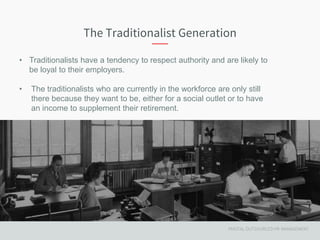
• Traditionalists have a tendency to respect authority and are likely to
be loyal to their employers.
• The traditionalists who are currently in the workforce are only still
there because they want to be, either for a social outlet or to have
an income to supplement their retirement.
PIVOTAL OUTSOURCED HUMAN RESOURCE MANAGEMENTPIVOTAL OUTSOURCED HR MANAGEMENT
The Baby
Boomer
Generation
The Baby Boomer Generation
• The Baby Boomers are the children of the Traditionalists, having
been born during the "baby boom" which came after World War
Two ended. This generation is comprised of those born from the
years 1946 to 1964.
• The difference between this generation and their parents, is the
baby boomers have opportunities that their parents could of
never dreamed of
• They are a very competitive generation, likely as a result of the
huge population swell that occurred in the post war years
PIVOTAL OUTSOURCED HUMAN RESOURCE MANAGEMENTPIVOTAL OUTSOURCED HR MANAGEMENT
The Baby Boomer Generation
PIVOTAL OUTSOURCED HUMAN RESOURCE MANAGEMENTPIVOTAL OUTSOURCED HR MANAGEMENT
• Baby Boomers have traditionally been motivated by competitive
salaries and opportunities for promotions or career growth.
• Since this segment of the population makes up the largest portion of
the workforce, retirement of the Baby Boomers could present a
significant challenge to employers in the near future as this age group
portion is the largest in the workforce.
Test Example
PIVOTAL OUTSOURCED HR MANAGEMENT
Generation X
Generation X
• Those born from 1965 to 1980 are commonly known as Generation X.
• Those from this generation were typically latch-key kids, born into families
with two working parents, or perhaps divorced parents. As a result, this
generation is typically very independent.
• Along with this independence comes skepticism – of everything from
organizations to questioning other people's intentions. The members of
Generation X have had easy access to education, perhaps being the most
well-educated generation thus far.
• Gen Xers often like to work independently and don't enjoy micro-
management. This group strives to find a work/life balance, unlike their
overly competitive parents from the Baby Boomer generation. Those from
this generation are typically entrepreneurial, and have adapted well to
technology as it has changed and evolved.
PIVOTAL OUTSOURCED HUMAN RESOURCE MANAGEMENTPIVOTAL OUTSOURCED HR MANAGEMENT
Test Example
PIVOTAL OUTSOURCED HR MANAGEMENT
Generation Y
Generation Y
So why is the newest generation to join the workforce called Generation Y?
• These young up- and-comers who were born from 1981 to 2000 is an age group that
comes from a completely different era from which no other generation has seen before
• Since their childhoods, Generation Y has dealt with many new technologies their
parents and grandparents could only ever dream of seeing become a reality when they
were younger
PIVOTAL OUTSOURCED HUMAN RESOURCE MANAGEMENTPIVOTAL OUTSOURCED HR MANAGEMENT
Generation Y
PIVOTAL OUTSOURCED HUMAN RESOURCE MANAGEMENTPIVOTAL OUTSOURCED HR MANAGEMENT
• Generation Y is a highly sociable group that uses social
media, cell phones, and the Internet to keep in touch with
their friends, families and colleagues.
• Because of their social nature, this generation typically
enjoys team work and wants to feel like a valued member of
the organization they work for.
• This group also enjoys frequent feedback on performance,
and can be very loyal to an organization.
Test Example
PIVOTAL OUTSOURCED HR MANAGEMENT
Generation Z
The Next Generation
• Whether you call them Generation Z, the Re-Generation or a yet to be
determined moniker, this group will be the next to join the workplace.
• This generation consists of individuals born after 2000.
• Little is known about this generation's working style as of yet, but this group
has been just as entrenched in technology as Generation Y, so it's reasonably
safe to assume that Millenials will enjoy flexible work environments and the
ability to use multiple forms of technology as a means for communication.
PIVOTAL OUTSOURCED HUMAN RESOURCE MANAGEMENTPIVOTAL OUTSOURCED HR MANAGEMENT
PIVOTAL OUTSOURCED HR MANAGEMENT
Closing Notes
Closing Notes
• It is important that all the members of the workplace learn to work
together harmoniously, creating an environment of mutual respect. This
can be done by…
1. Knowing Workplace Demographics
2. Educating and creating awareness
3. Setting goals and Objectives
4. Respecting each others needs and values
5. Utilizing the strengths of each generation
6. Create policies and programs which are flexible for each generation
7. Audit pay and benefit programs to ensure they meet each generational
need
8. Inspire a cross-mentoring culture
PIVOTAL OUTSOURCED HUMAN RESOURCE MANAGEMENTPIVOTAL OUTSOURCED HR MANAGEMENT
Closing Notes
• As with many issues of workplace diversity, it's
important that all the members of your organization
learn to work together harmoniously, creating an
environment of mutual respect.
• This can be done through allowing your employees
to build functional workplace relationships, creating
a sense of understanding and acceptance of
generational differences. Try to focus on the end
result rather than how you get there.
• Be open to the idea of letting the Generation X staff
work from home on occasion, or create open
workspaces that allow Generation Y staff work
collaboratively with their team.
PIVOTAL OUTSOURCED HR MANAGEMENT
Closing Notes
• Allow Traditionalists and Baby Boomers to work modified work schedules
or part-time hours in order to allow them the flexibility of semi-retirement,
or have them take on mentorship roles with the younger staff so that they
can share their experience and wisdom with emerging team members.
• Create a feedback loop that will allow staff members to be open and
honest with one another, and let your team members know that the
organization values diverse perspectives, regardless of age. Keep in mind
that people from different generations like to communicate differently, so
allow for a variety of communication tools within the office, everything from
face-to-face meetings, email, telephone, or even social media or instant
messaging.
PIVOTAL OUTSOURCED HUMAN RESOURCE MANAGEMENTPIVOTAL OUTSOURCED HR MANAGEMENT
Closing Notes
• You'll find people with poor work ethic in every generation, just the same
as you'll find truly outstanding workers who are both young and old.
• Every person brings something to the table, and those from different
generations bring with them their experiences from the past – with each
person having learned something unique from the issues that were
present during each specific time period.
PIVOTAL OUTSOURCED HUMAN RESOURCE MANAGEMENTPIVOTAL OUTSOURCED HR MANAGEMENT
The Bottom Line
It may seem cliché, but it's true that age is just a number.
• It's important to keep in mind that you'll find a range of traits and
behaviours in people from the same generation.
• Also, keep in mind that applying negative individual traits to an
entire generation is counter-productive. Instead leverage the
strengths of different generations to built a high performing
workplace.
PIVOTAL OUTSOURCED HUMAN RESOURCE MANAGEMENTPIVOTAL OUTSOURCED HR MANAGEMENT
Questions?
@PIVOTALHRCANADA PIVOTALHR www.pivotalsolutions.com
420 Britannia Road East, Unit 108
Mississauga, ON L4Z 3L5
1-855-378-7987

Pivotal generations ppwt

  • 1.
  • 2.
    Agenda 1. Summary of Presentation 2.Traditionalists 3. Baby Boomers 4. Generation X 5. Generation Y 6. Generation Z 7. Closing Notes 8. Questions? PIVOTAL OUTSOURCED HR MANAGEMENT
  • 3.
    Summary • In thepast, the workplace functioned in such a way that orders given by the supervisor were simply followed – no questions asked. As modern generations don't typically respond well to this type of management style, organizations have had to change and evolve. It's important to keep in mind that each generation tends to see the world through a unique lens that forms as a result of the events that were taking place in the world. It is critical that we take the time to understand how the 4 major generations within the workplace right now learn to understand and work together to benefit their workplace as a whole together. PIVOTAL OUTSOURCED HUMAN RESOURCE MANAGEMENTPIVOTAL OUTSOURCED HR MANAGEMENT
  • 4.
    PIVOTAL OUTSOURCED HUMANRESOURCE MANAGEMENTPIVOTAL OUTSOURCED HR MANAGEMENT The Traditionalist Generation
  • 5.
    The Traditionalist Generation •The traditionalist generation is also sometimes also known as "Veterans," (as they were born in the years of 1922-1945). • The people from these families came from the “nuclear” family era, where the mother would stay home to take care of the house as the husband and children went to work and school. • Those who are in this group may not be motivated by big salaries or job titles since a large portion of Traditionalists are beyond worrying about their career. PIVOTAL OUTSOURCED HUMAN RESOURCE MANAGEMENTPIVOTAL OUTSOURCED HR MANAGEMENT
  • 6.
    The Traditionalist Generation PIVOTALOUTSOURCED HUMAN RESOURCE MANAGEMENTPIVOTAL OUTSOURCED HR MANAGEMENT • Traditionalists have a tendency to respect authority and are likely to be loyal to their employers. • The traditionalists who are currently in the workforce are only still there because they want to be, either for a social outlet or to have an income to supplement their retirement.
  • 7.
    PIVOTAL OUTSOURCED HUMANRESOURCE MANAGEMENTPIVOTAL OUTSOURCED HR MANAGEMENT The Baby Boomer Generation
  • 8.
    The Baby BoomerGeneration • The Baby Boomers are the children of the Traditionalists, having been born during the "baby boom" which came after World War Two ended. This generation is comprised of those born from the years 1946 to 1964. • The difference between this generation and their parents, is the baby boomers have opportunities that their parents could of never dreamed of • They are a very competitive generation, likely as a result of the huge population swell that occurred in the post war years PIVOTAL OUTSOURCED HUMAN RESOURCE MANAGEMENTPIVOTAL OUTSOURCED HR MANAGEMENT
  • 9.
    The Baby BoomerGeneration PIVOTAL OUTSOURCED HUMAN RESOURCE MANAGEMENTPIVOTAL OUTSOURCED HR MANAGEMENT • Baby Boomers have traditionally been motivated by competitive salaries and opportunities for promotions or career growth. • Since this segment of the population makes up the largest portion of the workforce, retirement of the Baby Boomers could present a significant challenge to employers in the near future as this age group portion is the largest in the workforce.
  • 10.
    Test Example PIVOTAL OUTSOURCEDHR MANAGEMENT Generation X
  • 11.
    Generation X • Thoseborn from 1965 to 1980 are commonly known as Generation X. • Those from this generation were typically latch-key kids, born into families with two working parents, or perhaps divorced parents. As a result, this generation is typically very independent. • Along with this independence comes skepticism – of everything from organizations to questioning other people's intentions. The members of Generation X have had easy access to education, perhaps being the most well-educated generation thus far. • Gen Xers often like to work independently and don't enjoy micro- management. This group strives to find a work/life balance, unlike their overly competitive parents from the Baby Boomer generation. Those from this generation are typically entrepreneurial, and have adapted well to technology as it has changed and evolved. PIVOTAL OUTSOURCED HUMAN RESOURCE MANAGEMENTPIVOTAL OUTSOURCED HR MANAGEMENT
  • 12.
    Test Example PIVOTAL OUTSOURCEDHR MANAGEMENT Generation Y
  • 13.
    Generation Y So whyis the newest generation to join the workforce called Generation Y? • These young up- and-comers who were born from 1981 to 2000 is an age group that comes from a completely different era from which no other generation has seen before • Since their childhoods, Generation Y has dealt with many new technologies their parents and grandparents could only ever dream of seeing become a reality when they were younger PIVOTAL OUTSOURCED HUMAN RESOURCE MANAGEMENTPIVOTAL OUTSOURCED HR MANAGEMENT
  • 14.
    Generation Y PIVOTAL OUTSOURCEDHUMAN RESOURCE MANAGEMENTPIVOTAL OUTSOURCED HR MANAGEMENT • Generation Y is a highly sociable group that uses social media, cell phones, and the Internet to keep in touch with their friends, families and colleagues. • Because of their social nature, this generation typically enjoys team work and wants to feel like a valued member of the organization they work for. • This group also enjoys frequent feedback on performance, and can be very loyal to an organization.
  • 15.
    Test Example PIVOTAL OUTSOURCEDHR MANAGEMENT Generation Z
  • 16.
    The Next Generation •Whether you call them Generation Z, the Re-Generation or a yet to be determined moniker, this group will be the next to join the workplace. • This generation consists of individuals born after 2000. • Little is known about this generation's working style as of yet, but this group has been just as entrenched in technology as Generation Y, so it's reasonably safe to assume that Millenials will enjoy flexible work environments and the ability to use multiple forms of technology as a means for communication. PIVOTAL OUTSOURCED HUMAN RESOURCE MANAGEMENTPIVOTAL OUTSOURCED HR MANAGEMENT
  • 17.
    PIVOTAL OUTSOURCED HRMANAGEMENT Closing Notes
  • 18.
    Closing Notes • Itis important that all the members of the workplace learn to work together harmoniously, creating an environment of mutual respect. This can be done by… 1. Knowing Workplace Demographics 2. Educating and creating awareness 3. Setting goals and Objectives 4. Respecting each others needs and values 5. Utilizing the strengths of each generation 6. Create policies and programs which are flexible for each generation 7. Audit pay and benefit programs to ensure they meet each generational need 8. Inspire a cross-mentoring culture PIVOTAL OUTSOURCED HUMAN RESOURCE MANAGEMENTPIVOTAL OUTSOURCED HR MANAGEMENT
  • 19.
    Closing Notes • Aswith many issues of workplace diversity, it's important that all the members of your organization learn to work together harmoniously, creating an environment of mutual respect. • This can be done through allowing your employees to build functional workplace relationships, creating a sense of understanding and acceptance of generational differences. Try to focus on the end result rather than how you get there. • Be open to the idea of letting the Generation X staff work from home on occasion, or create open workspaces that allow Generation Y staff work collaboratively with their team. PIVOTAL OUTSOURCED HR MANAGEMENT
  • 20.
    Closing Notes • AllowTraditionalists and Baby Boomers to work modified work schedules or part-time hours in order to allow them the flexibility of semi-retirement, or have them take on mentorship roles with the younger staff so that they can share their experience and wisdom with emerging team members. • Create a feedback loop that will allow staff members to be open and honest with one another, and let your team members know that the organization values diverse perspectives, regardless of age. Keep in mind that people from different generations like to communicate differently, so allow for a variety of communication tools within the office, everything from face-to-face meetings, email, telephone, or even social media or instant messaging. PIVOTAL OUTSOURCED HUMAN RESOURCE MANAGEMENTPIVOTAL OUTSOURCED HR MANAGEMENT
  • 21.
    Closing Notes • You'llfind people with poor work ethic in every generation, just the same as you'll find truly outstanding workers who are both young and old. • Every person brings something to the table, and those from different generations bring with them their experiences from the past – with each person having learned something unique from the issues that were present during each specific time period. PIVOTAL OUTSOURCED HUMAN RESOURCE MANAGEMENTPIVOTAL OUTSOURCED HR MANAGEMENT
  • 22.
    The Bottom Line Itmay seem cliché, but it's true that age is just a number. • It's important to keep in mind that you'll find a range of traits and behaviours in people from the same generation. • Also, keep in mind that applying negative individual traits to an entire generation is counter-productive. Instead leverage the strengths of different generations to built a high performing workplace. PIVOTAL OUTSOURCED HUMAN RESOURCE MANAGEMENTPIVOTAL OUTSOURCED HR MANAGEMENT
  • 23.
    Questions? @PIVOTALHRCANADA PIVOTALHR www.pivotalsolutions.com 420Britannia Road East, Unit 108 Mississauga, ON L4Z 3L5 1-855-378-7987