UNIVERSITY OF AGRICULTURAL SCIENCES
College of Agriculture ,GKVK, Bengaluru
AGR 501: Modern Concepts In Crop Production(2+0)
Topic: PIVOT SYSTEM AND ROBOTICS IN CROP PRODUCTION
Submitted to:
Course Teacher
Department of Agronomy
UAS(B),GKVK
Presented by:
Devika AR
PAMB 0197
Jr M.Sc. (Agronomy)
INTRODUCTION
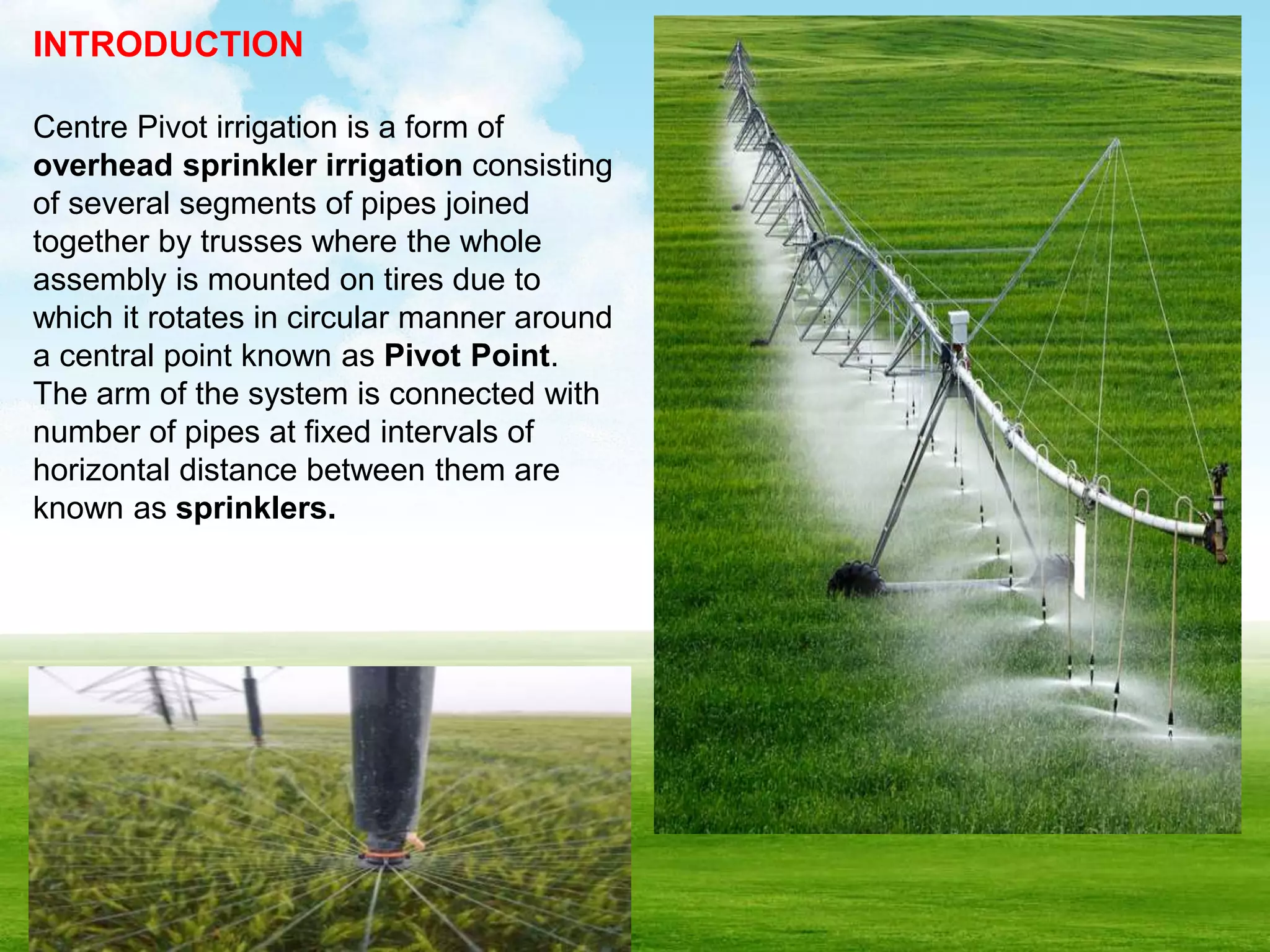
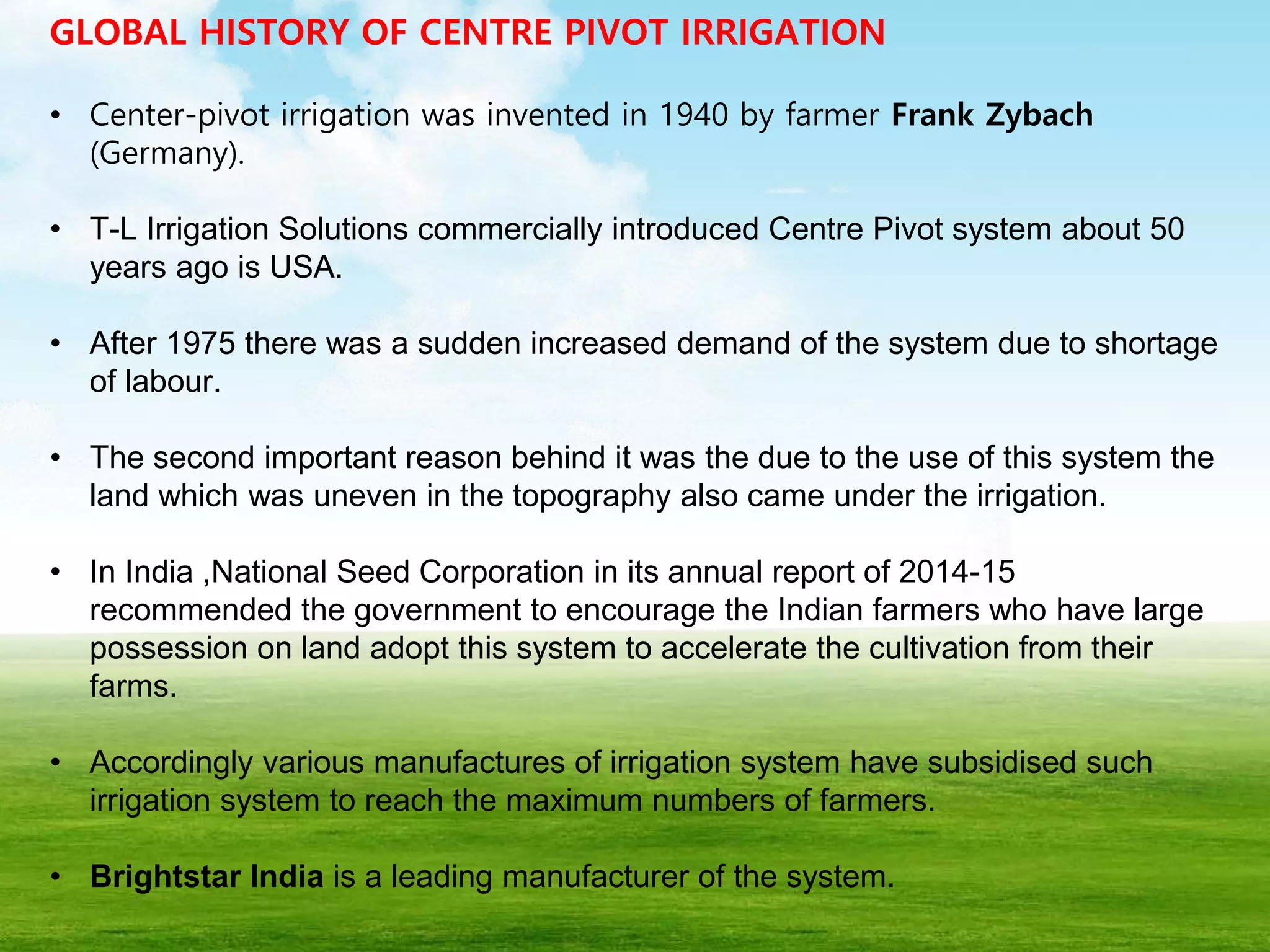
Centre Pivot irrigation is a form of
overhead sprinkler irrigation consisting
of several segments of pipes joined
together by trusses where the whole
assembly is mounted on tires due to
which it rotates in circular manner around
a central point known as Pivot Point.
The arm of the system is connected with
number of pipes at fixed intervals of
horizontal distance between them are
known as sprinklers.
GLOBAL HISTORY OF CENTRE PIVOT IRRIGATION
• Center-pivot irrigation was invented in 1940 by farmer Frank Zybach
(Germany).
• T-L Irrigation Solutions commercially introduced Centre Pivot system about 50
years ago is USA.
• After 1975 there was a sudden increased demand of the system due to shortage
of labour.
• The second important reason behind it was the due to the use of this system the
land which was uneven in the topography also came under the irrigation.
• In India ,National Seed Corporation in its annual report of 2014-15
recommended the government to encourage the Indian farmers who have large
possession on land adopt this system to accelerate the cultivation from their
farms.
• Accordingly various manufactures of irrigation system have subsidised such
irrigation system to reach the maximum numbers of farmers.
• Brightstar India is a leading manufacturer of the system.
Circular Pivot Irrigation
System
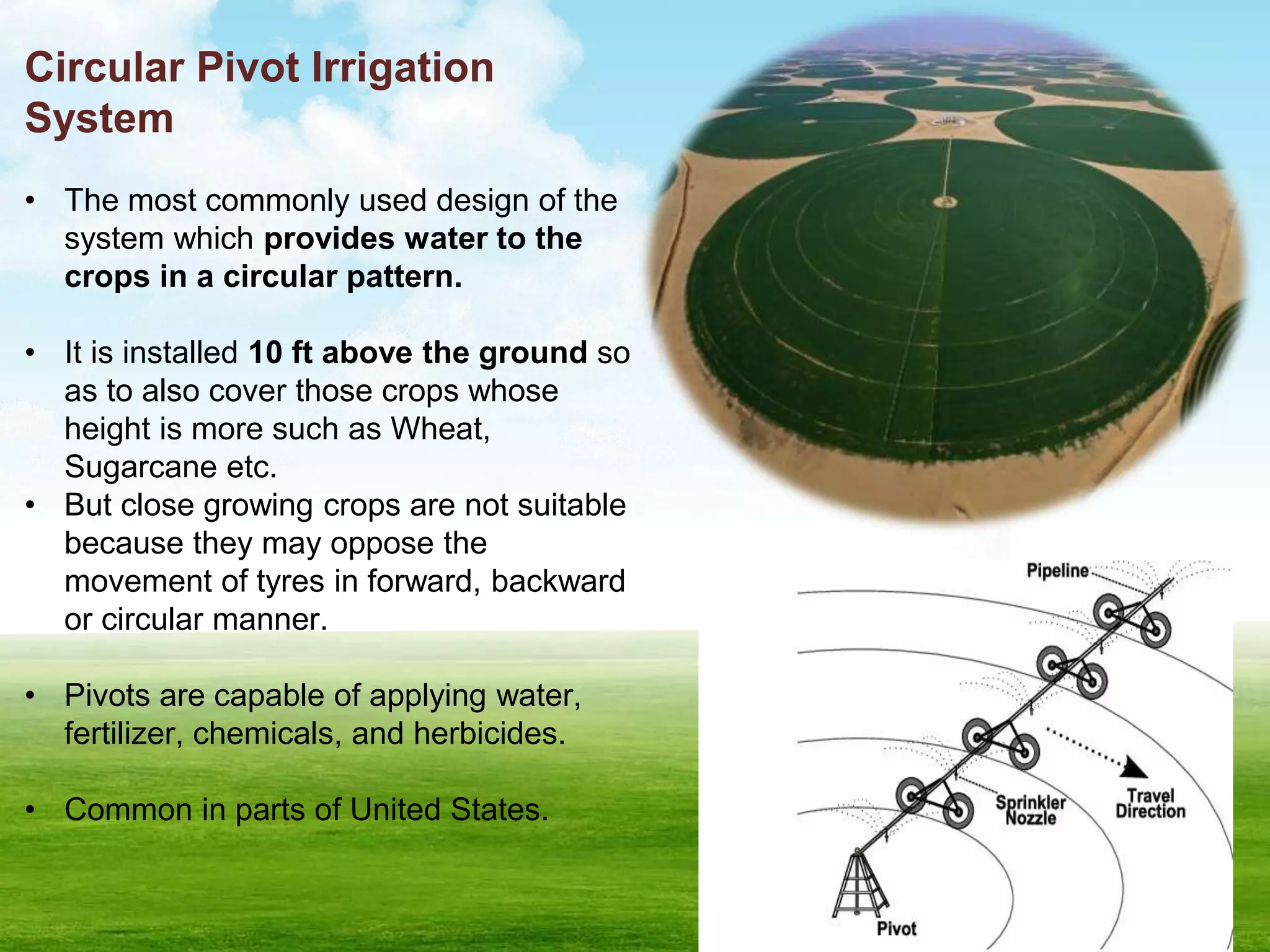
• The most commonly used design of the
system which provides water to the
crops in a circular pattern.
• It is installed 10 ft above the ground so
as to also cover those crops whose
height is more such as Wheat,
Sugarcane etc.
• But close growing crops are not suitable
because they may oppose the
movement of tyres in forward, backward
or circular manner.
• Pivots are capable of applying water,
fertilizer, chemicals, and herbicides.
• Common in parts of United States.
Rectangular System
• When the available field is of irregular shape then circular systems are useless
and then the field is to be divided in rectangular shapes.
• The movement of the assembly is only in forward and backward between two
fixed ends.
• This characteristic is typically suitable for Indian agricultural sector
because in India the fields are as less as 2 acres and also in irregular
shapes.
Lateral System
• It has a separate machine which travels parallel to the sides of the field to
irrigate upto 95% of the field area.
• It is more efficient in terms of area under irrigation than that of circular system
but it is costlier because separate length of pipe has to be attached to it to
supply water.
Corner system
• When circular system is adopted the corners of the field remain unirrigated
which are further irrigated by introducing traditional sprinkler irrigation system.
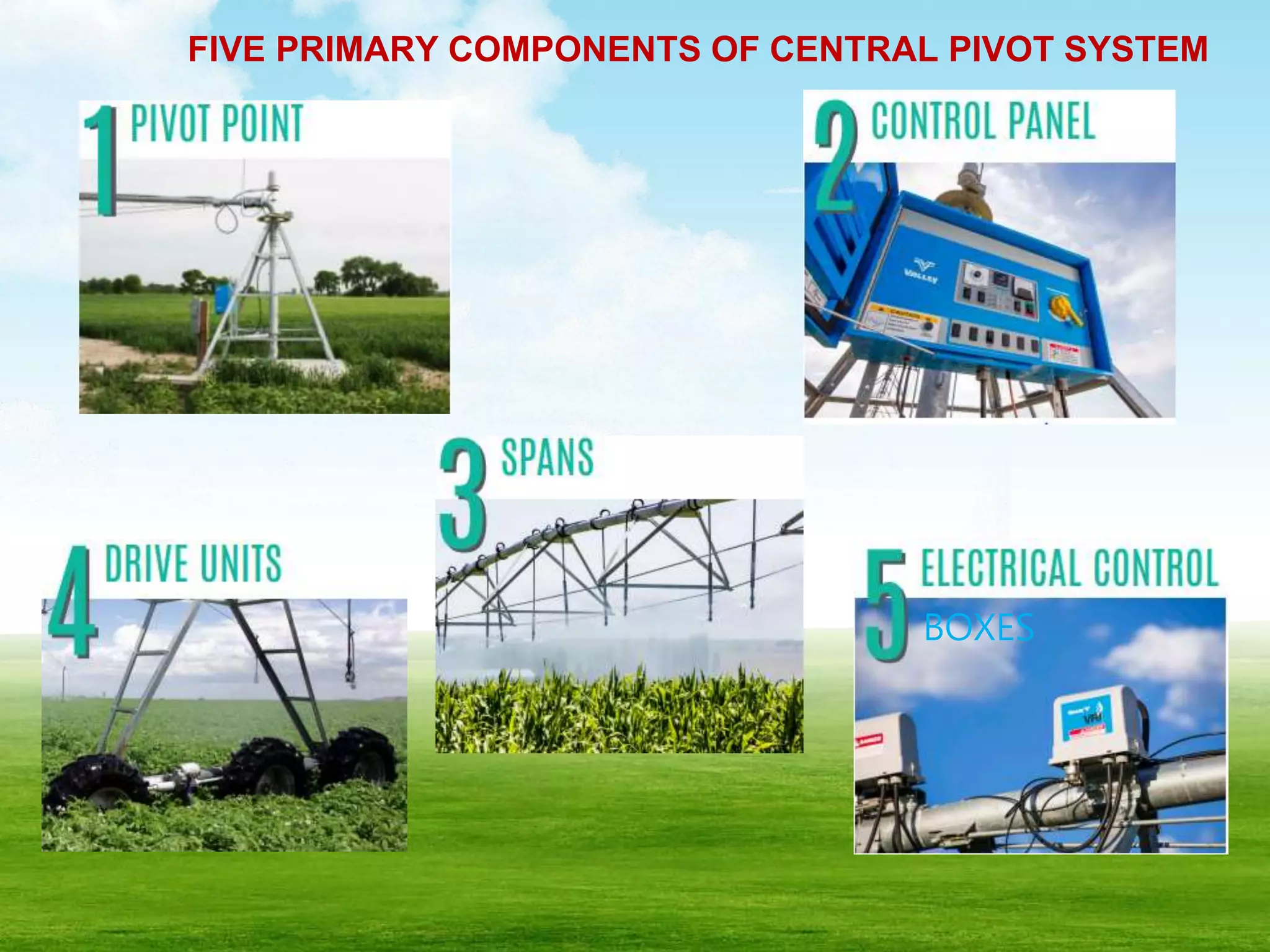
FIVE PRIMARY COMPONENTS OF CENTRAL PIVOT SYSTEM
BOXES
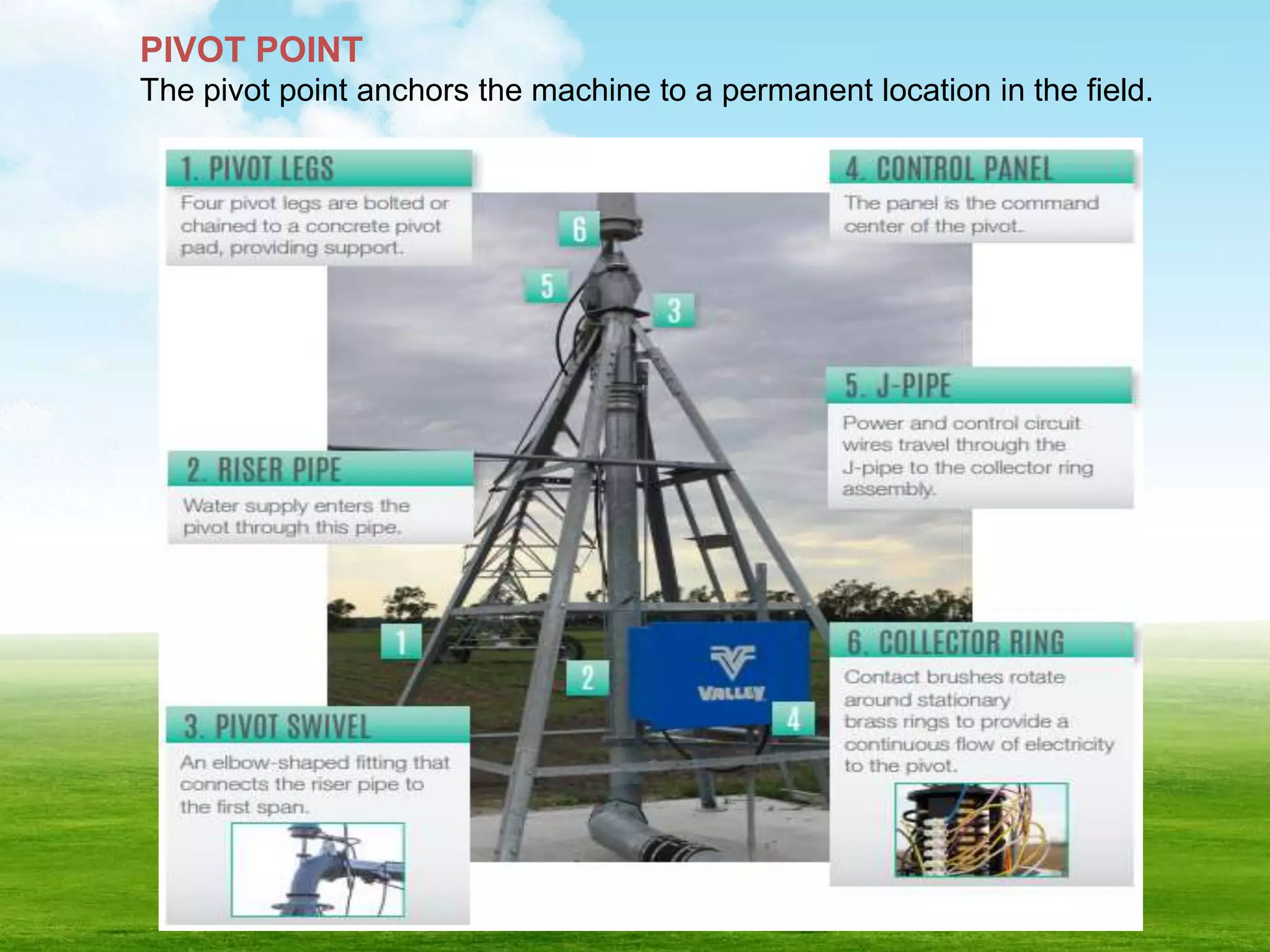
PIVOT POINT
The pivot point anchors the machine to a permanent location in the field.
Control Panel
• The control panel is the brains of the operation.
• It controls the stopping, starting, forward and reverse movements of
the pivot, water usage.
Spans
• Spans are the backbone of the whole center pivot structure.
• Spans consist of pipes that transfer water to the field via the
pivot’s sprinkler package.
• The span pipes are supported by trussing and the drive units.
Drive Units
• The drive units are the pneumatic
wheels that moves in the field.
• They provide clearance above the
crop for the spans and control the
movement of the machine.
Tower Boxes/Electrical Control
Boxes
• It controls pivot movement and
alignment.
• The average quantity of water from
sprinkler can be controlled by
Control Unit.
ADVANTAGES:
• It is economical and efficient method of irrigation for large fields. It requires
only 60% of the water than that of the traditional method of irrigation.
• Soil needs not to be in level because water flowing over the ground is not
due to gravity effect.
• Rubber tyres with moderate shock absorbing arrangement make the system
suitable even for undulating field.
• Indian farmer often suffer from shortage of labour power so this system
proves best because almost no labours are involved for operating.
• The towers of the system can also be equipped with cameras to inspect the
diseases and pests on crop plants.
• Since it is automatic , farmer needs not to present in the farm at the time of
application of water. He can watch live footage of it on his own smart phone
or computer.
• Herbicides, pesticides and soluble nutrient can be directly fed to each plant.
DISADVANTAGES :
• Very large initial cost in involved.
• All Indian farmers today are even hesitant to use Drip and Sprinkler
method so it is very hard to for them to adopt such a system at large
capital investment.
• If proper maintenance is not taken then the system may lead to
breakdown.
• Heavy constituent of salt may lead to blockages of sprinkle nozzles which
may lead to frequent replacement.
• For clayey soil care has to be taken so that wheel does not stuck in the
muddy wet soil.
• Skill requirement
• Wind affects the water distribution
• Evaporation losses can be high
CONCLUSION
• In Indian perspective , there is vast opportunities to practice it when we look
towards the advantages of the system such as its competency to operate
automatically as per the availability of power, this ultimately relieves Indian
farmer in a great way.
• Moreover this it saves considerably large area from being wasted in digging
the trenches.
• On the other hand its cost is a big issue and therefore various innovations are
needed to make the system cost efficient so that average Indian farmer can
install it.
• Secondly the central government should provide subsidy to the farmers to
encourage them.
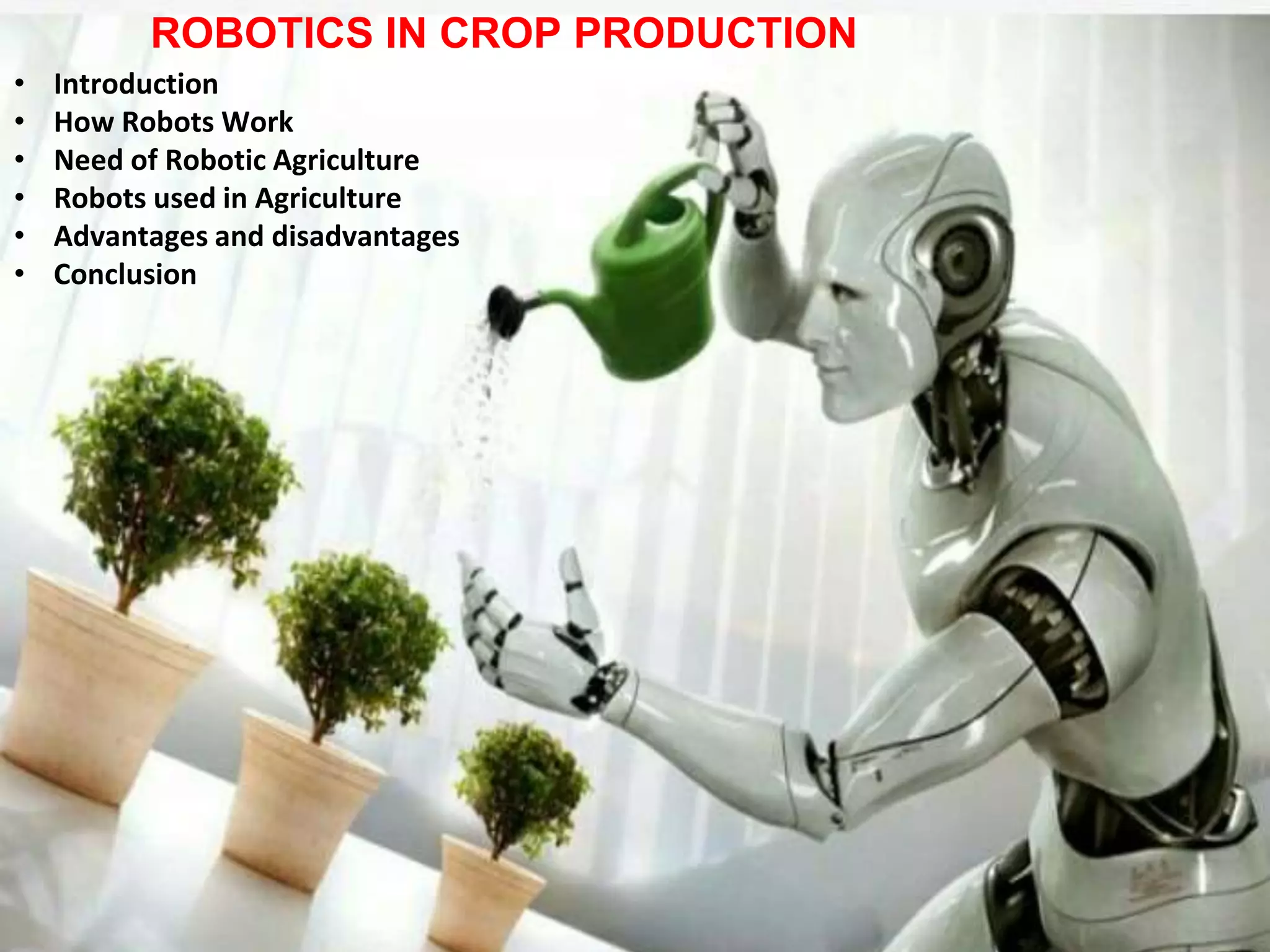
ROBOTICS IN CROP PRODUCTION
• Introduction
• How Robots Work
• Need of Robotic Agriculture
• Robots used in Agriculture
• Advantages and disadvantages
• Conclusion
Introduction
Robots
A robot is a mechanical, artificial agent and is usually an
electromechanical system. It is a device that, because of software
programming, makes complicated tasks easy to perform.
Agriculture robots/AGROBOT
“Agricultural robot” or “agrobot” is a mobile, autonomous, decision-making,
mechatronic device that accomplishes crop production tasks (e.g. soil
preparation, seeding, transplanting, weeding, pest control and harvesting) under
human supervision, but without direct human labour.
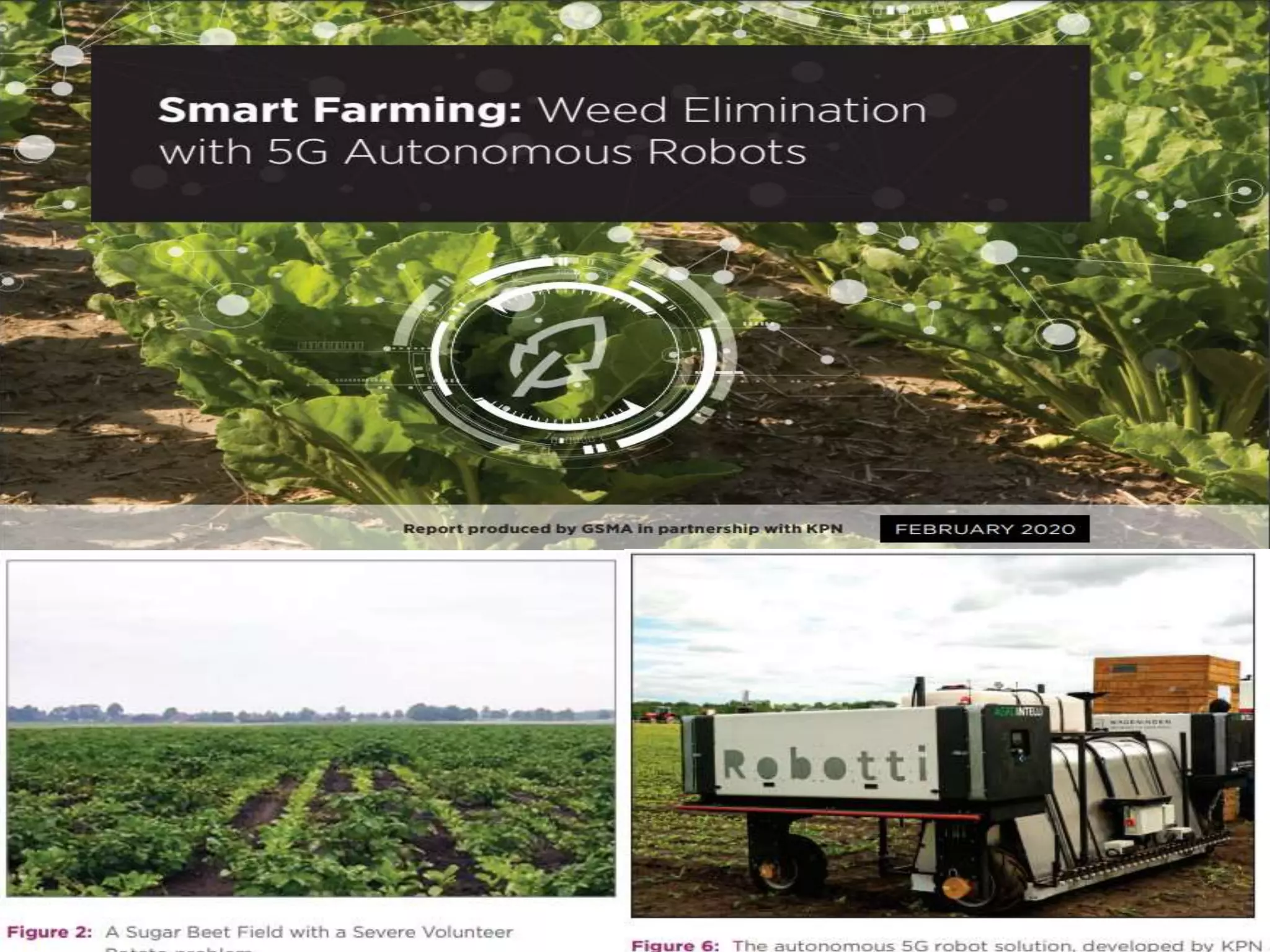
The first commercially available agrobots cover three main tasks: eliminating
weeds, monitoring pests and diseases, and harvesting specialized crops
(berries or vegetables).
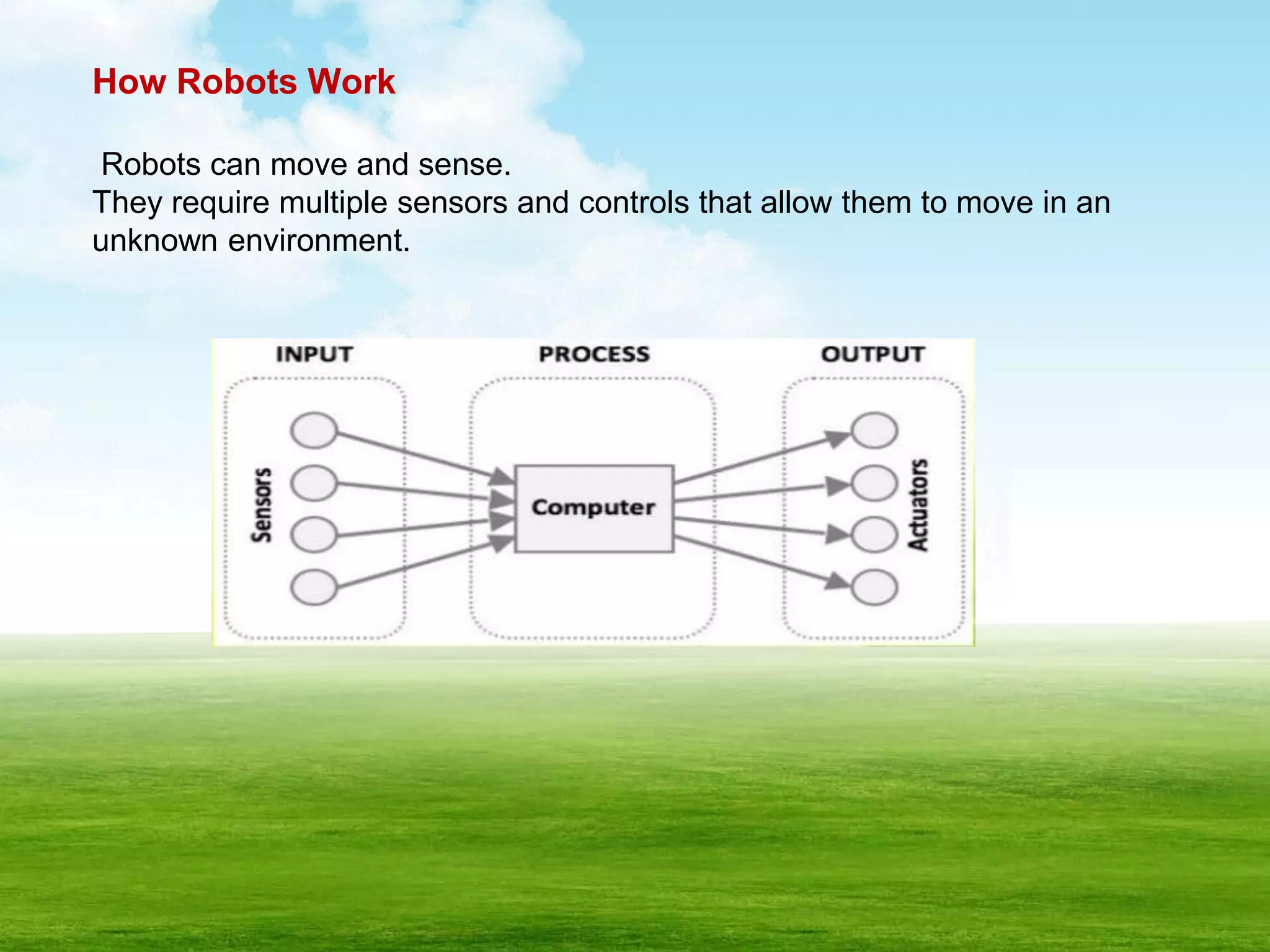
How Robots Work
Robots can move and sense.
They require multiple sensors and controls that allow them to move in an
unknown environment.
• The robots are equipped with sensors for navigation:
• GNSS(Global Navigation Satellite Systems)
• IMU (Inertial measurement units ) (which measure accelerations and rate
of turn), cameras, and encoders and soil sensors.
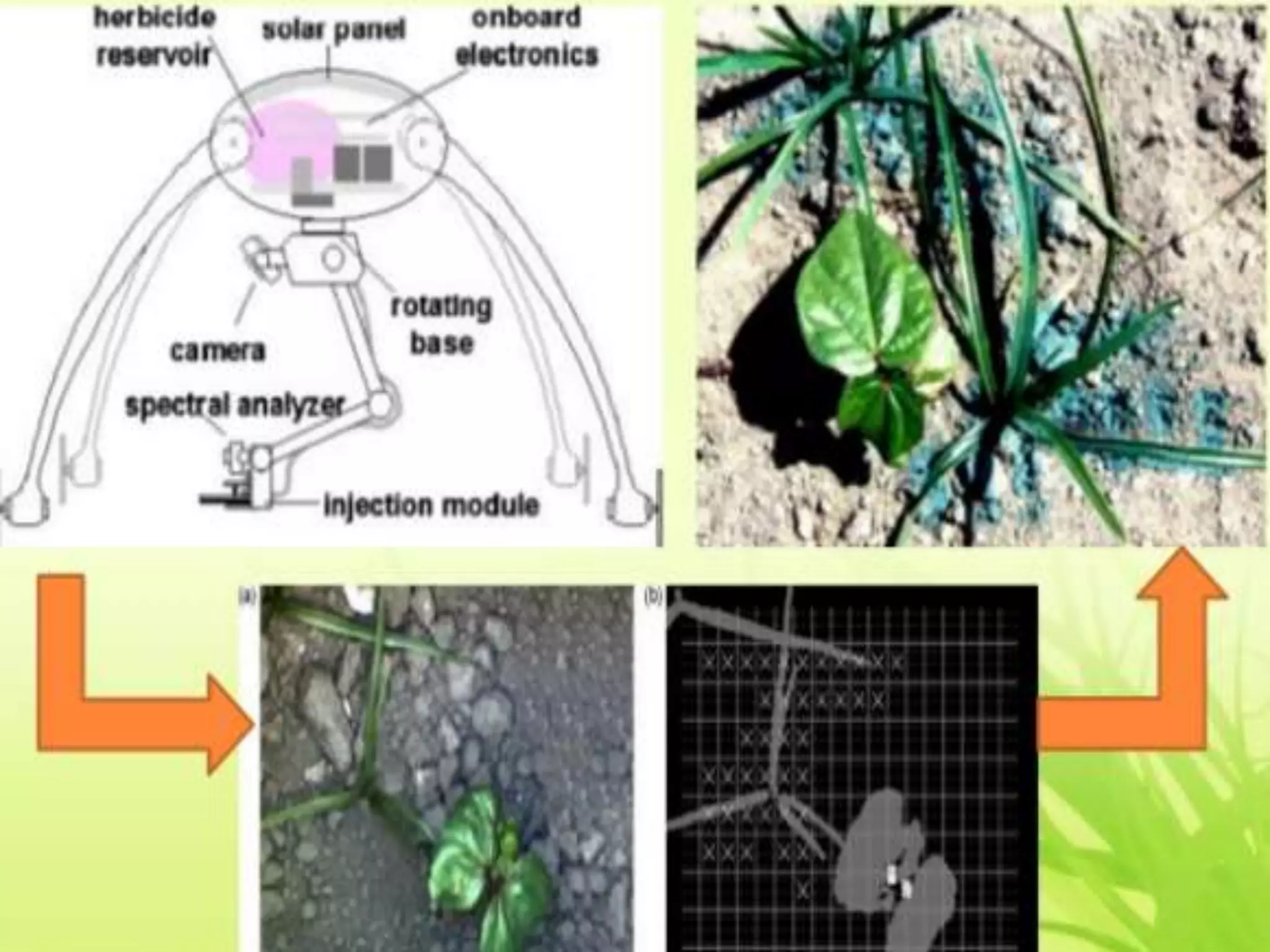
• The use of dedicated cameras for weed detection and classification can be
used to control variable rate technology (VRT) in herbicide application.
Where is an Agricultural Robot used?
Agribots help to automate routine farming activities because of which repetitive tasks
are completed in no time at all.
•Harvesting – This is among the most common functions performed by an Agribot.
These robots work with increased speed and accuracy to improve crop yield size and
reduce wastage.
•Weed Control – Agribots help distinguish weeds from useful crops and remove them
by causing artificial soil disturbances using laser technologies.
•Mowing – Agribots use smart sensors to determine plant density and cut farmlands
with precision.
•Seeding – Agribots also act as seeder attachments, where they accurately predict
the soil tendency and help in planting seeds at the right places.
•Spraying – Agribots help identify weeds and crops that require pesticides and
fertilizers, thereby leading to a reduction in wastage of resources.
•Sorting and Packaging – Agribots assist in detecting, sorting and packing
agricultural products.
•Livestock Monitoring – Agbots help in tracking livestock and navigating them
through rugged terrains.
•Irrigation – Artificial intelligence assists in accessing water volumes and helps
farmers use water in a controlled manner only on plants in need of water.
Robots usually have five parts:
• Sensors
• Controller/Computer
• Drive/Actuator
• Arm
• End-effectors
Robotic Sensor:
• A device that can detect physical signal and convert into electrical signal.
• Robotic sensors are used to estimate a robot's condition and environment.
• These signals are passed to a controller to enable appropriate behavior.
Controller /Computer:
•The controller functions as the "brain" of the robot.
•The controller also allows the robot to be networked to other systems, so that it
may work together with other machines, processes, or robots.
Actuators/ Drives :
• The drive or actuator is the "engine" of the robot.
• An actuator is defined as "a mechanical device that produces
motion”.
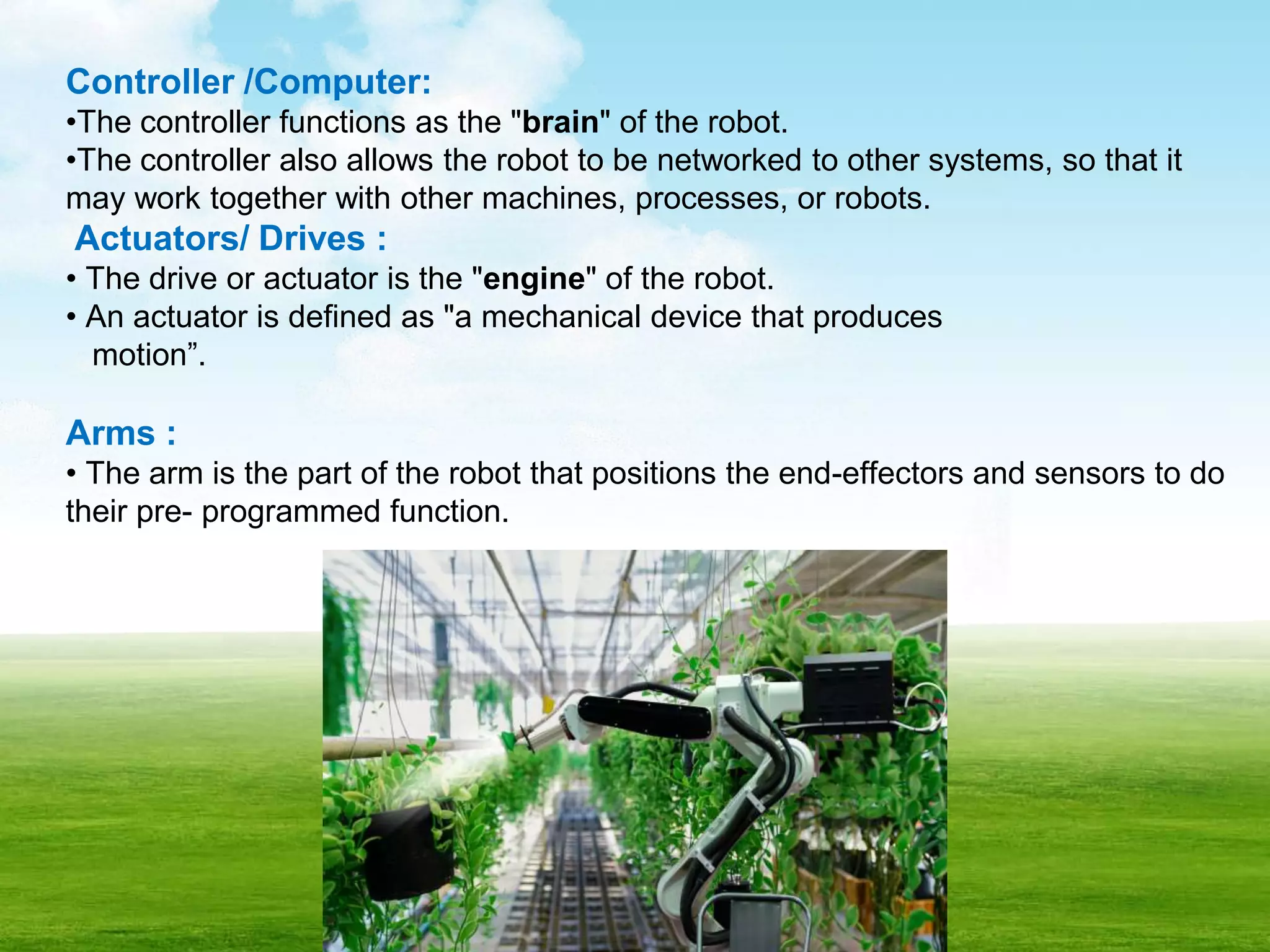
Arms :
• The arm is the part of the robot that positions the end-effectors and sensors to do
their pre- programmed function.
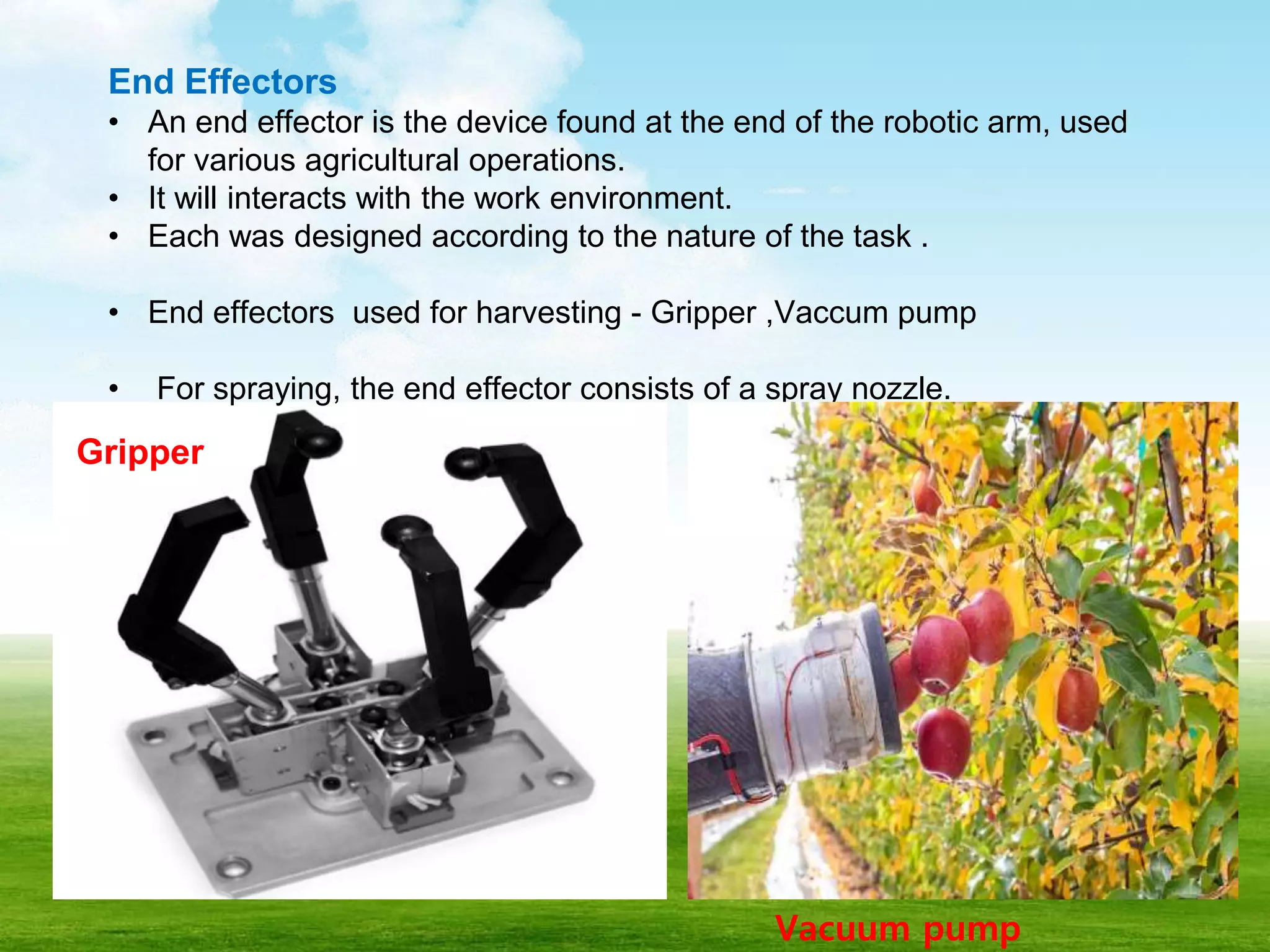
End Effectors
• An end effector is the device found at the end of the robotic arm, used
for various agricultural operations.
• It will interacts with the work environment.
• Each was designed according to the nature of the task .
• End effectors used for harvesting - Gripper ,Vaccum pump
• For spraying, the end effector consists of a spray nozzle.
Gripper
Vacuum pump
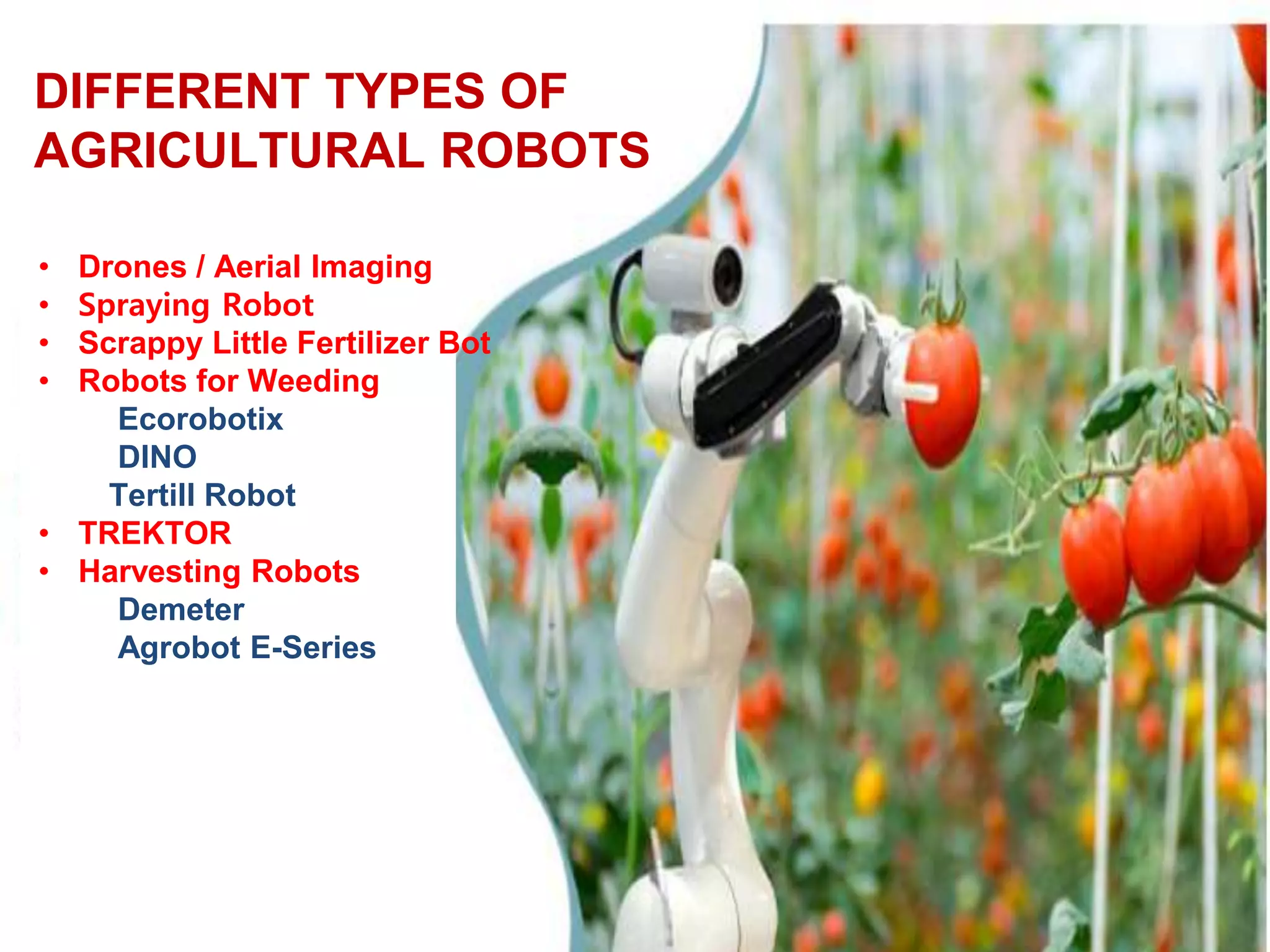
DIFFERENT TYPES OF
AGRICULTURAL ROBOTS
• Drones / Aerial Imaging
• Spraying Robot
• Scrappy Little Fertilizer Bot
• Robots for Weeding
Ecorobotix
DINO
Tertill Robot
• TREKTOR
• Harvesting Robots
Demeter
Agrobot E-Series
Drones / Aerial Imaging
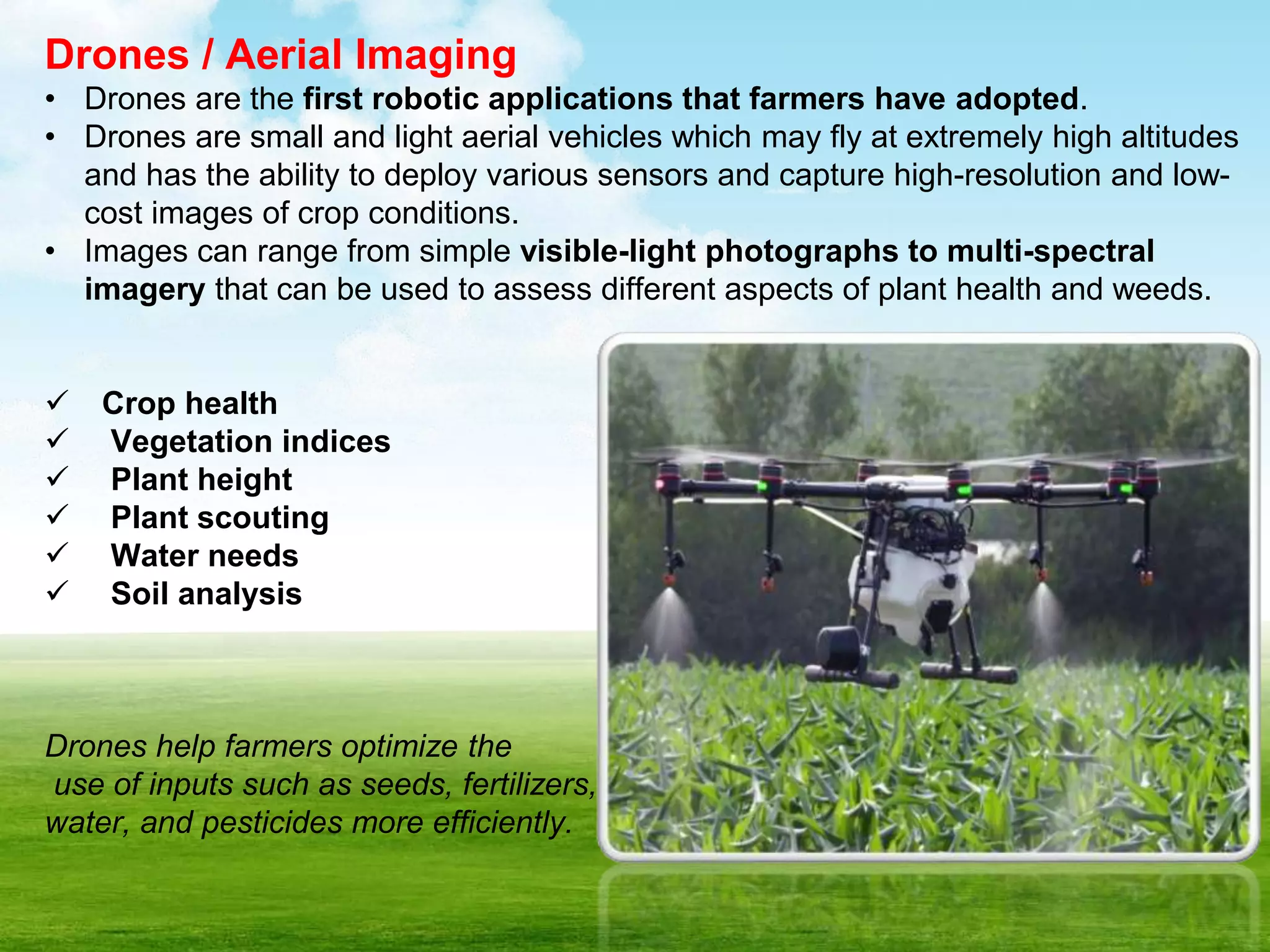
• Drones are the first robotic applications that farmers have adopted.
• Drones are small and light aerial vehicles which may fly at extremely high altitudes
and has the ability to deploy various sensors and capture high-resolution and low-
cost images of crop conditions.
• Images can range from simple visible-light photographs to multi-spectral
imagery that can be used to assess different aspects of plant health and weeds.
 Crop health
 Vegetation indices
 Plant height
 Plant scouting
 Water needs
 Soil analysis
Drones help farmers optimize the
use of inputs such as seeds, fertilizers,
water, and pesticides more efficiently.
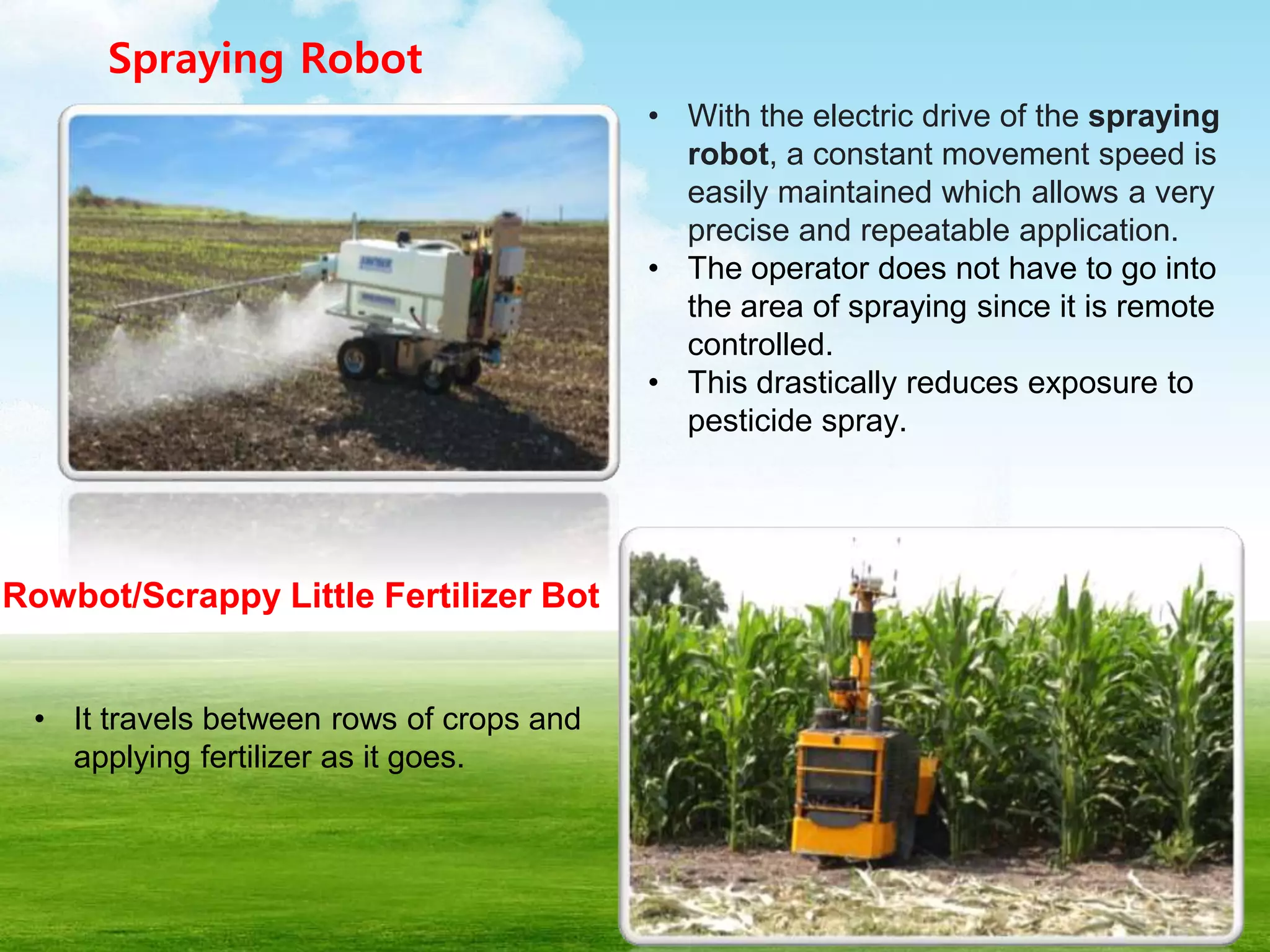
• With the electric drive of the spraying
robot, a constant movement speed is
easily maintained which allows a very
precise and repeatable application.
• The operator does not have to go into
the area of spraying since it is remote
controlled.
• This drastically reduces exposure to
pesticide spray.
Spraying Robot
• It travels between rows of crops and
applying fertilizer as it goes.
Rowbot/Scrappy Little Fertilizer Bot
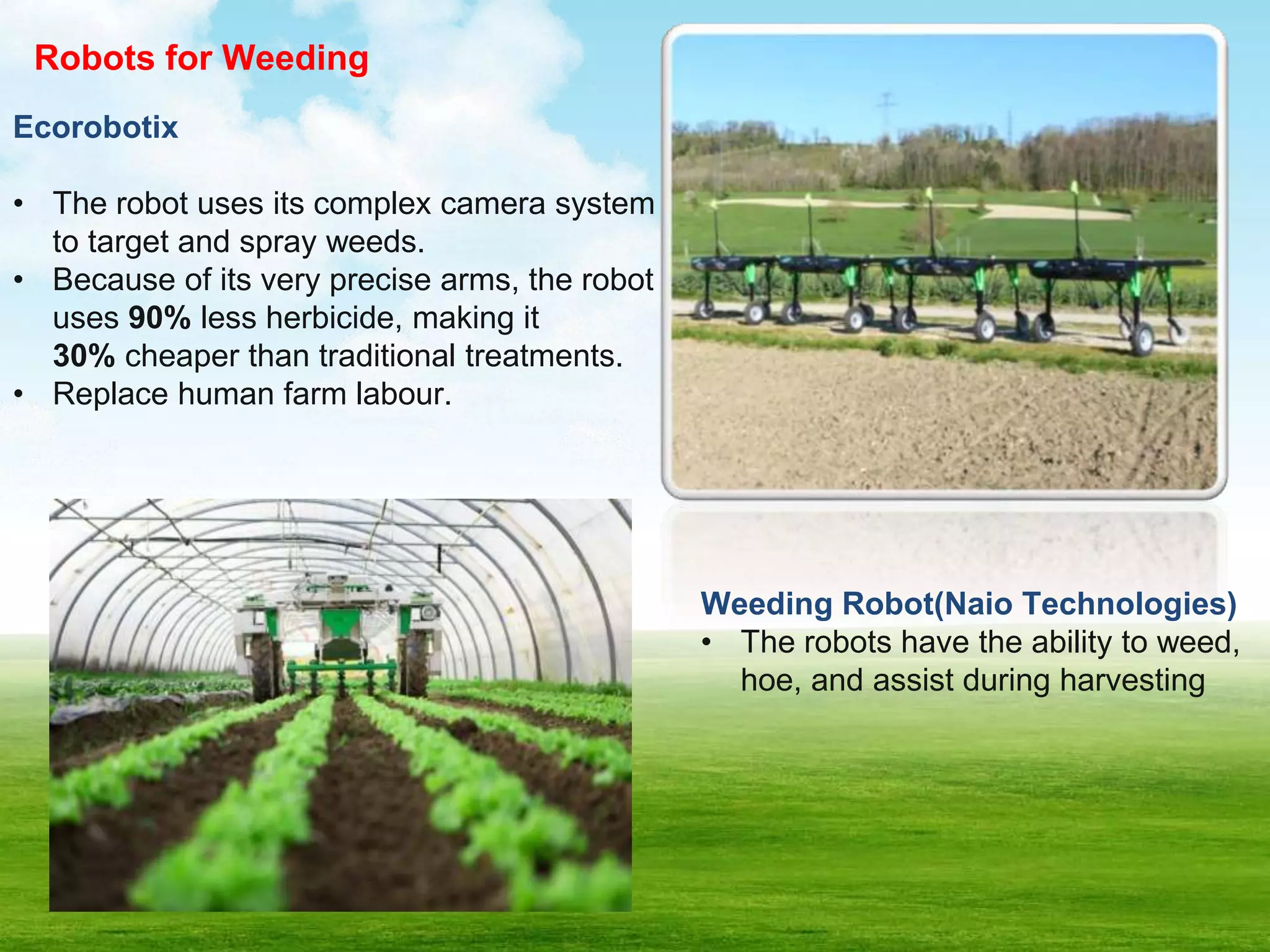
Ecorobotix
• The robot uses its complex camera system
to target and spray weeds.
• Because of its very precise arms, the robot
uses 90% less herbicide, making it
30% cheaper than traditional treatments.
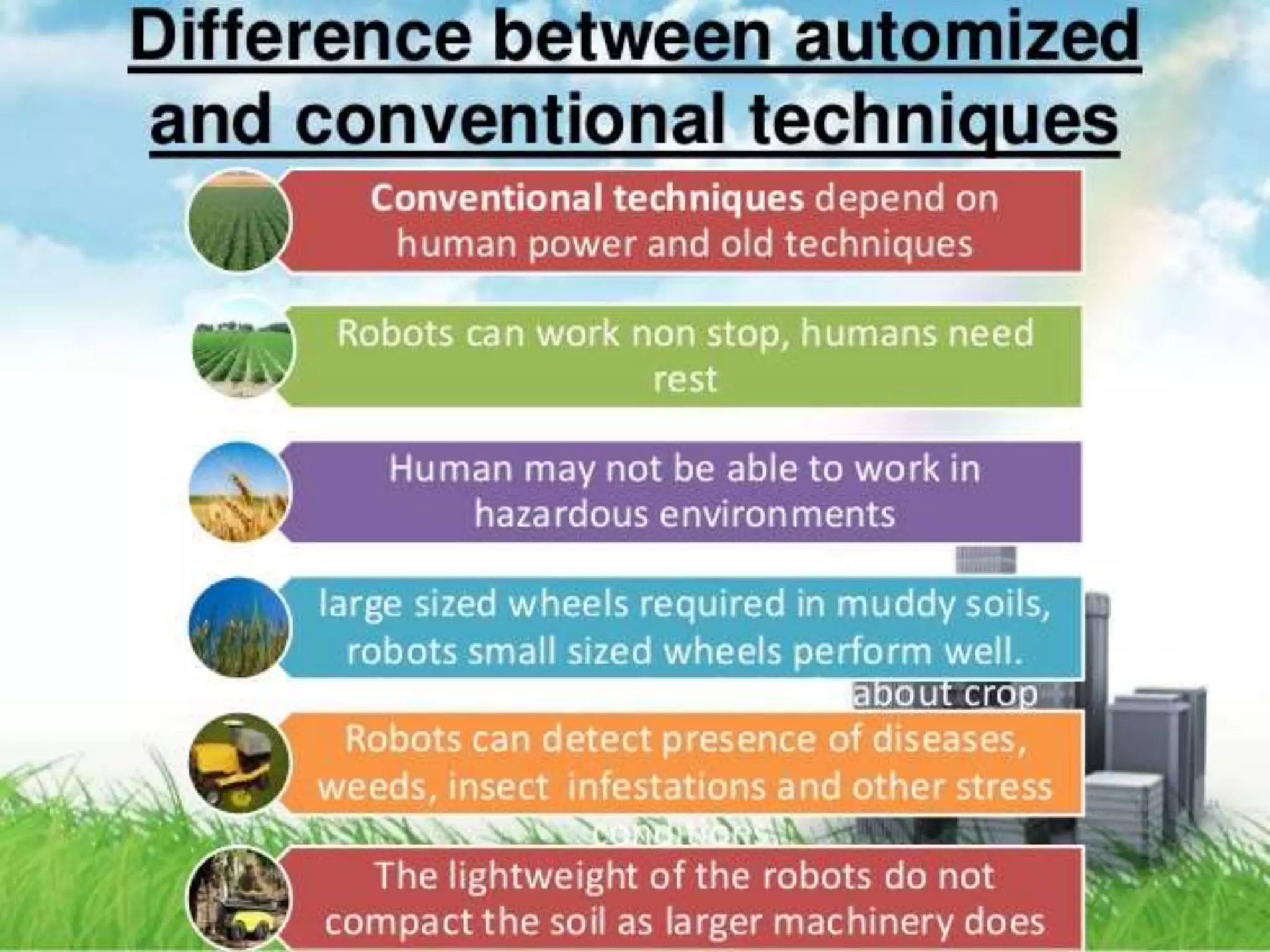
• Replace human farm labour.
Robots for Weeding
Weeding Robot(Naio Technologies)
• The robots have the ability to weed,
hoe, and assist during harvesting
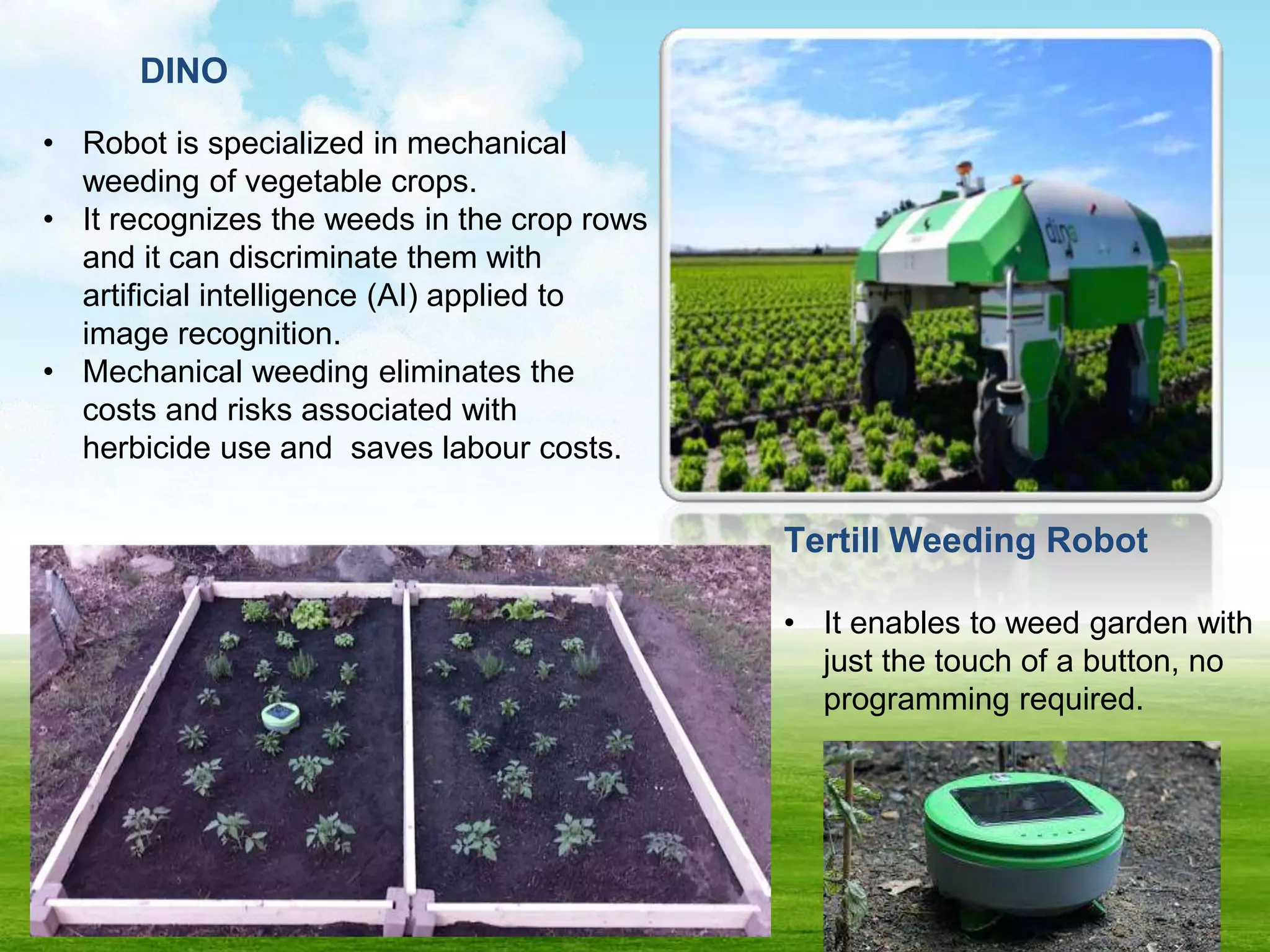
• Robot is specialized in mechanical
weeding of vegetable crops.
• It recognizes the weeds in the crop rows
and it can discriminate them with
artificial intelligence (AI) applied to
image recognition.
• Mechanical weeding eliminates the
costs and risks associated with
herbicide use and saves labour costs.
DINO
Tertill Weeding Robot
• It enables to weed garden with
just the touch of a button, no
programming required.
TREKTOR
• An autonomous hybrid robot
• It’s a tractor that works to weed
the organic vineyard
Demeter
• It has cameras that can detect the
difference between the crop that has
been cut and crop that hasn’t.
• This information tells it where to
drive, where to put its cutter head,
and when it has come to the end of a
crop row so it can turn around
• It can harvest wheat and alfalfa.
Harvesting Robots
Content Conventional Harvesting Robotic Harvesting
Labour More labour No labour
Cost Initially low
Long run: High
Initially high
Long run:Low
Time More Less
Energy Efficiency Less(20-30%) High(70-80%)
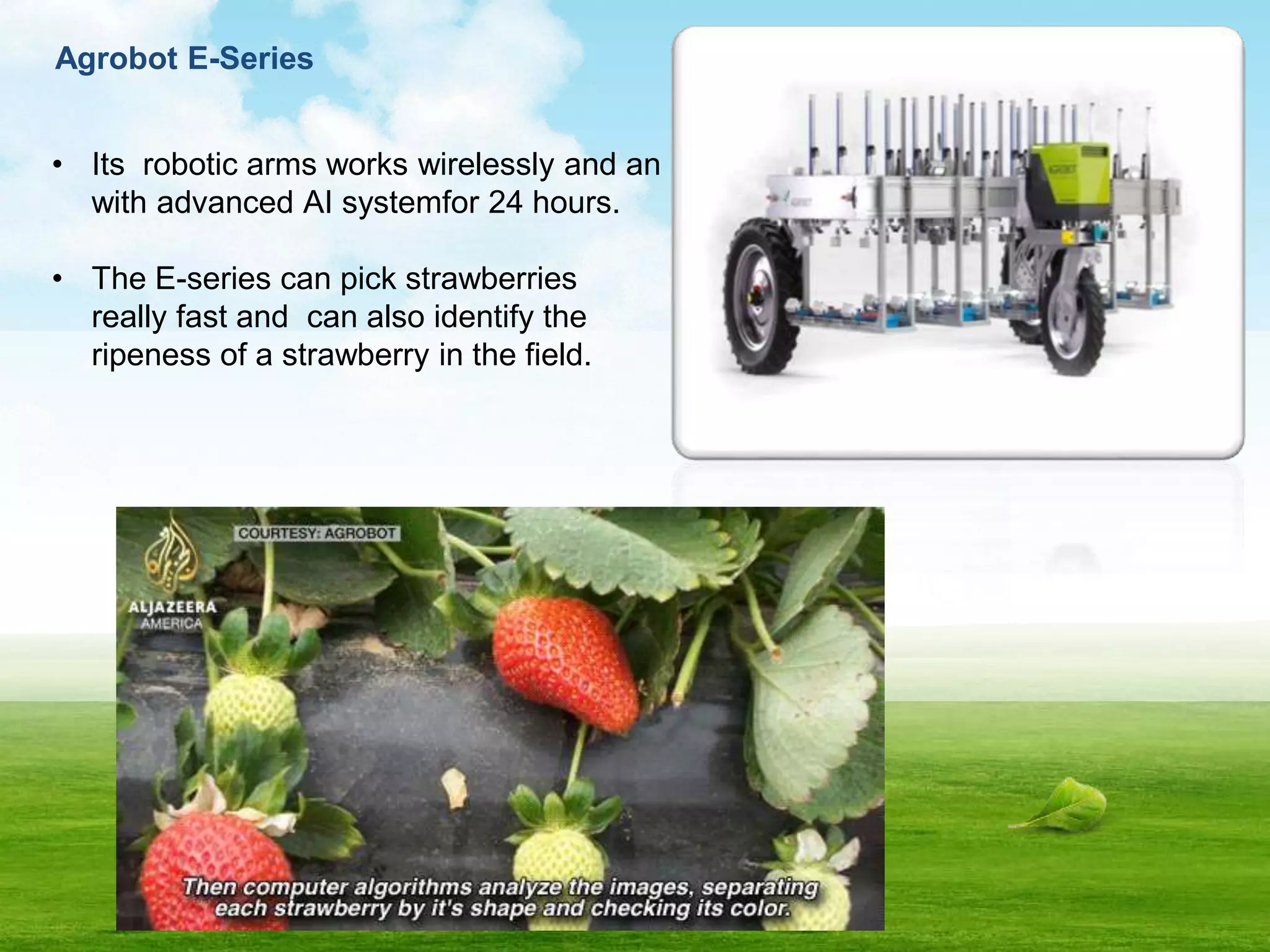
Agrobot E-Series
• Its robotic arms works wirelessly and an
with advanced AI systemfor 24 hours.
• The E-series can pick strawberries
really fast and can also identify the
ripeness of a strawberry in the field.
COMBINED HARVESTER ROBOT
GRAPE HARVESTING ROBOT
APPLE HARVESTING ROBOT
TOMATO PICKING ROBOT
• Decreased labour
• Increased profits
• Saving Precious Resources
• Attracts Young Talent
• Maximum productivity
• Can work 24 hours a day, every day without rest.
• Robots are extremely accurate compared to humans, so product quality is high.
• Perform tasks more quickly than humans
DRAWBACKS:
• Costly – Agribots are machines that require a considerable investment, which make
them an expensive affair for small and marginal farmers.
• Complex Operations – Agbots come equipped with the latest technological
advancements, making them complex to use.
• Requires Technical Expertise – Agricultural robots need farmers to become skilled
and proficient in handling modern technology, which hampers their ability to properly
take care of their farmlands.
• Power Cuts – India is a country faced with regular power cuts, especially in rural
areas. It renders agricultural robots useless because they cannot work without
electricity, leading to unnecessary wastage of time.
ADVANTAGES:
CONCLUSION
• This equipment may dominate in future, but at present rethinking of how
crop production can be done better with Agribots.
• Crop production may be done better and cheaper with a swarm of small
machines than with a few large ones since smaller machines are even more
acceptable to the non-farm community.
• The higher quality products can be sensed by machines (colour, firmness,
weight, density, ripeness, size, shape) accurately hence Robots can improve
the quality of our lives.
• The lack of abundant research funding and budgets in agriculture has
decelerated this technology.
• Some forms of human-robot collaboration as well as modification of the crop
breeding and planting systems in fields and greenhouses might be necessary
to solve the challenges of agricultural robotics that cannot yet be automated.
REFERENCES
• Centre Pivot Irrigation-A Modern Method of Irrigation in Indian
Perspective, Volume 2, Issue 12, December 2016,IJARSMT.
• James, L. G . 1982. Modeling the performance of center pivot
irrigation systems operating on variable topography.
TRANSACTIONS of the ASAE 25(1):143-149.
• Investing in centre pivot and lateral move systems | Centre pivot
and lateral move systems | Irrigation | Water | Farm management |
Agriculture Victoria.
• PIVOTBASICS ,Wilcox, J. C . and G . E. Sw ailes. 1947,Scientific
Agriculture 27:565-583.
• Agricultural robotics and automated equipment for sustainable
crop production ,By Santiago Santos Valle, Agricultural
Mechanization Specialist, FAO Josef Kienzle, Agricultural Engineer,
FAO NOVEMBER 2020 Food and Agriculture Organization of the
United Nations Rome, 2020
• Agrobot. 2020. Agrobot [online]. Huelva, Spain. [Cited 4 August
2020]. https://www.agrobot.com/
• Bechar, A. & Vigneault, C. 2016. Agricultural robots for field
operations: Concepts and components. Biosystems Engineering,
149: 94–111
Asadal has been running one of the biggest domain and web hosting sites in
Korea since March 1998. More than 3,000,000 people have visited our website,
www.asadal.com for domain registration and web hosting.
Insert my subtitle or main author’s name here
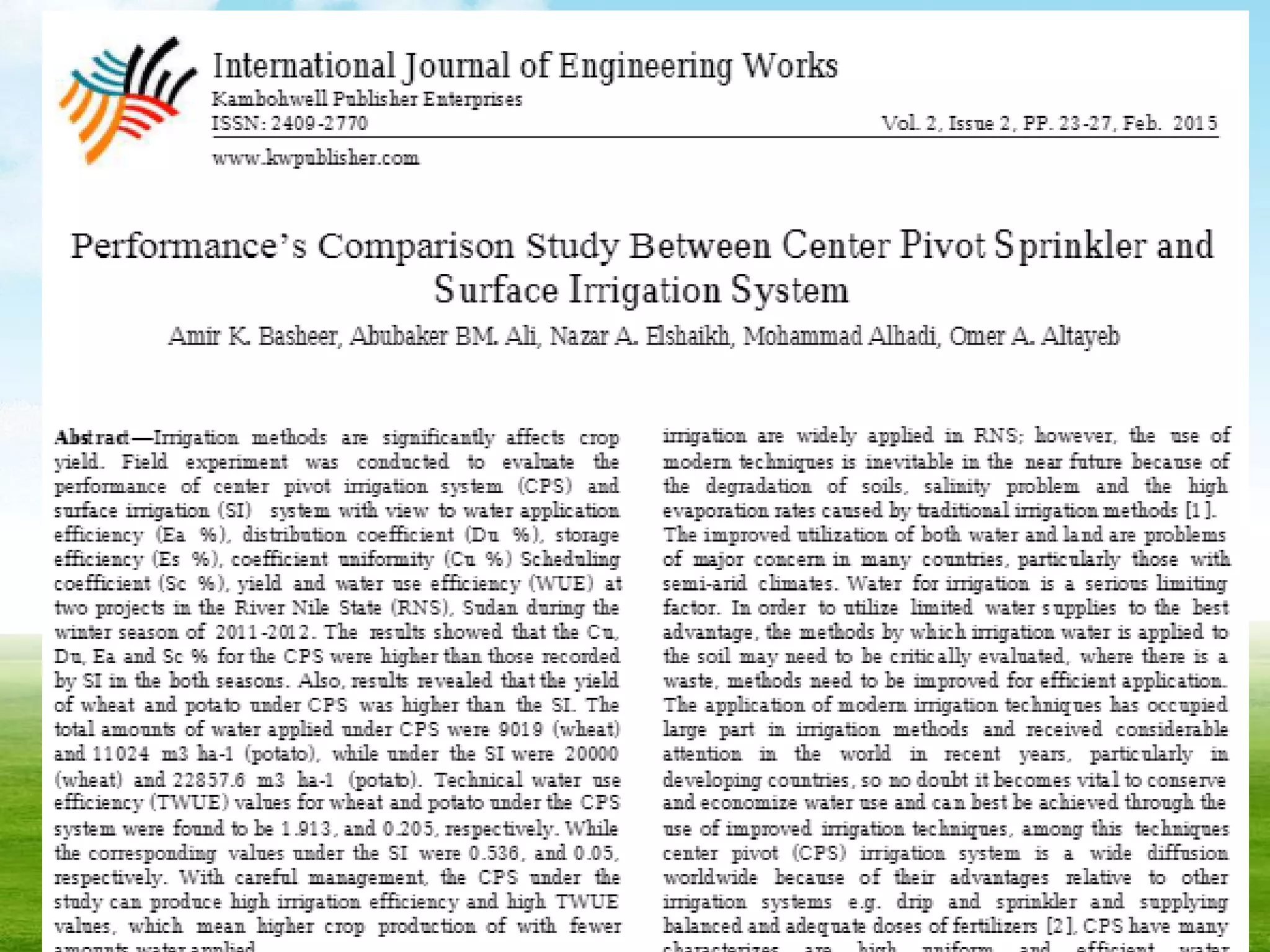
THANK YOU
THANK YOU

Pivot System and Robotics in Agriculture.

  • 1.
    UNIVERSITY OF AGRICULTURALSCIENCES College of Agriculture ,GKVK, Bengaluru AGR 501: Modern Concepts In Crop Production(2+0) Topic: PIVOT SYSTEM AND ROBOTICS IN CROP PRODUCTION Submitted to: Course Teacher Department of Agronomy UAS(B),GKVK Presented by: Devika AR PAMB 0197 Jr M.Sc. (Agronomy)
  • 2.
    INTRODUCTION Centre Pivot irrigationis a form of overhead sprinkler irrigation consisting of several segments of pipes joined together by trusses where the whole assembly is mounted on tires due to which it rotates in circular manner around a central point known as Pivot Point. The arm of the system is connected with number of pipes at fixed intervals of horizontal distance between them are known as sprinklers.
  • 3.
    GLOBAL HISTORY OFCENTRE PIVOT IRRIGATION • Center-pivot irrigation was invented in 1940 by farmer Frank Zybach (Germany). • T-L Irrigation Solutions commercially introduced Centre Pivot system about 50 years ago is USA. • After 1975 there was a sudden increased demand of the system due to shortage of labour. • The second important reason behind it was the due to the use of this system the land which was uneven in the topography also came under the irrigation. • In India ,National Seed Corporation in its annual report of 2014-15 recommended the government to encourage the Indian farmers who have large possession on land adopt this system to accelerate the cultivation from their farms. • Accordingly various manufactures of irrigation system have subsidised such irrigation system to reach the maximum numbers of farmers. • Brightstar India is a leading manufacturer of the system.
  • 4.
    Circular Pivot Irrigation System •The most commonly used design of the system which provides water to the crops in a circular pattern. • It is installed 10 ft above the ground so as to also cover those crops whose height is more such as Wheat, Sugarcane etc. • But close growing crops are not suitable because they may oppose the movement of tyres in forward, backward or circular manner. • Pivots are capable of applying water, fertilizer, chemicals, and herbicides. • Common in parts of United States.
  • 5.
    Rectangular System • Whenthe available field is of irregular shape then circular systems are useless and then the field is to be divided in rectangular shapes. • The movement of the assembly is only in forward and backward between two fixed ends. • This characteristic is typically suitable for Indian agricultural sector because in India the fields are as less as 2 acres and also in irregular shapes. Lateral System • It has a separate machine which travels parallel to the sides of the field to irrigate upto 95% of the field area. • It is more efficient in terms of area under irrigation than that of circular system but it is costlier because separate length of pipe has to be attached to it to supply water. Corner system • When circular system is adopted the corners of the field remain unirrigated which are further irrigated by introducing traditional sprinkler irrigation system.
  • 6.
    FIVE PRIMARY COMPONENTSOF CENTRAL PIVOT SYSTEM BOXES
  • 7.
    PIVOT POINT The pivotpoint anchors the machine to a permanent location in the field.
  • 8.
    Control Panel • Thecontrol panel is the brains of the operation. • It controls the stopping, starting, forward and reverse movements of the pivot, water usage. Spans • Spans are the backbone of the whole center pivot structure. • Spans consist of pipes that transfer water to the field via the pivot’s sprinkler package. • The span pipes are supported by trussing and the drive units. Drive Units • The drive units are the pneumatic wheels that moves in the field. • They provide clearance above the crop for the spans and control the movement of the machine. Tower Boxes/Electrical Control Boxes • It controls pivot movement and alignment. • The average quantity of water from sprinkler can be controlled by Control Unit.
  • 9.
    ADVANTAGES: • It iseconomical and efficient method of irrigation for large fields. It requires only 60% of the water than that of the traditional method of irrigation. • Soil needs not to be in level because water flowing over the ground is not due to gravity effect. • Rubber tyres with moderate shock absorbing arrangement make the system suitable even for undulating field. • Indian farmer often suffer from shortage of labour power so this system proves best because almost no labours are involved for operating. • The towers of the system can also be equipped with cameras to inspect the diseases and pests on crop plants. • Since it is automatic , farmer needs not to present in the farm at the time of application of water. He can watch live footage of it on his own smart phone or computer. • Herbicides, pesticides and soluble nutrient can be directly fed to each plant.
  • 10.
    DISADVANTAGES : • Verylarge initial cost in involved. • All Indian farmers today are even hesitant to use Drip and Sprinkler method so it is very hard to for them to adopt such a system at large capital investment. • If proper maintenance is not taken then the system may lead to breakdown. • Heavy constituent of salt may lead to blockages of sprinkle nozzles which may lead to frequent replacement. • For clayey soil care has to be taken so that wheel does not stuck in the muddy wet soil. • Skill requirement • Wind affects the water distribution • Evaporation losses can be high
  • 12.
    CONCLUSION • In Indianperspective , there is vast opportunities to practice it when we look towards the advantages of the system such as its competency to operate automatically as per the availability of power, this ultimately relieves Indian farmer in a great way. • Moreover this it saves considerably large area from being wasted in digging the trenches. • On the other hand its cost is a big issue and therefore various innovations are needed to make the system cost efficient so that average Indian farmer can install it. • Secondly the central government should provide subsidy to the farmers to encourage them.
  • 13.
    ROBOTICS IN CROPPRODUCTION • Introduction • How Robots Work • Need of Robotic Agriculture • Robots used in Agriculture • Advantages and disadvantages • Conclusion
  • 14.
    Introduction Robots A robot isa mechanical, artificial agent and is usually an electromechanical system. It is a device that, because of software programming, makes complicated tasks easy to perform. Agriculture robots/AGROBOT “Agricultural robot” or “agrobot” is a mobile, autonomous, decision-making, mechatronic device that accomplishes crop production tasks (e.g. soil preparation, seeding, transplanting, weeding, pest control and harvesting) under human supervision, but without direct human labour. The first commercially available agrobots cover three main tasks: eliminating weeds, monitoring pests and diseases, and harvesting specialized crops (berries or vegetables).
  • 15.
    How Robots Work Robotscan move and sense. They require multiple sensors and controls that allow them to move in an unknown environment.
  • 16.
    • The robotsare equipped with sensors for navigation: • GNSS(Global Navigation Satellite Systems) • IMU (Inertial measurement units ) (which measure accelerations and rate of turn), cameras, and encoders and soil sensors. • The use of dedicated cameras for weed detection and classification can be used to control variable rate technology (VRT) in herbicide application.
  • 17.
    Where is anAgricultural Robot used? Agribots help to automate routine farming activities because of which repetitive tasks are completed in no time at all. •Harvesting – This is among the most common functions performed by an Agribot. These robots work with increased speed and accuracy to improve crop yield size and reduce wastage. •Weed Control – Agribots help distinguish weeds from useful crops and remove them by causing artificial soil disturbances using laser technologies. •Mowing – Agribots use smart sensors to determine plant density and cut farmlands with precision. •Seeding – Agribots also act as seeder attachments, where they accurately predict the soil tendency and help in planting seeds at the right places. •Spraying – Agribots help identify weeds and crops that require pesticides and fertilizers, thereby leading to a reduction in wastage of resources. •Sorting and Packaging – Agribots assist in detecting, sorting and packing agricultural products. •Livestock Monitoring – Agbots help in tracking livestock and navigating them through rugged terrains. •Irrigation – Artificial intelligence assists in accessing water volumes and helps farmers use water in a controlled manner only on plants in need of water.
  • 18.
    Robots usually havefive parts: • Sensors • Controller/Computer • Drive/Actuator • Arm • End-effectors Robotic Sensor: • A device that can detect physical signal and convert into electrical signal. • Robotic sensors are used to estimate a robot's condition and environment. • These signals are passed to a controller to enable appropriate behavior.
  • 19.
    Controller /Computer: •The controllerfunctions as the "brain" of the robot. •The controller also allows the robot to be networked to other systems, so that it may work together with other machines, processes, or robots. Actuators/ Drives : • The drive or actuator is the "engine" of the robot. • An actuator is defined as "a mechanical device that produces motion”. Arms : • The arm is the part of the robot that positions the end-effectors and sensors to do their pre- programmed function.
  • 20.
    End Effectors • Anend effector is the device found at the end of the robotic arm, used for various agricultural operations. • It will interacts with the work environment. • Each was designed according to the nature of the task . • End effectors used for harvesting - Gripper ,Vaccum pump • For spraying, the end effector consists of a spray nozzle. Gripper Vacuum pump
  • 21.
    DIFFERENT TYPES OF AGRICULTURALROBOTS • Drones / Aerial Imaging • Spraying Robot • Scrappy Little Fertilizer Bot • Robots for Weeding Ecorobotix DINO Tertill Robot • TREKTOR • Harvesting Robots Demeter Agrobot E-Series
  • 22.
    Drones / AerialImaging • Drones are the first robotic applications that farmers have adopted. • Drones are small and light aerial vehicles which may fly at extremely high altitudes and has the ability to deploy various sensors and capture high-resolution and low- cost images of crop conditions. • Images can range from simple visible-light photographs to multi-spectral imagery that can be used to assess different aspects of plant health and weeds.  Crop health  Vegetation indices  Plant height  Plant scouting  Water needs  Soil analysis Drones help farmers optimize the use of inputs such as seeds, fertilizers, water, and pesticides more efficiently.
  • 23.
    • With theelectric drive of the spraying robot, a constant movement speed is easily maintained which allows a very precise and repeatable application. • The operator does not have to go into the area of spraying since it is remote controlled. • This drastically reduces exposure to pesticide spray. Spraying Robot • It travels between rows of crops and applying fertilizer as it goes. Rowbot/Scrappy Little Fertilizer Bot
  • 24.
    Ecorobotix • The robotuses its complex camera system to target and spray weeds. • Because of its very precise arms, the robot uses 90% less herbicide, making it 30% cheaper than traditional treatments. • Replace human farm labour. Robots for Weeding Weeding Robot(Naio Technologies) • The robots have the ability to weed, hoe, and assist during harvesting
  • 25.
    • Robot isspecialized in mechanical weeding of vegetable crops. • It recognizes the weeds in the crop rows and it can discriminate them with artificial intelligence (AI) applied to image recognition. • Mechanical weeding eliminates the costs and risks associated with herbicide use and saves labour costs. DINO Tertill Weeding Robot • It enables to weed garden with just the touch of a button, no programming required.
  • 27.
    TREKTOR • An autonomoushybrid robot • It’s a tractor that works to weed the organic vineyard
  • 28.
    Demeter • It hascameras that can detect the difference between the crop that has been cut and crop that hasn’t. • This information tells it where to drive, where to put its cutter head, and when it has come to the end of a crop row so it can turn around • It can harvest wheat and alfalfa. Harvesting Robots Content Conventional Harvesting Robotic Harvesting Labour More labour No labour Cost Initially low Long run: High Initially high Long run:Low Time More Less Energy Efficiency Less(20-30%) High(70-80%)
  • 29.
    Agrobot E-Series • Itsrobotic arms works wirelessly and an with advanced AI systemfor 24 hours. • The E-series can pick strawberries really fast and can also identify the ripeness of a strawberry in the field.
  • 30.
    COMBINED HARVESTER ROBOT GRAPEHARVESTING ROBOT APPLE HARVESTING ROBOT TOMATO PICKING ROBOT
  • 33.
    • Decreased labour •Increased profits • Saving Precious Resources • Attracts Young Talent • Maximum productivity • Can work 24 hours a day, every day without rest. • Robots are extremely accurate compared to humans, so product quality is high. • Perform tasks more quickly than humans DRAWBACKS: • Costly – Agribots are machines that require a considerable investment, which make them an expensive affair for small and marginal farmers. • Complex Operations – Agbots come equipped with the latest technological advancements, making them complex to use. • Requires Technical Expertise – Agricultural robots need farmers to become skilled and proficient in handling modern technology, which hampers their ability to properly take care of their farmlands. • Power Cuts – India is a country faced with regular power cuts, especially in rural areas. It renders agricultural robots useless because they cannot work without electricity, leading to unnecessary wastage of time. ADVANTAGES:
  • 34.
    CONCLUSION • This equipmentmay dominate in future, but at present rethinking of how crop production can be done better with Agribots. • Crop production may be done better and cheaper with a swarm of small machines than with a few large ones since smaller machines are even more acceptable to the non-farm community. • The higher quality products can be sensed by machines (colour, firmness, weight, density, ripeness, size, shape) accurately hence Robots can improve the quality of our lives. • The lack of abundant research funding and budgets in agriculture has decelerated this technology. • Some forms of human-robot collaboration as well as modification of the crop breeding and planting systems in fields and greenhouses might be necessary to solve the challenges of agricultural robotics that cannot yet be automated.
  • 39.
    REFERENCES • Centre PivotIrrigation-A Modern Method of Irrigation in Indian Perspective, Volume 2, Issue 12, December 2016,IJARSMT. • James, L. G . 1982. Modeling the performance of center pivot irrigation systems operating on variable topography. TRANSACTIONS of the ASAE 25(1):143-149. • Investing in centre pivot and lateral move systems | Centre pivot and lateral move systems | Irrigation | Water | Farm management | Agriculture Victoria. • PIVOTBASICS ,Wilcox, J. C . and G . E. Sw ailes. 1947,Scientific Agriculture 27:565-583. • Agricultural robotics and automated equipment for sustainable crop production ,By Santiago Santos Valle, Agricultural Mechanization Specialist, FAO Josef Kienzle, Agricultural Engineer, FAO NOVEMBER 2020 Food and Agriculture Organization of the United Nations Rome, 2020 • Agrobot. 2020. Agrobot [online]. Huelva, Spain. [Cited 4 August 2020]. https://www.agrobot.com/ • Bechar, A. & Vigneault, C. 2016. Agricultural robots for field operations: Concepts and components. Biosystems Engineering, 149: 94–111
  • 40.
    Asadal has beenrunning one of the biggest domain and web hosting sites in Korea since March 1998. More than 3,000,000 people have visited our website, www.asadal.com for domain registration and web hosting. Insert my subtitle or main author’s name here THANK YOU THANK YOU