Supported by:
Aspen HYSYS Training
Module 4: Logical Operations
Tutor:
M. Ersharry Yunashtanto
Zayyanatun Zulfa
Ikha Muliawati
Mada Harahap
• The Set Operation
• The Adjust Operation
• The Balance Operation
• The Recycle Operation
• The Spreadsheet
Logical Operations Used in HYSYS Steady State
SET OPERATION
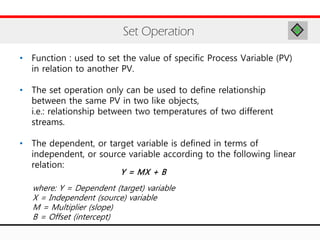
• Function : used to set the value of specific Process Variable (PV)
in relation to another PV.
• The set operation only can be used to define relationship
between the same PV in two like objects,
i.e.: relationship between two temperatures of two different
streams.
• The dependent, or target variable is defined in terms of
independent, or source variable according to the following linear
relation:
Set Operation
Y = MX + B
where: Y = Dependent (target) variable
X = Independent (source) variable
M = Multiplier (slope)
B = Offset (intercept)
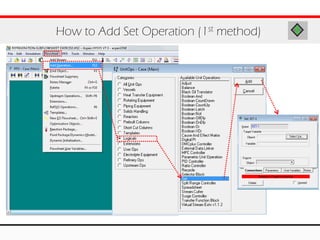
How to Add Set Operation (1st method)
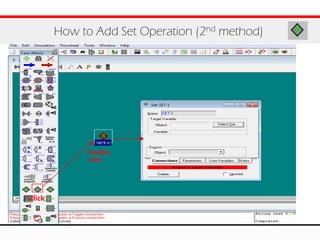
How to Add Set Operation (2nd method)
click
Double
click
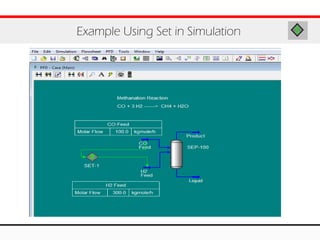
Example Using Set in Simulation
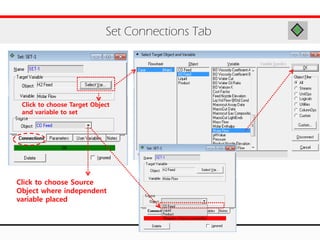
Set Connections Tab
Click to choose Target Object
and variable to set
Click to choose Source
Object where independent
variable placed
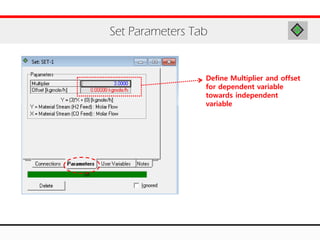
Set Parameters Tab
Define Multiplier and offset
for dependent variable
towards independent
variable
ADJUST OPERATION
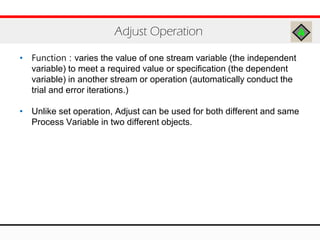
• Function : varies the value of one stream variable (the independent
variable) to meet a required value or specification (the dependent
variable) in another stream or operation (automatically conduct the
trial and error iterations.)
• Unlike set operation, Adjust can be used for both different and same
Process Variable in two different objects.
Adjust Operation
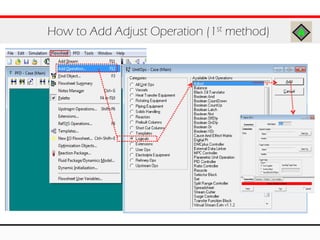
How to Add Adjust Operation (1st method)
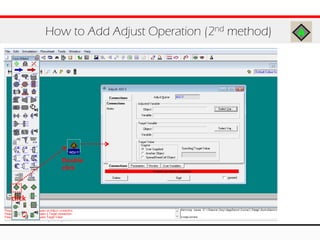
How to Add Adjust Operation (2nd method)
click
Double
click
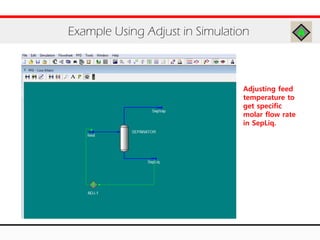
Example Using Adjust in Simulation
Adjusting feed
temperature to
get specific
molar flow rate
in SepLiq.
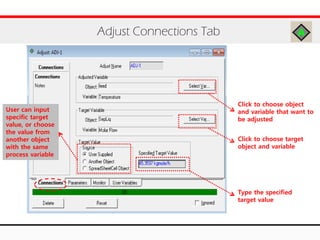
Adjust Connections Tab
Click to choose object
and variable that want to
be adjusted
Click to choose target
object and variable
Type the specified
target value
User can input
specific target
value, or choose
the value from
another object
with the same
process variable
Adjust ParametersTab
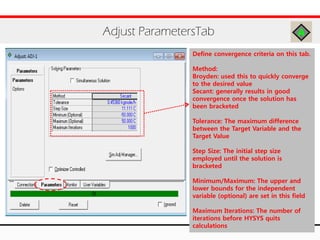
Define convergence criteria on this tab.
Method:
Broyden: used this to quickly converge
to the desired value
Secant: generally results in good
convergence once the solution has
been bracketed
Tolerance: The maximum difference
between the Target Variable and the
Target Value
Step Size: The initial step size
employed until the solution is
bracketed
Minimum/Maximum: The upper and
lower bounds for the independent
variable (optional) are set in this field
Maximum Iterations: The number of
iterations before HYSYS quits
calculations
SET & ADJUST OPERATION EXERCISE
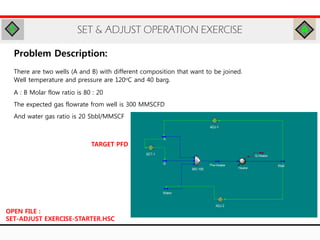
Problem Description:
There are two wells (A and B) with different composition that want to be joined.
Well temperature and pressure are 120oC and 40 barg.
A : B Molar flow ratio is 80 : 20
The expected gas flowrate from well is 300 MMSCFD
And water gas ratio is 20 Sbbl/MMSCF
TARGET PFD
OPEN FILE :
SET-ADJUST EXERCISE-STARTER.HSC
BALANCE OPERATION
• Function : provides a general-purpose heat and material balance
facility.
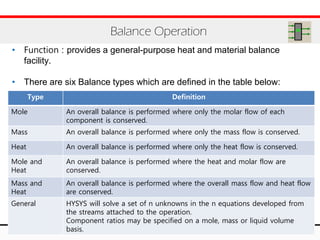
• There are six Balance types which are defined in the table below:
Balance Operation
Type Definition
Mole An overall balance is performed where only the molar flow of each
component is conserved.
Mass An overall balance is performed where only the mass flow is conserved.
Heat An overall balance is performed where only the heat flow is conserved.
Mole and
Heat
An overall balance is performed where the heat and molar flow are
conserved.
Mass and
Heat
An overall balance is performed where the overall mass flow and heat flow
are conserved.
General HYSYS will solve a set of n unknowns in the n equations developed from
the streams attached to the operation.
Component ratios may be specified on a mole, mass or liquid volume
basis.
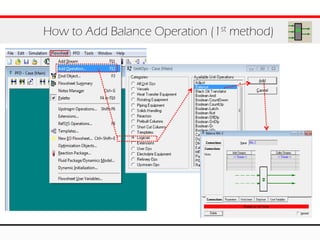
How to Add Balance Operation (1st method)
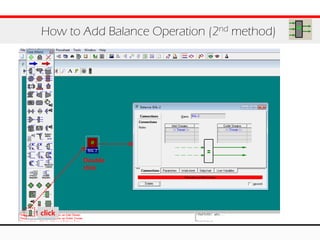
How to Add Balance Operation (2nd method)
click
Double
click
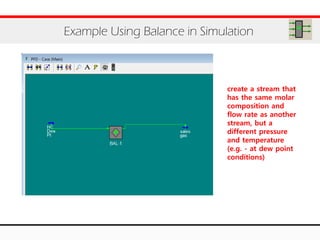
Example Using Balance in Simulation
create a stream that
has the same molar
composition and
flow rate as another
stream, but a
different pressure
and temperature
(e.g. - at dew point
conditions)
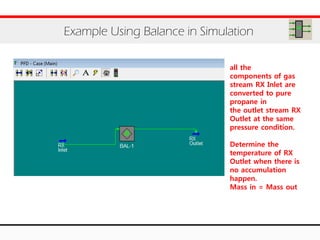
Example Using Balance in Simulation
all the
components of gas
stream RX Inlet are
converted to pure
propane in
the outlet stream RX
Outlet at the same
pressure condition.
Determine the
temperature of RX
Outlet when there is
no accumulation
happen.
Mass in = Mass out
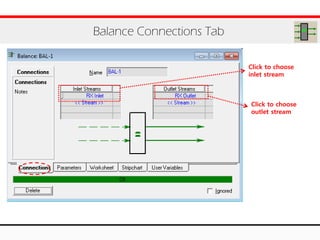
Balance Connections Tab
Click to choose
inlet stream
Click to choose
outlet stream
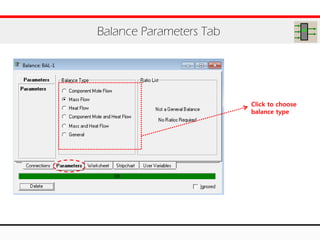
Balance Parameters Tab
Click to choose
balance type
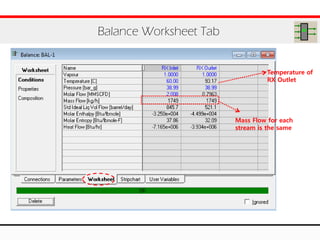
Balance Worksheet Tab
Mass Flow for each
stream is the same
Temperature of
RX Outlet
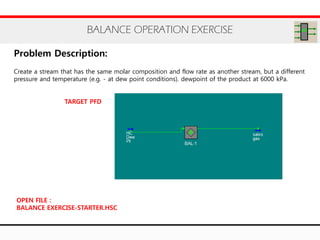
BALANCE OPERATION EXERCISE
Problem Description:
Create a stream that has the same molar composition and flow rate as another stream, but a different
pressure and temperature (e.g. - at dew point conditions). dewpoint of the product at 6000 kPa.
TARGET PFD
OPEN FILE :
BALANCE EXERCISE-STARTER.HSC
RECYCLE OPERATION
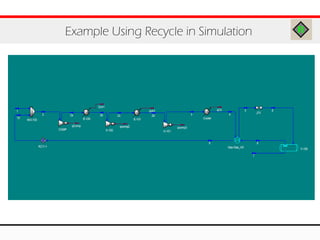
• Use this operation every time you need to recycle a stream.
• The logical block connects the two streams around the tear stream
(stream with temporary specification).
• Before you can install the RECYCLE the flowsheet must have
completed. That means there need to be values for both
the assumed stream and the calculated stream.
• Once the Recycle is attached and running, HYSYS compares the
two values, adjusts the assumed stream, and runs the flowsheet
again. HYSYS repeats this process until the two streams match
within specified tolerances.
Recycle Operation
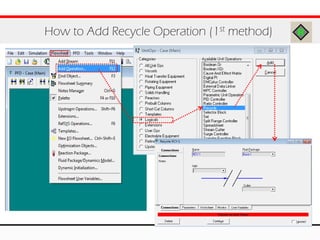
How to Add Recycle Operation (1st method)
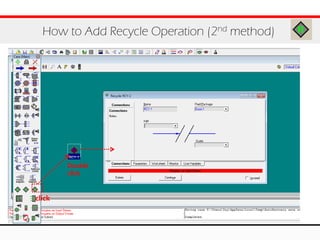
How to Add Recycle Operation (2nd method)
click
Double
click
Example Using Recycle in Simulation
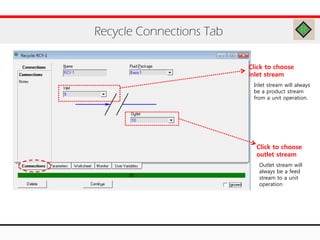
Recycle Connections Tab
Click to choose
inlet stream
Click to choose
outlet stream
Inlet stream will always
be a product stream
from a unit operation.
Outlet stream will
always be a feed
stream to a unit
operation
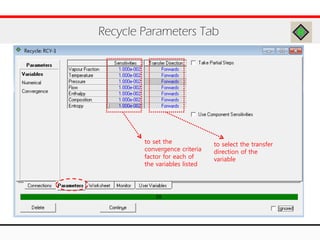
Recycle Parameters Tab
to set the
convergence criteria
factor for each of
the variables listed
to select the transfer
direction of the
variable
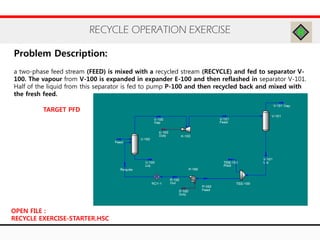
RECYCLE OPERATION EXERCISE
Problem Description:
a two-phase feed stream (FEED) is mixed with a recycled stream (RECYCLE) and fed to separator V-
100. The vapour from V-100 is expanded in expander E-100 and then reflashed in separator V-101.
Half of the liquid from this separator is fed to pump P-100 and then recycled back and mixed with
the fresh feed.
TARGET PFD
OPEN FILE :
RECYCLE EXERCISE-STARTER.HSC
SPREADSHEET
• The Spreadsheet applies the functionality of Spreadsheet programs
to flowsheet modeling. With essentially complete access to all
process variables, the Spreadsheet is extremely powerful and has
many applications in HYSYS.
• The HYSYS SPREADSHEET has standard row/column
functionality. You can import a variable, or enter a number or
formula anywhere in the spreadsheet.
• Complex mathematical formulas can be created, using syntax which
is similar to conventional Spreadsheets. Arithmetic, logarithmic, and
trigonometric functions are examples of the mathematical
functionality available in the Spreadsheet.
Spreadsheet
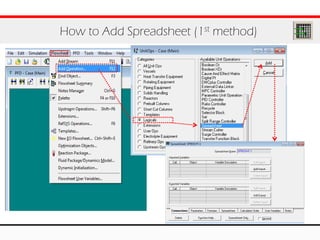
How to Add Spreadsheet (1st method)
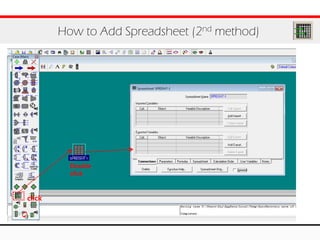
How to Add Spreadsheet (2nd method)
click
Double
click
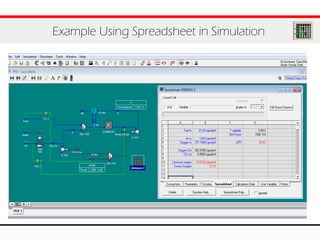
Example Using Spreadsheet in Simulation
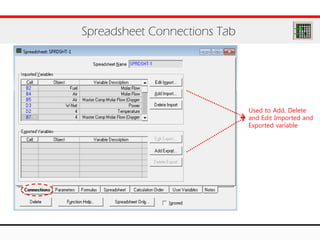
Spreadsheet Connections Tab
Used to Add, Delete
and Edit Imported and
Exported variable
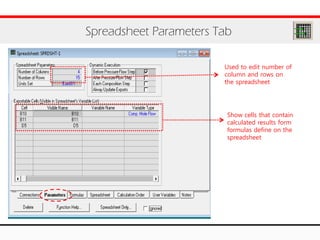
Spreadsheet Parameters Tab
Used to edit number of
column and rows on
the spreadsheet
Show cells that contain
calculated results form
formulas define on the
spreadsheet
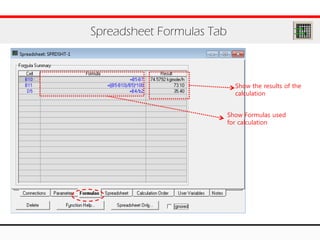
Spreadsheet Formulas Tab
Show the results of the
calculation
Show Formulas used
for calculation
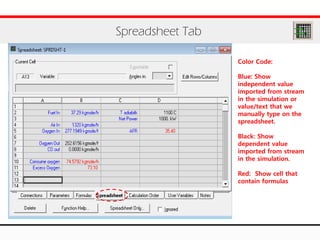
Spreadsheet Tab
Color Code:
Blue: Show
independent value
imported from stream
in the simulation or
value/text that we
manually type on the
spreadsheet.
Black: Show
dependent value
imported from stream
in the simulation.
Red: Show cell that
contain formulas
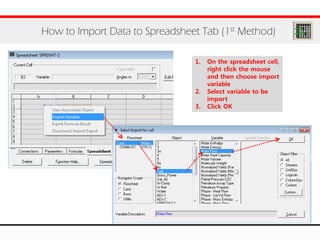
How to Import Data to Spreadsheet Tab (1st Method)
1. On the spreadsheet cell,
right click the mouse
and then choose import
variable
2. Select variable to be
import
3. Click OK
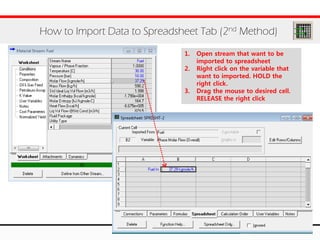
How to Import Data to Spreadsheet Tab (2nd Method)
1. Open stream that want to be
imported to spreadsheet
2. Right click on the variable that
want to imported. HOLD the
right click.
3. Drag the mouse to desired cell.
RELEASE the right click
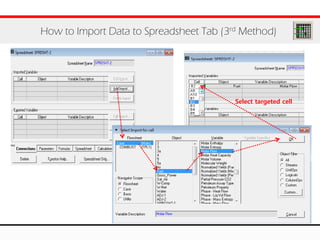
How to Import Data to Spreadsheet Tab (3rd Method)
Select targeted cell
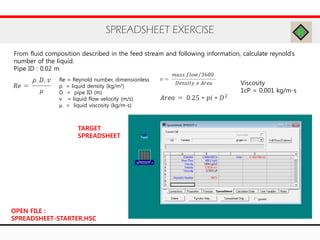
SPREADSHEET EXERCISE
From fluid composition described in the feed stream and following information, calculate reynold’s
number of the liquid.
Pipe ID : 0.02 m
TARGET
SPREADSHEET
OPEN FILE :
SPREADSHEET-STARTER.HSC
Re = Reynold number, dimensionless
ρ = liquid density (kg/m3)
D = pipe ID (m)
v = liquid flow velocity (m/s)
μ = liquid viscosity (kg/m-s)
Viscosity
1cP = 0.001 kg/m-s
Thank You
M. Ersharry Yunashtanto
Zayyanatun Zulfa
Ikha Muliawati
Mada Harahap
• Aspen Hysys Unit Operation Guide, Aspen Technology, 2011
• HYSYS.Plant Simulation Basis, Hyprotech Ltd, 2000.
• “……………….”, Process Simulation Workshop.
REFERENCES

Module 4 - Logical Operations

  • 1.
    Supported by: Aspen HYSYSTraining Module 4: Logical Operations Tutor: M. Ersharry Yunashtanto Zayyanatun Zulfa Ikha Muliawati Mada Harahap
  • 2.
    • The SetOperation • The Adjust Operation • The Balance Operation • The Recycle Operation • The Spreadsheet Logical Operations Used in HYSYS Steady State
  • 3.
  • 4.
    • Function :used to set the value of specific Process Variable (PV) in relation to another PV. • The set operation only can be used to define relationship between the same PV in two like objects, i.e.: relationship between two temperatures of two different streams. • The dependent, or target variable is defined in terms of independent, or source variable according to the following linear relation: Set Operation Y = MX + B where: Y = Dependent (target) variable X = Independent (source) variable M = Multiplier (slope) B = Offset (intercept)
  • 5.
    How to AddSet Operation (1st method)
  • 6.
    How to AddSet Operation (2nd method) click Double click
  • 7.
    Example Using Setin Simulation
  • 8.
    Set Connections Tab Clickto choose Target Object and variable to set Click to choose Source Object where independent variable placed
  • 9.
    Set Parameters Tab DefineMultiplier and offset for dependent variable towards independent variable
  • 10.
  • 11.
    • Function :varies the value of one stream variable (the independent variable) to meet a required value or specification (the dependent variable) in another stream or operation (automatically conduct the trial and error iterations.) • Unlike set operation, Adjust can be used for both different and same Process Variable in two different objects. Adjust Operation
  • 12.
    How to AddAdjust Operation (1st method)
  • 13.
    How to AddAdjust Operation (2nd method) click Double click
  • 14.
    Example Using Adjustin Simulation Adjusting feed temperature to get specific molar flow rate in SepLiq.
  • 15.
    Adjust Connections Tab Clickto choose object and variable that want to be adjusted Click to choose target object and variable Type the specified target value User can input specific target value, or choose the value from another object with the same process variable
  • 16.
    Adjust ParametersTab Define convergencecriteria on this tab. Method: Broyden: used this to quickly converge to the desired value Secant: generally results in good convergence once the solution has been bracketed Tolerance: The maximum difference between the Target Variable and the Target Value Step Size: The initial step size employed until the solution is bracketed Minimum/Maximum: The upper and lower bounds for the independent variable (optional) are set in this field Maximum Iterations: The number of iterations before HYSYS quits calculations
  • 17.
    SET & ADJUSTOPERATION EXERCISE Problem Description: There are two wells (A and B) with different composition that want to be joined. Well temperature and pressure are 120oC and 40 barg. A : B Molar flow ratio is 80 : 20 The expected gas flowrate from well is 300 MMSCFD And water gas ratio is 20 Sbbl/MMSCF TARGET PFD OPEN FILE : SET-ADJUST EXERCISE-STARTER.HSC
  • 18.
  • 19.
    • Function :provides a general-purpose heat and material balance facility. • There are six Balance types which are defined in the table below: Balance Operation Type Definition Mole An overall balance is performed where only the molar flow of each component is conserved. Mass An overall balance is performed where only the mass flow is conserved. Heat An overall balance is performed where only the heat flow is conserved. Mole and Heat An overall balance is performed where the heat and molar flow are conserved. Mass and Heat An overall balance is performed where the overall mass flow and heat flow are conserved. General HYSYS will solve a set of n unknowns in the n equations developed from the streams attached to the operation. Component ratios may be specified on a mole, mass or liquid volume basis.
  • 20.
    How to AddBalance Operation (1st method)
  • 21.
    How to AddBalance Operation (2nd method) click Double click
  • 22.
    Example Using Balancein Simulation create a stream that has the same molar composition and flow rate as another stream, but a different pressure and temperature (e.g. - at dew point conditions)
  • 23.
    Example Using Balancein Simulation all the components of gas stream RX Inlet are converted to pure propane in the outlet stream RX Outlet at the same pressure condition. Determine the temperature of RX Outlet when there is no accumulation happen. Mass in = Mass out
  • 24.
    Balance Connections Tab Clickto choose inlet stream Click to choose outlet stream
  • 25.
    Balance Parameters Tab Clickto choose balance type
  • 26.
    Balance Worksheet Tab MassFlow for each stream is the same Temperature of RX Outlet
  • 27.
    BALANCE OPERATION EXERCISE ProblemDescription: Create a stream that has the same molar composition and flow rate as another stream, but a different pressure and temperature (e.g. - at dew point conditions). dewpoint of the product at 6000 kPa. TARGET PFD OPEN FILE : BALANCE EXERCISE-STARTER.HSC
  • 28.
  • 29.
    • Use thisoperation every time you need to recycle a stream. • The logical block connects the two streams around the tear stream (stream with temporary specification). • Before you can install the RECYCLE the flowsheet must have completed. That means there need to be values for both the assumed stream and the calculated stream. • Once the Recycle is attached and running, HYSYS compares the two values, adjusts the assumed stream, and runs the flowsheet again. HYSYS repeats this process until the two streams match within specified tolerances. Recycle Operation
  • 30.
    How to AddRecycle Operation (1st method)
  • 31.
    How to AddRecycle Operation (2nd method) click Double click
  • 32.
    Example Using Recyclein Simulation
  • 33.
    Recycle Connections Tab Clickto choose inlet stream Click to choose outlet stream Inlet stream will always be a product stream from a unit operation. Outlet stream will always be a feed stream to a unit operation
  • 34.
    Recycle Parameters Tab toset the convergence criteria factor for each of the variables listed to select the transfer direction of the variable
  • 35.
    RECYCLE OPERATION EXERCISE ProblemDescription: a two-phase feed stream (FEED) is mixed with a recycled stream (RECYCLE) and fed to separator V- 100. The vapour from V-100 is expanded in expander E-100 and then reflashed in separator V-101. Half of the liquid from this separator is fed to pump P-100 and then recycled back and mixed with the fresh feed. TARGET PFD OPEN FILE : RECYCLE EXERCISE-STARTER.HSC
  • 36.
  • 37.
    • The Spreadsheetapplies the functionality of Spreadsheet programs to flowsheet modeling. With essentially complete access to all process variables, the Spreadsheet is extremely powerful and has many applications in HYSYS. • The HYSYS SPREADSHEET has standard row/column functionality. You can import a variable, or enter a number or formula anywhere in the spreadsheet. • Complex mathematical formulas can be created, using syntax which is similar to conventional Spreadsheets. Arithmetic, logarithmic, and trigonometric functions are examples of the mathematical functionality available in the Spreadsheet. Spreadsheet
  • 38.
    How to AddSpreadsheet (1st method)
  • 39.
    How to AddSpreadsheet (2nd method) click Double click
  • 40.
  • 41.
    Spreadsheet Connections Tab Usedto Add, Delete and Edit Imported and Exported variable
  • 42.
    Spreadsheet Parameters Tab Usedto edit number of column and rows on the spreadsheet Show cells that contain calculated results form formulas define on the spreadsheet
  • 43.
    Spreadsheet Formulas Tab Showthe results of the calculation Show Formulas used for calculation
  • 44.
    Spreadsheet Tab Color Code: Blue:Show independent value imported from stream in the simulation or value/text that we manually type on the spreadsheet. Black: Show dependent value imported from stream in the simulation. Red: Show cell that contain formulas
  • 45.
    How to ImportData to Spreadsheet Tab (1st Method) 1. On the spreadsheet cell, right click the mouse and then choose import variable 2. Select variable to be import 3. Click OK
  • 46.
    How to ImportData to Spreadsheet Tab (2nd Method) 1. Open stream that want to be imported to spreadsheet 2. Right click on the variable that want to imported. HOLD the right click. 3. Drag the mouse to desired cell. RELEASE the right click
  • 47.
    How to ImportData to Spreadsheet Tab (3rd Method) Select targeted cell
  • 48.
    SPREADSHEET EXERCISE From fluidcomposition described in the feed stream and following information, calculate reynold’s number of the liquid. Pipe ID : 0.02 m TARGET SPREADSHEET OPEN FILE : SPREADSHEET-STARTER.HSC Re = Reynold number, dimensionless ρ = liquid density (kg/m3) D = pipe ID (m) v = liquid flow velocity (m/s) μ = liquid viscosity (kg/m-s) Viscosity 1cP = 0.001 kg/m-s
  • 49.
    Thank You M. ErsharryYunashtanto Zayyanatun Zulfa Ikha Muliawati Mada Harahap
  • 50.
    • Aspen HysysUnit Operation Guide, Aspen Technology, 2011 • HYSYS.Plant Simulation Basis, Hyprotech Ltd, 2000. • “……………….”, Process Simulation Workshop. REFERENCES