PITCH
By Sabrina and Charlotte
1. Why did we choose to do a crime documentary?
We chose to go for a crime documentary as we know that there are
a lot of crimes that have been occurring recently therefore we want
to show to the audience about young people and what kind of
crimes they get themselves into, such as drug and alcohol use. It is
a more appealing topic that most people tend to watch and
therefore by choosing to do a crime documentary it will catch the
audiences eye’s a lot quicker. We have all the necessities to use for
a crime documentary therefore we felt this would be the perfect
topic to choose.
2. How will our documentary appeal to the audience? How
is it similar/different to other documentaries that they
like?
Our documentary will appeal to the audience as we will not have a
presenter on screen, so this way we are trying to get the audiences
attention on the crimes that will be present on screen. Presenters
are also seen to be overused in many kinds of documentaries. We do
not want to bore our young adult audience as we want to make it
look realistic but interesting at the same time to make them keep
watching. The only way that it is similar to other crime
documentaries is that it will have police officers, the criminals and
the tense kind of music to attract the audiences attention. However
we are also targeting a particular borough, doing interviews with
teachers and a police officer.
3. What kind of documentary are we making?
What will happen?
The kind of documentary that we are going to be making is a
performative documentary about youth crime, particularly on drugs
and alcohol which youth are associated with the most. It will
include: interviews of police officers and experts as well as the
youths themselves and teachers. A voiceover will accompany this by
giving facts and statistics about the issues covered within the
documentary.
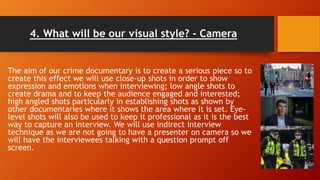
4. What will be our visual style? - Camera
The aim of our crime documentary is to create a serious piece so to
create this effect we will use close-up shots in order to show
expression and emotions when interviewing; low angle shots to
create drama and to keep the audience engaged and interested;
high angled shots particularly in establishing shots as shown by
other documentaries where it shows the area where it is set. Eye-
level shots will also be used to keep it professional as it is the best
way to capture an interview. We will use indirect interview
technique as we are not going to have a presenter on camera so we
will have the interviewees talking with a question prompt off
screen.
Editing
It will be continuous editing in order to create a clear message for
our audience so there is no confusion. Fast paced editing of
different shots of a city may be used along with a voiceover in order
to keep it interesting for young adult audiences so they can engage
with the documentary.
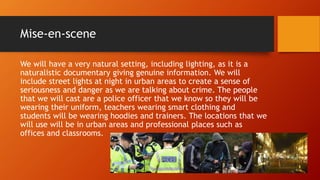
Mise-en-scene
We will have a very natural setting, including lighting, as it is a
naturalistic documentary giving genuine information. We will
include street lights at night in urban areas to create a sense of
seriousness and danger as we are talking about crime. The people
that we will cast are a police officer that we know so they will be
wearing their uniform, teachers wearing smart clothing and
students will be wearing hoodies and trainers. The locations that we
will use will be in urban areas and professional places such as
offices and classrooms.
Sound
We will use a voiceover to narrate our documentary along with
visual interviews. We will also use an asynchronous soundtrack with
tense music so that it will engage the audience and to emphasise
the seriousness of the topic.
5. Ancillary tasks – What are we doing? What real
media styles did we like?
We have decided that we are going to do a documentary on youth
crime because we liked the BBC Three style documentaries such as
‘Our Riots’ as well as BBC One’s ‘Crimewatch’ because of the
information they gave and the audience they targeted. We ourselves
were interested in these type of documentaries so we will choose to
explore elements of them both for our documentary.
6. What is our unique selling point? Why is the
audience going to like our documentary over
others?
Our unique selling point is that we are targeting young adults whilst
using their opinions within our documentary about drug and alcohol
use, which makes us different to other documentaries on crime. We
want to explore different views of youth crime rather than just
allow adults to have an opinion therefore showing more angles to
make us unique.

Pitch

  • 1.
  • 2.
    1. Why didwe choose to do a crime documentary? We chose to go for a crime documentary as we know that there are a lot of crimes that have been occurring recently therefore we want to show to the audience about young people and what kind of crimes they get themselves into, such as drug and alcohol use. It is a more appealing topic that most people tend to watch and therefore by choosing to do a crime documentary it will catch the audiences eye’s a lot quicker. We have all the necessities to use for a crime documentary therefore we felt this would be the perfect topic to choose.
  • 3.
    2. How willour documentary appeal to the audience? How is it similar/different to other documentaries that they like? Our documentary will appeal to the audience as we will not have a presenter on screen, so this way we are trying to get the audiences attention on the crimes that will be present on screen. Presenters are also seen to be overused in many kinds of documentaries. We do not want to bore our young adult audience as we want to make it look realistic but interesting at the same time to make them keep watching. The only way that it is similar to other crime documentaries is that it will have police officers, the criminals and the tense kind of music to attract the audiences attention. However we are also targeting a particular borough, doing interviews with teachers and a police officer.
  • 4.
    3. What kindof documentary are we making? What will happen? The kind of documentary that we are going to be making is a performative documentary about youth crime, particularly on drugs and alcohol which youth are associated with the most. It will include: interviews of police officers and experts as well as the youths themselves and teachers. A voiceover will accompany this by giving facts and statistics about the issues covered within the documentary.
  • 5.
    4. What willbe our visual style? - Camera The aim of our crime documentary is to create a serious piece so to create this effect we will use close-up shots in order to show expression and emotions when interviewing; low angle shots to create drama and to keep the audience engaged and interested; high angled shots particularly in establishing shots as shown by other documentaries where it shows the area where it is set. Eye- level shots will also be used to keep it professional as it is the best way to capture an interview. We will use indirect interview technique as we are not going to have a presenter on camera so we will have the interviewees talking with a question prompt off screen.
  • 6.
    Editing It will becontinuous editing in order to create a clear message for our audience so there is no confusion. Fast paced editing of different shots of a city may be used along with a voiceover in order to keep it interesting for young adult audiences so they can engage with the documentary.
  • 7.
    Mise-en-scene We will havea very natural setting, including lighting, as it is a naturalistic documentary giving genuine information. We will include street lights at night in urban areas to create a sense of seriousness and danger as we are talking about crime. The people that we will cast are a police officer that we know so they will be wearing their uniform, teachers wearing smart clothing and students will be wearing hoodies and trainers. The locations that we will use will be in urban areas and professional places such as offices and classrooms.
  • 8.
    Sound We will usea voiceover to narrate our documentary along with visual interviews. We will also use an asynchronous soundtrack with tense music so that it will engage the audience and to emphasise the seriousness of the topic.
  • 9.
    5. Ancillary tasks– What are we doing? What real media styles did we like? We have decided that we are going to do a documentary on youth crime because we liked the BBC Three style documentaries such as ‘Our Riots’ as well as BBC One’s ‘Crimewatch’ because of the information they gave and the audience they targeted. We ourselves were interested in these type of documentaries so we will choose to explore elements of them both for our documentary.
  • 10.
    6. What isour unique selling point? Why is the audience going to like our documentary over others? Our unique selling point is that we are targeting young adults whilst using their opinions within our documentary about drug and alcohol use, which makes us different to other documentaries on crime. We want to explore different views of youth crime rather than just allow adults to have an opinion therefore showing more angles to make us unique.