PISP Journey Based On
Open Banking UK
Charitha Deshapriya
Senior Software Engineer
WSO2 Open Banking Team
Agenda
● Introduction to PISP
● Different Payment Types
● API Resources
● PISP Flow
● Multi Authorization
● Idempotency Key Validation
● JWS Signature Validation
● Cut-off Date Time
● Payment Restrictions
● Integrating with the Bank Backend
● Release Management
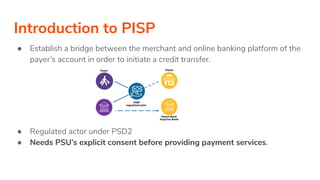
Introduction to PISP
● Establish a bridge between the merchant and online banking platform of the
payer’s account in order to initiate a credit transfer.
● Regulated actor under PSD2
● Needs PSU’s explicit consent before providing payment services.
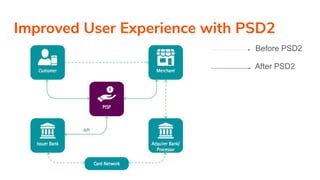
Improved User Experience with PSD2
Before PSD2
After PSD2
Payment Types
● Domestic Payments
● Domestic Scheduled Payments
● Domestic Standing Orders
● International Payments
● International Scheduled Payments
● International Standing Orders
● File Payments
Domestic Payments
● An instruction to ASPSP to make a one-off payment for a specific amount to
a specific payee.
● payment schemes
○ Single Immediate Payment (SIP) via Faster Payments
○ BACS
○ CHAPS
Domestic Scheduled Payments
PSUs can setup, through PISPs, an instruction to their ASPSPs to make a one-off
payment
● For a specific amount
● To a specific payee
● On a specific future date.
Domestic Standing Orders
PSUs can setup, through PISPs, an instruction to their ASPSPs to make a series
of payments
● Of a specific amount
● To a specific payee
● On a number of specified future dates
● Or on a regular basis.
International Payments
● PSUs can initiate, through PISPs, single international payments from their
GBP or foreign currency payment accounts.
● Payments can be made in any currency and to any country
International Scheduled Payments
PSUs can setup, through PISPs, an instruction to their ASPSPs to make a one-off
payment
● For a specific amount
● To a specific foreign payee account
● On a specific future date.
International Standing Orders
PSUs can setup, through PISPs, an instruction to their ASPSPs to make a series
of payments
● Of a specific amount
● To a specific foreign payee account
● On a number of specified future dates
● Or on a regular basis.
File Payments
● Allow PSU to make multiple payments from their payment accounts.
● Two type of Payments
○ Bulk payments
○ Batch payments
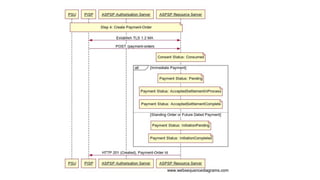
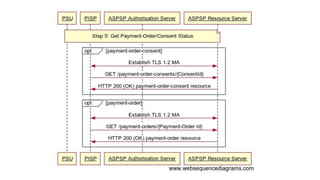
Payment API Resources
● Payment-Order Consent
○ POST /{Payment-Consent-Type}
○ GET /{Payment-Consent-Type}/{ConsentId}
● Payment-Order Resource
○ POST /{Payment-Type}
○ GET /{Payment-Type}/{PaymentId}
● In file payments there are additional resources.
○ POST /file-payment-consents/{ConsentId}/file
○ GET /file-payment-consents/{ConsentId}/file
○ GET /file-payments/{FilePaymentId}/report-file
● Funds Confirmation End Point for payments in UK Spec version 3.1.0
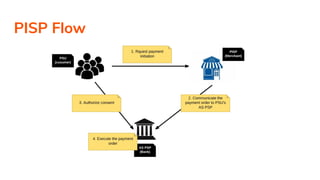
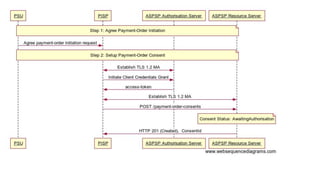
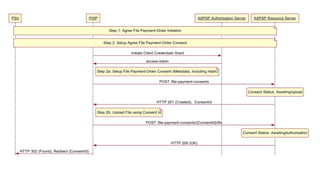
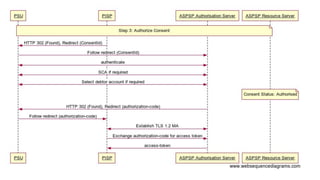
PISP Flow
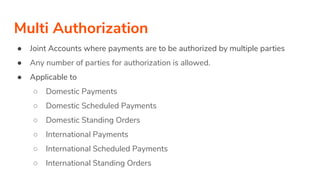
Multi Authorization
● Joint Accounts where payments are to be authorized by multiple parties
● Any number of parties for authorization is allowed.
● Applicable to
○ Domestic Payments
○ Domestic Scheduled Payments
○ Domestic Standing Orders
○ International Payments
○ International Scheduled Payments
○ International Standing Orders
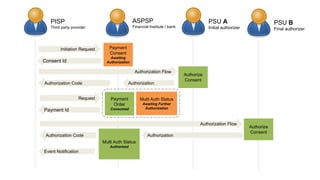
PISP
Third party provider
ASPSP
Financial Institute / bank
PSU A
Initial authorizer
PSU B
Final authorizer
Request Payment
Order
ConsumedPayment Id
Multi Auth Status
Awaiting Further
Authorization
Authorization Flow
Authorize
Consent
AuthorizationAuthorization Code
Event Notification
Multi Auth Status
Authorized
Initiation Request Payment
Consent
Awaiting
AuthorizationConsent Id
Authorization Flow
Authorize
Consent
AuthorizationAuthorization Code
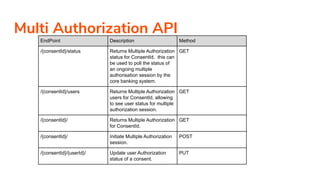
Multi Authorization API
EndPoint Description Method
/{consentId}/status Returns Multiple Authorization
status for ConsentId, this can
be used to poll the status of
an ongoing multiple
authorisation session by the
core banking system.
GET
/{consentId}/users Returns Multiple Authorization
users for ConsentId, allowing
to see user status for multiple
authorization session.
GET
/{consentId}/ Returns Multiple Authorization
for ConsentId.
GET
/{consentId}/ Initiate Multiple Authorization
session.
POST
/{consentId}/{userId}/ Update user Authorization
status of a consent.
PUT
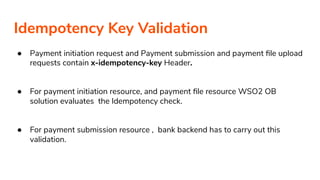
Idempotency Key Validation
● Payment initiation request and Payment submission and payment file upload
requests contain x-idempotency-key Header.
● For payment initiation resource, and payment file resource WSO2 OB
solution evaluates the Idempotency check.
● For payment submission resource , bank backend has to carry out this
validation.
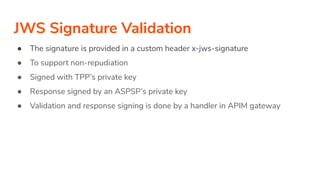
JWS Signature Validation
● The signature is provided in a custom header x-jws-signature
● To support non-repudiation
● Signed with TPP’s private key
● Response signed by an ASPSP’s private key
● Validation and response signing is done by a handler in APIM gateway
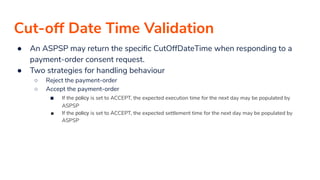
Cut-off Date Time Validation
● An ASPSP may return the specific CutOffDateTime when responding to a
payment-order consent request.
● Two strategies for handling behaviour
○ Reject the payment-order
○ Accept the payment-order
■ If the policy is set to ACCEPT, the expected execution time for the next day may be populated by
ASPSP
■ If the policy is set to ACCEPT, the expected settlement time for the next day may be populated by
ASPSP
Payment Restrictions
● The standard does not impose any restriction
● Each ASPSP must determine appropriate restrictions
○ The maximum InstructedAmount allowable
○ The domestic-standing-order Frequency patterns supported
○ The maximum future date on a scheduled-payment
● In case a payment order consent violates any of these restrictions ASPSP
must reject the the request
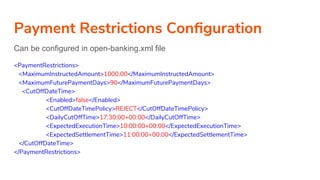
Payment Restrictions Configuration
Can be configured in open-banking.xml file
<PaymentRestrictions>
<MaximumInstructedAmount>1000.00</MaximumInstructedAmount>
<MaximumFuturePaymentDays>90</MaximumFuturePaymentDays>
<CutOffDateTime>
<Enabled>false</Enabled>
<CutOffDateTimePolicy>REJECT</CutOffDateTimePolicy>
<DailyCutOffTime>17:30:00+00:00</DailyCutOffTime>
<ExpectedExecutionTime>10:00:00+00:00</ExpectedExecutionTime>
<ExpectedSettlementTime>11:00:00+00:00</ExpectedSettlementTime>
</CutOffDateTime>
</PaymentRestrictions>
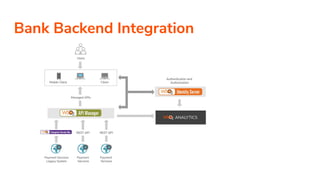
Bank Backend Integration
Mainly the following APIs of core banking system need to integrated with WSO2
Open banking solution in order to support PISP flow.
● Payment Submission APIs
● Payment Retrieval APIs
● Payable Accounts API
Multi-Authorization API of WSO2 OB Solution to allows bank backend to request
multi authorization related information
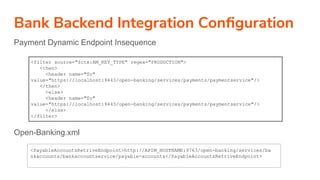
Bank Backend Integration Configuration
Payment Dynamic Endpoint Insequence
Open-Banking.xml
<filter source="$ctx:AM_KEY_TYPE" regex="PRODUCTION">
<then>
<header name="To"
value="https://localhost:9443/open-banking/services/payments/paymentservice"/>
</then>
<else>
<header name="To"
value="https://localhost:9443/open-banking/services/payments/paymentservice"/>
</else>
</filter>
<PayableAccountsRetriveEndpoint>http://APIM_HOSTNAME:9763/open-banking/services/ba
nkaccounts/bankaccountservice/payable-accounts</PayableAccountsRetriveEndpoint>
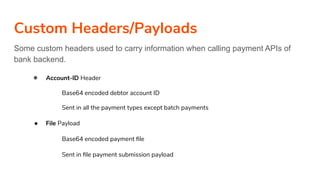
Custom Headers/Payloads
Some custom headers used to carry information when calling payment APIs of
bank backend.
● Account-ID Header
Base64 encoded debtor account ID
Sent in all the payment types except batch payments
● File Payload
Base64 encoded payment file
Sent in file payment submission payload
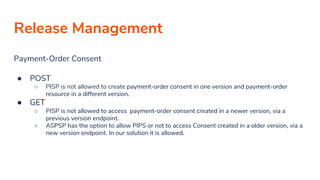
Release Management
Payment-Order Consent
● POST
○ PISP is not allowed to create payment-order consent in one version and payment-order
resource in a different version.
● GET
○ PISP is not allowed to access payment-order consent created in a newer version, via a
previous version endpoint.
○ ASPSP has the option to allow PIPS or not to access Consent created in a older version, via a
new version endpoint. In our solution it is allowed.
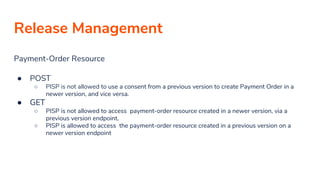
Release Management
Payment-Order Resource
● POST
○ PISP is not allowed to use a consent from a previous version to create Payment Order in a
newer version, and vice versa.
● GET
○ PISP is not allowed to access payment-order resource created in a newer version, via a
previous version endpoint.
○ PISP is allowed to access the payment-order resource created in a previous version on a
newer version endpoint
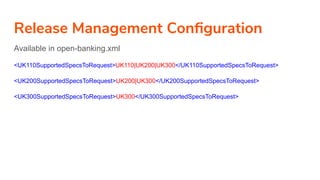
Release Management Configuration
Available in open-banking.xml
<UK110SupportedSpecsToRequest>UK110|UK200|UK300</UK110SupportedSpecsToRequest>
<UK200SupportedSpecsToRequest>UK200|UK300</UK200SupportedSpecsToRequest>
<UK300SupportedSpecsToRequest>UK300</UK300SupportedSpecsToRequest>
Additional Resources
More Information http://wso2.com/solutions/financial/open-banking/
Documentation https://docs.wso2.com/display/OB130/WSO2+Open+Banking
Try out WSO2 Open Banking https://openbanking.wso2.com
Get in Touch openbankingdemo@wso2.com
Solution RoadMap
Open Banking and PSD2: Are your APIs ready for external testing?
Meeting the March 2019 PSD2 Compliance Deadline with WSO2 Open Banking
THANK YOU
wso2.com

PISP Journey Based on Open Banking UK

  • 1.
    PISP Journey BasedOn Open Banking UK Charitha Deshapriya Senior Software Engineer WSO2 Open Banking Team
  • 2.
    Agenda ● Introduction toPISP ● Different Payment Types ● API Resources ● PISP Flow ● Multi Authorization ● Idempotency Key Validation ● JWS Signature Validation ● Cut-off Date Time ● Payment Restrictions ● Integrating with the Bank Backend ● Release Management
  • 3.
    Introduction to PISP ●Establish a bridge between the merchant and online banking platform of the payer’s account in order to initiate a credit transfer. ● Regulated actor under PSD2 ● Needs PSU’s explicit consent before providing payment services.
  • 4.
    Improved User Experiencewith PSD2 Before PSD2 After PSD2
  • 5.
    Payment Types ● DomesticPayments ● Domestic Scheduled Payments ● Domestic Standing Orders ● International Payments ● International Scheduled Payments ● International Standing Orders ● File Payments
  • 6.
    Domestic Payments ● Aninstruction to ASPSP to make a one-off payment for a specific amount to a specific payee. ● payment schemes ○ Single Immediate Payment (SIP) via Faster Payments ○ BACS ○ CHAPS
  • 7.
    Domestic Scheduled Payments PSUscan setup, through PISPs, an instruction to their ASPSPs to make a one-off payment ● For a specific amount ● To a specific payee ● On a specific future date.
  • 8.
    Domestic Standing Orders PSUscan setup, through PISPs, an instruction to their ASPSPs to make a series of payments ● Of a specific amount ● To a specific payee ● On a number of specified future dates ● Or on a regular basis.
  • 9.
    International Payments ● PSUscan initiate, through PISPs, single international payments from their GBP or foreign currency payment accounts. ● Payments can be made in any currency and to any country
  • 10.
    International Scheduled Payments PSUscan setup, through PISPs, an instruction to their ASPSPs to make a one-off payment ● For a specific amount ● To a specific foreign payee account ● On a specific future date.
  • 11.
    International Standing Orders PSUscan setup, through PISPs, an instruction to their ASPSPs to make a series of payments ● Of a specific amount ● To a specific foreign payee account ● On a number of specified future dates ● Or on a regular basis.
  • 12.
    File Payments ● AllowPSU to make multiple payments from their payment accounts. ● Two type of Payments ○ Bulk payments ○ Batch payments
  • 13.
    Payment API Resources ●Payment-Order Consent ○ POST /{Payment-Consent-Type} ○ GET /{Payment-Consent-Type}/{ConsentId} ● Payment-Order Resource ○ POST /{Payment-Type} ○ GET /{Payment-Type}/{PaymentId} ● In file payments there are additional resources. ○ POST /file-payment-consents/{ConsentId}/file ○ GET /file-payment-consents/{ConsentId}/file ○ GET /file-payments/{FilePaymentId}/report-file ● Funds Confirmation End Point for payments in UK Spec version 3.1.0
  • 14.
  • 20.
    Multi Authorization ● JointAccounts where payments are to be authorized by multiple parties ● Any number of parties for authorization is allowed. ● Applicable to ○ Domestic Payments ○ Domestic Scheduled Payments ○ Domestic Standing Orders ○ International Payments ○ International Scheduled Payments ○ International Standing Orders
  • 21.
    PISP Third party provider ASPSP FinancialInstitute / bank PSU A Initial authorizer PSU B Final authorizer Request Payment Order ConsumedPayment Id Multi Auth Status Awaiting Further Authorization Authorization Flow Authorize Consent AuthorizationAuthorization Code Event Notification Multi Auth Status Authorized Initiation Request Payment Consent Awaiting AuthorizationConsent Id Authorization Flow Authorize Consent AuthorizationAuthorization Code
  • 22.
    Multi Authorization API EndPointDescription Method /{consentId}/status Returns Multiple Authorization status for ConsentId, this can be used to poll the status of an ongoing multiple authorisation session by the core banking system. GET /{consentId}/users Returns Multiple Authorization users for ConsentId, allowing to see user status for multiple authorization session. GET /{consentId}/ Returns Multiple Authorization for ConsentId. GET /{consentId}/ Initiate Multiple Authorization session. POST /{consentId}/{userId}/ Update user Authorization status of a consent. PUT
  • 23.
    Idempotency Key Validation ●Payment initiation request and Payment submission and payment file upload requests contain x-idempotency-key Header. ● For payment initiation resource, and payment file resource WSO2 OB solution evaluates the Idempotency check. ● For payment submission resource , bank backend has to carry out this validation.
  • 24.
    JWS Signature Validation ●The signature is provided in a custom header x-jws-signature ● To support non-repudiation ● Signed with TPP’s private key ● Response signed by an ASPSP’s private key ● Validation and response signing is done by a handler in APIM gateway
  • 25.
    Cut-off Date TimeValidation ● An ASPSP may return the specific CutOffDateTime when responding to a payment-order consent request. ● Two strategies for handling behaviour ○ Reject the payment-order ○ Accept the payment-order ■ If the policy is set to ACCEPT, the expected execution time for the next day may be populated by ASPSP ■ If the policy is set to ACCEPT, the expected settlement time for the next day may be populated by ASPSP
  • 26.
    Payment Restrictions ● Thestandard does not impose any restriction ● Each ASPSP must determine appropriate restrictions ○ The maximum InstructedAmount allowable ○ The domestic-standing-order Frequency patterns supported ○ The maximum future date on a scheduled-payment ● In case a payment order consent violates any of these restrictions ASPSP must reject the the request
  • 27.
    Payment Restrictions Configuration Canbe configured in open-banking.xml file <PaymentRestrictions> <MaximumInstructedAmount>1000.00</MaximumInstructedAmount> <MaximumFuturePaymentDays>90</MaximumFuturePaymentDays> <CutOffDateTime> <Enabled>false</Enabled> <CutOffDateTimePolicy>REJECT</CutOffDateTimePolicy> <DailyCutOffTime>17:30:00+00:00</DailyCutOffTime> <ExpectedExecutionTime>10:00:00+00:00</ExpectedExecutionTime> <ExpectedSettlementTime>11:00:00+00:00</ExpectedSettlementTime> </CutOffDateTime> </PaymentRestrictions>
  • 28.
  • 29.
    Bank Backend Integration Mainlythe following APIs of core banking system need to integrated with WSO2 Open banking solution in order to support PISP flow. ● Payment Submission APIs ● Payment Retrieval APIs ● Payable Accounts API Multi-Authorization API of WSO2 OB Solution to allows bank backend to request multi authorization related information
  • 30.
    Bank Backend IntegrationConfiguration Payment Dynamic Endpoint Insequence Open-Banking.xml <filter source="$ctx:AM_KEY_TYPE" regex="PRODUCTION"> <then> <header name="To" value="https://localhost:9443/open-banking/services/payments/paymentservice"/> </then> <else> <header name="To" value="https://localhost:9443/open-banking/services/payments/paymentservice"/> </else> </filter> <PayableAccountsRetriveEndpoint>http://APIM_HOSTNAME:9763/open-banking/services/ba nkaccounts/bankaccountservice/payable-accounts</PayableAccountsRetriveEndpoint>
  • 31.
    Custom Headers/Payloads Some customheaders used to carry information when calling payment APIs of bank backend. ● Account-ID Header Base64 encoded debtor account ID Sent in all the payment types except batch payments ● File Payload Base64 encoded payment file Sent in file payment submission payload
  • 32.
    Release Management Payment-Order Consent ●POST ○ PISP is not allowed to create payment-order consent in one version and payment-order resource in a different version. ● GET ○ PISP is not allowed to access payment-order consent created in a newer version, via a previous version endpoint. ○ ASPSP has the option to allow PIPS or not to access Consent created in a older version, via a new version endpoint. In our solution it is allowed.
  • 33.
    Release Management Payment-Order Resource ●POST ○ PISP is not allowed to use a consent from a previous version to create Payment Order in a newer version, and vice versa. ● GET ○ PISP is not allowed to access payment-order resource created in a newer version, via a previous version endpoint. ○ PISP is allowed to access the payment-order resource created in a previous version on a newer version endpoint
  • 34.
    Release Management Configuration Availablein open-banking.xml <UK110SupportedSpecsToRequest>UK110|UK200|UK300</UK110SupportedSpecsToRequest> <UK200SupportedSpecsToRequest>UK200|UK300</UK200SupportedSpecsToRequest> <UK300SupportedSpecsToRequest>UK300</UK300SupportedSpecsToRequest>
  • 35.
    Additional Resources More Informationhttp://wso2.com/solutions/financial/open-banking/ Documentation https://docs.wso2.com/display/OB130/WSO2+Open+Banking Try out WSO2 Open Banking https://openbanking.wso2.com Get in Touch openbankingdemo@wso2.com Solution RoadMap Open Banking and PSD2: Are your APIs ready for external testing? Meeting the March 2019 PSD2 Compliance Deadline with WSO2 Open Banking
  • 36.