An Introduction
to Financial
Technology
Fintech, simplified
FinTech...
What to Know
What is Financial Technology or FinTech?
Banking Before and After FinTech
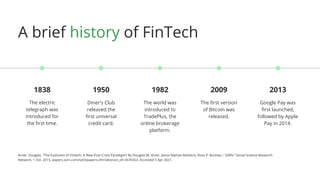
A brief history of FinTech
Challenges of FinTech
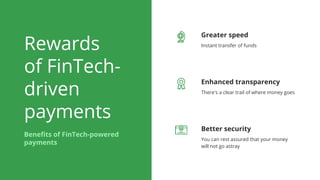
Rewards of FinTech-driven payments
What's next for FinTech?
What is Financial
Technology or
FinTech?
A combination of the words "financial" and "technology,"
FinTech is the catch-all term that applies to any technology
that helps consumers or financial institutions deliver
financial services in a novel, more convenient way.
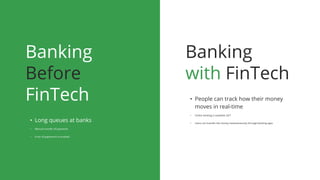
Banking
Before
FinTech
• Long queues at banks
• Manual transfer of payments
• A ton of paperwork is involved
Banking
with FinTech
• People can track how their money
moves in real-time
• Online banking is available 24/7
• Users can transfer the money instantaneously through banking apps
1950
Diner's Club
released the
first universal
credit card.
1838
The electric
telegraph was
introduced for
the first time.
1982
The world was
introduced to
TradePlus, the
online brokerage
platform.
2009
The first version
of Bitcoin was
released.
2013
Google Pay was
first launched,
followed by Apple
Pay in 2014.
Arner, Douglas. “The Evolution of Fintech: A New Post-Crisis Paradigm? By Douglas W. Arner, Janos Nathan Barberis, Ross P. Buckley :: SSRN.” Social Science Research
Network, 1 Oct. 2015, papers.ssrn.com/sol3/papers.cfm?abstract_id=2676553. Accessed 5 Apr 2021.
A brief history of FinTech
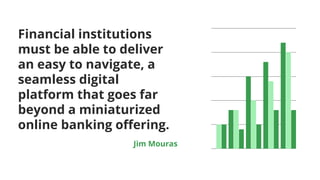
Financial institutions
must be able to deliver
an easy to navigate, a
seamless digital
platform that goes far
beyond a miniaturized
online banking offering.
Jim Mouras
The Role of
Cybersecurity
in FinTech
Because there's a lot of sensitive information involved in banking,
cybersecurity is non-negotiable. Financial institutions must have
robust cybersecurity measures to protect the data of consumers.
Protecting data is crucial
Challenges
of FinTech
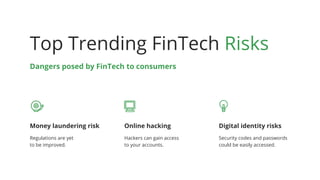
Top Trending FinTech Risks
Dangers posed by FinTech to consumers
Digital identity risks
Security codes and passwords
could be easily accessed.
Money laundering risk
Regulations are yet
to be improved.
Online hacking
Hackers can gain access
to your accounts.
Rewards
of FinTech-
driven
payments
Benefits of FinTech-powered
payments
Greater speed
Instant transfer of funds
Enhanced transparency
There's a clear trail of where money goes
Better security
You can rest assured that your money
will not go astray
What's next
for FinTech?
Artificial intelligence and machine learning
will further infiltrate and improve FinTech.
Looking forward to the future
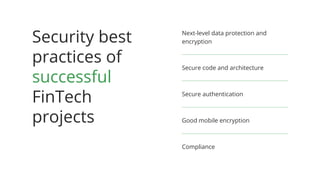
Security best
practices of
successful
FinTech
projects
Next-level data protection and
encryption
Secure code and architecture
Secure authentication
Good mobile encryption
Compliance
Technology companies can source
financing from several sources
including angels and angel
networks, by borrowing against
SRED claims or SaaS revenue,
Venture Capital, Subordinated Debt,
and Private Equity.
Ibtahaj Hashmi
Exuture Comsulting
Do you
have any
questions?
Send it to us! We hope you learned
something new.

Fintech Simplified

  • 1.
  • 2.
    FinTech... What to Know Whatis Financial Technology or FinTech? Banking Before and After FinTech A brief history of FinTech Challenges of FinTech Rewards of FinTech-driven payments What's next for FinTech?
  • 3.
    What is Financial Technologyor FinTech? A combination of the words "financial" and "technology," FinTech is the catch-all term that applies to any technology that helps consumers or financial institutions deliver financial services in a novel, more convenient way.
  • 4.
    Banking Before FinTech • Long queuesat banks • Manual transfer of payments • A ton of paperwork is involved Banking with FinTech • People can track how their money moves in real-time • Online banking is available 24/7 • Users can transfer the money instantaneously through banking apps
  • 5.
    1950 Diner's Club released the firstuniversal credit card. 1838 The electric telegraph was introduced for the first time. 1982 The world was introduced to TradePlus, the online brokerage platform. 2009 The first version of Bitcoin was released. 2013 Google Pay was first launched, followed by Apple Pay in 2014. Arner, Douglas. “The Evolution of Fintech: A New Post-Crisis Paradigm? By Douglas W. Arner, Janos Nathan Barberis, Ross P. Buckley :: SSRN.” Social Science Research Network, 1 Oct. 2015, papers.ssrn.com/sol3/papers.cfm?abstract_id=2676553. Accessed 5 Apr 2021. A brief history of FinTech
  • 6.
    Financial institutions must beable to deliver an easy to navigate, a seamless digital platform that goes far beyond a miniaturized online banking offering. Jim Mouras
  • 7.
    The Role of Cybersecurity inFinTech Because there's a lot of sensitive information involved in banking, cybersecurity is non-negotiable. Financial institutions must have robust cybersecurity measures to protect the data of consumers. Protecting data is crucial
  • 8.
  • 9.
    Top Trending FinTechRisks Dangers posed by FinTech to consumers Digital identity risks Security codes and passwords could be easily accessed. Money laundering risk Regulations are yet to be improved. Online hacking Hackers can gain access to your accounts.
  • 10.
    Rewards of FinTech- driven payments Benefits ofFinTech-powered payments Greater speed Instant transfer of funds Enhanced transparency There's a clear trail of where money goes Better security You can rest assured that your money will not go astray
  • 11.
    What's next for FinTech? Artificialintelligence and machine learning will further infiltrate and improve FinTech. Looking forward to the future
  • 12.
    Security best practices of successful FinTech projects Next-leveldata protection and encryption Secure code and architecture Secure authentication Good mobile encryption Compliance
  • 13.
    Technology companies cansource financing from several sources including angels and angel networks, by borrowing against SRED claims or SaaS revenue, Venture Capital, Subordinated Debt, and Private Equity. Ibtahaj Hashmi Exuture Comsulting
  • 14.
    Do you have any questions? Sendit to us! We hope you learned something new.