Ashley Bunch, Felicia Manoliu, Olinda Marcano, Meghan Molloy, Henry Snyder, and Nina Zhang
Pace University, Lienhard School of Nursing
BACKGROUND
Change Process
EBP Recommendations
Search Strategies Methods for Implementation of
Proposed Practice Change
Implementing the “no interruption zone” and the usage of
the red vests will require the cooperation and help from:
• the administration and hospital educator and the need to
purchase the red tape and red vests.
• The hospital educator would educate the nurses on the
unit, doctors, nursing aides, the administration, and
housekeeping of the importance of following the
protocols for the “no interruption zone” and the red vest.
• The educator would also educate the staff that the red
tape placed on the floors are put there for a reason and
should not be removed or damaged in any way.
PICO Question
Among adult patients on a medical surgical unit, does
implementation of a “no interruption zone” as well as
the use of a red vest reduce the number of medication
errors as opposed to the nursing staff that utilizes the
traditional method of medication administration?​
Review of Literature
Evaluation
References
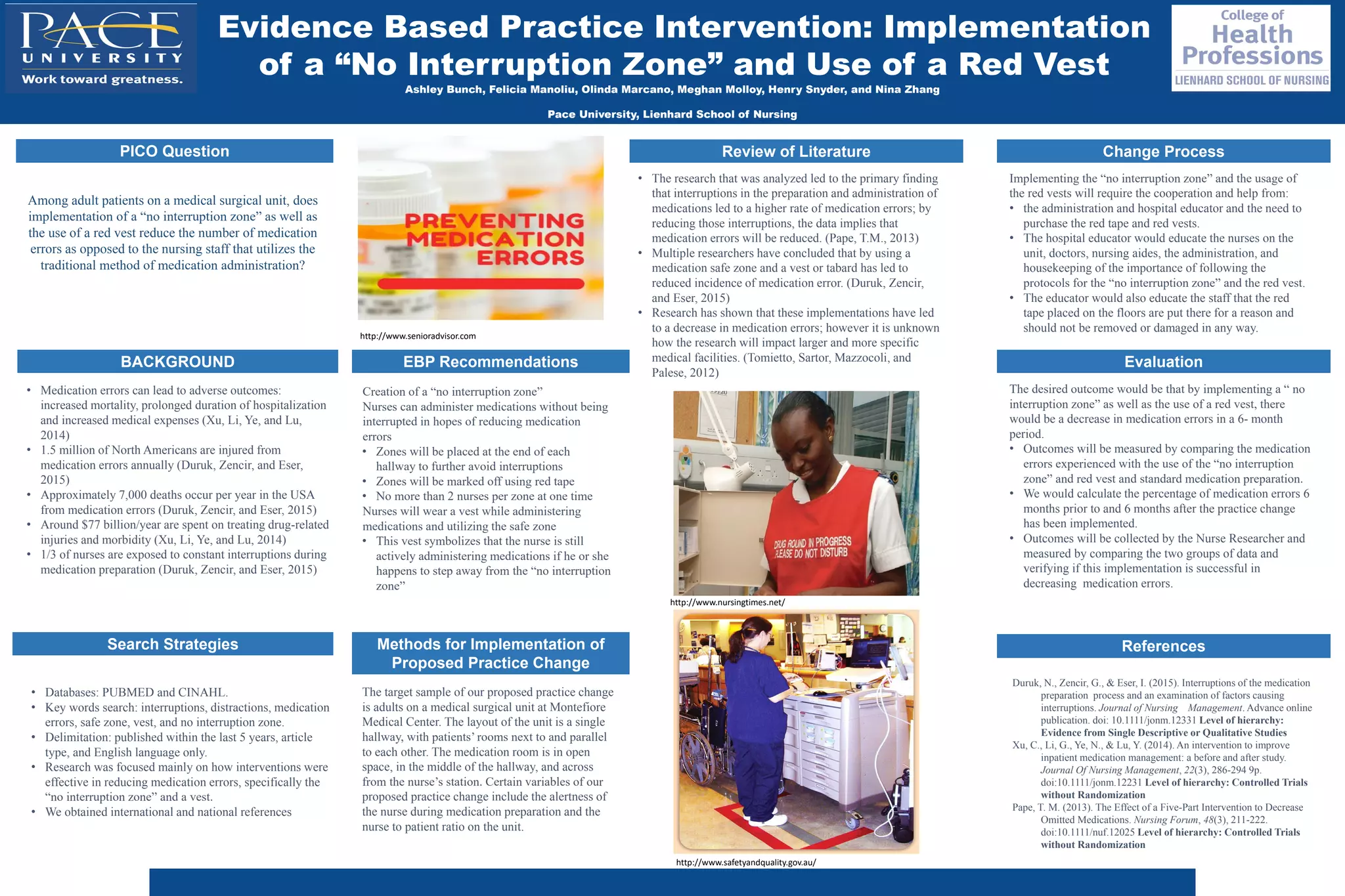
Creation of a “no interruption zone”
Nurses can administer medications without being
interrupted in hopes of reducing medication
errors
• Zones will be placed at the end of each
hallway to further avoid interruptions
• Zones will be marked off using red tape
• No more than 2 nurses per zone at one time
Nurses will wear a vest while administering
medications and utilizing the safe zone
• This vest symbolizes that the nurse is still
actively administering medications if he or she
happens to step away from the “no interruption
zone”
Evidence Based Practice Intervention: Implementation
of a “No Interruption Zone” and Use of a Red Vest
• Databases: PUBMED and CINAHL.
• Key words search: interruptions, distractions, medication
errors, safe zone, vest, and no interruption zone.
• Delimitation: published within the last 5 years, article
type, and English language only.
• Research was focused mainly on how interventions were
effective in reducing medication errors, specifically the
“no interruption zone” and a vest.
• We obtained international and national references
The target sample of our proposed practice change
is adults on a medical surgical unit at Montefiore
Medical Center. The layout of the unit is a single
hallway, with patients’ rooms next to and parallel
to each other. The medication room is in open
space, in the middle of the hallway, and across
from the nurse’s station. Certain variables of our
proposed practice change include the alertness of
the nurse during medication preparation and the
nurse to patient ratio on the unit.
• The research that was analyzed led to the primary finding
that interruptions in the preparation and administration of
medications led to a higher rate of medication errors; by
reducing those interruptions, the data implies that
medication errors will be reduced. (Pape, T.M., 2013)
• Multiple researchers have concluded that by using a
medication safe zone and a vest or tabard has led to
reduced incidence of medication error. (Duruk, Zencir,
and Eser, 2015)
• Research has shown that these implementations have led
to a decrease in medication errors; however it is unknown
how the research will impact larger and more specific
medical facilities. (Tomietto, Sartor, Mazzocoli, and
Palese, 2012)
The desired outcome would be that by implementing a “ no
interruption zone” as well as the use of a red vest, there
would be a decrease in medication errors in a 6- month
period.
• Outcomes will be measured by comparing the medication
errors experienced with the use of the “no interruption
zone” and red vest and standard medication preparation.
• We would calculate the percentage of medication errors 6
months prior to and 6 months after the practice change
has been implemented.
• Outcomes will be collected by the Nurse Researcher and
measured by comparing the two groups of data and
verifying if this implementation is successful in
decreasing medication errors.
Duruk, N., Zencir, G., & Eser, I. (2015). Interruptions of the medication
preparation process and an examination of factors causing
interruptions. Journal of Nursing Management. Advance online
publication. doi: 10.1111/jonm.12331 Level of hierarchy:
Evidence from Single Descriptive or Qualitative Studies
Xu, C., Li, G., Ye, N., & Lu, Y. (2014). An intervention to improve
inpatient medication management: a before and after study.
Journal Of Nursing Management, 22(3), 286-294 9p.
doi:10.1111/jonm.12231 Level of hierarchy: Controlled Trials
without Randomization
Pape, T. M. (2013). The Effect of a Five-Part Intervention to Decrease
Omitted Medications. Nursing Forum, 48(3), 211-222.
doi:10.1111/nuf.12025 Level of hierarchy: Controlled Trials
without Randomization
• Medication errors can lead to adverse outcomes:
increased mortality, prolonged duration of hospitalization
and increased medical expenses (Xu, Li, Ye, and Lu,
2014)
• 1.5 million of North Americans are injured from
medication errors annually (Duruk, Zencir, and Eser,
2015)
• Approximately 7,000 deaths occur per year in the USA
from medication errors (Duruk, Zencir, and Eser, 2015)
• Around $77 billion/year are spent on treating drug-related
injuries and morbidity (Xu, Li, Ye, and Lu, 2014)
• 1/3 of nurses are exposed to constant interruptions during
medication preparation (Duruk, Zencir, and Eser, 2015)
http://www.nursingtimes.net/
http://www.safetyandquality.gov.au/
http://www.senioradvisor.com

PIP-Medication Errors

  • 1.
    Ashley Bunch, FeliciaManoliu, Olinda Marcano, Meghan Molloy, Henry Snyder, and Nina Zhang Pace University, Lienhard School of Nursing BACKGROUND Change Process EBP Recommendations Search Strategies Methods for Implementation of Proposed Practice Change Implementing the “no interruption zone” and the usage of the red vests will require the cooperation and help from: • the administration and hospital educator and the need to purchase the red tape and red vests. • The hospital educator would educate the nurses on the unit, doctors, nursing aides, the administration, and housekeeping of the importance of following the protocols for the “no interruption zone” and the red vest. • The educator would also educate the staff that the red tape placed on the floors are put there for a reason and should not be removed or damaged in any way. PICO Question Among adult patients on a medical surgical unit, does implementation of a “no interruption zone” as well as the use of a red vest reduce the number of medication errors as opposed to the nursing staff that utilizes the traditional method of medication administration?​ Review of Literature Evaluation References Creation of a “no interruption zone” Nurses can administer medications without being interrupted in hopes of reducing medication errors • Zones will be placed at the end of each hallway to further avoid interruptions • Zones will be marked off using red tape • No more than 2 nurses per zone at one time Nurses will wear a vest while administering medications and utilizing the safe zone • This vest symbolizes that the nurse is still actively administering medications if he or she happens to step away from the “no interruption zone” Evidence Based Practice Intervention: Implementation of a “No Interruption Zone” and Use of a Red Vest • Databases: PUBMED and CINAHL. • Key words search: interruptions, distractions, medication errors, safe zone, vest, and no interruption zone. • Delimitation: published within the last 5 years, article type, and English language only. • Research was focused mainly on how interventions were effective in reducing medication errors, specifically the “no interruption zone” and a vest. • We obtained international and national references The target sample of our proposed practice change is adults on a medical surgical unit at Montefiore Medical Center. The layout of the unit is a single hallway, with patients’ rooms next to and parallel to each other. The medication room is in open space, in the middle of the hallway, and across from the nurse’s station. Certain variables of our proposed practice change include the alertness of the nurse during medication preparation and the nurse to patient ratio on the unit. • The research that was analyzed led to the primary finding that interruptions in the preparation and administration of medications led to a higher rate of medication errors; by reducing those interruptions, the data implies that medication errors will be reduced. (Pape, T.M., 2013) • Multiple researchers have concluded that by using a medication safe zone and a vest or tabard has led to reduced incidence of medication error. (Duruk, Zencir, and Eser, 2015) • Research has shown that these implementations have led to a decrease in medication errors; however it is unknown how the research will impact larger and more specific medical facilities. (Tomietto, Sartor, Mazzocoli, and Palese, 2012) The desired outcome would be that by implementing a “ no interruption zone” as well as the use of a red vest, there would be a decrease in medication errors in a 6- month period. • Outcomes will be measured by comparing the medication errors experienced with the use of the “no interruption zone” and red vest and standard medication preparation. • We would calculate the percentage of medication errors 6 months prior to and 6 months after the practice change has been implemented. • Outcomes will be collected by the Nurse Researcher and measured by comparing the two groups of data and verifying if this implementation is successful in decreasing medication errors. Duruk, N., Zencir, G., & Eser, I. (2015). Interruptions of the medication preparation process and an examination of factors causing interruptions. Journal of Nursing Management. Advance online publication. doi: 10.1111/jonm.12331 Level of hierarchy: Evidence from Single Descriptive or Qualitative Studies Xu, C., Li, G., Ye, N., & Lu, Y. (2014). An intervention to improve inpatient medication management: a before and after study. Journal Of Nursing Management, 22(3), 286-294 9p. doi:10.1111/jonm.12231 Level of hierarchy: Controlled Trials without Randomization Pape, T. M. (2013). The Effect of a Five-Part Intervention to Decrease Omitted Medications. Nursing Forum, 48(3), 211-222. doi:10.1111/nuf.12025 Level of hierarchy: Controlled Trials without Randomization • Medication errors can lead to adverse outcomes: increased mortality, prolonged duration of hospitalization and increased medical expenses (Xu, Li, Ye, and Lu, 2014) • 1.5 million of North Americans are injured from medication errors annually (Duruk, Zencir, and Eser, 2015) • Approximately 7,000 deaths occur per year in the USA from medication errors (Duruk, Zencir, and Eser, 2015) • Around $77 billion/year are spent on treating drug-related injuries and morbidity (Xu, Li, Ye, and Lu, 2014) • 1/3 of nurses are exposed to constant interruptions during medication preparation (Duruk, Zencir, and Eser, 2015) http://www.nursingtimes.net/ http://www.safetyandquality.gov.au/ http://www.senioradvisor.com