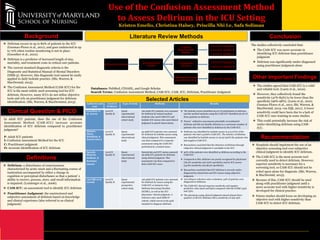
15 Research Articles
15 Quantitative
Articles
12 Quasi-
Experimental
Studies
2 Level II, Quality A
9 Level II, Quality B
1 Level II, Quality C
2 Systematic
Reviews
1 Level IV, Quality A
1 Level IV, Quality B
1 Retrospective non-
experimental study 1 Level III, Quality B
Use	
  of	
  the	
  Confusion	
  Assessment	
  Method	
  	
  
to	
  Assess	
  Delirium	
  in	
  the	
  ICU	
  Setting	
  
Kristen Emelio, Christina Halsey, Priscilla Nhi Le, Safa Soliman	


Background ConclusionLiterature Review Methods
Clinical Question & PICO
Definitions
Recommendation
In adult ICU patients, does the use of the Confusion
Assessment Method (CAM-ICU) increase accurate
identification of ICU delirium compared to practitioner
judgment?
 
P: Adult ICU patients
I: Confusion Assessment Method for the ICU
C: Practitioner judgment
O: Accurate identification of ICU delirium
v  Delirium occurs in up to 80% of patients in the ICU
(Gusmao-Flores et al., 2011), and goes undetected in up
to 72% when routine monitoring is not in place.
(Guenther et al., 2012).
v  Delirium is a predictor of increased length of stay,
mortality, and treatment costs in critical care patients.
v  The current standard diagnostic criteria is the
Diagnostic and Statistical Manual of Mental Disorders
(DSM-5). However, this diagnostic tool cannot be easily
applied to daily bedside practice. (Shi, Warren, &
MacDermid, 2013).
v  The Confusion Assessment Method (CAM-ICU) for the
ICU is the most widely used screening tool for ICU
delirium. However, many ICUs do not utilize objective
tools and rely on practitioner judgment for delirium
identification. (Shi, Warren, & MacDermind, 2013).
v  Delirium: a disturbance of consciousness
characterized by acute onset and a fluctuating course of
inattention accompanied by either a change in
cognition or perceptual disturbance so that a patient’s
ability to receive, process, store, and recall information
is impaired. (Lemiengre et al., 2006).
v  CAM-ICU: an assessment tool to identify ICU delirium
v  Practitioner Judgment: the unstructured and
subjective assessment of delirium based on knowledge
and clinical experience (also referred to as clinical
judgment)
Databases: PubMed, CINAHL, and Google Scholar
Search Terms: Confusion Assessment Method, CAM-ICU, CAM, ICU, Delirium, Practitioner Judgment
Author(s) and
year
Level of
Evidence
Type of study Methods Results
Guenther et
al. (2012)
Level II
Quality B.
Quasi-
experimental
observational
cohort study
 
160 adult ICU patients were assessed
for delirium by trained medical
students who used CAM-ICU and
bedside ICU nurses who used clinical
judgment in paired observations.
v  The bedside nurses identified 29.4% of participants as delirious,
and the medical students using the CAM-ICU identified 26.2% of
these patients as delirious.
v  Nurses’ subjective assessment potentially overestimated
delirium and did not identify delirium in a worrisome number of
patients who were identified as delirious by the CAM-ICU.
Mistarz,
Eliott,
Whitfield, &
Ernest (2011)
Level II
Quality B.
Quasi-
experimental
observational
study
35 adult ICU patients were assessed
for delirium by bedside nurses using
clinical judgment. This assessment
was then compared to a separate
assessment using the CAM-ICU
performed by a trained nurse.
v  Delirium was identified by bedside nurses in 3/5 (27%) of the
patients who had a positive CAM-ICU. The absence of delirium
was identified by bedside nurses in 22/30 (92%) the patients who
had negative CAM-ICU.
v  Researchers concluded that the detection of delirium through
subjective clinical judgment is unreliable in the ICU.
Spronk,
Riekerk,
Hofhuis, &
Rommes
(2009)
Level II
Quality B.
Quasi-
experimental
observational
study
Intensivists and ICU nurses assessed
46 adult ICU patients for delirium
using clinical judgment. This
assessment was then compared to
their CAM-ICU score.
v  50% of the patients were identified as delirious according to the
CAM-ICU.
v  Compared to this, delirium was poorly recognized by physicians
(28.0% sensitivity and 100% specificity) and by ICU nurses
(34.8% sensitivity and 98.3% specificity).
v  Researchers concluded that ICU delirium is severely under-
diagnosed by intensivists and ICU nurses using subjective
judgment.
van Eijk et al.
(2009)
Level II
Quality B.
Quasi-
experimental
prospective
cohort study
126 adult ICU patients were assessed
for delirium by nurses using the
CAM-ICU or Intensive Care
Delirium Screening Checklist
(ICDSC), as well as the ICU
physicians’ clinical judgment. A
reference rater used DSM-IV
criteria, which served as the gold
standard to diagnose delirium.
v  According to reference rater evaluation, 34% of patients were
diagnosed as delirious.
v  The CAM-ICU showed superior sensitivity and negative
predictive value (64% and 83%) compared with the ICDSC (43%
and 75%).
v  The physicians using clinical judgment missed almost three
quarters of all ICU delirium with a sensitivity of only 29%.
The studies collectively concluded that:
v  The CAM-ICU was more accurate in
identifying ICU delirium than practitioner
judgment
v  Delirium was significantly under-diagnosed
using practitioner judgment alone
v  The studies agreed that CAM-ICU is a valid
and reliable tool. (Luetz et al., 2010).
v  However, they collectively found the
sensitivity (47%-83%) to be lower than the
specificity (96%-98%). (Luetz et al., 2010;
Gusmao-Flores et al., 2011; Shi, Warren, &
MacDermid, 2013; van Eijk, 2011). A lower
sensitivity could have been due to a lack of
CAM-ICU user training in some studies.
v  This could potentially increase the risk of
under-identifying delirium using CAM-
ICU.
Other Important Findings
Selected Articles
v  Hospitals should implement the use of an
objective screening tool over subjective
clinical judgment to identify ICU delirium.
v  The CAM-ICU is the most accurate tool
currently used to detect delirium. However,
superior sensitivity is necessary for a
screening tool, so CAM-ICU should not be
relied upon alone for diagnosis. (Shi, Warren,
& MacDermid, 2013).
v  Because of this, CAM-ICU should be used
along with practitioner judgment until a
more accurate tool with higher sensitivity is
developed for clinical practice.
v  Future studies should focus on developing an
objective tool with higher sensitivity than
CAM-ICU to detect ICU delirium.

Final-PICO-Poster

  • 1.
    15 Research Articles 15Quantitative Articles 12 Quasi- Experimental Studies 2 Level II, Quality A 9 Level II, Quality B 1 Level II, Quality C 2 Systematic Reviews 1 Level IV, Quality A 1 Level IV, Quality B 1 Retrospective non- experimental study 1 Level III, Quality B Use  of  the  Confusion  Assessment  Method     to  Assess  Delirium  in  the  ICU  Setting   Kristen Emelio, Christina Halsey, Priscilla Nhi Le, Safa Soliman       Background ConclusionLiterature Review Methods Clinical Question & PICO Definitions Recommendation In adult ICU patients, does the use of the Confusion Assessment Method (CAM-ICU) increase accurate identification of ICU delirium compared to practitioner judgment?   P: Adult ICU patients I: Confusion Assessment Method for the ICU C: Practitioner judgment O: Accurate identification of ICU delirium v  Delirium occurs in up to 80% of patients in the ICU (Gusmao-Flores et al., 2011), and goes undetected in up to 72% when routine monitoring is not in place. (Guenther et al., 2012). v  Delirium is a predictor of increased length of stay, mortality, and treatment costs in critical care patients. v  The current standard diagnostic criteria is the Diagnostic and Statistical Manual of Mental Disorders (DSM-5). However, this diagnostic tool cannot be easily applied to daily bedside practice. (Shi, Warren, & MacDermid, 2013). v  The Confusion Assessment Method (CAM-ICU) for the ICU is the most widely used screening tool for ICU delirium. However, many ICUs do not utilize objective tools and rely on practitioner judgment for delirium identification. (Shi, Warren, & MacDermind, 2013). v  Delirium: a disturbance of consciousness characterized by acute onset and a fluctuating course of inattention accompanied by either a change in cognition or perceptual disturbance so that a patient’s ability to receive, process, store, and recall information is impaired. (Lemiengre et al., 2006). v  CAM-ICU: an assessment tool to identify ICU delirium v  Practitioner Judgment: the unstructured and subjective assessment of delirium based on knowledge and clinical experience (also referred to as clinical judgment) Databases: PubMed, CINAHL, and Google Scholar Search Terms: Confusion Assessment Method, CAM-ICU, CAM, ICU, Delirium, Practitioner Judgment Author(s) and year Level of Evidence Type of study Methods Results Guenther et al. (2012) Level II Quality B. Quasi- experimental observational cohort study   160 adult ICU patients were assessed for delirium by trained medical students who used CAM-ICU and bedside ICU nurses who used clinical judgment in paired observations. v  The bedside nurses identified 29.4% of participants as delirious, and the medical students using the CAM-ICU identified 26.2% of these patients as delirious. v  Nurses’ subjective assessment potentially overestimated delirium and did not identify delirium in a worrisome number of patients who were identified as delirious by the CAM-ICU. Mistarz, Eliott, Whitfield, & Ernest (2011) Level II Quality B. Quasi- experimental observational study 35 adult ICU patients were assessed for delirium by bedside nurses using clinical judgment. This assessment was then compared to a separate assessment using the CAM-ICU performed by a trained nurse. v  Delirium was identified by bedside nurses in 3/5 (27%) of the patients who had a positive CAM-ICU. The absence of delirium was identified by bedside nurses in 22/30 (92%) the patients who had negative CAM-ICU. v  Researchers concluded that the detection of delirium through subjective clinical judgment is unreliable in the ICU. Spronk, Riekerk, Hofhuis, & Rommes (2009) Level II Quality B. Quasi- experimental observational study Intensivists and ICU nurses assessed 46 adult ICU patients for delirium using clinical judgment. This assessment was then compared to their CAM-ICU score. v  50% of the patients were identified as delirious according to the CAM-ICU. v  Compared to this, delirium was poorly recognized by physicians (28.0% sensitivity and 100% specificity) and by ICU nurses (34.8% sensitivity and 98.3% specificity). v  Researchers concluded that ICU delirium is severely under- diagnosed by intensivists and ICU nurses using subjective judgment. van Eijk et al. (2009) Level II Quality B. Quasi- experimental prospective cohort study 126 adult ICU patients were assessed for delirium by nurses using the CAM-ICU or Intensive Care Delirium Screening Checklist (ICDSC), as well as the ICU physicians’ clinical judgment. A reference rater used DSM-IV criteria, which served as the gold standard to diagnose delirium. v  According to reference rater evaluation, 34% of patients were diagnosed as delirious. v  The CAM-ICU showed superior sensitivity and negative predictive value (64% and 83%) compared with the ICDSC (43% and 75%). v  The physicians using clinical judgment missed almost three quarters of all ICU delirium with a sensitivity of only 29%. The studies collectively concluded that: v  The CAM-ICU was more accurate in identifying ICU delirium than practitioner judgment v  Delirium was significantly under-diagnosed using practitioner judgment alone v  The studies agreed that CAM-ICU is a valid and reliable tool. (Luetz et al., 2010). v  However, they collectively found the sensitivity (47%-83%) to be lower than the specificity (96%-98%). (Luetz et al., 2010; Gusmao-Flores et al., 2011; Shi, Warren, & MacDermid, 2013; van Eijk, 2011). A lower sensitivity could have been due to a lack of CAM-ICU user training in some studies. v  This could potentially increase the risk of under-identifying delirium using CAM- ICU. Other Important Findings Selected Articles v  Hospitals should implement the use of an objective screening tool over subjective clinical judgment to identify ICU delirium. v  The CAM-ICU is the most accurate tool currently used to detect delirium. However, superior sensitivity is necessary for a screening tool, so CAM-ICU should not be relied upon alone for diagnosis. (Shi, Warren, & MacDermid, 2013). v  Because of this, CAM-ICU should be used along with practitioner judgment until a more accurate tool with higher sensitivity is developed for clinical practice. v  Future studies should focus on developing an objective tool with higher sensitivity than CAM-ICU to detect ICU delirium.