Ž .The Knee 9 2002 3᎐6
Patellar tendon length ᎏ the factor in patellar instability?
Ph. Neyreta,U
, A.H.N. Robinsonc
, B. Le Coultrea
, C. Laprab
, P. Chambatc
a
Departments of Orthopedics, Hopital de la Croix-Rousse, Centre Li¨et, 8 rue de Margnolles, 69300 Caluire, Franceˆ
b
Clinique Protestante, 1᎐3 Chemin du Penthod, 69300 Caluire, France
c
Clinique Sainte-Anne Lumiere, 85 crs Albert Thomas, 69003 Lyon, France`
Accepted 24 September 2001
Abstract
Patellar tendon length has been compared in 42 knees with a history of patellar dislocation, and 51 control knees. A lateral
Ž .X-ray and a magnetic resonance image MRI were taken of each knee. The mean radiological patellar tendon length was 46
mm in the controls and 53 mm in the dislocation group. From MRI images, the mean was 44 mm in controls and 52 mm in the
Ž .dislocation group. This means that the patellar tendon is significantly P-0.0001 longer in patients with a history of patellar
Ž .dislocation on both MRI and X-ray. There is no significant difference Ps0.52 between X-ray and MRI measurements of
tendon length. The distance between the tibial plateau and the point of tendon insertion was also measured and found to be
28 and 29 mm in the control and dislocation groups, respectively. There is no significant difference between these two
Ž .measures Ps0.19 . In conclusion, patella alta is caused by a long patellar tendon rather than a low insertion into the tibia.
Measuring the length of the patellar tendon using MRI is more specific and more sensitive than the Caton᎐Deschamps index
for patellar instability. ᮊ 2002 Elsevier Science B.V. All rights reserved.
Keywords: Patellar instability; Patellar tendon; Patellar dislocation
1. Introduction
There are four primary factors predisposing to
patellar instability, these are: trochlear dysplasia;
patellar tilt; tibial tubercle offset; and patellar height
w x4 . Of these factors all, except patellar height, are
directly measured or observed. Patella alta has also
been observed in 43% of patients in whom surgery for
w xpatellar instability has failed 8 . There are several
secondary factors that predispose to patellar instabil-
ity: femoral anteversion; genu valgum; genu recur-
Ž .vatum; or gender female , for example.
Patella height is expressed according to one of a
w xnumber of indirectly measured indices 2,3,6 . These
indices compare the length of the patella to other
radiological landmarks. Much controversy exists as to
U
Corresponding author. Tel.: q33-4-72-07-18-89.
Ž .E-mail address: philippe.neyret@chu-lyon.fr P. Neyret .
which of the many indices is the most appropriately
measured, furthermore, it has not yet been es-
tablished whether the cause of patella alta is simply a
long tendon, or a long tendon secondary to a low
insertion into the tibia.
The aim of this study was to measure the actual
length of the patellar tendon in a group of patients
with patellar instability, and compare this to the con-
trol knees. The patellar tendon length was measured
using both plain X-ray and MRI. The distance between
the tibial plateau and the tibial tuberosity was also
measured. The validity of MRI to determine indices
of patellar height has been determined.
2. Materials and methods
Ninety three knees in 72 patients were entered into
the study. There were 32 patients with 42 knees in the
0968-0160r02r$ - see front matter ᮊ 2002 Elsevier Science B.V. All rights reserved.
Ž .PII: S 0 9 6 8 - 0 1 6 0 0 1 0 0 1 3 6 - 3
( )P. Neyret et al. rThe Knee 9 2002 3᎐64
‘instability’ group. Instability was defined when a knee
had had one or more episodes of documented patellar
dislocation. In this group there were 17 women and
Ž21 right knees. The mean age was 25.4 years range
.16᎐48 years .
The ‘control’ group consisted of 51 knees in 50
patients. These patients were drawn from a group of
knees being investigated for other pathologies. Forty-
six knees had a possible meniscal tear and five an
anterior cruciate ligament injury. None of the control
group gave a history suggestive of patellar instability.
There were 28 women, and 29 right knees. The mean
Ž .age was 34.7 years range 15᎐58 .
The knees were all imaged using a plain lateral
radiograph, taken with the knee flexed to 10Њ. The
X-ray tube was positioned 1 m from the knee. The
patellar tendon length was measured according to the
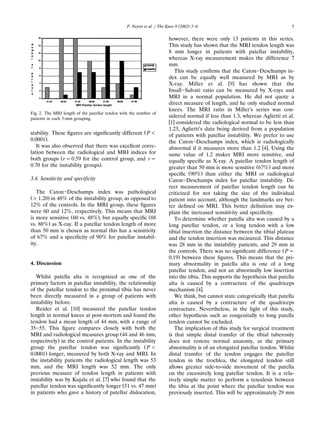
w x Ž .method of Insall and Salvati 6 Fig. 1b . The mea-
sured length was corrected for the magnification of
1.15. A further calculation was made of the distance
from the tibial plateau, to the tibial tuberosity. The
w x Ž .Caton᎐Deschamps 3 index was calculated Fig. 1a .
All knees also had an MRI of the knee performed.
The knee was flexed at 10Њ, and 2-mm sagittal cuts
were made. The patellar tendon length was measured
on the sagittal cut in which the longitudinal axis of
the patella was measured as being longest. All mea-
surements were made to the nearest millimeter. The
MRI scan measures were calculated directly from the
scan by computer.
All data were analyzed using a non-paired Student’s
t-test and the correlation coefficient ‘r’ calculated on
a Macintosh LC computer using logicel Instat.
3. Results
3.1. Tibial tuberosity height
Ž .This was measured as 28 mm S.D.s5 mm in the
Ž .instability group, and 29 mm S.D.s4 mm in the
control group. There was no significant difference
Ž .between these two figures Ps0.19 .
3.2. Patellar tendon length
The mean measured length of the patellar tendon
Ž .on X-ray was 53 mm ranges40᎐69, S.D.s7 in the
Ž .controls, and 61 mm ranges50᎐78, S.D.s7 in the
instability patients. After correction for the magnifi-
Ž .cation of 1.15, these figures are 46 ranges35᎐61 ,
Ž .and 53 mm ranges44᎐68 , respectively. This repre-
Ž .sents a significant difference P-0.0001 between
the two groups.
The MRI measurements of the knees also shows a
Žsignificant difference between the two groups P-
Ž .Fig. 1. a The Caton᎐Deschamps ratio is the distance from the
anterior border of the tibia to the most distal surface of the patella
divided by the length of the patellar subchondral bone. This ratio
Ž .should be between 0.8 and 1.2. b With the Insall᎐Salvati ratio, the
diagonal length of the patella should be equal to the length of the
patellar tendon "20%, and the ratio LTrLP-1.3 according to
w xMiller et al. 9 .
.0.0001 . The mean patellar tendon length was 44 mm
Ž .ranges32᎐62, S.D.s7 in the control group, and 52
Ž .mm ranges39᎐61, S.D.s6 in the instability group.
The MRI and radiological measurements were not
Ž .significantly different Ps0.52 .
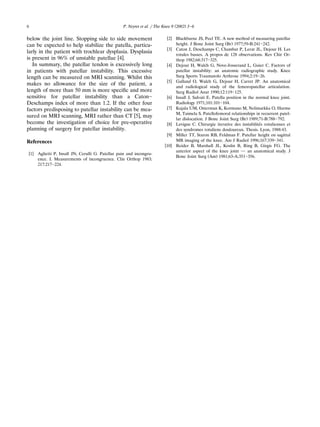
The distribution of the MRI patellar tendon lengths
in the two groups is shown in Fig. 2.
3.3. Index measurements
Ž .There is a significant difference P-0.0001 in the
radiological Caton᎐Deschamps index between the
Ž .control group means1.03, S.D.s0.17 and instabil-
Ž .ity groups means1.19, S.D.s0.20 .
Similarly, the mean Caton᎐Deschamps index mea-
Žsured by MRI in the control group was 1.03 S.D.s
. Ž .0.13 and 1.24 S.D.s0.18 in the patients with in-
( )P. Neyret et al. rThe Knee 9 2002 3᎐6 5
Fig. 2. The MRI length of the patellar tendon with the number of
patients in each 5-mm grouping.
Žstability. These figures are significantly different P-
.0.0001 .
It was also observed that there was excellent corre-
lation between the radiological and MRI indices for
Žboth groups rs0.59 for the control group, and rs
.0.70 for the instability groups .
3.4. Sensiti¨ity and specificity
The Caton᎐Deschamps index was pathological
Ž .)1.20 in 48% of the instability group, as opposed to
12% of the controls. In the MRI group, these figures
were 60 and 12%, respectively. This means that MRI
Ž . Žis more sensitive 60 vs. 48% , but equally specific 88
.vs. 88% as X-ray. If a patellar tendon length of more
than 50 mm is chosen as normal this has a sensitivity
of 67% and a specificity of 90% for patellar instabil-
ity.
4. Discussion
Whilst patella alta is recognized as one of the
primary factors in patellar instability, the relationship
of the patellar tendon to the proximal tibia has never
been directly measured in a group of patients with
instability before.
w xReider et al. 10 measured the patellar tendon
length in normal knees at post-mortem and found the
tendon had a mean length of 44 mm, with a range of
35᎐55. This figure compares closely with both the
ŽMRI and radiological measures group 44 and 46 mm,
.respectively in the control patients. In the instability
Žgroup the patellar tendon was significantly P-
.0.0001 longer, measured by both X-ray and MRI. In
the instability patients the radiological length was 53
mm, and the MRI length was 52 mm. The only
previous measure of tendon length in patients with
w xinstability was by Kujala et al. 7 who found that the
Ž .patellar tendon was significantly longer 51 vs. 47 mm
in patients who gave a history of patellar dislocation,
however, there were only 13 patients in this series.
This study has shown that the MRI tendon length was
8 mm longer in patients with patellar instability,
whereas X-ray measurement makes the difference 7
mm.
This study confirms that the Caton᎐Deschamps in-
dex can be equally well measured by MRI as by
w xX-ray. Miller et al. 9 has shown that the
Insall᎐Salvati ratio can be measured by X-rays and
MRI in a normal population. He did not quote a
direct measure of length, and he only studied normal
knees. The MRI ratio in Miller’s series was con-
sidered normal if less than 1.3, whereas Aglietti et al.
w x1 considered the radiological normal to be less than
1.23, Aglietti’s data being derived from a population
of patients with patellar instability. We prefer to use
the Caton᎐Deschamps index, which is radiologically
w xabnormal if it measures more than 1.2 4 . Using the
same value of 1.2 makes MRI more sensitive, and
equally specific as X-ray. A patellar tendon length of
Ž .greater than 50 mm is more sensitive 67% and more
Ž .specific 90% than either the MRI or radiological
Caton᎐Deschamps index for patellar instability. Di-
rect measurement of patellar tendon length can be
criticized for not taking the size of the individual
patient into account, although the landmarks are bet-
ter defined on MRI. This better definition may ex-
plain the increased sensitivity and specificity.
To determine whether patella alta was caused by a
long patellar tendon, or a long tendon with a low
tibial insertion the distance between the tibial plateau
and the tendon insertion was measured. This distance
was 28 mm in the instability patients, and 29 mm in
Žthe controls. There was no significant difference Ps
.0.19 between these figures. This means that the pri-
mary abnormality in patella alta is one of a long
patellar tendon, and not an abnormally low insertion
into the tibia. This supports the hypothesis that patella
alta is caused by a contracture of the quadriceps
w xmechanism 4 .
We think, but cannot state categorically that patella
alta is caused by a contracture of the quadriceps
contracture. Nevertheless, in the light of this study,
other hypothesis such as congenitally to long patella
tendon cannot be excluded.
The implication of this study for surgical treatment
is that simple distal transfer of the tibial tuberosity
does not restore normal anatomy, as the primary
abnormality is of an elongated patellar tendon. Whilst
distal transfer of the tendon engages the patellar
tendon in the trochlea, the elongated tendon still
allows greater side-to-side movement of the patella
on the excessively long patellar tendon. It is a rela-
tively simple matter to perform a tenodesis between
the tibia at the point where the patellar tendon was
previously inserted. This will be approximately 29 mm
( )P. Neyret et al. rThe Knee 9 2002 3᎐66
below the joint line. Stopping side to side movement
can be expected to help stabilize the patella, particu-
larly in the patient with trochlear dysplasia. Dysplasia
w xis present in 96% of unstable patellae 4 .
In summary, the patellar tendon is excessively long
in patients with patellar instability. This excessive
length can be measured on MRI scanning. Whilst this
makes no allowance for the size of the patient, a
length of more than 50 mm is more specific and more
sensitive for patellar instability than a Caton᎐
Deschamps index of more than 1.2. If the other four
factors predisposing to patellar instability can be mea-
w xsured on MRI scanning, MRI rather than CT 5 , may
become the investigation of choice for pre-operative
planning of surgery for patellar instability.
References
w x1 Aglietti P, Insall JN, Cerulli G. Patellar pain and incongru-
ence. I. Measurements of incongruence. Clin Orthop 1983;
217:217᎐224.
w x2 Blackburne JS, Peel TE. A new method of measuring patellar
Ž .height. J Bone Joint Surg Br 1977;59-B:241᎐242.
w x3 Caton J, Deschamps C, Chambat P, Lerat JL, Dejour H. Les
rotules basses. A propos de 128 observations. Rev Chir Or-
thop 1982;68:317᎐325.
w x4 Dejour H, Walch G, Nove-Josserand L, Guier C. Factors of
patellar instability: an anatomic radiographic study. Knee
Surg Sports Traumatolo Arthrosc 1994;2:19᎐26.
w x5 Galland O, Walch G, Dejour H, Carret JP. An anatomical
and radiological study of the femoropatellar articulation.
Surg Radiol Anat 1990;12:119᎐125.
w x6 Insall J, Salvati E. Patella position in the normal knee joint.
Radiology 1971;101:101᎐104.
w x7 Kujala UM, Osterman K, Kormano M, Nelimarkka O, Hurme
M, Taimela S. Patellofemoral relationships in recurrent patel-
Ž .lar dislocation. J Bone Joint Surg Br 1989;71-B:788᎐792.
w x8 Levigne C. Chirurgie iterative des instabilites rotuliennes et´
des syndromes rotuliens douloureux. Thesis. Lyon, 1988:43.
w x9 Miller TT, Staron RB, Feldman F. Patellar height on sagittal
MR imaging of the knee. Am J Radiol 1996;167:339᎐341.
w x10 Reider B, Marshall JL, Koslin B, Ring B, Girgis FG. The
anterior aspect of the knee joint ᎏ an anatomical study. J
Ž .Bone Joint Surg Am 1981;63-A:351᎐356.

Piis0968016001001363

  • 1.
    Ž .The Knee9 2002 3᎐6 Patellar tendon length ᎏ the factor in patellar instability? Ph. Neyreta,U , A.H.N. Robinsonc , B. Le Coultrea , C. Laprab , P. Chambatc a Departments of Orthopedics, Hopital de la Croix-Rousse, Centre Li¨et, 8 rue de Margnolles, 69300 Caluire, Franceˆ b Clinique Protestante, 1᎐3 Chemin du Penthod, 69300 Caluire, France c Clinique Sainte-Anne Lumiere, 85 crs Albert Thomas, 69003 Lyon, France` Accepted 24 September 2001 Abstract Patellar tendon length has been compared in 42 knees with a history of patellar dislocation, and 51 control knees. A lateral Ž .X-ray and a magnetic resonance image MRI were taken of each knee. The mean radiological patellar tendon length was 46 mm in the controls and 53 mm in the dislocation group. From MRI images, the mean was 44 mm in controls and 52 mm in the Ž .dislocation group. This means that the patellar tendon is significantly P-0.0001 longer in patients with a history of patellar Ž .dislocation on both MRI and X-ray. There is no significant difference Ps0.52 between X-ray and MRI measurements of tendon length. The distance between the tibial plateau and the point of tendon insertion was also measured and found to be 28 and 29 mm in the control and dislocation groups, respectively. There is no significant difference between these two Ž .measures Ps0.19 . In conclusion, patella alta is caused by a long patellar tendon rather than a low insertion into the tibia. Measuring the length of the patellar tendon using MRI is more specific and more sensitive than the Caton᎐Deschamps index for patellar instability. ᮊ 2002 Elsevier Science B.V. All rights reserved. Keywords: Patellar instability; Patellar tendon; Patellar dislocation 1. Introduction There are four primary factors predisposing to patellar instability, these are: trochlear dysplasia; patellar tilt; tibial tubercle offset; and patellar height w x4 . Of these factors all, except patellar height, are directly measured or observed. Patella alta has also been observed in 43% of patients in whom surgery for w xpatellar instability has failed 8 . There are several secondary factors that predispose to patellar instabil- ity: femoral anteversion; genu valgum; genu recur- Ž .vatum; or gender female , for example. Patella height is expressed according to one of a w xnumber of indirectly measured indices 2,3,6 . These indices compare the length of the patella to other radiological landmarks. Much controversy exists as to U Corresponding author. Tel.: q33-4-72-07-18-89. Ž .E-mail address: philippe.neyret@chu-lyon.fr P. Neyret . which of the many indices is the most appropriately measured, furthermore, it has not yet been es- tablished whether the cause of patella alta is simply a long tendon, or a long tendon secondary to a low insertion into the tibia. The aim of this study was to measure the actual length of the patellar tendon in a group of patients with patellar instability, and compare this to the con- trol knees. The patellar tendon length was measured using both plain X-ray and MRI. The distance between the tibial plateau and the tibial tuberosity was also measured. The validity of MRI to determine indices of patellar height has been determined. 2. Materials and methods Ninety three knees in 72 patients were entered into the study. There were 32 patients with 42 knees in the 0968-0160r02r$ - see front matter ᮊ 2002 Elsevier Science B.V. All rights reserved. Ž .PII: S 0 9 6 8 - 0 1 6 0 0 1 0 0 1 3 6 - 3
  • 2.
    ( )P. Neyretet al. rThe Knee 9 2002 3᎐64 ‘instability’ group. Instability was defined when a knee had had one or more episodes of documented patellar dislocation. In this group there were 17 women and Ž21 right knees. The mean age was 25.4 years range .16᎐48 years . The ‘control’ group consisted of 51 knees in 50 patients. These patients were drawn from a group of knees being investigated for other pathologies. Forty- six knees had a possible meniscal tear and five an anterior cruciate ligament injury. None of the control group gave a history suggestive of patellar instability. There were 28 women, and 29 right knees. The mean Ž .age was 34.7 years range 15᎐58 . The knees were all imaged using a plain lateral radiograph, taken with the knee flexed to 10Њ. The X-ray tube was positioned 1 m from the knee. The patellar tendon length was measured according to the w x Ž .method of Insall and Salvati 6 Fig. 1b . The mea- sured length was corrected for the magnification of 1.15. A further calculation was made of the distance from the tibial plateau, to the tibial tuberosity. The w x Ž .Caton᎐Deschamps 3 index was calculated Fig. 1a . All knees also had an MRI of the knee performed. The knee was flexed at 10Њ, and 2-mm sagittal cuts were made. The patellar tendon length was measured on the sagittal cut in which the longitudinal axis of the patella was measured as being longest. All mea- surements were made to the nearest millimeter. The MRI scan measures were calculated directly from the scan by computer. All data were analyzed using a non-paired Student’s t-test and the correlation coefficient ‘r’ calculated on a Macintosh LC computer using logicel Instat. 3. Results 3.1. Tibial tuberosity height Ž .This was measured as 28 mm S.D.s5 mm in the Ž .instability group, and 29 mm S.D.s4 mm in the control group. There was no significant difference Ž .between these two figures Ps0.19 . 3.2. Patellar tendon length The mean measured length of the patellar tendon Ž .on X-ray was 53 mm ranges40᎐69, S.D.s7 in the Ž .controls, and 61 mm ranges50᎐78, S.D.s7 in the instability patients. After correction for the magnifi- Ž .cation of 1.15, these figures are 46 ranges35᎐61 , Ž .and 53 mm ranges44᎐68 , respectively. This repre- Ž .sents a significant difference P-0.0001 between the two groups. The MRI measurements of the knees also shows a Žsignificant difference between the two groups P- Ž .Fig. 1. a The Caton᎐Deschamps ratio is the distance from the anterior border of the tibia to the most distal surface of the patella divided by the length of the patellar subchondral bone. This ratio Ž .should be between 0.8 and 1.2. b With the Insall᎐Salvati ratio, the diagonal length of the patella should be equal to the length of the patellar tendon "20%, and the ratio LTrLP-1.3 according to w xMiller et al. 9 . .0.0001 . The mean patellar tendon length was 44 mm Ž .ranges32᎐62, S.D.s7 in the control group, and 52 Ž .mm ranges39᎐61, S.D.s6 in the instability group. The MRI and radiological measurements were not Ž .significantly different Ps0.52 . The distribution of the MRI patellar tendon lengths in the two groups is shown in Fig. 2. 3.3. Index measurements Ž .There is a significant difference P-0.0001 in the radiological Caton᎐Deschamps index between the Ž .control group means1.03, S.D.s0.17 and instabil- Ž .ity groups means1.19, S.D.s0.20 . Similarly, the mean Caton᎐Deschamps index mea- Žsured by MRI in the control group was 1.03 S.D.s . Ž .0.13 and 1.24 S.D.s0.18 in the patients with in-
  • 3.
    ( )P. Neyretet al. rThe Knee 9 2002 3᎐6 5 Fig. 2. The MRI length of the patellar tendon with the number of patients in each 5-mm grouping. Žstability. These figures are significantly different P- .0.0001 . It was also observed that there was excellent corre- lation between the radiological and MRI indices for Žboth groups rs0.59 for the control group, and rs .0.70 for the instability groups . 3.4. Sensiti¨ity and specificity The Caton᎐Deschamps index was pathological Ž .)1.20 in 48% of the instability group, as opposed to 12% of the controls. In the MRI group, these figures were 60 and 12%, respectively. This means that MRI Ž . Žis more sensitive 60 vs. 48% , but equally specific 88 .vs. 88% as X-ray. If a patellar tendon length of more than 50 mm is chosen as normal this has a sensitivity of 67% and a specificity of 90% for patellar instabil- ity. 4. Discussion Whilst patella alta is recognized as one of the primary factors in patellar instability, the relationship of the patellar tendon to the proximal tibia has never been directly measured in a group of patients with instability before. w xReider et al. 10 measured the patellar tendon length in normal knees at post-mortem and found the tendon had a mean length of 44 mm, with a range of 35᎐55. This figure compares closely with both the ŽMRI and radiological measures group 44 and 46 mm, .respectively in the control patients. In the instability Žgroup the patellar tendon was significantly P- .0.0001 longer, measured by both X-ray and MRI. In the instability patients the radiological length was 53 mm, and the MRI length was 52 mm. The only previous measure of tendon length in patients with w xinstability was by Kujala et al. 7 who found that the Ž .patellar tendon was significantly longer 51 vs. 47 mm in patients who gave a history of patellar dislocation, however, there were only 13 patients in this series. This study has shown that the MRI tendon length was 8 mm longer in patients with patellar instability, whereas X-ray measurement makes the difference 7 mm. This study confirms that the Caton᎐Deschamps in- dex can be equally well measured by MRI as by w xX-ray. Miller et al. 9 has shown that the Insall᎐Salvati ratio can be measured by X-rays and MRI in a normal population. He did not quote a direct measure of length, and he only studied normal knees. The MRI ratio in Miller’s series was con- sidered normal if less than 1.3, whereas Aglietti et al. w x1 considered the radiological normal to be less than 1.23, Aglietti’s data being derived from a population of patients with patellar instability. We prefer to use the Caton᎐Deschamps index, which is radiologically w xabnormal if it measures more than 1.2 4 . Using the same value of 1.2 makes MRI more sensitive, and equally specific as X-ray. A patellar tendon length of Ž .greater than 50 mm is more sensitive 67% and more Ž .specific 90% than either the MRI or radiological Caton᎐Deschamps index for patellar instability. Di- rect measurement of patellar tendon length can be criticized for not taking the size of the individual patient into account, although the landmarks are bet- ter defined on MRI. This better definition may ex- plain the increased sensitivity and specificity. To determine whether patella alta was caused by a long patellar tendon, or a long tendon with a low tibial insertion the distance between the tibial plateau and the tendon insertion was measured. This distance was 28 mm in the instability patients, and 29 mm in Žthe controls. There was no significant difference Ps .0.19 between these figures. This means that the pri- mary abnormality in patella alta is one of a long patellar tendon, and not an abnormally low insertion into the tibia. This supports the hypothesis that patella alta is caused by a contracture of the quadriceps w xmechanism 4 . We think, but cannot state categorically that patella alta is caused by a contracture of the quadriceps contracture. Nevertheless, in the light of this study, other hypothesis such as congenitally to long patella tendon cannot be excluded. The implication of this study for surgical treatment is that simple distal transfer of the tibial tuberosity does not restore normal anatomy, as the primary abnormality is of an elongated patellar tendon. Whilst distal transfer of the tendon engages the patellar tendon in the trochlea, the elongated tendon still allows greater side-to-side movement of the patella on the excessively long patellar tendon. It is a rela- tively simple matter to perform a tenodesis between the tibia at the point where the patellar tendon was previously inserted. This will be approximately 29 mm
  • 4.
    ( )P. Neyretet al. rThe Knee 9 2002 3᎐66 below the joint line. Stopping side to side movement can be expected to help stabilize the patella, particu- larly in the patient with trochlear dysplasia. Dysplasia w xis present in 96% of unstable patellae 4 . In summary, the patellar tendon is excessively long in patients with patellar instability. This excessive length can be measured on MRI scanning. Whilst this makes no allowance for the size of the patient, a length of more than 50 mm is more specific and more sensitive for patellar instability than a Caton᎐ Deschamps index of more than 1.2. If the other four factors predisposing to patellar instability can be mea- w xsured on MRI scanning, MRI rather than CT 5 , may become the investigation of choice for pre-operative planning of surgery for patellar instability. References w x1 Aglietti P, Insall JN, Cerulli G. Patellar pain and incongru- ence. I. Measurements of incongruence. Clin Orthop 1983; 217:217᎐224. w x2 Blackburne JS, Peel TE. A new method of measuring patellar Ž .height. J Bone Joint Surg Br 1977;59-B:241᎐242. w x3 Caton J, Deschamps C, Chambat P, Lerat JL, Dejour H. Les rotules basses. A propos de 128 observations. Rev Chir Or- thop 1982;68:317᎐325. w x4 Dejour H, Walch G, Nove-Josserand L, Guier C. Factors of patellar instability: an anatomic radiographic study. Knee Surg Sports Traumatolo Arthrosc 1994;2:19᎐26. w x5 Galland O, Walch G, Dejour H, Carret JP. An anatomical and radiological study of the femoropatellar articulation. Surg Radiol Anat 1990;12:119᎐125. w x6 Insall J, Salvati E. Patella position in the normal knee joint. Radiology 1971;101:101᎐104. w x7 Kujala UM, Osterman K, Kormano M, Nelimarkka O, Hurme M, Taimela S. Patellofemoral relationships in recurrent patel- Ž .lar dislocation. J Bone Joint Surg Br 1989;71-B:788᎐792. w x8 Levigne C. Chirurgie iterative des instabilites rotuliennes et´ des syndromes rotuliens douloureux. Thesis. Lyon, 1988:43. w x9 Miller TT, Staron RB, Feldman F. Patellar height on sagittal MR imaging of the knee. Am J Radiol 1996;167:339᎐341. w x10 Reider B, Marshall JL, Koslin B, Ring B, Girgis FG. The anterior aspect of the knee joint ᎏ an anatomical study. J Ž .Bone Joint Surg Am 1981;63-A:351᎐356.