Evaluation of Stabilization failure
in Thoracolumber spine
Dr. Md. Shafiul Alam
Dr. Ferdous Ara Islam
NINS&H
Introduction
Stabilization of Thoracolumber, Lumber and
Lumbosacral spine is a common surgical
procedures. This surgery become more
popular in our country for last two decades.
Stabilization by transpedicular screws and
rods through posterior approach are
preferred.
Indications of stabilization were
• Traumatic fracture
• Osteoporotic fracture
• Primary bone lession
• Secondaries in the spine
• Tuberculosis of the spine
• Spondylolisthesis
• Failure of transpedicular screws and rods are
not uncommon. Now it is a challenging
surgical issue.
• The purpose of study was to find out the
causes of failure and ways to avoid it as much
as possible.
Materials and Methods
Study Design
It was a retrospective study.
Study Period
January 2007 to December 2015
Patient selection criteria
All patient of stabilization of Thoracolumber,
Lumber and Lumbosacral spine by pedicle
screws and rods for different indications were
included in this study.
Evaluation of the patient
Implant status was assessed on the basis on
Intra-operative
immediate post-operative
and follow up X-Ray findings.
The mean duration of follow up was 2 years.
Range, 1month -3 years.
Implant failure and radiological analysis
• The postoperative plain radiological studies
includes the standard A/P and Lat. Views.
• Successful fusion was determined by
evaluating the radiographs for the presence
bridging bone between the fused segments.
The radiographs were interpreted for
– Manifestation of failure of fixation
– Effect of implant failure
– The point of implant failure
– Screw length and diameter
– Rod length and diameter
– Status of bone graft
The common complications were seen
– Screw misplacement
– Breakage of screws
– Breakage of rods
– Loosening of screws and rods
Results
Total No. of cases : 93
Male : 61
Female : 32
61
32
Sex
Male
Female
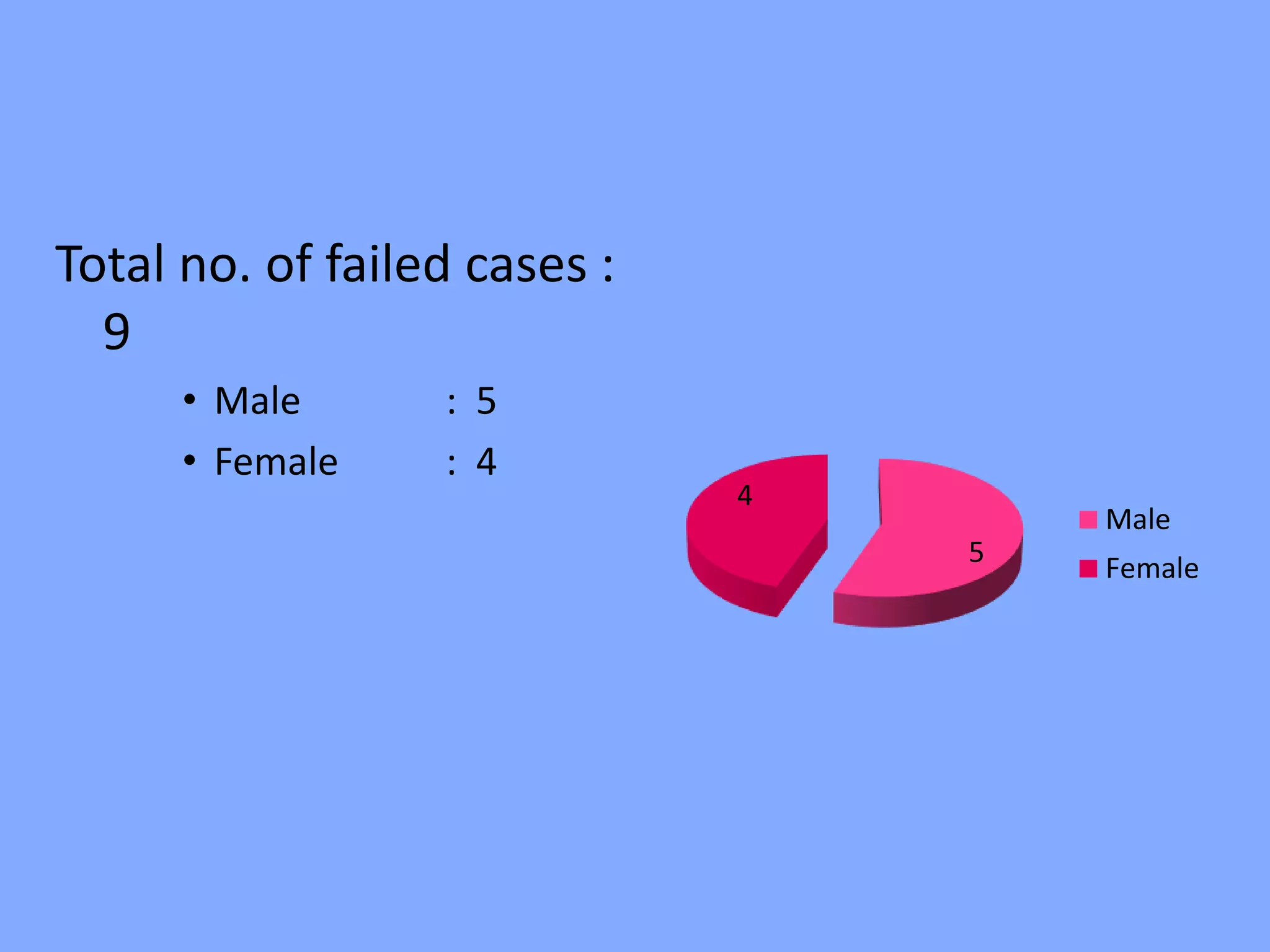
Total no. of failed cases :
9
• Male : 5
• Female : 4
5
4
Male
Female
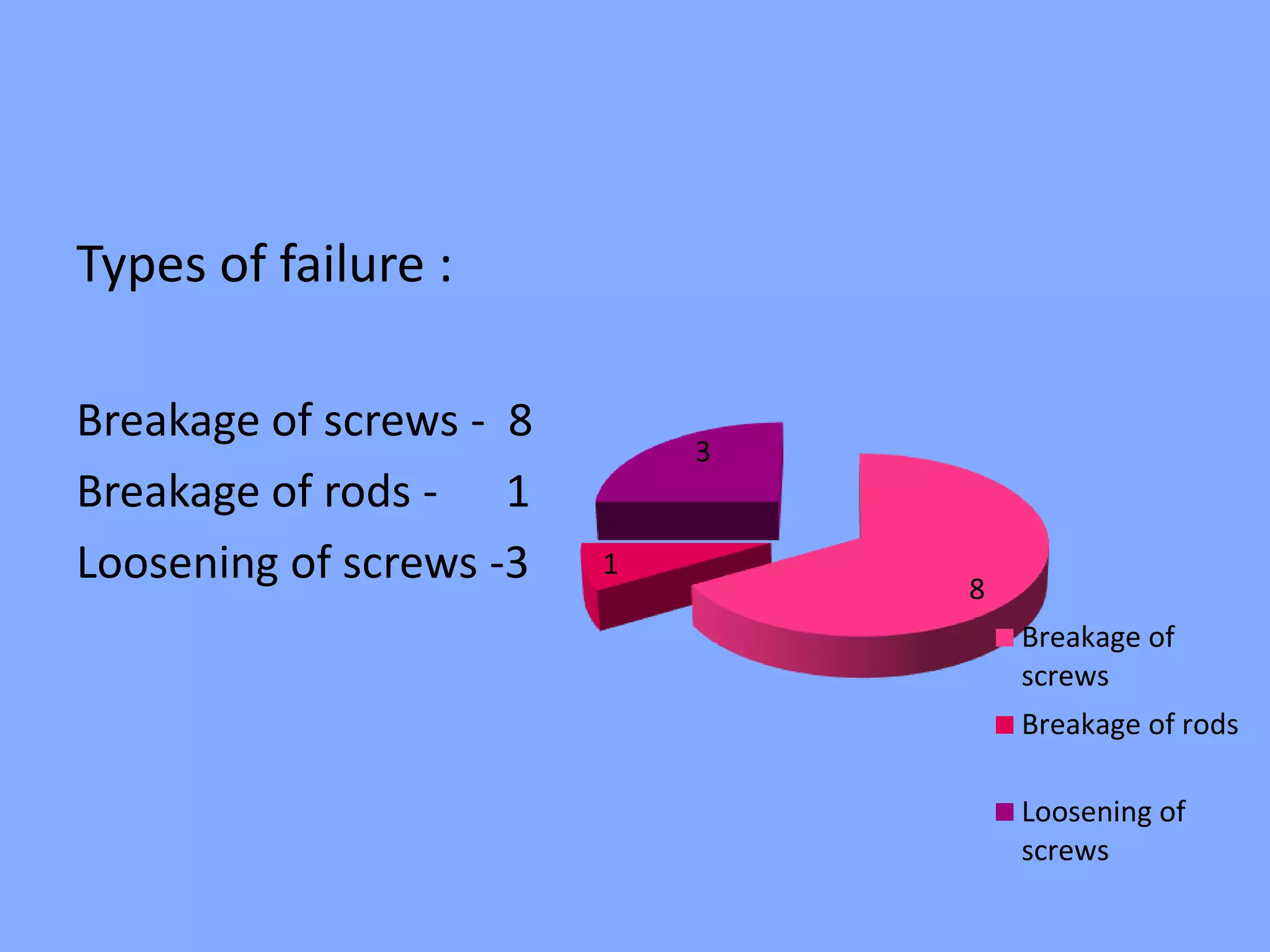
Types of failure :
Breakage of screws - 8
Breakage of rods - 1
Loosening of screws -3 8
1
3
Breakage of
screws
Breakage of rods
Loosening of
screws
Probable causes of implant failure
• Absence of adequate bone graft
• Failure to bone fusion
• Poor surgical technique
• Use less diameter screws
• Poor quality of implants
• Inadequate rest after surgery
• Trauma after surgery
• Short fixation
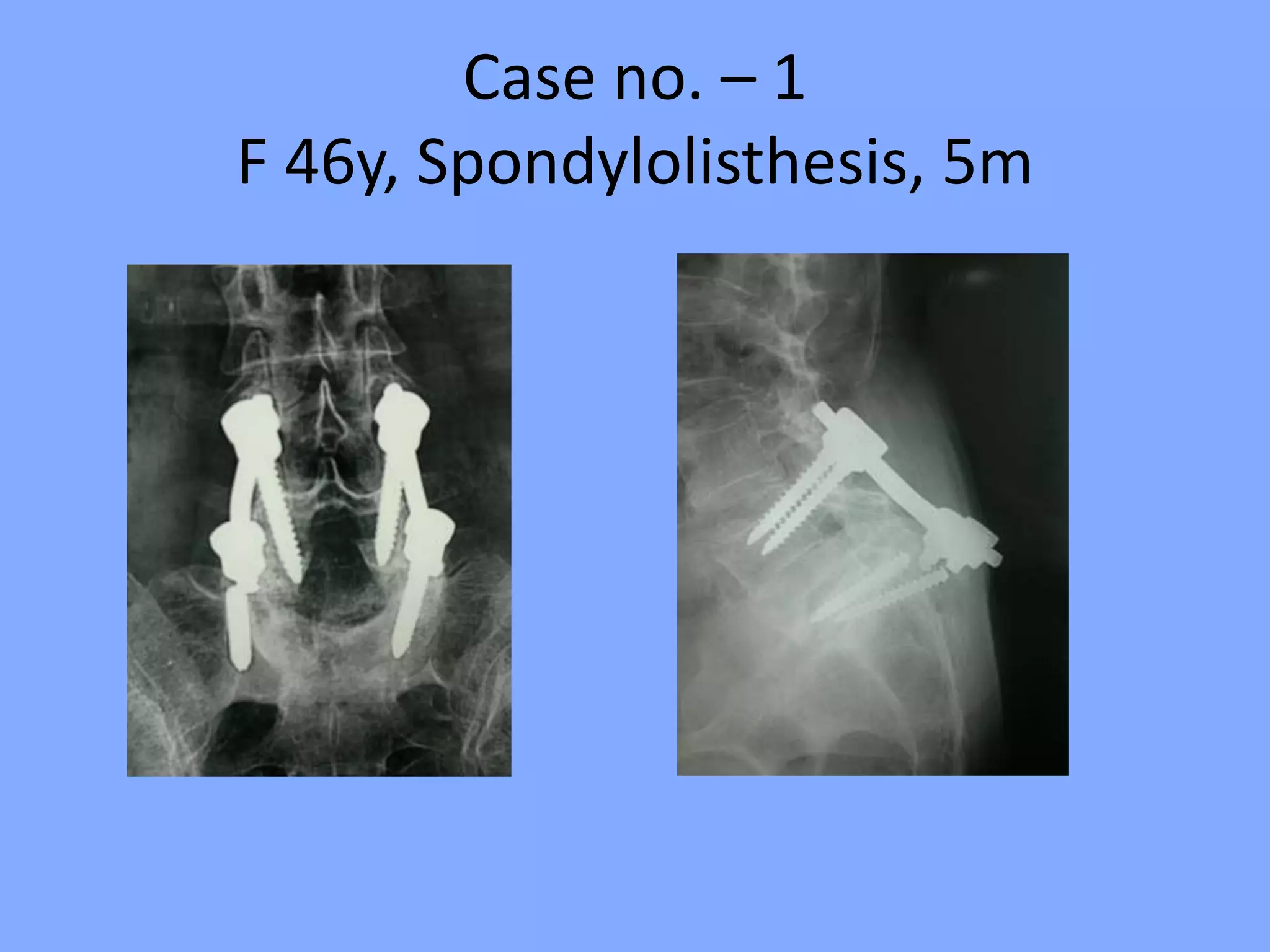
Case no. – 1
F 46y, Spondylolisthesis, 5m
Case no. – 2
M 52y, HOF, 8m
Case no. – 3
F 43y, Spondylolisthesis, 3m
Case no. – 4
M 35, FFH, 12m
Case no. – 5
M 25y, RTA, 7m
Case no. – 6
F 52y, Osteoporotic, 12m
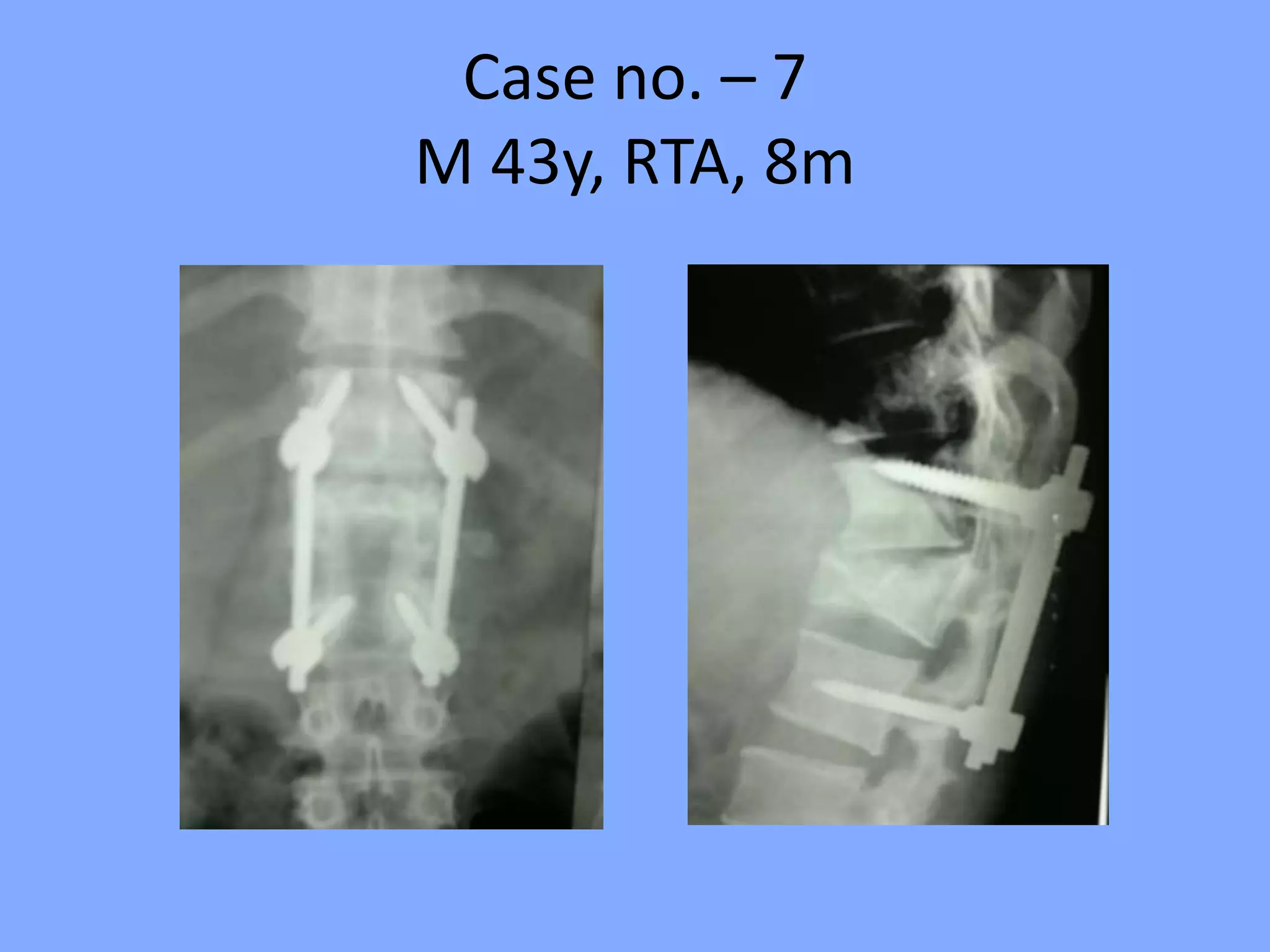
Case no. – 7
M 43y, RTA, 8m
Case no. – 8
M 32y, FFH, 6m
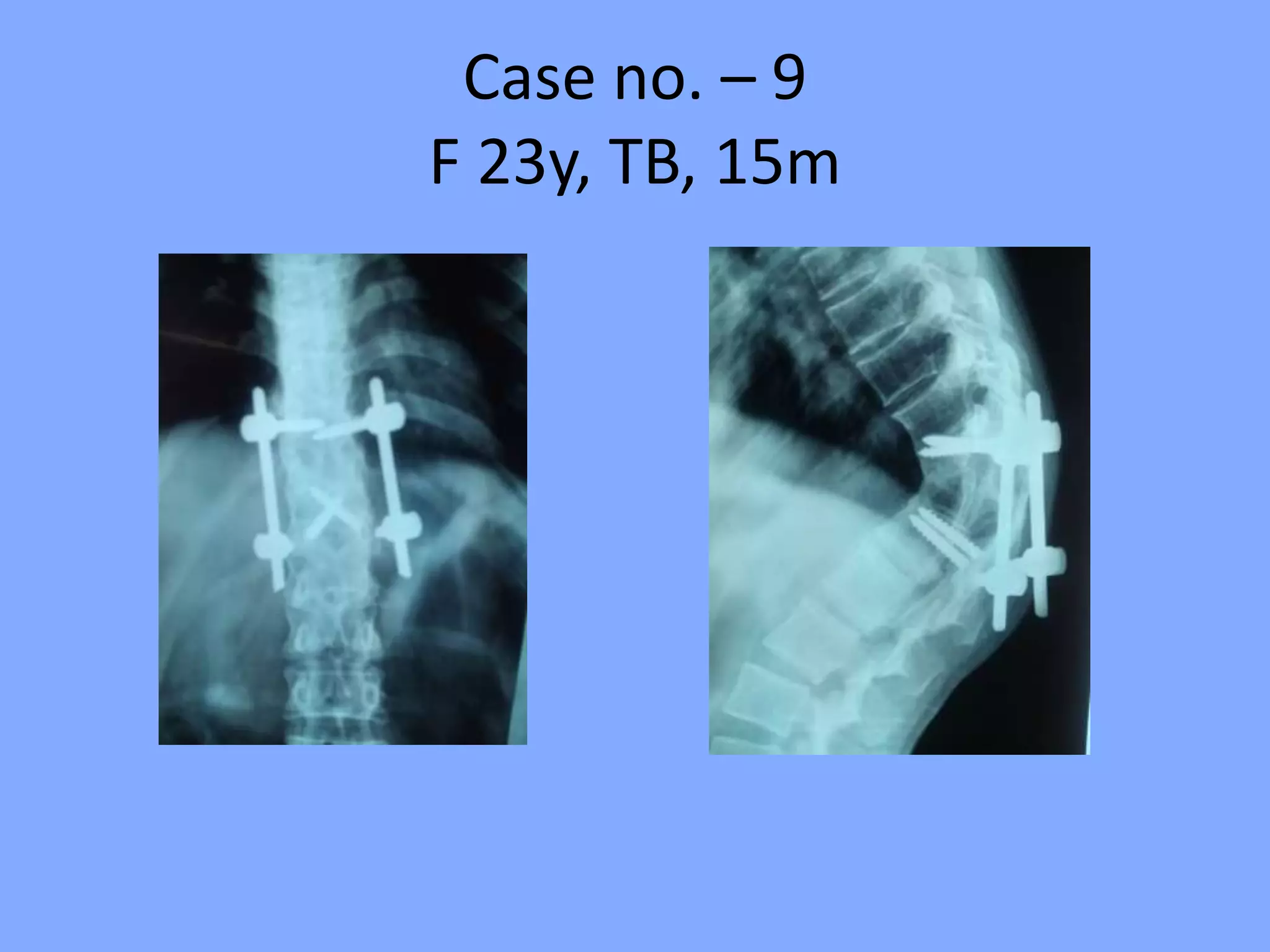
Case no. – 9
F 23y, TB, 15m
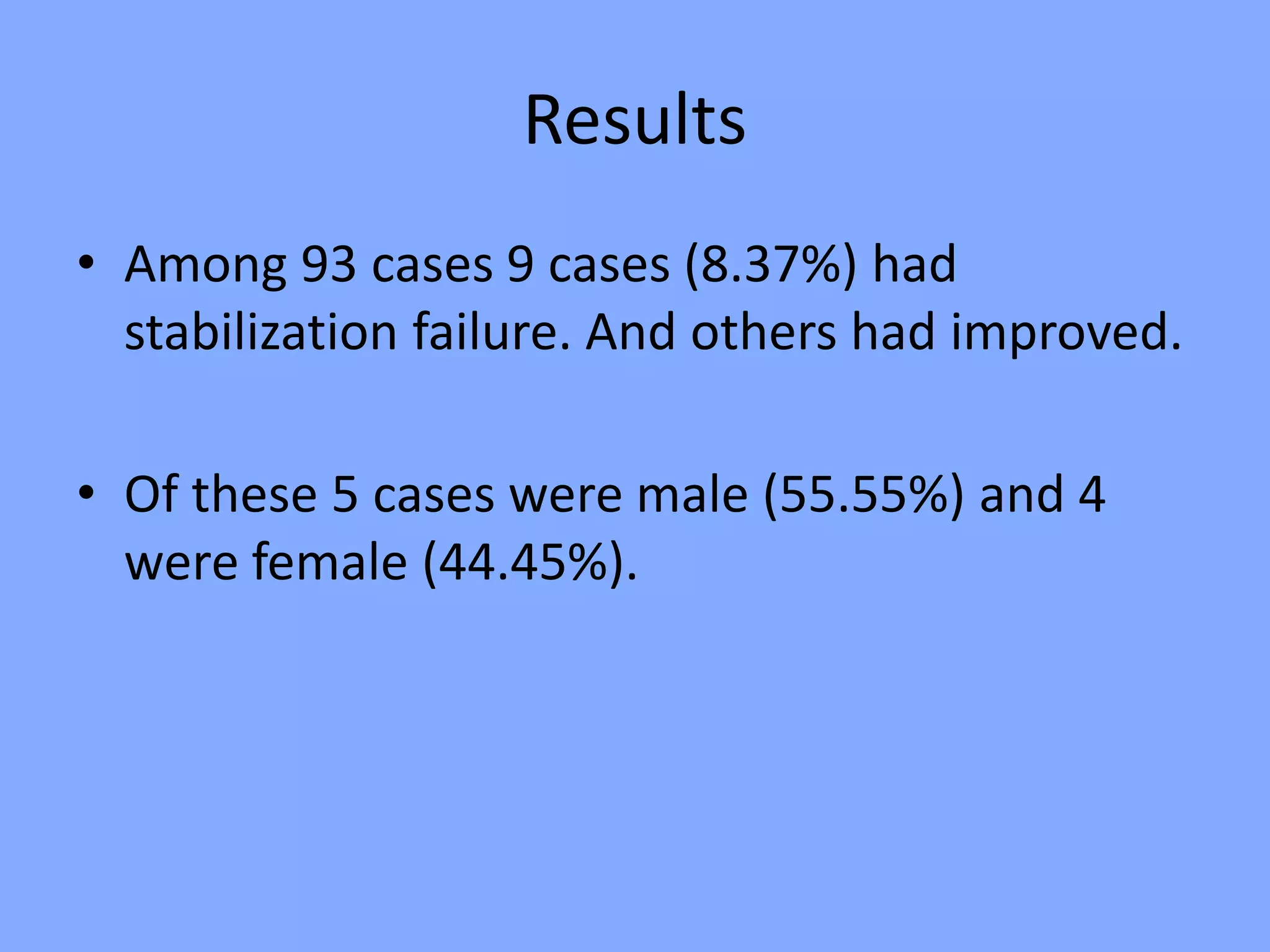
Results
• Among 93 cases 9 cases (8.37%) had
stabilization failure. And others had improved.
• Of these 5 cases were male (55.55%) and 4
were female (44.45%).
Flow chart of failed cases
Sl. No. Sex Age (yrs) Indication Followup
(Months)
1 F 46 Spondylolisthesis 5
2 M 52 Fall from Height 8
3 F 43 Spondylolisthesis 3
4 M 35 Fall from height 12
5 M 25 RTA 7
6 F 52 Osteoporotic fracture 12
7 M 43 RTA 8
8 M 32 Fall from Height 6
9 F 23 TB Spine 15
Prevention of Implant failure
• Limiting the use of stabilization
• Good surgical technique
• Adequate bone grafting
• Use of cages where indicated
• Proper choice of screw and rod
• Use of good quality implants
• Use of more screws in junctional regions
• Considering the biomechanics of the spine
Conclusion
Failure of implanted pedicle screws and rods are
not unavoidable complications. Failure to provide
adequate stabilization can necessitate additional
surgical procedures to achieve spinal fusion.
An understanding of fundamental biomechanical
principles of the spine, fixation strategies and good
surgical technique are essential to avoid
unnecessary subsequent failures.
Chapal (2)

Chapal (2)

  • 1.
    Evaluation of Stabilizationfailure in Thoracolumber spine Dr. Md. Shafiul Alam Dr. Ferdous Ara Islam NINS&H
  • 3.
    Introduction Stabilization of Thoracolumber,Lumber and Lumbosacral spine is a common surgical procedures. This surgery become more popular in our country for last two decades. Stabilization by transpedicular screws and rods through posterior approach are preferred.
  • 4.
    Indications of stabilizationwere • Traumatic fracture • Osteoporotic fracture • Primary bone lession • Secondaries in the spine • Tuberculosis of the spine • Spondylolisthesis
  • 5.
    • Failure oftranspedicular screws and rods are not uncommon. Now it is a challenging surgical issue. • The purpose of study was to find out the causes of failure and ways to avoid it as much as possible.
  • 6.
    Materials and Methods StudyDesign It was a retrospective study. Study Period January 2007 to December 2015
  • 7.
    Patient selection criteria Allpatient of stabilization of Thoracolumber, Lumber and Lumbosacral spine by pedicle screws and rods for different indications were included in this study.
  • 8.
    Evaluation of thepatient Implant status was assessed on the basis on Intra-operative immediate post-operative and follow up X-Ray findings. The mean duration of follow up was 2 years. Range, 1month -3 years.
  • 9.
    Implant failure andradiological analysis • The postoperative plain radiological studies includes the standard A/P and Lat. Views. • Successful fusion was determined by evaluating the radiographs for the presence bridging bone between the fused segments.
  • 10.
    The radiographs wereinterpreted for – Manifestation of failure of fixation – Effect of implant failure – The point of implant failure – Screw length and diameter – Rod length and diameter – Status of bone graft
  • 11.
    The common complicationswere seen – Screw misplacement – Breakage of screws – Breakage of rods – Loosening of screws and rods
  • 12.
    Results Total No. ofcases : 93 Male : 61 Female : 32 61 32 Sex Male Female
  • 13.
    Total no. offailed cases : 9 • Male : 5 • Female : 4 5 4 Male Female
  • 14.
    Types of failure: Breakage of screws - 8 Breakage of rods - 1 Loosening of screws -3 8 1 3 Breakage of screws Breakage of rods Loosening of screws
  • 15.
    Probable causes ofimplant failure • Absence of adequate bone graft • Failure to bone fusion • Poor surgical technique • Use less diameter screws • Poor quality of implants • Inadequate rest after surgery • Trauma after surgery • Short fixation
  • 16.
    Case no. –1 F 46y, Spondylolisthesis, 5m
  • 17.
    Case no. –2 M 52y, HOF, 8m
  • 18.
    Case no. –3 F 43y, Spondylolisthesis, 3m
  • 19.
    Case no. –4 M 35, FFH, 12m
  • 20.
    Case no. –5 M 25y, RTA, 7m
  • 21.
    Case no. –6 F 52y, Osteoporotic, 12m
  • 22.
    Case no. –7 M 43y, RTA, 8m
  • 23.
    Case no. –8 M 32y, FFH, 6m
  • 24.
    Case no. –9 F 23y, TB, 15m
  • 25.
    Results • Among 93cases 9 cases (8.37%) had stabilization failure. And others had improved. • Of these 5 cases were male (55.55%) and 4 were female (44.45%).
  • 26.
    Flow chart offailed cases Sl. No. Sex Age (yrs) Indication Followup (Months) 1 F 46 Spondylolisthesis 5 2 M 52 Fall from Height 8 3 F 43 Spondylolisthesis 3 4 M 35 Fall from height 12 5 M 25 RTA 7 6 F 52 Osteoporotic fracture 12 7 M 43 RTA 8 8 M 32 Fall from Height 6 9 F 23 TB Spine 15
  • 27.
    Prevention of Implantfailure • Limiting the use of stabilization • Good surgical technique • Adequate bone grafting • Use of cages where indicated • Proper choice of screw and rod • Use of good quality implants • Use of more screws in junctional regions • Considering the biomechanics of the spine
  • 28.
    Conclusion Failure of implantedpedicle screws and rods are not unavoidable complications. Failure to provide adequate stabilization can necessitate additional surgical procedures to achieve spinal fusion. An understanding of fundamental biomechanical principles of the spine, fixation strategies and good surgical technique are essential to avoid unnecessary subsequent failures.