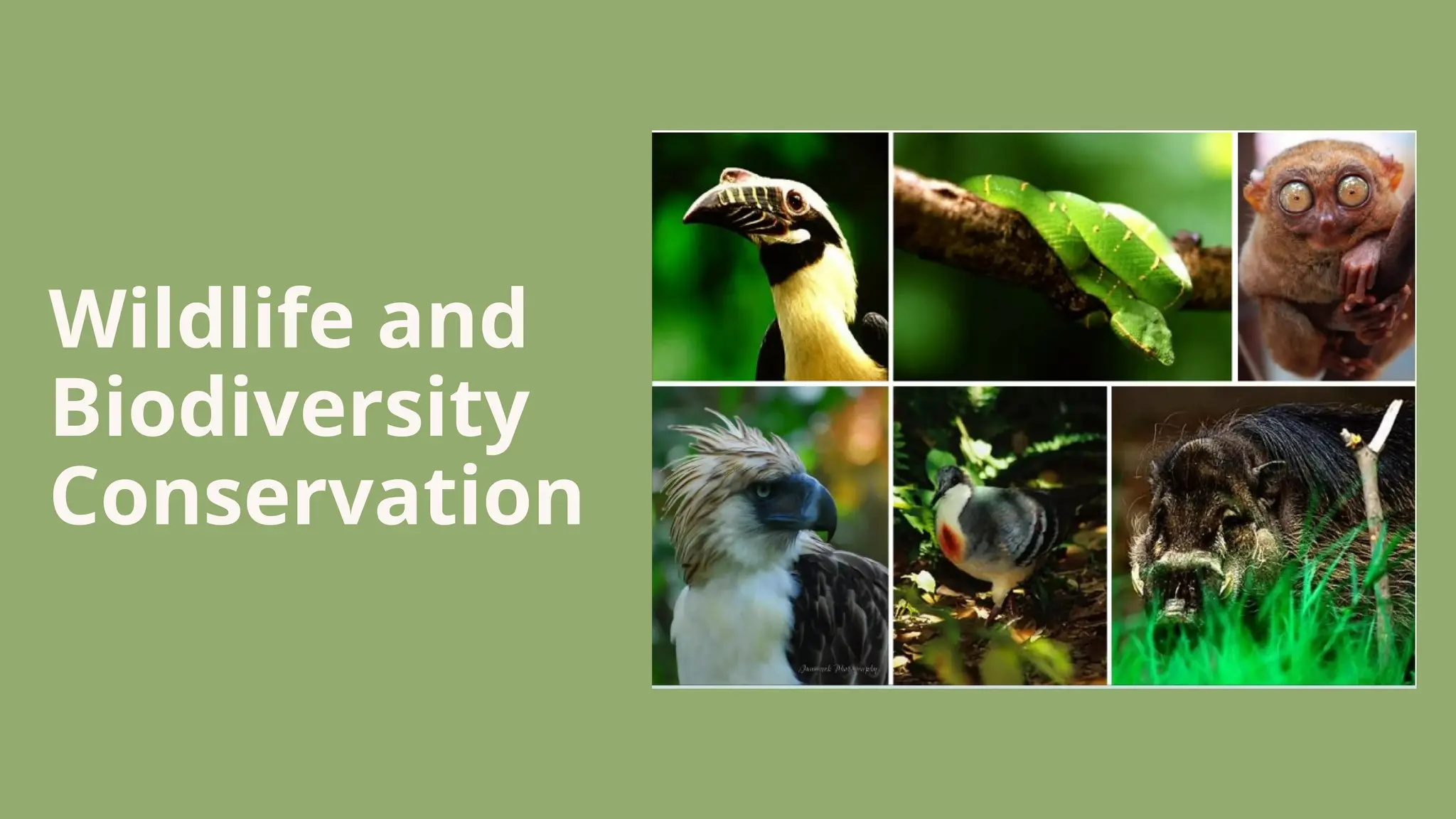
Wildlife and
Biodiversity
Conservation
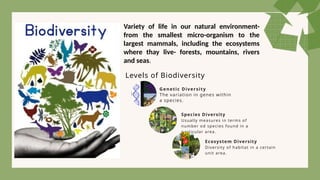
Variety of life in our natural environment-
from the smallest micro-organism to the
largest mammals, including the ecosystems
where thay live- forests, mountains, rivers
and seas.
Genetic Diversity
The variation in genes within
a species.
Species Diversity
Usually measures in terms of
number od species found in a
particular area.
Ecosystem Diversity
Diversity of habitat in a certain
unit area.
Levels of Biodiversity
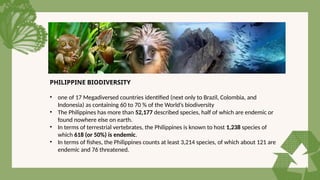
PHILIPPINE BIODIVERSITY
• one of 17 Megadiversed countries identified (next only to Brazil, Colombia, and
Indonesia) as containing 60 to 70 % of the World’s biodiversity
• The Philippines has more than 52,177 described species, half of which are endemic or
found nowhere else on earth.
• In terms of terrestrial vertebrates, the Philippines is known to host 1,238 species of
which 618 (or 50%) is endemic.
• In terms of fishes, the Philippines counts at least 3,214 species, of which about 121 are
endemic and 76 threatened.
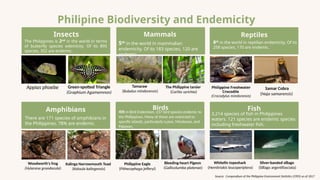
Philipine Biodiversity and Endemicity
The Philippines is 2nd
in the world in terms
of butterfly species edemicity. Of its 895
species, 352 are endemic.
Insects
5th
in the world in mammalian
endemicity. Of its 183 species, 120 are
endemic.
Mammals
8th
in the world in reptilian endemicity. Of its
258 species, 170 are endemic.
Reptiles
3,214 species of fish in Philippines
waters. 121 species are endemic species
including freshwater fish.
Fish
4th in Bird Endemism. 237 bird species endemic to
the Philippines. Many of these are restricted to
specific islands, particularly Luzon, Mindanao, and
Palawan.
Birds
There are 171 species of amphibians in
the Philippines. 78% are endemic.
Amphibians
Appias phoebe Green-spotted Triangle
(Graphium Agamemnon)
Tamaraw
(Bubalus mindorensis)
The Philippine tarsier
(Carlito syrichta)
Philippine Freshwater
Crocodile
(Crocodylus mindorensis)
Samar Cobra
(Naja samarensis)
Woodworth's frog
(Hylarana grandocula)
Kalinga Narrowmouth Toad
(Kaloula kalingensis)
Philippine Eagle
(Pithecophaga jefferyi)
Bleeding-heart Pigeon
(Gallicolumba platenae)
Whitefin topeshark
(Hemitriakis leucoperiptera)
Silver-banded sillago
(Sillago argentifasciata)
Source: Compendium of the Philippine Environment Statistics (CPES) as of 2017
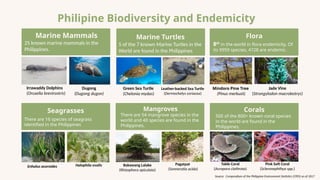
Philipine Biodiversity and Endemicity
25 known marine mammals in the
Philippines.
Marine Mammals
5 of the 7 known Marine Turtles in the
World are found in the Philippines
Marine Turtles
8th
in the world in flora endemicity. Of
its 9959 species, 4728 are endemic.
Flora
500 of the 800+ known coral species
in the world are found in the
Philippines.
Corals
There are 54 mangrove species in the
world and 40 species are found in the
Philippines.
Mangroves
There are 16 species of seagrass
identified in the Philippines
Seagrasses
Irrawaddy Dolphins
(Orcaella brevirostris)
Dugong
(Dugong dugon)
Mindoro Pine Tree
(Pinus merkusii)
Jade Vine
(Strongylodon macrobotrys)
Enhalus acoroides Halophila ovalis Bakawang Lalake
(Rhizophora apiculata)
Pagatpat
(Sonneratia acida)
Table Coral
(Acropora clathrata)
Pink Soft Coral
(Scleronephthya spp.)
Green Sea Turtle
(Chelonia mydas)
Leather-backed Sea Turtle
(Dermochelys coriacea)
Source: Compendium of the Philippine Environment Statistics (CPES) as of 2017
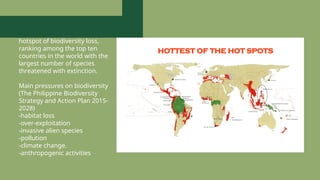
However, the Philippines is also a
hotspot of biodiversity loss,
ranking among the top ten
countries in the world with the
largest number of species
threatened with extinction.
Main pressures on biodiversity
(The Philippine Biodiversity
Strategy and Action Plan 2015-
2028)
-habitat loss
-over-exploitation
-invasive alien species
-pollution
-climate change.
-anthropogenic activities
HOTTEST OF THE HOT SPOTS
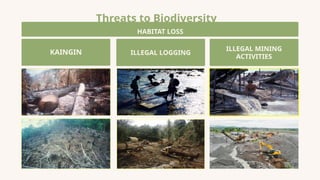
Threats to Biodiversity
KAINGIN ILLEGAL LOGGING
ILLEGAL MINING
ACTIVITIES
HABITAT LOSS
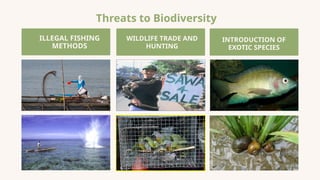
Threats to Biodiversity
ILLEGAL FISHING
METHODS
WILDLIFE TRADE AND
HUNTING
INTRODUCTION OF
EXOTIC SPECIES
Picture soure: Internet
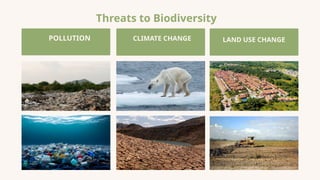
Threats to Biodiversity
POLLUTION CLIMATE CHANGE LAND USE CHANGE
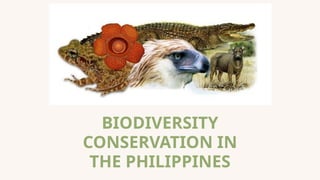
BIODIVERSITY
CONSERVATION IN
THE PHILIPPINES
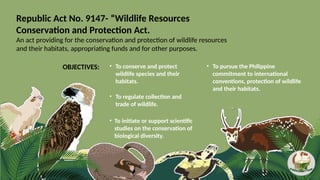
Republic Act No. 9147- “Wildlife Resources
Conservation and Protection Act.
An act providing for the conservation and protection of wildlife resources
and their habitats, appropriating funds and for other purposes.
• To conserve and protect
wildlife species and their
habitats.
• To pursue the Philippine
commitment to international
conventions, protection of wildlife
and their habitats.
• To regulate collection and
trade of wildlife.
• To initiate or support scientific
studies on the conservation of
biological diversity.
OBJECTIVES:
Republic Act No. 9147- “Wildlife Resources
Conservation and Protection Act.
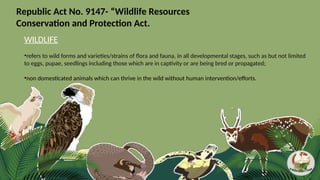
WILDLIFE
•refers to wild forms and varieties/strains of flora and fauna, in all developmental stages, such as but not limited
to eggs, pupae, seedlings including those which are in captivity or are being bred or propagated;
•non domesticated animals which can thrive in the wild without human intervention/efforts.
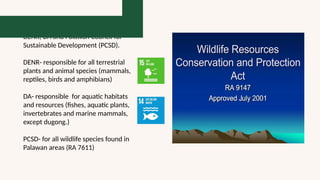
RA 9147 is joint implementation of
DENR, DA and Palawan Council for
Sustainable Development (PCSD).
DENR- responsible for all terrestrial
plants and animal species (mammals,
reptiles, birds and amphibians)
DA- responsible for aquatic habitats
and resources (fishes, aquatic plants,
invertebrates and marine mammals,
except dugong.)
PCSD- for all wildlife species found in
Palawan areas (RA 7611)
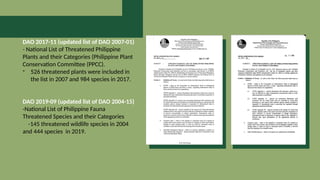
DAO 2017-11 (updated list of DAO 2007-01)
- National List of Threatened Philippine
Plants and their Categories (Philippine Plant
Conservation Committee (PPCC).
- 526 threatened plants were included in
the list in 2007 and 984 species in 2017.
DAO 2019-09 (updated list of DAO 2004-15)
-National List of Philippine Fauna
Threatened Species and their Categories
-145 threatened wildlife species in 2004
and 444 species in 2019.
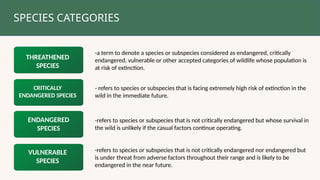
SPECIES CATEGORIES
-a term to denote a species or subspecies considered as endangered, critically
endangered, vulnerable or other accepted categories of wildlife whose population is
at risk of extinction.
THREATHENED
SPECIES
VULNERABLE
SPECIES
ENDANGERED
SPECIES
CRITICALLY
ENDANGERED SPECIES
-refers to species or subspecies that is not critically endangered nor endangered but
is under threat from adverse factors throughout their range and is likely to be
endangered in the near future.
-refers to species or subspecies that is not critically endangered but whose survival in
the wild is unlikely if the casual factors continue operating.
- refers to species or subspecies that is facing extremely high risk of extinction in the
wild in the immediate future.
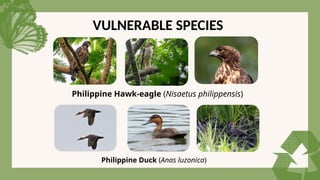
VULNERABLE SPECIES
Philippine Hawk-eagle (Nisaetus philippensis)
Philippine Duck (Anas luzonica)
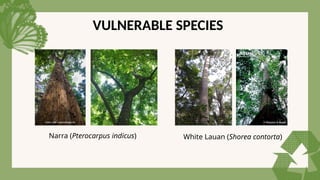
VULNERABLE SPECIES
White Lauan (Shorea contorta)
Narra (Pterocarpus indicus)
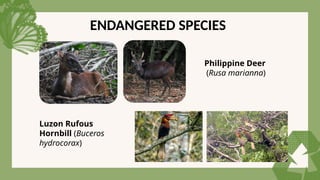
ENDANGERED SPECIES
Philippine Deer
(Rusa marianna)
Luzon Rufous
Hornbill (Buceros
hydrocorax)
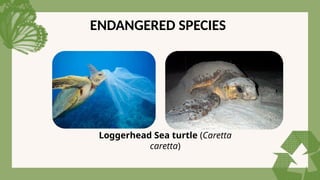
ENDANGERED SPECIES
Loggerhead Sea turtle (Caretta
caretta)
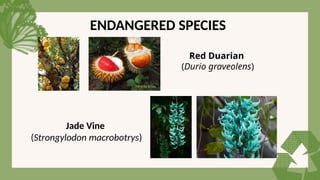
ENDANGERED SPECIES
Red Duarian
(Durio graveolens)
Jade Vine
(Strongylodon macrobotrys)
CRITICALLY ENDANGERED SPECIES
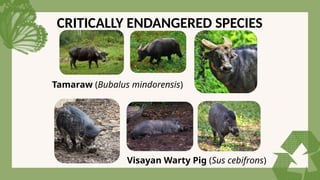
Tamaraw (Bubalus mindorensis)
Visayan Warty Pig (Sus cebifrons)
CRITICALLY ENDANGERED SPECIES
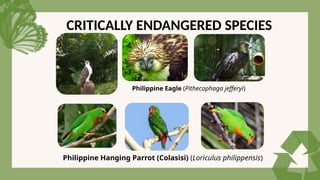
Philippine Hanging Parrot (Colasisi) (Loriculus philippensis)
Philippine Eagle (Pithecophaga jefferyi)
CRITICALLY ENDANGERED SPECIES
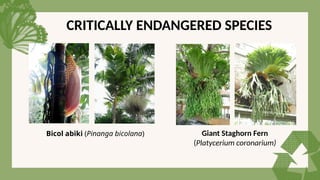
Bicol abiki (Pinanga bicolana) Giant Staghorn Fern
(Platycerium coronarium)
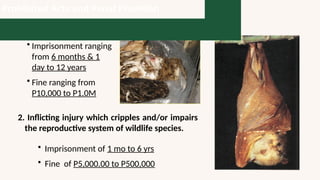
1. Killing and destroying wildlife species
• Imprisonment ranging
from 6 months & 1
day to 12 years
• Fine ranging from
P10,000 to P1.0M
2. Inflicting injury which cripples and/or impairs
the reproductive system of wildlife species.
• Imprisonment of 1 mo to 6 yrs
• Fine of P5,000.00 to P500,000
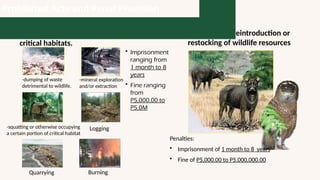
Prohibited Acts and Penal Provision
3. Effecting any of the following acts in
critical habitats.
-dumping of waste
detrimental to wildlife.
-squatting or otherwise occupying
a certain portion of critical habitat
-mineral exploration
and/or extraction
Burning
Quarrying
Logging
• Imprisonment
ranging from
1 month to 8
years
• Fine ranging
from
P5,000.00 to
P5.0M
4. Introduction, reintroduction or
restocking of wildlife resources
Penalties:
• Imprisonment of 1 month to 8 years
• Fine of P5,000.00 to P5,000,000.00
Prohibited Acts and Penal Provision
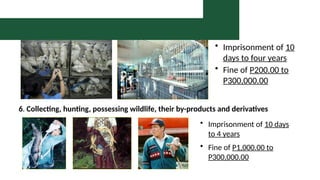
5. Illegal Trading of Wildlife
• Imprisonment of 10
days to four years
• Fine of P200.00 to
P300,000.00
6. Collecting, hunting, possessing wildlife, their by-products and derivatives
• Imprisonment of 10 days
to 4 years
• Fine of P1,000.00 to
P300,000.00
Prohibited Acts and Penal Provision
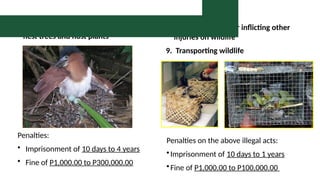
7. Gathering or destroying of active nests,
nest trees and host plants
Penalties:
• Imprisonment of 10 days to 4 years
• Fine of P1,000.00 to P300,000.00
8. Maltreating and/or inflicting other
injuries on wildlife
9. Transporting wildlife
Penalties on the above illegal acts:
•Imprisonment of 10 days to 1 years
•Fine of P1,000.00 to P100,000.00
Prohibited Acts and Penal Provision
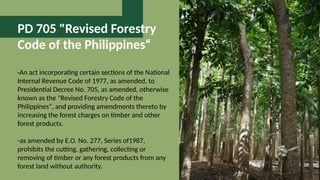
PD 705 "Revised Forestry
Code of the Philippines“
-An act incorporating certain sections of the National
Internal Revenue Code of 1977, as amended, to
Presidential Decree No. 705, as amended, otherwise
known as the "Revised Forestry Code of the
Philippines", and providing amendments thereto by
increasing the forest charges on timber and other
forest products.
-as amended by E.O. No. 277, Series of1987,
prohibits the cutting, gathering, collecting or
removing of timber or any forest products from any
forest land without authority.
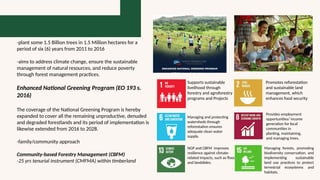
National Greening Program (EO 26, s. 2011)
-plant some 1.5 Billion trees in 1.5 Million hectares for a
period of six (6) years from 2011 to 2016
-aims to address climate change, ensure the sustainable
management of natural resources, and reduce poverty
through forest management practices.
Enhanced National Greening Program (EO 193 s.
2016)
The coverage of the National Greening Program is hereby
expanded to cover all the remaining unproductive, denuded
and degraded forestlands and its period of implementation is
likewise extended from 2016 to 2028.
-family/community approach
Community-based Forestry Management (CBFM)
-25 yrs tenurial instrument (CMFMA) within timberland
Supports sustainable
livelihood through
forestry and agroforestry
programs and Projects
Promotes reforestation
and sustainable land
management, which
enhances food security
Provides employment
opportunities/ income
generation for local
communities in
planting, maintaining,
and managing trees.
NGP and CBFM improves
resilience against climate-
related impacts, such as floods
and landslides.
Managing forests, promoting
biodiversity conservation, and
implementing sustainable
land use practices to protect
terrestrial ecosystems and
habitats.
Managing and protecting
watersheds through
reforestation ensures
adequate clean water
supply.
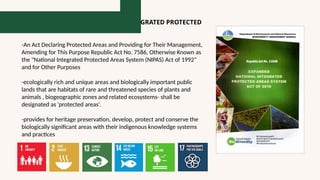
RA 11038: EXPANDED NATIONAL INTERGRATED PROTECTED
AREAS SYSTEM ACT OF 2018 (ENIPAS)
-An Act Declaring Protected Areas and Providing for Their Management,
Amending for This Purpose Republic Act No. 7586, Otherwise Known as
the "National Integrated Protected Areas System (NIPAS) Act of 1992"
and for Other Purposes
-ecologically rich and unique areas and biologically important public
lands that are habitats of rare and threatened species of plants and
animals , biogeographic zones and related ecosystems- shall be
designated as 'protected areas'.
-provides for heritage preservation, develop, protect and conserve the
biologically significant areas with their indigenous knowledge systems
and practices
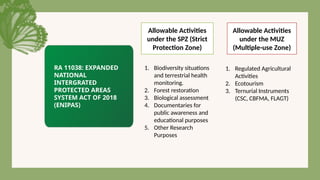
Allowable Activities
under the SPZ (Strict
Protection Zone)
1. Biodiversity situations
and terrestrial health
monitoring.
2. Forest restoration
3. Biological assessment
4. Documentaries for
public awareness and
educational purposes
5. Other Research
Purposes
RA 11038: EXPANDED
NATIONAL
INTERGRATED
PROTECTED AREAS
SYSTEM ACT OF 2018
(ENIPAS)
1. Regulated Agricultural
Activities
2. Ecotourism
3. Ternurial Instruments
(CSC, CBFMA, FLAGT)
Allowable Activities
under the MUZ
(Multiple-use Zone)
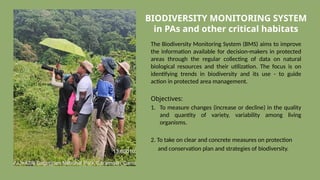
The Biodiversity Monitoring System (BMS) aims to improve
the information available for decision-makers in protected
areas through the regular collecting of data on natural
biological resources and their utilization. The focus is on
identifying trends in biodiversity and its use - to guide
action in protected area management.
Objectives:
1. To measure changes (increase or decline) in the quality
and quantity of variety, variability among living
organisms.
2. To take on clear and concrete measures on protection
and conservation plan and strategies of biodiversity.
BIODIVERSITY MONITORING SYSTEM
in PAs and other critical habitats
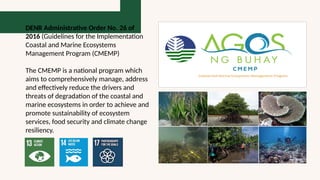
DENR Administrative Order No. 26 of
2016 (Guidelines for the Implementation
Coastal and Marine Ecosystems
Management Program (CMEMP)
The CMEMP is a national program which
aims to comprehensively manage, address
and effectively reduce the drivers and
threats of degradation of the coastal and
marine ecosystems in order to achieve and
promote sustainability of ecosystem
services, food security and climate change
resiliency.
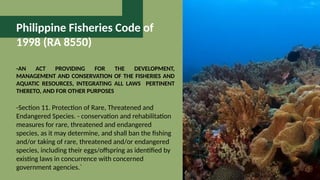
Philippine Fisheries Code of
1998 (RA 8550)
-AN ACT PROVIDING FOR THE DEVELOPMENT,
MANAGEMENT AND CONSERVATION OF THE FISHERIES AND
AQUATIC RESOURCES, INTEGRATING ALL LAWS PERTINENT
THERETO, AND FOR OTHER PURPOSES
-Section 11. Protection of Rare, Threatened and
Endangered Species. - conservation and rehabilitation
measures for rare, threatened and endangered
species, as it may determine, and shall ban the fishing
and/or taking of rare, threatened and/or endangered
species, including their eggs/offspring as identified by
existing laws in concurrence with concerned
government agencies.`
International Agreements
RAMSAR Convention on
Wetlands (1971)
Convention on International Trade of
Endangered Species (CITES) 1993
Convention on Biological Diversity
(1992)
Convention on Migratory
Species
International Union for the
Conservation of Nature
World Wildlife Fund
-The Philippine Biodiversity Strategy and Action Plan (PBSAP) 2015-
2028 serves as a strategic instrument, whose vision is that by 2028,
biodiversity is restored and rehabilitated, valued, effectively
managed and secured, maintaining ecosystem services to sustain
healthy, resilient Filipino communities and delivering benefits to all.
-Initiated by Biodiversity Management Bureau (BMB) of the
Department of Environment and Natural Resources (DENR) .
-Conservation efforts in partnership with ASEAN Centre for
Biodiversity (ACB); BirdLife International; Haribon Foundation, Inc.;
Deutsche Gesellschaft für Internationale Zusammenarbeit (GIZ)
through the Protected Area Management Enhancement in the
Philippines (PAME) Project, Philippine Biodiversity Conservation
Foundation Inc. etc.
The Philippine Biodiversity Strategy and Action
Plan (PBSAP)
Strategies implemented in some LGUs, Agencies
and other Stakeholders:
1. IEC/CEPA
2. Regular updating of Wildlife Information through research
3. Conservation breeding or propagation of wildlife resources
4. Establishment of Critical Habitats
5. Designation of wildlife rescue centers
6. Creation of Wildlife Traffic Monitoring Units (Community Monitoring Group)
7. Deputation of Wildlife Enforcement Officers (Bantay Dagat & Bantay Gubat)
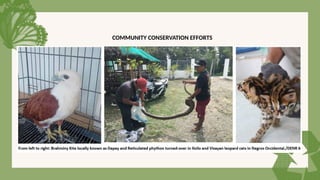
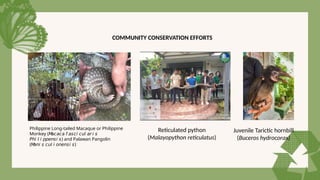
COMMUNITY CONSERVATION EFFORTS
Philippine Long-tailed Macaque or Philippine
Monkey (𝘔
𝘢𝘤𝘢𝘤𝘢 𝘧 𝘢𝘴𝘤𝘪 𝘤𝘶𝘭 𝘢𝘳 𝘪 𝘴
) and Palawan Pangolin
𝘗𝘩𝘪 𝘭 𝘪 𝘱𝘱𝘦𝘯𝘴𝘪 𝘴
( )
𝘔
𝘢𝘯𝘪 𝘴 𝘤𝘶𝘭 𝘪 𝘰𝘯𝘦𝘯𝘴𝘪 𝘴
Reticulated python
(Malayopython reticulatus)
Juvenile Tarictic hornbill
(Buceros hydrocorax)
COMMUNITY CONSERVATION EFFORTS
Key Challenges in Environmental
Governance
•Law Enforcement
•Corruption
•Fragmented Policies
• Insufficient Funding
•Community Engagement
•Climate Change Adaptation
•Data Gaps
•Capacity Building
Thank
you!
Continue to video presentation…….
Thank
you!
Continue to video presentation…….

Wildlife and Biodiversity Presentation.pptx

  • 1.
  • 2.
    Variety of lifein our natural environment- from the smallest micro-organism to the largest mammals, including the ecosystems where thay live- forests, mountains, rivers and seas. Genetic Diversity The variation in genes within a species. Species Diversity Usually measures in terms of number od species found in a particular area. Ecosystem Diversity Diversity of habitat in a certain unit area. Levels of Biodiversity
  • 3.
    PHILIPPINE BIODIVERSITY • oneof 17 Megadiversed countries identified (next only to Brazil, Colombia, and Indonesia) as containing 60 to 70 % of the World’s biodiversity • The Philippines has more than 52,177 described species, half of which are endemic or found nowhere else on earth. • In terms of terrestrial vertebrates, the Philippines is known to host 1,238 species of which 618 (or 50%) is endemic. • In terms of fishes, the Philippines counts at least 3,214 species, of which about 121 are endemic and 76 threatened.
  • 4.
    Philipine Biodiversity andEndemicity The Philippines is 2nd in the world in terms of butterfly species edemicity. Of its 895 species, 352 are endemic. Insects 5th in the world in mammalian endemicity. Of its 183 species, 120 are endemic. Mammals 8th in the world in reptilian endemicity. Of its 258 species, 170 are endemic. Reptiles 3,214 species of fish in Philippines waters. 121 species are endemic species including freshwater fish. Fish 4th in Bird Endemism. 237 bird species endemic to the Philippines. Many of these are restricted to specific islands, particularly Luzon, Mindanao, and Palawan. Birds There are 171 species of amphibians in the Philippines. 78% are endemic. Amphibians Appias phoebe Green-spotted Triangle (Graphium Agamemnon) Tamaraw (Bubalus mindorensis) The Philippine tarsier (Carlito syrichta) Philippine Freshwater Crocodile (Crocodylus mindorensis) Samar Cobra (Naja samarensis) Woodworth's frog (Hylarana grandocula) Kalinga Narrowmouth Toad (Kaloula kalingensis) Philippine Eagle (Pithecophaga jefferyi) Bleeding-heart Pigeon (Gallicolumba platenae) Whitefin topeshark (Hemitriakis leucoperiptera) Silver-banded sillago (Sillago argentifasciata) Source: Compendium of the Philippine Environment Statistics (CPES) as of 2017
  • 5.
    Philipine Biodiversity andEndemicity 25 known marine mammals in the Philippines. Marine Mammals 5 of the 7 known Marine Turtles in the World are found in the Philippines Marine Turtles 8th in the world in flora endemicity. Of its 9959 species, 4728 are endemic. Flora 500 of the 800+ known coral species in the world are found in the Philippines. Corals There are 54 mangrove species in the world and 40 species are found in the Philippines. Mangroves There are 16 species of seagrass identified in the Philippines Seagrasses Irrawaddy Dolphins (Orcaella brevirostris) Dugong (Dugong dugon) Mindoro Pine Tree (Pinus merkusii) Jade Vine (Strongylodon macrobotrys) Enhalus acoroides Halophila ovalis Bakawang Lalake (Rhizophora apiculata) Pagatpat (Sonneratia acida) Table Coral (Acropora clathrata) Pink Soft Coral (Scleronephthya spp.) Green Sea Turtle (Chelonia mydas) Leather-backed Sea Turtle (Dermochelys coriacea) Source: Compendium of the Philippine Environment Statistics (CPES) as of 2017
  • 6.
    However, the Philippinesis also a hotspot of biodiversity loss, ranking among the top ten countries in the world with the largest number of species threatened with extinction. Main pressures on biodiversity (The Philippine Biodiversity Strategy and Action Plan 2015- 2028) -habitat loss -over-exploitation -invasive alien species -pollution -climate change. -anthropogenic activities HOTTEST OF THE HOT SPOTS
  • 7.
    Threats to Biodiversity KAINGINILLEGAL LOGGING ILLEGAL MINING ACTIVITIES HABITAT LOSS
  • 8.
    Threats to Biodiversity ILLEGALFISHING METHODS WILDLIFE TRADE AND HUNTING INTRODUCTION OF EXOTIC SPECIES Picture soure: Internet
  • 9.
    Threats to Biodiversity POLLUTIONCLIMATE CHANGE LAND USE CHANGE
  • 10.
  • 11.
    Republic Act No.9147- “Wildlife Resources Conservation and Protection Act. An act providing for the conservation and protection of wildlife resources and their habitats, appropriating funds and for other purposes. • To conserve and protect wildlife species and their habitats. • To pursue the Philippine commitment to international conventions, protection of wildlife and their habitats. • To regulate collection and trade of wildlife. • To initiate or support scientific studies on the conservation of biological diversity. OBJECTIVES:
  • 12.
    Republic Act No.9147- “Wildlife Resources Conservation and Protection Act. WILDLIFE •refers to wild forms and varieties/strains of flora and fauna, in all developmental stages, such as but not limited to eggs, pupae, seedlings including those which are in captivity or are being bred or propagated; •non domesticated animals which can thrive in the wild without human intervention/efforts.
  • 13.
    RA 9147 isjoint implementation of DENR, DA and Palawan Council for Sustainable Development (PCSD). DENR- responsible for all terrestrial plants and animal species (mammals, reptiles, birds and amphibians) DA- responsible for aquatic habitats and resources (fishes, aquatic plants, invertebrates and marine mammals, except dugong.) PCSD- for all wildlife species found in Palawan areas (RA 7611)
  • 14.
    DAO 2017-11 (updatedlist of DAO 2007-01) - National List of Threatened Philippine Plants and their Categories (Philippine Plant Conservation Committee (PPCC). - 526 threatened plants were included in the list in 2007 and 984 species in 2017. DAO 2019-09 (updated list of DAO 2004-15) -National List of Philippine Fauna Threatened Species and their Categories -145 threatened wildlife species in 2004 and 444 species in 2019.
  • 15.
    SPECIES CATEGORIES -a termto denote a species or subspecies considered as endangered, critically endangered, vulnerable or other accepted categories of wildlife whose population is at risk of extinction. THREATHENED SPECIES VULNERABLE SPECIES ENDANGERED SPECIES CRITICALLY ENDANGERED SPECIES -refers to species or subspecies that is not critically endangered nor endangered but is under threat from adverse factors throughout their range and is likely to be endangered in the near future. -refers to species or subspecies that is not critically endangered but whose survival in the wild is unlikely if the casual factors continue operating. - refers to species or subspecies that is facing extremely high risk of extinction in the wild in the immediate future.
  • 16.
    VULNERABLE SPECIES Philippine Hawk-eagle(Nisaetus philippensis) Philippine Duck (Anas luzonica)
  • 17.
    VULNERABLE SPECIES White Lauan(Shorea contorta) Narra (Pterocarpus indicus)
  • 18.
    ENDANGERED SPECIES Philippine Deer (Rusamarianna) Luzon Rufous Hornbill (Buceros hydrocorax)
  • 19.
    ENDANGERED SPECIES Loggerhead Seaturtle (Caretta caretta)
  • 20.
    ENDANGERED SPECIES Red Duarian (Duriograveolens) Jade Vine (Strongylodon macrobotrys)
  • 21.
    CRITICALLY ENDANGERED SPECIES Tamaraw(Bubalus mindorensis) Visayan Warty Pig (Sus cebifrons)
  • 22.
    CRITICALLY ENDANGERED SPECIES PhilippineHanging Parrot (Colasisi) (Loriculus philippensis) Philippine Eagle (Pithecophaga jefferyi)
  • 23.
    CRITICALLY ENDANGERED SPECIES Bicolabiki (Pinanga bicolana) Giant Staghorn Fern (Platycerium coronarium)
  • 24.
    1. Killing anddestroying wildlife species • Imprisonment ranging from 6 months & 1 day to 12 years • Fine ranging from P10,000 to P1.0M 2. Inflicting injury which cripples and/or impairs the reproductive system of wildlife species. • Imprisonment of 1 mo to 6 yrs • Fine of P5,000.00 to P500,000 Prohibited Acts and Penal Provision
  • 25.
    3. Effecting anyof the following acts in critical habitats. -dumping of waste detrimental to wildlife. -squatting or otherwise occupying a certain portion of critical habitat -mineral exploration and/or extraction Burning Quarrying Logging • Imprisonment ranging from 1 month to 8 years • Fine ranging from P5,000.00 to P5.0M 4. Introduction, reintroduction or restocking of wildlife resources Penalties: • Imprisonment of 1 month to 8 years • Fine of P5,000.00 to P5,000,000.00 Prohibited Acts and Penal Provision
  • 26.
    5. Illegal Tradingof Wildlife • Imprisonment of 10 days to four years • Fine of P200.00 to P300,000.00 6. Collecting, hunting, possessing wildlife, their by-products and derivatives • Imprisonment of 10 days to 4 years • Fine of P1,000.00 to P300,000.00 Prohibited Acts and Penal Provision
  • 27.
    7. Gathering ordestroying of active nests, nest trees and host plants Penalties: • Imprisonment of 10 days to 4 years • Fine of P1,000.00 to P300,000.00 8. Maltreating and/or inflicting other injuries on wildlife 9. Transporting wildlife Penalties on the above illegal acts: •Imprisonment of 10 days to 1 years •Fine of P1,000.00 to P100,000.00 Prohibited Acts and Penal Provision
  • 28.
    PD 705 "RevisedForestry Code of the Philippines“ -An act incorporating certain sections of the National Internal Revenue Code of 1977, as amended, to Presidential Decree No. 705, as amended, otherwise known as the "Revised Forestry Code of the Philippines", and providing amendments thereto by increasing the forest charges on timber and other forest products. -as amended by E.O. No. 277, Series of1987, prohibits the cutting, gathering, collecting or removing of timber or any forest products from any forest land without authority.
  • 29.
    National Greening Program(EO 26, s. 2011) -plant some 1.5 Billion trees in 1.5 Million hectares for a period of six (6) years from 2011 to 2016 -aims to address climate change, ensure the sustainable management of natural resources, and reduce poverty through forest management practices. Enhanced National Greening Program (EO 193 s. 2016) The coverage of the National Greening Program is hereby expanded to cover all the remaining unproductive, denuded and degraded forestlands and its period of implementation is likewise extended from 2016 to 2028. -family/community approach Community-based Forestry Management (CBFM) -25 yrs tenurial instrument (CMFMA) within timberland Supports sustainable livelihood through forestry and agroforestry programs and Projects Promotes reforestation and sustainable land management, which enhances food security Provides employment opportunities/ income generation for local communities in planting, maintaining, and managing trees. NGP and CBFM improves resilience against climate- related impacts, such as floods and landslides. Managing forests, promoting biodiversity conservation, and implementing sustainable land use practices to protect terrestrial ecosystems and habitats. Managing and protecting watersheds through reforestation ensures adequate clean water supply.
  • 30.
    RA 11038: EXPANDEDNATIONAL INTERGRATED PROTECTED AREAS SYSTEM ACT OF 2018 (ENIPAS) -An Act Declaring Protected Areas and Providing for Their Management, Amending for This Purpose Republic Act No. 7586, Otherwise Known as the "National Integrated Protected Areas System (NIPAS) Act of 1992" and for Other Purposes -ecologically rich and unique areas and biologically important public lands that are habitats of rare and threatened species of plants and animals , biogeographic zones and related ecosystems- shall be designated as 'protected areas'. -provides for heritage preservation, develop, protect and conserve the biologically significant areas with their indigenous knowledge systems and practices
  • 31.
    Allowable Activities under theSPZ (Strict Protection Zone) 1. Biodiversity situations and terrestrial health monitoring. 2. Forest restoration 3. Biological assessment 4. Documentaries for public awareness and educational purposes 5. Other Research Purposes RA 11038: EXPANDED NATIONAL INTERGRATED PROTECTED AREAS SYSTEM ACT OF 2018 (ENIPAS) 1. Regulated Agricultural Activities 2. Ecotourism 3. Ternurial Instruments (CSC, CBFMA, FLAGT) Allowable Activities under the MUZ (Multiple-use Zone)
  • 32.
    The Biodiversity MonitoringSystem (BMS) aims to improve the information available for decision-makers in protected areas through the regular collecting of data on natural biological resources and their utilization. The focus is on identifying trends in biodiversity and its use - to guide action in protected area management. Objectives: 1. To measure changes (increase or decline) in the quality and quantity of variety, variability among living organisms. 2. To take on clear and concrete measures on protection and conservation plan and strategies of biodiversity. BIODIVERSITY MONITORING SYSTEM in PAs and other critical habitats
  • 33.
    DENR Administrative OrderNo. 26 of 2016 (Guidelines for the Implementation Coastal and Marine Ecosystems Management Program (CMEMP) The CMEMP is a national program which aims to comprehensively manage, address and effectively reduce the drivers and threats of degradation of the coastal and marine ecosystems in order to achieve and promote sustainability of ecosystem services, food security and climate change resiliency.
  • 34.
    Philippine Fisheries Codeof 1998 (RA 8550) -AN ACT PROVIDING FOR THE DEVELOPMENT, MANAGEMENT AND CONSERVATION OF THE FISHERIES AND AQUATIC RESOURCES, INTEGRATING ALL LAWS PERTINENT THERETO, AND FOR OTHER PURPOSES -Section 11. Protection of Rare, Threatened and Endangered Species. - conservation and rehabilitation measures for rare, threatened and endangered species, as it may determine, and shall ban the fishing and/or taking of rare, threatened and/or endangered species, including their eggs/offspring as identified by existing laws in concurrence with concerned government agencies.`
  • 35.
    International Agreements RAMSAR Conventionon Wetlands (1971) Convention on International Trade of Endangered Species (CITES) 1993 Convention on Biological Diversity (1992) Convention on Migratory Species International Union for the Conservation of Nature World Wildlife Fund
  • 36.
    -The Philippine BiodiversityStrategy and Action Plan (PBSAP) 2015- 2028 serves as a strategic instrument, whose vision is that by 2028, biodiversity is restored and rehabilitated, valued, effectively managed and secured, maintaining ecosystem services to sustain healthy, resilient Filipino communities and delivering benefits to all. -Initiated by Biodiversity Management Bureau (BMB) of the Department of Environment and Natural Resources (DENR) . -Conservation efforts in partnership with ASEAN Centre for Biodiversity (ACB); BirdLife International; Haribon Foundation, Inc.; Deutsche Gesellschaft für Internationale Zusammenarbeit (GIZ) through the Protected Area Management Enhancement in the Philippines (PAME) Project, Philippine Biodiversity Conservation Foundation Inc. etc. The Philippine Biodiversity Strategy and Action Plan (PBSAP)
  • 37.
    Strategies implemented insome LGUs, Agencies and other Stakeholders: 1. IEC/CEPA 2. Regular updating of Wildlife Information through research 3. Conservation breeding or propagation of wildlife resources 4. Establishment of Critical Habitats 5. Designation of wildlife rescue centers 6. Creation of Wildlife Traffic Monitoring Units (Community Monitoring Group) 7. Deputation of Wildlife Enforcement Officers (Bantay Dagat & Bantay Gubat)
  • 38.
    COMMUNITY CONSERVATION EFFORTS PhilippineLong-tailed Macaque or Philippine Monkey (𝘔 𝘢𝘤𝘢𝘤𝘢 𝘧 𝘢𝘴𝘤𝘪 𝘤𝘶𝘭 𝘢𝘳 𝘪 𝘴 ) and Palawan Pangolin 𝘗𝘩𝘪 𝘭 𝘪 𝘱𝘱𝘦𝘯𝘴𝘪 𝘴 ( ) 𝘔 𝘢𝘯𝘪 𝘴 𝘤𝘶𝘭 𝘪 𝘰𝘯𝘦𝘯𝘴𝘪 𝘴 Reticulated python (Malayopython reticulatus) Juvenile Tarictic hornbill (Buceros hydrocorax)
  • 39.
  • 40.
    Key Challenges inEnvironmental Governance •Law Enforcement •Corruption •Fragmented Policies • Insufficient Funding •Community Engagement •Climate Change Adaptation •Data Gaps •Capacity Building
  • 41.
    Thank you! Continue to videopresentation…….
  • 42.
    Thank you! Continue to videopresentation…….

Editor's Notes

  • #2 Genetic. The genes are responsible for the uniqueness of every living organism. Ex. Dogs same species but different breeds human- curly hair/straight hair, skin color Species. Ex. dogs Genetic Diversity: It is a level of biodiversity that refers to the total number of genetic characteristics in the genetic make up of a species. Species Div It refers to the variety of species with in a region Ecos Div Ecosystem diversity refers to the diversity of a place at the level of ecosystems.
  • #4 Appias phoebe (2020)
  • #6 The Philippine Biodiversity Strategy and Action Plan (PBSAP) 2015-2028 identified the five main pressures on biodiversity in the Philippines as habitat loss, over-exploitation, invasive alien species, pollution and climate change. Habitat loss- due to land conversion, illegal human activities Over exploitation- results to ecosystem and resources degradation Invasive species- species domination, other species not thriving ex. Eurasian tree sparrow Pollution- Plastics end up in the ocean where they are eaten by birds and sea creatures (turtle), causing injury and death. Climate Change- consequences for species as expected changes in temperature, rainfall, and seasonality will cause shifts in tree species distribution and therefore habitat.
  • #7 Kaingin, logging and minahan na nakakasira sa natural formations and resources ng ecosystems
  • #8 Dynamite and Cyanide fishing Kapag and hunting is conducted at a rate higher than a species can reproduce, it leads to population declines. In some cases, this can push species toward extinction. Invasive species can alter food webs, reduce the availability of resources for native species, and sometimes lead to the extinction of indigenous species. Tilapia-introduced in the phil in 1950s
  • #9 Pollution from various sources, galing chemicals, plastic waste, heavy metals, and fertilizers, na may toxic effects on wildlife. It can contaminate air, water, and soil, impacting the health of various ecosystems. Climate change- Species may struggle to adapt or migrate fast enough, and some may face extinction. The conversion of natural landscapes for agriculture, industrial development, or urban sprawl leads to a loss of natural ecosystems. This alters the availability of resources for species and disrupts ecological functions.
  • #12 So basically, wildlife are non domesticated animals which can thrive in the wild without human intervention/efforts.
  • #13 Dugong jurisdiction by DENR Palawan Council for Sustainable Development
  • #14 This shows na tumataas yung rate ng threats sa biodiversity
  • #24 July 2024, shot eagle in Davao.
  • #25  Introduction of Inavasive Alien Species-makakarisa sa food chain/web system ng isang ecosystem (mahogany and giant bamboo allelophatic, secreting substances sa lupa para wala na magthrive. Reintroduction of extinct species sa isang lugar due to natural factors na kapag inintroduce ulit is baka di na magthrive kasi di na sya adapted sa area Restocking of species. Ex additional tamarraws in Mindoro but will depete their natural source of food. High mortality rate Or additional raptor like Serpent eagles. Masira food chain and food resources. Wala makain ang nasa 2nd and 3rd trophic levels.
  • #29 Dugong jurisdiction by DENR Palawan Council for Sustainable Development
  • #30 RA 11038- PAs within timberland PAs decalred by LGU such as LMMPA, Forest Parks for tourism Bago I declare as PA, PASA to become PA-kung ano ba species andun, ano kelangan I protect/conserve SDG 1and 2- same with NGP. May mga NGP sites sa PA SDG 13- same with NGP SDG 14 and 15- PA not only terr but marine (Protected Landscape and Seascape) SDG 17-partner ship with local and international partners
  • #33 Also contri to SDG Climate action- coastal ecosystem contributes to high carbon sequestrations, ecosystem-based resiliency and climate change abatement SDG 14-proect and conserve the countrys coastal and marine habitats In partnership with DA through BFAR, Academe, LGUs and other stakeholders (monitoring and enforcement, research studies, conservation efforts)
  • #34 Mainly implemented by BFAR. Coordinated with the DENR for the conservation of locally mnaged marine protected areas (marine sanctuaries)
  • #35 RAMSAR Convention – currently adopting ng phil ang wetland mgt (ex. Cabusao wetlands) CBD- adopted by the phil sa marine turtle (Pawikan Conservation Project)
  • #37 Role of LGUs I forest management- Acc. Sec 447 RA 7160- responsible to protect forest and other ecosystems in their jurisdiction and monitor illegal activities LGU, in partnership with DENR provide additional bantay gubat and bantay dagat
  • #40 Weak Law Enforcement: Despite existing laws and regulations, enforcement is often inconsistent, more leading to illegal logging, poaching, and wildlife trafficking. Corruption: Corruption at various levels of government can undermine conservation efforts, allowing illegal activities to persist. Fragmented Policies: Overlapping jurisdictions and a lack of cohesive policies among different government agencies can create gaps in conservation strategies. Insufficient Funding: Limited financial resources for conservation programs can hinder effective governance and management of protected areas. Community Engagement: Lack of knowledge ng tao, leading to resistance or lack of support for initiatives. Climate Change Adaptation: Governance frameworks may not adequately address the impacts of climate change on biodiversity, resulting in reactive rather than proactive measures. Data Gaps: Inadequate scientific data on species and ecosystems can lead to poor decision-making and ineffective conservation strategies. Capacity Building: Limited training and resources for local officials and stakeholders can impede effective governance and management of biodiversity.