WHAT IS COFFEE?
 According to Merriam Webster, Coffee is a
dark brown drink made from ground coffee
beans and boiled water. It is a beverage made
by percolation, infusion, or decoction from the
roasted and ground seeds of a coffee plant.
 According to Wikipedia, Coffee is
slightly acidic and can have a stimulating effect
on humans because of its caffeine content.
Coffee is one of the most popular drinks in the
world.
TYPES OF COFFEE
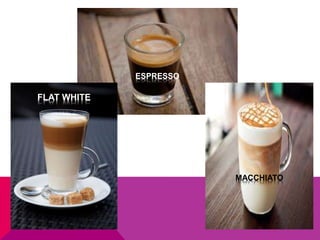
 ESPRESSO
The espresso (aka “short black”) is the foundation and
the most important part to every espresso based drink.
 DOUBLE ESPRESSO
A double espresso (aka “Doppio”) is just that, two
espresso shots in one cup.
 SHORT MACCHIATO
A short macchiato is similar to an espresso but with a
dollop of steamed milk and foam to mellow the harsh
taste of an espresso.
 LONG MACCHIATO
A long macchiato is the same as a short macchiato but
with a double shot of espresso.
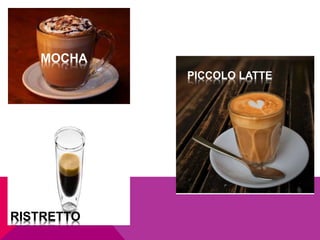
RISTRETTO
A ristretto is an espresso shot that is extracted with the
same amount of coffee but half the amount of water.
The end result is a more concentrated and darker
espresso extraction.
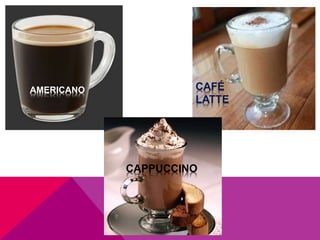
LONG BLACK (AMERICANO)
A long black (aka “Americano”) is hot water with an
espresso shot extracted on top of the hot water.
 CAFÉ LATTE
A café latte, or “latte” for short, is an espresso based drink with
steamed milk and micro-foam added to the coffee. This coffee is
much sweeter compared to an espresso due to the steamed milk.
 CAPPUCCINO
A cappuccino is similar to a latte. However the key difference
between a latte and cappuccino is that a cappuccino has more
foam and chocolate placed on top of the drink. Further a
cappuccino is made in a cup rather than a tumbler glass.
 FLAT WHITE
A flat white is a coffee beverage prepared by pouring microfoam
(steamed milk from the bottom of a pitcher) over a single or
double shot of espresso.
 PICCOLO LATTE
A piccolo latte is a café latte made in an espresso cup. This
means it has a very strong but mellowed down espresso
taste thanks to the steamed milk and micro foam within it.
 MOCHA
A mocha is a mix between a cappuccino and a hot chocolate.
It is made by putting mixing chocolate powder with an
espresso shot and then adding steamed milk and micro-foam
into the beverage.
 AFFOGATO
An affogato is a simple dessert coffee that is treat during
summer and after dinner. It is made by placing one big scoop of
vanilla ice cream within a single or double shot of espresso.
AMERICANO CAFÉ
LATTE
CAPPUCCINO
ESPRESSO
FLAT WHITE
MACCHIATO
MOCHA
PICCOLO LATTE
RISTRETTO
TRIVIAS ABOUT COFFEE:
 There are 18% tannins, poisonous chemicals, in these drinks. These may
increase risk of esophageal cancer. These create a fissure in the stomach
and generate gas in it.
 There is 3% theanine (a poisonous substance) in these drinks. It causes
mental imbalance and also heaviness in the lungs and head.
 A poison known as ‘volatile’ is harmful for the intestines.
 Carbonic acid increases acidity in the body.
 Pomin weakens the digestive ability.
 Aeromolic has an ill-effect on the intestines.
 Cyanogen causes dreadful ailments like insomnia and paralytic strokes.
 Oxalic acid is very harmful for the body.
 Stenoil causes blood diseases and impotency.
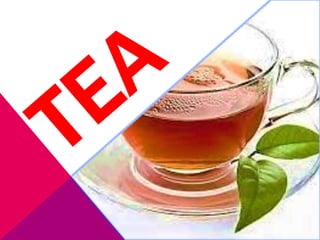
 According to
Wikipedia, Tea is an
aromatic beverage
commonly prepared
by pouring hot water
over cured leaves of
the Camellia sinensis,
an evergreen shrub
native to Asia.
 According to
Merriam Webster,
Tea is an aromatic
beverage prepared
from tea leaves by
infusion with
boiling water.
WHAT IS TEA?
TYPES OF TEA
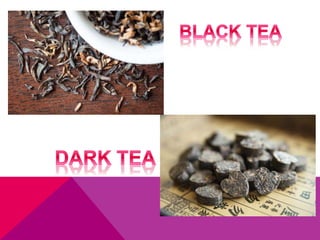
 Black teas. They usually undergo full oxidation, and the
results are the characteristic dark brown and black leaf,
the typically more robust and pronounced flavours of
black teas, and when brewed appropriately, a higher
caffeine content compared to other teas (50-65% of
coffee, depending on the type and brewing technique).
 Dark Tea. This is from Hunan and Sichuan provinces of
China and is a flavourful aged probiotic tea that steeps
up very smooth with a natural slightly sweet note.
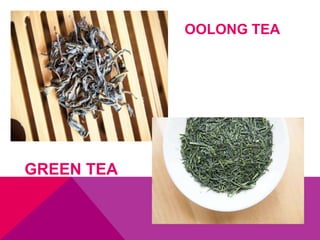
 Oolong tea (also known as wulong tea). This tea is allowed to
undergo partial oxidation. These teas have a caffeine content
between that of green teas and black teas. The flavour of oolong
(wulong) teas is typically not as robust as blacks or as subtle as
greens, but has its own extremely fragrant and intriguing tones.
Oolongs (wulongs) are often compared to the taste and aroma of
fresh flowers or fresh fruit.
 Green Tea. It is allowed to wither only slightly after being picked.
Then the oxidation process is stopped very quickly by firing
(rapidly heating) the leaves. Therefore, when brewed at lower
temperatures and for less time, green tea tend to have less
caffeine (10-30% of coffee). Greens also tend to produce more
subtle flavours with many undertones and accents that
connoisseurs treasure.
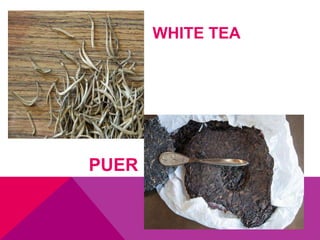
 White teas. These are the most delicate of all teas. They are
appreciated for their subtlety, complexity, and natural sweetness.
They are hand-processed using the youngest shoots of the tea
plant, with no oxidation. When brewed correctly, with a very low
temperature and a short steeping time, white teas can produce low
amounts of caffeine. But by definition, white tea does not have less
caffeine than other teas.
 Puer. It is an aged black tea from China prized for its medicinal
properties and earthy flavor. It is perhaps the most mysterious of
all tea. Until 1995 it was illegal to import it into the U.S., and the
process of its production is a closely guarded state secret in China.
It is very strong with an incredibly deep and rich flavor, and no
bitterness, and an element that could best be described as almost
peaty in flavor.
OOLONG TEA
GREEN TEA
WHITE TEA
PUER
TRIVIAS ABOUT TEA:
 The term herbal tea usually refers to infusions of fruit or herbs made without
the tea plant, such as steeps of rosehip, chamomile, or rooibos. These are
sometimes called tisanes or herbal infusions to prevent confusion with tea
made from the tea plant.
 The tea industry often confusingly uses the term fruit tea to refer to what are in
fact fruit-flavored black teas, not fruit teas.
 Tea originated in Southwest China, where it was used as a medicinal drink. It
was popularized as a recreational drink during the Chinese Tang dynasty, and
tea drinking spread to other East Asian countries. Portuguese priests and
merchants introduced it to Europe during the 16th century. During the 17th
century, drinking tea became fashionable among Britons, who started large-
scale production and commercialization of the plant in India to bypass the
Chinese monopoly.
1. COFFEE CAN HELP
YOU BURN FAT
Several studies show that
caffeine can boost the
metabolic rate by 3-11%
Other studies show that
caffeine can specifically
increase the burning
of fat, by as much as 10%
in obese individuals and
29% in lean people.
2. THERE ARE ESSENTIAL
NUTRIENTS IN COFFEE
A single cup of coffee contains:
• Riboflavin (Vitamin B2):
11% of the RDA.
• Pantothenic Acid (Vitamin
B5): 6% of the RDA.
• Manganese and Potassium:
3% of the RDA.
• Magnesium and Niacin (B3):
2% of the RDA.
3. COFFEE CAN FIGHT
DEPRESSION
In a Harvard
study published in 2011,
women who drank 4 or
more cups per day had a
20% lower risk of
becoming depressed .
Another study with
208,424 individuals found
that those who drank 4 or
more cups per day were
53% less likely to commit
suicide
4. IT CAN CAUSE A LOT
OF THINGS
Coffee containing caffeine
can cause insomnia,
nervousness and
restlessness, stomach upset,
nausea and vomiting,
increased heart and
breathing rate, and other
side effects. Consuming large
amounts of coffee might also
cause headache, anxiety,
agitation, ringing in the ears,
and irregular heartbeats
1. Tea can boost exercise
endurance. Scientists have
found that the
catechins (antioxidants) in
green tea extract increase
the body’s ability to burn fat
as fuel, which accounts for
improved muscle endurance.
2. Drinking tea could help
reduce the risk of heart
attack. Tea might also help
protect against
cardiovascular and
degenerative diseases.
3. The antioxidants in tea might
help protect against a boatload
of cancers,
including breast,colon, colorectal
, skin, lung, esophagus,
stomach, small intestine,
pancreas, liver, ovarian, prostate
and oral cancers. But don’t rely
solely on tea to keep a healthy
body — tea is not a miracle cure,
after all. While more studies than
not suggest that tea has cancer-
fighting benefits, the current
research is mixed.
4. Tea helps fight free radicals. Tea is high in oxygen
radical absorbance capacity (“ORAC” to its friends),
which is a fancy way of saying that it helps destroy
free radicals (which can damage DNA) in the body.
While our bodies are designed to fight free radicals on
their own, they’re not 100 percent effective — and
since damage from these radical oxygen ninjas has
been linked to cancer, heart disease and neurological
degeneration, we’ll take all the help we can get.
5. Tea is hydrating to the body (even despite the
caffeine!).
CAFFEINE CAN HAVE BOTH POSITIVE AND NEGATIVE
EFFECTS ON THE BODY. FOR EXAMPLE, TEA AND
COFFEE WILL IMPROVE MENTAL ALERTNESS AND
MIGHT HELP TO REDUCE THE RISK OF PARKINSON’S
DISEASE AND ATHEROSCLEROSIS, ACCORDING TO
MEDLINE PLUS, THERE’S ALSO A DARK SIDE TO
CAFFEINE, THOUGH. NOT EVERYBODY REACTS THE
SAME WAY TO IT AND SOME PEOPLE MIGHT HAVE
MORE SERIOUS SIDE EFFECTS THAN OTHERS, EVEN IF
THEY’RE DRINKING THE SAME AMOUNT OF TEA AND
COFFEE.
INCREASED HEART RATE
Both tea and coffee can increase heart
rate and blood pressure. As heart rate
increases, the flow of blood to the heart
increases and the flow of blood to the brain
decreases. This means that you might feel
foggy and tired as you come down from a
caffeine “high,” which can happen minutes
to hours after drinking coffee.
ANXIETY
According to the Diabetes Mellitus
Information website, caffeine increases
the production of adrenaline and
cortisol, the stress hormones. This can
result in heightened senses but will also
put you on edge, elevate your stress
levels and might cause anxiety.
ELEVATED BLOOD SUGAR
Caffeine can affect blood glucose,
according to MedLine Plus. When you
drink caffeine, your blood sugar spikes.
As you come down from the “caffeine
high,” your blood sugar plummets. These
sudden changes in blood sugar can be
dangerous for people with diabetes.
INCREASED RISK OF
OSTEOPOROSIS
According to MedLine Plus, caffeine can
increase the loss of calcium. When you
consume lots of caffeine, your body has
trouble absorbing the calcium you get from
your diet. Instead, much of it is immediately
lost in the urine. This can lead to weak
bones and osteoporosis later on in life.

Abonalla Macayan

  • 3.
    WHAT IS COFFEE? According to Merriam Webster, Coffee is a dark brown drink made from ground coffee beans and boiled water. It is a beverage made by percolation, infusion, or decoction from the roasted and ground seeds of a coffee plant.  According to Wikipedia, Coffee is slightly acidic and can have a stimulating effect on humans because of its caffeine content. Coffee is one of the most popular drinks in the world.
  • 4.
    TYPES OF COFFEE ESPRESSO The espresso (aka “short black”) is the foundation and the most important part to every espresso based drink.  DOUBLE ESPRESSO A double espresso (aka “Doppio”) is just that, two espresso shots in one cup.  SHORT MACCHIATO A short macchiato is similar to an espresso but with a dollop of steamed milk and foam to mellow the harsh taste of an espresso.
  • 5.
     LONG MACCHIATO Along macchiato is the same as a short macchiato but with a double shot of espresso. RISTRETTO A ristretto is an espresso shot that is extracted with the same amount of coffee but half the amount of water. The end result is a more concentrated and darker espresso extraction. LONG BLACK (AMERICANO) A long black (aka “Americano”) is hot water with an espresso shot extracted on top of the hot water.
  • 6.
     CAFÉ LATTE Acafé latte, or “latte” for short, is an espresso based drink with steamed milk and micro-foam added to the coffee. This coffee is much sweeter compared to an espresso due to the steamed milk.  CAPPUCCINO A cappuccino is similar to a latte. However the key difference between a latte and cappuccino is that a cappuccino has more foam and chocolate placed on top of the drink. Further a cappuccino is made in a cup rather than a tumbler glass.  FLAT WHITE A flat white is a coffee beverage prepared by pouring microfoam (steamed milk from the bottom of a pitcher) over a single or double shot of espresso.
  • 7.
     PICCOLO LATTE Apiccolo latte is a café latte made in an espresso cup. This means it has a very strong but mellowed down espresso taste thanks to the steamed milk and micro foam within it.  MOCHA A mocha is a mix between a cappuccino and a hot chocolate. It is made by putting mixing chocolate powder with an espresso shot and then adding steamed milk and micro-foam into the beverage.  AFFOGATO An affogato is a simple dessert coffee that is treat during summer and after dinner. It is made by placing one big scoop of vanilla ice cream within a single or double shot of espresso.
  • 8.
  • 9.
  • 10.
  • 11.
    TRIVIAS ABOUT COFFEE: There are 18% tannins, poisonous chemicals, in these drinks. These may increase risk of esophageal cancer. These create a fissure in the stomach and generate gas in it.  There is 3% theanine (a poisonous substance) in these drinks. It causes mental imbalance and also heaviness in the lungs and head.  A poison known as ‘volatile’ is harmful for the intestines.  Carbonic acid increases acidity in the body.  Pomin weakens the digestive ability.  Aeromolic has an ill-effect on the intestines.  Cyanogen causes dreadful ailments like insomnia and paralytic strokes.  Oxalic acid is very harmful for the body.  Stenoil causes blood diseases and impotency.
  • 13.
     According to Wikipedia,Tea is an aromatic beverage commonly prepared by pouring hot water over cured leaves of the Camellia sinensis, an evergreen shrub native to Asia.  According to Merriam Webster, Tea is an aromatic beverage prepared from tea leaves by infusion with boiling water. WHAT IS TEA?
  • 14.
    TYPES OF TEA Black teas. They usually undergo full oxidation, and the results are the characteristic dark brown and black leaf, the typically more robust and pronounced flavours of black teas, and when brewed appropriately, a higher caffeine content compared to other teas (50-65% of coffee, depending on the type and brewing technique).  Dark Tea. This is from Hunan and Sichuan provinces of China and is a flavourful aged probiotic tea that steeps up very smooth with a natural slightly sweet note.
  • 15.
     Oolong tea(also known as wulong tea). This tea is allowed to undergo partial oxidation. These teas have a caffeine content between that of green teas and black teas. The flavour of oolong (wulong) teas is typically not as robust as blacks or as subtle as greens, but has its own extremely fragrant and intriguing tones. Oolongs (wulongs) are often compared to the taste and aroma of fresh flowers or fresh fruit.  Green Tea. It is allowed to wither only slightly after being picked. Then the oxidation process is stopped very quickly by firing (rapidly heating) the leaves. Therefore, when brewed at lower temperatures and for less time, green tea tend to have less caffeine (10-30% of coffee). Greens also tend to produce more subtle flavours with many undertones and accents that connoisseurs treasure.
  • 16.
     White teas.These are the most delicate of all teas. They are appreciated for their subtlety, complexity, and natural sweetness. They are hand-processed using the youngest shoots of the tea plant, with no oxidation. When brewed correctly, with a very low temperature and a short steeping time, white teas can produce low amounts of caffeine. But by definition, white tea does not have less caffeine than other teas.  Puer. It is an aged black tea from China prized for its medicinal properties and earthy flavor. It is perhaps the most mysterious of all tea. Until 1995 it was illegal to import it into the U.S., and the process of its production is a closely guarded state secret in China. It is very strong with an incredibly deep and rich flavor, and no bitterness, and an element that could best be described as almost peaty in flavor.
  • 18.
  • 19.
  • 20.
    TRIVIAS ABOUT TEA: The term herbal tea usually refers to infusions of fruit or herbs made without the tea plant, such as steeps of rosehip, chamomile, or rooibos. These are sometimes called tisanes or herbal infusions to prevent confusion with tea made from the tea plant.  The tea industry often confusingly uses the term fruit tea to refer to what are in fact fruit-flavored black teas, not fruit teas.  Tea originated in Southwest China, where it was used as a medicinal drink. It was popularized as a recreational drink during the Chinese Tang dynasty, and tea drinking spread to other East Asian countries. Portuguese priests and merchants introduced it to Europe during the 16th century. During the 17th century, drinking tea became fashionable among Britons, who started large- scale production and commercialization of the plant in India to bypass the Chinese monopoly.
  • 22.
    1. COFFEE CANHELP YOU BURN FAT Several studies show that caffeine can boost the metabolic rate by 3-11% Other studies show that caffeine can specifically increase the burning of fat, by as much as 10% in obese individuals and 29% in lean people. 2. THERE ARE ESSENTIAL NUTRIENTS IN COFFEE A single cup of coffee contains: • Riboflavin (Vitamin B2): 11% of the RDA. • Pantothenic Acid (Vitamin B5): 6% of the RDA. • Manganese and Potassium: 3% of the RDA. • Magnesium and Niacin (B3): 2% of the RDA.
  • 23.
    3. COFFEE CANFIGHT DEPRESSION In a Harvard study published in 2011, women who drank 4 or more cups per day had a 20% lower risk of becoming depressed . Another study with 208,424 individuals found that those who drank 4 or more cups per day were 53% less likely to commit suicide 4. IT CAN CAUSE A LOT OF THINGS Coffee containing caffeine can cause insomnia, nervousness and restlessness, stomach upset, nausea and vomiting, increased heart and breathing rate, and other side effects. Consuming large amounts of coffee might also cause headache, anxiety, agitation, ringing in the ears, and irregular heartbeats
  • 25.
    1. Tea canboost exercise endurance. Scientists have found that the catechins (antioxidants) in green tea extract increase the body’s ability to burn fat as fuel, which accounts for improved muscle endurance. 2. Drinking tea could help reduce the risk of heart attack. Tea might also help protect against cardiovascular and degenerative diseases. 3. The antioxidants in tea might help protect against a boatload of cancers, including breast,colon, colorectal , skin, lung, esophagus, stomach, small intestine, pancreas, liver, ovarian, prostate and oral cancers. But don’t rely solely on tea to keep a healthy body — tea is not a miracle cure, after all. While more studies than not suggest that tea has cancer- fighting benefits, the current research is mixed.
  • 26.
    4. Tea helpsfight free radicals. Tea is high in oxygen radical absorbance capacity (“ORAC” to its friends), which is a fancy way of saying that it helps destroy free radicals (which can damage DNA) in the body. While our bodies are designed to fight free radicals on their own, they’re not 100 percent effective — and since damage from these radical oxygen ninjas has been linked to cancer, heart disease and neurological degeneration, we’ll take all the help we can get. 5. Tea is hydrating to the body (even despite the caffeine!).
  • 28.
    CAFFEINE CAN HAVEBOTH POSITIVE AND NEGATIVE EFFECTS ON THE BODY. FOR EXAMPLE, TEA AND COFFEE WILL IMPROVE MENTAL ALERTNESS AND MIGHT HELP TO REDUCE THE RISK OF PARKINSON’S DISEASE AND ATHEROSCLEROSIS, ACCORDING TO MEDLINE PLUS, THERE’S ALSO A DARK SIDE TO CAFFEINE, THOUGH. NOT EVERYBODY REACTS THE SAME WAY TO IT AND SOME PEOPLE MIGHT HAVE MORE SERIOUS SIDE EFFECTS THAN OTHERS, EVEN IF THEY’RE DRINKING THE SAME AMOUNT OF TEA AND COFFEE.
  • 29.
    INCREASED HEART RATE Bothtea and coffee can increase heart rate and blood pressure. As heart rate increases, the flow of blood to the heart increases and the flow of blood to the brain decreases. This means that you might feel foggy and tired as you come down from a caffeine “high,” which can happen minutes to hours after drinking coffee.
  • 30.
    ANXIETY According to theDiabetes Mellitus Information website, caffeine increases the production of adrenaline and cortisol, the stress hormones. This can result in heightened senses but will also put you on edge, elevate your stress levels and might cause anxiety.
  • 31.
    ELEVATED BLOOD SUGAR Caffeinecan affect blood glucose, according to MedLine Plus. When you drink caffeine, your blood sugar spikes. As you come down from the “caffeine high,” your blood sugar plummets. These sudden changes in blood sugar can be dangerous for people with diabetes.
  • 32.
    INCREASED RISK OF OSTEOPOROSIS Accordingto MedLine Plus, caffeine can increase the loss of calcium. When you consume lots of caffeine, your body has trouble absorbing the calcium you get from your diet. Instead, much of it is immediately lost in the urine. This can lead to weak bones and osteoporosis later on in life.