PIG PRODUCTION
• One of the oldest domesticated
animals
• Found in almost all parts of the
world where religion does not
prevents it from being reared
Introduction
• Major source of meat
Advantages of pig production
> Pig has 15,000 taste buds as against
humans with 9,000 enabling it to eat all
edible to man and other animals including
forage.
>Pig carcasses are easier to dress and have
superior curing.
>Pigs adopt easily to environmental
conditions. They are also adoptable to
intensified or diversified agriculture.
>Pigs droppings rich in nutrients.pig faeces
makes good fertilizer for crops.
• • Pigs grow very rapidly from 1.5kg
at birth to 90kg in 170 days only
• Pigs can be raised on small land
especially where land holdings are
small
• They produce many young ones.
You can raise 20 pigs from one
female pig (sow) in a year
• Pig production has low labour
requirements.
• Pigs are mainly fed on maize and
other grains and root tubers which
can normally be bought at very low
prices during peak seasons of
harvesting.
• Pigs can also be raised on pasture
and other crop residues and agro
industrial by products
• Pigs give quick returns on your
investment
• World Meat Production By Source (Source:
FAO, 2015)
> PORK ------ 38%
> CHICKEN ---- 30%
> BEEF -------- 25%
> SHEEP/ GOAT- 7%
Advantages of Pig Raising
• What are the advantages of pig raising?
>1. Efficient conversion of animal feed to
human food .
2. Financially rewarding
3. Omnivores
4. Tolerant to wide variety of feeds
5. Live in small areas
6. Improve soil fertility
7. High percentage of useful products per pig
Uses of pigs other than for eating
• Organ donors – Xenotransplantation and cloning
.(transplantation of an organ , tissue ,or cells
between 2 different species)
• As a source of biological materials, ex. Insulin or
heparin. An anticougulant or anti clotting of
blood.
• As a model for biomedical research Uses of pigs
other than for eating
• As an organ donor to humans
• For entertainment
• As pets
• As truffle-finders (they are smell experts)
How do we raise pigs? What are
different system of pig raising?
• Scavenging System
> Pigs are let loose day and night on a self
supporting feeding management system
Backyard Pig Raising
>Pigs are kept in a simple sty constructed with
an elevated bamboo or wood
> Pigs are also tethered with a rope around
the heart-girth in the yard of elsewhere
• Conventional sytem
PIGS NEEDS
• Food- Pigs need a balanced, mixed diet made
up of the three
• food groups:
• > energy foods (carbohydrate)
• > body building foods (protein)
• > protective foods (vitamins and minerals).
Water- Pigs need plenty of fresh water every
day.
Shelter -Pigs need shelter that is:
> dry, that keeps out the rain comfortable
> keeps them warm at night
> protects them from strong winds.
>Each pig will need a room in the pig house
• A clean house and pen- The pig house must be cleaned
regularly. This stops the pigs becoming sick.
• Space- Pigs need enough space in their house and pen
to make them comfortable.
Health care - We check our pigs regularly for disease.
When pigs become sick we look first for custom
medicine.
Note: Special imported medicine is expensive.
• AI - artificial insemination.
• Barrow- male pig castrated before reaching
sexual maturity.
• Boar- male hog or pig with intact testicles.
• Castrate- remove testicles by surgery.
• Colostrum- first milk produced by the sow; it
provides immunity to the baby pigs for the first
few weeks.
• Creep feeder- area accessible to small pigs but
not their dams, in which a high protein
supplement is provided.
• Cull sow- full-grown female sold for
slaughter.
• Dressing percent- percentage of the carcass
usable, compared to liveweight.
• Farrow- to give birth to pigs.
• Flush feed- increase feed to stimulate
ovulation in females.
• Full-(self)-feed- animals are allowed to eat as
much as they will clean up; feed is available
at all times.
• Gestation period- pregnancy, lasting
about 114 days in swine.
• Gilt- young female that has not yet
produced a litter.
• Growing-finishing pig- animal weighing
between 40 and 220 lbs. that is being
fed for slaughter.
• Runt- small or weak pig in a litter.
Shrink- weight loss, usually temporary.
Sow- female which has farrowed at least
once.
Wallow- water-filled depression or
container large enough for pigs to lay in to
cool off during warm weather.
Weaning- removing young from their
mother.
Yield- percentage of the carcass in the
four lean cuts: ham, loin, picnic, and
Boston butt.
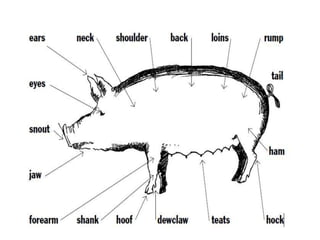
• Parts of a pig
Different breeds of pigs grow to
different sizes and have different
colours and hair.
All pigs are covered in hair and
use their snout for digging in the
soil.
Pig production

Pig production

  • 1.
    PIG PRODUCTION • Oneof the oldest domesticated animals • Found in almost all parts of the world where religion does not prevents it from being reared Introduction • Major source of meat
  • 2.
    Advantages of pigproduction > Pig has 15,000 taste buds as against humans with 9,000 enabling it to eat all edible to man and other animals including forage. >Pig carcasses are easier to dress and have superior curing. >Pigs adopt easily to environmental conditions. They are also adoptable to intensified or diversified agriculture. >Pigs droppings rich in nutrients.pig faeces makes good fertilizer for crops.
  • 3.
    • • Pigsgrow very rapidly from 1.5kg at birth to 90kg in 170 days only • Pigs can be raised on small land especially where land holdings are small • They produce many young ones. You can raise 20 pigs from one female pig (sow) in a year • Pig production has low labour requirements.
  • 4.
    • Pigs aremainly fed on maize and other grains and root tubers which can normally be bought at very low prices during peak seasons of harvesting. • Pigs can also be raised on pasture and other crop residues and agro industrial by products • Pigs give quick returns on your investment
  • 5.
    • World MeatProduction By Source (Source: FAO, 2015) > PORK ------ 38% > CHICKEN ---- 30% > BEEF -------- 25% > SHEEP/ GOAT- 7%
  • 6.
    Advantages of PigRaising • What are the advantages of pig raising? >1. Efficient conversion of animal feed to human food . 2. Financially rewarding 3. Omnivores 4. Tolerant to wide variety of feeds 5. Live in small areas 6. Improve soil fertility 7. High percentage of useful products per pig
  • 7.
    Uses of pigsother than for eating • Organ donors – Xenotransplantation and cloning .(transplantation of an organ , tissue ,or cells between 2 different species) • As a source of biological materials, ex. Insulin or heparin. An anticougulant or anti clotting of blood. • As a model for biomedical research Uses of pigs other than for eating • As an organ donor to humans • For entertainment • As pets • As truffle-finders (they are smell experts)
  • 8.
    How do weraise pigs? What are different system of pig raising? • Scavenging System > Pigs are let loose day and night on a self supporting feeding management system Backyard Pig Raising >Pigs are kept in a simple sty constructed with an elevated bamboo or wood > Pigs are also tethered with a rope around the heart-girth in the yard of elsewhere
  • 9.
    • Conventional sytem PIGSNEEDS • Food- Pigs need a balanced, mixed diet made up of the three • food groups: • > energy foods (carbohydrate) • > body building foods (protein) • > protective foods (vitamins and minerals).
  • 10.
    Water- Pigs needplenty of fresh water every day. Shelter -Pigs need shelter that is: > dry, that keeps out the rain comfortable > keeps them warm at night > protects them from strong winds. >Each pig will need a room in the pig house
  • 11.
    • A cleanhouse and pen- The pig house must be cleaned regularly. This stops the pigs becoming sick. • Space- Pigs need enough space in their house and pen to make them comfortable. Health care - We check our pigs regularly for disease. When pigs become sick we look first for custom medicine. Note: Special imported medicine is expensive.
  • 12.
    • AI -artificial insemination. • Barrow- male pig castrated before reaching sexual maturity. • Boar- male hog or pig with intact testicles. • Castrate- remove testicles by surgery. • Colostrum- first milk produced by the sow; it provides immunity to the baby pigs for the first few weeks. • Creep feeder- area accessible to small pigs but not their dams, in which a high protein supplement is provided.
  • 13.
    • Cull sow-full-grown female sold for slaughter. • Dressing percent- percentage of the carcass usable, compared to liveweight. • Farrow- to give birth to pigs. • Flush feed- increase feed to stimulate ovulation in females. • Full-(self)-feed- animals are allowed to eat as much as they will clean up; feed is available at all times.
  • 14.
    • Gestation period-pregnancy, lasting about 114 days in swine. • Gilt- young female that has not yet produced a litter. • Growing-finishing pig- animal weighing between 40 and 220 lbs. that is being fed for slaughter. • Runt- small or weak pig in a litter.
  • 15.
    Shrink- weight loss,usually temporary. Sow- female which has farrowed at least once. Wallow- water-filled depression or container large enough for pigs to lay in to cool off during warm weather. Weaning- removing young from their mother. Yield- percentage of the carcass in the four lean cuts: ham, loin, picnic, and Boston butt.
  • 16.
    • Parts ofa pig Different breeds of pigs grow to different sizes and have different colours and hair. All pigs are covered in hair and use their snout for digging in the soil.