Pi-tastic
Yumm….
Did You Know?

Albert Einstein (one
of the greatest
physicists of all time)
was born on pi day.
Bet you didn’t know
that.
Pi is super long
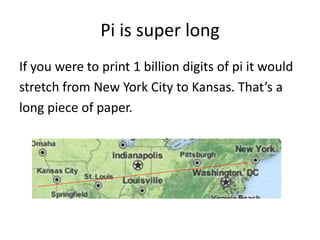
If you were to print 1 billion digits of pi it would
stretch from New York City to Kansas. That’s a
long piece of paper.
We use pi more than you think
Pi occurs in hundreds of equations in many
sciences including those describing the DNA
double helix, a rainbow, ripples spreading from
where a raindrop fell into
water, superstrings, general relativity, normal
distribution, distribution of primes, geometry
problems, waves, navigation and much more.
You think memorizing 100 digits is hard?


Hiroyuki Goto of Tokyo, Japan holds the world
record for most memorized digits of pie with
42,195
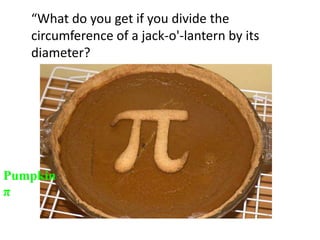
“What do you get if you divide the
   circumference of a jack-o'-lantern by its
   diameter?


Pumpkin
π
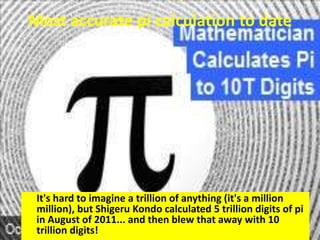
Most accurate pi calculation to date


 It's hard to imagine a trillion of anything (it's a million
 million), but Shigeru Kondo calculated 5 trillion digits of pi
 in August of 2011... and then blew that away with 10
 trillion digits!
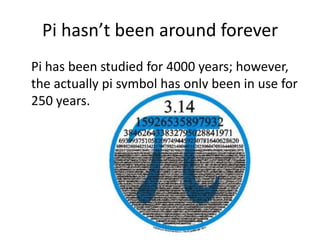
Pi hasn’t been around forever
Pi has been studied for 4000 years; however,
the actually pi symbol has only been in use for
250 years.
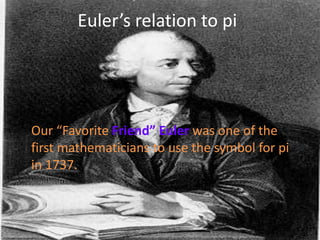
Euler’s relation to pi


Our “Favorite Friend” Euler was one of the
first mathematicians to use the symbol for pi
in 1737.
Common misconception of circles
Most people would say that a circle has no
corners, but it is more accurate to say that it
has an infinite number of corners.
Babylonian mathematicians


The first signs of pi were in Babylon in 2000
b.c. They used the fraction 25/8 or 3.125 as
pi, we’ve come a long way since then.
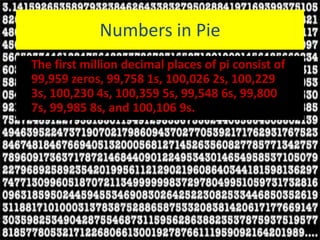
Numbers in Pie
The first million decimal places of pi consist of
99,959 zeros, 99,758 1s, 100,026 2s, 100,229
3s, 100,230 4s, 100,359 5s, 99,548 6s, 99,800
7s, 99,985 8s, and 100,106 9s.
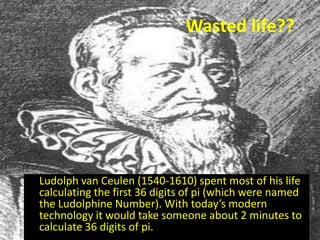
Wasted life??


Ludolph van Ceulen (1540-1610) spent most of his life
calculating the first 36 digits of pi (which were named
the Ludolphine Number). With today’s modern
technology it would take someone about 2 minutes to
calculate 36 digits of pi.
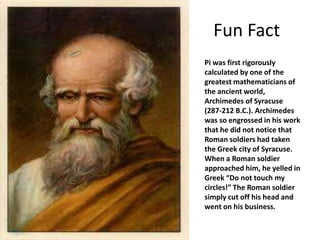
Fun Fact
Pi was first rigorously
calculated by one of the
greatest mathematicians of
the ancient world,
Archimedes of Syracuse
(287-212 B.C.). Archimedes
was so engrossed in his work
that he did not notice that
Roman soldiers had taken
the Greek city of Syracuse.
When a Roman soldier
approached him, he yelled in
Greek “Do not touch my
circles!” The Roman soldier
simply cut off his head and
went on his business.
Circumference is never exact
We can never truly measure the
circumference or the area of a circle because
we can never truly know the value of pi. Pi is
an irrational number, meaning its digits go on
forever in a seemingly random sequence

Pi tastic

  • 1.
  • 2.
  • 3.
    Did You Know? AlbertEinstein (one of the greatest physicists of all time) was born on pi day. Bet you didn’t know that.
  • 4.
    Pi is superlong If you were to print 1 billion digits of pi it would stretch from New York City to Kansas. That’s a long piece of paper.
  • 5.
    We use pimore than you think Pi occurs in hundreds of equations in many sciences including those describing the DNA double helix, a rainbow, ripples spreading from where a raindrop fell into water, superstrings, general relativity, normal distribution, distribution of primes, geometry problems, waves, navigation and much more.
  • 6.
    You think memorizing100 digits is hard? Hiroyuki Goto of Tokyo, Japan holds the world record for most memorized digits of pie with 42,195
  • 7.
    “What do youget if you divide the circumference of a jack-o'-lantern by its diameter? Pumpkin π
  • 8.
    Most accurate picalculation to date It's hard to imagine a trillion of anything (it's a million million), but Shigeru Kondo calculated 5 trillion digits of pi in August of 2011... and then blew that away with 10 trillion digits!
  • 9.
    Pi hasn’t beenaround forever Pi has been studied for 4000 years; however, the actually pi symbol has only been in use for 250 years.
  • 11.
    Euler’s relation topi Our “Favorite Friend” Euler was one of the first mathematicians to use the symbol for pi in 1737.
  • 12.
    Common misconception ofcircles Most people would say that a circle has no corners, but it is more accurate to say that it has an infinite number of corners.
  • 13.
    Babylonian mathematicians The firstsigns of pi were in Babylon in 2000 b.c. They used the fraction 25/8 or 3.125 as pi, we’ve come a long way since then.
  • 14.
    Numbers in Pie Thefirst million decimal places of pi consist of 99,959 zeros, 99,758 1s, 100,026 2s, 100,229 3s, 100,230 4s, 100,359 5s, 99,548 6s, 99,800 7s, 99,985 8s, and 100,106 9s.
  • 15.
    Wasted life?? Ludolph vanCeulen (1540-1610) spent most of his life calculating the first 36 digits of pi (which were named the Ludolphine Number). With today’s modern technology it would take someone about 2 minutes to calculate 36 digits of pi.
  • 16.
    Fun Fact Pi wasfirst rigorously calculated by one of the greatest mathematicians of the ancient world, Archimedes of Syracuse (287-212 B.C.). Archimedes was so engrossed in his work that he did not notice that Roman soldiers had taken the Greek city of Syracuse. When a Roman soldier approached him, he yelled in Greek “Do not touch my circles!” The Roman soldier simply cut off his head and went on his business.
  • 17.
    Circumference is neverexact We can never truly measure the circumference or the area of a circle because we can never truly know the value of pi. Pi is an irrational number, meaning its digits go on forever in a seemingly random sequence