PI (Π)
Name : Shama Singla
Class : X-B
Roll No. : 27
INDEX
 Introduction
 Value
 Type of number
 Formula
 History of Pi
 Uses
 Facts
 Pi day
INTRODUCTION
 Pi is a mathematical constant that is used to solve
problems generally related to circles.
 Its value is fixed .
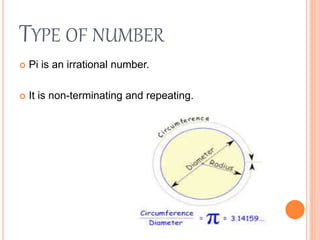
 Pi is basically the ratio of a circle's circumference to
its diameter.
VALUE
 Its value is fixed universally.
 It is 3.14 or 22/7.
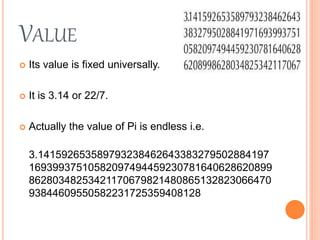
 Actually the value of Pi is endless i.e.
3.141592653589793238462643383279502884197
16939937510582097494459230781640628620899
86280348253421170679821480865132823066470
93844609550582231725359408128
TYPE OF NUMBER
 Pi is an irrational number.
 It is non-terminating and repeating.
FORMULA
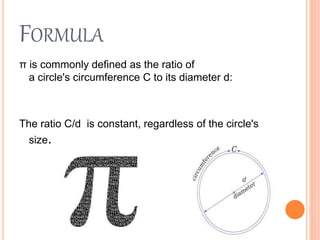
π is commonly defined as the ratio of
a circle's circumference C to its diameter d:
The ratio C/d is constant, regardless of the circle's
size.
HISTORY OF PI
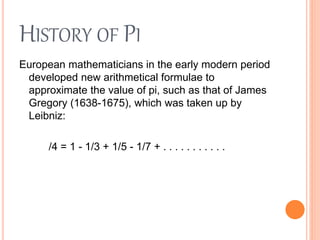
European mathematicians in the early modern period
developed new arithmetical formulae to
approximate the value of pi, such as that of James
Gregory (1638-1675), which was taken up by
Leibniz:
/4 = 1 - 1/3 + 1/5 - 1/7 + . . . . . . . . . . .
One problem with using this formula to calculate the
value of pi is that you would have to add 5 million
terms to work out a value of /4 that extends to 6 or
7 decimal places.
In 1706, another mathematician named John Machin
developed a refinement on Gregory's formula,
yielding the formula still used today by computer
programmers to compute pi.
Using this formula, an Englishman named William
Shanks calculated pi to 707 places, a labour of
many years, which he published in 1873.
USES
π appears in formulae for areas and volumes of
geometrical shapes based on circles, such
as ellipses, spheres, cones, and tori.
Below are some of the more common formulae that
involve π.
1. The circumference of a circle with radius r is 2πr.
2. The area of a circle with radius r is πr2.
3. The volume of a sphere with radius r is 4/3πr3.
4. The surface area of a sphere with radius r is 4πr2.
FACTS
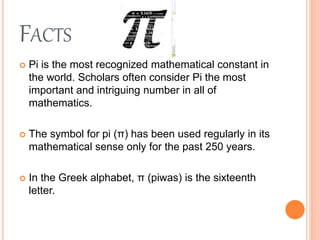
 Pi is the most recognized mathematical constant in
the world. Scholars often consider Pi the most
important and intriguing number in all of
mathematics.
 The symbol for pi (π) has been used regularly in its
mathematical sense only for the past 250 years.
 In the Greek alphabet, π (piwas) is the sixteenth
letter.
 Albert Einstein was born on Pi day.
 Hiroyuki Goto of Tokyo, Japan has the world record
for most memorized digits of pie with 42,195 digits
in d4ecimal place.
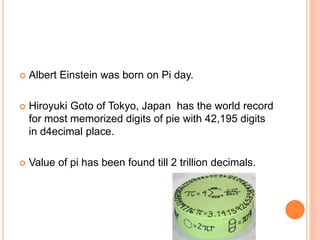
 Value of pi has been found till 2 trillion decimals.
PI DAY
Pi Day is an annual celebration of
the mathematical constant π. Pi
Day is observed on March 14
(3/14 in the month/day date
format) since 3, 1, and 4 are the
first three significant digits of π. In
2009, the United States House of
Representatives supported the
designation of Pi Day.
Pi Approximation Day is
observed on July 22 (22/7
in the day/month date
format), since
the fraction 22⁄7 is a common
approximation of π, which is
accurate to two decimal
places and dates
from Archimedes.
pi-150615072435-lva1-app6892 (1).pdf

pi-150615072435-lva1-app6892 (1).pdf

  • 1.
    PI (Π) Name :Shama Singla Class : X-B Roll No. : 27
  • 2.
    INDEX  Introduction  Value Type of number  Formula  History of Pi  Uses  Facts  Pi day
  • 3.
    INTRODUCTION  Pi isa mathematical constant that is used to solve problems generally related to circles.  Its value is fixed .  Pi is basically the ratio of a circle's circumference to its diameter.
  • 4.
    VALUE  Its valueis fixed universally.  It is 3.14 or 22/7.  Actually the value of Pi is endless i.e. 3.141592653589793238462643383279502884197 16939937510582097494459230781640628620899 86280348253421170679821480865132823066470 93844609550582231725359408128
  • 5.
    TYPE OF NUMBER Pi is an irrational number.  It is non-terminating and repeating.
  • 6.
    FORMULA π is commonlydefined as the ratio of a circle's circumference C to its diameter d: The ratio C/d is constant, regardless of the circle's size.
  • 7.
    HISTORY OF PI Europeanmathematicians in the early modern period developed new arithmetical formulae to approximate the value of pi, such as that of James Gregory (1638-1675), which was taken up by Leibniz: /4 = 1 - 1/3 + 1/5 - 1/7 + . . . . . . . . . . .
  • 8.
    One problem withusing this formula to calculate the value of pi is that you would have to add 5 million terms to work out a value of /4 that extends to 6 or 7 decimal places. In 1706, another mathematician named John Machin developed a refinement on Gregory's formula, yielding the formula still used today by computer programmers to compute pi. Using this formula, an Englishman named William Shanks calculated pi to 707 places, a labour of many years, which he published in 1873.
  • 9.
    USES π appears informulae for areas and volumes of geometrical shapes based on circles, such as ellipses, spheres, cones, and tori. Below are some of the more common formulae that involve π. 1. The circumference of a circle with radius r is 2πr. 2. The area of a circle with radius r is πr2. 3. The volume of a sphere with radius r is 4/3πr3. 4. The surface area of a sphere with radius r is 4πr2.
  • 10.
    FACTS  Pi isthe most recognized mathematical constant in the world. Scholars often consider Pi the most important and intriguing number in all of mathematics.  The symbol for pi (π) has been used regularly in its mathematical sense only for the past 250 years.  In the Greek alphabet, π (piwas) is the sixteenth letter.
  • 11.
     Albert Einsteinwas born on Pi day.  Hiroyuki Goto of Tokyo, Japan has the world record for most memorized digits of pie with 42,195 digits in d4ecimal place.  Value of pi has been found till 2 trillion decimals.
  • 12.
    PI DAY Pi Dayis an annual celebration of the mathematical constant π. Pi Day is observed on March 14 (3/14 in the month/day date format) since 3, 1, and 4 are the first three significant digits of π. In 2009, the United States House of Representatives supported the designation of Pi Day.
  • 13.
    Pi Approximation Dayis observed on July 22 (22/7 in the day/month date format), since the fraction 22⁄7 is a common approximation of π, which is accurate to two decimal places and dates from Archimedes.