π = 3.14159265358979323846264
The Definition of Pi
 The 16th letter of the Greek alphabet is P or p,
corresponding to the roman p.
.
The Definition of Pi
 The 16th letter of the Greek alphabet is P or p,
corresponding to the roman p.

 A number, represented by said letter,
expressing the ratio of the circumference of a
perfect circle to its diameter. The value of pi has
been calculated to many millions of decimal
places, to no readily apparent pattern.
Beginning of Pi
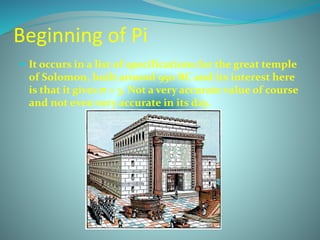
 It occurs in a list of specifications for the great temple
of Solomon, built around 950 BC and its interest here
is that it gives π = 3. Not a very accurate value of course
and not even very accurate in its day.
Beginning of Pi
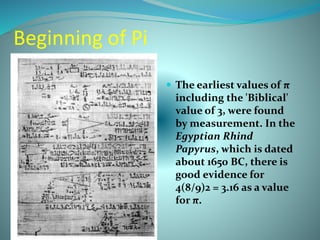
 The earliest values of π
including the 'Biblical'
value of 3, were found
by measurement. In the
Egyptian Rhind
Papyrus, which is dated
about 1650 BC, there is
good evidence for
4(8/9)2 = 3.16 as a value
for π.
What is pi ?
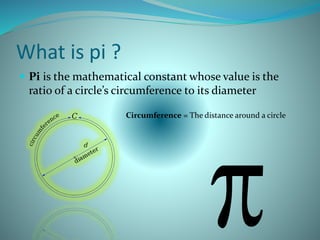
 Pi is the mathematical constant whose value is the
ratio of a circle’s circumference to its diameter
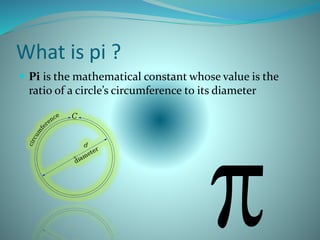
What is pi ?
 Pi is the mathematical constant whose value is the
ratio of a circle’s circumference to its diameter
What is pi ?
 Pi is the mathematical constant whose value is the
ratio of a circle’s circumference to its diameter
Circumference = The distance around a circle
What is pi ?
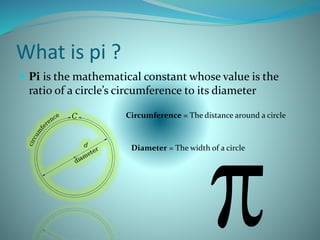
 Pi is the mathematical constant whose value is the
ratio of a circle’s circumference to its diameter
Circumference = The distance around a circle
Diameter = The width of a circle
Pi (rather than some other Greek
letter like Alpha or Omega) was
chosen as the letter to represent the
number 3.141592... because the letter
[ ] in Greek, pronounced like our
letter 'p', stands for 'perimeter
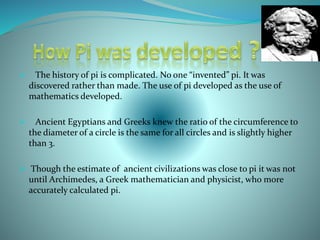
 The history of pi is complicated. No one “invented” pi. It was
discovered rather than made. The use of pi developed as the use of
mathematics developed.
 The history of pi is complicated. No one “invented” pi. It was
discovered rather than made. The use of pi developed as the use of
mathematics developed.
 Ancient Egyptians and Greeks knew the ratio of the circumference to
the diameter of a circle is the same for all circles and is slightly higher
than 3.
 The history of pi is complicated. No one “invented” pi. It was
discovered rather than made. The use of pi developed as the use of
mathematics developed.
 Ancient Egyptians and Greeks knew the ratio of the circumference to
the diameter of a circle is the same for all circles and is slightly higher
than 3.
 Though the estimate of ancient civilizations was close to pi it was not
until Archimedes, a Greek mathematician and physicist, who more
accurately calculated pi.
How Pi was developed.
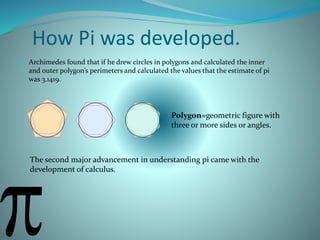
 Archimedes found that if he drew circles in polygons and calculated the inner
and outer polygon’s perimeters and calculated the values that the estimate of pi
was 3.1419.
The second major advancement in understanding pi came with the
development of calculus.
Polygon=geometric figure with
three or more sides or angles.
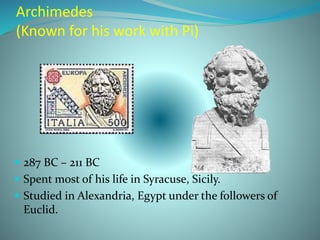
Archimedes
(Known for his work with Pi)
Archimedes
(Known for his work with Pi)
 287 BC – 211 BC
Archimedes
(Known for his work with Pi)
 287 BC – 211 BC
 Spent most of his life in Syracuse, Sicily.
Archimedes
(Known for his work with Pi)
 287 BC – 211 BC
 Spent most of his life in Syracuse, Sicily.
 Studied in Alexandria, Egypt under the followers of
Euclid.
Archimedes
(Known for his work with Pi)
 287 BC – 211 BC
 Spent most of his life in Syracuse, Sicily.
 Studied in Alexandria, Egypt under the followers of
Euclid.
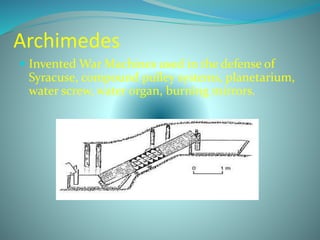
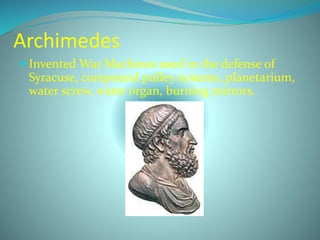
Archimedes
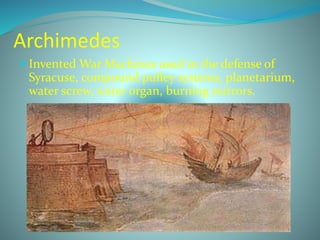
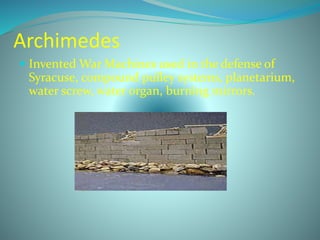
 Invented War Machines used in the defense of
Syracuse, compound pulley systems, planetarium,
water screw, water organ, burning mirrors.
Archimedes
 Invented War Machines used in the defense of
Syracuse, compound pulley systems, planetarium,
water screw, water organ, burning mirrors.
Archimedes
 Invented War Machines used in the defense of
Syracuse, compound pulley systems, planetarium,
water screw, water organ, burning mirrors.
Archimedes
 Invented War Machines used in the defense of
Syracuse, compound pulley systems, planetarium,
water screw, water organ, burning mirrors.
Archimedes
 Invented War Machines used in the defense of
Syracuse, compound pulley systems, planetarium,
water screw, water organ, burning mirrors.
The Notation of pi
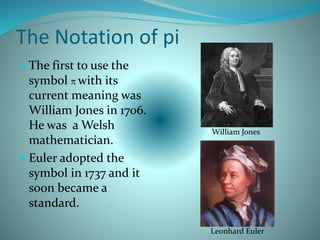
 The first to use the
symbol π with its
current meaning was
William Jones in 1706.
He was a Welsh
mathematician.
 Euler adopted the
symbol in 1737 and it
soon became a
standard.
William Jones
Leonhard Euler
Augustus de Morgan
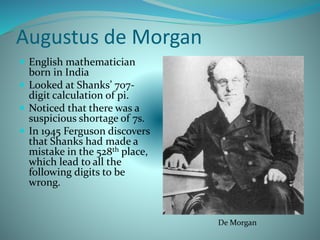
 English mathematician
born in India
 Looked at Shanks’ 707-
digit calculation of pi.
 Noticed that there was a
suspicious shortage of 7s.
 In 1945 Ferguson discovers
that Shanks had made a
mistake in the 528th place,
which lead to all the
following digits to be
wrong.
De Morgan
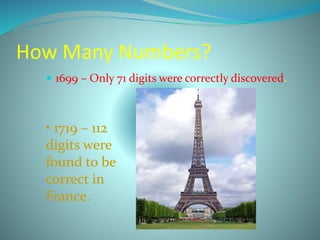
How Many Numbers?
 1699 – Only 71 digits were correctly discovered.
• 1719 – 112
digits were
found to be
correct in
France.
 There are no repeating parts in Pi. This means that
at no part during the 1.2411 trillion counts of Pi did
the pattern begin to repeat itself. It is the only
number like this in the world.
 There are no repeating parts in Pi. This means that
at no part during the 1.2411 trillion counts of Pi did
the pattern begin to repeat itself. It is the only
number like this in the world.
 So far, the largest count of Pi was done by a
supercomputer at the University of Tokyo in Sept
of 2002. 1.2411 trillion decimal digits were
calculated. That looks like 1,241,100,000,000
numbers
The area of a circle = πr2
Circumference of a Circle = πd or 2πr
The area of a circle = πr2
Circumference of a Circle = πd or 2πr
Surface Area of a Sphere, Volume of a
Cone, Cylinder and Sphere all are
formulas that involve π.
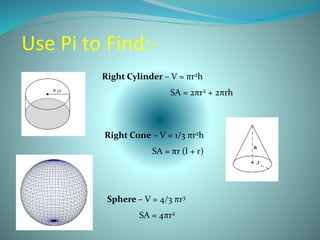
Use Pi to Find:-
Right Cylinder – V = πr2h
SA = 2πr2 + 2πrh
Right Cone – V = 1/3 πr2h
SA = πr (l + r)
Sphere – V = 4/3 πr3
SA = 4πr2
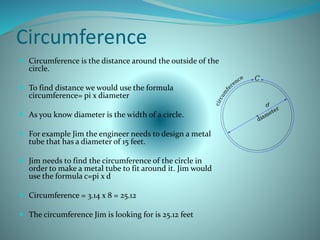
Circumference
 Circumference is the distance around the outside of the
circle.
 To find distance we would use the formula
circumference= pi x diameter
 As you know diameter is the width of a circle.
 For example Jim the engineer needs to design a metal
tube that has a diameter of 15 feet.
 Jim needs to find the circumference of the circle in
order to make a metal tube to fit around it. Jim would
use the formula c=pi x d
 Circumference = 3.14 x 8 = 25.12
 The circumference Jim is looking for is 25.12 feet.
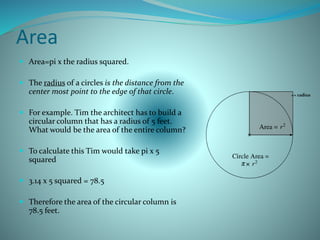
Area
 Area=pi x the radius squared.
 The radius of a circles is the distance from the
center most point to the edge of that circle.
 For example. Tim the architect has to build a
circular column that has a radius of 5 feet.
What would be the area of the entire column?
 To calculate this Tim would take pi x 5
squared
 3.14 x 5 squared = 78.5
 Therefore the area of the circular column is
78.5 feet.
<= radius
Volume
 To find volume we would use the formula volume = pi x radius squared x height.
 Tom the agriculturist needs to know the volume of a dipping vat for his cows to safely and
comfortably fit in.
 Before he can calculate he needs to know the radius and the height of the structure
before he can begin building.
 Tom measures the radius at 5 feet and the height at 9 feet.
 Therefore Tom’s formula would look like Volume=3.14 x 5 squared x 9
 3.14 x 5 squared x 9 = 706.5 feet cubed
 Some people were “dedicated” enough to actually
spend incredible amounts of time and effort
continuing the calculation of pi.
 1699: Sharp gets 71 correct digits
 1701: Machin gets 100 digits
 1719: de Lagny gets 112 correct digits
 1789: Vega gets 126 places
 1794: Vega gets 136 places
 1841: Rutherford gets 152 digits
 1853: Rutherford gets 440 digits
 1873: Shanks calculates 707 places of which 527
were correct
Pi in the Professions.
 Agricultural professionals may use pi to determine the area covered
by a pivot irrigation system or storage facility. The would use the
formula
Architects and construction works would both use the formula
for Area extensively. They also use the formula for volume
extensively to fill columns of concrete and to know the space a
building would take up.
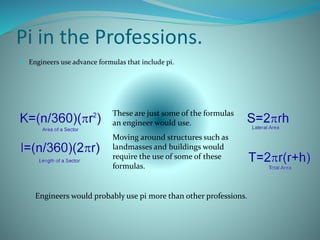
Pi in the Professions.
 Engineers use advance formulas that include pi.
These are just some of the formulas
an engineer would use.
Moving around structures such as
landmasses and buildings would
require the use of some of these
formulas.
Engineers would probably use pi more than other professions.
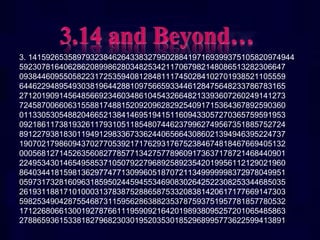
3. 141592653589793238462643383279502884197169399375105820974944
592307816406286208998628034825342117067982148086513282306647
093844609550582231725359408128481117450284102701938521105559
644622948954930381964428810975665933446128475648233786783165
271201909145648566923460348610454326648213393607260249141273
724587006606315588174881520920962829254091715364367892590360
011330530548820466521384146951941511609433057270365759591953
092186117381932611793105118548074462379962749567351885752724
891227938183011949129833673362440656643086021394946395224737
190702179860943702770539217176293176752384674818467669405132
000568127145263560827785771342757789609173637178721468440901
224953430146549585371050792279689258923542019956112129021960
864034418159813629774771309960518707211349999998372978049951
059731732816096318595024459455346908302642522308253344685035
261931188171010003137838752886587533208381420617177669147303
598253490428755468731159562863882353787593751957781857780532
171226806613001927876611195909216420198938095257201065485863
278865936153381827968230301952035301852968995773622599413891
Summary
 Pi is the mathematical constant whose value is the ratio of a circle’s
circumference to its diameter.
 The use of pi dates back to 1900 BC with ancient Egypt and Greece.
 It has taken 100’s of different algorithms to help estimate pi’s number because it
is a repeating decimal.
 Pi has been developed along with the development of mathematics.
 There are many different applications for pi.
 Many different professionals such as engineers, agriculturalist, and
construction workers use pi.
 Pi day is celebrated on 3/14 of every year because pi = 3.14 
 “Probably no symbol in
mathematics has evoked as
much mystery, romanticism,
misconception and human
interest as the number pi.”
William L. Schaaf, Nature and History of Pi
Created By :-
History

History

  • 2.
  • 3.
  • 4.
  • 5.
    The Definition ofPi  The 16th letter of the Greek alphabet is P or p, corresponding to the roman p. .
  • 6.
    The Definition ofPi  The 16th letter of the Greek alphabet is P or p, corresponding to the roman p.   A number, represented by said letter, expressing the ratio of the circumference of a perfect circle to its diameter. The value of pi has been calculated to many millions of decimal places, to no readily apparent pattern.
  • 8.
    Beginning of Pi It occurs in a list of specifications for the great temple of Solomon, built around 950 BC and its interest here is that it gives π = 3. Not a very accurate value of course and not even very accurate in its day.
  • 9.
    Beginning of Pi The earliest values of π including the 'Biblical' value of 3, were found by measurement. In the Egyptian Rhind Papyrus, which is dated about 1650 BC, there is good evidence for 4(8/9)2 = 3.16 as a value for π.
  • 10.
    What is pi?  Pi is the mathematical constant whose value is the ratio of a circle’s circumference to its diameter
  • 11.
    What is pi?  Pi is the mathematical constant whose value is the ratio of a circle’s circumference to its diameter
  • 12.
    What is pi?  Pi is the mathematical constant whose value is the ratio of a circle’s circumference to its diameter Circumference = The distance around a circle
  • 13.
    What is pi?  Pi is the mathematical constant whose value is the ratio of a circle’s circumference to its diameter Circumference = The distance around a circle Diameter = The width of a circle
  • 14.
    Pi (rather thansome other Greek letter like Alpha or Omega) was chosen as the letter to represent the number 3.141592... because the letter [ ] in Greek, pronounced like our letter 'p', stands for 'perimeter
  • 16.
     The historyof pi is complicated. No one “invented” pi. It was discovered rather than made. The use of pi developed as the use of mathematics developed.
  • 17.
     The historyof pi is complicated. No one “invented” pi. It was discovered rather than made. The use of pi developed as the use of mathematics developed.  Ancient Egyptians and Greeks knew the ratio of the circumference to the diameter of a circle is the same for all circles and is slightly higher than 3.
  • 18.
     The historyof pi is complicated. No one “invented” pi. It was discovered rather than made. The use of pi developed as the use of mathematics developed.  Ancient Egyptians and Greeks knew the ratio of the circumference to the diameter of a circle is the same for all circles and is slightly higher than 3.  Though the estimate of ancient civilizations was close to pi it was not until Archimedes, a Greek mathematician and physicist, who more accurately calculated pi.
  • 19.
    How Pi wasdeveloped.  Archimedes found that if he drew circles in polygons and calculated the inner and outer polygon’s perimeters and calculated the values that the estimate of pi was 3.1419. The second major advancement in understanding pi came with the development of calculus. Polygon=geometric figure with three or more sides or angles.
  • 20.
  • 21.
    Archimedes (Known for hiswork with Pi)  287 BC – 211 BC
  • 22.
    Archimedes (Known for hiswork with Pi)  287 BC – 211 BC  Spent most of his life in Syracuse, Sicily.
  • 23.
    Archimedes (Known for hiswork with Pi)  287 BC – 211 BC  Spent most of his life in Syracuse, Sicily.  Studied in Alexandria, Egypt under the followers of Euclid.
  • 24.
    Archimedes (Known for hiswork with Pi)  287 BC – 211 BC  Spent most of his life in Syracuse, Sicily.  Studied in Alexandria, Egypt under the followers of Euclid.
  • 25.
    Archimedes  Invented WarMachines used in the defense of Syracuse, compound pulley systems, planetarium, water screw, water organ, burning mirrors.
  • 26.
    Archimedes  Invented WarMachines used in the defense of Syracuse, compound pulley systems, planetarium, water screw, water organ, burning mirrors.
  • 27.
    Archimedes  Invented WarMachines used in the defense of Syracuse, compound pulley systems, planetarium, water screw, water organ, burning mirrors.
  • 28.
    Archimedes  Invented WarMachines used in the defense of Syracuse, compound pulley systems, planetarium, water screw, water organ, burning mirrors.
  • 29.
    Archimedes  Invented WarMachines used in the defense of Syracuse, compound pulley systems, planetarium, water screw, water organ, burning mirrors.
  • 30.
    The Notation ofpi  The first to use the symbol π with its current meaning was William Jones in 1706. He was a Welsh mathematician.  Euler adopted the symbol in 1737 and it soon became a standard. William Jones Leonhard Euler
  • 31.
    Augustus de Morgan English mathematician born in India  Looked at Shanks’ 707- digit calculation of pi.  Noticed that there was a suspicious shortage of 7s.  In 1945 Ferguson discovers that Shanks had made a mistake in the 528th place, which lead to all the following digits to be wrong. De Morgan
  • 32.
    How Many Numbers? 1699 – Only 71 digits were correctly discovered. • 1719 – 112 digits were found to be correct in France.
  • 34.
     There areno repeating parts in Pi. This means that at no part during the 1.2411 trillion counts of Pi did the pattern begin to repeat itself. It is the only number like this in the world.
  • 35.
     There areno repeating parts in Pi. This means that at no part during the 1.2411 trillion counts of Pi did the pattern begin to repeat itself. It is the only number like this in the world.  So far, the largest count of Pi was done by a supercomputer at the University of Tokyo in Sept of 2002. 1.2411 trillion decimal digits were calculated. That looks like 1,241,100,000,000 numbers
  • 37.
    The area ofa circle = πr2
  • 38.
    The area ofa circle = πr2 Circumference of a Circle = πd or 2πr
  • 39.
    The area ofa circle = πr2 Circumference of a Circle = πd or 2πr Surface Area of a Sphere, Volume of a Cone, Cylinder and Sphere all are formulas that involve π.
  • 40.
    Use Pi toFind:- Right Cylinder – V = πr2h SA = 2πr2 + 2πrh Right Cone – V = 1/3 πr2h SA = πr (l + r) Sphere – V = 4/3 πr3 SA = 4πr2
  • 41.
    Circumference  Circumference isthe distance around the outside of the circle.  To find distance we would use the formula circumference= pi x diameter  As you know diameter is the width of a circle.  For example Jim the engineer needs to design a metal tube that has a diameter of 15 feet.  Jim needs to find the circumference of the circle in order to make a metal tube to fit around it. Jim would use the formula c=pi x d  Circumference = 3.14 x 8 = 25.12  The circumference Jim is looking for is 25.12 feet.
  • 42.
    Area  Area=pi xthe radius squared.  The radius of a circles is the distance from the center most point to the edge of that circle.  For example. Tim the architect has to build a circular column that has a radius of 5 feet. What would be the area of the entire column?  To calculate this Tim would take pi x 5 squared  3.14 x 5 squared = 78.5  Therefore the area of the circular column is 78.5 feet. <= radius
  • 43.
    Volume  To findvolume we would use the formula volume = pi x radius squared x height.  Tom the agriculturist needs to know the volume of a dipping vat for his cows to safely and comfortably fit in.  Before he can calculate he needs to know the radius and the height of the structure before he can begin building.  Tom measures the radius at 5 feet and the height at 9 feet.  Therefore Tom’s formula would look like Volume=3.14 x 5 squared x 9  3.14 x 5 squared x 9 = 706.5 feet cubed
  • 44.
     Some peoplewere “dedicated” enough to actually spend incredible amounts of time and effort continuing the calculation of pi.  1699: Sharp gets 71 correct digits  1701: Machin gets 100 digits  1719: de Lagny gets 112 correct digits  1789: Vega gets 126 places  1794: Vega gets 136 places  1841: Rutherford gets 152 digits  1853: Rutherford gets 440 digits  1873: Shanks calculates 707 places of which 527 were correct
  • 45.
    Pi in theProfessions.  Agricultural professionals may use pi to determine the area covered by a pivot irrigation system or storage facility. The would use the formula Architects and construction works would both use the formula for Area extensively. They also use the formula for volume extensively to fill columns of concrete and to know the space a building would take up.
  • 46.
    Pi in theProfessions.  Engineers use advance formulas that include pi. These are just some of the formulas an engineer would use. Moving around structures such as landmasses and buildings would require the use of some of these formulas. Engineers would probably use pi more than other professions.
  • 47.
    3. 141592653589793238462643383279502884197169399375105820974944 592307816406286208998628034825342117067982148086513282306647 093844609550582231725359408128481117450284102701938521105559 644622948954930381964428810975665933446128475648233786783165 271201909145648566923460348610454326648213393607260249141273 724587006606315588174881520920962829254091715364367892590360 011330530548820466521384146951941511609433057270365759591953 092186117381932611793105118548074462379962749567351885752724 891227938183011949129833673362440656643086021394946395224737 190702179860943702770539217176293176752384674818467669405132 000568127145263560827785771342757789609173637178721468440901 224953430146549585371050792279689258923542019956112129021960 864034418159813629774771309960518707211349999998372978049951 059731732816096318595024459455346908302642522308253344685035 261931188171010003137838752886587533208381420617177669147303 598253490428755468731159562863882353787593751957781857780532 171226806613001927876611195909216420198938095257201065485863 278865936153381827968230301952035301852968995773622599413891
  • 48.
    Summary  Pi isthe mathematical constant whose value is the ratio of a circle’s circumference to its diameter.  The use of pi dates back to 1900 BC with ancient Egypt and Greece.  It has taken 100’s of different algorithms to help estimate pi’s number because it is a repeating decimal.  Pi has been developed along with the development of mathematics.  There are many different applications for pi.  Many different professionals such as engineers, agriculturalist, and construction workers use pi.  Pi day is celebrated on 3/14 of every year because pi = 3.14 
  • 49.
     “Probably nosymbol in mathematics has evoked as much mystery, romanticism, misconception and human interest as the number pi.” William L. Schaaf, Nature and History of Pi
  • 50.