Peer instructions questions that support expert-like thinking 
1 
Peer instruction questions to support expert-like thinking 
Peter Newbury Center for Teaching Development, University of California, San Diego 
pnewbury@ucsd.edu @polarisdotca 
ctd.ucsd.edu 
resources: see Weekly Workshops at ctd.ucsd.edu 
please sign in 
try to sit with others in your subject area
How familiar are you with peer instruction and clickers? 
A)I’ve heard about it but never used it 
B)I’ve used it once or twice 
C)I use it every time I teach 
D)I can’t imagine teaching without clickers 
Peer instruction questions to support expert-like thinking 
2
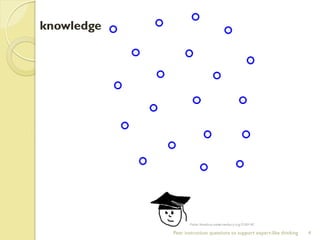
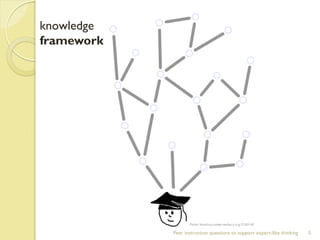
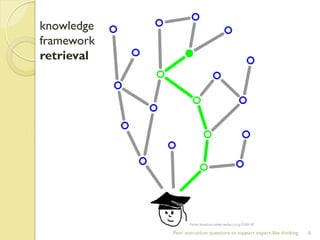
What is expertise? [1] 
To develop competence in an area of inquiry, student must 
(a)have a deep foundation of factual knowledge 
(b)understand facts and ideas in the context of a conceptual framework, and 
(c)organize knowledge in ways that facilitate retrieval and application 
Peer instruction questions to support expert-like thinking 
3
Peer instruction questions to support expert-like thinking 
4 
knowledge
Peer instruction questions to support expert-like thinking 
5 
knowledge framework
6 
knowledge 
framework 
retrieval 
Peer instruction questions to support expert-like thinking
Peer instruction questions to support expert-like thinking 
What the best college teachers do[2] 
More than anything else, the best teachers try to create a natural critical learning environment: natural because students encounter skills, habits, attitudes, and information they are trying to learn embedded in questions and tasks they find fascinating – authentic tasks that arouse curiosity and become intrinsically interesting, critical because students learn to think critically, to reason from evidence, to examine the quality of their reasoning using a variety of intellectual standards, to make improvements while thinking, and to ask probing and insightful questions about the thinking of other people. 
7
In natural critical learning environments 
students encounter safe yet challenging conditions in which they can try, fail, receive feedback, and try again without facing a summative evaluation.[2] 
Peer instruction questions to support expert-like thinking 
8 
try 
fail 
receive feedback
Peer instruction 
Pause to let students think, provide a question for them to think about, and provide prompts so they have the conversations you want them to have. 
Peer instruction questions to support expert-like thinking 
9
Supporting expert-like thinking: Introductory Biology class 
The molecules making up the dry mass of wood in a tree come from 
A)sunlight 
B)the air 
C)the seed 
D)the soil 
Peer instruction questions to support expert-like thinking 
10 
(Question: Bill Wood) 
(Image: Autumn? No Doubt! by blavandmaster on flickr CC)
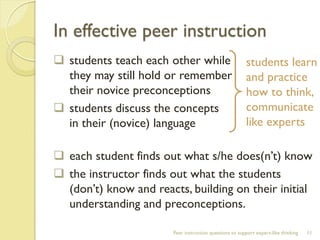
In effective peer instruction 
students teach each other while they may still hold or remember their novice preconceptions 
students discuss the concepts in their (novice) language 
each student finds out what s/he does(n’t) know 
the instructor finds out what the students (don’t) know and reacts, building on their initial understanding and preconceptions. 
Peer instruction questions to support expert-like thinking 
11 
students learn and practice how to think, communicate like experts
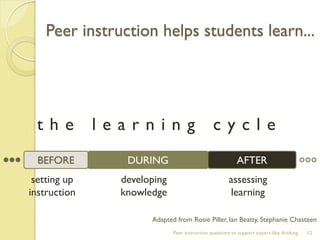
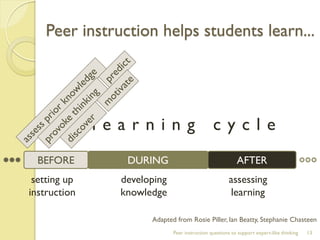
the learning cycle 
Peer instruction helps students learn... 
Peer instruction questions to support expert-like thinking 
12 
BEFORE 
DURING 
AFTER 
setting up instruction 
developing 
knowledge 
assessing 
learning 
Adapted from Rosie Piller, Ian Beatty, Stephanie Chasteen
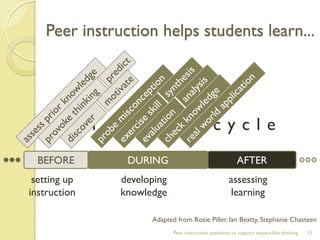
the learning cycle 
Peer instruction helps students learn... 
Peer instruction questions to support expert-like thinking 
13 
BEFORE 
DURING 
AFTER 
setting up 
instruction 
developing 
knowledge 
assessing 
learning 
Adapted from Rosie Piller, Ian Beatty, Stephanie Chasteen
the learning cycle 
Peer instruction helps students learn... 
Peer instruction questions to support expert-like thinking 
14 
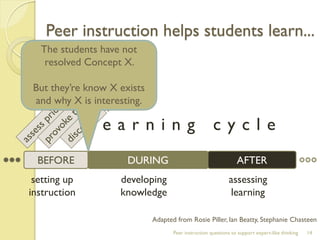
BEFORE 
DURING 
AFTER 
setting up 
instruction 
developing 
knowledge 
assessing 
learning 
Adapted from Rosie Piller, Ian Beatty, Stephanie Chasteen 
The students have not resolved Concept X. 
But they’re know X exists and why X is interesting.
the learning cycle 
Peer instruction helps students learn... 
Peer instruction questions to support expert-like thinking 
15 
BEFORE 
DURING 
AFTER 
setting up 
instruction 
developing 
knowledge 
assessing 
learning 
Adapted from Rosie Piller, Ian Beatty, Stephanie Chasteen
the learning cycle 
Peer instruction helps students learn... 
Peer instruction questions to support expert-like thinking 
16 
BEFORE 
DURING 
AFTER 
setting up 
instruction 
developing 
knowledge 
assessing 
learning 
Adapted from Rosie Piller, Ian Beatty, Stephanie Chasteen 
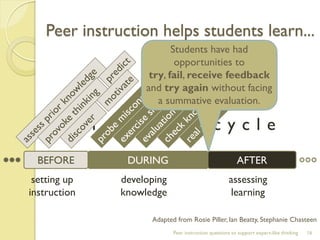
Students have had opportunities to try, fail, receive feedback and try again without facing a summative evaluation.
the learning cycle 
Peer instruction helps students learn... 
Peer instruction questions to support expert-like thinking 
17 
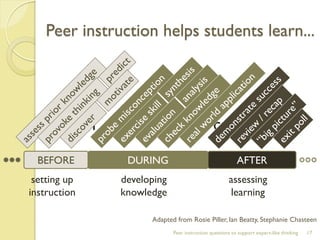
BEFORE 
DURING 
AFTER 
setting up 
instruction 
developing 
knowledge 
assessing 
learning 
Adapted from Rosie Piller, Ian Beatty, Stephanie Chasteen
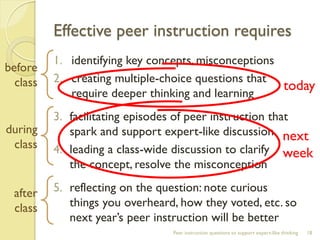
Effective peer instruction requires 
1.identifying key concepts, misconceptions 
2.creating multiple-choice questions that require deeper thinking and learning 
3.facilitating episodes of peer instruction that spark and support expert-like discussion 
4.leading a class-wide discussion to clarify the concept, resolve the misconception 
5.reflecting on the question: note curious things you overheard, how they voted, etc. so next year’s peer instruction will be better 
Peer instruction questions to support expert-like thinking 
18 
before 
class 
during 
class 
after 
class 
today 
next week
Peer instruction questions to support expert-like thinking 
19 
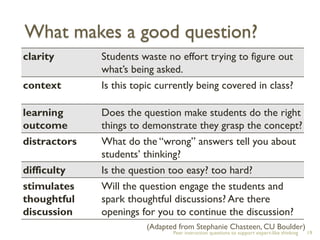
What makes a good question? 
clarity 
Students waste no effort trying to figure out what’s being asked. 
context 
Is this topic currently being covered in class? 
learning outcome 
Does the question make students do the right things to demonstrate they grasp the concept? 
distractors 
What do the “wrong” answers tell you about students’ thinking? 
difficulty 
Is the question too easy? too hard? 
stimulates thoughtful discussion 
Will the question engage the students and spark thoughtful discussions? Are there openings for you to continue the discussion? 
(Adapted from Stephanie Chasteen, CU Boulder)
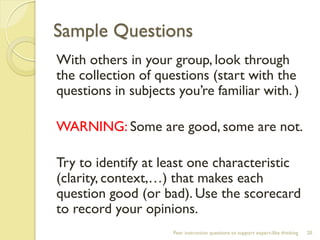
Sample Questions 
With others in your group, look through the collection of questions (start with the questions in subjects you’re familiar with. ) 
WARNING: Some are good, some are not. 
Try to identify at least one characteristic (clarity, context,…) that makes each question good (or bad). Use the scorecard to record your opinions. 
Peer instruction questions to support expert-like thinking 
20
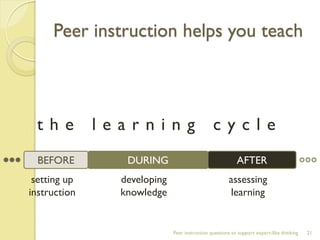
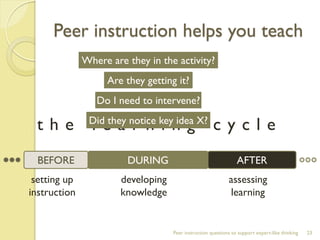
Peer instruction helps you teach 
Peer instruction questions to support expert-like thinking 
21 
BEFORE 
DURING 
AFTER 
setting up 
instruction 
developing knowledge 
assessing 
learning 
the learning cycle
the learning cycle 
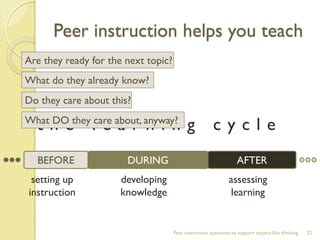
Peer instruction helps you teach 
Peer instruction questions to support expert-like thinking 
22 
BEFORE 
DURING 
AFTER 
setting up 
instruction 
developing 
knowledge 
assessing 
learning 
Do they care about this? 
Are they ready for the next topic? 
What DO they care about, anyway? 
What do they already know?
the learning cycle 
Did they notice key idea X? 
Where are they in the activity? 
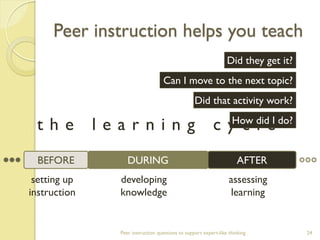
Peer instruction helps you teach 
Peer instruction questions to support expert-like thinking 
23 
BEFORE 
DURING 
AFTER 
setting up 
instruction 
developing 
knowledge 
assessing 
learning 
Are they getting it? 
Do I need to intervene?
the learning cycle 
How did I do? 
Did they get it? 
Peer instruction helps you teach 
Peer instruction questions to support expert-like thinking 
24 
BEFORE 
DURING 
AFTER 
setting up instruction 
developing 
knowledge 
assessing 
learning 
Can I move to the next topic? 
Did that activity work?
Resources 
1.Bain, K. (2004). What the best college teachers do. Cambridge, MA: Harvard University Press. 
2.National Research Council (2000). How People Learn: Brain, Mind, Experience, and School: Expanded Edition. J.D. Bransford, A.L Brown & R.R. Cocking (Eds.),Washington, DC: The National Academies Press. 
3.Colvin, G. (2006, October 19). What it takes to be great. Fortune, 88- 96. Available at money.cnn.com/magazines/fortune/fortune_archive/2006/10/30/8391794/index.htm 
4.Peer instruction resources from the Carl Wieman Science Education Initiative at the Univ. of British Columbia : http://www.cwsei.ubc.ca/resources/clickers.htm 
5.Videos by the Science Education Initiative at the Univ. of Colorado (Boulder) provide excellent background for using clickers: http://www.cwsei.ubc.ca/resources/SEI_video.html 
6.Peer Instruction network blog.peerinstruction.net 
Peer instruction questions to support expert-like thinking 
25

CTD Fa14 Weekly Workshop: Peer instruction questions that support expert-like thinking

  • 1.
    Peer instructions questionsthat support expert-like thinking 1 Peer instruction questions to support expert-like thinking Peter Newbury Center for Teaching Development, University of California, San Diego pnewbury@ucsd.edu @polarisdotca ctd.ucsd.edu resources: see Weekly Workshops at ctd.ucsd.edu please sign in try to sit with others in your subject area
  • 2.
    How familiar areyou with peer instruction and clickers? A)I’ve heard about it but never used it B)I’ve used it once or twice C)I use it every time I teach D)I can’t imagine teaching without clickers Peer instruction questions to support expert-like thinking 2
  • 3.
    What is expertise?[1] To develop competence in an area of inquiry, student must (a)have a deep foundation of factual knowledge (b)understand facts and ideas in the context of a conceptual framework, and (c)organize knowledge in ways that facilitate retrieval and application Peer instruction questions to support expert-like thinking 3
  • 4.
    Peer instruction questionsto support expert-like thinking 4 knowledge
  • 5.
    Peer instruction questionsto support expert-like thinking 5 knowledge framework
  • 6.
    6 knowledge framework retrieval Peer instruction questions to support expert-like thinking
  • 7.
    Peer instruction questionsto support expert-like thinking What the best college teachers do[2] More than anything else, the best teachers try to create a natural critical learning environment: natural because students encounter skills, habits, attitudes, and information they are trying to learn embedded in questions and tasks they find fascinating – authentic tasks that arouse curiosity and become intrinsically interesting, critical because students learn to think critically, to reason from evidence, to examine the quality of their reasoning using a variety of intellectual standards, to make improvements while thinking, and to ask probing and insightful questions about the thinking of other people. 7
  • 8.
    In natural criticallearning environments students encounter safe yet challenging conditions in which they can try, fail, receive feedback, and try again without facing a summative evaluation.[2] Peer instruction questions to support expert-like thinking 8 try fail receive feedback
  • 9.
    Peer instruction Pauseto let students think, provide a question for them to think about, and provide prompts so they have the conversations you want them to have. Peer instruction questions to support expert-like thinking 9
  • 10.
    Supporting expert-like thinking:Introductory Biology class The molecules making up the dry mass of wood in a tree come from A)sunlight B)the air C)the seed D)the soil Peer instruction questions to support expert-like thinking 10 (Question: Bill Wood) (Image: Autumn? No Doubt! by blavandmaster on flickr CC)
  • 11.
    In effective peerinstruction students teach each other while they may still hold or remember their novice preconceptions students discuss the concepts in their (novice) language each student finds out what s/he does(n’t) know the instructor finds out what the students (don’t) know and reacts, building on their initial understanding and preconceptions. Peer instruction questions to support expert-like thinking 11 students learn and practice how to think, communicate like experts
  • 12.
    the learning cycle Peer instruction helps students learn... Peer instruction questions to support expert-like thinking 12 BEFORE DURING AFTER setting up instruction developing knowledge assessing learning Adapted from Rosie Piller, Ian Beatty, Stephanie Chasteen
  • 13.
    the learning cycle Peer instruction helps students learn... Peer instruction questions to support expert-like thinking 13 BEFORE DURING AFTER setting up instruction developing knowledge assessing learning Adapted from Rosie Piller, Ian Beatty, Stephanie Chasteen
  • 14.
    the learning cycle Peer instruction helps students learn... Peer instruction questions to support expert-like thinking 14 BEFORE DURING AFTER setting up instruction developing knowledge assessing learning Adapted from Rosie Piller, Ian Beatty, Stephanie Chasteen The students have not resolved Concept X. But they’re know X exists and why X is interesting.
  • 15.
    the learning cycle Peer instruction helps students learn... Peer instruction questions to support expert-like thinking 15 BEFORE DURING AFTER setting up instruction developing knowledge assessing learning Adapted from Rosie Piller, Ian Beatty, Stephanie Chasteen
  • 16.
    the learning cycle Peer instruction helps students learn... Peer instruction questions to support expert-like thinking 16 BEFORE DURING AFTER setting up instruction developing knowledge assessing learning Adapted from Rosie Piller, Ian Beatty, Stephanie Chasteen Students have had opportunities to try, fail, receive feedback and try again without facing a summative evaluation.
  • 17.
    the learning cycle Peer instruction helps students learn... Peer instruction questions to support expert-like thinking 17 BEFORE DURING AFTER setting up instruction developing knowledge assessing learning Adapted from Rosie Piller, Ian Beatty, Stephanie Chasteen
  • 18.
    Effective peer instructionrequires 1.identifying key concepts, misconceptions 2.creating multiple-choice questions that require deeper thinking and learning 3.facilitating episodes of peer instruction that spark and support expert-like discussion 4.leading a class-wide discussion to clarify the concept, resolve the misconception 5.reflecting on the question: note curious things you overheard, how they voted, etc. so next year’s peer instruction will be better Peer instruction questions to support expert-like thinking 18 before class during class after class today next week
  • 19.
    Peer instruction questionsto support expert-like thinking 19 What makes a good question? clarity Students waste no effort trying to figure out what’s being asked. context Is this topic currently being covered in class? learning outcome Does the question make students do the right things to demonstrate they grasp the concept? distractors What do the “wrong” answers tell you about students’ thinking? difficulty Is the question too easy? too hard? stimulates thoughtful discussion Will the question engage the students and spark thoughtful discussions? Are there openings for you to continue the discussion? (Adapted from Stephanie Chasteen, CU Boulder)
  • 20.
    Sample Questions Withothers in your group, look through the collection of questions (start with the questions in subjects you’re familiar with. ) WARNING: Some are good, some are not. Try to identify at least one characteristic (clarity, context,…) that makes each question good (or bad). Use the scorecard to record your opinions. Peer instruction questions to support expert-like thinking 20
  • 21.
    Peer instruction helpsyou teach Peer instruction questions to support expert-like thinking 21 BEFORE DURING AFTER setting up instruction developing knowledge assessing learning the learning cycle
  • 22.
    the learning cycle Peer instruction helps you teach Peer instruction questions to support expert-like thinking 22 BEFORE DURING AFTER setting up instruction developing knowledge assessing learning Do they care about this? Are they ready for the next topic? What DO they care about, anyway? What do they already know?
  • 23.
    the learning cycle Did they notice key idea X? Where are they in the activity? Peer instruction helps you teach Peer instruction questions to support expert-like thinking 23 BEFORE DURING AFTER setting up instruction developing knowledge assessing learning Are they getting it? Do I need to intervene?
  • 24.
    the learning cycle How did I do? Did they get it? Peer instruction helps you teach Peer instruction questions to support expert-like thinking 24 BEFORE DURING AFTER setting up instruction developing knowledge assessing learning Can I move to the next topic? Did that activity work?
  • 25.
    Resources 1.Bain, K.(2004). What the best college teachers do. Cambridge, MA: Harvard University Press. 2.National Research Council (2000). How People Learn: Brain, Mind, Experience, and School: Expanded Edition. J.D. Bransford, A.L Brown & R.R. Cocking (Eds.),Washington, DC: The National Academies Press. 3.Colvin, G. (2006, October 19). What it takes to be great. Fortune, 88- 96. Available at money.cnn.com/magazines/fortune/fortune_archive/2006/10/30/8391794/index.htm 4.Peer instruction resources from the Carl Wieman Science Education Initiative at the Univ. of British Columbia : http://www.cwsei.ubc.ca/resources/clickers.htm 5.Videos by the Science Education Initiative at the Univ. of Colorado (Boulder) provide excellent background for using clickers: http://www.cwsei.ubc.ca/resources/SEI_video.html 6.Peer Instruction network blog.peerinstruction.net Peer instruction questions to support expert-like thinking 25