Physiological
Homeostasis
Dr Sutapa Datta
Assistant Professor of Zoology
dattasutapa@gmail.com
https://www.slideshare.net/SutapaDatta6
1dattasutapa@gmail.com
PART-1
Homeostasis
• dynamic physiological processes
• maintain a stable internal milieu suitable for
normal function.
• internal variables (like body temperature, blood
pressure, blood sugar, heart rate) are kept within
a range of values (set point)
• a stimulus –changes one of the internal variables-
-- creates a signal that the body will respond to---
-- carry out homeostasis.
2dattasutapa@gmail.com
• Homeostasis is the tendency of biological systems to
maintain a relatively constant internal environment
with the change in both internal and external
environment by continuously interacting with body’s
own control systems.
3dattasutapa@gmail.com
•The constant internal environment is maintained by feedback
mechanisms. A feedback happens after a change in physiological
process. A physiological process is a series of events where change in
any component can regulate the process. Thus forming a feedback
loop.
Feedback loop
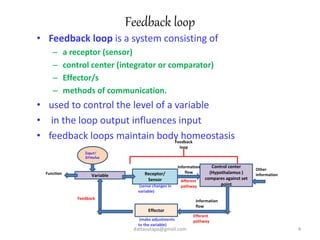
• Feedback loop is a system consisting of
– a receptor (sensor)
– control center (integrator or comparator)
– Effector/s
– methods of communication.
• used to control the level of a variable
• in the loop output influences input
• feedback loops maintain body homeostasis
4dattasutapa@gmail.com
Input/
Stimulus
Receptor/
Sensor
Effector
Control center
(Hypothalamus )
compares against set
point
VariableFunction
Other
information
Information
flow
Information
flow
Feedback
loop
Afferent
pathway
Efferent
pathway
Feedback
(make adjustments
to the variable)
(sense changes in
variable)
Feedback loops:
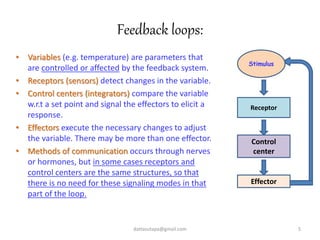
• Variables (e.g. temperature) are parameters that
are controlled or affected by the feedback system.
• Receptors (sensors) detect changes in the variable.
• Control centers (integrators) compare the variable
w.r.t a set point and signal the effectors to elicit a
response.
• Effectors execute the necessary changes to adjust
the variable. There may be more than one effector.
• Methods of communication occurs through nerves
or hormones, but in some cases receptors and
control centers are the same structures, so that
there is no need for these signaling modes in that
part of the loop.
5dattasutapa@gmail.com
Stimulus
Receptor
Control
center
Effector
• Positive feedback loops
• Negative feedback loops
Types:
6dattasutapa@gmail.com
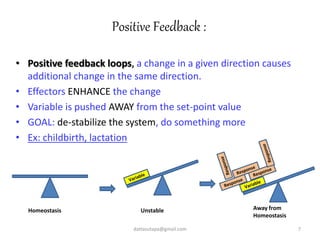
• Positive feedback loops, a change in a given direction causes
additional change in the same direction.
• Effectors ENHANCE the change
• Variable is pushed AWAY from the set-point value
• GOAL: de-stabilize the system, do something more
• Ex: childbirth, lactation
dattasutapa@gmail.com 7
Homeostasis Unstable Away from
Homeostasis
Positive Feedback :
•Negative feedback loops, a change in a given direction causes
change in the opposite direction.
•Effectors OPPOSE the change
•Variable is pushed BACK toward the set-point value
•GOAL: stabilize the system, counteract the stimulus
•Ex: thermoregulation, blood sugar
Variable
Counter
response
Homeostasis Back to
Homeostasis
Unstable
negative Feedback :
8dattasutapa@gmail.com
dattasutapa@gmail.com 9
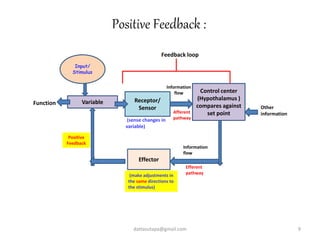
Input/
Stimulus
Receptor/
Sensor
Effector
Control center
(Hypothalamus )
compares against
set point
VariableFunction
Other
information
Information
flow
Information
flow
Feedback loop
Afferent
pathway
Efferent
pathway
Positive
Feedback
(make adjustments in
the same directions to
the stimulus)
(sense changes in
variable)
Positive Feedback :
dattasutapa@gmail.com 10
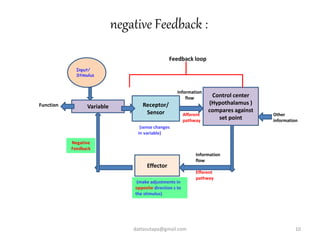
Input/
Stimulus
Receptor/
Sensor
Effector
Control center
(Hypothalamus )
compares against
set point
VariableFunction
Other
information
Information
flow
Information
flow
Feedback loop
Afferent
pathway
Efferent
pathway
Negative
Feedback
(make adjustments in
opposite direction s to
the stimulus)
(sense changes
in variable)
negative Feedback :
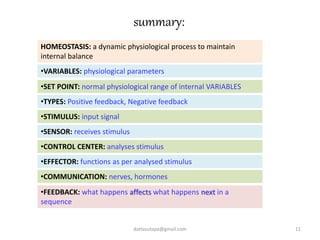
summary:
•SET POINT: normal physiological range of internal VARIABLES
•TYPES: Positive feedback, Negative feedback
HOMEOSTASIS: a dynamic physiological process to maintain
internal balance
•VARIABLES: physiological parameters
•STIMULUS: input signal
•SENSOR: receives stimulus
•CONTROL CENTER: analyses stimulus
•EFFECTOR: functions as per analysed stimulus
•COMMUNICATION: nerves, hormones
•FEEDBACK: what happens affects what happens next in a
sequence
11dattasutapa@gmail.com
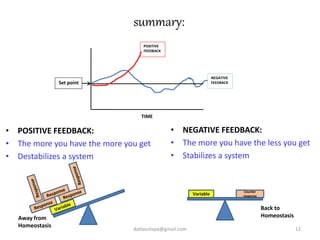
• POSITIVE FEEDBACK:
• The more you have the more you get
• Destabilizes a system
• NEGATIVE FEEDBACK:
• The more you have the less you get
• Stabilizes a system
summary:
Variable
Counter
response
Away from
Homeostasis
Back to
Homeostasis
Set point
NEGATIVE
FEEDBACK
POSITIVE
FEEDBACK
TIME
12dattasutapa@gmail.com

Physiological homeostasis part 1

  • 1.
    Physiological Homeostasis Dr Sutapa Datta AssistantProfessor of Zoology dattasutapa@gmail.com https://www.slideshare.net/SutapaDatta6 1dattasutapa@gmail.com PART-1
  • 2.
    Homeostasis • dynamic physiologicalprocesses • maintain a stable internal milieu suitable for normal function. • internal variables (like body temperature, blood pressure, blood sugar, heart rate) are kept within a range of values (set point) • a stimulus –changes one of the internal variables- -- creates a signal that the body will respond to--- -- carry out homeostasis. 2dattasutapa@gmail.com
  • 3.
    • Homeostasis isthe tendency of biological systems to maintain a relatively constant internal environment with the change in both internal and external environment by continuously interacting with body’s own control systems. 3dattasutapa@gmail.com •The constant internal environment is maintained by feedback mechanisms. A feedback happens after a change in physiological process. A physiological process is a series of events where change in any component can regulate the process. Thus forming a feedback loop.
  • 4.
    Feedback loop • Feedbackloop is a system consisting of – a receptor (sensor) – control center (integrator or comparator) – Effector/s – methods of communication. • used to control the level of a variable • in the loop output influences input • feedback loops maintain body homeostasis 4dattasutapa@gmail.com Input/ Stimulus Receptor/ Sensor Effector Control center (Hypothalamus ) compares against set point VariableFunction Other information Information flow Information flow Feedback loop Afferent pathway Efferent pathway Feedback (make adjustments to the variable) (sense changes in variable)
  • 5.
    Feedback loops: • Variables(e.g. temperature) are parameters that are controlled or affected by the feedback system. • Receptors (sensors) detect changes in the variable. • Control centers (integrators) compare the variable w.r.t a set point and signal the effectors to elicit a response. • Effectors execute the necessary changes to adjust the variable. There may be more than one effector. • Methods of communication occurs through nerves or hormones, but in some cases receptors and control centers are the same structures, so that there is no need for these signaling modes in that part of the loop. 5dattasutapa@gmail.com Stimulus Receptor Control center Effector
  • 6.
    • Positive feedbackloops • Negative feedback loops Types: 6dattasutapa@gmail.com
  • 7.
    • Positive feedbackloops, a change in a given direction causes additional change in the same direction. • Effectors ENHANCE the change • Variable is pushed AWAY from the set-point value • GOAL: de-stabilize the system, do something more • Ex: childbirth, lactation dattasutapa@gmail.com 7 Homeostasis Unstable Away from Homeostasis Positive Feedback :
  • 8.
    •Negative feedback loops,a change in a given direction causes change in the opposite direction. •Effectors OPPOSE the change •Variable is pushed BACK toward the set-point value •GOAL: stabilize the system, counteract the stimulus •Ex: thermoregulation, blood sugar Variable Counter response Homeostasis Back to Homeostasis Unstable negative Feedback : 8dattasutapa@gmail.com
  • 9.
    dattasutapa@gmail.com 9 Input/ Stimulus Receptor/ Sensor Effector Control center (Hypothalamus) compares against set point VariableFunction Other information Information flow Information flow Feedback loop Afferent pathway Efferent pathway Positive Feedback (make adjustments in the same directions to the stimulus) (sense changes in variable) Positive Feedback :
  • 10.
    dattasutapa@gmail.com 10 Input/ Stimulus Receptor/ Sensor Effector Control center (Hypothalamus) compares against set point VariableFunction Other information Information flow Information flow Feedback loop Afferent pathway Efferent pathway Negative Feedback (make adjustments in opposite direction s to the stimulus) (sense changes in variable) negative Feedback :
  • 11.
    summary: •SET POINT: normalphysiological range of internal VARIABLES •TYPES: Positive feedback, Negative feedback HOMEOSTASIS: a dynamic physiological process to maintain internal balance •VARIABLES: physiological parameters •STIMULUS: input signal •SENSOR: receives stimulus •CONTROL CENTER: analyses stimulus •EFFECTOR: functions as per analysed stimulus •COMMUNICATION: nerves, hormones •FEEDBACK: what happens affects what happens next in a sequence 11dattasutapa@gmail.com
  • 12.
    • POSITIVE FEEDBACK: •The more you have the more you get • Destabilizes a system • NEGATIVE FEEDBACK: • The more you have the less you get • Stabilizes a system summary: Variable Counter response Away from Homeostasis Back to Homeostasis Set point NEGATIVE FEEDBACK POSITIVE FEEDBACK TIME 12dattasutapa@gmail.com