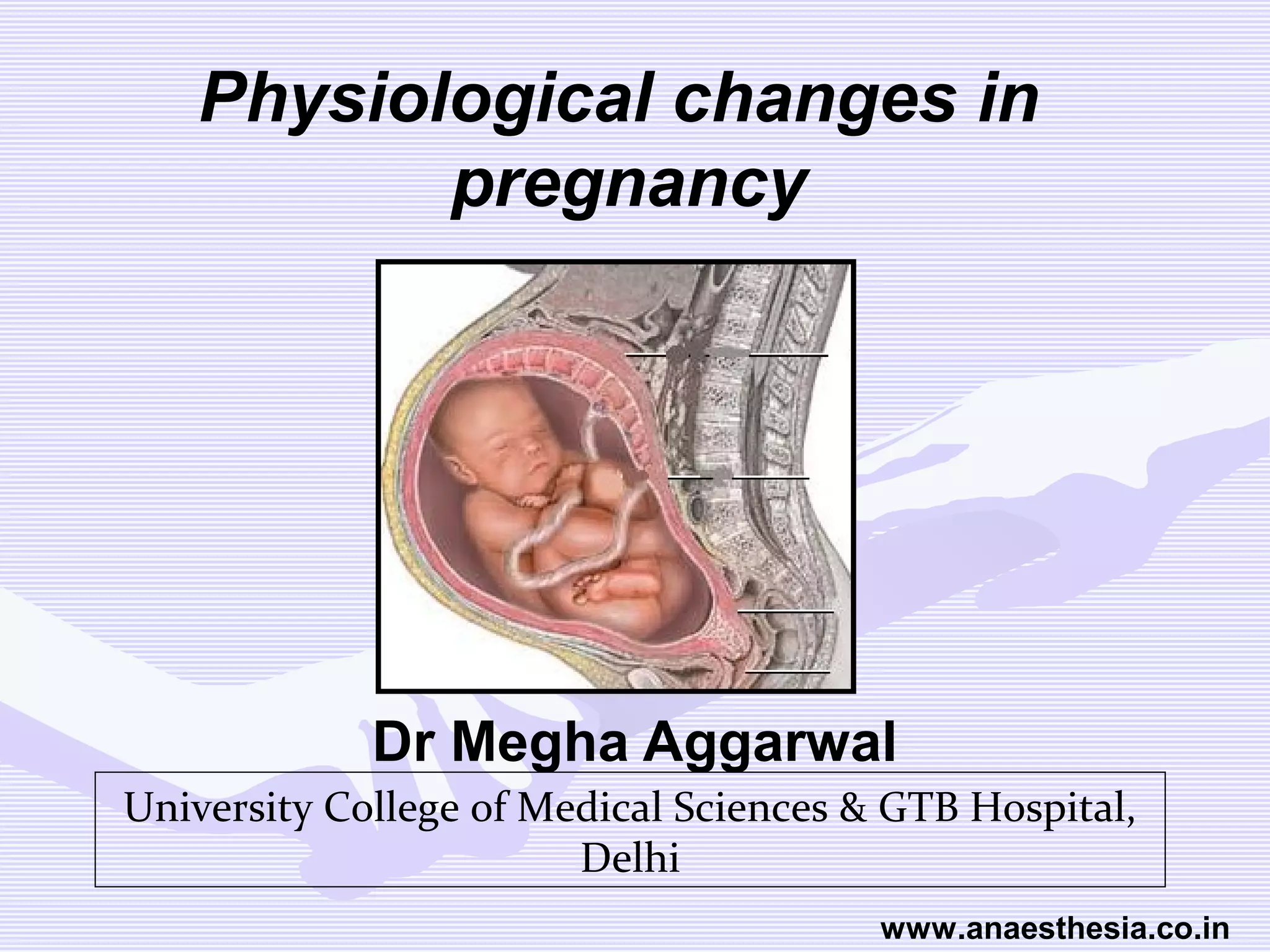
Physiological changes in
pregnancy

Dr Megha Aggarwal
University College of Medical Sciences & GTB Hospital,
Delhi
www.anaesthesia.co.in
Today’s seminar
1.
2.
3.
4.
5.
6.

Introduction
Why to know the changes during pegnancy
Systems affected
Anaesthetic implications
Changes during labour
Changes during puerperium
www.anaesthesia.co.in

Introduction
Changes occur in pregnancy to
1. Support the foetus
2. Prepare mother for delivery
Changes are due to
1. Hormonal changes
2. Increasing size of uterus and foetus
3. Anatomical changes
Why study these changes?
1.
2.
3.
4.

To differentiate normal from abnormal
To understand its anaesthetic implications
To make the process of delivery smooth
To anticipate and manage complications

www.anaesthesia.co.in
Systems affected
Body wt & metabolism
Respiratory
Cardiovascular
Hematopoietic
Gastrointestinal
CNS
Hepatobiliary
Renal
Endocrine
Pharmacological
Body wt. & metabolism
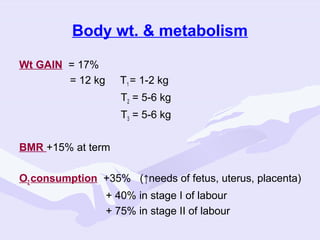
Wt GAIN = 17%
= 12 kg

T1 = 1-2 kg
T2 = 5-6 kg
T3 = 5-6 kg

BMR +15% at term
O2 consumption +35% (↑needs of fetus, uterus, placenta)
+ 40% in stage I of labour
+ 75% in stage II of labour
Respiratory
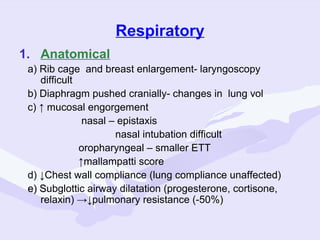
1. Anatomical
a) Rib cage and breast enlargement- laryngoscopy
difficult
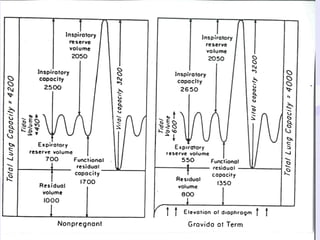
b) Diaphragm pushed cranially- changes in lung vol
c) ↑ mucosal engorgement
nasal – epistaxis
nasal intubation difficult
oropharyngeal – smaller ETT
↑mallampatti score
d) ↓Chest wall compliance (lung compliance unaffected)
e) Subglottic airway dilatation (progesterone, cortisone,
S
relaxin) →↓pulmonary resistance (-50%)
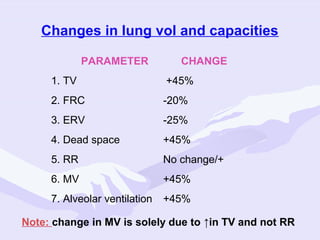
Changes in lung vol and capacities
PARAMETER

CHANGE

1. TV

+45%

2. FRC

-20%

3. ERV

-25%

4. Dead space

+45%

5. RR

No change/+

6. MV

+45%

7. Alveolar ventilation

+45%

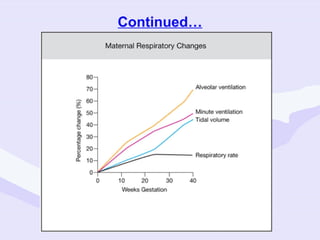
Note: change in MV is solely due to ↑in TV and not RR
Continued…
Continued…
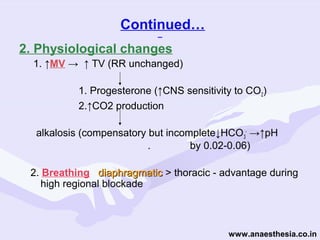
2. Physiological changes
1. ↑MV → ↑ TV (RR unchanged)
1. Progesterone (↑CNS sensitivity to CO2)
2.↑CO2 production
alkalosis (compensatory but incomplete↓HCO3- →↑pH
.
by 0.02-0.06)
2. Breathing diaphragmatic > thoracic - advantage during
high regional blockade

www.anaesthesia.co.in
Continued…
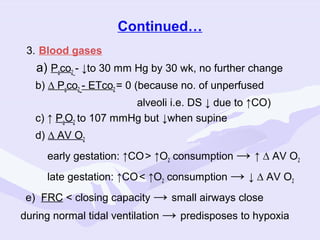
3. Blood gases

a) Paco2_- ↓to 30 mm Hg by 30 wk, no further change
b) ∆ Paco2_- ETco2 = 0 (because no. of unperfused
alveoli i.e. DS ↓ due to ↑CO)
c) ↑ PaO2 to 107 mmHg but ↓when supine
d) ∆ AV O2
early gestation: ↑CO > ↑O2 consumption → ↑ ∆ AV O2
late gestation: ↑CO < ↑O2 consumption → ↓ ∆ AV O2
e) FRC < closing capacity → small airways close
during normal tidal ventilation → predisposes to hypoxia
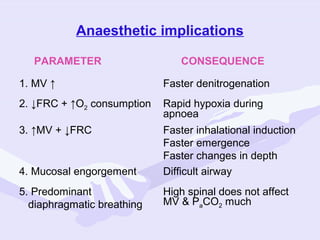
Anaesthetic implications
PARAMETER

CONSEQUENCE

1. MV ↑

Faster denitrogenation

2. ↓FRC + ↑O2 consumption

Rapid hypoxia during
apnoea

3. ↑MV + ↓FRC

4. Mucosal engorgement

Faster inhalational induction
Faster emergence
Faster changes in depth
Difficult airway

5. Predominant
diaphragmatic breathing

High spinal does not affect
MV & PaCO2 much
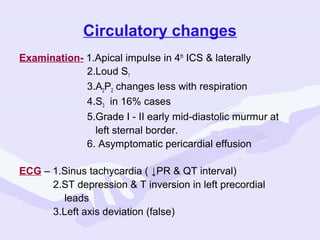
Circulatory changes
Examination- 1.Apical impulse in 4th ICS & laterally
2.Loud S1
3.A2P2 changes less with respiration
4.S3 in 16% cases
5.Grade I - II early mid-diastolic murmur at
left sternal border.
6. Asymptomatic pericardial effusion
ECG – 1.Sinus tachycardia ( ↓PR & QT interval)
2.ST depression & T inversion in left precordial
leads
3.Left axis deviation (false)
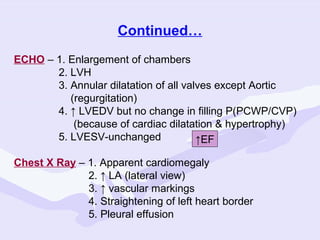
Continued…
ECHO – 1. Enlargement of chambers
2. LVH
3. Annular dilatation of all valves except Aortic
(regurgitation)
4. ↑ LVEDV but no change in filling P(PCWP/CVP)
(because of cardiac dilatation & hypertrophy)
5. LVESV-unchanged
↑EF
Chest X Ray – 1. Apparent cardiomegaly
2. ↑ LA (lateral view)
3. ↑ vascular markings
4. Straightening of left heart border
5. Pleural effusion
Continued…
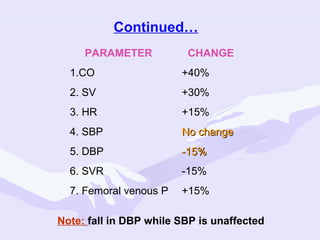
PARAMETER

CHANGE

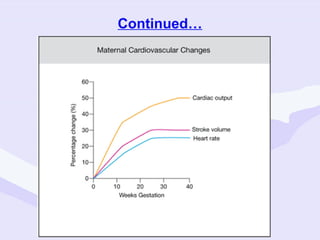
1.CO

+40%

2. SV

+30%

3. HR

+15%

4. SBP

No change

5. DBP

-15%

6. SVR

-15%

7. Femoral venous P

+15%

Note: fall in DBP while SBP is unaffected
Continued…
Continued…
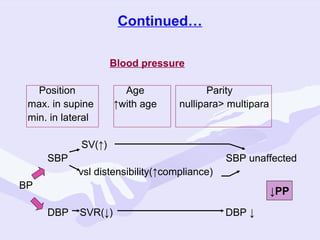
Blood pressure
Position
max. in supine
min. in lateral

Age
↑with age

Parity
nullipara> multipara

SV(↑)
SBP

SBP unaffected
vsl distensibility(↑compliance)

BP

↓PP
DBP

SVR(↓)

DBP ↓
Continued…
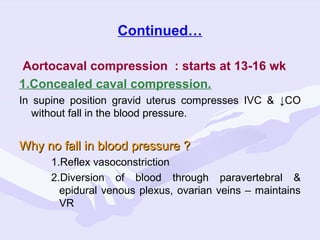
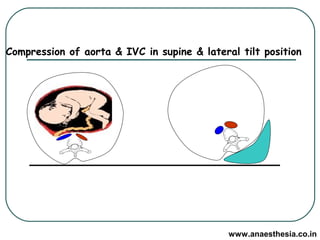
Aortocaval compression : starts at 13-16 wk
1.Concealed caval compression.
In supine position gravid uterus compresses IVC & ↓CO
without fall in the blood pressure.

Why no fall in blood pressure ?
1.Reflex vasoconstriction
2.Diversion of blood through paravertebral &
epidural venous plexus, ovarian veins – maintains
VR
Continued…
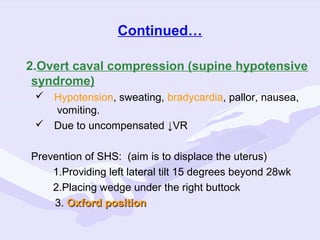
2.Overt caval compression (supine hypotensive
syndrome)
 Hypotension, sweating, bradycardia, pallor, nausea,
vomiting.
 Due to uncompensated ↓VR
Prevention of SHS: (aim is to displace the uterus)
1.Providing left lateral tilt 15 degrees beyond 28wk
2.Placing wedge under the right buttock
3. Oxford position
Compression of aorta & IVC in supine & lateral tilt position

www.anaesthesia.co.in
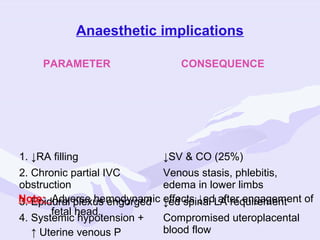
Anaesthetic implications
PARAMETER

1. ↓RA filling

CONSEQUENCE

↓SV & CO (25%)

2. Chronic partial IVC
Venous stasis, phlebitis,
obstruction
edema in lower limbs
Note: Adverse hemodynamic ↓ed spinal LA requirement
3. Epidural plexus engorged effects ↓ed after engagement of
fetal head.
4. Systemic hypotension +
Compromised uteroplacental
blood flow
↑ Uterine venous P
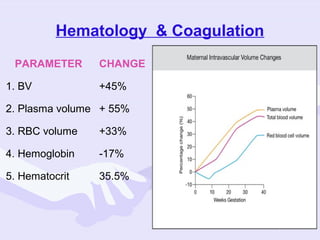
Hematology & Coagulation
PARAMETER
1. BV

CHANGE
+45%

2. Plasma volume + 55%
3. RBC volume

+33%

4. Hemoglobin

-17%

5. Hematocrit

35.5%
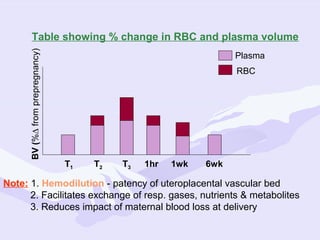
BV (%∆ from prepregnancy)

Table showing % change in RBC and plasma volume
Plasma
RBC

T1

T2

T3

1hr

1wk

6wk

Note: 1. Hemodilution - patency of uteroplacental vascular bed
2. Facilitates exchange of resp. gases, nutrients & metabolites
3. Reduces impact of maternal blood loss at delivery
Continued…
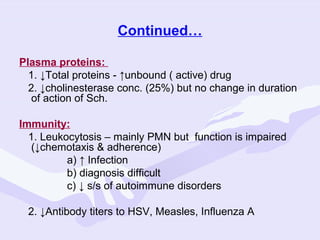
Plasma proteins:
1. ↓Total proteins - ↑unbound ( active) drug
2. ↓cholinesterase conc. (25%) but no change in duration
of action of Sch.
Immunity:
1. Leukocytosis – mainly PMN but function is impaired
(↓chemotaxis & adherence)
a) ↑ Infection
b) diagnosis difficult
c) ↓ s/s of autoimmune disorders
2. ↓Antibody titers to HSV, Measles, Influenza A
Continued…
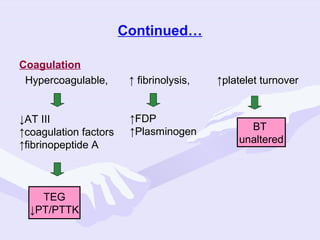
Coagulation
Hypercoagulable,

↓AT III
↑coagulation factors
↑fibrinopeptide A

TEG
↓PT/PTTK

↑ fibrinolysis,
↑FDP
↑Plasminogen

↑platelet turnover

BT
unaltered
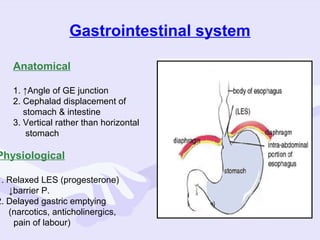
Gastrointestinal system
Anatomical
1. ↑Angle of GE junction
2. Cephalad displacement of
stomach & intestine
3. Vertical rather than horizontal
stomach

Physiological

1. Relaxed LES (progesterone)
↓barrier P.
2. Delayed gastric emptying
(narcotics, anticholinergics,
pain of labour)
Anaesthetic implications
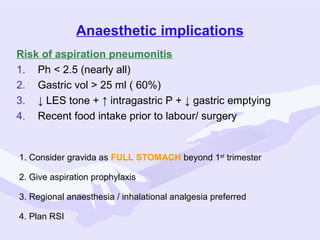
Risk of aspiration pneumonitis
1. Ph < 2.5 (nearly all)
2. Gastric vol > 25 ml ( 60%)
3. ↓ LES tone + ↑ intragastric P + ↓ gastric emptying
4. Recent food intake prior to labour/ surgery

1. Consider gravida as FULL STOMACH beyond 1st trimester
2. Give aspiration prophylaxis
3. Regional anaesthesia / inhalational analgesia preferred
4. Plan RSI
Nervous system
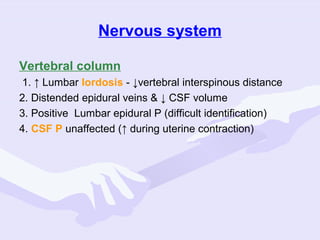
Vertebral column
1. ↑ Lumbar lordosis - ↓vertebral interspinous distance
2. Distended epidural veins & ↓ CSF volume
3. Positive Lumbar epidural P (difficult identification)
4. CSF P unaffected (↑ during uterine contraction)
Continued…
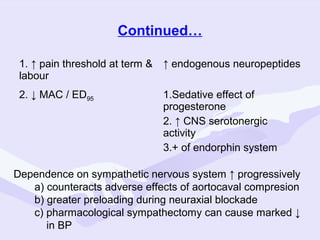
1. ↑ pain threshold at term & ↑ endogenous neuropeptides
labour
2. ↓ MAC / ED95

1.Sedative effect of
progesterone
2. ↑ CNS serotonergic
activity
3.+ of endorphin system

Dependence on sympathetic nervous system ↑ progressively
a) counteracts adverse effects of aortocaval compresion
b) greater preloading during neuraxial blockade
c) pharmacological sympathectomy can cause marked ↓
in BP
Continued…

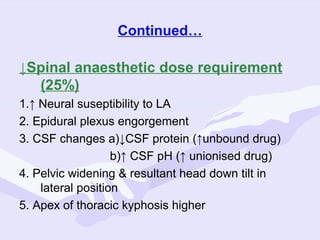
↓Spinal anaesthetic dose requirement
(25%)
1.↑ Neural suseptibility to LA
2. Epidural plexus engorgement
3. CSF changes a)↓CSF protein (↑unbound drug)
b)↑ CSF pH (↑ unionised drug)
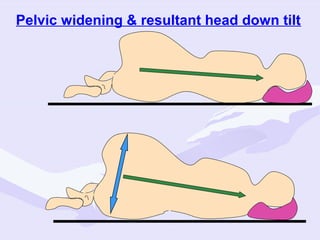
4. Pelvic widening & resultant head down tilt in
lateral position
5. Apex of thoracic kyphosis higher
Pelvic widening & resultant head down tilt
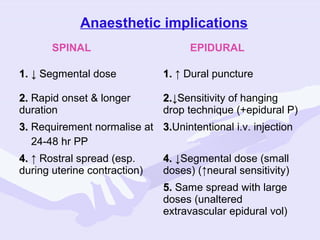
Anaesthetic implications
SPINAL

EPIDURAL

1. ↓ Segmental dose
S

1. ↑ Dural puncture

2. Rapid onset & longer
duration

2.↓Sensitivity of hanging
drop technique (+epidural P)

3. Requirement normalise at 3.Unintentional i.v. injection
3.
24-48 hr PP
4. ↑ Rostral spread (esp.
during uterine contraction)

4. ↓Segmental dose (small
doses) (↑neural sensitivity)
5. Same spread with large
doses (unaltered
extravascular epidural vol)
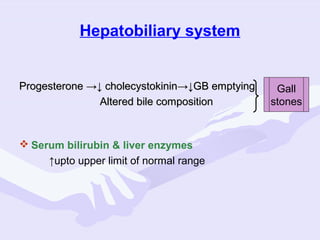
Hepatobiliary system

Progesterone →↓ cholecystokinin→↓GB emptying
Altered bile composition

 Serum bilirubin & liver enzymes
↑upto upper limit of normal range

Gall
stones
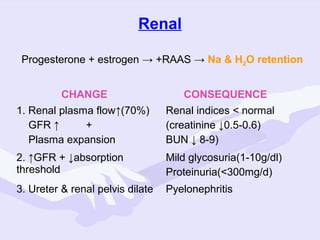
Renal
Progesterone + estrogen → +RAAS → Na & H2O retention
CHANGE

CONSEQUENCE

1. Renal plasma flow↑(70%)
GFR ↑
+
Plasma expansion

Renal indices < normal
(creatinine ↓0.5-0.6)
BUN ↓ 8-9)

2. ↑GFR + ↓absorption
threshold

Mild glycosuria(1-10g/dl)
Proteinuria(<300mg/d)

3. Ureter & renal pelvis dilate

Pyelonephritis
Continued…
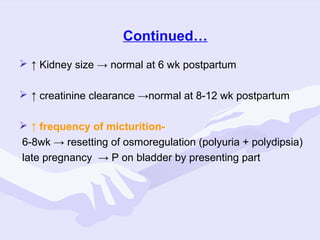
 ↑ Kidney size → normal at 6 wk postpartum
 ↑ creatinine clearance →normal at 8-12 wk postpartum
 ↑ frequency of micturition6-8wk → resetting of osmoregulation (polyuria + polydipsia)
late pregnancy → P on bladder by presenting part
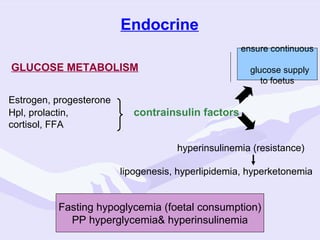
Endocrine
ensure continuous

GLUCOSE METABOLISM
Estrogen, progesterone
Hpl, prolactin,
cortisol, FFA

glucose supply
to foetus

4

contrainsulin factors
hyperinsulinemia (resistance)
lipogenesis, hyperlipidemia, hyperketonemia

Fasting hypoglycemia (foetal consumption)
PP hyperglycemia& hyperinsulinemia
Continued…
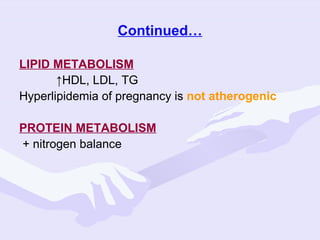
LIPID METABOLISM
↑HDL, LDL, TG
Hyperlipidemia of pregnancy is not atherogenic
PROTEIN METABOLISM
+ nitrogen balance
Continued…
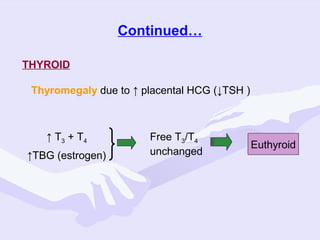
THYROID
Thyromegaly due to ↑ placental HCG (↓TSH )

↑ T3 + T 4
↑TBG (estrogen)

Free T3/T4
unchanged

Euthyroid
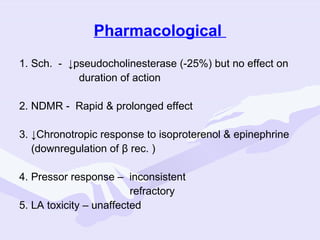
Pharmacological
1. Sch. - ↓pseudocholinesterase (-25%) but no effect on
duration of action
2. NDMR - Rapid & prolonged effect
3. ↓Chronotropic response to isoproterenol & epinephrine
(downregulation of β rec. )
4. Pressor response – inconsistent
refractory
5. LA toxicity – unaffected
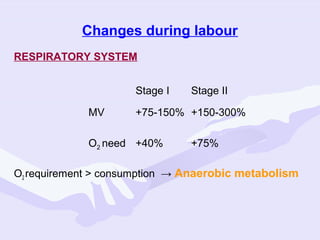
Changes during labour
RESPIRATORY SYSTEM
Stage I
MV

Stage II

+75-150% +150-300%

O2 need +40%

+75%

O2 requirement > consumption → Anaerobic metabolism
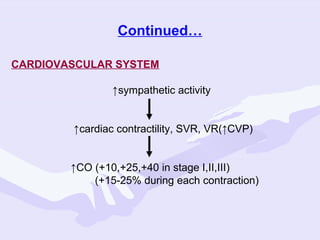
Continued…
CARDIOVASCULAR SYSTEM
↑sympathetic activity

↑cardiac contractility, SVR, VR(↑CVP)

↑CO (+10,+25,+40 in stage I,II,III)
(+15-25% during each contraction)
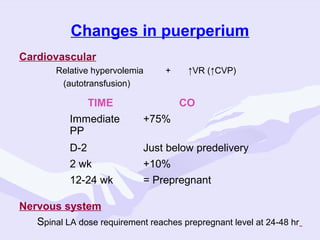
Changes in puerperium
Cardiovascular
Relative hypervolemia
(autotransfusion)

+

TIME

↑VR (↑CVP)

CO

Immediate
PP

+75%

D-2

Just below predelivery

2 wk

+10%

12-24 wk

= Prepregnant

Nervous system
Spinal LA dose requirement reaches prepregnant level at 24-48 hr
www.anaesthesia.co.in

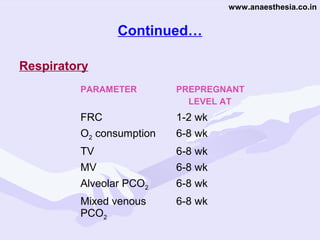
Continued…
Respiratory
PARAMETER

PREPREGNANT
LEVEL AT

FRC

1-2 wk

O2 consumption

6-8 wk

TV

6-8 wk

MV

6-8 wk

Alveolar PCO2

6-8 wk

Mixed venous
PCO2

6-8 wk
www.anaesthesia.co.in

Continued…

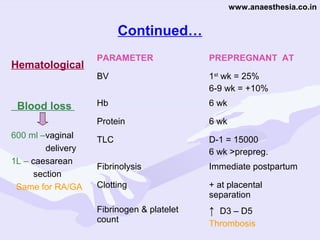
600 ml –vaginal
delivery
1L – caesarean
section
Same for RA/GA

1st wk = 25%
6-9 wk = +10%

Hb

6 wk

Protein

Blood loss

PREPREGNANT AT

BV

Hematological

PARAMETER

6 wk

TLC

D-1 = 15000
6 wk >prepreg.

Fibrinolysis

Immediate postpartum

Clotting

+ at placental
separation

Fibrinogen & platelet
count

↑ D3 – D5
Thrombosis
www.anaesthesia.co.in

References
1. Obstetric anaesthesia – principles and practiceDavid H Chestnut
2. Anaesthesia & Co-existing diseases-Stoelting
3. Millers anaesthesia
4. Short Practice of Anaesthesia – Churchill Davidson
5. Textbook of obstetrics- DC Dutta
www.anaesthesia.co.in

Physiological changes-in-pregnancy 1

  • 1.
    Physiological changes in pregnancy DrMegha Aggarwal University College of Medical Sciences & GTB Hospital, Delhi www.anaesthesia.co.in
  • 2.
    Today’s seminar 1. 2. 3. 4. 5. 6. Introduction Why toknow the changes during pegnancy Systems affected Anaesthetic implications Changes during labour Changes during puerperium
  • 3.
    www.anaesthesia.co.in Introduction Changes occur inpregnancy to 1. Support the foetus 2. Prepare mother for delivery Changes are due to 1. Hormonal changes 2. Increasing size of uterus and foetus 3. Anatomical changes
  • 4.
    Why study thesechanges? 1. 2. 3. 4. To differentiate normal from abnormal To understand its anaesthetic implications To make the process of delivery smooth To anticipate and manage complications www.anaesthesia.co.in
  • 5.
    Systems affected Body wt& metabolism Respiratory Cardiovascular Hematopoietic Gastrointestinal CNS Hepatobiliary Renal Endocrine Pharmacological
  • 6.
    Body wt. &metabolism Wt GAIN = 17% = 12 kg T1 = 1-2 kg T2 = 5-6 kg T3 = 5-6 kg BMR +15% at term O2 consumption +35% (↑needs of fetus, uterus, placenta) + 40% in stage I of labour + 75% in stage II of labour
  • 7.
    Respiratory 1. Anatomical a) Ribcage and breast enlargement- laryngoscopy difficult b) Diaphragm pushed cranially- changes in lung vol c) ↑ mucosal engorgement nasal – epistaxis nasal intubation difficult oropharyngeal – smaller ETT ↑mallampatti score d) ↓Chest wall compliance (lung compliance unaffected) e) Subglottic airway dilatation (progesterone, cortisone, S relaxin) →↓pulmonary resistance (-50%)
  • 9.
    Changes in lungvol and capacities PARAMETER CHANGE 1. TV +45% 2. FRC -20% 3. ERV -25% 4. Dead space +45% 5. RR No change/+ 6. MV +45% 7. Alveolar ventilation +45% Note: change in MV is solely due to ↑in TV and not RR
  • 10.
  • 11.
    Continued… 2. Physiological changes 1.↑MV → ↑ TV (RR unchanged) 1. Progesterone (↑CNS sensitivity to CO2) 2.↑CO2 production alkalosis (compensatory but incomplete↓HCO3- →↑pH . by 0.02-0.06) 2. Breathing diaphragmatic > thoracic - advantage during high regional blockade www.anaesthesia.co.in
  • 12.
    Continued… 3. Blood gases a)Paco2_- ↓to 30 mm Hg by 30 wk, no further change b) ∆ Paco2_- ETco2 = 0 (because no. of unperfused alveoli i.e. DS ↓ due to ↑CO) c) ↑ PaO2 to 107 mmHg but ↓when supine d) ∆ AV O2 early gestation: ↑CO > ↑O2 consumption → ↑ ∆ AV O2 late gestation: ↑CO < ↑O2 consumption → ↓ ∆ AV O2 e) FRC < closing capacity → small airways close during normal tidal ventilation → predisposes to hypoxia
  • 13.
    Anaesthetic implications PARAMETER CONSEQUENCE 1. MV↑ Faster denitrogenation 2. ↓FRC + ↑O2 consumption Rapid hypoxia during apnoea 3. ↑MV + ↓FRC 4. Mucosal engorgement Faster inhalational induction Faster emergence Faster changes in depth Difficult airway 5. Predominant diaphragmatic breathing High spinal does not affect MV & PaCO2 much
  • 14.
    Circulatory changes Examination- 1.Apicalimpulse in 4th ICS & laterally 2.Loud S1 3.A2P2 changes less with respiration 4.S3 in 16% cases 5.Grade I - II early mid-diastolic murmur at left sternal border. 6. Asymptomatic pericardial effusion ECG – 1.Sinus tachycardia ( ↓PR & QT interval) 2.ST depression & T inversion in left precordial leads 3.Left axis deviation (false)
  • 15.
    Continued… ECHO – 1.Enlargement of chambers 2. LVH 3. Annular dilatation of all valves except Aortic (regurgitation) 4. ↑ LVEDV but no change in filling P(PCWP/CVP) (because of cardiac dilatation & hypertrophy) 5. LVESV-unchanged ↑EF Chest X Ray – 1. Apparent cardiomegaly 2. ↑ LA (lateral view) 3. ↑ vascular markings 4. Straightening of left heart border 5. Pleural effusion
  • 16.
    Continued… PARAMETER CHANGE 1.CO +40% 2. SV +30% 3. HR +15% 4.SBP No change 5. DBP -15% 6. SVR -15% 7. Femoral venous P +15% Note: fall in DBP while SBP is unaffected
  • 17.
  • 18.
    Continued… Blood pressure Position max. insupine min. in lateral Age ↑with age Parity nullipara> multipara SV(↑) SBP SBP unaffected vsl distensibility(↑compliance) BP ↓PP DBP SVR(↓) DBP ↓
  • 19.
    Continued… Aortocaval compression :starts at 13-16 wk 1.Concealed caval compression. In supine position gravid uterus compresses IVC & ↓CO without fall in the blood pressure. Why no fall in blood pressure ? 1.Reflex vasoconstriction 2.Diversion of blood through paravertebral & epidural venous plexus, ovarian veins – maintains VR
  • 20.
    Continued… 2.Overt caval compression(supine hypotensive syndrome)  Hypotension, sweating, bradycardia, pallor, nausea, vomiting.  Due to uncompensated ↓VR Prevention of SHS: (aim is to displace the uterus) 1.Providing left lateral tilt 15 degrees beyond 28wk 2.Placing wedge under the right buttock 3. Oxford position
  • 21.
    Compression of aorta& IVC in supine & lateral tilt position www.anaesthesia.co.in
  • 22.
    Anaesthetic implications PARAMETER 1. ↓RAfilling CONSEQUENCE ↓SV & CO (25%) 2. Chronic partial IVC Venous stasis, phlebitis, obstruction edema in lower limbs Note: Adverse hemodynamic ↓ed spinal LA requirement 3. Epidural plexus engorged effects ↓ed after engagement of fetal head. 4. Systemic hypotension + Compromised uteroplacental blood flow ↑ Uterine venous P
  • 23.
    Hematology & Coagulation PARAMETER 1.BV CHANGE +45% 2. Plasma volume + 55% 3. RBC volume +33% 4. Hemoglobin -17% 5. Hematocrit 35.5%
  • 24.
    BV (%∆ fromprepregnancy) Table showing % change in RBC and plasma volume Plasma RBC T1 T2 T3 1hr 1wk 6wk Note: 1. Hemodilution - patency of uteroplacental vascular bed 2. Facilitates exchange of resp. gases, nutrients & metabolites 3. Reduces impact of maternal blood loss at delivery
  • 25.
    Continued… Plasma proteins: 1. ↓Totalproteins - ↑unbound ( active) drug 2. ↓cholinesterase conc. (25%) but no change in duration of action of Sch. Immunity: 1. Leukocytosis – mainly PMN but function is impaired (↓chemotaxis & adherence) a) ↑ Infection b) diagnosis difficult c) ↓ s/s of autoimmune disorders 2. ↓Antibody titers to HSV, Measles, Influenza A
  • 26.
    Continued… Coagulation Hypercoagulable, ↓AT III ↑coagulation factors ↑fibrinopeptideA TEG ↓PT/PTTK ↑ fibrinolysis, ↑FDP ↑Plasminogen ↑platelet turnover BT unaltered
  • 27.
    Gastrointestinal system Anatomical 1. ↑Angleof GE junction 2. Cephalad displacement of stomach & intestine 3. Vertical rather than horizontal stomach Physiological 1. Relaxed LES (progesterone) ↓barrier P. 2. Delayed gastric emptying (narcotics, anticholinergics, pain of labour)
  • 28.
    Anaesthetic implications Risk ofaspiration pneumonitis 1. Ph < 2.5 (nearly all) 2. Gastric vol > 25 ml ( 60%) 3. ↓ LES tone + ↑ intragastric P + ↓ gastric emptying 4. Recent food intake prior to labour/ surgery 1. Consider gravida as FULL STOMACH beyond 1st trimester 2. Give aspiration prophylaxis 3. Regional anaesthesia / inhalational analgesia preferred 4. Plan RSI
  • 29.
    Nervous system Vertebral column 1.↑ Lumbar lordosis - ↓vertebral interspinous distance 2. Distended epidural veins & ↓ CSF volume 3. Positive Lumbar epidural P (difficult identification) 4. CSF P unaffected (↑ during uterine contraction)
  • 30.
    Continued… 1. ↑ painthreshold at term & ↑ endogenous neuropeptides labour 2. ↓ MAC / ED95 1.Sedative effect of progesterone 2. ↑ CNS serotonergic activity 3.+ of endorphin system Dependence on sympathetic nervous system ↑ progressively a) counteracts adverse effects of aortocaval compresion b) greater preloading during neuraxial blockade c) pharmacological sympathectomy can cause marked ↓ in BP
  • 31.
    Continued… ↓Spinal anaesthetic doserequirement (25%) 1.↑ Neural suseptibility to LA 2. Epidural plexus engorgement 3. CSF changes a)↓CSF protein (↑unbound drug) b)↑ CSF pH (↑ unionised drug) 4. Pelvic widening & resultant head down tilt in lateral position 5. Apex of thoracic kyphosis higher
  • 32.
    Pelvic widening &resultant head down tilt
  • 33.
    Anaesthetic implications SPINAL EPIDURAL 1. ↓Segmental dose S 1. ↑ Dural puncture 2. Rapid onset & longer duration 2.↓Sensitivity of hanging drop technique (+epidural P) 3. Requirement normalise at 3.Unintentional i.v. injection 3. 24-48 hr PP 4. ↑ Rostral spread (esp. during uterine contraction) 4. ↓Segmental dose (small doses) (↑neural sensitivity) 5. Same spread with large doses (unaltered extravascular epidural vol)
  • 34.
    Hepatobiliary system Progesterone →↓cholecystokinin→↓GB emptying Altered bile composition  Serum bilirubin & liver enzymes ↑upto upper limit of normal range Gall stones
  • 35.
    Renal Progesterone + estrogen→ +RAAS → Na & H2O retention CHANGE CONSEQUENCE 1. Renal plasma flow↑(70%) GFR ↑ + Plasma expansion Renal indices < normal (creatinine ↓0.5-0.6) BUN ↓ 8-9) 2. ↑GFR + ↓absorption threshold Mild glycosuria(1-10g/dl) Proteinuria(<300mg/d) 3. Ureter & renal pelvis dilate Pyelonephritis
  • 36.
    Continued…  ↑ Kidneysize → normal at 6 wk postpartum  ↑ creatinine clearance →normal at 8-12 wk postpartum  ↑ frequency of micturition6-8wk → resetting of osmoregulation (polyuria + polydipsia) late pregnancy → P on bladder by presenting part
  • 37.
    Endocrine ensure continuous GLUCOSE METABOLISM Estrogen,progesterone Hpl, prolactin, cortisol, FFA glucose supply to foetus 4 contrainsulin factors hyperinsulinemia (resistance) lipogenesis, hyperlipidemia, hyperketonemia Fasting hypoglycemia (foetal consumption) PP hyperglycemia& hyperinsulinemia
  • 38.
    Continued… LIPID METABOLISM ↑HDL, LDL,TG Hyperlipidemia of pregnancy is not atherogenic PROTEIN METABOLISM + nitrogen balance
  • 39.
    Continued… THYROID Thyromegaly due to↑ placental HCG (↓TSH ) ↑ T3 + T 4 ↑TBG (estrogen) Free T3/T4 unchanged Euthyroid
  • 40.
    Pharmacological 1. Sch. -↓pseudocholinesterase (-25%) but no effect on duration of action 2. NDMR - Rapid & prolonged effect 3. ↓Chronotropic response to isoproterenol & epinephrine (downregulation of β rec. ) 4. Pressor response – inconsistent refractory 5. LA toxicity – unaffected
  • 41.
    Changes during labour RESPIRATORYSYSTEM Stage I MV Stage II +75-150% +150-300% O2 need +40% +75% O2 requirement > consumption → Anaerobic metabolism
  • 42.
    Continued… CARDIOVASCULAR SYSTEM ↑sympathetic activity ↑cardiaccontractility, SVR, VR(↑CVP) ↑CO (+10,+25,+40 in stage I,II,III) (+15-25% during each contraction)
  • 43.
    Changes in puerperium Cardiovascular Relativehypervolemia (autotransfusion) + TIME ↑VR (↑CVP) CO Immediate PP +75% D-2 Just below predelivery 2 wk +10% 12-24 wk = Prepregnant Nervous system Spinal LA dose requirement reaches prepregnant level at 24-48 hr
  • 44.
    www.anaesthesia.co.in Continued… Respiratory PARAMETER PREPREGNANT LEVEL AT FRC 1-2 wk O2consumption 6-8 wk TV 6-8 wk MV 6-8 wk Alveolar PCO2 6-8 wk Mixed venous PCO2 6-8 wk
  • 45.
    www.anaesthesia.co.in Continued… 600 ml –vaginal delivery 1L– caesarean section Same for RA/GA 1st wk = 25% 6-9 wk = +10% Hb 6 wk Protein Blood loss PREPREGNANT AT BV Hematological PARAMETER 6 wk TLC D-1 = 15000 6 wk >prepreg. Fibrinolysis Immediate postpartum Clotting + at placental separation Fibrinogen & platelet count ↑ D3 – D5 Thrombosis
  • 46.
    www.anaesthesia.co.in References 1. Obstetric anaesthesia– principles and practiceDavid H Chestnut 2. Anaesthesia & Co-existing diseases-Stoelting 3. Millers anaesthesia 4. Short Practice of Anaesthesia – Churchill Davidson 5. Textbook of obstetrics- DC Dutta
  • 47.