03/04/2025 1
Physiological Changes in
Pregnancy
PRESENTER
Dr Bulus Faith K
MODERATOR
DR Idris Mohammad El-Amin.
03/04/2025 2
OUTLINE
• INTRODUCTION
• CARDIOVASCULAR SYSTEM CHANGES
• RESPIRATORY SYSTEM CHANGES
• HAEMATOLOGICAL CHANGES
• GASTROINTESTINAL SYSTEM CHANGES
• RENAL SYSTEM CHANGES
• CENTRAL NERVOUS SYSTEM CHANGES
• ENDOCRINE SYSTEM CHANGES
• FACTORS AFFECTING PLACENTAL TRANSFER OF DRUGS
• ANAESTHETIC DRUGS
• CONCLUSION
• REFERENCES
03/04/2025 3
INTRODUCTION
• Pregnancy is associated with significant adaptive changes in most of
the organ systems of the maternal body.
• The basis of most changes are hormonal, being in response to the
marked changes in the hormones associated with pregnancy.
• Most of the changes are in place in the first trimester but may
increase in intensity as pregnancy progresses.
03/04/2025 4
CARDIOVASCULAR SYSTEM CHANGES
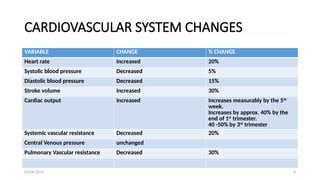
VARIABLE CHANGE % CHANGE
Heart rate Increased 20%
Systolic blood pressure Decreased 5%
Diastolic blood pressure Decreased 15%
Stroke volume Increased 30%
Cardiac output Increased Increases measurably by the 5th
week.
Increases by approx. 40% by the
end of 1st
trimester.
40 -50% by 3rd
trimester
Systemic vascular resistance Decreased 20%
Central Venous pressure unchanged
Pulmonary Vascular resistance Decreased 30%
03/04/2025 5
ANAESTHETIC IMPLICATIONS
CVS EXAM
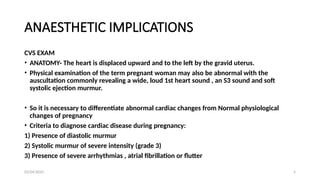
• ANATOMY- The heart is displaced upward and to the left by the gravid uterus.
• Physical examination of the term pregnant woman may also be abnormal with the
auscultation commonly revealing a wide, loud 1st heart sound , an S3 sound and soft
systolic ejection murmur.
• So it is necessary to differentiate abnormal cardiac changes from Normal physiological
changes of pregnancy
• Criteria to diagnose cardiac disease during pregnancy:
1) Presence of diastolic murmur
2) Systolic murmur of severe intensity (grade 3)
3) Presence of severe arrhythmias , atrial fibrillation or flutter
03/04/2025 6
CVS EXAM 2
• Systemic vascular resistance(SVR) is decreased due to vasodilatory
effect of progesterone and proliferation of low vascular resistance
vascular beds in the intervillous spaces of placenta.
• BP is decreased due to decrease in SVR.
• ECG shows Left axis deviation, ST segment depression and T wave
flattening due to cephalad movement of diaphragm.
• Blood flow- to uterus increases up to 700mls/min by term.
• - increases to kidney and skin
• - remains same to brain and liver
03/04/2025 7
ANAESTHETIC IMPLICATIONS CONTD
AORTOCAVAL Compression
• Enlarged uterus compresses IVC and Lower Aorta when the patient lies supine.
Obstruction of IVC decreases venous return which then leads to decrease in
cardiac output.
• It can occur as early as the 13th
week of pregnancy.
• When awake most women are capable of compensating for the decrease in
stroke volume by increasing Sytemic Vascular Resistance and Heart rate. There
are also alternative venous pathways : the paravertebral and azygos systems.
• During Anaesthesia compensatory mechanisms are reduced or abolished.
• Obstruction of lower aorta causes reduced blood flow to kidneys,
uteroplacental unit and lower extremities.
03/04/2025 8
SUPINE HYPOTENSION SYNDROME
• It is seen in 8 to 15% of pregnant women, they have Overt Caval
Compression (supine hypotension syndrome) characterized by;
Hypotension, Sweating, Bradycardia, Pallor, Nausea and Vomiting
• Prevention of SHS: Uterus should be displaced by placing a rigid
wedge under the right hip or left lateral tilting of the operating
table.
03/04/2025 9
RESPIRATORY SYSTEM CHANGES
• Changes in the respiratory system during pregnancy involves the
upper airway, minute ventilation, lung volume , oxygen consumption.
• Major changes occurs in the respiratory system during pregnancy, due
to combination of both hormonal and mechanical factors.
• The maternal respiratory pattern changes as the uterus enlarges :-
Diaphragm rises up by 4 cm , causes reduction in the Functional
residual capacity by 20% patient prefers thoracic breathing over the
Abdominal.
• Due to increased metabolic demands, Oxygen consumption and
minute volume increases (40- 50%) progressively.
03/04/2025 10
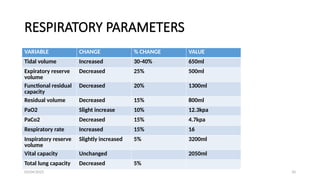
RESPIRATORY PARAMETERS
VARIABLE CHANGE % CHANGE VALUE
Tidal volume Increased 30-40% 650ml
Expiratory reserve
volume
Decreased 25% 500ml
Functional residual
capacity
Decreased 20% 1300ml
Residual volume Decreased 15% 800ml
PaO2 Slight increase 10% 12.3kpa
PaCo2 Decreased 15% 4.7kpa
Respiratory rate Increased 15% 16
Inspiratory reserve
volume
Slightly increased 5% 3200ml
Vital capacity Unchanged 2050ml
Total lung capacity Decreased 5%
03/04/2025 11
ANAESTHETIC IMPLICATIONS
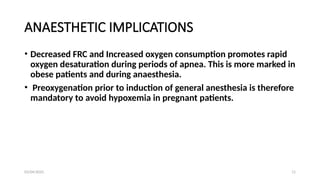
• Decreased FRC and Increased oxygen consumption promotes rapid
oxygen desaturation during periods of apnea. This is more marked in
obese patients and during anaesthesia.
• Preoxygenation prior to induction of general anesthesia is therefore
mandatory to avoid hypoxemia in pregnant patients.
03/04/2025 12
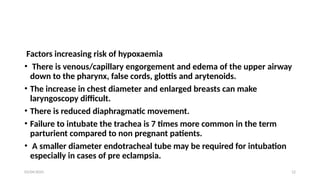
Factors increasing risk of hypoxaemia
• There is venous/capillary engorgement and edema of the upper airway
down to the pharynx, false cords, glottis and arytenoids.
• The increase in chest diameter and enlarged breasts can make
laryngoscopy difficult.
• There is reduced diaphragmatic movement.
• Failure to intubate the trachea is 7 times more common in the term
parturient compared to non pregnant patients.
• A smaller diameter endotracheal tube may be required for intubation
especially in cases of pre eclampsia.
03/04/2025 13
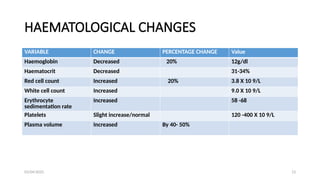
HAEMATOLOGICAL CHANGES
VARIABLE CHANGE PERCENTAGE CHANGE Value
Haemoglobin Decreased 20% 12g/dl
Haematocrit Decreased 31-34%
Red cell count Increased 20% 3.8 X 10 9/L
White cell count Increased 9.0 X 10 9/L
Erythrocyte
sedimentation rate
Increased 58 -68
Platelets Slight increase/normal 120 -400 X 10 9/L
Plasma volume Increased By 40- 50%
03/04/2025 14
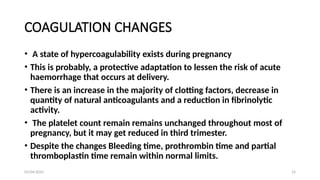
COAGULATION CHANGES
• A state of hypercoagulability exists during pregnancy
• This is probably, a protective adaptation to lessen the risk of acute
haemorrhage that occurs at delivery.
• There is an increase in the majority of clotting factors, decrease in
quantity of natural anticoagulants and a reduction in fibrinolytic
activity.
• The platelet count remain remains unchanged throughout most of
pregnancy, but it may get reduced in third trimester.
• Despite the changes Bleeding time, prothrombin time and partial
thromboplastin time remain within normal limits.
03/04/2025 15
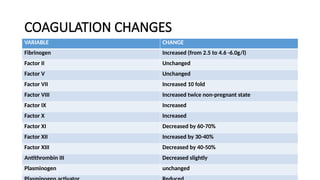
COAGULATION CHANGES
VARIABLE CHANGE
Fibrinogen Increased (from 2.5 to 4.6 -6.0g/l)
Factor II Unchanged
Factor V Unchanged
Factor VII Increased 10 fold
Factor VIII Increased twice non-pregnant state
Factor IX Increased
Factor X Increased
Factor XI Decreased by 60-70%
Factor XII Increased by 30-40%
Factor XIII Decreased by 40-50%
Antithrombin III Decreased slightly
Plasminogen unchanged
03/04/2025 16
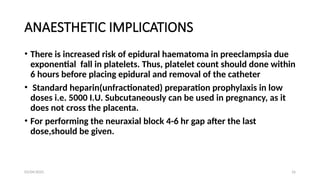
ANAESTHETIC IMPLICATIONS
• There is increased risk of epidural haematoma in preeclampsia due
exponential fall in platelets. Thus, platelet count should done within
6 hours before placing epidural and removal of the catheter
• Standard heparin(unfractionated) preparation prophylaxis in low
doses i.e. 5000 I.U. Subcutaneously can be used in pregnancy, as it
does not cross the placenta.
• For performing the neuraxial block 4-6 hr gap after the last
dose,should be given.
03/04/2025 17
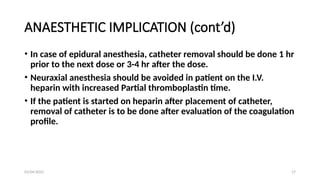
ANAESTHETIC IMPLICATION (cont’d)
• In case of epidural anesthesia, catheter removal should be done 1 hr
prior to the next dose or 3-4 hr after the dose.
• Neuraxial anesthesia should be avoided in patient on the I.V.
heparin with increased Partial thromboplastin time.
• If the patient is started on heparin after placement of catheter,
removal of catheter is to be done after evaluation of the coagulation
profile.
03/04/2025 18
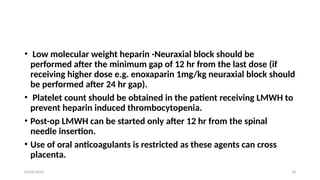
• Low molecular weight heparin -Neuraxial block should be
performed after the minimum gap of 12 hr from the last dose (if
receiving higher dose e.g. enoxaparin 1mg/kg neuraxial block should
be performed after 24 hr gap).
• Platelet count should be obtained in the patient receiving LMWH to
prevent heparin induced thrombocytopenia.
• Post-op LMWH can be started only after 12 hr from the spinal
needle insertion.
• Use of oral anticoagulants is restricted as these agents can cross
placenta.
03/04/2025 19
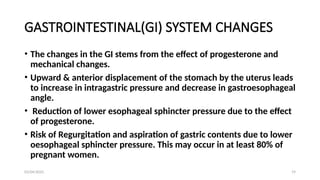
GASTROINTESTINAL(GI) SYSTEM CHANGES
• The changes in the GI stems from the effect of progesterone and
mechanical changes.
• Upward & anterior displacement of the stomach by the uterus leads
to increase in intragastric pressure and decrease in gastroesophageal
angle.
• Reduction of lower esophageal sphincter pressure due to the effect
of progesterone.
• Risk of Regurgitation and aspiration of gastric contents due to lower
oesophageal sphincter pressure. This may occur in at least 80% of
pregnant women.
03/04/2025 20
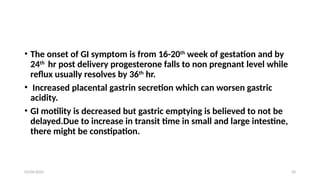
• The onset of GI symptom is from 16-20th
week of gestation and by
24th
hr post delivery progesterone falls to non pregnant level while
reflux usually resolves by 36th
hr.
• Increased placental gastrin secretion which can worsen gastric
acidity.
• GI motility is decreased but gastric emptying is believed to not be
delayed.Due to increase in transit time in small and large intestine,
there might be constipation.
03/04/2025 21
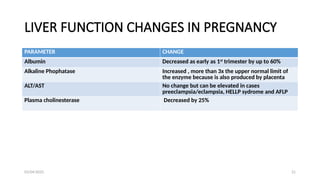
LIVER FUNCTION CHANGES IN PREGNANCY
PARAMETER CHANGE
Albumin Decreased as early as 1st
trimester by up to 60%
Alkaline Phophatase Increased , more than 3x the upper normal limit of
the enzyme because is also produced by placenta
ALT/AST No change but can be elevated in cases
preeclampsia/eclampsia, HELLP sydrome and AFLP
Plasma cholinesterase Decreased by 25%
03/04/2025 22
ANAESTHETIC IMPLICATIONS
• The parturient should be considered a full stomach patient during most of
gestation.
• Prophylaxis in the form of H2 blocking drug and Prokinetic drugs should be
given routinely to pregnant patients before surgery from 2nd trimester.
• During GA airway protection by means of cuffed ETT is mandatory; So is
rapid sequence induction from 2nd trimester of pregnancy till 48hrs post
partum.
• Extubation should be done when the patient is awake and on their side to
reduce the risk of aspiration.
• The danger of aspiration is almost eliminated when regional anaethesia is
used.
03/04/2025 23
RENAL SYSTEM CHANGES
• Renal vasodilatation increases renal blood flow by 40% during early
pregnancy.
• Increased Cardiac output leads to Increased GFR & Increased renal plasma
flow by 50% which increases clearance of urea, uric acid and Creatinine.
• Increased Renin & Aldosterone level promotes Na+ retention leading to
volume overload, fall in serum creatinine and urea.
• Decreased Renal tubular threshold for glucose & amino acids → mild
glycosuria & proteinuria (< 300mg/d).
• Progesterone mediated ureteric smooth muscle relaxation can lead to
urinary stasis making pregnant women prone to urinary tract infections.
03/04/2025 24
CENTRAL NERVOUS SYSTEM CHANGES
• CBF is increased due to decreased Cerebrovascular resistance
• Permeability of BBB is increased
• There is an increase in threshold to pain at term and labour due
increase level plasma endorphins and progesterone
• Engorged epidural plexus of veins will decrease the volume of the
epidural and subarachnoid space.
• The CSF pressure is increased due to compression from the epidural
veins in the epidural space.
• Exaggerated lumbar lordosis contribute to cephalad spread of the local
anaesthetic.
25
• 25-40% decrease in minimum alveolar concentrations (MAC)
secondary to increased levels of progesterone and β- endorphin
levels which will lead to rapid induction with inhalation agents.
• The amount of local anaesthetic drug required in a pregnant woman
is decreased by up to 30% (2/3) compared to the non pregnant
state.
• Increased sensitivity to opiods, sedatives, and local anaesthetics
when used for neuraxial anaesthesia.
03/04/2025
03/04/2025 26
ENDOCRINE SYSTEM
• Preganancy is Diabetogenic as insulin steadily rises during pregnancy and the human
placental lactogen (aka human chorionic Somatomamotropin) causes relative insulin
resistance.
• Pregnancy is biochemically a starving like state (blood glucose and amino acids are low
and Free fatty acids , ketones and triglycerides are high) to promote the Foetal growth.
• Secretion of HCG and Elevated oestrogen levels promotes hypertrophy of the thyroid
gland.
• There is increased in the production of thyroid globulin: although T3, T4 levels are
elevated up to 50% but the free T3, T4 & TSH remain normal due to increase production
THYROID BINDING GLOBULIN
• Level of PARATHYROID HORMONES and serum Ca++
tend to fall during pregnancy but the
level of ionized Ca++
tend to remain constant due changes in serum albumin concentration
03/04/2025 27
• There is 30% increase in oxytocin store in the pituitary which is
released during labour
• There is hyperprolactinaemia due to placenta lactogen and
dopamine during pregnancy
• GA can mask the signs and symptom of hypoglycaemia while
neuraxial anaesthesia can worsen the haemodynamic instability due
to autonomic dysfunction related to DM
03/04/2025 28
MUSCULOSKELETAL SYSTEM
• Exaggerated lumbar lordosis with flexion of the neck and downward
movement of the shoulders
• Due to relaxin, progesterone and mechanical effects of pregnancy, joint
laxity is increased to prepare for child birth
Implication
• Lordosis can decrease the distance between the spinous processes and
make neuraxial techniques difficult
• Widening of pelvis causes head down position in lateral decubitus and
lead cephalad position of LA during SAB in lateral position
• A pillow placed under the dependent position can counteract this effect
03/04/2025 29
FACTORS AFFECTING PLACENTAL TRANSFER
OF DRUGS
• Lipid Solubility:- The placental membrane is freely permeable to
lipid soluble substances, higher the solubility higher is the drug
transfer. Highly ionized substances have poor lipid solubility.
• Protein binding:- Protein bound drugs will not diffuse easily, only
free drug would cross the placental barrier easily , reduced albumin
levels will increases the unbound portion of drug in plasma. 
• Maternal drug concentration :- Directly proportional , Affected by
the dose and route of administration.
• Others factors include: tissue binding, pH, pKa and blood flow
03/04/2025 30
ANAESTHETIC DRUGS
• OPIODS– All opioids cross the placenta in significant amounts. They are weak
bases, bound to α-glycoprotein.
• Pethidine – Longer half life is due to its active metabolite norpethidine, which
may lead to respiratory depression in the neonate.
• Morphine – It is water soluble but readily crosses the placenta due to low
protein binding.
• Fentanyl – It is highly lipid soluble and albumin bound, so crosses the
placental barrier easily.
• IV Induction agents – Sodium thiopentone is highly lipid soluble, weakly
acidic, 75% protein bound and less than 50% ionized at physiological pH. It
crosses the placenta easily. Propofol – It is highly protein bound and lipophilic.
03/04/2025 31
• INHALATIONAL AGENTS-These agents are highly soluble with low
molecular weights.
• All cross placenta
• Muscle relaxants – These are quaternary ammonium compounds and
fully ionized with low lipid solubility, hence they do not cross the
placenta.
• Local Anaesthetics – These drugs have low molecular weights and also
are lipid soluble. The materno-foetal transfer is enhanced by foetal
acidosis leading to ion trapping.
• Different drugs have different protein binding.
03/04/2025 32
CONCLUSION
• Pregnancy produces profound physiological changes that alter the
usual responses to Anesthesia .
• Unique challenges - two patients are cared for simultaneously .
• Failure to take care can be disastrous for one or both of them.
03/04/2025 33
REFERENCES
• John F,David M,John W: Morgan and Mikhail’s Clinical
anaesthesiology 5th
edition
• Alan R.A,Ian K.M,Jonathan P.T: Smith&Aitkenhead’s textbook of
anaesthesia 6th
edition,2014
• Peter K,Ian P: Principles of phyiology for the Amaesthetist,4th
edition
• Lee CY: Manual of Anaesthesia, MGH Education, 2006
• Steve MY, Nicholas PH, James KI: Anaesthesia, Intensive Care And
Perioperative Medicine (A-Z), 6th
edition
03/04/2025 34
•THANK YOU FOR LISTENING

physiological changes in pregnancy PPT.pptx

  • 1.
    03/04/2025 1 Physiological Changesin Pregnancy PRESENTER Dr Bulus Faith K MODERATOR DR Idris Mohammad El-Amin.
  • 2.
    03/04/2025 2 OUTLINE • INTRODUCTION •CARDIOVASCULAR SYSTEM CHANGES • RESPIRATORY SYSTEM CHANGES • HAEMATOLOGICAL CHANGES • GASTROINTESTINAL SYSTEM CHANGES • RENAL SYSTEM CHANGES • CENTRAL NERVOUS SYSTEM CHANGES • ENDOCRINE SYSTEM CHANGES • FACTORS AFFECTING PLACENTAL TRANSFER OF DRUGS • ANAESTHETIC DRUGS • CONCLUSION • REFERENCES
  • 3.
    03/04/2025 3 INTRODUCTION • Pregnancyis associated with significant adaptive changes in most of the organ systems of the maternal body. • The basis of most changes are hormonal, being in response to the marked changes in the hormones associated with pregnancy. • Most of the changes are in place in the first trimester but may increase in intensity as pregnancy progresses.
  • 4.
    03/04/2025 4 CARDIOVASCULAR SYSTEMCHANGES VARIABLE CHANGE % CHANGE Heart rate Increased 20% Systolic blood pressure Decreased 5% Diastolic blood pressure Decreased 15% Stroke volume Increased 30% Cardiac output Increased Increases measurably by the 5th week. Increases by approx. 40% by the end of 1st trimester. 40 -50% by 3rd trimester Systemic vascular resistance Decreased 20% Central Venous pressure unchanged Pulmonary Vascular resistance Decreased 30%
  • 5.
    03/04/2025 5 ANAESTHETIC IMPLICATIONS CVSEXAM • ANATOMY- The heart is displaced upward and to the left by the gravid uterus. • Physical examination of the term pregnant woman may also be abnormal with the auscultation commonly revealing a wide, loud 1st heart sound , an S3 sound and soft systolic ejection murmur. • So it is necessary to differentiate abnormal cardiac changes from Normal physiological changes of pregnancy • Criteria to diagnose cardiac disease during pregnancy: 1) Presence of diastolic murmur 2) Systolic murmur of severe intensity (grade 3) 3) Presence of severe arrhythmias , atrial fibrillation or flutter
  • 6.
    03/04/2025 6 CVS EXAM2 • Systemic vascular resistance(SVR) is decreased due to vasodilatory effect of progesterone and proliferation of low vascular resistance vascular beds in the intervillous spaces of placenta. • BP is decreased due to decrease in SVR. • ECG shows Left axis deviation, ST segment depression and T wave flattening due to cephalad movement of diaphragm. • Blood flow- to uterus increases up to 700mls/min by term. • - increases to kidney and skin • - remains same to brain and liver
  • 7.
    03/04/2025 7 ANAESTHETIC IMPLICATIONSCONTD AORTOCAVAL Compression • Enlarged uterus compresses IVC and Lower Aorta when the patient lies supine. Obstruction of IVC decreases venous return which then leads to decrease in cardiac output. • It can occur as early as the 13th week of pregnancy. • When awake most women are capable of compensating for the decrease in stroke volume by increasing Sytemic Vascular Resistance and Heart rate. There are also alternative venous pathways : the paravertebral and azygos systems. • During Anaesthesia compensatory mechanisms are reduced or abolished. • Obstruction of lower aorta causes reduced blood flow to kidneys, uteroplacental unit and lower extremities.
  • 8.
    03/04/2025 8 SUPINE HYPOTENSIONSYNDROME • It is seen in 8 to 15% of pregnant women, they have Overt Caval Compression (supine hypotension syndrome) characterized by; Hypotension, Sweating, Bradycardia, Pallor, Nausea and Vomiting • Prevention of SHS: Uterus should be displaced by placing a rigid wedge under the right hip or left lateral tilting of the operating table.
  • 9.
    03/04/2025 9 RESPIRATORY SYSTEMCHANGES • Changes in the respiratory system during pregnancy involves the upper airway, minute ventilation, lung volume , oxygen consumption. • Major changes occurs in the respiratory system during pregnancy, due to combination of both hormonal and mechanical factors. • The maternal respiratory pattern changes as the uterus enlarges :- Diaphragm rises up by 4 cm , causes reduction in the Functional residual capacity by 20% patient prefers thoracic breathing over the Abdominal. • Due to increased metabolic demands, Oxygen consumption and minute volume increases (40- 50%) progressively.
  • 10.
    03/04/2025 10 RESPIRATORY PARAMETERS VARIABLECHANGE % CHANGE VALUE Tidal volume Increased 30-40% 650ml Expiratory reserve volume Decreased 25% 500ml Functional residual capacity Decreased 20% 1300ml Residual volume Decreased 15% 800ml PaO2 Slight increase 10% 12.3kpa PaCo2 Decreased 15% 4.7kpa Respiratory rate Increased 15% 16 Inspiratory reserve volume Slightly increased 5% 3200ml Vital capacity Unchanged 2050ml Total lung capacity Decreased 5%
  • 11.
    03/04/2025 11 ANAESTHETIC IMPLICATIONS •Decreased FRC and Increased oxygen consumption promotes rapid oxygen desaturation during periods of apnea. This is more marked in obese patients and during anaesthesia. • Preoxygenation prior to induction of general anesthesia is therefore mandatory to avoid hypoxemia in pregnant patients.
  • 12.
    03/04/2025 12 Factors increasingrisk of hypoxaemia • There is venous/capillary engorgement and edema of the upper airway down to the pharynx, false cords, glottis and arytenoids. • The increase in chest diameter and enlarged breasts can make laryngoscopy difficult. • There is reduced diaphragmatic movement. • Failure to intubate the trachea is 7 times more common in the term parturient compared to non pregnant patients. • A smaller diameter endotracheal tube may be required for intubation especially in cases of pre eclampsia.
  • 13.
    03/04/2025 13 HAEMATOLOGICAL CHANGES VARIABLECHANGE PERCENTAGE CHANGE Value Haemoglobin Decreased 20% 12g/dl Haematocrit Decreased 31-34% Red cell count Increased 20% 3.8 X 10 9/L White cell count Increased 9.0 X 10 9/L Erythrocyte sedimentation rate Increased 58 -68 Platelets Slight increase/normal 120 -400 X 10 9/L Plasma volume Increased By 40- 50%
  • 14.
    03/04/2025 14 COAGULATION CHANGES •A state of hypercoagulability exists during pregnancy • This is probably, a protective adaptation to lessen the risk of acute haemorrhage that occurs at delivery. • There is an increase in the majority of clotting factors, decrease in quantity of natural anticoagulants and a reduction in fibrinolytic activity. • The platelet count remain remains unchanged throughout most of pregnancy, but it may get reduced in third trimester. • Despite the changes Bleeding time, prothrombin time and partial thromboplastin time remain within normal limits.
  • 15.
    03/04/2025 15 COAGULATION CHANGES VARIABLECHANGE Fibrinogen Increased (from 2.5 to 4.6 -6.0g/l) Factor II Unchanged Factor V Unchanged Factor VII Increased 10 fold Factor VIII Increased twice non-pregnant state Factor IX Increased Factor X Increased Factor XI Decreased by 60-70% Factor XII Increased by 30-40% Factor XIII Decreased by 40-50% Antithrombin III Decreased slightly Plasminogen unchanged
  • 16.
    03/04/2025 16 ANAESTHETIC IMPLICATIONS •There is increased risk of epidural haematoma in preeclampsia due exponential fall in platelets. Thus, platelet count should done within 6 hours before placing epidural and removal of the catheter • Standard heparin(unfractionated) preparation prophylaxis in low doses i.e. 5000 I.U. Subcutaneously can be used in pregnancy, as it does not cross the placenta. • For performing the neuraxial block 4-6 hr gap after the last dose,should be given.
  • 17.
    03/04/2025 17 ANAESTHETIC IMPLICATION(cont’d) • In case of epidural anesthesia, catheter removal should be done 1 hr prior to the next dose or 3-4 hr after the dose. • Neuraxial anesthesia should be avoided in patient on the I.V. heparin with increased Partial thromboplastin time. • If the patient is started on heparin after placement of catheter, removal of catheter is to be done after evaluation of the coagulation profile.
  • 18.
    03/04/2025 18 • Lowmolecular weight heparin -Neuraxial block should be performed after the minimum gap of 12 hr from the last dose (if receiving higher dose e.g. enoxaparin 1mg/kg neuraxial block should be performed after 24 hr gap). • Platelet count should be obtained in the patient receiving LMWH to prevent heparin induced thrombocytopenia. • Post-op LMWH can be started only after 12 hr from the spinal needle insertion. • Use of oral anticoagulants is restricted as these agents can cross placenta.
  • 19.
    03/04/2025 19 GASTROINTESTINAL(GI) SYSTEMCHANGES • The changes in the GI stems from the effect of progesterone and mechanical changes. • Upward & anterior displacement of the stomach by the uterus leads to increase in intragastric pressure and decrease in gastroesophageal angle. • Reduction of lower esophageal sphincter pressure due to the effect of progesterone. • Risk of Regurgitation and aspiration of gastric contents due to lower oesophageal sphincter pressure. This may occur in at least 80% of pregnant women.
  • 20.
    03/04/2025 20 • Theonset of GI symptom is from 16-20th week of gestation and by 24th hr post delivery progesterone falls to non pregnant level while reflux usually resolves by 36th hr. • Increased placental gastrin secretion which can worsen gastric acidity. • GI motility is decreased but gastric emptying is believed to not be delayed.Due to increase in transit time in small and large intestine, there might be constipation.
  • 21.
    03/04/2025 21 LIVER FUNCTIONCHANGES IN PREGNANCY PARAMETER CHANGE Albumin Decreased as early as 1st trimester by up to 60% Alkaline Phophatase Increased , more than 3x the upper normal limit of the enzyme because is also produced by placenta ALT/AST No change but can be elevated in cases preeclampsia/eclampsia, HELLP sydrome and AFLP Plasma cholinesterase Decreased by 25%
  • 22.
    03/04/2025 22 ANAESTHETIC IMPLICATIONS •The parturient should be considered a full stomach patient during most of gestation. • Prophylaxis in the form of H2 blocking drug and Prokinetic drugs should be given routinely to pregnant patients before surgery from 2nd trimester. • During GA airway protection by means of cuffed ETT is mandatory; So is rapid sequence induction from 2nd trimester of pregnancy till 48hrs post partum. • Extubation should be done when the patient is awake and on their side to reduce the risk of aspiration. • The danger of aspiration is almost eliminated when regional anaethesia is used.
  • 23.
    03/04/2025 23 RENAL SYSTEMCHANGES • Renal vasodilatation increases renal blood flow by 40% during early pregnancy. • Increased Cardiac output leads to Increased GFR & Increased renal plasma flow by 50% which increases clearance of urea, uric acid and Creatinine. • Increased Renin & Aldosterone level promotes Na+ retention leading to volume overload, fall in serum creatinine and urea. • Decreased Renal tubular threshold for glucose & amino acids → mild glycosuria & proteinuria (< 300mg/d). • Progesterone mediated ureteric smooth muscle relaxation can lead to urinary stasis making pregnant women prone to urinary tract infections.
  • 24.
    03/04/2025 24 CENTRAL NERVOUSSYSTEM CHANGES • CBF is increased due to decreased Cerebrovascular resistance • Permeability of BBB is increased • There is an increase in threshold to pain at term and labour due increase level plasma endorphins and progesterone • Engorged epidural plexus of veins will decrease the volume of the epidural and subarachnoid space. • The CSF pressure is increased due to compression from the epidural veins in the epidural space. • Exaggerated lumbar lordosis contribute to cephalad spread of the local anaesthetic.
  • 25.
    25 • 25-40% decreasein minimum alveolar concentrations (MAC) secondary to increased levels of progesterone and β- endorphin levels which will lead to rapid induction with inhalation agents. • The amount of local anaesthetic drug required in a pregnant woman is decreased by up to 30% (2/3) compared to the non pregnant state. • Increased sensitivity to opiods, sedatives, and local anaesthetics when used for neuraxial anaesthesia. 03/04/2025
  • 26.
    03/04/2025 26 ENDOCRINE SYSTEM •Preganancy is Diabetogenic as insulin steadily rises during pregnancy and the human placental lactogen (aka human chorionic Somatomamotropin) causes relative insulin resistance. • Pregnancy is biochemically a starving like state (blood glucose and amino acids are low and Free fatty acids , ketones and triglycerides are high) to promote the Foetal growth. • Secretion of HCG and Elevated oestrogen levels promotes hypertrophy of the thyroid gland. • There is increased in the production of thyroid globulin: although T3, T4 levels are elevated up to 50% but the free T3, T4 & TSH remain normal due to increase production THYROID BINDING GLOBULIN • Level of PARATHYROID HORMONES and serum Ca++ tend to fall during pregnancy but the level of ionized Ca++ tend to remain constant due changes in serum albumin concentration
  • 27.
    03/04/2025 27 • Thereis 30% increase in oxytocin store in the pituitary which is released during labour • There is hyperprolactinaemia due to placenta lactogen and dopamine during pregnancy • GA can mask the signs and symptom of hypoglycaemia while neuraxial anaesthesia can worsen the haemodynamic instability due to autonomic dysfunction related to DM
  • 28.
    03/04/2025 28 MUSCULOSKELETAL SYSTEM •Exaggerated lumbar lordosis with flexion of the neck and downward movement of the shoulders • Due to relaxin, progesterone and mechanical effects of pregnancy, joint laxity is increased to prepare for child birth Implication • Lordosis can decrease the distance between the spinous processes and make neuraxial techniques difficult • Widening of pelvis causes head down position in lateral decubitus and lead cephalad position of LA during SAB in lateral position • A pillow placed under the dependent position can counteract this effect
  • 29.
    03/04/2025 29 FACTORS AFFECTINGPLACENTAL TRANSFER OF DRUGS • Lipid Solubility:- The placental membrane is freely permeable to lipid soluble substances, higher the solubility higher is the drug transfer. Highly ionized substances have poor lipid solubility. • Protein binding:- Protein bound drugs will not diffuse easily, only free drug would cross the placental barrier easily , reduced albumin levels will increases the unbound portion of drug in plasma.  • Maternal drug concentration :- Directly proportional , Affected by the dose and route of administration. • Others factors include: tissue binding, pH, pKa and blood flow
  • 30.
    03/04/2025 30 ANAESTHETIC DRUGS •OPIODS– All opioids cross the placenta in significant amounts. They are weak bases, bound to α-glycoprotein. • Pethidine – Longer half life is due to its active metabolite norpethidine, which may lead to respiratory depression in the neonate. • Morphine – It is water soluble but readily crosses the placenta due to low protein binding. • Fentanyl – It is highly lipid soluble and albumin bound, so crosses the placental barrier easily. • IV Induction agents – Sodium thiopentone is highly lipid soluble, weakly acidic, 75% protein bound and less than 50% ionized at physiological pH. It crosses the placenta easily. Propofol – It is highly protein bound and lipophilic.
  • 31.
    03/04/2025 31 • INHALATIONALAGENTS-These agents are highly soluble with low molecular weights. • All cross placenta • Muscle relaxants – These are quaternary ammonium compounds and fully ionized with low lipid solubility, hence they do not cross the placenta. • Local Anaesthetics – These drugs have low molecular weights and also are lipid soluble. The materno-foetal transfer is enhanced by foetal acidosis leading to ion trapping. • Different drugs have different protein binding.
  • 32.
    03/04/2025 32 CONCLUSION • Pregnancyproduces profound physiological changes that alter the usual responses to Anesthesia . • Unique challenges - two patients are cared for simultaneously . • Failure to take care can be disastrous for one or both of them.
  • 33.
    03/04/2025 33 REFERENCES • JohnF,David M,John W: Morgan and Mikhail’s Clinical anaesthesiology 5th edition • Alan R.A,Ian K.M,Jonathan P.T: Smith&Aitkenhead’s textbook of anaesthesia 6th edition,2014 • Peter K,Ian P: Principles of phyiology for the Amaesthetist,4th edition • Lee CY: Manual of Anaesthesia, MGH Education, 2006 • Steve MY, Nicholas PH, James KI: Anaesthesia, Intensive Care And Perioperative Medicine (A-Z), 6th edition
  • 34.

Editor's Notes

  • #5 Flow murmur is due to increase in plasma volume and COP, REGURGITANT MURMUR can also be seen in cardiac dilatations although unusual.
  • #10 ERV-decreased from 20/52 due to gravid uterus
  • #21 Drugs metabolized by plasma cholinesterase-suxa, mivacurium, ESTERS- Cocaine,procaine
  • #24 Engorgement of the epidural veins is due to compression of IVC by gravid uterus,increase epidural fat.