INDUSTRIAL
SECURITY
MANAGEMENT
COURSE DESCRIPTION
• Industrial security management is a study involving the
organizational set-up and operation of security guards
pursuant to the Private Security Agency Law (RA 5487)
and it’s implementing rules and regulations (IRR). The
course covers various security measures and provisions
to include asset protection, loss prevention
management, security surveys and risk assessment.
This is a three-unit course intended for criminology
students inclined to pursue a career as security
professional or protection specialist.
Importance of Security
• Without proper security measures in place,
businesses risk losing their valuable
assets to theft or damage.
• In addition to protecting assets, security is
important for the safety of employees.
Businesses have a responsibility to ensure
the safety of their employees while they
are on the job.
The History of Private
Security
The History of Private Security
 The concept of private security can be
traced to thousand of years before the
birth of Christ.
 Psalm 127 makes mention of the
security guard, in the phrase, "Except
the Lord build the house, they labor in
vain that built it, except the Lord keep
the city, the watchman waked but in
vain."
 Security of communities mostly relied
on military troops.
The History of Private
Security
• Bodyguards were also utilized
to secure travel or transport of
valuable goods from place to
place.
Famous Known Security
Personnel in Ancient times
Praetorian Guards of ancient Rome
Swiss Guard Vatican City Rome
Medjay Egypt
Middles Ages Knights
Shire-Reeves the Norman
period (1066 - 1199)
• The word comes from the two words
'Shire' and 'Reeve'. A Reeve was an
official position which began in
Saxon times, when the reeve
was empowered to hold court and
try local civil and criminal matters.
After the conquest they were
appointed for every shire, and
therefore the name became Shire
Reeve or Sheriff.
Security in the USA
Security in the USA
In the US, in 1850,
Allan Pinkerton
established the
Pinkerton Detective
Agency. They also
served as the
intelligence agents of
the Union Army during
the Civil War.
• In 1889, Brinks,
Incorporated started the
business of protecting
property and payroll of
private companies.
• Local armored
transportation services to
providing corporate
financial logistics and
international secure
transportation.
 In 1909, William J. Burns,
Inc. was formed to become
the sole investigating
agency for the American
Banking Association.
 Pinkerton and Burns were
the only national
investigation bodies that
investigated non-
specialized crimes, until the
creation of the Federal
Bureau of Investigation.
Security in the Philippines
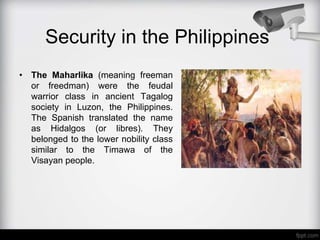
• The Maharlika (meaning freeman
or freedman) were the feudal
warrior class in ancient Tagalog
society in Luzon, the Philippines.
The Spanish translated the name
as Hidalgos (or libres). They
belonged to the lower nobility class
similar to the Timawa of the
Visayan people.
Guardia Civil - Spanish Era
The Civil Guard (Spanish:
Guardia Civil) of the Philippines
was a local gendarmerie
police force organized under
the Spanish colonial
government.
It was disbanded after the
Spanish–American War and was
replaced by the Philippine
Constabulary.
Philippine Constabulary
The first Filipinos on the
Constabulary were Jose
Velasquez of Nueva Ecija and
Felix Llarento of Manila. The first
Filipino to become chief of the
Philippine Constabulary was
Brigadier General Rafael Crame,
who served with distinction from
December 17, 1917, to January 1,
1927.
• On 01 June 1969, Republic Act 5487
otherwise known as the “Private Security
Agency Law” was enacted making the
Philippine Constabulary as the sole
authority to provide administrative services
and general supervision over the
management and operations of all organize
Private Security Agencies
• Today, the uniformed security guard
remains the most familiar symbol of security
in society.
• JOSE B. MANIWANG PhD, WSO-CSSD,
Registered Criminologist and well known
as the “Father of Philippine Security” first
established as a single proprietor, a
private security agency the National
Intelligence and Security Service, a
business he thought of after World War II,
being a war veteran under the USAFFE
and as the country.
Understanding Industrial
Security
What is Security?
Security – freedom from danger, risk, etc.;
- freedom from care or doubt;
- protection or defense
Important Terms
• Security- protection against any
type of crime to safeguard life and
assets by various methods and
device
• Security Guard- is any natural
person who offers and render
personal service to watch or guard
residential, or business of both,
government buildings, establishment
and or their premises for hire and
compensation
• Security supervisor-
charged with directing
the work and
observation the
behavioral
performance of the
guard under his unit
• Private Detective- any natural
person, not a member of the
regular police force or the AFP,
who does detective work for hire
reward or commission
• Security Guard Force-
group of forces of men
selected trained or organized
into functional group for the
purpose of protecting
operational processes from
those disruption which
impede efficiency or halt
operation at a particular plant,
facility, institution or special
activity
• Security supervisor- charged with directing the work and
observation the behavioral performance of the guard
under his unit.
• Security Education program- program given to
employees of an installation by means of lecture
pertaining to measures and safeguards to be taken.
• Assets protection Program- sum total of protection
scheme encompassing the entire security spectrum,
designed to eliminate, reduce or control threats, hazards
or dangers to company
• Security Planning- it involves knowing the objectives of the
security and the means and the method to reach these
objectives or goal must then evolved
• Security Survey- the process of conducting an exhaustive
physical examination and thorough inspection of all operation
system and procedures of a facility
• Security Inspection- the process of conducting physical
examination to determine compliance with establishment
security policies as a result of security survey
• Security hazard- any act or condition which may result in the
compromise of information, loss of life, loss or destruction of
property or disruption of the objectives of the installation
INTRODUCTION TO
SECURITY
By: Gerald Kevin P. Hernandez, RCrim, MSCJ, CST, CSSP
THE THREE DIMENSIONS OF
SECURITY
• Physical Security – Focus more on the
structure/designed of a building
• Personnel Security – focus on the
employment, training and deployment
• Information Security – protection against
espionage
PHYSICAL SECURITY
• Physical security refers to a barrier or
system of barriers placed between the
potential intruder and the matter to be
protected. It could also refer to any
protective device against hazards, threat,
vulnerability and risks.
• There is no such thing as an impenetrable
barrier.
• An intruder must be able to acquire access
to the property in order to benefit.
• Delays provide defense against
surreptitious and non-surreptitious entry.
• Each installation is different and will
require its own unique physical security
system.
Principles of Physical Security
34
• Freedom from unauthorized intrusion.
• Freedom from theft, damage and arson.
• Freedom from outside interruption.
Reason for Establishing
Physical Security
35
 Perimeter – fence, wire, wood, brick, design,
construction, etc.
 Exit/ Entrance – description, quantity, location,
fireproofing, locking devices, fire protection,
precaution, safety measures, and vulnerable spots.
 Offices/ Rooms – layout, location
 Personnel – staff, visitors, contracted personnel,
maintenance, ID system, etc.
 Lighting - movable, emergency, stationary, standby.
 Equipment/ Supplies – package control
 Doors and Windows
Coverage of Physical Security
36
• Alarms – CCTVs, detectors, etc.
• Communication – telephones, radios, etc.
• Internal Open Premises – structure,
vulnerable spots, fire protection, etc.
• Locks/ Keys – padlocks, electronic locks,
combination locks, etc.
Coverage of Physical Security
37
Main purpose –
to deny or
impede
access or exit
of
unauthorized
persons.
Perimeter Barrier
(1st Line of Defense)
38
Secondary purposes:
1.It defines the boundary of the property to be
secured.
2.It creates a physical and psychological
deterrent to unauthorized entry.
3.It delays intrusion, thus, facilitating
apprehension of intruders.
Perimeter Barrier
(1st Line of Defense)
39
Secondary purposes:
4.It assists in a more efficient and
economical employment of guards.
5.It facilitates and improves the control of
pedestrians and vehicular traffic.
Perimeter Barrier
(1st Line of Defense)
40
 Physical – Any facility, equipment, material,
building, or document
 Security – Freedom from loss and damages
 System – Defense plan or protective operating
procedure
 Physical Security System – Measures adopted to
prevent unauthorized access to facilities,
equipment, material, and documents to safeguard
them against, loss, damage, and pilferage.
 Barriers – Structures capable of restricting,
preventing or delaying illegal access.
Important Terms
41
• THREATS – Positive inimical acts.
• HAZARDS – Passive inimical conditions.
• VULNERABILITY – Measure of how open is an
establishment to intrusion, attack or injury.
• RISK – Probability of an event to happen that
will lead to losses.
Factors That Bring About
Insecure Condition
42
Barriers Defined
• Refers to any physical structure whether
natural or man made capable of
restricting, deterring, delaying or
preventing illegal and unauthorized access
to an installation.
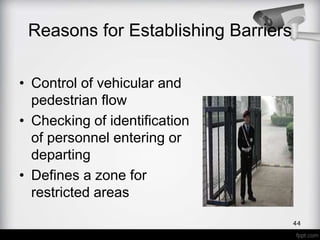
• Control of vehicular and
pedestrian flow
• Checking of identification
of personnel entering or
departing
• Defines a zone for
restricted areas
Reasons for Establishing Barriers
44
TYPES OF PHYSICAL BARRIER
1. Natural barrier- like cliffs, terrain, ocean, or body of
water
2. Structural/Manmade barrier- fences, walls, grill,
etc
3. Human barrier- security guards and employees
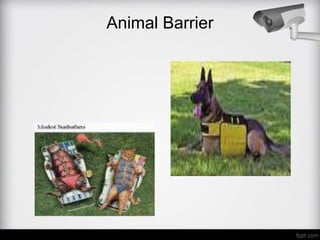
4. Animal barrier- dogs, geese, etc
5. Energy barrier- electronic devise
• Natural Barriers – these are
offered by nature which could
obstruct or delay the passage
way of potential intruders. These
also refer to natural structures
that serve as deterrents or
obstructions to intruders such as
high cliff, canyon, desert or
bodies of water.
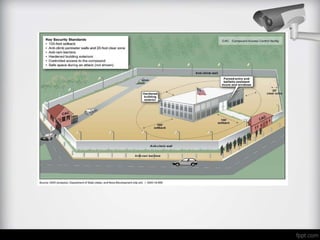
• Man-made Barriers –
these are structural
constructions like
fences, walls, floors,
roofs, grills, bars,
roadblocks, or other
physical means to
deter or impede
penetration.
Animal Barrier
• animal used in
partially providing
a guarding system
Energy Barrier
Usually electrical or electronics devices used to provide
assistance to guard personnel. ex. protective lightnings,
anti intrusion devices.
Structural Barriers
Barriers are manmade
and
include landscaping,
ditches, fences, and
walls. A structural barrier
physically and
psychologically deters or
discourages the
undetermined, delays
the determined, and
channels the flow of
authorized traffic through
proper entrances
Human Barrier
Human being
used in providing
security or
partially providing
a guarding
system.
Level of Physical Security
• Also varies on the type and location of
facility and other factors needing security.
Levels of physical security could be any of
the following:
• Low Level Security – is a system designed to impede
and detect some unauthorized external activity such as
on small retail store, storage warehouses.
• Medium Security – is designed to impede, detect and
access most external activity and some unauthorized
internal activity that range from simple shoplifting to
conspiracy to commit sabotage. This include:
- Use of advance intrusion alarm system
- Establishment of perimeter and perimeter
barriers and
- Use of an unarmed guard.
• High level Security – is designed to impede, detect and access
most unauthorized external and internal activities of certain prisons,
defense contractors, pharmaceutical companies and sophisticated
electronic manufacturers. This include the following
- Close Circuit Television (CCTV);
- Perimeter alarm system;
- High security lighting;
- Highly trained armed guards
- Control designs; and
- Coordination with local law enforcement
agencies
Perimeter Barriers Openings
• In determining the appropriate perimeter
barriers, security manager should not
overlook the necessary of monitoring
perimeter openings that could be used by
intruders. These openings are:
• Gates and Doors –
should be guarded or
locked as much as
possible.
• Window and Similar
Openings – should also
be guarded or grills
should be installed so as
not to be used by
intruders. Whenever
possible, window and
openings less than 18 ft.
above grounds, roof and
ledges or less than 14 ft.
• Utilities Openings – such
as sewers, air intakes,
exhaust tunnels which
penetrate the barriers and
which have cross-
sectioned area of 96 sq.
inches or more should be
protected by bars, grills,
etc.
• Clear zone – is an
unobstructed area maintained
on both sides of the perimeter
barriers. A clear zone of 20 ft.
or more is desirable between
the barrier and extension
structures and natural covers
which may provide
concealment or assistance to
a person seeking
unauthorized entry.
Types of Perimeter Barriers
• Fences - are independent structures
designed to control physical and visual
access between outside areas. Types of
fences include:
• Solid fence – is made of
opaque material in
such a way visual access
through the fence
structure is denied. Solid
fences are constructed with
heavy materials such as
bricks, stone and concrete,
and usually extended down
into the ground to a point
view below the frost line.
Advantage of Solid Fence
• Denies visual access of the installation to
the intruder.
• Denies the intruder the opportunity to
become familiar with the personnel,
activities and the schedule of the
movement of the guards.
Disadvantages of Solid Fence
• Prevents the guards from observing the
area around the installation.
• Creates shadow which may be used by
the intruder for cover and concealment.
• Full-View fence – is
constructed in such
a manner that visual
access is permitted
such as wire fence,
through the fence
structure. It is
designed purely to
control physical
access between two
areas.
Advantage of Full-view Fence
• Guards are able to keep the area
surrounding the installation under
observation.
• Does not create any shadow
Disadvantages of Full-view Fence
• Allows visual access to the installation.
• Allows the intruder to get familiar with the
movements and the time schedule of the
guard patrol.
Top Guard
A top guard is an overhang of
barbed wire or tape along the
top of a fence, facing outward
and upward at about a 45-
degree angle. Placing barbed
wire or tape above it can further
enhance the top guard.
Concertina wire serving as topguard.
Concertina wire serving as additional
perimeter barrier.
69
70
Different types of razor wire.
Animal Barrier
Energy Barrier
Structural Barriers
Human Barrier
ADDITIONAL PROTECTIVE MEASURES
1. Top Guard- an additional overhang of barbed wire placed on
vertical perimeter fences facing upward and outward with 45
degree with three to four strands of barbed wires, 6 inches apart
and must be stalled on the supporting arms.
2. Guard control system- this is normally provided at main
perimeter entrance to secure arrears located out of doors, and
manned by guard on a full-time basis.
3. Towers- guard tower are house like structures above the
perimeter barriers.
4. Barrier Maintenance- regular inspection of fencing barriers and
protective walls.
5. Protection in Depth
6. Signs and Notices
PROTECTIVE
ALARMS SYSTEM
• Security Alarm System - combination of
compatible intrusion and detection device
so arranged and wired as to support one
another
THREE BASIC PARTS OF ALARM
SYSTEM
–Sensor or trigger device
–Transmission line
–Enunciator/annunciator
TYPES OF ALARM SYSTEM
1. Metallic foil or wire- all possible [point of entry
can be wired by using electrically charge strips
of tinfoil or wire. Any action that will move the
foil or wire breaks the circuit and activate an
alarm, metallic foil or wire are used in window or
glass surface.
2. Photoelectric or Electric Eye Device - A light
beam is transmitted at a frequency of several
thousand vibrations per second. It is connected
by a wire a control station and when an intruder
crosses the beam, he break the contract with
the photoelectric coil which thus activates the
alarm.
3. Audio detection device - supersensitive
microphone speaker sensor or installed
in walls ceilings and floors of the
protected area of any sound caused by
attempted forced entry is detected by the
sensor.
4. Vibration detection device- vibration
sensitive sensor are attached to walls,
ceilings or floors of the protected area.
Any vibration caused by attempted force
entry is detected by the sensor. Can be
effective to safeguard enclose areas in
sound detection system.
OTHER TYPES OF PROTECTIVE ALARMS
1. Foot rail activator- placed on the floor in such a position that
tellers may activate the alarm by placing the front of their foot to
engage the activation bar.
2. Bill traps or currency activation devices- are usually placed in
tellers top, cash drawer and connected to the alarm system
using a wire connector. When currency is removed from the
devices, the alarm is activated.
3. Knee or thigh buttons- installed inside the desk or teller station
so they can be activated by knee or thigh pressure. They are
commonly found in location where personnel usually perform
their duties from seated position.
4. Foot button- permits alarm activation in relatively safety while
both hands remain clear in view of the robbers.
5. Double squeeze buttons- re4quires pressure on both side of
the device and therefore the probability of accidental alarm is
reduced.
TYPES OF ALARM DETECTION SYSTEM
1. Central Station System- when alarm is sounded,
central station notifies police and other agency.
2. Propriety system - this function in the same way as
a central station system except the company owns
that.
3. Local alarm system- in this case the sensor
activates circuit, which in turn activates a horn or
siren or even flashing light, located in the immediate
vicinity of the alarmed area.
4. Auxiliary system- in this system installation circuits
are led into local police or fire department by lease
telephone lines.
PROTECTIVE
LIGHTING
Security lighting- providing of sufficient illumination
to areas during hours of darkness to ensure
visibility ant to act ads deterrent to intruders
PURPOSES OF PROTECTIVE LIGHTING
1. Provides sufficient illumination to the areas during
hours of darkness
2. Lightning can help improve visibility so that
intruder can be seen and identified and, if possible
apprehended.
3. Lighting also gives that psychological fear and that
serve as a deterrent to thieves, pilferer,
trespassers and saboteurs.
TYPES OF PROTECTIVE LIGHTING
1. Stationary luminary- series of fixed luminaries to
flood given area-continuously overlap
2. Standby lighting- turn on manually or physically
as needed
3. Movable lighting- searchlight; supplementary top
other types of lighting.
4. Emergency light - This can be utilized in an event
of electric failure.
TYPES OF LIGHTING EQUIPMENT
1. Floodlights- these light project light in concentrated beams.
They are appropriate for use in instances, which call for
illumination of boundaries, building or fences.
2. Searchlight- these are highly focused incandescent lamps used
to pinpoint potential trouble spots.
3. Fresnel light- wide beam units, primary used to extend
the illumination in long, horizontal strips to protect the
approaches to the perimeter barrier.Horizontal beam
which is approximately 180 degrees in the horizontal
and from 15-30 degrees in the vertical.
4. Street light- this produces diffused rather than
directional beam. They are widely used in parking
areas.
PROTECTIVE
LOCKS AND KEYS
• LOCK – A mechanical, electrical,
hydraulic, or electronic device designed to
prevent entry into a building, room, and
container or hiding place.
• KEY – A device that is use to open a lock.
TYPES OF LOCK
1. Key Operated Mechanical Lock
2. Padlock
3. Combination Lock
4. Code-Operated Lock
5. Electrical Lock
6. Card Operated Lock
TYPES OF KEY
1. Change Key
2. Sub Master Key
3. Master Key
4. Grand Master Key
• SECURITY CABINET – The final line of defense at
any facility that is used in the storage of papers,
records, plans or cashable instrument, precious
metal or other specially valuable assets.
TYPES OF SECURITY CABINET
1. Safe
2. Vault
3. File Room
Safe
– a metallic container used for
the safekeeping of documents
or small items in an office or
installation. Safe can be
classified as either robbery or
burglary resistance depending
upon the use and need.
- weight must be at least 750
lbs. and should anchored to a
building structure.
Vault
heavily constructed fire
and burglar resistance
container usually a part of the
building structure used to
keep and protect cash,
documents and negotiable
instruments. Vaults are bigger
than safe but smaller than a
file room.
The vault must be
resistive up to 6 hours.
File room
A cubicle in a building
constructed a little lighter than
a vault but of bigger size to
accommodate limited people to
work on the records inside.
file room must at most 12
feet high.
it must have a water weight
door and at least fire proof for
one hour.
LAYERS OF SECURITY
• 1st Line – Perimeter
• 2nd Line – Building Walls, Doors &
Windows
• 3rd Line – Interior Barriers
Three Lines of Defense
99
• Deter
• Detect
• Delay
• Detain
Four D’s of DEFENSE
100
PERSONNEL AND
INFORMATION SECURITY
101
PERSONNEL SECURITY
102
• Personnel Security covers policies and procedures that
seek to manage the risk of people who have legitimate
access to an organization’s assets and possibly using
those assets for unauthorized purposes.
• It is about securing a company or a firm from insiders
or employees.
Introduction
103
• Personnel screening
• Background checks and lifestyle checks
• Security Education – includes:
– whistleblower programs,
– employee surveillance, and
– employee loyalty programs
• Security clearance system
Areas covered by
personnel security
104
• Failure to focus on the laxity, carelessness or
deliberate negligence is also a major threat to one’s
business.
• No security expert can anticipate all situations relating
to internal losses.
• One cannot be protect against everything, but, if
attention is given to basics and details, then losses can
be greatly hindered, if not minimized.
Some Principles Regarding
Internal Theft
105
• The objective of personnel screening is to prevent theft
by employees.
• A goal of personnel screening is convince employees
that they would be caught if they steal from the
company.
• Basic to the effectiveness of any personnel security
program is the cooperation of the employees.
• The best place to start any personnel security program is
the screening of applicants.
Personnel Screening
106
• SCREENING – is the process of finding the best-
qualified person for the job, in terms of both skills AND
personal integrity.
• Rejection of job applicants with dubious characters, or
those considered as “BAD RISKS”, must be on the basis
of carefully established standards.
• Standards must be met in every particular case, and not
on a selective basis.
Personnel Screening
107
• Instability in personal relations;
• Lack job stability;
• Declining salary history, or are taking a cut in pay from
the previous job;
• Unexplained gaps in employment history;
• Clearly overqualified;
• Unable to recall or are hazy about relevant information in
the recent past.
“Red flags” in an applicant’s
background
108
• Many employees turn bad only once they are already
employed.
• A LIFESTYLE CHECK is a system of checking the
lifestyle of certain employees and to determine whether
or not changes in lifestyle are explainable by legitimate
sources of income.
Background and Lifestyle
Checks
109
• Continuous background check is important in order not
only to keep tabs on an employee’s personal information
(residence, marital status, etc.), but also for purposes of
determining changes in lifestyle, that may be a result of
illegal activities.
• Background checks should also be done if an employee
is a candidate for promotion to a more responsible or
sensitive position.
Background and Lifestyle
Checks
110
SEARCH POLICY
• Theft is reduced if there is a possibility that people
will be challenged and searched.
• Management has a right to impose search policies
within company premises.
• Searches should be approached from a
consensual point of view.
• Company rules should be acknowledged in writing
by each employee at the time of employment.
• Make sure everyone is informed.
Personnel Security Policies
111
Tips in Implementing a Search Policy:
• Check with your attorneys.
• Make sure ALL employees are aware of the policy.
Signatures may be required as evidence of notification.
• Inform all visitors openly that a search policy exists and
they are subject to it while on company premises.
Vehicles are also subject to the same policy.
• All employees, at all levels, including executives, are
subject to this policy.
Personnel Security Policies
112
• Exit interviews allow you to find out the real reason why
employees resign.
• It also gives you an opportunity to get information or
feedback regarding how the company is run.
• Exit interviews can be used to gather information of
illegal practices being done within the company.
Exit Interviews and Debriefing
113
• Staff vigilance is key to your protective
measures.
• Staff must have the confidence to report
anything suspicious.
• Training is important.
• Staff should be briefed to look out for
packets, bags or other items in odd places,
carefully placed (rather than dropped) items
in rubbish bins and unusual interest shown by
strangers in less accessible places.
Developing Security
Awareness Among
Employees
114
• The key is the secrecy of the agents’ true intentions and
identity.
• More than one agent is usually employed.
• The ability of the agent to successfully infiltrate the
organization without standing out is very important.
• Undercover operations are costly and need some time in
order to succeed.
Undercover Operations
115
INFORMATION
SECURITY
116
Information security is all about protecting
information that a company considers vital or
important to its business and not readily accessible
by outsiders.
Protection of Sensitive
Information
117
Some of the basic principles :
• Information need not be lost in order to be
compromised or “stolen”.
• Information needs to be known in order to be
useful.
Protection of Sensitive
Information
118
Proprietary Information – Is information,
which in some special way, is related to the
status, operations or activities of the possessor
over which the possessor asserts ownership.
Trade Secret – may consist of any formula,
pattern, device or compilation of information
which is used in one’s business and which
gives him an opportunity to gain an advantage
over competitors who do not know or use it.
Definition of Terms
119
• Information – Means any knowledge that can be
communicated or documentary material.
• Control – Means the authority of the agency that
originates information, or its successor in function, to
regulate access to the information.
• Classified information – Means information that has
been determined to require protection against
unauthorized disclosure.
Definition of Terms
120
• Unauthorized disclosure – Means a communication
or physical transfer of classified information to an
unauthorized recipient.
• Proprietary Information – Is information, which in
some special way, is related to the status, operations or
activities of the possessor over which the possessor
asserts ownership.
Definition of Terms
121
• Fake proposals for
mergers, joint ventures,
etc.
• Fake job interviews
• Plant tours
• Irresponsible sales reps
• Areas where SI may be
Lost
• Suppliers
• Consultants
• Company in-house
publications
• Employees
• Targets for Industrial
Espionage
• Romantic partners
• Personnel who can be
tempted to change
careers
• Unauthorized access
• Trash cover
• Connivance with insiders
• Phishing
• Social engineering
Areas where Sensitive
information may be Lost:
122
• Pre-employment
screening and
employee interviews
• Security awareness
programs
• Non-disclosure
agreements.
• Documented records of
exposure.
• Protective
Countermeasures
• Non-competitive
agreements.
• Physical security
measures.
• Notice to new
employers of former
employee access and
responsibility.
• Continuous and
informed monitoring of
routine activities.
Policies and Procedures
Regarding Sensitive Information
123
DOCUMENT/INFO SECURITY
 SECURITY CLEARANCE – is an
administrative determination that an
individual is eligible from a security
standpoint for access to classified matter
of a specific category.
COMPARTMENTATION –
the grant of access to
classified matter only to
cleared persons when such
classified information is
required in the performance
of their official duties, and
restricting it to specific
physical confine when
feasible.
DOCUMENT/INFO SECURITY
NEED TO KNOW – the requirement that the
dissemination of classified matters be limited
strictly to persons whose official duties require
knowledge thereof.
CLASSIFIED MATTERS
 TOP SECRET (Code Green) - information, the unauthorized disclosure of
which would cause exceptionally grave damage to the nation politically,
economically, or military.
 SECRET (Code Red) – information, the unauthorized disclosure of which
would endanger national security, causes serious injury to the interest or
prestige of the nation or any government activity.
DOCUMENT/INFO SECURITY
CLASSIFIED MATTERS
 CONFIDENTIAL (Code Blue) - Any information and
materials, the unauthorized disclosure of which
would be prejudicial to the interest or prestige of the
nation or government activity or would cause
administrative embarrassment or unwarranted injury.
 RESTRICTED (Code Black) - Any information and
material which requires special protection other than
those determined to be confidential, secret and top
secret.
DOCUMENT/INFO SECURITY
METHOD OF
TRANSMISSIO
N
1.By direct
contact of
officer or
personnel
concerned.
2.By official
courier
3.Electrical
means in
cryptographic
METHOD OF
DESTRUCTION
1. Burning
2. Shredding
METHOD OF
CLASSIFICATION
1. Upgrade
2. Downgrade
3. Reclassify
4. Declassify
• Responsibility for information security must be defined,
assigned and announced.
• Security audits should be regularly performed, and
where deficiencies are noted, corrected.
• Employees should be continuously reminded of their
continuing responsibility to protect the company’s SI.
Suggested Security Measures
128
End of Presentation.

Physical Security.pptx

  • 1.
  • 2.
    COURSE DESCRIPTION • Industrialsecurity management is a study involving the organizational set-up and operation of security guards pursuant to the Private Security Agency Law (RA 5487) and it’s implementing rules and regulations (IRR). The course covers various security measures and provisions to include asset protection, loss prevention management, security surveys and risk assessment. This is a three-unit course intended for criminology students inclined to pursue a career as security professional or protection specialist.
  • 3.
    Importance of Security •Without proper security measures in place, businesses risk losing their valuable assets to theft or damage. • In addition to protecting assets, security is important for the safety of employees. Businesses have a responsibility to ensure the safety of their employees while they are on the job.
  • 4.
    The History ofPrivate Security
  • 5.
    The History ofPrivate Security  The concept of private security can be traced to thousand of years before the birth of Christ.  Psalm 127 makes mention of the security guard, in the phrase, "Except the Lord build the house, they labor in vain that built it, except the Lord keep the city, the watchman waked but in vain."  Security of communities mostly relied on military troops.
  • 6.
    The History ofPrivate Security • Bodyguards were also utilized to secure travel or transport of valuable goods from place to place.
  • 7.
  • 8.
  • 9.
  • 10.
  • 11.
  • 12.
    Shire-Reeves the Norman period(1066 - 1199) • The word comes from the two words 'Shire' and 'Reeve'. A Reeve was an official position which began in Saxon times, when the reeve was empowered to hold court and try local civil and criminal matters. After the conquest they were appointed for every shire, and therefore the name became Shire Reeve or Sheriff.
  • 13.
  • 14.
    Security in theUSA In the US, in 1850, Allan Pinkerton established the Pinkerton Detective Agency. They also served as the intelligence agents of the Union Army during the Civil War.
  • 15.
    • In 1889,Brinks, Incorporated started the business of protecting property and payroll of private companies. • Local armored transportation services to providing corporate financial logistics and international secure transportation.
  • 16.
     In 1909,William J. Burns, Inc. was formed to become the sole investigating agency for the American Banking Association.  Pinkerton and Burns were the only national investigation bodies that investigated non- specialized crimes, until the creation of the Federal Bureau of Investigation.
  • 17.
    Security in thePhilippines • The Maharlika (meaning freeman or freedman) were the feudal warrior class in ancient Tagalog society in Luzon, the Philippines. The Spanish translated the name as Hidalgos (or libres). They belonged to the lower nobility class similar to the Timawa of the Visayan people.
  • 19.
    Guardia Civil -Spanish Era The Civil Guard (Spanish: Guardia Civil) of the Philippines was a local gendarmerie police force organized under the Spanish colonial government. It was disbanded after the Spanish–American War and was replaced by the Philippine Constabulary.
  • 20.
    Philippine Constabulary The firstFilipinos on the Constabulary were Jose Velasquez of Nueva Ecija and Felix Llarento of Manila. The first Filipino to become chief of the Philippine Constabulary was Brigadier General Rafael Crame, who served with distinction from December 17, 1917, to January 1, 1927.
  • 21.
    • On 01June 1969, Republic Act 5487 otherwise known as the “Private Security Agency Law” was enacted making the Philippine Constabulary as the sole authority to provide administrative services and general supervision over the management and operations of all organize Private Security Agencies • Today, the uniformed security guard remains the most familiar symbol of security in society.
  • 22.
    • JOSE B.MANIWANG PhD, WSO-CSSD, Registered Criminologist and well known as the “Father of Philippine Security” first established as a single proprietor, a private security agency the National Intelligence and Security Service, a business he thought of after World War II, being a war veteran under the USAFFE and as the country.
  • 23.
  • 24.
    What is Security? Security– freedom from danger, risk, etc.; - freedom from care or doubt; - protection or defense
  • 25.
    Important Terms • Security-protection against any type of crime to safeguard life and assets by various methods and device • Security Guard- is any natural person who offers and render personal service to watch or guard residential, or business of both, government buildings, establishment and or their premises for hire and compensation
  • 26.
    • Security supervisor- chargedwith directing the work and observation the behavioral performance of the guard under his unit
  • 27.
    • Private Detective-any natural person, not a member of the regular police force or the AFP, who does detective work for hire reward or commission
  • 28.
    • Security GuardForce- group of forces of men selected trained or organized into functional group for the purpose of protecting operational processes from those disruption which impede efficiency or halt operation at a particular plant, facility, institution or special activity
  • 29.
    • Security supervisor-charged with directing the work and observation the behavioral performance of the guard under his unit. • Security Education program- program given to employees of an installation by means of lecture pertaining to measures and safeguards to be taken. • Assets protection Program- sum total of protection scheme encompassing the entire security spectrum, designed to eliminate, reduce or control threats, hazards or dangers to company
  • 30.
    • Security Planning-it involves knowing the objectives of the security and the means and the method to reach these objectives or goal must then evolved • Security Survey- the process of conducting an exhaustive physical examination and thorough inspection of all operation system and procedures of a facility • Security Inspection- the process of conducting physical examination to determine compliance with establishment security policies as a result of security survey • Security hazard- any act or condition which may result in the compromise of information, loss of life, loss or destruction of property or disruption of the objectives of the installation
  • 31.
    INTRODUCTION TO SECURITY By: GeraldKevin P. Hernandez, RCrim, MSCJ, CST, CSSP
  • 32.
    THE THREE DIMENSIONSOF SECURITY • Physical Security – Focus more on the structure/designed of a building • Personnel Security – focus on the employment, training and deployment • Information Security – protection against espionage
  • 33.
    PHYSICAL SECURITY • Physicalsecurity refers to a barrier or system of barriers placed between the potential intruder and the matter to be protected. It could also refer to any protective device against hazards, threat, vulnerability and risks.
  • 34.
    • There isno such thing as an impenetrable barrier. • An intruder must be able to acquire access to the property in order to benefit. • Delays provide defense against surreptitious and non-surreptitious entry. • Each installation is different and will require its own unique physical security system. Principles of Physical Security 34
  • 35.
    • Freedom fromunauthorized intrusion. • Freedom from theft, damage and arson. • Freedom from outside interruption. Reason for Establishing Physical Security 35
  • 36.
     Perimeter –fence, wire, wood, brick, design, construction, etc.  Exit/ Entrance – description, quantity, location, fireproofing, locking devices, fire protection, precaution, safety measures, and vulnerable spots.  Offices/ Rooms – layout, location  Personnel – staff, visitors, contracted personnel, maintenance, ID system, etc.  Lighting - movable, emergency, stationary, standby.  Equipment/ Supplies – package control  Doors and Windows Coverage of Physical Security 36
  • 37.
    • Alarms –CCTVs, detectors, etc. • Communication – telephones, radios, etc. • Internal Open Premises – structure, vulnerable spots, fire protection, etc. • Locks/ Keys – padlocks, electronic locks, combination locks, etc. Coverage of Physical Security 37
  • 38.
    Main purpose – todeny or impede access or exit of unauthorized persons. Perimeter Barrier (1st Line of Defense) 38
  • 39.
    Secondary purposes: 1.It definesthe boundary of the property to be secured. 2.It creates a physical and psychological deterrent to unauthorized entry. 3.It delays intrusion, thus, facilitating apprehension of intruders. Perimeter Barrier (1st Line of Defense) 39
  • 40.
    Secondary purposes: 4.It assistsin a more efficient and economical employment of guards. 5.It facilitates and improves the control of pedestrians and vehicular traffic. Perimeter Barrier (1st Line of Defense) 40
  • 41.
     Physical –Any facility, equipment, material, building, or document  Security – Freedom from loss and damages  System – Defense plan or protective operating procedure  Physical Security System – Measures adopted to prevent unauthorized access to facilities, equipment, material, and documents to safeguard them against, loss, damage, and pilferage.  Barriers – Structures capable of restricting, preventing or delaying illegal access. Important Terms 41
  • 42.
    • THREATS –Positive inimical acts. • HAZARDS – Passive inimical conditions. • VULNERABILITY – Measure of how open is an establishment to intrusion, attack or injury. • RISK – Probability of an event to happen that will lead to losses. Factors That Bring About Insecure Condition 42
  • 43.
    Barriers Defined • Refersto any physical structure whether natural or man made capable of restricting, deterring, delaying or preventing illegal and unauthorized access to an installation.
  • 44.
    • Control ofvehicular and pedestrian flow • Checking of identification of personnel entering or departing • Defines a zone for restricted areas Reasons for Establishing Barriers 44
  • 45.
    TYPES OF PHYSICALBARRIER 1. Natural barrier- like cliffs, terrain, ocean, or body of water 2. Structural/Manmade barrier- fences, walls, grill, etc 3. Human barrier- security guards and employees 4. Animal barrier- dogs, geese, etc 5. Energy barrier- electronic devise
  • 46.
    • Natural Barriers– these are offered by nature which could obstruct or delay the passage way of potential intruders. These also refer to natural structures that serve as deterrents or obstructions to intruders such as high cliff, canyon, desert or bodies of water.
  • 47.
    • Man-made Barriers– these are structural constructions like fences, walls, floors, roofs, grills, bars, roadblocks, or other physical means to deter or impede penetration.
  • 48.
    Animal Barrier • animalused in partially providing a guarding system
  • 49.
    Energy Barrier Usually electricalor electronics devices used to provide assistance to guard personnel. ex. protective lightnings, anti intrusion devices.
  • 50.
    Structural Barriers Barriers aremanmade and include landscaping, ditches, fences, and walls. A structural barrier physically and psychologically deters or discourages the undetermined, delays the determined, and channels the flow of authorized traffic through proper entrances
  • 51.
    Human Barrier Human being usedin providing security or partially providing a guarding system.
  • 52.
    Level of PhysicalSecurity • Also varies on the type and location of facility and other factors needing security. Levels of physical security could be any of the following:
  • 53.
    • Low LevelSecurity – is a system designed to impede and detect some unauthorized external activity such as on small retail store, storage warehouses. • Medium Security – is designed to impede, detect and access most external activity and some unauthorized internal activity that range from simple shoplifting to conspiracy to commit sabotage. This include: - Use of advance intrusion alarm system - Establishment of perimeter and perimeter barriers and - Use of an unarmed guard.
  • 54.
    • High levelSecurity – is designed to impede, detect and access most unauthorized external and internal activities of certain prisons, defense contractors, pharmaceutical companies and sophisticated electronic manufacturers. This include the following - Close Circuit Television (CCTV); - Perimeter alarm system; - High security lighting; - Highly trained armed guards - Control designs; and - Coordination with local law enforcement agencies
  • 55.
    Perimeter Barriers Openings •In determining the appropriate perimeter barriers, security manager should not overlook the necessary of monitoring perimeter openings that could be used by intruders. These openings are:
  • 56.
    • Gates andDoors – should be guarded or locked as much as possible.
  • 57.
    • Window andSimilar Openings – should also be guarded or grills should be installed so as not to be used by intruders. Whenever possible, window and openings less than 18 ft. above grounds, roof and ledges or less than 14 ft.
  • 58.
    • Utilities Openings– such as sewers, air intakes, exhaust tunnels which penetrate the barriers and which have cross- sectioned area of 96 sq. inches or more should be protected by bars, grills, etc.
  • 59.
    • Clear zone– is an unobstructed area maintained on both sides of the perimeter barriers. A clear zone of 20 ft. or more is desirable between the barrier and extension structures and natural covers which may provide concealment or assistance to a person seeking unauthorized entry.
  • 61.
    Types of PerimeterBarriers • Fences - are independent structures designed to control physical and visual access between outside areas. Types of fences include:
  • 62.
    • Solid fence– is made of opaque material in such a way visual access through the fence structure is denied. Solid fences are constructed with heavy materials such as bricks, stone and concrete, and usually extended down into the ground to a point view below the frost line.
  • 63.
    Advantage of SolidFence • Denies visual access of the installation to the intruder. • Denies the intruder the opportunity to become familiar with the personnel, activities and the schedule of the movement of the guards.
  • 64.
    Disadvantages of SolidFence • Prevents the guards from observing the area around the installation. • Creates shadow which may be used by the intruder for cover and concealment.
  • 65.
    • Full-View fence– is constructed in such a manner that visual access is permitted such as wire fence, through the fence structure. It is designed purely to control physical access between two areas.
  • 66.
    Advantage of Full-viewFence • Guards are able to keep the area surrounding the installation under observation. • Does not create any shadow
  • 67.
    Disadvantages of Full-viewFence • Allows visual access to the installation. • Allows the intruder to get familiar with the movements and the time schedule of the guard patrol.
  • 68.
    Top Guard A topguard is an overhang of barbed wire or tape along the top of a fence, facing outward and upward at about a 45- degree angle. Placing barbed wire or tape above it can further enhance the top guard.
  • 69.
    Concertina wire servingas topguard. Concertina wire serving as additional perimeter barrier. 69
  • 70.
  • 71.
  • 73.
  • 74.
  • 75.
  • 76.
    ADDITIONAL PROTECTIVE MEASURES 1.Top Guard- an additional overhang of barbed wire placed on vertical perimeter fences facing upward and outward with 45 degree with three to four strands of barbed wires, 6 inches apart and must be stalled on the supporting arms. 2. Guard control system- this is normally provided at main perimeter entrance to secure arrears located out of doors, and manned by guard on a full-time basis. 3. Towers- guard tower are house like structures above the perimeter barriers. 4. Barrier Maintenance- regular inspection of fencing barriers and protective walls. 5. Protection in Depth 6. Signs and Notices
  • 77.
  • 78.
    • Security AlarmSystem - combination of compatible intrusion and detection device so arranged and wired as to support one another
  • 79.
    THREE BASIC PARTSOF ALARM SYSTEM –Sensor or trigger device –Transmission line –Enunciator/annunciator
  • 80.
    TYPES OF ALARMSYSTEM 1. Metallic foil or wire- all possible [point of entry can be wired by using electrically charge strips of tinfoil or wire. Any action that will move the foil or wire breaks the circuit and activate an alarm, metallic foil or wire are used in window or glass surface. 2. Photoelectric or Electric Eye Device - A light beam is transmitted at a frequency of several thousand vibrations per second. It is connected by a wire a control station and when an intruder crosses the beam, he break the contract with the photoelectric coil which thus activates the alarm.
  • 81.
    3. Audio detectiondevice - supersensitive microphone speaker sensor or installed in walls ceilings and floors of the protected area of any sound caused by attempted forced entry is detected by the sensor. 4. Vibration detection device- vibration sensitive sensor are attached to walls, ceilings or floors of the protected area. Any vibration caused by attempted force entry is detected by the sensor. Can be effective to safeguard enclose areas in sound detection system.
  • 82.
    OTHER TYPES OFPROTECTIVE ALARMS 1. Foot rail activator- placed on the floor in such a position that tellers may activate the alarm by placing the front of their foot to engage the activation bar. 2. Bill traps or currency activation devices- are usually placed in tellers top, cash drawer and connected to the alarm system using a wire connector. When currency is removed from the devices, the alarm is activated. 3. Knee or thigh buttons- installed inside the desk or teller station so they can be activated by knee or thigh pressure. They are commonly found in location where personnel usually perform their duties from seated position. 4. Foot button- permits alarm activation in relatively safety while both hands remain clear in view of the robbers. 5. Double squeeze buttons- re4quires pressure on both side of the device and therefore the probability of accidental alarm is reduced.
  • 83.
    TYPES OF ALARMDETECTION SYSTEM 1. Central Station System- when alarm is sounded, central station notifies police and other agency. 2. Propriety system - this function in the same way as a central station system except the company owns that. 3. Local alarm system- in this case the sensor activates circuit, which in turn activates a horn or siren or even flashing light, located in the immediate vicinity of the alarmed area. 4. Auxiliary system- in this system installation circuits are led into local police or fire department by lease telephone lines.
  • 84.
  • 85.
    Security lighting- providingof sufficient illumination to areas during hours of darkness to ensure visibility ant to act ads deterrent to intruders
  • 86.
    PURPOSES OF PROTECTIVELIGHTING 1. Provides sufficient illumination to the areas during hours of darkness 2. Lightning can help improve visibility so that intruder can be seen and identified and, if possible apprehended. 3. Lighting also gives that psychological fear and that serve as a deterrent to thieves, pilferer, trespassers and saboteurs.
  • 87.
    TYPES OF PROTECTIVELIGHTING 1. Stationary luminary- series of fixed luminaries to flood given area-continuously overlap 2. Standby lighting- turn on manually or physically as needed 3. Movable lighting- searchlight; supplementary top other types of lighting. 4. Emergency light - This can be utilized in an event of electric failure.
  • 88.
    TYPES OF LIGHTINGEQUIPMENT 1. Floodlights- these light project light in concentrated beams. They are appropriate for use in instances, which call for illumination of boundaries, building or fences. 2. Searchlight- these are highly focused incandescent lamps used to pinpoint potential trouble spots.
  • 89.
    3. Fresnel light-wide beam units, primary used to extend the illumination in long, horizontal strips to protect the approaches to the perimeter barrier.Horizontal beam which is approximately 180 degrees in the horizontal and from 15-30 degrees in the vertical. 4. Street light- this produces diffused rather than directional beam. They are widely used in parking areas.
  • 90.
  • 91.
    • LOCK –A mechanical, electrical, hydraulic, or electronic device designed to prevent entry into a building, room, and container or hiding place. • KEY – A device that is use to open a lock.
  • 92.
    TYPES OF LOCK 1.Key Operated Mechanical Lock 2. Padlock 3. Combination Lock 4. Code-Operated Lock 5. Electrical Lock 6. Card Operated Lock
  • 93.
    TYPES OF KEY 1.Change Key 2. Sub Master Key 3. Master Key 4. Grand Master Key
  • 94.
    • SECURITY CABINET– The final line of defense at any facility that is used in the storage of papers, records, plans or cashable instrument, precious metal or other specially valuable assets. TYPES OF SECURITY CABINET 1. Safe 2. Vault 3. File Room
  • 95.
    Safe – a metalliccontainer used for the safekeeping of documents or small items in an office or installation. Safe can be classified as either robbery or burglary resistance depending upon the use and need. - weight must be at least 750 lbs. and should anchored to a building structure.
  • 96.
    Vault heavily constructed fire andburglar resistance container usually a part of the building structure used to keep and protect cash, documents and negotiable instruments. Vaults are bigger than safe but smaller than a file room. The vault must be resistive up to 6 hours.
  • 97.
    File room A cubiclein a building constructed a little lighter than a vault but of bigger size to accommodate limited people to work on the records inside. file room must at most 12 feet high. it must have a water weight door and at least fire proof for one hour.
  • 98.
  • 99.
    • 1st Line– Perimeter • 2nd Line – Building Walls, Doors & Windows • 3rd Line – Interior Barriers Three Lines of Defense 99
  • 100.
    • Deter • Detect •Delay • Detain Four D’s of DEFENSE 100
  • 101.
  • 102.
  • 103.
    • Personnel Securitycovers policies and procedures that seek to manage the risk of people who have legitimate access to an organization’s assets and possibly using those assets for unauthorized purposes. • It is about securing a company or a firm from insiders or employees. Introduction 103
  • 104.
    • Personnel screening •Background checks and lifestyle checks • Security Education – includes: – whistleblower programs, – employee surveillance, and – employee loyalty programs • Security clearance system Areas covered by personnel security 104
  • 105.
    • Failure tofocus on the laxity, carelessness or deliberate negligence is also a major threat to one’s business. • No security expert can anticipate all situations relating to internal losses. • One cannot be protect against everything, but, if attention is given to basics and details, then losses can be greatly hindered, if not minimized. Some Principles Regarding Internal Theft 105
  • 106.
    • The objectiveof personnel screening is to prevent theft by employees. • A goal of personnel screening is convince employees that they would be caught if they steal from the company. • Basic to the effectiveness of any personnel security program is the cooperation of the employees. • The best place to start any personnel security program is the screening of applicants. Personnel Screening 106
  • 107.
    • SCREENING –is the process of finding the best- qualified person for the job, in terms of both skills AND personal integrity. • Rejection of job applicants with dubious characters, or those considered as “BAD RISKS”, must be on the basis of carefully established standards. • Standards must be met in every particular case, and not on a selective basis. Personnel Screening 107
  • 108.
    • Instability inpersonal relations; • Lack job stability; • Declining salary history, or are taking a cut in pay from the previous job; • Unexplained gaps in employment history; • Clearly overqualified; • Unable to recall or are hazy about relevant information in the recent past. “Red flags” in an applicant’s background 108
  • 109.
    • Many employeesturn bad only once they are already employed. • A LIFESTYLE CHECK is a system of checking the lifestyle of certain employees and to determine whether or not changes in lifestyle are explainable by legitimate sources of income. Background and Lifestyle Checks 109
  • 110.
    • Continuous backgroundcheck is important in order not only to keep tabs on an employee’s personal information (residence, marital status, etc.), but also for purposes of determining changes in lifestyle, that may be a result of illegal activities. • Background checks should also be done if an employee is a candidate for promotion to a more responsible or sensitive position. Background and Lifestyle Checks 110
  • 111.
    SEARCH POLICY • Theftis reduced if there is a possibility that people will be challenged and searched. • Management has a right to impose search policies within company premises. • Searches should be approached from a consensual point of view. • Company rules should be acknowledged in writing by each employee at the time of employment. • Make sure everyone is informed. Personnel Security Policies 111
  • 112.
    Tips in Implementinga Search Policy: • Check with your attorneys. • Make sure ALL employees are aware of the policy. Signatures may be required as evidence of notification. • Inform all visitors openly that a search policy exists and they are subject to it while on company premises. Vehicles are also subject to the same policy. • All employees, at all levels, including executives, are subject to this policy. Personnel Security Policies 112
  • 113.
    • Exit interviewsallow you to find out the real reason why employees resign. • It also gives you an opportunity to get information or feedback regarding how the company is run. • Exit interviews can be used to gather information of illegal practices being done within the company. Exit Interviews and Debriefing 113
  • 114.
    • Staff vigilanceis key to your protective measures. • Staff must have the confidence to report anything suspicious. • Training is important. • Staff should be briefed to look out for packets, bags or other items in odd places, carefully placed (rather than dropped) items in rubbish bins and unusual interest shown by strangers in less accessible places. Developing Security Awareness Among Employees 114
  • 115.
    • The keyis the secrecy of the agents’ true intentions and identity. • More than one agent is usually employed. • The ability of the agent to successfully infiltrate the organization without standing out is very important. • Undercover operations are costly and need some time in order to succeed. Undercover Operations 115
  • 116.
  • 117.
    Information security isall about protecting information that a company considers vital or important to its business and not readily accessible by outsiders. Protection of Sensitive Information 117
  • 118.
    Some of thebasic principles : • Information need not be lost in order to be compromised or “stolen”. • Information needs to be known in order to be useful. Protection of Sensitive Information 118
  • 119.
    Proprietary Information –Is information, which in some special way, is related to the status, operations or activities of the possessor over which the possessor asserts ownership. Trade Secret – may consist of any formula, pattern, device or compilation of information which is used in one’s business and which gives him an opportunity to gain an advantage over competitors who do not know or use it. Definition of Terms 119
  • 120.
    • Information –Means any knowledge that can be communicated or documentary material. • Control – Means the authority of the agency that originates information, or its successor in function, to regulate access to the information. • Classified information – Means information that has been determined to require protection against unauthorized disclosure. Definition of Terms 120
  • 121.
    • Unauthorized disclosure– Means a communication or physical transfer of classified information to an unauthorized recipient. • Proprietary Information – Is information, which in some special way, is related to the status, operations or activities of the possessor over which the possessor asserts ownership. Definition of Terms 121
  • 122.
    • Fake proposalsfor mergers, joint ventures, etc. • Fake job interviews • Plant tours • Irresponsible sales reps • Areas where SI may be Lost • Suppliers • Consultants • Company in-house publications • Employees • Targets for Industrial Espionage • Romantic partners • Personnel who can be tempted to change careers • Unauthorized access • Trash cover • Connivance with insiders • Phishing • Social engineering Areas where Sensitive information may be Lost: 122
  • 123.
    • Pre-employment screening and employeeinterviews • Security awareness programs • Non-disclosure agreements. • Documented records of exposure. • Protective Countermeasures • Non-competitive agreements. • Physical security measures. • Notice to new employers of former employee access and responsibility. • Continuous and informed monitoring of routine activities. Policies and Procedures Regarding Sensitive Information 123
  • 124.
    DOCUMENT/INFO SECURITY  SECURITYCLEARANCE – is an administrative determination that an individual is eligible from a security standpoint for access to classified matter of a specific category. COMPARTMENTATION – the grant of access to classified matter only to cleared persons when such classified information is required in the performance of their official duties, and restricting it to specific physical confine when feasible.
  • 125.
    DOCUMENT/INFO SECURITY NEED TOKNOW – the requirement that the dissemination of classified matters be limited strictly to persons whose official duties require knowledge thereof. CLASSIFIED MATTERS  TOP SECRET (Code Green) - information, the unauthorized disclosure of which would cause exceptionally grave damage to the nation politically, economically, or military.  SECRET (Code Red) – information, the unauthorized disclosure of which would endanger national security, causes serious injury to the interest or prestige of the nation or any government activity.
  • 126.
    DOCUMENT/INFO SECURITY CLASSIFIED MATTERS CONFIDENTIAL (Code Blue) - Any information and materials, the unauthorized disclosure of which would be prejudicial to the interest or prestige of the nation or government activity or would cause administrative embarrassment or unwarranted injury.  RESTRICTED (Code Black) - Any information and material which requires special protection other than those determined to be confidential, secret and top secret.
  • 127.
    DOCUMENT/INFO SECURITY METHOD OF TRANSMISSIO N 1.Bydirect contact of officer or personnel concerned. 2.By official courier 3.Electrical means in cryptographic METHOD OF DESTRUCTION 1. Burning 2. Shredding METHOD OF CLASSIFICATION 1. Upgrade 2. Downgrade 3. Reclassify 4. Declassify
  • 128.
    • Responsibility forinformation security must be defined, assigned and announced. • Security audits should be regularly performed, and where deficiencies are noted, corrected. • Employees should be continuously reminded of their continuing responsibility to protect the company’s SI. Suggested Security Measures 128
  • 129.

Editor's Notes

  • #100 Note to Instructor: The picture above indicates the concept of physical defense as a layered concept. In some references, they term it the “onion skin” concept of physical security.