Introduction
to Security
Welcome to Core
Security Services
Core Security Services
– At Your Service.
Welcome!
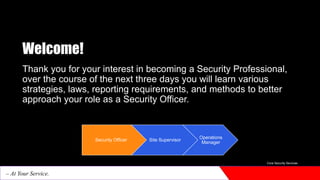
Thank you for your interest in becoming a Security Professional,
over the course of the next three days you will learn various
strategies, laws, reporting requirements, and methods to better
approach your role as a Security Officer.
Security Officer Site Supervisor
Operations
Manager
Core Security Services
– At Your Service.
Introduction to Physical Security
Physical security is an integral component of overall security
strategies, focusing on the protection of physical assets, people,
and resources. It encompasses measures and practices designed
to prevent unauthorized access, theft, vandalism, and other
physical threats to individuals and organizations.
In today's world, where physical threats and risks are present in
various forms, physical security measures are crucial for
maintaining safety and minimizing potential harm. From residential
homes and commercial establishments to critical infrastructure
and government facilities, physical security plays a vital role in
safeguarding assets and ensuring the well-being of individuals.
Core Security Services
– At Your Service.
Introduction to Physical Security
The primary objective of physical security is to create a secure
environment by establishing layers of defense that deter potential
threats, detect, and respond to incidents, and mitigate the impact of any
security breaches. Physical security measures can include a
combination of physical barriers, access control systems, surveillance
technologies, security personnel, and emergency response protocols.
Physical barriers are essential components of physical security and can
range from fences, gates, and locks to reinforced doors, windows, and
walls. These barriers serve as deterrents, making it more challenging
for unauthorized individuals to gain access to protected areas. Access
control systems complement physical barriers by allowing authorized
individuals to enter specific areas while restricting access to others.
Examples of access control mechanisms include key cards, biometric
scanners, and PIN codes.
Core Security Services
– At Your Service.
Introduction to Physical Security
Surveillance technologies play a vital role in physical security by
providing real-time monitoring and recording of activities in and
around protected areas. Closed-circuit television (CCTV)
cameras, motion sensors, and alarm systems enable prompt
detection of suspicious behavior or security breaches. Advanced
surveillance systems may also incorporate video analytics and
facial recognition technologies to enhance threat identification and
response capabilities.
Core Security Services
– At Your Service.
Introduction to Physical Security
Security personnel, such as security guards or patrols, serve as
an additional layer of protection in physical security. Their
presence acts as a deterrent and provides a human response to
potential threats or incidents. Security personnel can be trained to
monitor surveillance systems, perform access control functions,
conduct security checks, and respond effectively in emergency
situations.
Core Security Services
– At Your Service.
Introduction to Physical Security
Emergency response protocols and procedures are critical
elements of physical security planning. These protocols outline the
appropriate actions to be taken in the event of an emergency,
such as fires, natural disasters, or security breaches. Regular
drills and training sessions ensure that individuals are familiar with
the procedures and can respond quickly and efficiently during
critical situations.
Core Security Services
– At Your Service.
Introduction to Physical Security
Overall, physical security is a vital aspect of comprehensive
security strategies. It complements other security domains, such
as cybersecurity and information security, to provide a holistic
approach to protecting assets and individuals. By implementing
effective physical security measures, organizations and individuals
can mitigate risks, deter threats, and maintain a safe and secure
environment.
Core Security Services
– At Your Service.
Introduction to Physical Security
Physical security is the protection of people, property, and assets
from unauthorized access, damage, or theft. It includes a wide
range of measures, such as:
• Physical barriers: This includes fences, walls, gates, and other
physical barriers that prevent unauthorized access to a facility.
• Access control: This includes biometric scanners, key cards, and
other systems that control who can enter and exit a facility.
Core Security Services
– At Your Service.
Introduction to Physical Security
Physical security is the protection of people, property, and assets
from unauthorized access, damage, or theft. It includes a wide
range of measures, such as:
• Video surveillance: This includes cameras that monitor a facility
and record activity.
• Intrusion detection systems: This includes sensors that detect
unauthorized entry into a facility.
• Security guards: This includes personnel who patrol a facility and
deter unauthorized access.
Core Security Services
– At Your Service.
Introduction to Physical Security
Physical security is the protection of people, property, and assets
from unauthorized access, damage, or theft. It includes a wide
range of measures, such as:
• Video surveillance: This includes cameras that monitor a facility
and record activity.
• Intrusion detection systems: This includes sensors that detect
unauthorized entry into a facility.
• Security guards: This includes personnel who patrol a facility and
deter unauthorized access.
Core Security Services
– At Your Service.
Introduction to Physical Security
Here are some of the benefits of physical security:
• Prevents unauthorized access: Physical security measures can
prevent unauthorized individuals from accessing a facility or its
assets. This can help to protect people, property, and information
from theft, damage, or misuse.
• Deters crime: Physical security measures can deter crime by
making it more difficult for criminals to commit crimes. This can
help to create a safer environment for employees, customers,
and visitors.
Core Security Services
– At Your Service.
Introduction to Physical Security
Here are some of the benefits of physical security:
• Reduces insurance costs: Physical security measures can help
to reduce insurance costs by making a facility less of a target for
criminals.
• Improves morale: A safe and secure environment can improve
morale among employees and customers. This can lead to
increased productivity and profitability.
Core Security Services
– At Your Service.
Time and Reporting
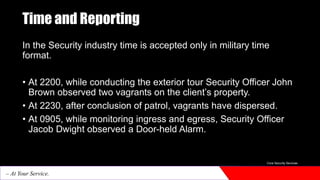
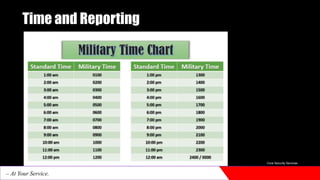
In the Security industry time is accepted only in military time
format.
• At 2200, while conducting the exterior tour Security Officer John
Brown observed two vagrants on the client’s property.
• At 2230, after conclusion of patrol, vagrants have dispersed.
• At 0905, while monitoring ingress and egress, Security Officer
Jacob Dwight observed a Door-held Alarm.
Core Security Services
– At Your Service.
Time and Reporting
Core Security Services
– At Your Service.
Security Terminology
Over the course of your career in Security you will be presented
with various terms. The terms and their definitions have been
provided by Asis and SecurityCEU. At each post, for reference, a
copy of the Asis Glossary of terms has been provided to better
assist you in understanding the terms of the Security Industry and
to give you something to reference should you run into a situation
where you aren’t sure of what something means.
Core Security Services
– At Your Service.
Security Terminology
Access
(1) A condition or equipment mode that allows authorized entry
into a protected area without alarm by electronically or
mechanically deactivating a sensor or sensors. (2) The ability and
means to approach, store or retrieve data, or to communicate with
or make use of Information Technology resources. (3) The ability
and opportunity to obtain knowledge of classified information. An
individual, in fact, may have access to classified information by
being in a place where such information is kept if the security
measures which are in force are not sufficient to prevent gaining
knowledge of the classified information. Core Security Services
– At Your Service.
Security Terminology
Access Control
A measure that provides restriction of access to a place or other
resource and ensures authorized access to physical or logical
assets. A procedure to identify and/or admit personnel with proper
security clearance and required access approval(s) to information
or facilities using physical, electronic, and/or human controls.
Core Security Services
– At Your Service.
Security Terminology
Access Rights
The cumulative rights provided to a person, system, or other
object that are required to perform one or more activities.
Core Security Services
– At Your Service.
Security Terminology
Active Barriers
Materials or systems, which must be command or sensor
activated to prevent or impede unauthorized passage.
Core Security Services
– At Your Service.
Security Terminology
Alarm Response Records
Alarm monitoring facility records of alarm response activity, as appropriate,
including, but not necessarily limited to, the following to the extent that alarm
response services are provided by employees of the monitoring facility:
1. Date and time of the original alarm signal
2. Date and time the public response agency was notified
3. Date and time the alarm agent was dispatched
4. Date and time the alarm agent arrived at the alarmed premises
5. Date and time the alarm agent departed the scene after the agent's report was
completed
6. Report of event disposition reported by the public response agency
7. All details included in the alarm agent's report.
Core Security Services
– At Your Service.
Security Terminology
Anti-Pass Back
A method for providing one-card, one-way access into and then
out of a secure area. It prevents someone from using a card to
enter a secure area and then passing that card back to someone
else to enter that same area.
Core Security Services
– At Your Service.
Security Terminology
Badge Reader
A reader used to read and interpret data encoded in an
identification badge.
Core Security Services
– At Your Service.
Security Terminology
Business Continuity Plan
Also known as Business Continuity Planning; (1) The process of
documenting prevention measures, disaster recovery, business
resumption and restoration plans, (2) The development,
implementation and maintenance of policies, frameworks and
programs to assist agencies manage a business disruption, as
well as build agency resilience. It is the capability that assists in
preventing, preparing for, responding to, managing and recovering
from the impacts of a disruptive event.
Core Security Services
– At Your Service.
Security Terminology
Call List
List of user-authorized agents and their telephone numbers, in the
order in which the monitoring facility is to follow in attempting to
reach someone for notification purposes. Unless otherwise
instructed, the notification process stops when one person has
been notified.
Core Security Services
– At Your Service.
Security Terminology
Card Access
A type of access control system that uses a card with a coded
area or strip, on or inside the card, to actuate a lock or other
access control device. To activate the device, the card is inserted
into or through a slot where the data in the coded area is read. If
the code is accepted, a signal will be transmitted to unlock the
device or perform some other access control function. See
definition of Card Reader for more information on types
Core Security Services
– At Your Service.
Security Terminology
CCTV
The common abbreviation for Closed Circuit Television. A private
or closed television system, usually hard-wired, used for
proprietary purposes and not for public or general broadcast.
Often used in security applications in conjunction with access
control, general surveillance, motion detection, or alarm
assessment.
Core Security Services
– At Your Service.
Security Terminology
Door Forced Alarm
An alarm generated when a door is forced open, opening the door
switch contact.
Core Security Services
– At Your Service.
Security Terminology
Door Held Open Alarm
An alarm generated when a door is held open beyond the
designated period as allotted in the access control software.
Core Security Services
– At Your Service.
Security Terminology
Emergency Medical Service
An agency that dispatches emergency medical or ambulance
personnel.
Core Security Services
– At Your Service.
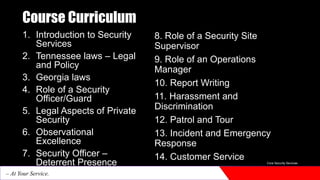
Course Curriculum
1. Introduction to Security
Services
2. Tennessee laws – Legal
and Policy
3. Georgia laws
4. Role of a Security
Officer/Guard
5. Legal Aspects of Private
Security
6. Observational
Excellence
7. Security Officer –
Deterrent Presence
8. Role of a Security Site
Supervisor
9. Role of an Operations
Manager
10. Report Writing
11. Harassment and
Discrimination
12. Patrol and Tour
13. Incident and Emergency
Response
14. Customer Service Core Security Services
– At Your Service.
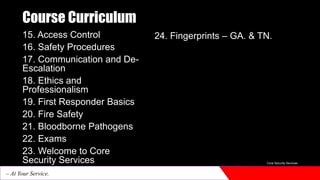
Course Curriculum
15. Access Control
16. Safety Procedures
17. Communication and De-
Escalation
18. Ethics and
Professionalism
19. First Responder Basics
20. Fire Safety
21. Bloodborne Pathogens
22. Exams
23. Welcome to Core
Security Services
24. Fingerprints – GA. & TN.
Core Security Services
– At Your Service.
Introduction Conclusion - Exam
Core Security Services
– At Your Service.

Introduction to Security

  • 1.
    Introduction to Security Welcome toCore Security Services Core Security Services – At Your Service.
  • 2.
    Welcome! Thank you foryour interest in becoming a Security Professional, over the course of the next three days you will learn various strategies, laws, reporting requirements, and methods to better approach your role as a Security Officer. Security Officer Site Supervisor Operations Manager Core Security Services – At Your Service.
  • 3.
    Introduction to PhysicalSecurity Physical security is an integral component of overall security strategies, focusing on the protection of physical assets, people, and resources. It encompasses measures and practices designed to prevent unauthorized access, theft, vandalism, and other physical threats to individuals and organizations. In today's world, where physical threats and risks are present in various forms, physical security measures are crucial for maintaining safety and minimizing potential harm. From residential homes and commercial establishments to critical infrastructure and government facilities, physical security plays a vital role in safeguarding assets and ensuring the well-being of individuals. Core Security Services – At Your Service.
  • 4.
    Introduction to PhysicalSecurity The primary objective of physical security is to create a secure environment by establishing layers of defense that deter potential threats, detect, and respond to incidents, and mitigate the impact of any security breaches. Physical security measures can include a combination of physical barriers, access control systems, surveillance technologies, security personnel, and emergency response protocols. Physical barriers are essential components of physical security and can range from fences, gates, and locks to reinforced doors, windows, and walls. These barriers serve as deterrents, making it more challenging for unauthorized individuals to gain access to protected areas. Access control systems complement physical barriers by allowing authorized individuals to enter specific areas while restricting access to others. Examples of access control mechanisms include key cards, biometric scanners, and PIN codes. Core Security Services – At Your Service.
  • 5.
    Introduction to PhysicalSecurity Surveillance technologies play a vital role in physical security by providing real-time monitoring and recording of activities in and around protected areas. Closed-circuit television (CCTV) cameras, motion sensors, and alarm systems enable prompt detection of suspicious behavior or security breaches. Advanced surveillance systems may also incorporate video analytics and facial recognition technologies to enhance threat identification and response capabilities. Core Security Services – At Your Service.
  • 6.
    Introduction to PhysicalSecurity Security personnel, such as security guards or patrols, serve as an additional layer of protection in physical security. Their presence acts as a deterrent and provides a human response to potential threats or incidents. Security personnel can be trained to monitor surveillance systems, perform access control functions, conduct security checks, and respond effectively in emergency situations. Core Security Services – At Your Service.
  • 7.
    Introduction to PhysicalSecurity Emergency response protocols and procedures are critical elements of physical security planning. These protocols outline the appropriate actions to be taken in the event of an emergency, such as fires, natural disasters, or security breaches. Regular drills and training sessions ensure that individuals are familiar with the procedures and can respond quickly and efficiently during critical situations. Core Security Services – At Your Service.
  • 8.
    Introduction to PhysicalSecurity Overall, physical security is a vital aspect of comprehensive security strategies. It complements other security domains, such as cybersecurity and information security, to provide a holistic approach to protecting assets and individuals. By implementing effective physical security measures, organizations and individuals can mitigate risks, deter threats, and maintain a safe and secure environment. Core Security Services – At Your Service.
  • 9.
    Introduction to PhysicalSecurity Physical security is the protection of people, property, and assets from unauthorized access, damage, or theft. It includes a wide range of measures, such as: • Physical barriers: This includes fences, walls, gates, and other physical barriers that prevent unauthorized access to a facility. • Access control: This includes biometric scanners, key cards, and other systems that control who can enter and exit a facility. Core Security Services – At Your Service.
  • 10.
    Introduction to PhysicalSecurity Physical security is the protection of people, property, and assets from unauthorized access, damage, or theft. It includes a wide range of measures, such as: • Video surveillance: This includes cameras that monitor a facility and record activity. • Intrusion detection systems: This includes sensors that detect unauthorized entry into a facility. • Security guards: This includes personnel who patrol a facility and deter unauthorized access. Core Security Services – At Your Service.
  • 11.
    Introduction to PhysicalSecurity Physical security is the protection of people, property, and assets from unauthorized access, damage, or theft. It includes a wide range of measures, such as: • Video surveillance: This includes cameras that monitor a facility and record activity. • Intrusion detection systems: This includes sensors that detect unauthorized entry into a facility. • Security guards: This includes personnel who patrol a facility and deter unauthorized access. Core Security Services – At Your Service.
  • 12.
    Introduction to PhysicalSecurity Here are some of the benefits of physical security: • Prevents unauthorized access: Physical security measures can prevent unauthorized individuals from accessing a facility or its assets. This can help to protect people, property, and information from theft, damage, or misuse. • Deters crime: Physical security measures can deter crime by making it more difficult for criminals to commit crimes. This can help to create a safer environment for employees, customers, and visitors. Core Security Services – At Your Service.
  • 13.
    Introduction to PhysicalSecurity Here are some of the benefits of physical security: • Reduces insurance costs: Physical security measures can help to reduce insurance costs by making a facility less of a target for criminals. • Improves morale: A safe and secure environment can improve morale among employees and customers. This can lead to increased productivity and profitability. Core Security Services – At Your Service.
  • 14.
    Time and Reporting Inthe Security industry time is accepted only in military time format. • At 2200, while conducting the exterior tour Security Officer John Brown observed two vagrants on the client’s property. • At 2230, after conclusion of patrol, vagrants have dispersed. • At 0905, while monitoring ingress and egress, Security Officer Jacob Dwight observed a Door-held Alarm. Core Security Services – At Your Service.
  • 15.
    Time and Reporting CoreSecurity Services – At Your Service.
  • 16.
    Security Terminology Over thecourse of your career in Security you will be presented with various terms. The terms and their definitions have been provided by Asis and SecurityCEU. At each post, for reference, a copy of the Asis Glossary of terms has been provided to better assist you in understanding the terms of the Security Industry and to give you something to reference should you run into a situation where you aren’t sure of what something means. Core Security Services – At Your Service.
  • 17.
    Security Terminology Access (1) Acondition or equipment mode that allows authorized entry into a protected area without alarm by electronically or mechanically deactivating a sensor or sensors. (2) The ability and means to approach, store or retrieve data, or to communicate with or make use of Information Technology resources. (3) The ability and opportunity to obtain knowledge of classified information. An individual, in fact, may have access to classified information by being in a place where such information is kept if the security measures which are in force are not sufficient to prevent gaining knowledge of the classified information. Core Security Services – At Your Service.
  • 18.
    Security Terminology Access Control Ameasure that provides restriction of access to a place or other resource and ensures authorized access to physical or logical assets. A procedure to identify and/or admit personnel with proper security clearance and required access approval(s) to information or facilities using physical, electronic, and/or human controls. Core Security Services – At Your Service.
  • 19.
    Security Terminology Access Rights Thecumulative rights provided to a person, system, or other object that are required to perform one or more activities. Core Security Services – At Your Service.
  • 20.
    Security Terminology Active Barriers Materialsor systems, which must be command or sensor activated to prevent or impede unauthorized passage. Core Security Services – At Your Service.
  • 21.
    Security Terminology Alarm ResponseRecords Alarm monitoring facility records of alarm response activity, as appropriate, including, but not necessarily limited to, the following to the extent that alarm response services are provided by employees of the monitoring facility: 1. Date and time of the original alarm signal 2. Date and time the public response agency was notified 3. Date and time the alarm agent was dispatched 4. Date and time the alarm agent arrived at the alarmed premises 5. Date and time the alarm agent departed the scene after the agent's report was completed 6. Report of event disposition reported by the public response agency 7. All details included in the alarm agent's report. Core Security Services – At Your Service.
  • 22.
    Security Terminology Anti-Pass Back Amethod for providing one-card, one-way access into and then out of a secure area. It prevents someone from using a card to enter a secure area and then passing that card back to someone else to enter that same area. Core Security Services – At Your Service.
  • 23.
    Security Terminology Badge Reader Areader used to read and interpret data encoded in an identification badge. Core Security Services – At Your Service.
  • 24.
    Security Terminology Business ContinuityPlan Also known as Business Continuity Planning; (1) The process of documenting prevention measures, disaster recovery, business resumption and restoration plans, (2) The development, implementation and maintenance of policies, frameworks and programs to assist agencies manage a business disruption, as well as build agency resilience. It is the capability that assists in preventing, preparing for, responding to, managing and recovering from the impacts of a disruptive event. Core Security Services – At Your Service.
  • 25.
    Security Terminology Call List Listof user-authorized agents and their telephone numbers, in the order in which the monitoring facility is to follow in attempting to reach someone for notification purposes. Unless otherwise instructed, the notification process stops when one person has been notified. Core Security Services – At Your Service.
  • 26.
    Security Terminology Card Access Atype of access control system that uses a card with a coded area or strip, on or inside the card, to actuate a lock or other access control device. To activate the device, the card is inserted into or through a slot where the data in the coded area is read. If the code is accepted, a signal will be transmitted to unlock the device or perform some other access control function. See definition of Card Reader for more information on types Core Security Services – At Your Service.
  • 27.
    Security Terminology CCTV The commonabbreviation for Closed Circuit Television. A private or closed television system, usually hard-wired, used for proprietary purposes and not for public or general broadcast. Often used in security applications in conjunction with access control, general surveillance, motion detection, or alarm assessment. Core Security Services – At Your Service.
  • 28.
    Security Terminology Door ForcedAlarm An alarm generated when a door is forced open, opening the door switch contact. Core Security Services – At Your Service.
  • 29.
    Security Terminology Door HeldOpen Alarm An alarm generated when a door is held open beyond the designated period as allotted in the access control software. Core Security Services – At Your Service.
  • 30.
    Security Terminology Emergency MedicalService An agency that dispatches emergency medical or ambulance personnel. Core Security Services – At Your Service.
  • 31.
    Course Curriculum 1. Introductionto Security Services 2. Tennessee laws – Legal and Policy 3. Georgia laws 4. Role of a Security Officer/Guard 5. Legal Aspects of Private Security 6. Observational Excellence 7. Security Officer – Deterrent Presence 8. Role of a Security Site Supervisor 9. Role of an Operations Manager 10. Report Writing 11. Harassment and Discrimination 12. Patrol and Tour 13. Incident and Emergency Response 14. Customer Service Core Security Services – At Your Service.
  • 32.
    Course Curriculum 15. AccessControl 16. Safety Procedures 17. Communication and De- Escalation 18. Ethics and Professionalism 19. First Responder Basics 20. Fire Safety 21. Bloodborne Pathogens 22. Exams 23. Welcome to Core Security Services 24. Fingerprints – GA. & TN. Core Security Services – At Your Service.
  • 33.
    Introduction Conclusion -Exam Core Security Services – At Your Service.