Physical Science Review
T. Spence
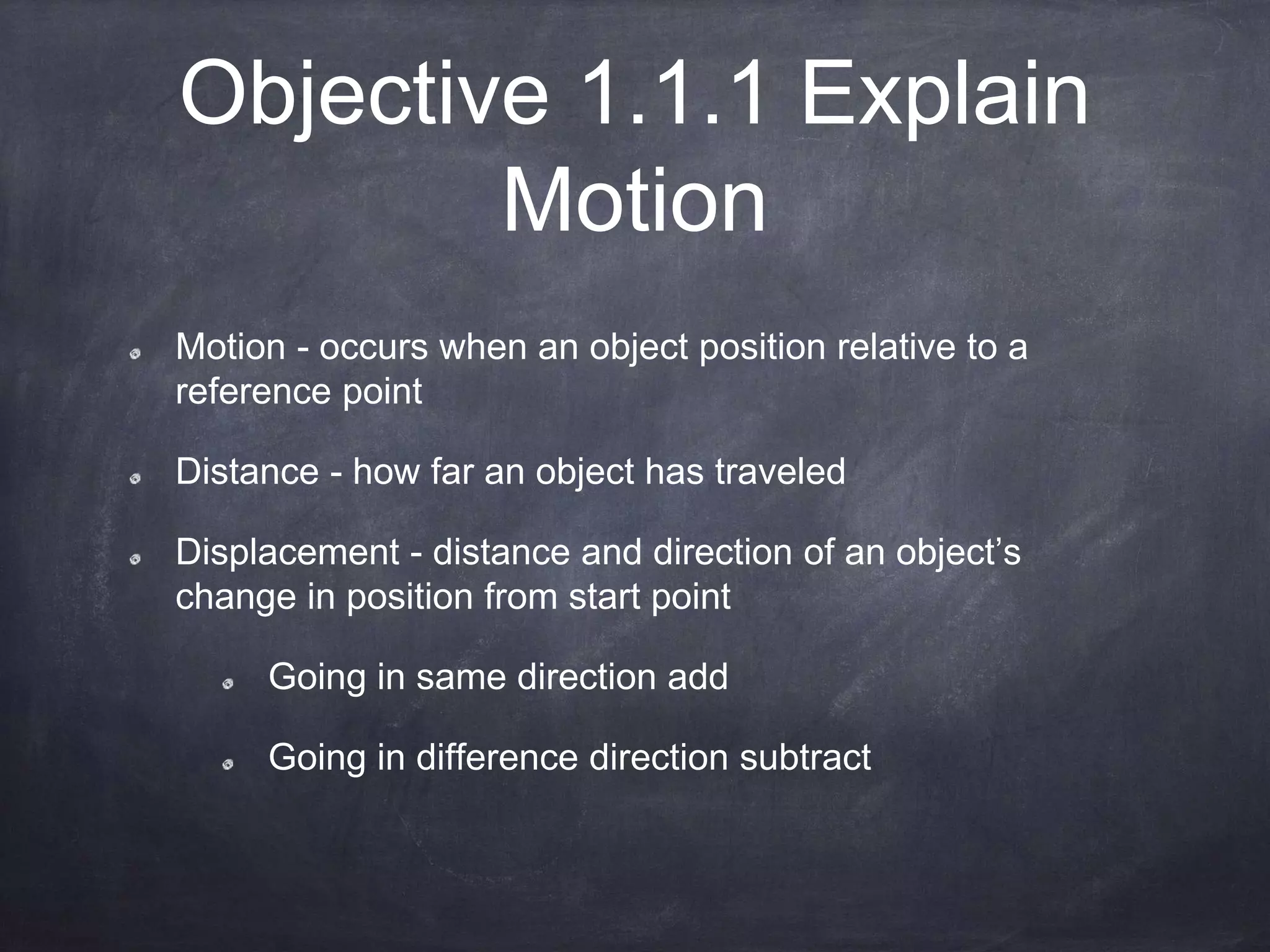
Objective 1.1.1 Explain
Motion
Motion - occurs when an object position relative to a
reference point
Distance - how far an object has traveled
Displacement - distance and direction of an object’s
change in position from start point
Going in same direction add
Going in difference direction subtract
Objective 1.1.1 Explain
Motion
Speed - the distance an object travels per unit
time - rate of change in position
Speed = Distance/Time
Objective 1.1.1 Explain
Motion
Velocity - includes speed of an object and the
direction of the motion
Velocity = Distance/Time
Objective 1.1.1 Explain
Motion
Acceleration - rate of change of velocity
Acceleration = velocity final - velocity initial
/ time
Objective 1.1.1 Explain
Motion
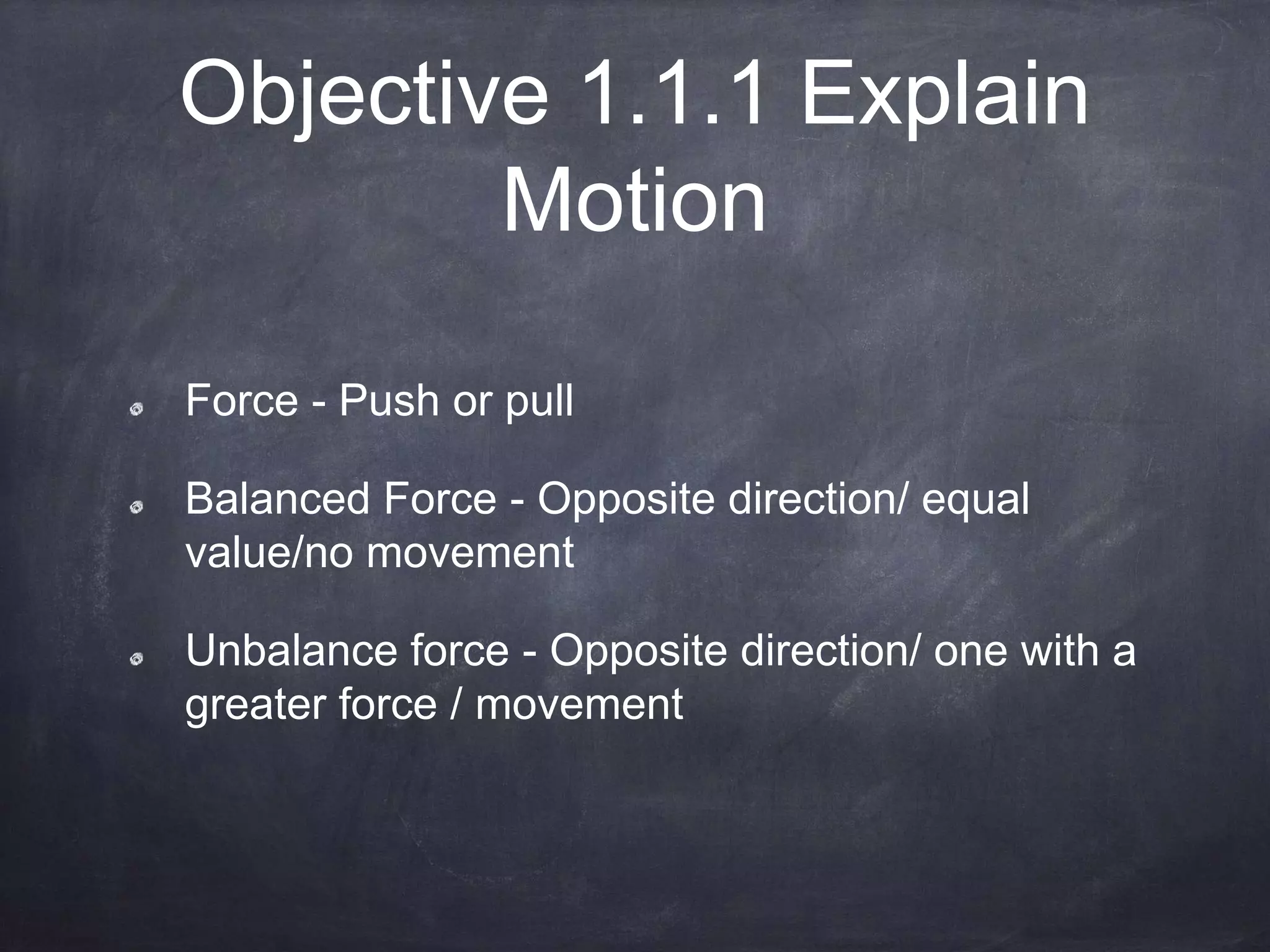
Force - Push or pull
Balanced Force - Opposite direction/ equal
value/no movement
Unbalance force - Opposite direction/ one with a
greater force / movement
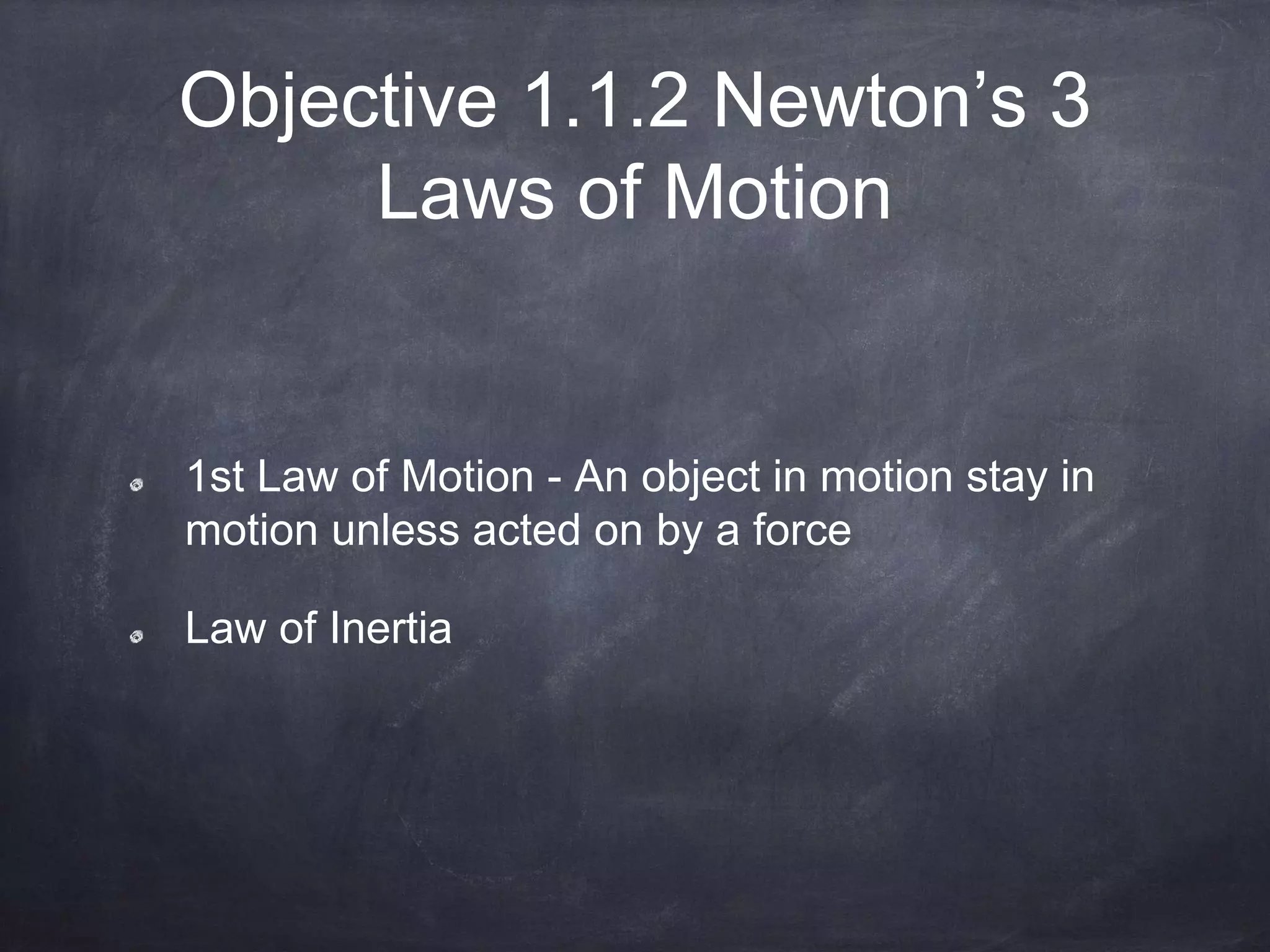
Objective 1.1.2 Newton’s 3
Laws of Motion
1st Law of Motion - An object in motion stay in
motion unless acted on by a force
Law of Inertia
Objective 1.1.2 Newton’s 3
Laws of Motion
Second Law - the acceleration of a body
depends on the ratio of the acting force to the
mass of the body
Objective 1.1.1 Explain
Motion
Force = Mass * acceleration
Objective 1.1.1 Explain
Motion
3rd Law of Motion - For every action there is an
equal but opposite reaction
Balanced forces
Objective 1.2.2 Friction
Friction - A force that resist motion and can cause heat
Static Friction - friction on a stationary object
Sliding friction - friction sliding over a surface
Rolling friction - friction acting on an object that rolling
Fluid friction - friction acting on a fluid (water or air)
Objective 1.2.2 Friction
Air Resistance - Force acting upward against
gravity (Newton’s 3rd Law of Motion)
If 2 objects drop in a vacuum both will hit the
ground at the same time.
Objective 1.2.2 Weight
Weight Formula (Newtons) = Mass * gravity
Objective 3.1.4
Work and Power
Work - Transfer of energy that occurs when a
force makes an object move
Work (J) = Force (N) x Distance (m)
Objective 3.1.4
Work and Power
Power - The rate at which work is done
Power (Watts) = Work (J) / time (s)
Objective 3.1.4
Simple Machines
Makes work easier - increase force, distance, direction
Lever - Bar that is free to pivot around a fixed point
Pulley - Grooved wheel with a rope chain or cable running along groove
Wheel & Axle - As a wheel and axle
Inclined plane - Sloped surface
Screw - Inclined plane wrapped in a spiral around a cylindrical post
Wedge - An inclined plan with one or 2 sloping sides
Objective 3.1.4
Simple Machines
Input force - what you put into the machine
Output force - the force put out by the machine
Input work - work done by you
Output work - work done by you
Objective 3.1.4
Simple Machines
Law of conservation - Energy is not created nor
destroyed
Work in = Work out
Objective 3.1.4
Mechanical Advantage
Actual Mechanical Advantage = Output Force/Input
Force
Idea Mechanical Advantage = Input Force/Output Force
Efficiency = Work Out / Work In X 100
Objective 3.1.2
Energy and Heat
Energy - The ability to cause change
Forms - Electrical, Thermal, Chemical, and Mechanical
(know the differences), Nuclear Energy,
Electromagnetic Energy
Energy can only change forms, cannot be created nor
destroyed
Objective 3.1.2
Energy and Heat
2 Types of Energy
Kinetic Energy - Energy of motion (J) depends on
mass and speed
Potential Energy - Energy stored depends on height
Objective 3.1.2
Energy and Heat
Kinetic Energy = 0.5(m)(v2)
Potential Energy = m(g)(h)
Gravity on Earth = 9.8
Objective 3.1.2
Energy and Heat
Heat Transfers from hot to cold
Temperature is a measure of how fast molecules move
(kinetic energy)
Move fast - expand - hot
Move slow - contract - cold
Objective 3.1.1
Heat Transfer
Specific Heat - Amount of heat needed to raise the
temp. Of one gram of material by one degree Celsius
Low Specific - faster it heats up and cool down
Objective 3.1.1
Heat Transfer
3 Types of Heat Transfer
Conduction - by touch
Convection - in fluids
Radiation - through space
Objective 3.1.1
Heat Transfer
3 Types of Heat Transfer
Conduction - by touch
Convection - in fluids
Radiation - through space
Objective 3.2.2
Waves
Wave - A repeating movement or disturbance that transfers energy through
matter or space
Mechanical waves - waves that can only travel through a medium (matter)
Transverse waves - matter moves back & forth at right angles to the direction
that the wave travels
Longitudinal waves - matter in the medium moves in the same direction that
the wave travels
Electromagnetic waves - travels at the same speed in a vacuum
Surface Waves - Water Waves
Objective 3.2.1
Wave Parts
Crest - highest point of wave
Troughs - Lowest point of waves
Compressions - coils close together
Rarefaction - coils spread apart
Wavelength - distance between crests or troughs
Frequency - number of wavelengths that pass a fixed point
Amplitude - measure from rest position to crest or trough
Objective 3.2.1
Wave Speed
Wave Speed (m/s) = frequency (Hz) x Wavelength (m)
Objective 3.2.4
Wave Interactions
Reflection - A wave strikes an object and bounces off
Refraction - bending
Diffraction - Change in direction
Interference - When 2 or more waves overlap and
combine to form a new wave

Physical science review

  • 1.
  • 2.
    Objective 1.1.1 Explain Motion Motion- occurs when an object position relative to a reference point Distance - how far an object has traveled Displacement - distance and direction of an object’s change in position from start point Going in same direction add Going in difference direction subtract
  • 3.
    Objective 1.1.1 Explain Motion Speed- the distance an object travels per unit time - rate of change in position Speed = Distance/Time
  • 4.
    Objective 1.1.1 Explain Motion Velocity- includes speed of an object and the direction of the motion Velocity = Distance/Time
  • 5.
    Objective 1.1.1 Explain Motion Acceleration- rate of change of velocity Acceleration = velocity final - velocity initial / time
  • 6.
    Objective 1.1.1 Explain Motion Force- Push or pull Balanced Force - Opposite direction/ equal value/no movement Unbalance force - Opposite direction/ one with a greater force / movement
  • 7.
    Objective 1.1.2 Newton’s3 Laws of Motion 1st Law of Motion - An object in motion stay in motion unless acted on by a force Law of Inertia
  • 8.
    Objective 1.1.2 Newton’s3 Laws of Motion Second Law - the acceleration of a body depends on the ratio of the acting force to the mass of the body
  • 9.
  • 10.
    Objective 1.1.1 Explain Motion 3rdLaw of Motion - For every action there is an equal but opposite reaction Balanced forces
  • 11.
    Objective 1.2.2 Friction Friction- A force that resist motion and can cause heat Static Friction - friction on a stationary object Sliding friction - friction sliding over a surface Rolling friction - friction acting on an object that rolling Fluid friction - friction acting on a fluid (water or air)
  • 12.
    Objective 1.2.2 Friction AirResistance - Force acting upward against gravity (Newton’s 3rd Law of Motion) If 2 objects drop in a vacuum both will hit the ground at the same time.
  • 13.
    Objective 1.2.2 Weight WeightFormula (Newtons) = Mass * gravity
  • 14.
    Objective 3.1.4 Work andPower Work - Transfer of energy that occurs when a force makes an object move Work (J) = Force (N) x Distance (m)
  • 15.
    Objective 3.1.4 Work andPower Power - The rate at which work is done Power (Watts) = Work (J) / time (s)
  • 16.
    Objective 3.1.4 Simple Machines Makeswork easier - increase force, distance, direction Lever - Bar that is free to pivot around a fixed point Pulley - Grooved wheel with a rope chain or cable running along groove Wheel & Axle - As a wheel and axle Inclined plane - Sloped surface Screw - Inclined plane wrapped in a spiral around a cylindrical post Wedge - An inclined plan with one or 2 sloping sides
  • 17.
    Objective 3.1.4 Simple Machines Inputforce - what you put into the machine Output force - the force put out by the machine Input work - work done by you Output work - work done by you
  • 18.
    Objective 3.1.4 Simple Machines Lawof conservation - Energy is not created nor destroyed Work in = Work out
  • 19.
    Objective 3.1.4 Mechanical Advantage ActualMechanical Advantage = Output Force/Input Force Idea Mechanical Advantage = Input Force/Output Force Efficiency = Work Out / Work In X 100
  • 20.
    Objective 3.1.2 Energy andHeat Energy - The ability to cause change Forms - Electrical, Thermal, Chemical, and Mechanical (know the differences), Nuclear Energy, Electromagnetic Energy Energy can only change forms, cannot be created nor destroyed
  • 21.
    Objective 3.1.2 Energy andHeat 2 Types of Energy Kinetic Energy - Energy of motion (J) depends on mass and speed Potential Energy - Energy stored depends on height
  • 22.
    Objective 3.1.2 Energy andHeat Kinetic Energy = 0.5(m)(v2) Potential Energy = m(g)(h) Gravity on Earth = 9.8
  • 23.
    Objective 3.1.2 Energy andHeat Heat Transfers from hot to cold Temperature is a measure of how fast molecules move (kinetic energy) Move fast - expand - hot Move slow - contract - cold
  • 24.
    Objective 3.1.1 Heat Transfer SpecificHeat - Amount of heat needed to raise the temp. Of one gram of material by one degree Celsius Low Specific - faster it heats up and cool down
  • 25.
    Objective 3.1.1 Heat Transfer 3Types of Heat Transfer Conduction - by touch Convection - in fluids Radiation - through space
  • 26.
    Objective 3.1.1 Heat Transfer 3Types of Heat Transfer Conduction - by touch Convection - in fluids Radiation - through space
  • 27.
    Objective 3.2.2 Waves Wave -A repeating movement or disturbance that transfers energy through matter or space Mechanical waves - waves that can only travel through a medium (matter) Transverse waves - matter moves back & forth at right angles to the direction that the wave travels Longitudinal waves - matter in the medium moves in the same direction that the wave travels Electromagnetic waves - travels at the same speed in a vacuum Surface Waves - Water Waves
  • 28.
    Objective 3.2.1 Wave Parts Crest- highest point of wave Troughs - Lowest point of waves Compressions - coils close together Rarefaction - coils spread apart Wavelength - distance between crests or troughs Frequency - number of wavelengths that pass a fixed point Amplitude - measure from rest position to crest or trough
  • 29.
    Objective 3.2.1 Wave Speed WaveSpeed (m/s) = frequency (Hz) x Wavelength (m)
  • 30.
    Objective 3.2.4 Wave Interactions Reflection- A wave strikes an object and bounces off Refraction - bending Diffraction - Change in direction Interference - When 2 or more waves overlap and combine to form a new wave