LUSTRE :
The brilliancy of mineral surface in the reflected light is called as lustre.
It is the general appearance of a mineral surface in reflected light. Lustre of
mineral varies with nature of their surface (smooth or rough) and the quantity of
light reflected. Based on the type of shining, lustres are grouped as Metallic,
Sub-metallic and Non-metallic.
1. Metallic - Shining like polished metals . e.g. Galena, Pyrite, Gold.
2. Sub-metallic – If amount of shining is less, metallic lustre will be described
as Sub-metallic.
3. Non-metallic – Non-metallic lustres are of different types.
i) Vitreous lustre – Shining like broken glass. e.g. Quartz
ii) Pearly lustre - Shining like a pearl e.g. Muscovite, Kyanite
iii) Silky lustre – Shining like silk e.g. Asbestos, Gypsum
iv) Resinous lustre – Shining like resin/wax e.g. Sphalerite, chlorite
v) Greasy lustre – shining like grease e.g. Graphite, Serpentine
vi) Admantine lustre – Shining like Diamond .e.g. Diamond, Zircon
vii) Dull or Earthy – No Shining e.g. Kaolin, Chalk.
Dr. S. V. Kulkarni
CLEAVAGE :
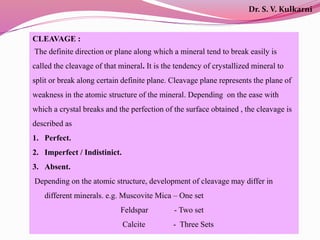
The definite direction or plane along which a mineral tend to break easily is
called the cleavage of that mineral. It is the tendency of crystallized mineral to
split or break along certain definite plane. Cleavage plane represents the plane of
weakness in the atomic structure of the mineral. Depending on the ease with
which a crystal breaks and the perfection of the surface obtained , the cleavage is
described as
1. Perfect.
2. Imperfect / Indistinict.
3. Absent.
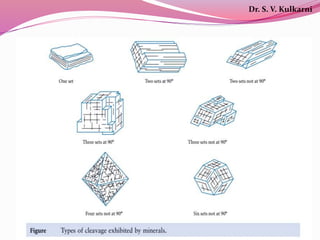
Depending on the atomic structure, development of cleavage may differ in
different minerals. e.g. Muscovite Mica – One set
Feldspar - Two set
Calcite - Three Sets
Dr. S. V. Kulkarni
Dr. S. V. Kulkarni
FRACTURE :
Fracture is the nature of randomly broken surface of a mineral. The broken surface
of the mineral other than cleavage direction is called as fracture. On the basis of
nature of broken surface , fractures may be described as
1. Even Fracture – If the broken surface is plain and smooth (almost flat).
2. Uneven Fracture - If the broken surface is rough and irregular.
3. Hackly Fracture - If the broken surface is very rough with sharp projections.
4. Conchoidal Fracture – if the broken surface is smooth and curved. (concave and
convex surface)
Generally the minerals do not show cleavage, break with irregular surface.
Fracture is independent of atomic structure.
Dr. S. V. Kulkarni
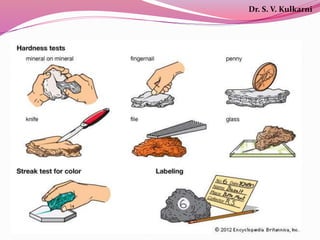
HARDNESS:
Hardness may be defined as the resistance offered by the mineral to abrasion or
scratching. It is an important physical property used for identification of mineral.
Hardness of a mineral dependent on atomic packing. In the identification of minerals in
hand specimens, only relative hardness is determined . For this, the mineral is compared
with the hardness of a set of ten standard minerals. These reference minerals represent
nearly the complete range of hardness of minerals and are arranged in the increasing order
of hardness. This standard set of ten reference minerals is called Moh’s scale of Hardness.
Moh’s scale of hardness
Name of Mineral Hardness
Talc 1
Gypsum 2
Calcite 3
Fluorite 4
Apatite 5
Feldspar 6
Quartz 7
Topaz 8
Corundum 9
Diamond 10
Dr. S. V. Kulkarni
Dr. S. V. Kulkarni
SPECIFIC GRAVITY :
Specific gravity of the mineral is the ratio of its weight to an
equal of volume of water. For practical purpose , however, approximation
can be made by holding the mineral specimen in hand and comparing its
weight the following terms are used to describe specific gravity :
1. Heavy - High
2. Medium - Medium
3. Light -Low
OTHER PROPERTIES :
In addition to the above described physical properties of the mineral,
there are some other properties which can be used as diagnostic
character for their identification. These properties are:
1. Test
2. Solubility
3. Smell or odour
4. Magnetism
5. Reaction with acid.
Dr. S. V. Kulkarni
Specimen No. :-
A] Chemical composition :- SiO2
B ] Crystal System :- HEXAGONAL
C ] Physical properties :-
1. Form / Habit – Crystalline
2. Colour – Colourless
3. Streak – White / Absent
4. Lustre – Vitreous
5. Cleavage – Absent
6. Fracture – Conchoidal
7. Hardness – Can not be scratched by knife (7)
8. Specific gravity – Medium
D] Diagnostic character – Crystalline form, Absence of cleavage,
Conchoidal Fracture, Hardness 7
On the basis of above physical properties , the mineral may
be identified as QUARTZ
Dr. S. V. Kulkarni
Specimen No. :-
A] Chemical composition :- CaCO3
B ] Crystal System :- HEXAGONAL
C ] Physical properties :-
1. Form / Habit – Crystalline / Rhombohedral
2. Colour – White
3. Streak – White
4. Lustre – Vitreous
5. Cleavage – Perfect
6. Fracture – Even
7. Hardness – Can be scratched by knife (3-3.5)
8. Specific gravity – Medium
D] Diagnostic character – Rhombohedral form, Perfect Cleavage
Even Fracture, Hardness 3, Gives +ve
acid test
On the basis of above physical properties , the mineral
may be identified as CALCITE.
Dr. S. V. Kulkarni
Specimen No. :-
A] Chemical composition :- KAlSi3O8 (Potassium aluminium
silicate)
B ] Crystal System :- TRICLINIC
C ] Physical properties :-
1. Form / Habit – Crystalline/ Tabular
2. Colour – Flesh red
3. Streak – Absent
4. Lustre – Vitreous
5. Cleavage – Present
6. Fracture – Even
7. Hardness – Can be scratched by knife (6-6.5)
8. Specific gravity – Medium
D] Diagnostic character – Flesh red colour, Perfect cleavage,
Vitreous lustre, Hardness 6, Tabular form
On the basis of above physical properties , the mineral may
be identified as MICROCLINE
Dr. S. V. Kulkarni
Specimen No. :-
A] Chemical composition :- KAlSi3O8 (Potassium aluminum
silicate)
B ] Crystal System :- TRICLINIC
C ] Physical properties :-
1. Form / Habit – Massive/ Tabular
2. Colour – White
3. Streak – White
4. Lustre – Vitreous
5. Cleavage – Present
6. Fracture – Uneven
7. Hardness – Can be scratched by knife (6-6.5)
8. Specific gravity – Medium
D] Diagnostic character – White colour, Perfect cleavage,
Vitreous lustre, Hardness 6, Massive form
On the basis of above physical properties , the mineral may
be identified as ORTHOCLASE
Dr. S. V. Kulkarni
Specimen No. :-
A] Chemical composition :- KAl2(Al Si3O10) (OH)2 Hydrous Silicate
of K & Al
B ] Crystal System :- MONOCLINIC
C ] Physical properties :-
1. Form / Habit – Flaky / Platy
2. Colour – Colourless/ Transparent
3. Streak – Absent
4. Lustre – Pearly/ Vitreous
5. Cleavage – Perfect
6. Fracture – Even
7. Hardness – Can be scratched by Fingernail (2.7 to 3)
8. Specific gravity – Low
D] Diagnostic character – Colourless, Flaky form, Perfect cleavage,
Pearly lustre,
On the basis of above physical properties , the mineral may be
identified as MUSCOVITE
Dr. S. V. Kulkarni
Specimen No. :-
A] Chemical composition :- K(Mg Fe)3 AlSi3O10 (OH)2
B ] Crystal System :- MONOCLINIC
C ] Physical properties :-
1. Form / Habit – Flaky
2. Colour – Deep Brown / Black
3. Streak – Absent
4. Lustre – Pearly/ Vitreous
5. Cleavage – Perfect
6. Fracture – Even
7. Hardness – Can be scratched by Fingernail (2.7 to 3)
8. Specific gravity – Medium
D] Diagnostic character – Brownish Black colour, Perfect cleavage,
Vitreous lustre, Flaky Form
On the basis of above physical properties , the mineral may
be identified as BIOTITE
Dr. S. V. Kulkarni
Specimen No. :-
A] Chemical composition :- Al2SiO5
B ] Crystal System :- TRICLINIC
C ] Physical properties :-
1. Form / Habit – Bladed
2. Colour – Brownish red
3. Streak – Absent
4. Lustre – Vitreous to Subvitreous
5. Cleavage – Perfect
6. Fracture – -
7. Hardness – Variable hardness(Lenghtwise 5 – Across 7)
8. Specific gravity – Medium
D] Diagnostic character – Bladed form, Perfect cleavage,
Variable hardness
On the basis of above physical properties , the mineral may be
identified as KYANITE
Dr. S. V. Kulkarni
Specimen No. :-
A] Chemical composition :- Ca2Na (Mg,Fe)4 (AlFeTi)(AlSi)8O22(OH)2
Complex Silicate of Ca,Mg,Fe,Al & Na
B ] Crystal System :- MONOCLINIC
C ] Physical properties :-
1. Form / Habit – Crystalline ( Prismatic)
2. Colour – Black / Dark Green
3. Streak – Absent
4. Lustre – Vitreous
5. Cleavage – Present
6. Fracture – Uneven
7. Hardness – Can be scratched by knife (5-5.5)
8. Specific gravity – Medium
D] Diagnostic character – Dark colour, Perfect cleavage,
Vitreous lustre, Hardness 5, Prismatic form
On the basis of above physical properties , the mineral may be
identified as HORNBLENDE
Dr. S. V. Kulkarni
Specimen No. :-
A] Chemical composition :- (Ca,Na)(Mg,Fe++,Fe+++,Al)(Si,Al)2O6
B ] Crystal System :- MONOCLINIC
C ] Physical properties :-
1. Form / Habit – Crystalline/ Tabular
2. Colour – Black / Dark Green
3. Streak – Greyish White
4. Lustre – Vitreous
5. Cleavage – Present
6. Fracture – Uneven
7. Hardness – Can be scratched by knife (5-5.5)
8. Specific gravity – Medium
D] Diagnostic character – Dark black colour, Perfect cleavage,
Vitreous lustre, Hardness 5.5, Prismatic
form
On the basis of above physical properties , the mineral may
be identified as AUGITE
Dr. S. V. Kulkarni
Specimen No. :-
A] Chemical composition :- Al2O3
B ] Crystal System :- HEXAGONAL
C ] Physical properties :-
1. Form / Habit – Crystalline/ Tabular
2. Colour – Reddish brown
3. Streak – Greyish White
4. Lustre – Admantine
5. Cleavage – Present
6. Fracture – Uneven
7. Hardness – Can not be scratched by knife (9)
8. Specific gravity – High
D] Diagnostic character – Reddish brown colour, Perfect cleavage,
Admantine lustre, Hardness 9,
On the basis of above physical properties , the mineral may
be identified as CORUNDUM
Dr. S. V. Kulkarni
Specimen No. :-
A] Chemical composition :- Complex Silicate of Ca, Mg, Fe, Al.
B ] Crystal System :- CUBIC/ISOMETRIC
C ] Physical properties :-
1. Form / Habit – Crystalline/ Dodecahedron
2. Colour – Reddish brown/ Wine Red
3. Streak – Absent
4. Lustre – Resinous
5. Cleavage – Indistinct
6. Fracture – Uneven
7. Hardness – Can not be scratched by knife (6.5-7)
8. Specific gravity – High
D] Diagnostic character – Wine red colour, Crystalline form,
Resinous lustre, Hardness,
On the basis of above physical properties , the mineral may
be identified as GARNET
Dr. S. V. Kulkarni
Specimen No. :-
A] Chemical composition :- (Mg,Fe)2 SiO4
B ] Crystal System :- ORTHORHOMBIC
C ] Physical properties :-
1. Form / Habit – Crystalline/ Granular
2. Colour – Olive Green
3. Streak – White
4. Lustre – Vitreous/ Subvitreous
5. Cleavage – Absent
6. Fracture – Uneven
7. Hardness – Can be scratched by knife (6.5)
8. Specific gravity – Medium
D] Diagnostic character – Olive Green colour, Absence of cleavage,
Vitreous lustre, Crystalline form
On the basis of above physical properties , the mineral may
be identified as OLIVINE
Dr. S. V. Kulkarni
Specimen No. :-
A] Chemical composition :- Mg3 Si4 O10(OH)2
B ] Crystal System :- ORTHORHOMBIC
C ] Physical properties :-
1. Form / Habit – Foliated /Massive
2. Colour – White/ pale yellow
3. Streak – White
4. Lustre – Pearly
5. Cleavage – present
6. Fracture – Uneven
7. Hardness – Can be scratched by fingernail (1-1.5)
8. Specific gravity – Medium
D] Diagnostic character – Soapy / very soft , Low hardness
Pearly lustre,
On the basis of above physical properties , the mineral may
be identified as TALC
Dr. S. V. Kulkarni
Specimen No. :-
A] Chemical composition :- Complex Silicate of Boron and aluminum
B ] Crystal System :- HEXAGONAL
C ] Physical properties :-
1. Form / Habit – Crystalline /Prismatic
2. Colour – Jet Black
3. Streak – Greyish white
4. Lustre – Vitreous
5. Cleavage – Present
6. Fracture – Uneven
7. Hardness – Can not be scratched by fingernail (7-7.5)
8. Specific gravity – Medium
D] Diagnostic character – Jet black colour, Prismatic form
On the basis of above physical properties , the mineral may be
identified as TOURMALINE
Dr. S. V. Kulkarni
Specimen No. :-
A] Chemical composition :- Ca SO4.2H2O
B ] Crystal System :- MONOCLINIC
C ] Physical properties :-
1. Form / Habit – Crystalline
2. Colour – White/ Colourless
3. Streak – White
4. Lustre – Vitreous/ Pearly
5. Cleavage – Present
6. Fracture – Uneven
7. Hardness – Can be scratched by fingernail (2-2.5)
8. Specific gravity – Medium
D] Diagnostic character – Crystalline form, Low hardness
On the basis of above physical properties , the mineral may be
identified as GYPSUM
Dr. S. V. Kulkarni
Specimen No. :-
A] Chemical composition :- Fe2O3
B ] Crystal System :- HEXAGONAL
C ] Physical properties :-
1. Form / Habit – Massive/ Granular
2. Colour – Reddish brown / Dark brown/ Black
3. Streak – Cherry Red
4. Lustre – Metallic / Submetallic
5. Cleavage – Absent
6. Fracture – Uneven
7. Hardness – Can be scratched by penknife (5-5.5)
8. Specific gravity – Medium to high
D] Diagnostic character – Metallic Lustre, Cherry red streak,
High Sp. gravity
On the basis of above physical properties , the mineral may be
identified as HEMATITE
Dr. S. V. Kulkarni
Specimen No. :-
A] Chemical composition :- FeCr2O4
B ] Crystal System :- CUBIC/ ISOMETRIC
C ] Physical properties :-
1. Form / Habit – Crystalline/ Granular
2. Colour – Greyish black/ Dark greenish
3. Streak – Brownish black
4. Lustre – Submetallic / Dull
5. Cleavage – Absent
6. Fracture – Uneven
7. Hardness – Can be scratched by penknife (5-5.5)
8. Specific gravity – High
D] Diagnostic character – Submetallic Lustre, Greyish black Colour,
High Sp. gravity
On the basis of above physical properties , the mineral may be
identified as CHROMITE
Dr. S. V. Kulkarni
Specimen No. :-
A] Chemical composition :- MgCO3
B ] Crystal System :- HEXAGONAL
C ] Physical properties :-
1. Form / Habit – Massive
2. Colour – Chalk White
3. Streak – White
4. Lustre – Dull
5. Cleavage – Absent
6. Fracture – Uneven
7. Hardness – Can be scratched by penknife (4)
8. Specific gravity – Medium
D] Diagnostic character – White Colour, Absence of Cleavage
On the basis of above physical properties , the mineral may be
identified as MAGNESITE
Dr. S. V. Kulkarni
Specimen No. :-
A] Chemical composition :- Cu Fe S2
B ] Crystal System :- TETRAGONAL
C ] Physical properties :-
1. Form / Habit – Crystalline/ Massive
2. Colour – Brass yellow Colour
3. Streak – Greenish black
4. Lustre – Submetallic
5. Cleavage – Absent
6. Fracture – Uneven
7. Hardness – Can be scratched by penknife (4-4.5)
8. Specific gravity – High
D] Diagnostic character – Brass Yellow Colour, Greenish black
High Sp. gravity
On the basis of above physical properties , the mineral may be
identified as CHALCOPYRITE
Dr. S. V. Kulkarni`
Specimen No. :-
A] Chemical composition :- CaCO3.MgCO3
B ] Crystal System :- HEXAGONAL
C ] Physical properties :-
1. Form / Habit – Crystalline/ Massive
2. Colour – White/ Grey
3. Streak – White
4. Lustre – Dull
5. Cleavage – Perfect
6. Fracture – Uneven
7. Hardness – Can be scratched by penknife (3.5-4)
8. Specific gravity – Medium
D] Diagnostic character – Greyish Colour, Reacts with HCl.
Medium Sp. gravity
On the basis of above physical properties , the mineral may be
identified as DOLOMITE
Dr. S. V. Kulkarni
Specimen No. :-
A] Chemical composition :- C
B ] Crystal System :- CUBIC/ ISOMETRIC
C ] Physical properties :-
1. Form / Habit – Crystalline/ Granular
2. Colour – Greyish black/Black
3. Streak – Black
4. Lustre – Metallic
5. Cleavage – Perfect
6. Fracture – Uneven
7. Hardness – Can be scratched by penknife (2)
8. Specific gravity – Low to medium
D] Diagnostic character – Metallic Lustre, Greyish black Colour,
Black shining streak
On the basis of above physical properties , the mineral may be
identified as GRAPHITE
Dr. S. V. Kulkarni
Specimen No. :-
A] Chemical composition :- (Mg Fe Al)6(Al Si)4 O10 (OH)8
B ] Crystal System :- Monoclinic
C ] Physical properties :-
1. Form / Habit – Folliated
2. Colour – Greenish
3. Streak – Brownish black
4. Lustre – Vitreous
5. Cleavage – Perfect
6. Fracture – Uneven
7. Hardness – Can be scratched by penknife (5-5.5)
8. Specific gravity – High
D] Diagnostic character – Vitreous Lustre, Greyish black Colour,
High Sp. gravity
On the basis of above physical properties , the mineral may be
identified as CHLORITE
Dr. S. V. Kulkarni
Specimen No. :-
A] Chemical composition :- CaF2
B ] Crystal System :- CUBIC/ ISOMETRIC
C ] Physical properties :-
1. Form / Habit – Crystalline/ Granular
2. Colour – Yellow/ White
3. Streak – Brownish black
4. Lustre – Vitreous
5. Cleavage – Perfect
6. Fracture – Uneven
7. Hardness – Can be scratched by penknife (4)
8. Specific gravity – Medium to High
D] Diagnostic character – Crystalline form,
High Sp. gravity
On the basis of above physical properties , the mineral may be
identified as FLUORITE
Dr. S. V. Kulkarni
Specimen No. :-
A] Chemical composition :- Mg3Si2O5 (OH)4
B ] Crystal System :- MONOCLINIC
C ] Physical properties :-
1. Form / Habit – Fibrous
2. Colour – Greenish
3. Streak – White
4. Lustre – Pearly
5. Cleavage – Perfect
6. Fracture – Uneven
7. Hardness – Can be scratched by penknife (3)
8. Specific gravity – High
D] Diagnostic character – Fibrous form, Pearly lustre
On the basis of above physical properties , the mineral may be
identified as ASBESTOS
Dr. S. V. Kulkarni

Physical properties

  • 2.
    LUSTRE : The brilliancyof mineral surface in the reflected light is called as lustre. It is the general appearance of a mineral surface in reflected light. Lustre of mineral varies with nature of their surface (smooth or rough) and the quantity of light reflected. Based on the type of shining, lustres are grouped as Metallic, Sub-metallic and Non-metallic. 1. Metallic - Shining like polished metals . e.g. Galena, Pyrite, Gold. 2. Sub-metallic – If amount of shining is less, metallic lustre will be described as Sub-metallic. 3. Non-metallic – Non-metallic lustres are of different types. i) Vitreous lustre – Shining like broken glass. e.g. Quartz ii) Pearly lustre - Shining like a pearl e.g. Muscovite, Kyanite iii) Silky lustre – Shining like silk e.g. Asbestos, Gypsum iv) Resinous lustre – Shining like resin/wax e.g. Sphalerite, chlorite v) Greasy lustre – shining like grease e.g. Graphite, Serpentine vi) Admantine lustre – Shining like Diamond .e.g. Diamond, Zircon vii) Dull or Earthy – No Shining e.g. Kaolin, Chalk. Dr. S. V. Kulkarni
  • 3.
    CLEAVAGE : The definitedirection or plane along which a mineral tend to break easily is called the cleavage of that mineral. It is the tendency of crystallized mineral to split or break along certain definite plane. Cleavage plane represents the plane of weakness in the atomic structure of the mineral. Depending on the ease with which a crystal breaks and the perfection of the surface obtained , the cleavage is described as 1. Perfect. 2. Imperfect / Indistinict. 3. Absent. Depending on the atomic structure, development of cleavage may differ in different minerals. e.g. Muscovite Mica – One set Feldspar - Two set Calcite - Three Sets Dr. S. V. Kulkarni
  • 4.
    Dr. S. V.Kulkarni
  • 5.
    FRACTURE : Fracture isthe nature of randomly broken surface of a mineral. The broken surface of the mineral other than cleavage direction is called as fracture. On the basis of nature of broken surface , fractures may be described as 1. Even Fracture – If the broken surface is plain and smooth (almost flat). 2. Uneven Fracture - If the broken surface is rough and irregular. 3. Hackly Fracture - If the broken surface is very rough with sharp projections. 4. Conchoidal Fracture – if the broken surface is smooth and curved. (concave and convex surface) Generally the minerals do not show cleavage, break with irregular surface. Fracture is independent of atomic structure. Dr. S. V. Kulkarni
  • 6.
    HARDNESS: Hardness may bedefined as the resistance offered by the mineral to abrasion or scratching. It is an important physical property used for identification of mineral. Hardness of a mineral dependent on atomic packing. In the identification of minerals in hand specimens, only relative hardness is determined . For this, the mineral is compared with the hardness of a set of ten standard minerals. These reference minerals represent nearly the complete range of hardness of minerals and are arranged in the increasing order of hardness. This standard set of ten reference minerals is called Moh’s scale of Hardness. Moh’s scale of hardness Name of Mineral Hardness Talc 1 Gypsum 2 Calcite 3 Fluorite 4 Apatite 5 Feldspar 6 Quartz 7 Topaz 8 Corundum 9 Diamond 10 Dr. S. V. Kulkarni
  • 7.
    Dr. S. V.Kulkarni
  • 8.
    SPECIFIC GRAVITY : Specificgravity of the mineral is the ratio of its weight to an equal of volume of water. For practical purpose , however, approximation can be made by holding the mineral specimen in hand and comparing its weight the following terms are used to describe specific gravity : 1. Heavy - High 2. Medium - Medium 3. Light -Low OTHER PROPERTIES : In addition to the above described physical properties of the mineral, there are some other properties which can be used as diagnostic character for their identification. These properties are: 1. Test 2. Solubility 3. Smell or odour 4. Magnetism 5. Reaction with acid. Dr. S. V. Kulkarni
  • 9.
    Specimen No. :- A]Chemical composition :- SiO2 B ] Crystal System :- HEXAGONAL C ] Physical properties :- 1. Form / Habit – Crystalline 2. Colour – Colourless 3. Streak – White / Absent 4. Lustre – Vitreous 5. Cleavage – Absent 6. Fracture – Conchoidal 7. Hardness – Can not be scratched by knife (7) 8. Specific gravity – Medium D] Diagnostic character – Crystalline form, Absence of cleavage, Conchoidal Fracture, Hardness 7 On the basis of above physical properties , the mineral may be identified as QUARTZ Dr. S. V. Kulkarni
  • 10.
    Specimen No. :- A]Chemical composition :- CaCO3 B ] Crystal System :- HEXAGONAL C ] Physical properties :- 1. Form / Habit – Crystalline / Rhombohedral 2. Colour – White 3. Streak – White 4. Lustre – Vitreous 5. Cleavage – Perfect 6. Fracture – Even 7. Hardness – Can be scratched by knife (3-3.5) 8. Specific gravity – Medium D] Diagnostic character – Rhombohedral form, Perfect Cleavage Even Fracture, Hardness 3, Gives +ve acid test On the basis of above physical properties , the mineral may be identified as CALCITE. Dr. S. V. Kulkarni
  • 11.
    Specimen No. :- A]Chemical composition :- KAlSi3O8 (Potassium aluminium silicate) B ] Crystal System :- TRICLINIC C ] Physical properties :- 1. Form / Habit – Crystalline/ Tabular 2. Colour – Flesh red 3. Streak – Absent 4. Lustre – Vitreous 5. Cleavage – Present 6. Fracture – Even 7. Hardness – Can be scratched by knife (6-6.5) 8. Specific gravity – Medium D] Diagnostic character – Flesh red colour, Perfect cleavage, Vitreous lustre, Hardness 6, Tabular form On the basis of above physical properties , the mineral may be identified as MICROCLINE Dr. S. V. Kulkarni
  • 12.
    Specimen No. :- A]Chemical composition :- KAlSi3O8 (Potassium aluminum silicate) B ] Crystal System :- TRICLINIC C ] Physical properties :- 1. Form / Habit – Massive/ Tabular 2. Colour – White 3. Streak – White 4. Lustre – Vitreous 5. Cleavage – Present 6. Fracture – Uneven 7. Hardness – Can be scratched by knife (6-6.5) 8. Specific gravity – Medium D] Diagnostic character – White colour, Perfect cleavage, Vitreous lustre, Hardness 6, Massive form On the basis of above physical properties , the mineral may be identified as ORTHOCLASE Dr. S. V. Kulkarni
  • 13.
    Specimen No. :- A]Chemical composition :- KAl2(Al Si3O10) (OH)2 Hydrous Silicate of K & Al B ] Crystal System :- MONOCLINIC C ] Physical properties :- 1. Form / Habit – Flaky / Platy 2. Colour – Colourless/ Transparent 3. Streak – Absent 4. Lustre – Pearly/ Vitreous 5. Cleavage – Perfect 6. Fracture – Even 7. Hardness – Can be scratched by Fingernail (2.7 to 3) 8. Specific gravity – Low D] Diagnostic character – Colourless, Flaky form, Perfect cleavage, Pearly lustre, On the basis of above physical properties , the mineral may be identified as MUSCOVITE Dr. S. V. Kulkarni
  • 14.
    Specimen No. :- A]Chemical composition :- K(Mg Fe)3 AlSi3O10 (OH)2 B ] Crystal System :- MONOCLINIC C ] Physical properties :- 1. Form / Habit – Flaky 2. Colour – Deep Brown / Black 3. Streak – Absent 4. Lustre – Pearly/ Vitreous 5. Cleavage – Perfect 6. Fracture – Even 7. Hardness – Can be scratched by Fingernail (2.7 to 3) 8. Specific gravity – Medium D] Diagnostic character – Brownish Black colour, Perfect cleavage, Vitreous lustre, Flaky Form On the basis of above physical properties , the mineral may be identified as BIOTITE Dr. S. V. Kulkarni
  • 15.
    Specimen No. :- A]Chemical composition :- Al2SiO5 B ] Crystal System :- TRICLINIC C ] Physical properties :- 1. Form / Habit – Bladed 2. Colour – Brownish red 3. Streak – Absent 4. Lustre – Vitreous to Subvitreous 5. Cleavage – Perfect 6. Fracture – - 7. Hardness – Variable hardness(Lenghtwise 5 – Across 7) 8. Specific gravity – Medium D] Diagnostic character – Bladed form, Perfect cleavage, Variable hardness On the basis of above physical properties , the mineral may be identified as KYANITE Dr. S. V. Kulkarni
  • 16.
    Specimen No. :- A]Chemical composition :- Ca2Na (Mg,Fe)4 (AlFeTi)(AlSi)8O22(OH)2 Complex Silicate of Ca,Mg,Fe,Al & Na B ] Crystal System :- MONOCLINIC C ] Physical properties :- 1. Form / Habit – Crystalline ( Prismatic) 2. Colour – Black / Dark Green 3. Streak – Absent 4. Lustre – Vitreous 5. Cleavage – Present 6. Fracture – Uneven 7. Hardness – Can be scratched by knife (5-5.5) 8. Specific gravity – Medium D] Diagnostic character – Dark colour, Perfect cleavage, Vitreous lustre, Hardness 5, Prismatic form On the basis of above physical properties , the mineral may be identified as HORNBLENDE Dr. S. V. Kulkarni
  • 17.
    Specimen No. :- A]Chemical composition :- (Ca,Na)(Mg,Fe++,Fe+++,Al)(Si,Al)2O6 B ] Crystal System :- MONOCLINIC C ] Physical properties :- 1. Form / Habit – Crystalline/ Tabular 2. Colour – Black / Dark Green 3. Streak – Greyish White 4. Lustre – Vitreous 5. Cleavage – Present 6. Fracture – Uneven 7. Hardness – Can be scratched by knife (5-5.5) 8. Specific gravity – Medium D] Diagnostic character – Dark black colour, Perfect cleavage, Vitreous lustre, Hardness 5.5, Prismatic form On the basis of above physical properties , the mineral may be identified as AUGITE Dr. S. V. Kulkarni
  • 18.
    Specimen No. :- A]Chemical composition :- Al2O3 B ] Crystal System :- HEXAGONAL C ] Physical properties :- 1. Form / Habit – Crystalline/ Tabular 2. Colour – Reddish brown 3. Streak – Greyish White 4. Lustre – Admantine 5. Cleavage – Present 6. Fracture – Uneven 7. Hardness – Can not be scratched by knife (9) 8. Specific gravity – High D] Diagnostic character – Reddish brown colour, Perfect cleavage, Admantine lustre, Hardness 9, On the basis of above physical properties , the mineral may be identified as CORUNDUM Dr. S. V. Kulkarni
  • 19.
    Specimen No. :- A]Chemical composition :- Complex Silicate of Ca, Mg, Fe, Al. B ] Crystal System :- CUBIC/ISOMETRIC C ] Physical properties :- 1. Form / Habit – Crystalline/ Dodecahedron 2. Colour – Reddish brown/ Wine Red 3. Streak – Absent 4. Lustre – Resinous 5. Cleavage – Indistinct 6. Fracture – Uneven 7. Hardness – Can not be scratched by knife (6.5-7) 8. Specific gravity – High D] Diagnostic character – Wine red colour, Crystalline form, Resinous lustre, Hardness, On the basis of above physical properties , the mineral may be identified as GARNET Dr. S. V. Kulkarni
  • 20.
    Specimen No. :- A]Chemical composition :- (Mg,Fe)2 SiO4 B ] Crystal System :- ORTHORHOMBIC C ] Physical properties :- 1. Form / Habit – Crystalline/ Granular 2. Colour – Olive Green 3. Streak – White 4. Lustre – Vitreous/ Subvitreous 5. Cleavage – Absent 6. Fracture – Uneven 7. Hardness – Can be scratched by knife (6.5) 8. Specific gravity – Medium D] Diagnostic character – Olive Green colour, Absence of cleavage, Vitreous lustre, Crystalline form On the basis of above physical properties , the mineral may be identified as OLIVINE Dr. S. V. Kulkarni
  • 21.
    Specimen No. :- A]Chemical composition :- Mg3 Si4 O10(OH)2 B ] Crystal System :- ORTHORHOMBIC C ] Physical properties :- 1. Form / Habit – Foliated /Massive 2. Colour – White/ pale yellow 3. Streak – White 4. Lustre – Pearly 5. Cleavage – present 6. Fracture – Uneven 7. Hardness – Can be scratched by fingernail (1-1.5) 8. Specific gravity – Medium D] Diagnostic character – Soapy / very soft , Low hardness Pearly lustre, On the basis of above physical properties , the mineral may be identified as TALC Dr. S. V. Kulkarni
  • 22.
    Specimen No. :- A]Chemical composition :- Complex Silicate of Boron and aluminum B ] Crystal System :- HEXAGONAL C ] Physical properties :- 1. Form / Habit – Crystalline /Prismatic 2. Colour – Jet Black 3. Streak – Greyish white 4. Lustre – Vitreous 5. Cleavage – Present 6. Fracture – Uneven 7. Hardness – Can not be scratched by fingernail (7-7.5) 8. Specific gravity – Medium D] Diagnostic character – Jet black colour, Prismatic form On the basis of above physical properties , the mineral may be identified as TOURMALINE Dr. S. V. Kulkarni
  • 23.
    Specimen No. :- A]Chemical composition :- Ca SO4.2H2O B ] Crystal System :- MONOCLINIC C ] Physical properties :- 1. Form / Habit – Crystalline 2. Colour – White/ Colourless 3. Streak – White 4. Lustre – Vitreous/ Pearly 5. Cleavage – Present 6. Fracture – Uneven 7. Hardness – Can be scratched by fingernail (2-2.5) 8. Specific gravity – Medium D] Diagnostic character – Crystalline form, Low hardness On the basis of above physical properties , the mineral may be identified as GYPSUM Dr. S. V. Kulkarni
  • 24.
    Specimen No. :- A]Chemical composition :- Fe2O3 B ] Crystal System :- HEXAGONAL C ] Physical properties :- 1. Form / Habit – Massive/ Granular 2. Colour – Reddish brown / Dark brown/ Black 3. Streak – Cherry Red 4. Lustre – Metallic / Submetallic 5. Cleavage – Absent 6. Fracture – Uneven 7. Hardness – Can be scratched by penknife (5-5.5) 8. Specific gravity – Medium to high D] Diagnostic character – Metallic Lustre, Cherry red streak, High Sp. gravity On the basis of above physical properties , the mineral may be identified as HEMATITE Dr. S. V. Kulkarni
  • 25.
    Specimen No. :- A]Chemical composition :- FeCr2O4 B ] Crystal System :- CUBIC/ ISOMETRIC C ] Physical properties :- 1. Form / Habit – Crystalline/ Granular 2. Colour – Greyish black/ Dark greenish 3. Streak – Brownish black 4. Lustre – Submetallic / Dull 5. Cleavage – Absent 6. Fracture – Uneven 7. Hardness – Can be scratched by penknife (5-5.5) 8. Specific gravity – High D] Diagnostic character – Submetallic Lustre, Greyish black Colour, High Sp. gravity On the basis of above physical properties , the mineral may be identified as CHROMITE Dr. S. V. Kulkarni
  • 26.
    Specimen No. :- A]Chemical composition :- MgCO3 B ] Crystal System :- HEXAGONAL C ] Physical properties :- 1. Form / Habit – Massive 2. Colour – Chalk White 3. Streak – White 4. Lustre – Dull 5. Cleavage – Absent 6. Fracture – Uneven 7. Hardness – Can be scratched by penknife (4) 8. Specific gravity – Medium D] Diagnostic character – White Colour, Absence of Cleavage On the basis of above physical properties , the mineral may be identified as MAGNESITE Dr. S. V. Kulkarni
  • 27.
    Specimen No. :- A]Chemical composition :- Cu Fe S2 B ] Crystal System :- TETRAGONAL C ] Physical properties :- 1. Form / Habit – Crystalline/ Massive 2. Colour – Brass yellow Colour 3. Streak – Greenish black 4. Lustre – Submetallic 5. Cleavage – Absent 6. Fracture – Uneven 7. Hardness – Can be scratched by penknife (4-4.5) 8. Specific gravity – High D] Diagnostic character – Brass Yellow Colour, Greenish black High Sp. gravity On the basis of above physical properties , the mineral may be identified as CHALCOPYRITE Dr. S. V. Kulkarni`
  • 28.
    Specimen No. :- A]Chemical composition :- CaCO3.MgCO3 B ] Crystal System :- HEXAGONAL C ] Physical properties :- 1. Form / Habit – Crystalline/ Massive 2. Colour – White/ Grey 3. Streak – White 4. Lustre – Dull 5. Cleavage – Perfect 6. Fracture – Uneven 7. Hardness – Can be scratched by penknife (3.5-4) 8. Specific gravity – Medium D] Diagnostic character – Greyish Colour, Reacts with HCl. Medium Sp. gravity On the basis of above physical properties , the mineral may be identified as DOLOMITE Dr. S. V. Kulkarni
  • 29.
    Specimen No. :- A]Chemical composition :- C B ] Crystal System :- CUBIC/ ISOMETRIC C ] Physical properties :- 1. Form / Habit – Crystalline/ Granular 2. Colour – Greyish black/Black 3. Streak – Black 4. Lustre – Metallic 5. Cleavage – Perfect 6. Fracture – Uneven 7. Hardness – Can be scratched by penknife (2) 8. Specific gravity – Low to medium D] Diagnostic character – Metallic Lustre, Greyish black Colour, Black shining streak On the basis of above physical properties , the mineral may be identified as GRAPHITE Dr. S. V. Kulkarni
  • 30.
    Specimen No. :- A]Chemical composition :- (Mg Fe Al)6(Al Si)4 O10 (OH)8 B ] Crystal System :- Monoclinic C ] Physical properties :- 1. Form / Habit – Folliated 2. Colour – Greenish 3. Streak – Brownish black 4. Lustre – Vitreous 5. Cleavage – Perfect 6. Fracture – Uneven 7. Hardness – Can be scratched by penknife (5-5.5) 8. Specific gravity – High D] Diagnostic character – Vitreous Lustre, Greyish black Colour, High Sp. gravity On the basis of above physical properties , the mineral may be identified as CHLORITE Dr. S. V. Kulkarni
  • 31.
    Specimen No. :- A]Chemical composition :- CaF2 B ] Crystal System :- CUBIC/ ISOMETRIC C ] Physical properties :- 1. Form / Habit – Crystalline/ Granular 2. Colour – Yellow/ White 3. Streak – Brownish black 4. Lustre – Vitreous 5. Cleavage – Perfect 6. Fracture – Uneven 7. Hardness – Can be scratched by penknife (4) 8. Specific gravity – Medium to High D] Diagnostic character – Crystalline form, High Sp. gravity On the basis of above physical properties , the mineral may be identified as FLUORITE Dr. S. V. Kulkarni
  • 32.
    Specimen No. :- A]Chemical composition :- Mg3Si2O5 (OH)4 B ] Crystal System :- MONOCLINIC C ] Physical properties :- 1. Form / Habit – Fibrous 2. Colour – Greenish 3. Streak – White 4. Lustre – Pearly 5. Cleavage – Perfect 6. Fracture – Uneven 7. Hardness – Can be scratched by penknife (3) 8. Specific gravity – High D] Diagnostic character – Fibrous form, Pearly lustre On the basis of above physical properties , the mineral may be identified as ASBESTOS Dr. S. V. Kulkarni