











Total fitness
PHYSICAL EDUCATION
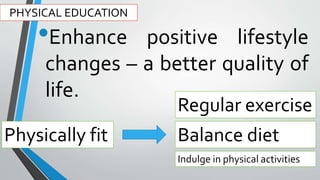
•Enhance positive lifestyle
changes – a better quality of
life.
Regular exercise
Physically fit Balance diet
Indulge in physical activities
•Good life – satisfies this
basic needs such as
physical well – being,
love, affection, security,
and self respect.
Historical Development of
PE
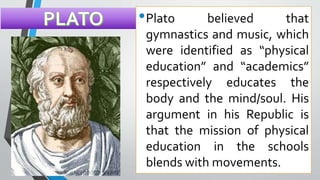
•Plato believed that
gymnastics and music, which
were identified as “physical
education” and “academics”
respectively educates the
body and the mind/soul. His
argument in his Republic is
that the mission of physical
education in the schools
blends with movements.
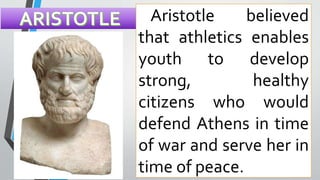
Aristotle believed
that athletics enables
youth to develop
strong, healthy
citizens who would
defend Athens in time
of war and serve her in
time of peace.
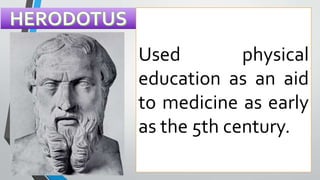
Used physical
education as an aid
to medicine as early
as the 5th century.
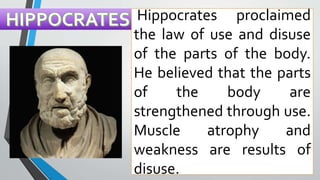
Hippocrates proclaimed
the law of use and disuse
of the parts of the body.
He believed that the parts
of the body are
strengthened through use.
Muscle atrophy and
weakness are results of
disuse.
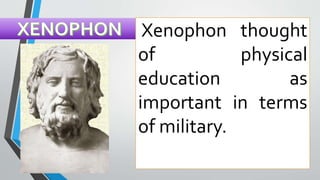
Xenophon thought
of physical
education as
important in terms
of military.
Article 1, International Charter of Physical Education and Sports,
UNESCO, Paris, 1978 and Recommendation 1, International
Disciplinary Regional Meeting of Experts on Physical Education,
UNESCO, Brisbane, 1982 –
“The practice of physical education and sport is a fundamental
right of all…”
“And this right should not be treated as different in principle
from the right to adequate food, shelter , and medical care.”
Article XIV, Section 19, 1986 Constitution of the Republic of the
Philippines .
“The state shall promote physical education and encourage
sports programs, league competitions and amateur sports
including training for international competition to foster self-
discipline, teamwork, and excellence for the development of a
healthy and alert citizenry.”
“All educational institutions shall undertake regular sports
activities throughout the country and in cooperation with
athletic clubs and other sectors.”
Integral part of the educational system which is designed to
promote the optimum development of an individual in terms of his
physical, emotional, mental and social well – being through total
body movement in the performance of properly selected physical
activities.
A course taken in lower, middle, high school, and collegiate level
that utilizes learning in the cognitive, affective and psychomotor
domains in a play or movement exploration setting.
Interdisciplinary study of all areas of science relating to the
transmission of physical knowledge and skills to an individual or a
group, the application of these skills, and their results.
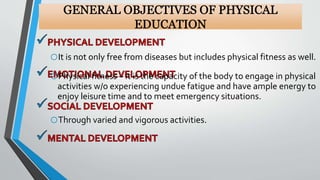
oIt is not only free from diseases but includes physical fitness as well.
oPhysical fitness – it is the capacity of the body to engage in physical
activities w/o experiencing undue fatigue and have ample energy to
enjoy leisure time and to meet emergency situations.
oThrough varied and vigorous activities.
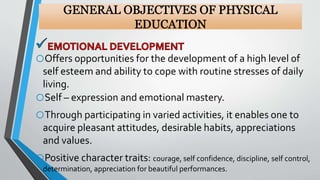
oOffers opportunities for the development of a high level of
self esteem and ability to cope with routine stresses of daily
living.
oSelf – expression and emotional mastery.
oThrough participating in varied activities, it enables one to
acquire pleasant attitudes, desirable habits, appreciations
and values.
oPositive character traits: courage, self confidence, discipline, self control,
determination, appreciation for beautiful performances.
oDevelopment and maintenance of a meaningful interpersonal
relationship.
oRelating to people or society in general
oBe with others / teamwork
oDevelop leadership.
oPositive traits: cooperation, friendliness, respect the rights of others, good sportsmanship,
good leader/ followership, honesty in group competition.
oThrough participation in physical education activities, the
individual develops his mental capacities as he learns the
principles, rules and strategies of games and sports.
oAcquisition of knowledge, understanding, ability to
analyze body movement skills, evaluate game situations
and make important decisions.
oAppreciate understanding
oCreativity exposed.
Importance of
Physical FitnessThrough regular exercises, physical fitness helps the individual:
In the proper growth of young bones and muscles;
Improve the ability to avoid and recover from illness and accidents;
Improve posture and appearance by strengthening muscles that support the body;
Minimize stress response;
Maintain proper body weight;
Prevent heart ailment;
Improve organic functions;
Delay the aging process;
Feel good and younger as human being, and
Experience joy of participation in any recreational or sports activities.
Psychomotor
Objectives
Physical Fitness
Development and
Movement Skills.
Physical fitness components – endurance,
strength, flexibility, balance.
Body mechanics, games, dance, and sport
skills.
Cognitive
Objectives
Knowledge and
Information
Body function and development process.
Analysis, reasoning and decision making.
Rules, strategies and safety.
Affective
Objectives
Social and
Emotional Stability
Cooperation, sportsmanship, aesthetic
appreciation, self – expression.
BASIC PRINCIPLES PHYSICAL EDUCATION
1. PHYSICAL ACTIVITY denotes any body
movement carried out by the skeletal
muscles and requiring energy.
2. EXERCISE means planned, structured,
repetitive movement of the body designed to
improve or maintain physical fitness.
3. PHYSICAL FITNESS refers to the set of
physical attributes that allows the body to
respond or adapt to the demands and stress
of physical effort.
Lifestyle PhysicalActivity
For health promotion:
Expend about 150 calories – equivalent to 30 minutes of brisk walking – on
most days.
For health promotion and weight management:
Engage in 45 – 60 or more minutes of activity on most days.
Exercise to Develop Physical Fitness
Lifestyle activity improves health but may not improve fitness.
A structured, formal exercise program improves physical fitness and
provides even greater health improvements.
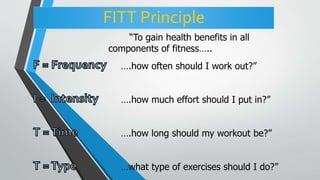
FITT Principle
“To gain health benefits in all
components of fitness…..
….how often should I work out?”
….how much effort should I put in?”
….how long should my workout be?”
…what type of exercises should I do?”
PHYSICAL
FITNESS
Physical Fitness
Components of Physical Fitness
•Health – Related Physical Fitness
•Skill – Related / Performance – Related Physical
Fitness

Physical education 1

  • 2.
  • 3.
    PHYSICAL EDUCATION •Enhance positivelifestyle changes – a better quality of life. Regular exercise Physically fit Balance diet Indulge in physical activities
  • 4.
    •Good life –satisfies this basic needs such as physical well – being, love, affection, security, and self respect.
  • 5.
  • 21.
    •Plato believed that gymnasticsand music, which were identified as “physical education” and “academics” respectively educates the body and the mind/soul. His argument in his Republic is that the mission of physical education in the schools blends with movements.
  • 22.
    Aristotle believed that athleticsenables youth to develop strong, healthy citizens who would defend Athens in time of war and serve her in time of peace.
  • 23.
    Used physical education asan aid to medicine as early as the 5th century.
  • 24.
    Hippocrates proclaimed the lawof use and disuse of the parts of the body. He believed that the parts of the body are strengthened through use. Muscle atrophy and weakness are results of disuse.
  • 25.
    Xenophon thought of physical educationas important in terms of military.
  • 27.
    Article 1, InternationalCharter of Physical Education and Sports, UNESCO, Paris, 1978 and Recommendation 1, International Disciplinary Regional Meeting of Experts on Physical Education, UNESCO, Brisbane, 1982 – “The practice of physical education and sport is a fundamental right of all…” “And this right should not be treated as different in principle from the right to adequate food, shelter , and medical care.”
  • 28.
    Article XIV, Section19, 1986 Constitution of the Republic of the Philippines . “The state shall promote physical education and encourage sports programs, league competitions and amateur sports including training for international competition to foster self- discipline, teamwork, and excellence for the development of a healthy and alert citizenry.” “All educational institutions shall undertake regular sports activities throughout the country and in cooperation with athletic clubs and other sectors.”
  • 29.
    Integral part ofthe educational system which is designed to promote the optimum development of an individual in terms of his physical, emotional, mental and social well – being through total body movement in the performance of properly selected physical activities. A course taken in lower, middle, high school, and collegiate level that utilizes learning in the cognitive, affective and psychomotor domains in a play or movement exploration setting. Interdisciplinary study of all areas of science relating to the transmission of physical knowledge and skills to an individual or a group, the application of these skills, and their results.
  • 31.
    oIt is notonly free from diseases but includes physical fitness as well. oPhysical fitness – it is the capacity of the body to engage in physical activities w/o experiencing undue fatigue and have ample energy to enjoy leisure time and to meet emergency situations. oThrough varied and vigorous activities.
  • 32.
    oOffers opportunities forthe development of a high level of self esteem and ability to cope with routine stresses of daily living. oSelf – expression and emotional mastery. oThrough participating in varied activities, it enables one to acquire pleasant attitudes, desirable habits, appreciations and values. oPositive character traits: courage, self confidence, discipline, self control, determination, appreciation for beautiful performances.
  • 33.
    oDevelopment and maintenanceof a meaningful interpersonal relationship. oRelating to people or society in general oBe with others / teamwork oDevelop leadership. oPositive traits: cooperation, friendliness, respect the rights of others, good sportsmanship, good leader/ followership, honesty in group competition.
  • 34.
    oThrough participation inphysical education activities, the individual develops his mental capacities as he learns the principles, rules and strategies of games and sports. oAcquisition of knowledge, understanding, ability to analyze body movement skills, evaluate game situations and make important decisions. oAppreciate understanding oCreativity exposed.
  • 35.
    Importance of Physical FitnessThroughregular exercises, physical fitness helps the individual: In the proper growth of young bones and muscles; Improve the ability to avoid and recover from illness and accidents; Improve posture and appearance by strengthening muscles that support the body; Minimize stress response; Maintain proper body weight; Prevent heart ailment; Improve organic functions; Delay the aging process; Feel good and younger as human being, and Experience joy of participation in any recreational or sports activities.
  • 36.
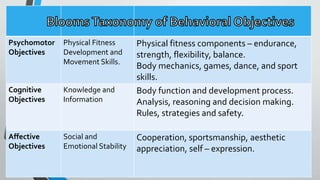
    Psychomotor Objectives Physical Fitness Development and MovementSkills. Physical fitness components – endurance, strength, flexibility, balance. Body mechanics, games, dance, and sport skills. Cognitive Objectives Knowledge and Information Body function and development process. Analysis, reasoning and decision making. Rules, strategies and safety. Affective Objectives Social and Emotional Stability Cooperation, sportsmanship, aesthetic appreciation, self – expression.
  • 37.
    BASIC PRINCIPLES PHYSICALEDUCATION 1. PHYSICAL ACTIVITY denotes any body movement carried out by the skeletal muscles and requiring energy. 2. EXERCISE means planned, structured, repetitive movement of the body designed to improve or maintain physical fitness. 3. PHYSICAL FITNESS refers to the set of physical attributes that allows the body to respond or adapt to the demands and stress of physical effort.
  • 38.
    Lifestyle PhysicalActivity For healthpromotion: Expend about 150 calories – equivalent to 30 minutes of brisk walking – on most days. For health promotion and weight management: Engage in 45 – 60 or more minutes of activity on most days. Exercise to Develop Physical Fitness Lifestyle activity improves health but may not improve fitness. A structured, formal exercise program improves physical fitness and provides even greater health improvements.
  • 39.
    FITT Principle “To gainhealth benefits in all components of fitness….. ….how often should I work out?” ….how much effort should I put in?” ….how long should my workout be?” …what type of exercises should I do?”
  • 40.
  • 41.
  • 42.
    Components of PhysicalFitness •Health – Related Physical Fitness •Skill – Related / Performance – Related Physical Fitness

Editor's Notes

  • #7 Mimetic games provided children the opportunity to prepare themselves for adult life and responsibilities. Through dancing, primitive people communicated to their gods.
  • #8 Kung Fu - was designed to prevent diseases and keep the body in good organic conditions.
  • #9 Physical education was the modality used to accomplish the primary aim of developing in their young men military skills, high moral standards and patriotism to strengthen and extend the empire.
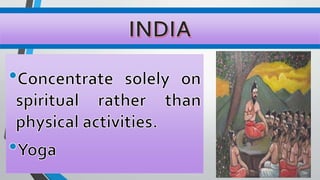
  • #10 Yoga, which was a unique activity involving exercises in posture, regulated breathing, to discipline the mind and the body. Physical exercises were sometimes used to promote health
  • #16 At the age of 30 the men can marry.
  • #43 Health – Related – consist of those components of Physical Fitness that have a relationship in good health. Skill – related – those components of PF that have a relationship in performance in sports and motorskills.