Introduction to php 
By 
K1/ 4, Second floor, Sector-15/16 Market, 
Vashi, Navi Mumbai 
www.vibranttechnologies.co.in 
Mob No: 
9892900103 
9892900173
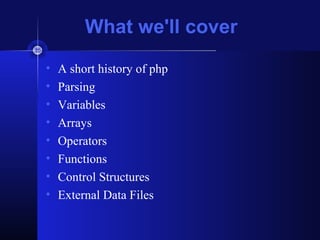
What we'll cover 
• A short history of php 
• Parsing 
• Variables 
• Arrays 
• Operators 
• Functions 
• Control Structures 
• External Data Files
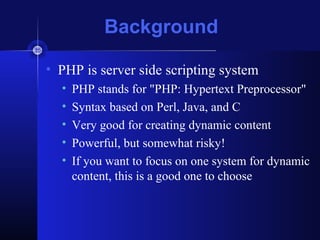
Background 
• PHP is server side scripting system 
• PHP stands for "PHP: Hypertext Preprocessor" 
• Syntax based on Perl, Java, and C 
• Very good for creating dynamic content 
• Powerful, but somewhat risky! 
• If you want to focus on one system for dynamic 
content, this is a good one to choose
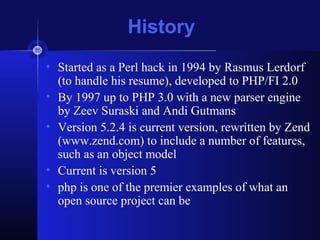
History 
• Started as a Perl hack in 1994 by Rasmus Lerdorf 
(to handle his resume), developed to PHP/FI 2.0 
• By 1997 up to PHP 3.0 with a new parser engine 
by Zeev Suraski and Andi Gutmans 
• Version 5.2.4 is current version, rewritten by Zend 
(www.zend.com) to include a number of features, 
such as an object model 
• Current is version 5 
• php is one of the premier examples of what an 
open source project can be
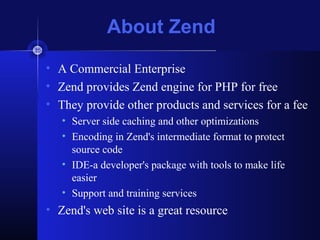
About Zend 
• A Commercial Enterprise 
• Zend provides Zend engine for PHP for free 
• They provide other products and services for a fee 
• Server side caching and other optimizations 
• Encoding in Zend's intermediate format to protect 
source code 
• IDE-a developer's package with tools to make life 
easier 
• Support and training services 
• Zend's web site is a great resource
PHP 5 Architecture 
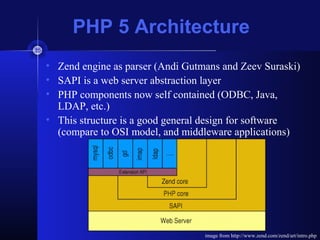
• Zend engine as parser (Andi Gutmans and Zeev Suraski) 
• SAPI is a web server abstraction layer 
• PHP components now self contained (ODBC, Java, 
LDAP, etc.) 
• This structure is a good general design for software 
(compare to OSI model, and middleware applications) 
image from http://www.zend.com/zend/art/intro.php
PHP Scripts 
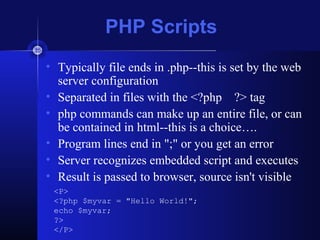
• Typically file ends in .php--this is set by the web 
server configuration 
• Separated in files with the <?php ?> tag 
• php commands can make up an entire file, or can 
be contained in html--this is a choice…. 
• Program lines end in ";" or you get an error 
• Server recognizes embedded script and executes 
• Result is passed to browser, source isn't visible 
<P> 
<?php $myvar = "Hello World!"; 
echo $myvar; 
?> 
</P>
Parsing 
• We've talk about how the browser can read a text 
file and process it, that's a basic parsing method 
• Parsing involves acting on relevant portions of a 
file and ignoring others 
• Browsers parse web pages as they load 
• Web servers with server side technologies like php 
parse web pages as they are being passed out to 
the browser 
• Parsing does represent work, so there is a cost
Two Ways 
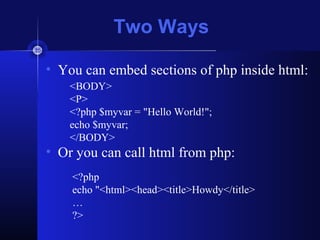
• You can embed sections of php inside html: 
<BODY> 
<P> 
<?php $myvar = "Hello World!"; 
echo $myvar; 
</BODY> 
• Or you can call html from php: 
<?php 
echo "<html><head><title>Howdy</title> 
… 
?>
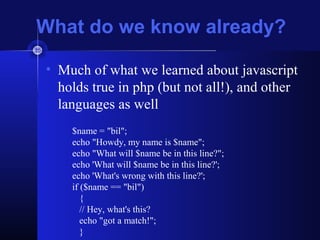
What do we know already? 
• Much of what we learned about javascript 
holds true in php (but not all!), and other 
languages as well 
$name = "bil"; 
echo "Howdy, my name is $name"; 
echo "What will $name be in this line?"; 
echo 'What will $name be in this line?'; 
echo 'What's wrong with this line?'; 
if ($name == "bil") 
{ 
// Hey, what's this? 
echo "got a match!"; 
}
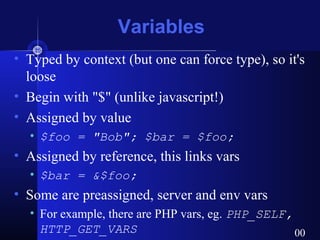
Variables 
• Typed by context (but one can force type), so it's 
loose 
• Begin with "$" (unlike javascript!) 
• Assigned by value 
• $foo = "Bob"; $bar = $foo; 
• Assigned by reference, this links vars 
• $bar = &$foo; 
• Some are preassigned, server and env vars 
• For example, there are PHP vars, eg. PHP_SELF, 
HTTP_GET_VARS 00
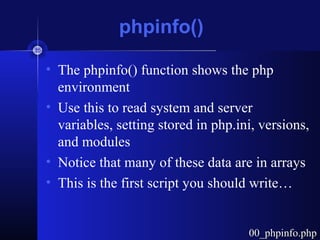
phpinfo() 
• The phpinfo() function shows the php 
environment 
• Use this to read system and server 
variables, setting stored in php.ini, versions, 
and modules 
• Notice that many of these data are in arrays 
• This is the first script you should write… 
00_phpinfo.php
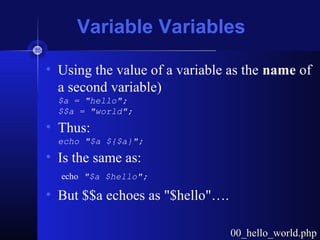
Variable Variables 
• Using the value of a variable as the name of 
a second variable) 
$a = "hello"; 
$$a = "world"; 
• Thus: 
echo "$a ${$a}"; 
• Is the same as: 
echo "$a $hello"; 
• But $$a echoes as "$hello"…. 
00_hello_world.php
Operators 
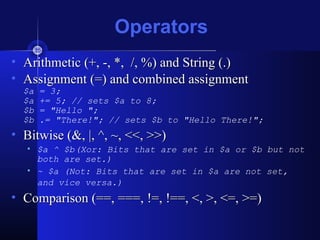
• Arithmetic (+, -, *, /, %) and String (.) 
• Assignment (=) and combined assignment 
$a = 3; 
$a += 5; // sets $a to 8; 
$b = "Hello "; 
$b .= "There!"; // sets $b to "Hello There!"; 
• Bitwise (&, |, ^, ~, <<, >>) 
• $a ^ $b(Xor: Bits that are set in $a or $b but not 
both are set.) 
• ~ $a (Not: Bits that are set in $a are not set, 
and vice versa.) 
• Comparison (==, ===, !=, !==, <, >, <=, >=)
Coercion 
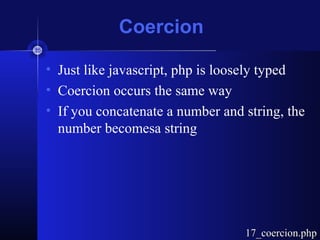
• Just like javascript, php is loosely typed 
• Coercion occurs the same way 
• If you concatenate a number and string, the 
number becomesa string 
17_coercion.php
Operators: The Movie 
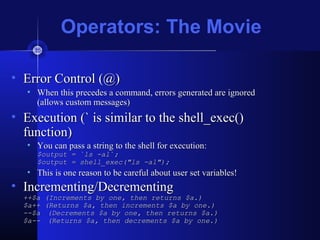
• Error Control (@) 
• When this precedes a command, errors generated are ignored 
(allows custom messages) 
• Execution (` is similar to the shell_exec() 
function) 
• You can pass a string to the shell for execution: 
$$oouuttppuutt == ``llss --aall``;; 
$$oouuttppuutt == sshheellll__eexxeecc((""llss --aall""));; 
• This is one reason to be careful about user set variables! 
• Incrementing/Decrementing 
++$a (Increments by one, then returns $a.) 
$a++ (Returns $a, then increments $a by one.) 
--$a (Decrements $a by one, then returns $a.) 
$a-- (Returns $a, then decrements $a by one.)
Son of the Valley of Operators 
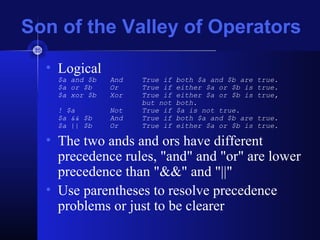
• Logical 
$a and $b And True if both $a and $b are true. 
$a or $b Or True if either $a or $b is true. 
$a xor $b Xor True if either $a or $b is true, 
but not both. 
! $a Not True if $a is not true. 
$a && $b And True if both $a and $b are true. 
$a || $b Or True if either $a or $b is true. 
• The two ands and ors have different 
precedence rules, "and" and "or" are lower 
precedence than "&&" and "||" 
• Use parentheses to resolve precedence 
problems or just to be clearer
Control Structures 
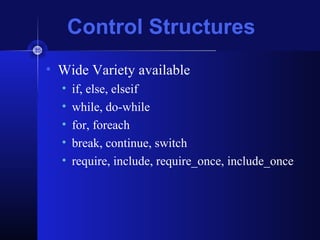
• Wide Variety available 
• if, else, elseif 
• while, do-while 
• for, foreach 
• break, continue, switch 
• require, include, require_once, include_once
Control Structures 
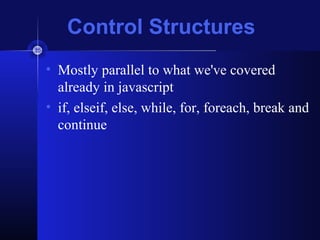
• Mostly parallel to what we've covered 
already in javascript 
• if, elseif, else, while, for, foreach, break and 
continue
Switch 
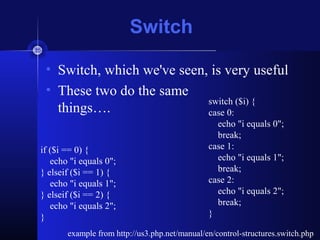
• Switch, which we've seen, is very useful 
• These two do the same 
things…. 
if ($i == 0) { 
echo "i equals 0"; 
} elseif ($i == 1) { 
echo "i equals 1"; 
} elseif ($i == 2) { 
echo "i equals 2"; 
} 
switch ($i) { 
case 0: 
echo "i equals 0"; 
break; 
case 1: 
echo "i equals 1"; 
break; 
case 2: 
echo "i equals 2"; 
break; 
} 
example from http://us3.php.net/manual/en/control-structures.switch.php
Nesting Files 
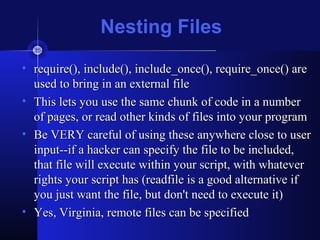
• require(), include(), include_once(), require_once() are 
used to bring in an external file 
• This lets you use the same chunk of code in a number 
of pages, or read other kinds of files into your program 
• Be VERY careful of using these anywhere close to user 
input--if a hacker can specify the file to be included, 
that file will execute within your script, with whatever 
rights your script has (readfile is a good alternative if 
you just want the file, but don't need to execute it) 
• Yes, Virginia, remote files can be specified
Example: A Dynamic Table 
• I hate writing html tables 
• You can build one in php 
• This example uses pictures and builds a 
table with pictures in one column, and 
captions in another 
• The captions are drawn from text files 
• I'm using tables, but you could use css for 
placement easily…
Arrays 
• You can create an array with the array function, or use the 
explode function (this is very useful when reading files into 
web programs…) 
$my_array = array(1, 2, 3, 4, 5); 
$pizza = "piece1 piece2 piece3 piece4 piece5 piece6"; 
$pieces = explode(" ", $pizza); 
• An array is simply a variable representing a keyed list 
• A list of values or variables 
• If a variable, that var can also be an array 
• Each variable in the list has a key 
• The key can be a number or a text label
Arrays 
• Arrays are lists, or lists of lists, or list of lists of 
lists, you get the idea--Arrays can be multi-dimensional 
• Array elements can be addressed by either by 
number or by name (strings) 
• If you want to see the structure of an array, use the 
print_r function to recursively print an array inside 
of pre tags
Text versus Keys 
• Text keys work like number keys (well, 
really, it's the other way around--number 
keys are just labels) 
• You assign and call them the same way, 
except you have to assign the label to the 
value or variables, eg: 
echo "$my_text_array[third]"; 
$my_text_array = array(first=>1, second=>2, third=>3); 
echo "<pre>"; 
print_r($my_text_array); 
echo "</pre>";
Walking Arrays 
• Use a loop, eg a foreach loop to walk 
through an array 
• while loops also work for arrays with 
numeric keys--just set a variable for the 
loop, and make sure to increment that 
variable within the loop 
$colors = array('red', 'blue', 'green', 'yellow'); 
foreach ($colors as $color) { 
echo "Do you like $color?n"; 
} 
05_arrays.php
05_arrays.php 
• You can't echo an 
array directly… 
• You can walk through 
an echo or print() line 
by line 
• You can use print_r(), 
this will show you the 
structure of complex 
arrays--that output is 
to the right, and it's 
handy for learning the 
structure of an array 
Array 
( 
[1] => Array 
( 
[sku] => A13412 
[quantity] => 10 
[item] => Whirly Widgets 
[price] => .50 
) 
[2] => Array 
( 
[sku] => A43214 
[quantity] => 142 
[item] => Widget Nuts 
[price] => .05 
)
Multidimensional Arrays 
• A one dimensional array is a list, a spreadsheet or other columnar data 
is two dimensional… 
• Basically, you can make an array of arrays 
$multiD = array 
( 
"fruits" => array("myfavorite" => "orange", "yuck" => 
"banana", "yum" => "apple"), 
"numbers" => array(1, 2, 3, 4, 5, 6), 
"holes" => array("first", 5 => "second", "third") 
); 
• The structure can be built array by array, or declared with a single 
statement 
• You can reference individual elements by nesting: 
echo "<p>Yes, we have no " . $multiD["fruits"]["yuck"] . " 
(ok by me).</p>"; 
• print_r() will show the entire structure, but don’t fo0r1gae_tatrhrea ypsr.ep htapgs
Getting Data into arrays 
• You can directly read data into individual 
array slots via a direct assignment: 
$pieces[5] = "poulet resistance"; 
• From a file: 
• Use the file command to read a delimited file 
(the delimiter can be any unique char): 
$pizza = file(./our_pizzas.txt) 
• Use explode to create an array from a line 
within a loop: 
$pieces = explode(" ", $pizza);
The Surface 
• The power of php lies partially in the wealth of 
functions---for example, the 40+ array functions 
• array_flip() swaps keys for values 
• array_count_values() returns an associative array of all 
values in an array, and their frequency 
• array_rand() pulls a random element 
• array_unique() removes duppies 
• array_walk() applies a user defined function to each 
element of an array (so you can dice all of a dataset) 
• count() returns the number of elements in an array 
• array_search() returns the key for the first match in an 
array 
08_array_fu.php
Using External Data 
• You can build dynamic pages with just the 
information in a php script 
• But where php shines is in building pages 
out of external data sources, so that the web 
pages change when the data does 
• Most of the time, people think of a database 
like MySQL as the backend, but you can 
also use text or other files, LDAP, pretty 
much anything….
Standard data files 
• Normally you'd use a tab delimited file, but you can 
use pretty much anything as a delimiter 
• Files get read as arrays, one line per slot 
• Remember each line ends in n, you should clean 
this up, and be careful about white space 
• Once the file is read, you can use explode to break 
the lines into fields, one at a time, in a loop….
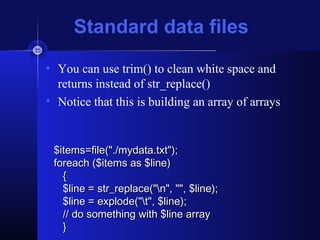
Standard data files 
• You can use trim() to clean white space and 
returns instead of str_replace() 
• Notice that this is building an array of arrays 
$iitteemmss==ffiillee((""..//mmyyddaattaa..ttxxtt""));; 
ffoorreeaacchh (($$iitteemmss aass $$lliinnee)) 
{{ 
$$lliinnee == ssttrr__rreeppllaaccee((""nn"",, """",, $$lliinnee));; 
$$lliinnee == eexxppllooddee((""tt"",, $$lliinnee));; 
//// ddoo ssoommeetthhiinngg wwiitthh $$lliinnee aarrrraayy 
}}
Useful string functions 
• str_replace() 
• trim(), ltrim(), rtrim() 
• implode(), explode() 
• addslashes(), stripslashes() 
• htmlentities(), html_entity_decode(), 
htmlspecialchars() 
• striptags()
06_more_arrays.php 
• This is a simple script to read and process a text 
file 
• The data file is tab delimited and has the column 
titles as the first line of the file
How it works 
• The script uses the first line to build text labels for 
the subsequent lines, so that the array elements 
can be called by the text label 
• If you add a new column, this script 
compensates 
• Text based arrays are not position dependent… 
• This script could be the basis of a nice function 
• There are two version of this, calling two different 
datafiles, but that's the only difference
06a_more_arrays.php 
• This version shows how to dynamically build a table in the 
html output
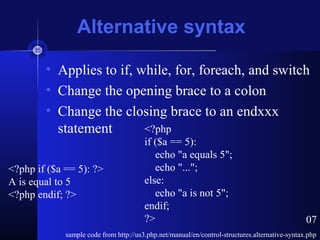
Alternative syntax 
• Applies to if, while, for, foreach, and switch 
• Change the opening brace to a colon 
• Change the closing brace to an endxxx 
statement 
<?php if ($a == 5): ?> 
A is equal to 5 
<?php endif; ?> 
<?php 
if ($a == 5): 
echo "a equals 5"; 
echo "..."; 
else: 
echo "a is not 5"; 
endif; 
?> 07 
sample code from http://us3.php.net/manual/en/control-structures.alternative-syntax.php
Thank You !!!

Php classes in mumbai

  • 2.
    Introduction to php By K1/ 4, Second floor, Sector-15/16 Market, Vashi, Navi Mumbai www.vibranttechnologies.co.in Mob No: 9892900103 9892900173
  • 3.
    What we'll cover • A short history of php • Parsing • Variables • Arrays • Operators • Functions • Control Structures • External Data Files
  • 4.
    Background • PHPis server side scripting system • PHP stands for "PHP: Hypertext Preprocessor" • Syntax based on Perl, Java, and C • Very good for creating dynamic content • Powerful, but somewhat risky! • If you want to focus on one system for dynamic content, this is a good one to choose
  • 5.
    History • Startedas a Perl hack in 1994 by Rasmus Lerdorf (to handle his resume), developed to PHP/FI 2.0 • By 1997 up to PHP 3.0 with a new parser engine by Zeev Suraski and Andi Gutmans • Version 5.2.4 is current version, rewritten by Zend (www.zend.com) to include a number of features, such as an object model • Current is version 5 • php is one of the premier examples of what an open source project can be
  • 6.
    About Zend •A Commercial Enterprise • Zend provides Zend engine for PHP for free • They provide other products and services for a fee • Server side caching and other optimizations • Encoding in Zend's intermediate format to protect source code • IDE-a developer's package with tools to make life easier • Support and training services • Zend's web site is a great resource
  • 7.
    PHP 5 Architecture • Zend engine as parser (Andi Gutmans and Zeev Suraski) • SAPI is a web server abstraction layer • PHP components now self contained (ODBC, Java, LDAP, etc.) • This structure is a good general design for software (compare to OSI model, and middleware applications) image from http://www.zend.com/zend/art/intro.php
  • 8.
    PHP Scripts •Typically file ends in .php--this is set by the web server configuration • Separated in files with the <?php ?> tag • php commands can make up an entire file, or can be contained in html--this is a choice…. • Program lines end in ";" or you get an error • Server recognizes embedded script and executes • Result is passed to browser, source isn't visible <P> <?php $myvar = "Hello World!"; echo $myvar; ?> </P>
  • 9.
    Parsing • We'vetalk about how the browser can read a text file and process it, that's a basic parsing method • Parsing involves acting on relevant portions of a file and ignoring others • Browsers parse web pages as they load • Web servers with server side technologies like php parse web pages as they are being passed out to the browser • Parsing does represent work, so there is a cost
  • 10.
    Two Ways •You can embed sections of php inside html: <BODY> <P> <?php $myvar = "Hello World!"; echo $myvar; </BODY> • Or you can call html from php: <?php echo "<html><head><title>Howdy</title> … ?>
  • 11.
    What do weknow already? • Much of what we learned about javascript holds true in php (but not all!), and other languages as well $name = "bil"; echo "Howdy, my name is $name"; echo "What will $name be in this line?"; echo 'What will $name be in this line?'; echo 'What's wrong with this line?'; if ($name == "bil") { // Hey, what's this? echo "got a match!"; }
  • 12.
    Variables • Typedby context (but one can force type), so it's loose • Begin with "$" (unlike javascript!) • Assigned by value • $foo = "Bob"; $bar = $foo; • Assigned by reference, this links vars • $bar = &$foo; • Some are preassigned, server and env vars • For example, there are PHP vars, eg. PHP_SELF, HTTP_GET_VARS 00
  • 13.
    phpinfo() • Thephpinfo() function shows the php environment • Use this to read system and server variables, setting stored in php.ini, versions, and modules • Notice that many of these data are in arrays • This is the first script you should write… 00_phpinfo.php
  • 14.
    Variable Variables •Using the value of a variable as the name of a second variable) $a = "hello"; $$a = "world"; • Thus: echo "$a ${$a}"; • Is the same as: echo "$a $hello"; • But $$a echoes as "$hello"…. 00_hello_world.php
  • 15.
    Operators • Arithmetic(+, -, *, /, %) and String (.) • Assignment (=) and combined assignment $a = 3; $a += 5; // sets $a to 8; $b = "Hello "; $b .= "There!"; // sets $b to "Hello There!"; • Bitwise (&, |, ^, ~, <<, >>) • $a ^ $b(Xor: Bits that are set in $a or $b but not both are set.) • ~ $a (Not: Bits that are set in $a are not set, and vice versa.) • Comparison (==, ===, !=, !==, <, >, <=, >=)
  • 16.
    Coercion • Justlike javascript, php is loosely typed • Coercion occurs the same way • If you concatenate a number and string, the number becomesa string 17_coercion.php
  • 17.
    Operators: The Movie • Error Control (@) • When this precedes a command, errors generated are ignored (allows custom messages) • Execution (` is similar to the shell_exec() function) • You can pass a string to the shell for execution: $$oouuttppuutt == ``llss --aall``;; $$oouuttppuutt == sshheellll__eexxeecc((""llss --aall""));; • This is one reason to be careful about user set variables! • Incrementing/Decrementing ++$a (Increments by one, then returns $a.) $a++ (Returns $a, then increments $a by one.) --$a (Decrements $a by one, then returns $a.) $a-- (Returns $a, then decrements $a by one.)
  • 18.
    Son of theValley of Operators • Logical $a and $b And True if both $a and $b are true. $a or $b Or True if either $a or $b is true. $a xor $b Xor True if either $a or $b is true, but not both. ! $a Not True if $a is not true. $a && $b And True if both $a and $b are true. $a || $b Or True if either $a or $b is true. • The two ands and ors have different precedence rules, "and" and "or" are lower precedence than "&&" and "||" • Use parentheses to resolve precedence problems or just to be clearer
  • 19.
    Control Structures •Wide Variety available • if, else, elseif • while, do-while • for, foreach • break, continue, switch • require, include, require_once, include_once
  • 20.
    Control Structures •Mostly parallel to what we've covered already in javascript • if, elseif, else, while, for, foreach, break and continue
  • 21.
    Switch • Switch,which we've seen, is very useful • These two do the same things…. if ($i == 0) { echo "i equals 0"; } elseif ($i == 1) { echo "i equals 1"; } elseif ($i == 2) { echo "i equals 2"; } switch ($i) { case 0: echo "i equals 0"; break; case 1: echo "i equals 1"; break; case 2: echo "i equals 2"; break; } example from http://us3.php.net/manual/en/control-structures.switch.php
  • 22.
    Nesting Files •require(), include(), include_once(), require_once() are used to bring in an external file • This lets you use the same chunk of code in a number of pages, or read other kinds of files into your program • Be VERY careful of using these anywhere close to user input--if a hacker can specify the file to be included, that file will execute within your script, with whatever rights your script has (readfile is a good alternative if you just want the file, but don't need to execute it) • Yes, Virginia, remote files can be specified
  • 23.
    Example: A DynamicTable • I hate writing html tables • You can build one in php • This example uses pictures and builds a table with pictures in one column, and captions in another • The captions are drawn from text files • I'm using tables, but you could use css for placement easily…
  • 24.
    Arrays • Youcan create an array with the array function, or use the explode function (this is very useful when reading files into web programs…) $my_array = array(1, 2, 3, 4, 5); $pizza = "piece1 piece2 piece3 piece4 piece5 piece6"; $pieces = explode(" ", $pizza); • An array is simply a variable representing a keyed list • A list of values or variables • If a variable, that var can also be an array • Each variable in the list has a key • The key can be a number or a text label
  • 25.
    Arrays • Arraysare lists, or lists of lists, or list of lists of lists, you get the idea--Arrays can be multi-dimensional • Array elements can be addressed by either by number or by name (strings) • If you want to see the structure of an array, use the print_r function to recursively print an array inside of pre tags
  • 26.
    Text versus Keys • Text keys work like number keys (well, really, it's the other way around--number keys are just labels) • You assign and call them the same way, except you have to assign the label to the value or variables, eg: echo "$my_text_array[third]"; $my_text_array = array(first=>1, second=>2, third=>3); echo "<pre>"; print_r($my_text_array); echo "</pre>";
  • 27.
    Walking Arrays •Use a loop, eg a foreach loop to walk through an array • while loops also work for arrays with numeric keys--just set a variable for the loop, and make sure to increment that variable within the loop $colors = array('red', 'blue', 'green', 'yellow'); foreach ($colors as $color) { echo "Do you like $color?n"; } 05_arrays.php
  • 28.
    05_arrays.php • Youcan't echo an array directly… • You can walk through an echo or print() line by line • You can use print_r(), this will show you the structure of complex arrays--that output is to the right, and it's handy for learning the structure of an array Array ( [1] => Array ( [sku] => A13412 [quantity] => 10 [item] => Whirly Widgets [price] => .50 ) [2] => Array ( [sku] => A43214 [quantity] => 142 [item] => Widget Nuts [price] => .05 )
  • 29.
    Multidimensional Arrays •A one dimensional array is a list, a spreadsheet or other columnar data is two dimensional… • Basically, you can make an array of arrays $multiD = array ( "fruits" => array("myfavorite" => "orange", "yuck" => "banana", "yum" => "apple"), "numbers" => array(1, 2, 3, 4, 5, 6), "holes" => array("first", 5 => "second", "third") ); • The structure can be built array by array, or declared with a single statement • You can reference individual elements by nesting: echo "<p>Yes, we have no " . $multiD["fruits"]["yuck"] . " (ok by me).</p>"; • print_r() will show the entire structure, but don’t fo0r1gae_tatrhrea ypsr.ep htapgs
  • 30.
    Getting Data intoarrays • You can directly read data into individual array slots via a direct assignment: $pieces[5] = "poulet resistance"; • From a file: • Use the file command to read a delimited file (the delimiter can be any unique char): $pizza = file(./our_pizzas.txt) • Use explode to create an array from a line within a loop: $pieces = explode(" ", $pizza);
  • 31.
    The Surface •The power of php lies partially in the wealth of functions---for example, the 40+ array functions • array_flip() swaps keys for values • array_count_values() returns an associative array of all values in an array, and their frequency • array_rand() pulls a random element • array_unique() removes duppies • array_walk() applies a user defined function to each element of an array (so you can dice all of a dataset) • count() returns the number of elements in an array • array_search() returns the key for the first match in an array 08_array_fu.php
  • 32.
    Using External Data • You can build dynamic pages with just the information in a php script • But where php shines is in building pages out of external data sources, so that the web pages change when the data does • Most of the time, people think of a database like MySQL as the backend, but you can also use text or other files, LDAP, pretty much anything….
  • 33.
    Standard data files • Normally you'd use a tab delimited file, but you can use pretty much anything as a delimiter • Files get read as arrays, one line per slot • Remember each line ends in n, you should clean this up, and be careful about white space • Once the file is read, you can use explode to break the lines into fields, one at a time, in a loop….
  • 34.
    Standard data files • You can use trim() to clean white space and returns instead of str_replace() • Notice that this is building an array of arrays $iitteemmss==ffiillee((""..//mmyyddaattaa..ttxxtt""));; ffoorreeaacchh (($$iitteemmss aass $$lliinnee)) {{ $$lliinnee == ssttrr__rreeppllaaccee((""nn"",, """",, $$lliinnee));; $$lliinnee == eexxppllooddee((""tt"",, $$lliinnee));; //// ddoo ssoommeetthhiinngg wwiitthh $$lliinnee aarrrraayy }}
  • 35.
    Useful string functions • str_replace() • trim(), ltrim(), rtrim() • implode(), explode() • addslashes(), stripslashes() • htmlentities(), html_entity_decode(), htmlspecialchars() • striptags()
  • 36.
    06_more_arrays.php • Thisis a simple script to read and process a text file • The data file is tab delimited and has the column titles as the first line of the file
  • 37.
    How it works • The script uses the first line to build text labels for the subsequent lines, so that the array elements can be called by the text label • If you add a new column, this script compensates • Text based arrays are not position dependent… • This script could be the basis of a nice function • There are two version of this, calling two different datafiles, but that's the only difference
  • 38.
    06a_more_arrays.php • Thisversion shows how to dynamically build a table in the html output
  • 39.
    Alternative syntax •Applies to if, while, for, foreach, and switch • Change the opening brace to a colon • Change the closing brace to an endxxx statement <?php if ($a == 5): ?> A is equal to 5 <?php endif; ?> <?php if ($a == 5): echo "a equals 5"; echo "..."; else: echo "a is not 5"; endif; ?> 07 sample code from http://us3.php.net/manual/en/control-structures.alternative-syntax.php
  • 40.