 Photosynthesis is the formation of sugars(g
lucose) with the help of CO2 and H2O in p
resence of light
Photosynthesis
Light and Dark reaction
 Photosynthesis is the formation of sugars(
glucose) with the help of CO2 and H2O in
presence of light
 Why plants are in green? Plants absorbs bl
ue and red light from sun and reflects gre
en light.
 Photosynthesis is the formation of sugars(
glucose) with the help of CO2 and H2O in p
resence of light
6CO2 + 6H2O C6H12O6 + 6O2
 It takes place in chloroplast.
 Photosynthesis
Light reaction
Dark reaction
LIGHT REACTION DARK REACTION
Light dependent reaction
.
Light independent reacti
on. Carbon assimilation r
eaction
Occur in grana. Occur in stroma.
Includes cyclic & non cyc
lic photophosphorylation.
Include C3 cycle.
C4, C2, CAM pathway
Light is absorbed & conv
erted to ATP & NADPH.
ATP & NADPH are utiliz
ed and triose phosphate,
starch& sucrose are form
ed
LIGHT REACTION DARK REACTION
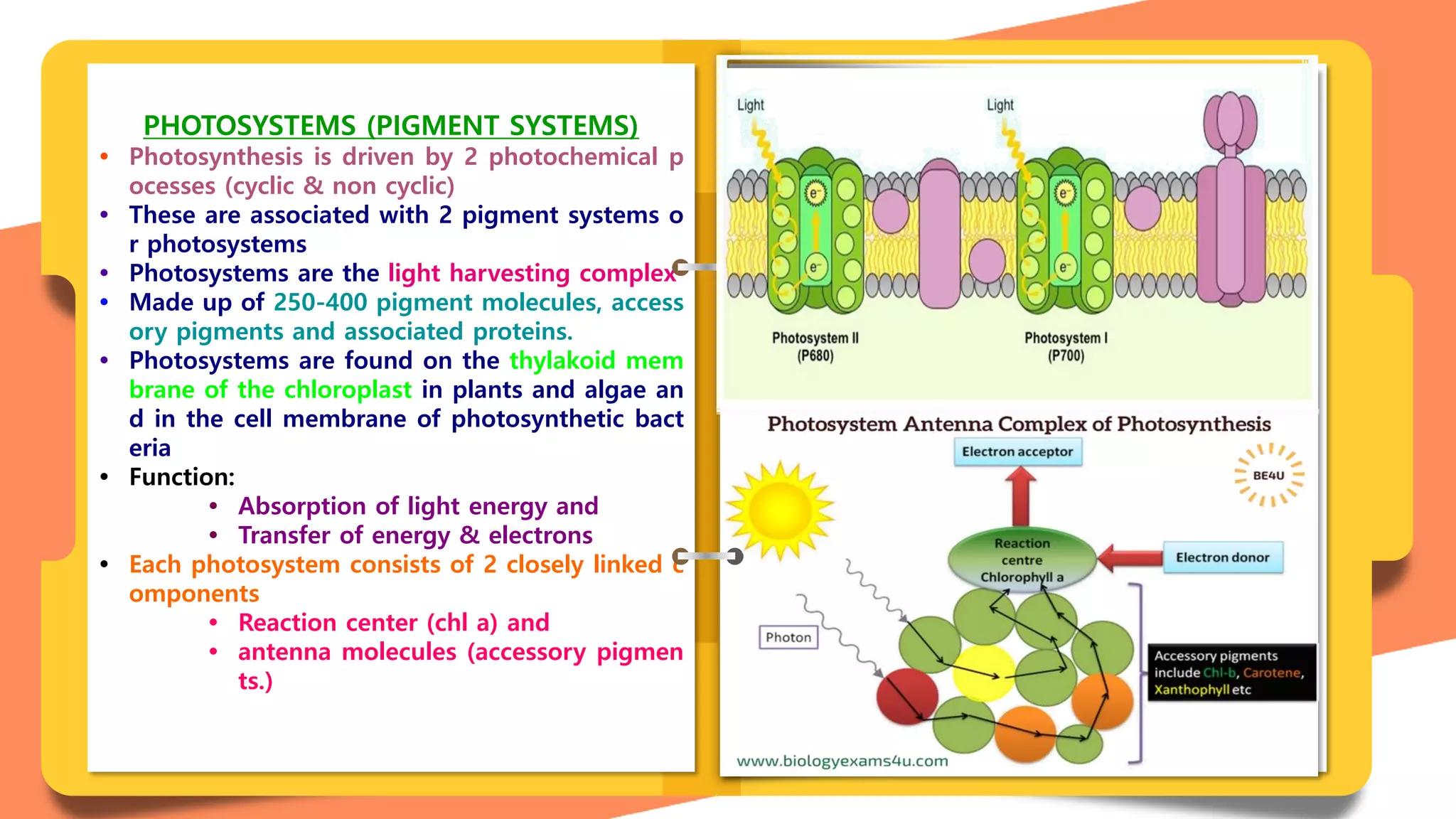
PHOTOSYSTEMS (PIGMENT SYSTEMS)
 Photosynthesis is driven by 2 photochemical p
ocesses (cyclic & non cyclic)
 These are associated with 2 pigment systems o
r photosystems
 Photosystems are the light harvesting complex
 Made up of 250-400 pigment molecules, access
ory pigments and associated proteins.
 Photosystems are found on the thylakoid mem
brane of the chloroplast in plants and algae an
d in the cell membrane of photosynthetic bact
eria
 Function:
 Absorption of light energy and
 Transfer of energy & electrons
 Each photosystem consists of 2 closely linked c
omponents
 Reaction center (chl a) and
 antenna molecules (accessory pigmen
ts.)
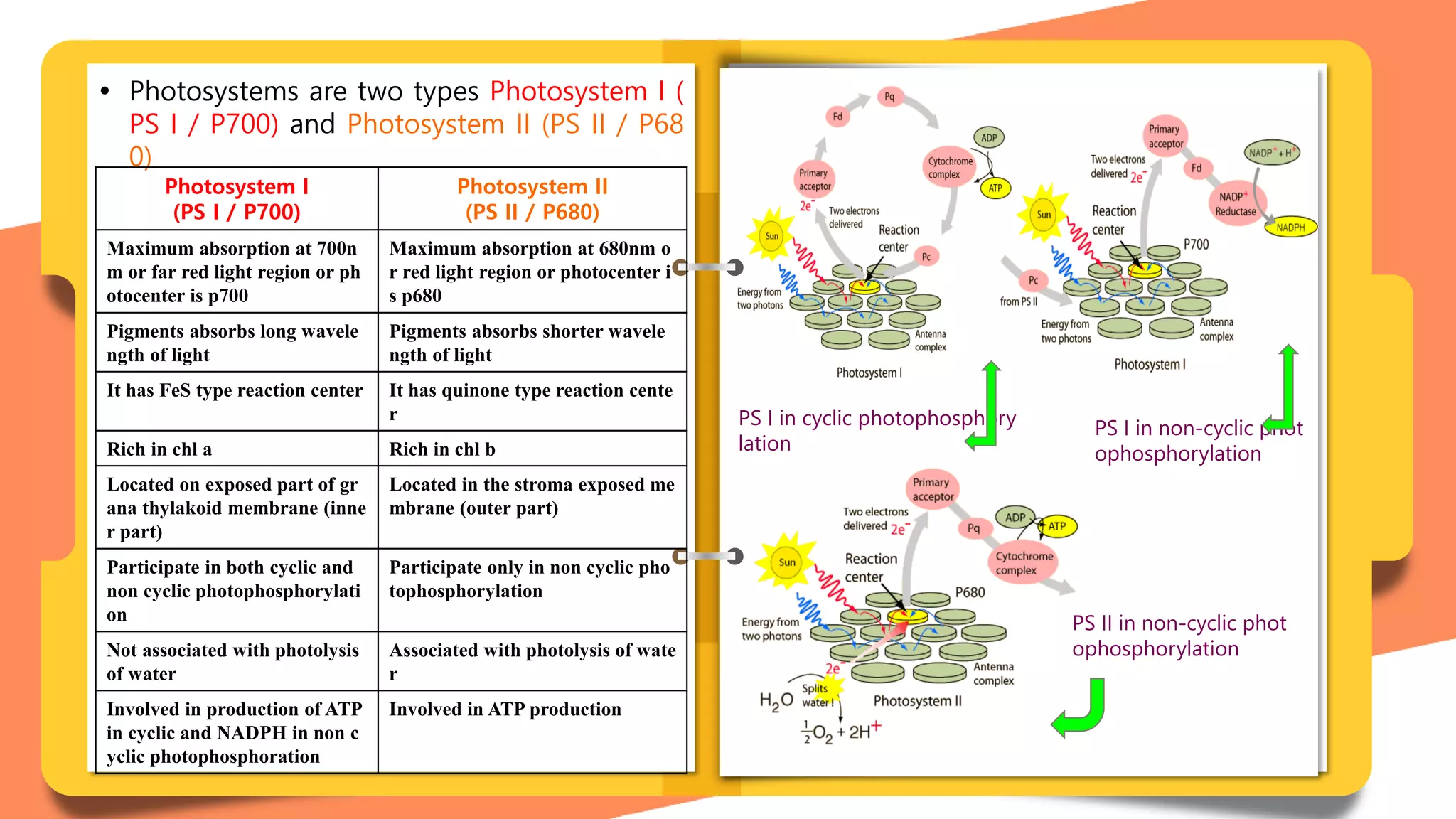
 Photosystems are two types Photosystem I (
PS I / P700) and Photosystem II (PS II / P68
0)
Photosystem I
(PS I / P700)
Photosystem II
(PS II / P680)
Maximum absorption at 700n
m or far red light region or ph
otocenter is p700
Maximum absorption at 680nm o
r red light region or photocenter i
s p680
Pigments absorbs long wavele
ngth of light
Pigments absorbs shorter wavele
ngth of light
It has FeS type reaction center It has quinone type reaction cente
r
Rich in chl a Rich in chl b
Located on exposed part of gr
ana thylakoid membrane (inne
r part)
Located in the stroma exposed me
mbrane (outer part)
Participate in both cyclic and
non cyclic photophosphorylati
on
Participate only in non cyclic pho
tophosphorylation
Not associated with photolysis
of water
Associated with photolysis of wate
r
Involved in production of ATP
in cyclic and NADPH in non c
yclic photophosphoration
Involved in ATP production
PS I in cyclic photophosphory
lation
PS I in non-cyclic phot
ophosphorylation
PS II in non-cyclic phot
ophosphorylation
LIGHT REACTION
 Dependent on light
 Also called Hill’s reaction
 Takes palce in thylakoid membrane of me
sophyll cells
 Includes cyclic & non- cyclic photophosph
orylation
 Involves 2 pigment system, PSI &PSII
 ATP, NADPH & molecular oxygen (OEC) ar
e produced
CYCLIC PHOTOPHOSPHORYLATION
 Light absorbed by reaction centre of PSI
 Electron passed to primary e acceptor FR
S (ferridoxin reducing substance)
 Electrons are passed throgh e carriers an
d returned back to PSI
 ATP are produced.
1.
PHOTOPHOSPHORYLATION: Process of fo
rmation of ATP from ADP in presence of li
ght in chloroplast.
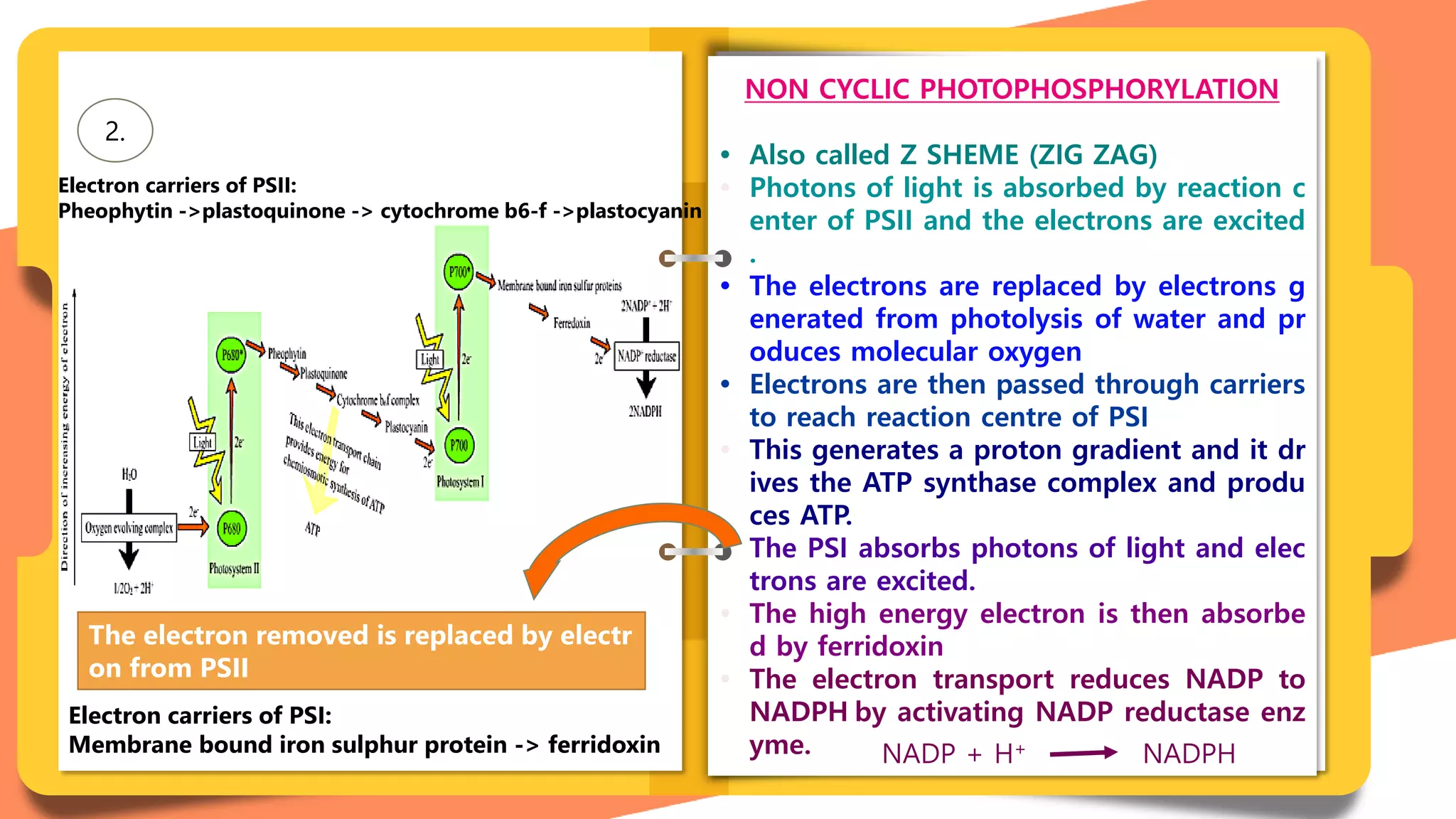
NON CYCLIC PHOTOPHOSPHORYLATION
 Also called Z SHEME (ZIG ZAG)
 Photons of light is absorbed by reaction c
enter of PSII and the electrons are excited
.
 The electrons are replaced by electrons g
enerated from photolysis of water and pr
oduces molecular oxygen
 Electrons are then passed through carriers
to reach reaction centre of PSI
 This generates a proton gradient and it dr
ives the ATP synthase complex and produ
ces ATP.
 The PSI absorbs photons of light and elec
trons are excited.
 The high energy electron is then absorbe
d by ferridoxin
 The electron transport reduces NADP to
NADPH by activating NADP reductase enz
yme.
2.
The electron removed is replaced by electr
on from PSII
NADP + H+ NADPH
Electron carriers of PSII:
Pheophytin ->plastoquinone -> cytochrome b6-f ->plastocyanin
Electron carriers of PSI:
Membrane bound iron sulphur protein -> ferridoxin
Thylakoid
e
e
e
e
H
+
H+
H+
e
e
NADP + H+ ->
NADPH
STROMA
ATMOSPHERE
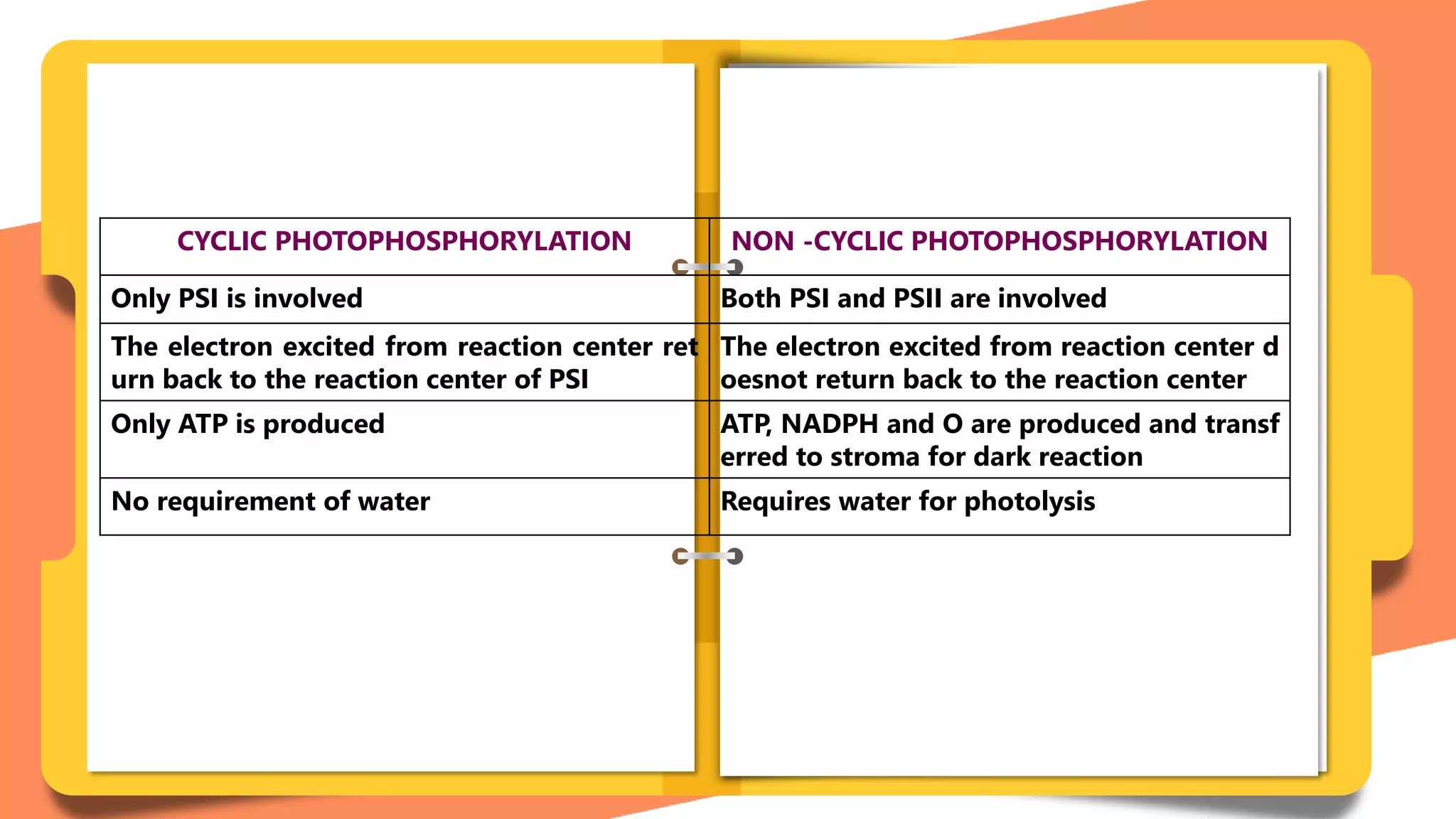
CYCLIC PHOTOPHOSPHORYLATION NON -CYCLIC PHOTOPHOSPHORYLATION
Only PSI is involved Both PSI and PSII are involved
The electron excited from reaction center ret
urn back to the reaction center of PSI
The electron excited from reaction center d
oesnot return back to the reaction center
Only ATP is produced ATP, NADPH and O are produced and transf
erred to stroma for dark reaction
No requirement of water Requires water for photolysis
ELECTRON CARRIERS
Ferridoxin : Small, water soluble, iron sulph
ur protein
Plastocyanin: Cu containing protein, blue co
lored, 8 stranded antiparallel beta barrel co
ntainng 1 Cu center
Plastoquinone: Isoprenoid quinone molecule
, PQ A, PQB, PQ C and PQ D, structurally si
milar to ubiquinone
Cytb6f: Found in thylakoid membrane
Pheophytin: Chlorophyll molecule lacking ce
ntral Mg2+ ion. Dark bluish waxy pigment
INHIBITORS OF LIGHT REACTION
COMMERCIAL HERBICIDES
DCMU: 3-(3,4- DICHLOROPHENYL) 1,1- DI
METHYL UREA
CMU: 3,4- CHLOROPHENYL 1,1- DIMETHYL
UREA
Photosynthesis -light reaction

Photosynthesis -light reaction

  • 1.
     Photosynthesis isthe formation of sugars(g lucose) with the help of CO2 and H2O in p resence of light Photosynthesis Light and Dark reaction  Photosynthesis is the formation of sugars( glucose) with the help of CO2 and H2O in presence of light  Why plants are in green? Plants absorbs bl ue and red light from sun and reflects gre en light.  Photosynthesis is the formation of sugars( glucose) with the help of CO2 and H2O in p resence of light 6CO2 + 6H2O C6H12O6 + 6O2  It takes place in chloroplast.
  • 3.
     Photosynthesis Light reaction Darkreaction LIGHT REACTION DARK REACTION Light dependent reaction . Light independent reacti on. Carbon assimilation r eaction Occur in grana. Occur in stroma. Includes cyclic & non cyc lic photophosphorylation. Include C3 cycle. C4, C2, CAM pathway Light is absorbed & conv erted to ATP & NADPH. ATP & NADPH are utiliz ed and triose phosphate, starch& sucrose are form ed LIGHT REACTION DARK REACTION
  • 4.
    PHOTOSYSTEMS (PIGMENT SYSTEMS) Photosynthesis is driven by 2 photochemical p ocesses (cyclic & non cyclic)  These are associated with 2 pigment systems o r photosystems  Photosystems are the light harvesting complex  Made up of 250-400 pigment molecules, access ory pigments and associated proteins.  Photosystems are found on the thylakoid mem brane of the chloroplast in plants and algae an d in the cell membrane of photosynthetic bact eria  Function:  Absorption of light energy and  Transfer of energy & electrons  Each photosystem consists of 2 closely linked c omponents  Reaction center (chl a) and  antenna molecules (accessory pigmen ts.)
  • 5.
     Photosystems aretwo types Photosystem I ( PS I / P700) and Photosystem II (PS II / P68 0) Photosystem I (PS I / P700) Photosystem II (PS II / P680) Maximum absorption at 700n m or far red light region or ph otocenter is p700 Maximum absorption at 680nm o r red light region or photocenter i s p680 Pigments absorbs long wavele ngth of light Pigments absorbs shorter wavele ngth of light It has FeS type reaction center It has quinone type reaction cente r Rich in chl a Rich in chl b Located on exposed part of gr ana thylakoid membrane (inne r part) Located in the stroma exposed me mbrane (outer part) Participate in both cyclic and non cyclic photophosphorylati on Participate only in non cyclic pho tophosphorylation Not associated with photolysis of water Associated with photolysis of wate r Involved in production of ATP in cyclic and NADPH in non c yclic photophosphoration Involved in ATP production PS I in cyclic photophosphory lation PS I in non-cyclic phot ophosphorylation PS II in non-cyclic phot ophosphorylation
  • 6.
    LIGHT REACTION  Dependenton light  Also called Hill’s reaction  Takes palce in thylakoid membrane of me sophyll cells  Includes cyclic & non- cyclic photophosph orylation  Involves 2 pigment system, PSI &PSII  ATP, NADPH & molecular oxygen (OEC) ar e produced CYCLIC PHOTOPHOSPHORYLATION  Light absorbed by reaction centre of PSI  Electron passed to primary e acceptor FR S (ferridoxin reducing substance)  Electrons are passed throgh e carriers an d returned back to PSI  ATP are produced. 1. PHOTOPHOSPHORYLATION: Process of fo rmation of ATP from ADP in presence of li ght in chloroplast.
  • 7.
    NON CYCLIC PHOTOPHOSPHORYLATION Also called Z SHEME (ZIG ZAG)  Photons of light is absorbed by reaction c enter of PSII and the electrons are excited .  The electrons are replaced by electrons g enerated from photolysis of water and pr oduces molecular oxygen  Electrons are then passed through carriers to reach reaction centre of PSI  This generates a proton gradient and it dr ives the ATP synthase complex and produ ces ATP.  The PSI absorbs photons of light and elec trons are excited.  The high energy electron is then absorbe d by ferridoxin  The electron transport reduces NADP to NADPH by activating NADP reductase enz yme. 2. The electron removed is replaced by electr on from PSII NADP + H+ NADPH Electron carriers of PSII: Pheophytin ->plastoquinone -> cytochrome b6-f ->plastocyanin Electron carriers of PSI: Membrane bound iron sulphur protein -> ferridoxin
  • 8.
  • 9.
    CYCLIC PHOTOPHOSPHORYLATION NON-CYCLIC PHOTOPHOSPHORYLATION Only PSI is involved Both PSI and PSII are involved The electron excited from reaction center ret urn back to the reaction center of PSI The electron excited from reaction center d oesnot return back to the reaction center Only ATP is produced ATP, NADPH and O are produced and transf erred to stroma for dark reaction No requirement of water Requires water for photolysis
  • 10.
    ELECTRON CARRIERS Ferridoxin :Small, water soluble, iron sulph ur protein Plastocyanin: Cu containing protein, blue co lored, 8 stranded antiparallel beta barrel co ntainng 1 Cu center Plastoquinone: Isoprenoid quinone molecule , PQ A, PQB, PQ C and PQ D, structurally si milar to ubiquinone Cytb6f: Found in thylakoid membrane Pheophytin: Chlorophyll molecule lacking ce ntral Mg2+ ion. Dark bluish waxy pigment INHIBITORS OF LIGHT REACTION COMMERCIAL HERBICIDES DCMU: 3-(3,4- DICHLOROPHENYL) 1,1- DI METHYL UREA CMU: 3,4- CHLOROPHENYL 1,1- DIMETHYL UREA