Science – key stage 4
Dr Jasmine Brar
Email : drjasmine1807@gmail.com
Photosynthesis
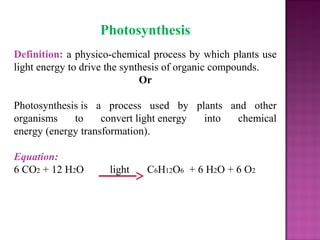
Definition: a physico-chemical process by which plants use
light energy to drive the synthesis of organic compounds.
Or
Photosynthesis is a process used by plants and other
organisms to convert light energy into chemical
energy (energy transformation).
Equation:
6 CO2 + 12 H2O light C6H12O6 + 6 H2O + 6 O2
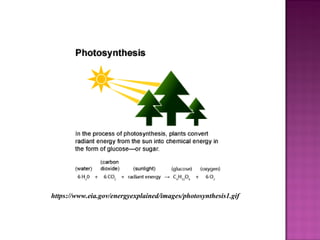
https://www.eia.gov/energyexplained/images/photosynthesis1.gif
Photosynthesis as the key process for food
production and therefore biomass for life
 All animals including human beings depend on
plants for their food and production of biomass.
Biomass is the total quantity or weight of organisms
in a given area or volume.
Green plants have to synthesise the food they need
and all other organisms depend on them for their
needs and production of their biomass by
photosynthesis.
Ultimately, all living forms on earth depend on
sunlight for energy. The use of energy from sunlight
by plants doing photosynthesis is the basis of life on
earth.
Photosynthesis is important due to two reasons: it
is the primary source of all food on earth. It is also
responsible for the release of oxygen into the
atmosphere by green plants.
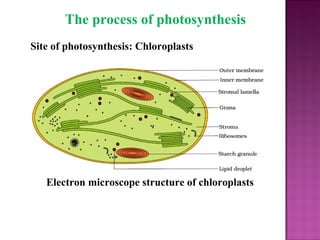
The process of photosynthesis
Electron microscope structure of chloroplasts
Site of photosynthesis: Chloroplasts
Pigments involved in photosynthesis
Pigments are substances that have an ability to
absorb light, at specific wavelengths.
Chlorophyll a: blue green
Chlorophyll b: yellow green
Carotenoids: yellow to yellow orange
Xanthophylls: yellow
We can conclude that chlorophyll a is the chief
pigment associated with photosynthesis
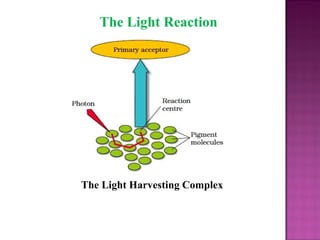
The Light Reaction
The Light Harvesting Complex
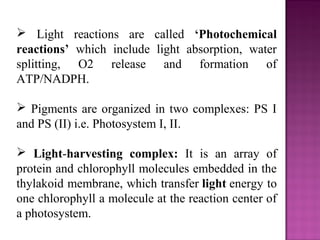
 Light reactions are called ‘Photochemical
reactions’ which include light absorption, water
splitting, O2 release and formation of
ATP/NADPH.
 Pigments are organized in two complexes: PS I
and PS (II) i.e. Photosystem I, II.
 Light-harvesting complex: It is an array of
protein and chlorophyll molecules embedded in the
thylakoid membrane, which transfer light energy to
one chlorophyll a molecule at the reaction center of
a photosystem.
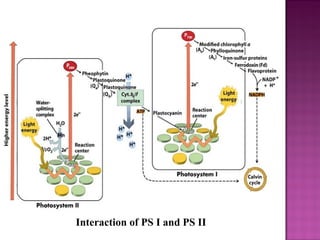
Interaction of PS I and PS II
The electrons flow from PS II through cytochrome
bf to PSI. PSI optimally absorbs photons of
wavelength of 700 nm. It is responsible for
providing high energy electrons with which to
reduce NADP+ to produce NADPH to be used in
the Calvin cycle.
PS II (water-plastoquinone oxidoreductase) is the
first protein complex in the light-dependent
reactions of photosynthesis. It is located in the
thylakoid membrane of plants, algae, and
cyanobacteria.
Interaction of PS I and PS II
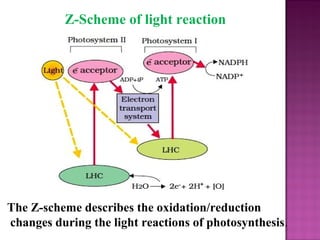
The Z-scheme describes the oxidation/reduction
changes during the light reactions of photosynthesis. 
Z-Scheme of light reaction
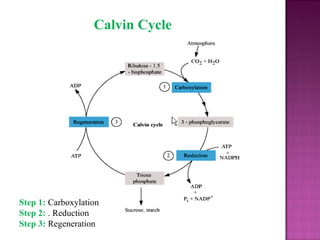
Calvin Cycle
Step 1: Carboxylation
Step 2: . Reduction
Step 3: Regeneration
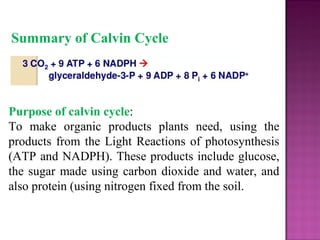
Summary of Calvin Cycle
Purpose of calvin cycle:
To make organic products plants need, using the
products from the Light Reactions of photosynthesis
(ATP and NADPH). These products include glucose,
the sugar made using carbon dioxide and water, and
also protein (using nitrogen fixed from the soil.
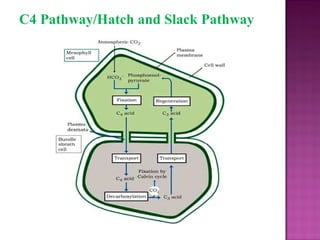
C4 Pathway/Hatch and Slack Pathway
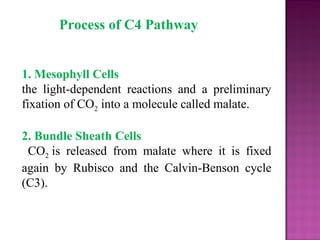
1. Mesophyll Cells
the light-dependent reactions and a preliminary
fixation of CO2 into a molecule called malate.
2. Bundle Sheath Cells
CO2 is released from malate where it is fixed
again by Rubisco and the Calvin-Benson cycle
(C3).
Process of C4 Pathway
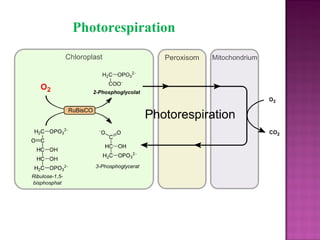
Photorespiration
Photorespiration or C2 photosynthesis is a
process in plant metabolism where the enzyme
RuBisCO oxygenates RuBP, causing some of
the energy produced by photosynthesis to be
wasted.
CAM plants avoid photorespiration
1)PEP carboxylase
2)Separation in time of carbon fixation and the
dark reactions of Calvin cycle.
Crassulacean acid metabolism, also known
as CAM photosynthesis, is a carbon fixation
pathway in some plants as an adaptation to arid
conditions. In CAM plants, the stomata in the
leaves remain shut during the day to reduce
evapotranspiration, but open at night to collect
carbon dioxide (CO2).
Eg. Aeonium and Kalanchoe of the family
Crassulaceae, pineapple (Ananas comosus), cacti,
orchids, Agave, and waxplant (Hoya carnosa,
family Apocynaceae).
Crassulacean acid metabolism (CAM)
Factors affecting the rate of photosynthesis
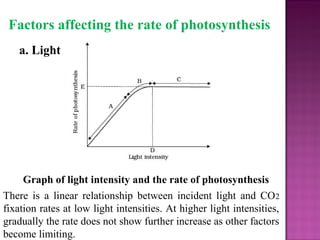
Graph of light intensity and the rate of photosynthesis
There is a linear relationship between incident light and CO2
fixation rates at low light intensities. At higher light intensities,
gradually the rate does not show further increase as other factors
become limiting.
a. Light
b. Carbon di-oxide
CO2 is the major limiting factor for photosynthesis. The
concentration of CO2 is low in the atmosphere (between
0.03 and 0.04%). Increase in concentration upto 0.05% can
cause an increase in CO2 fixation rates. C3 plants respond to
higher CO2 concentration by showing increased rates of
photosynthesis leading to higher productivity.
c. Temperature
Tropical plants have a higher temperature optimum than
the plants adapted to temperate climates. The C4 plants
show higher rate of photosynthesis while C3 plants have a
much lower temperature optimum.
d. Water
Water stress causes the stomata to close hence
reducing the CO2 availability. Water stress leads
to wilting of leaves, thus, reducing the surface
area of the leaves and their metabolic activity as
well.
Photosynthesis

Photosynthesis

  • 1.
    Science – keystage 4 Dr Jasmine Brar Email : drjasmine1807@gmail.com
  • 2.
    Photosynthesis Definition: a physico-chemicalprocess by which plants use light energy to drive the synthesis of organic compounds. Or Photosynthesis is a process used by plants and other organisms to convert light energy into chemical energy (energy transformation). Equation: 6 CO2 + 12 H2O light C6H12O6 + 6 H2O + 6 O2
  • 3.
  • 4.
    Photosynthesis as thekey process for food production and therefore biomass for life  All animals including human beings depend on plants for their food and production of biomass. Biomass is the total quantity or weight of organisms in a given area or volume. Green plants have to synthesise the food they need and all other organisms depend on them for their needs and production of their biomass by photosynthesis.
  • 5.
    Ultimately, all livingforms on earth depend on sunlight for energy. The use of energy from sunlight by plants doing photosynthesis is the basis of life on earth. Photosynthesis is important due to two reasons: it is the primary source of all food on earth. It is also responsible for the release of oxygen into the atmosphere by green plants.
  • 6.
    The process ofphotosynthesis Electron microscope structure of chloroplasts Site of photosynthesis: Chloroplasts
  • 7.
    Pigments involved inphotosynthesis Pigments are substances that have an ability to absorb light, at specific wavelengths. Chlorophyll a: blue green Chlorophyll b: yellow green Carotenoids: yellow to yellow orange Xanthophylls: yellow We can conclude that chlorophyll a is the chief pigment associated with photosynthesis
  • 8.
    The Light Reaction TheLight Harvesting Complex
  • 9.
     Light reactionsare called ‘Photochemical reactions’ which include light absorption, water splitting, O2 release and formation of ATP/NADPH.  Pigments are organized in two complexes: PS I and PS (II) i.e. Photosystem I, II.  Light-harvesting complex: It is an array of protein and chlorophyll molecules embedded in the thylakoid membrane, which transfer light energy to one chlorophyll a molecule at the reaction center of a photosystem.
  • 10.
    Interaction of PSI and PS II
  • 11.
    The electrons flowfrom PS II through cytochrome bf to PSI. PSI optimally absorbs photons of wavelength of 700 nm. It is responsible for providing high energy electrons with which to reduce NADP+ to produce NADPH to be used in the Calvin cycle. PS II (water-plastoquinone oxidoreductase) is the first protein complex in the light-dependent reactions of photosynthesis. It is located in the thylakoid membrane of plants, algae, and cyanobacteria. Interaction of PS I and PS II
  • 12.
    The Z-scheme describesthe oxidation/reduction changes during the light reactions of photosynthesis.  Z-Scheme of light reaction
  • 13.
    Calvin Cycle Step 1:Carboxylation Step 2: . Reduction Step 3: Regeneration
  • 14.
    Summary of CalvinCycle Purpose of calvin cycle: To make organic products plants need, using the products from the Light Reactions of photosynthesis (ATP and NADPH). These products include glucose, the sugar made using carbon dioxide and water, and also protein (using nitrogen fixed from the soil.
  • 15.
    C4 Pathway/Hatch andSlack Pathway
  • 16.
    1. Mesophyll Cells thelight-dependent reactions and a preliminary fixation of CO2 into a molecule called malate. 2. Bundle Sheath Cells CO2 is released from malate where it is fixed again by Rubisco and the Calvin-Benson cycle (C3). Process of C4 Pathway
  • 17.
  • 18.
    Photorespiration or C2photosynthesis is a process in plant metabolism where the enzyme RuBisCO oxygenates RuBP, causing some of the energy produced by photosynthesis to be wasted. CAM plants avoid photorespiration 1)PEP carboxylase 2)Separation in time of carbon fixation and the dark reactions of Calvin cycle.
  • 20.
    Crassulacean acid metabolism,also known as CAM photosynthesis, is a carbon fixation pathway in some plants as an adaptation to arid conditions. In CAM plants, the stomata in the leaves remain shut during the day to reduce evapotranspiration, but open at night to collect carbon dioxide (CO2). Eg. Aeonium and Kalanchoe of the family Crassulaceae, pineapple (Ananas comosus), cacti, orchids, Agave, and waxplant (Hoya carnosa, family Apocynaceae). Crassulacean acid metabolism (CAM)
  • 21.
    Factors affecting therate of photosynthesis Graph of light intensity and the rate of photosynthesis There is a linear relationship between incident light and CO2 fixation rates at low light intensities. At higher light intensities, gradually the rate does not show further increase as other factors become limiting. a. Light
  • 22.
    b. Carbon di-oxide CO2is the major limiting factor for photosynthesis. The concentration of CO2 is low in the atmosphere (between 0.03 and 0.04%). Increase in concentration upto 0.05% can cause an increase in CO2 fixation rates. C3 plants respond to higher CO2 concentration by showing increased rates of photosynthesis leading to higher productivity. c. Temperature Tropical plants have a higher temperature optimum than the plants adapted to temperate climates. The C4 plants show higher rate of photosynthesis while C3 plants have a much lower temperature optimum.
  • 23.
    d. Water Water stresscauses the stomata to close hence reducing the CO2 availability. Water stress leads to wilting of leaves, thus, reducing the surface area of the leaves and their metabolic activity as well.