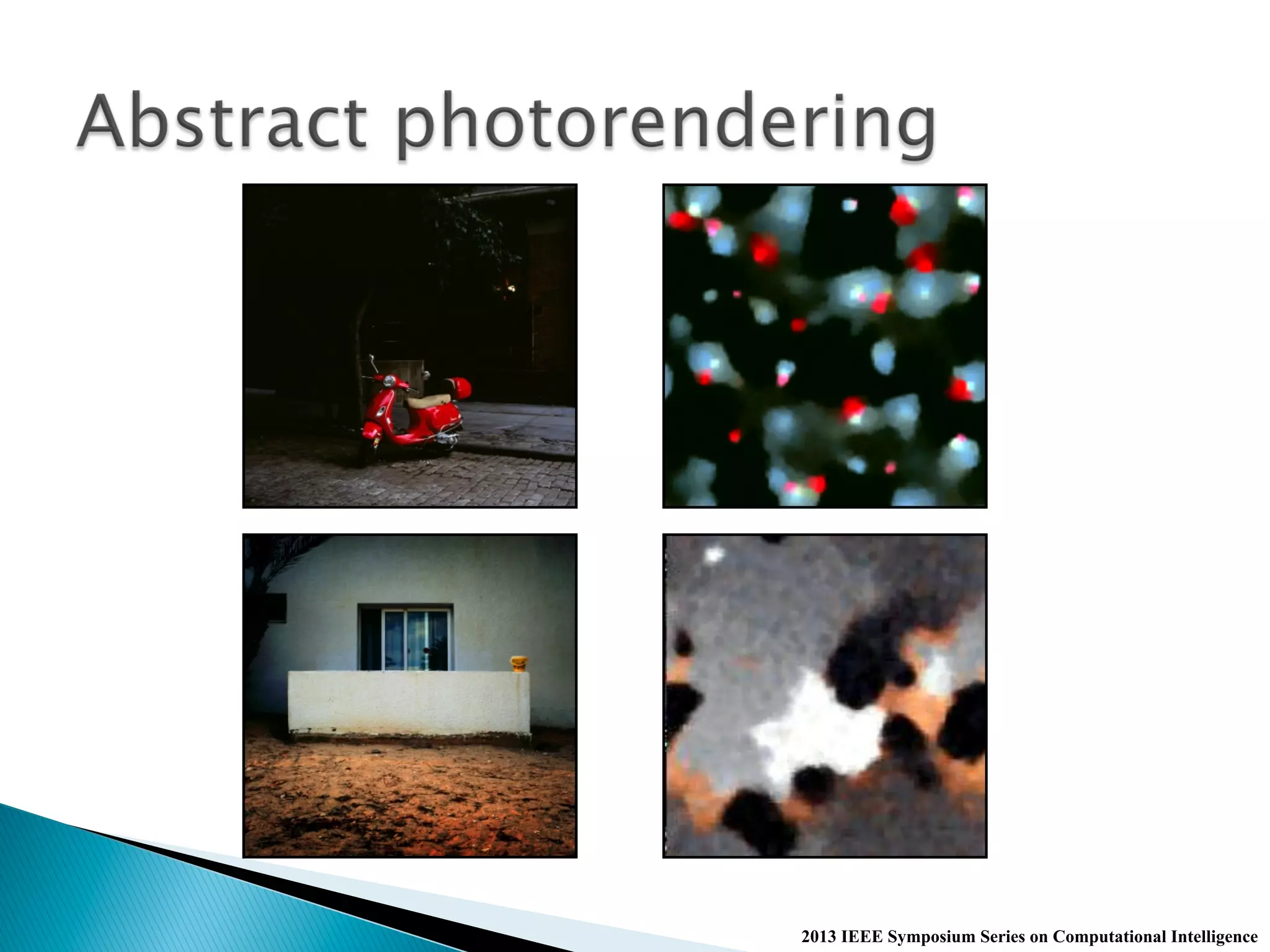
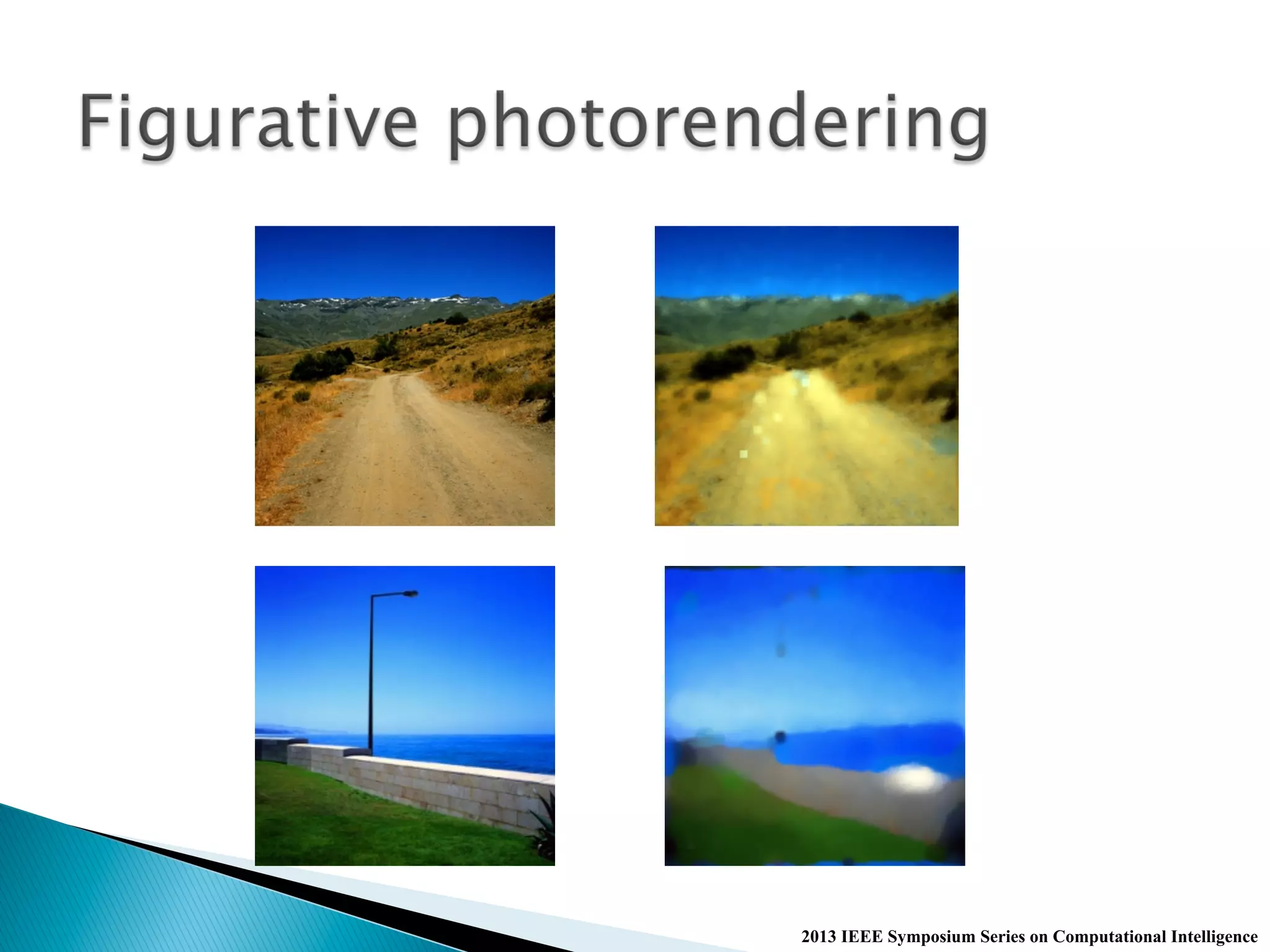
Carlos M. Fernandes, Antonio M. Mora, J.J. Merelo
(University of Granada)
C. Cotta
(University of Malaga)
A.C. Rosa
(Technical University of Lisbon)
2013 IEEE Symposium Series on Computational Intelligence
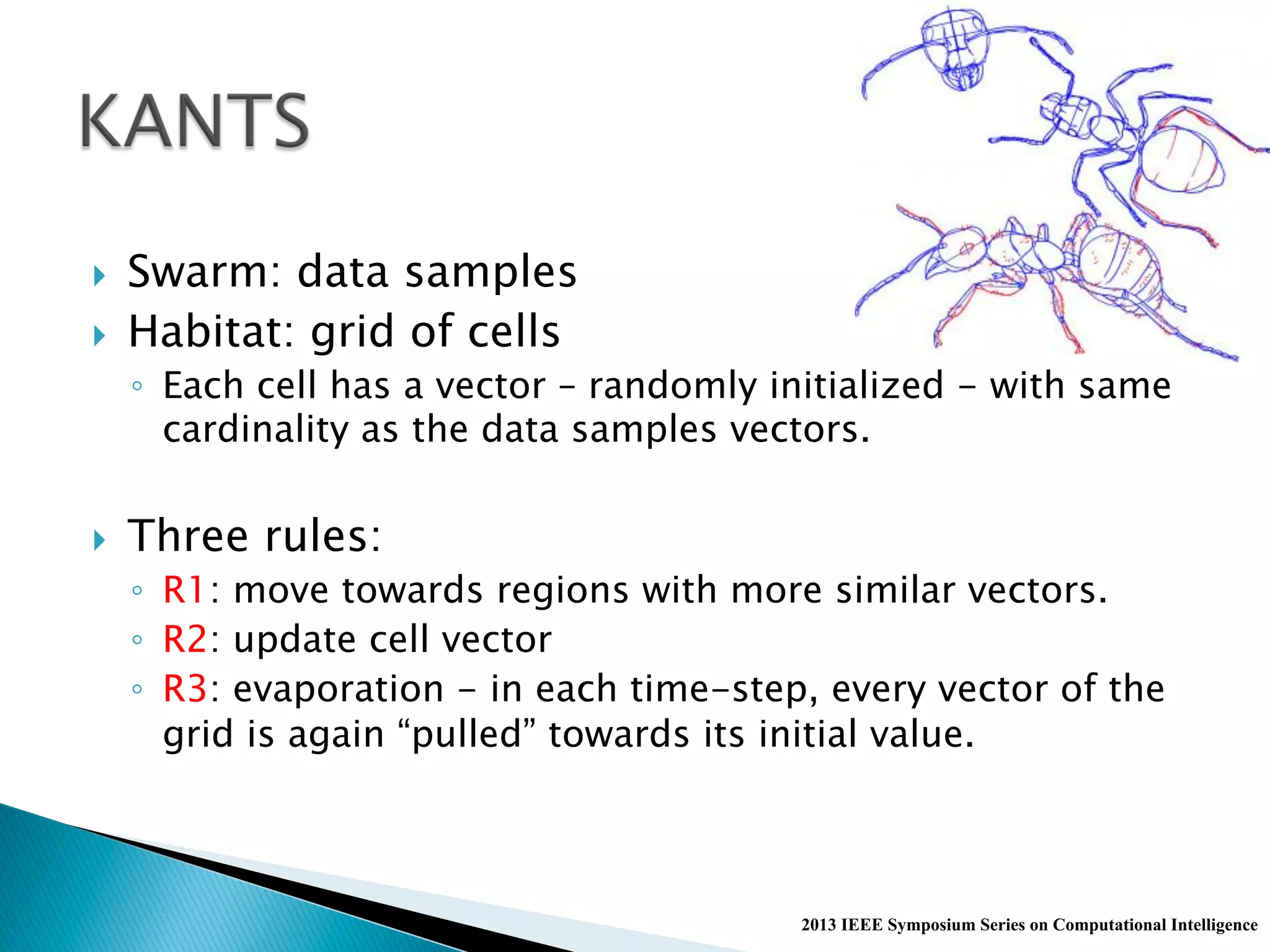
}  KANTS is swarm
intelligence clustering
algorithm.
}  Uses stigmergy –
communication with and
via the environment – as
the basic rule.
}  Data samples are the
swarm. They communicate
and self-organize into
clusters of similar
samples.
2013 IEEE Symposium Series on Computational Intelligence
}  Swarm: data samples
}  Habitat: grid of cells
◦  Each cell has a vector – randomly initialized - with same
cardinality as the data samples vectors.
}  Three rules:
◦  R1: move towards regions with more similar vectors.
◦  R2: update cell vector
◦  R3: evaporation - in each time-step, every vector of the
grid is again “pulled” towards its initial value.
2013 IEEE Symposium Series on Computational Intelligence
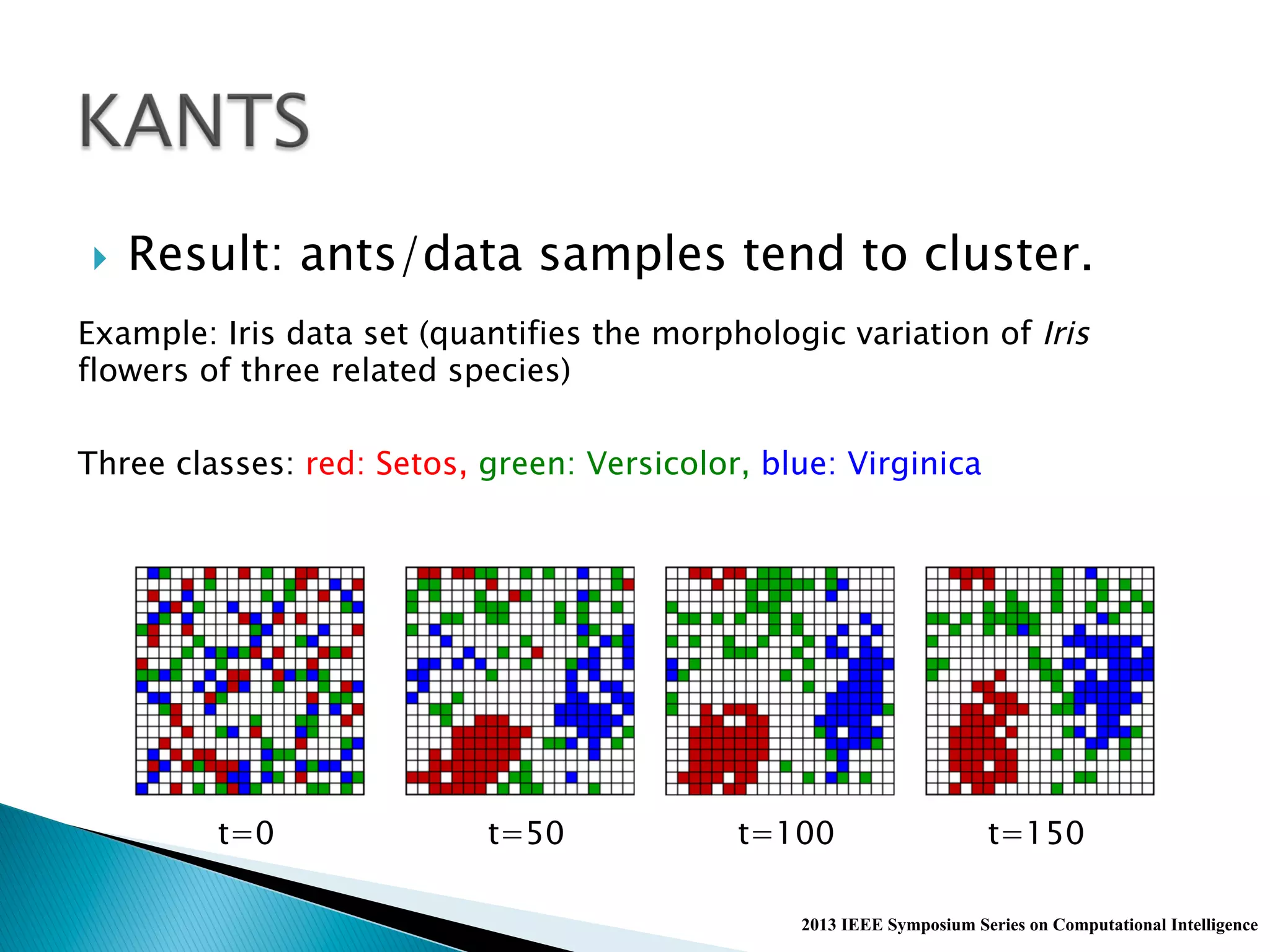
}  Result: ants/data samples tend to cluster.
2013 IEEE Symposium Series on Computational Intelligence
Example: Iris data set (quantifies the morphologic variation of Iris
flowers of three related species)
Three classes: red: Setos, green: Versicolor, blue: Virginica
t=0 t=50 t=100 t=150
2013 IEEE Symposium Series on Computational Intelligence
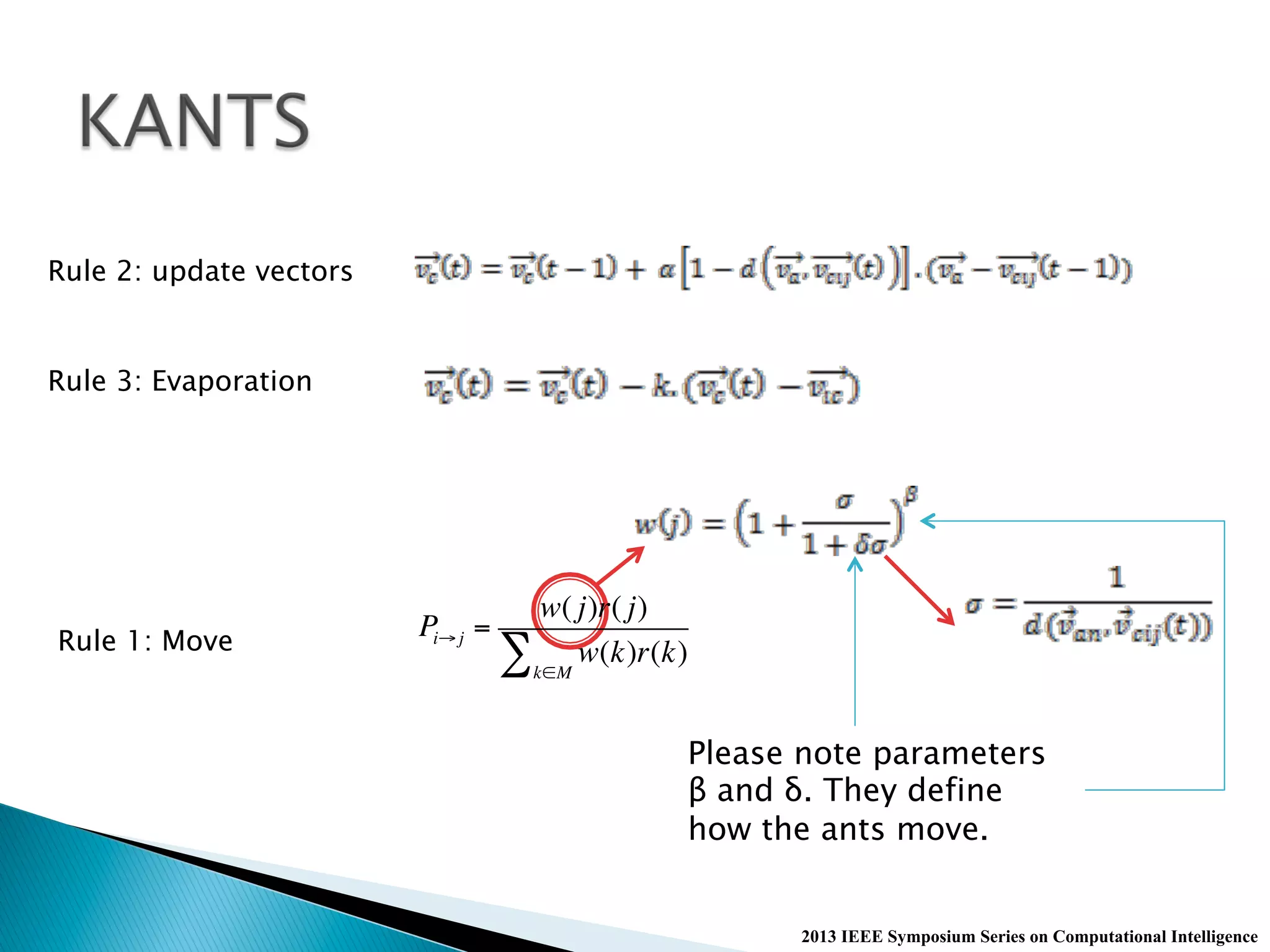
Rule 2: update vectors
Rule 3: Evaporation
Rule 1: Move
Please note parameters
β and δ. They define
how the ants move.
Pi!j =
w( j)r( j)
w(k)r(k)
k"M
#
2013 IEEE Symposium Series on Computational Intelligence
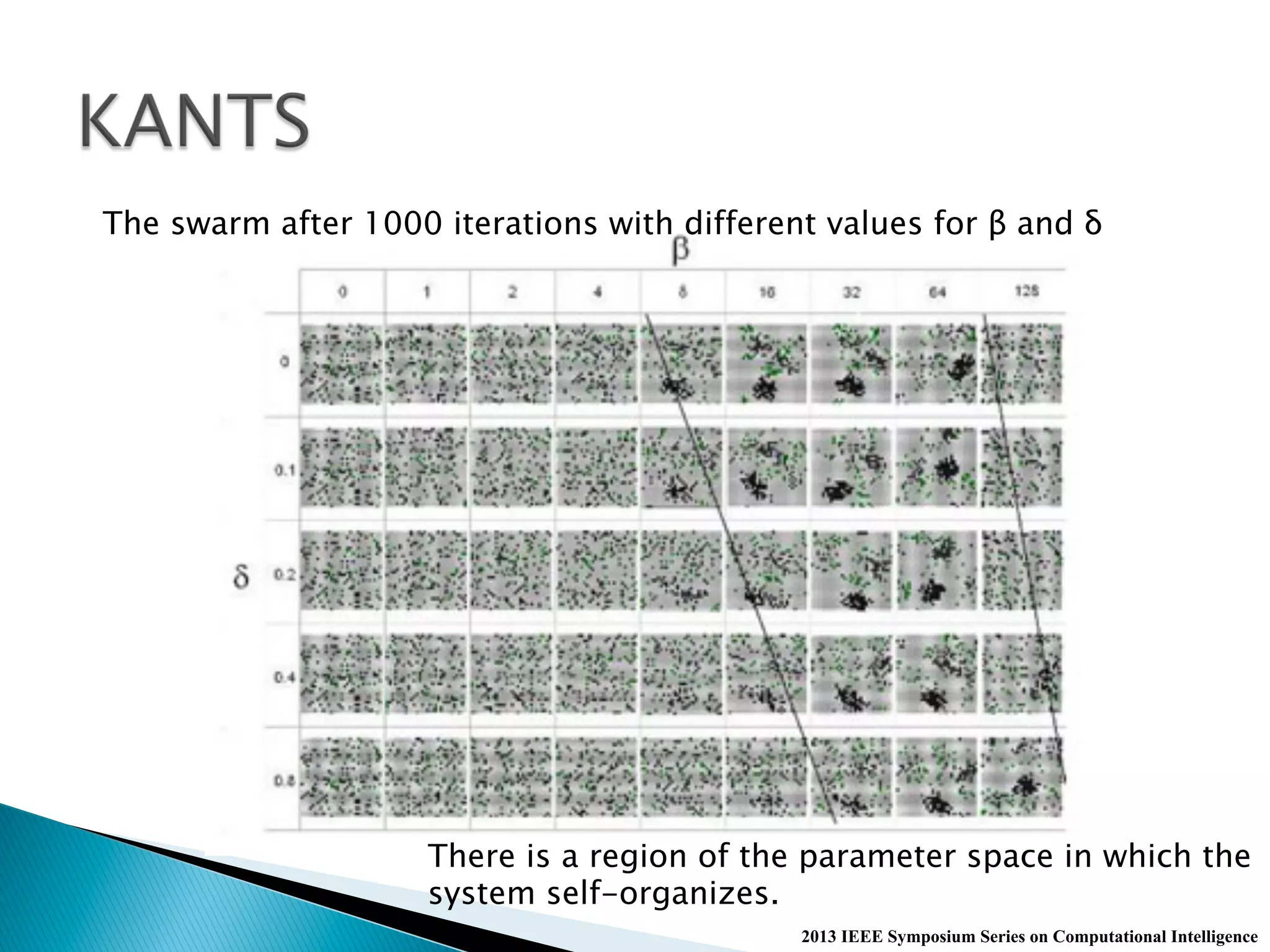
The swarm after 1000 iterations with different values for β and δ
There is a region of the parameter space in which the
system self-organizes.
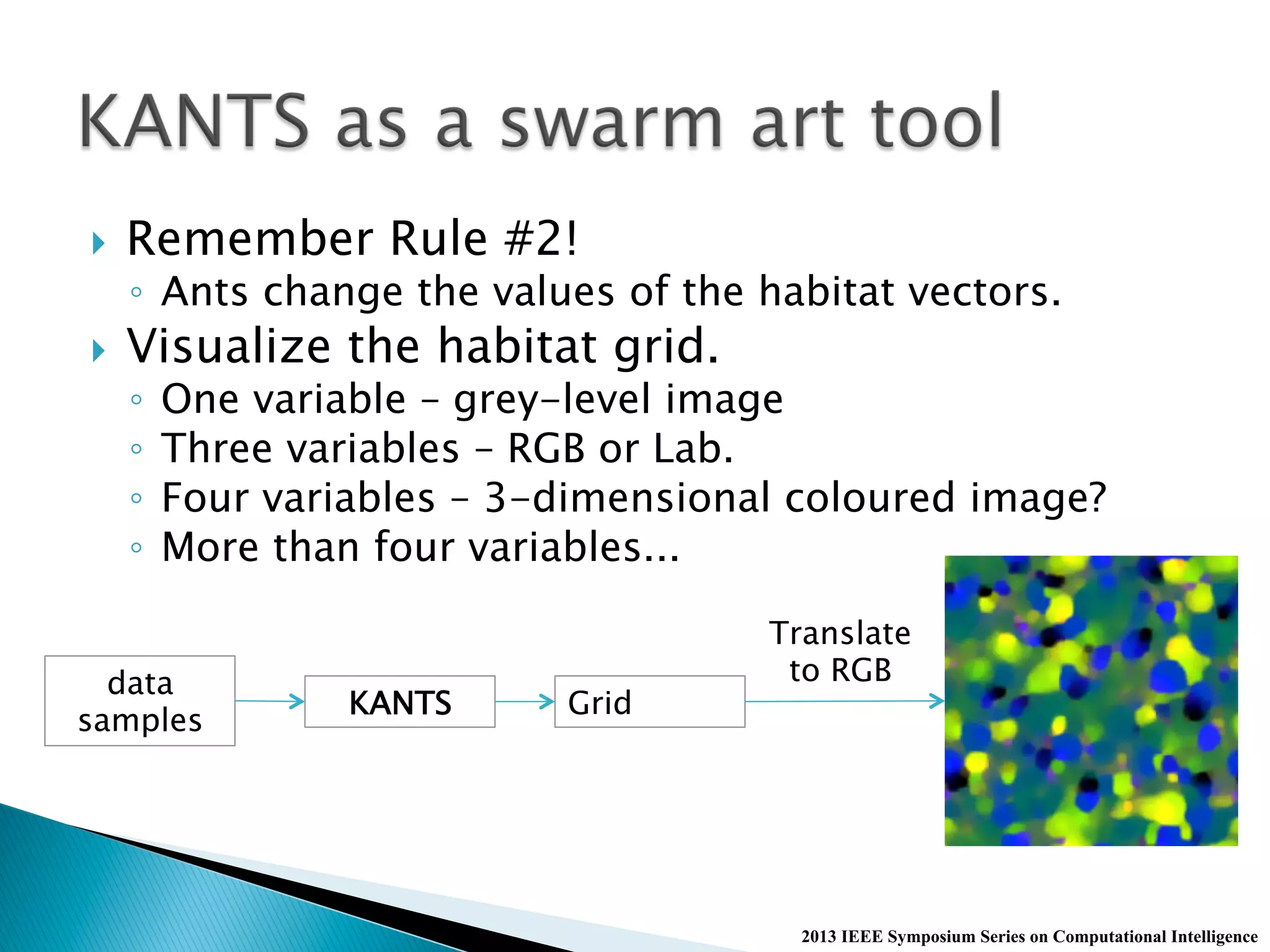
}  Remember Rule #2!
◦  Ants change the values of the habitat vectors.
}  Visualize the habitat grid.
◦  One variable – grey-level image
◦  Three variables – RGB or Lab.
◦  Four variables – 3-dimensional coloured image?
◦  More than four variables...
2013 IEEE Symposium Series on Computational Intelligence
data
samples
KANTS Grid
Translate
to RGB
2013 IEEE Symposium Series on Computational Intelligence
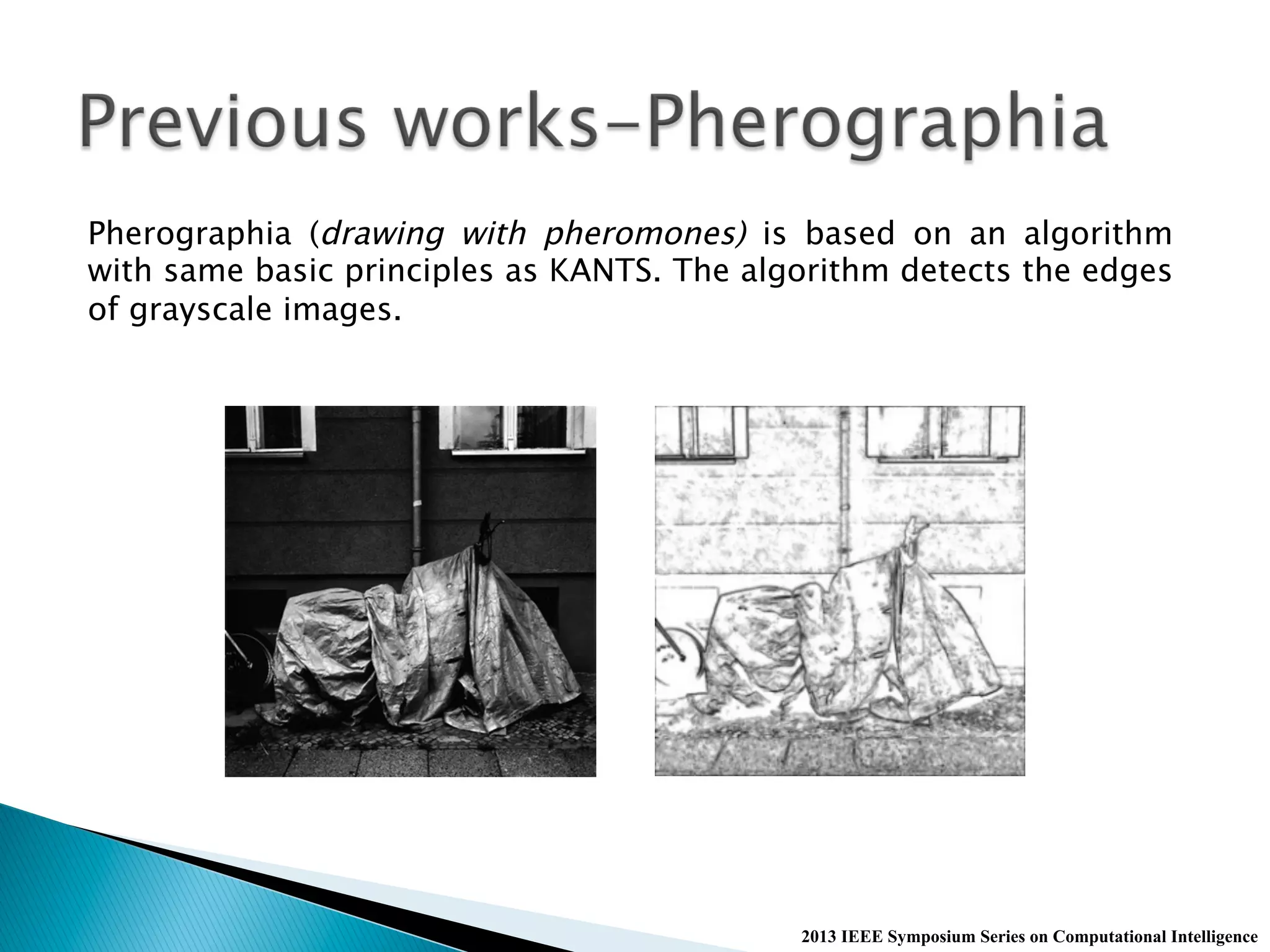
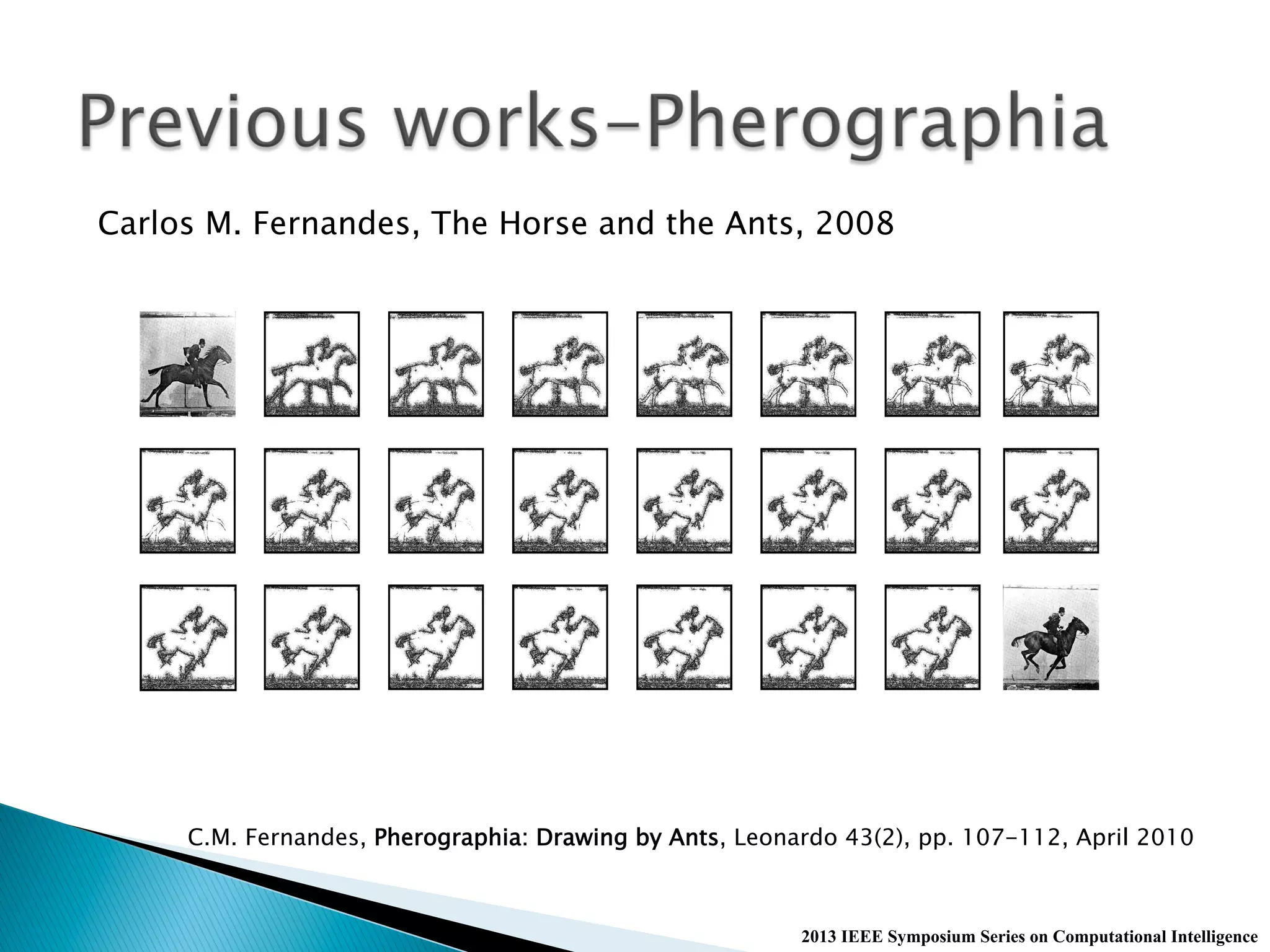
Pherographia (drawing with pheromones) is based on an algorithm
with same basic principles as KANTS. The algorithm detects the edges
of grayscale images.
2013 IEEE Symposium Series on Computational Intelligence
Carlos M. Fernandes, The Horse and the Ants, 2008
C.M. Fernandes, Pherographia: Drawing by Ants, Leonardo 43(2), pp. 107-112, April 2010
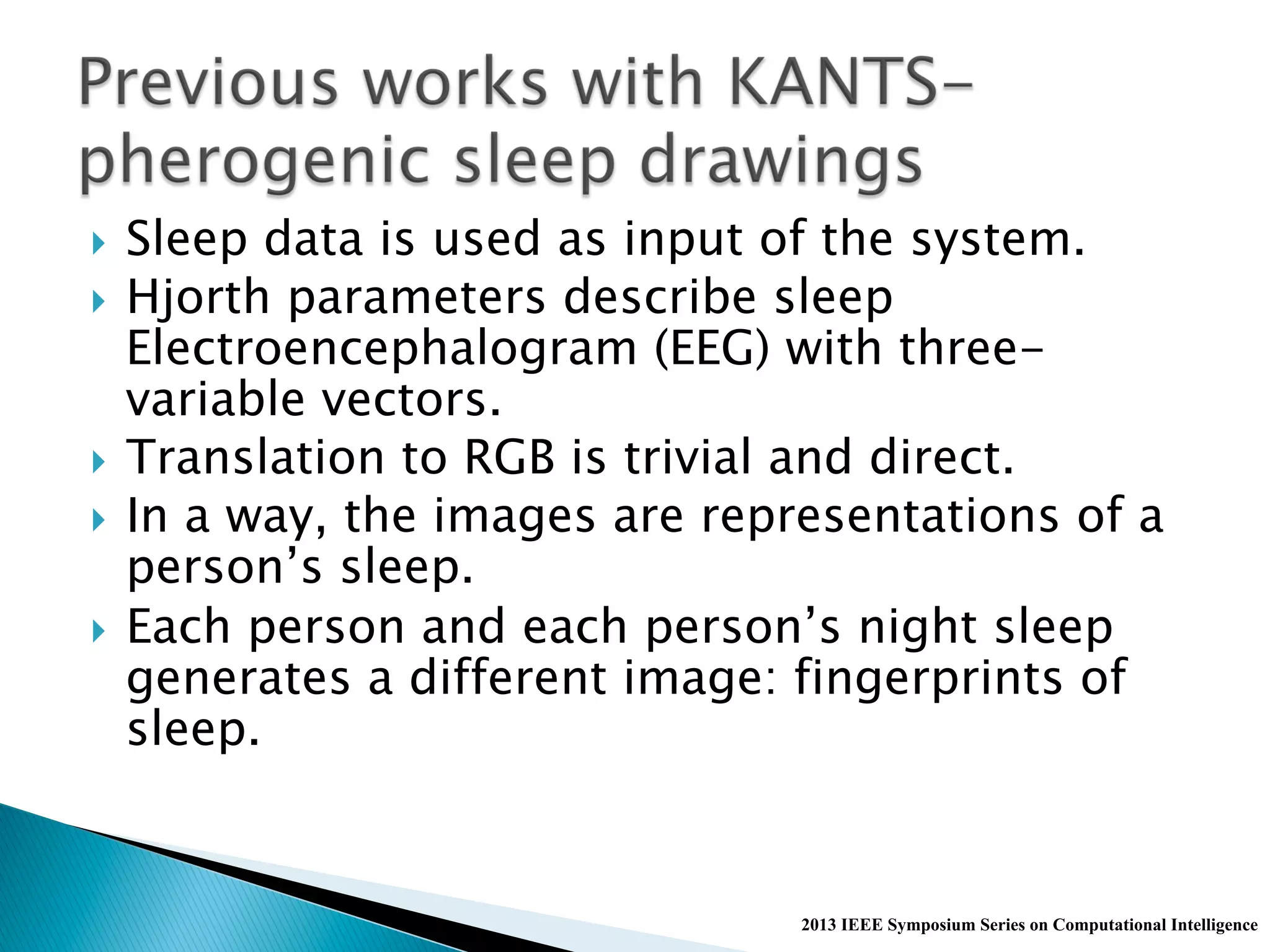
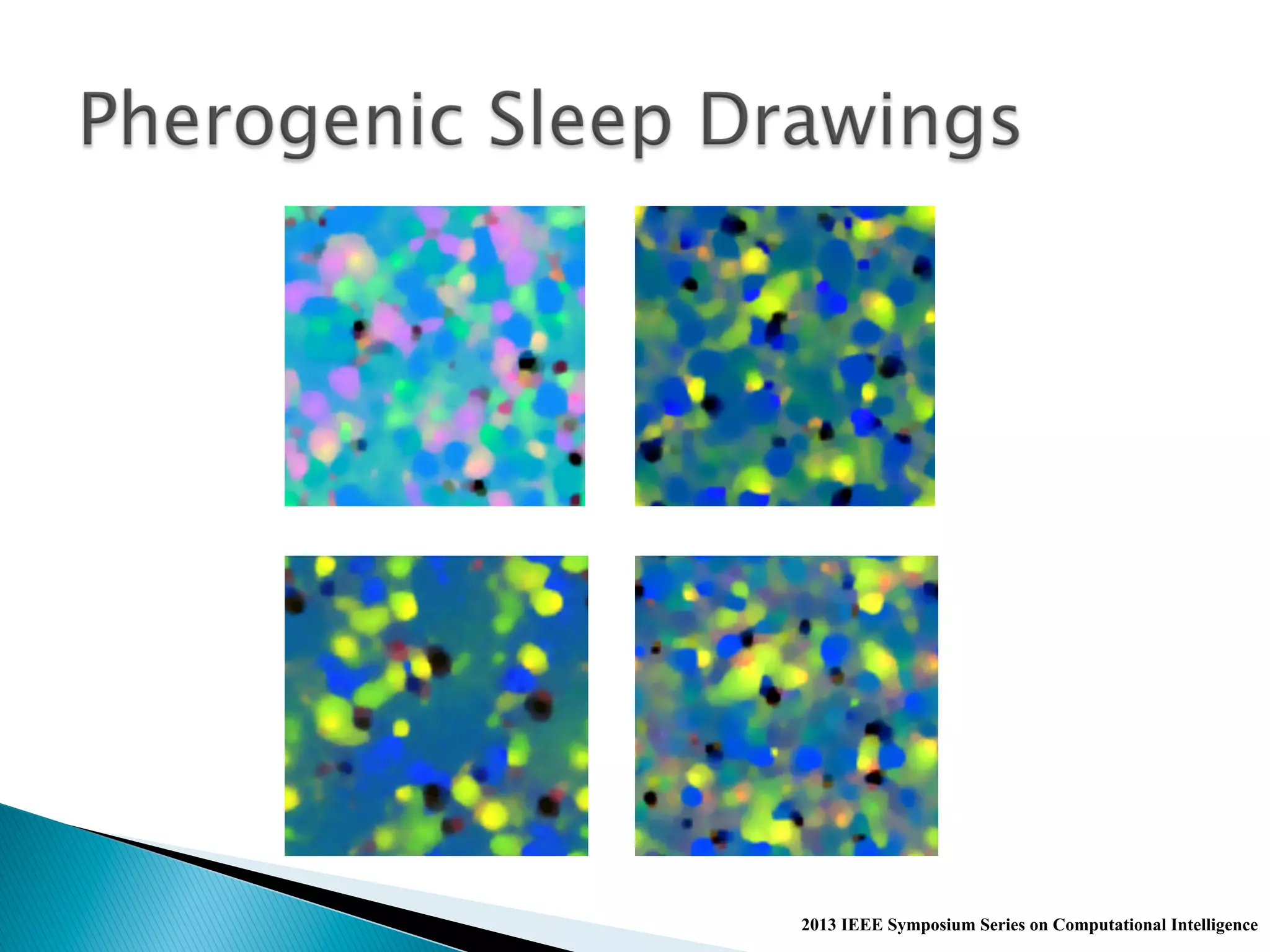
}  Sleep data is used as input of the system.
}  Hjorth parameters describe sleep
Electroencephalogram (EEG) with three-
variable vectors.
}  Translation to RGB is trivial and direct.
}  In a way, the images are representations of a
person’s sleep.
}  Each person and each person’s night sleep
generates a different image: fingerprints of
sleep.
2013 IEEE Symposium Series on Computational Intelligence
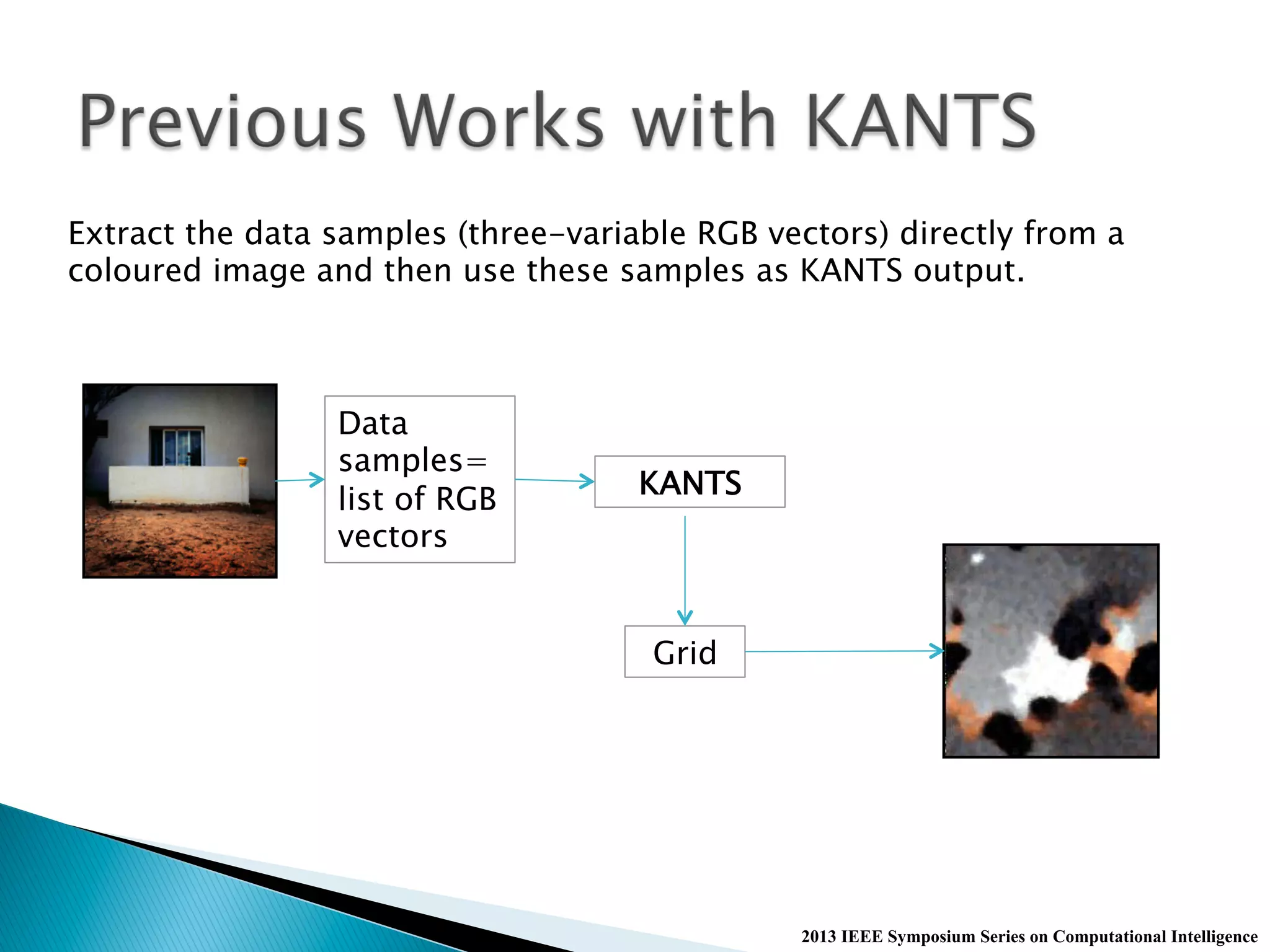
Data
samples=
list of RGB
vectors
KANTS
Grid
Extract the data samples (three-variable RGB vectors) directly from a
coloured image and then use these samples as KANTS output.
}  Winner of the Evolutionary, Design and Competition Art
Competition (GECCO’12)
2013 IEEE Symposium Series on Computational Intelligence
Carlos M. Fernandes, Abstracting the Abstract #4 (after Kandinsky), 2012
2013 IEEE Symposium Series on Computational Intelligence
Carlos M. Fernandes, Abstracting the Abstract #5 (after Miró), 2012
2013 IEEE Symposium Series on Computational Intelligence
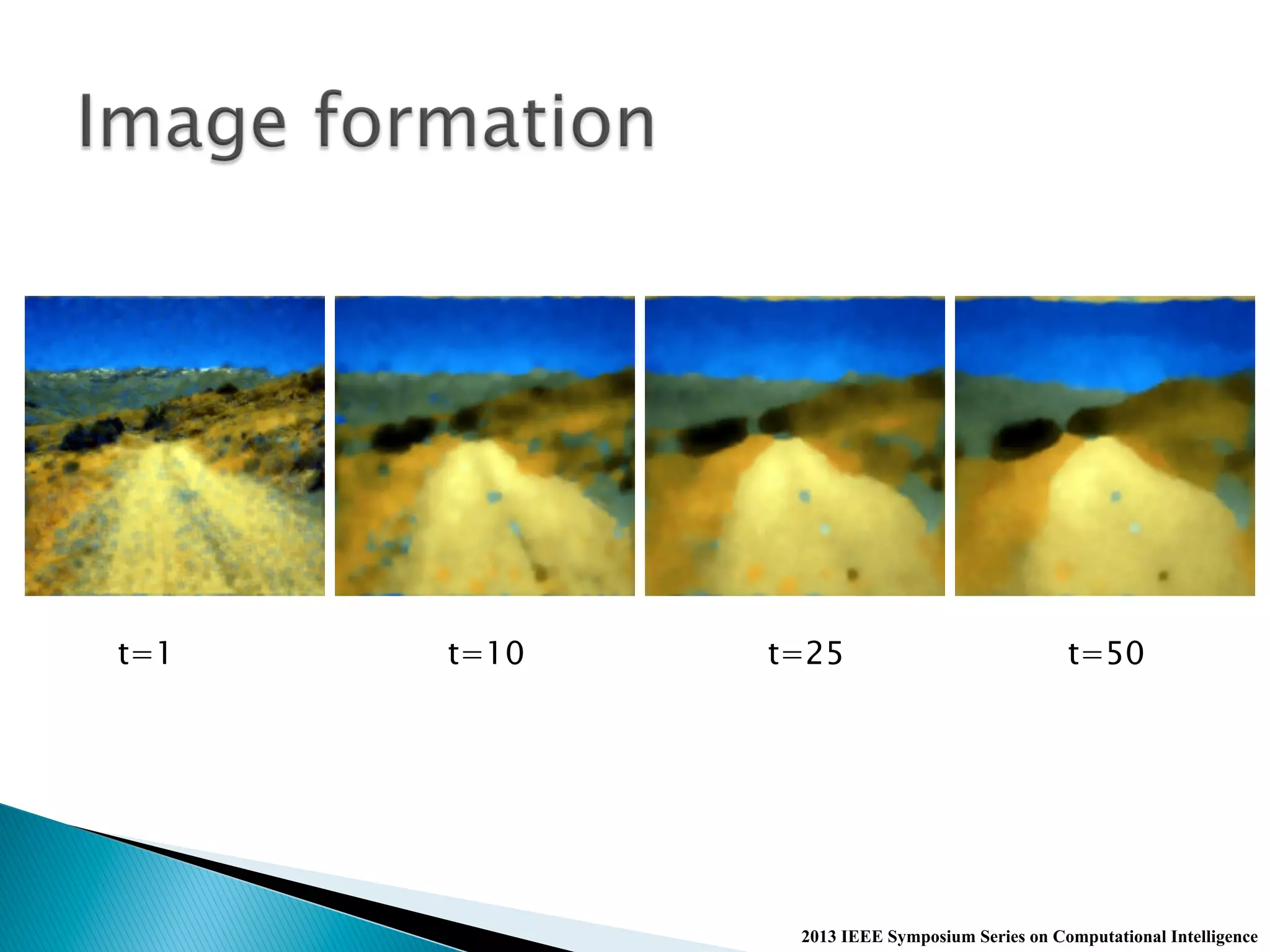
t=1 t=10 t=25 t=50
2013 IEEE Symposium Series on Computational Intelligence
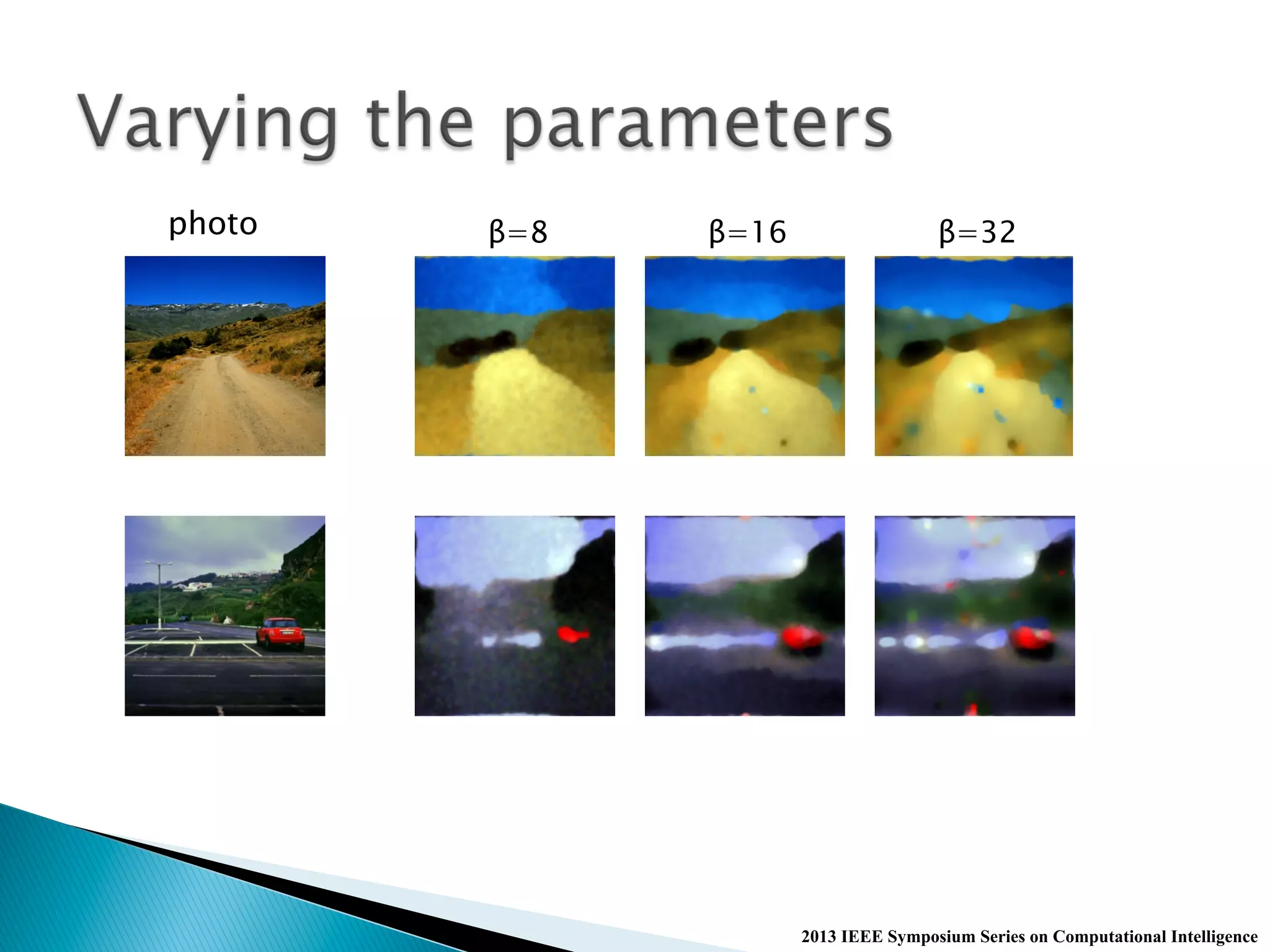
photo β=8 β=16 β=32
2013 IEEE Symposium Series on Computational Intelligence
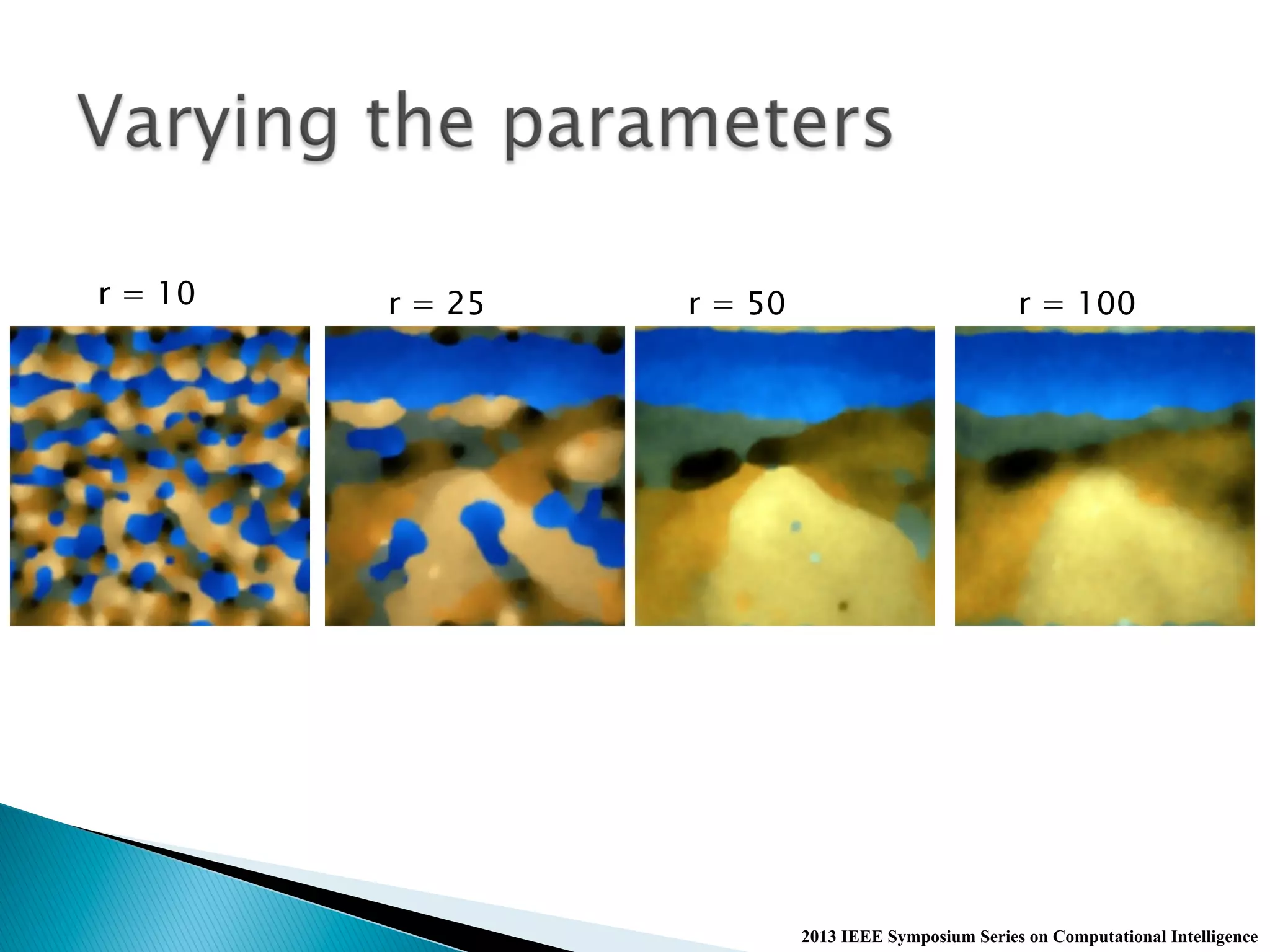
r = 10 r = 25 r = 50 r = 100
}  Devise other forms of representation when
the cardinality of the vectors is >3
}  4-variables: maybe 3-dimensional
representations.
}  Many variables. How to represent them?
2013 IEEE Symposium Series on Computational Intelligence
ANYSELF
Please, find us in Facebook
and in Twitter
AnyselfProject
@AnyselfProject

Photo Rendering with Swarms: From Figurative to Abstract Pherogenic Imaging

  • 1.
    Carlos M. Fernandes,Antonio M. Mora, J.J. Merelo (University of Granada) C. Cotta (University of Malaga) A.C. Rosa (Technical University of Lisbon) 2013 IEEE Symposium Series on Computational Intelligence
  • 2.
    }  KANTS isswarm intelligence clustering algorithm. }  Uses stigmergy – communication with and via the environment – as the basic rule. }  Data samples are the swarm. They communicate and self-organize into clusters of similar samples. 2013 IEEE Symposium Series on Computational Intelligence
  • 3.
    }  Swarm: datasamples }  Habitat: grid of cells ◦  Each cell has a vector – randomly initialized - with same cardinality as the data samples vectors. }  Three rules: ◦  R1: move towards regions with more similar vectors. ◦  R2: update cell vector ◦  R3: evaporation - in each time-step, every vector of the grid is again “pulled” towards its initial value. 2013 IEEE Symposium Series on Computational Intelligence
  • 4.
    }  Result: ants/datasamples tend to cluster. 2013 IEEE Symposium Series on Computational Intelligence Example: Iris data set (quantifies the morphologic variation of Iris flowers of three related species) Three classes: red: Setos, green: Versicolor, blue: Virginica t=0 t=50 t=100 t=150
  • 5.
    2013 IEEE SymposiumSeries on Computational Intelligence Rule 2: update vectors Rule 3: Evaporation Rule 1: Move Please note parameters β and δ. They define how the ants move. Pi!j = w( j)r( j) w(k)r(k) k"M #
  • 6.
    2013 IEEE SymposiumSeries on Computational Intelligence The swarm after 1000 iterations with different values for β and δ There is a region of the parameter space in which the system self-organizes.
  • 7.
    }  Remember Rule#2! ◦  Ants change the values of the habitat vectors. }  Visualize the habitat grid. ◦  One variable – grey-level image ◦  Three variables – RGB or Lab. ◦  Four variables – 3-dimensional coloured image? ◦  More than four variables... 2013 IEEE Symposium Series on Computational Intelligence data samples KANTS Grid Translate to RGB
  • 8.
    2013 IEEE SymposiumSeries on Computational Intelligence Pherographia (drawing with pheromones) is based on an algorithm with same basic principles as KANTS. The algorithm detects the edges of grayscale images.
  • 9.
    2013 IEEE SymposiumSeries on Computational Intelligence Carlos M. Fernandes, The Horse and the Ants, 2008 C.M. Fernandes, Pherographia: Drawing by Ants, Leonardo 43(2), pp. 107-112, April 2010
  • 10.
    }  Sleep datais used as input of the system. }  Hjorth parameters describe sleep Electroencephalogram (EEG) with three- variable vectors. }  Translation to RGB is trivial and direct. }  In a way, the images are representations of a person’s sleep. }  Each person and each person’s night sleep generates a different image: fingerprints of sleep. 2013 IEEE Symposium Series on Computational Intelligence
  • 11.
    2013 IEEE SymposiumSeries on Computational Intelligence
  • 12.
    2013 IEEE SymposiumSeries on Computational Intelligence Data samples= list of RGB vectors KANTS Grid Extract the data samples (three-variable RGB vectors) directly from a coloured image and then use these samples as KANTS output.
  • 13.
    }  Winner ofthe Evolutionary, Design and Competition Art Competition (GECCO’12) 2013 IEEE Symposium Series on Computational Intelligence Carlos M. Fernandes, Abstracting the Abstract #4 (after Kandinsky), 2012
  • 14.
    2013 IEEE SymposiumSeries on Computational Intelligence Carlos M. Fernandes, Abstracting the Abstract #5 (after Miró), 2012
  • 15.
    2013 IEEE SymposiumSeries on Computational Intelligence
  • 16.
    2013 IEEE SymposiumSeries on Computational Intelligence
  • 17.
    2013 IEEE SymposiumSeries on Computational Intelligence t=1 t=10 t=25 t=50
  • 18.
    2013 IEEE SymposiumSeries on Computational Intelligence photo β=8 β=16 β=32
  • 19.
    2013 IEEE SymposiumSeries on Computational Intelligence r = 10 r = 25 r = 50 r = 100
  • 20.
    }  Devise otherforms of representation when the cardinality of the vectors is >3 }  4-variables: maybe 3-dimensional representations. }  Many variables. How to represent them? 2013 IEEE Symposium Series on Computational Intelligence
  • 21.
    ANYSELF Please, find usin Facebook and in Twitter AnyselfProject @AnyselfProject