The case for  another   systems biology  modelling environment Jonathan Blakes 19/2/2009 ASAP seminar
Abstract Systems biology is a growing interdisciplinary field that aims understand the normal and abnormal functioning of organisms by modelling the relationships between molecular species in living cells. There is a large body of software, often developed in academia, to assist with the building and simulation of such models.  This talk will give an overview of recent computational modelling approaches in systems biology and the associated software landscape. It presents the case for the development of a new modelling environment aims to improve the user experience of biologists by making models easier to build and to refine, while increasing the complexity of and scales over which models can be built.
Outline Problem domain Systems Biology Synthetic Biology Modelling formalisms Existing software Room for improvement Implementation Conclusions
Systems Biology A wealth of knowledge from molecular biology and Omics projects We know the components, their interactions and locations (partially) Desire to integrate this knowledge Networks of molecular interactions operate over large scales - picoseconds to days, nanometers to meters – to produce complex phenotypes Truly interdisciplinary field
Systems Biology Simulate biochemical reactions and observe dynamics in time and space Obtain results that are comparable with laboratory observations Look “under the hood” and trace individual molecules Test hypotheses quickly  in silico
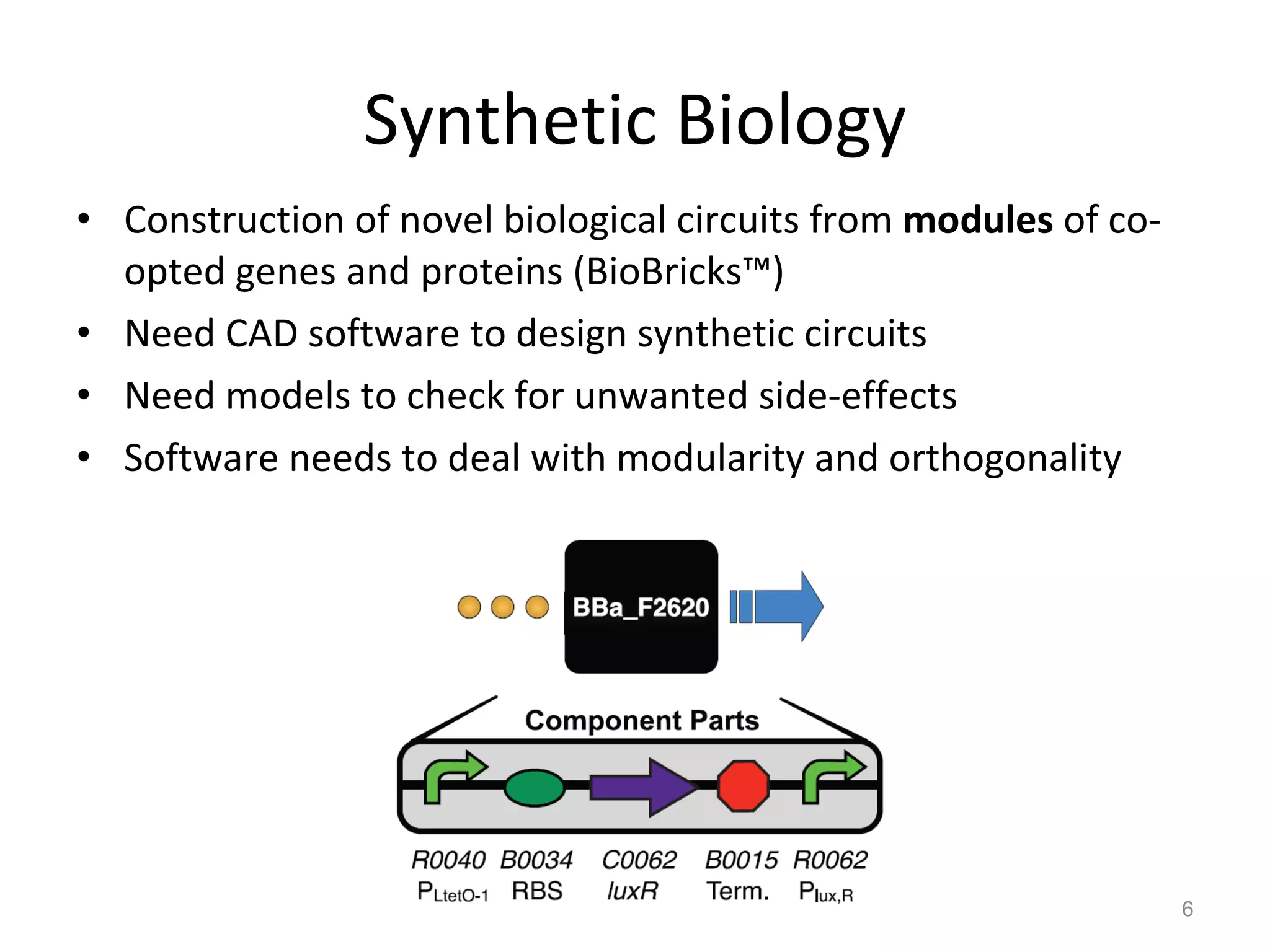
Synthetic Biology Construction of novel biological circuits from  modules  of co-opted genes and proteins (BioBricks ™ )  Need CAD software to design synthetic circuits Need models to check for unwanted side-effects Software needs to deal with modularity and orthogonality
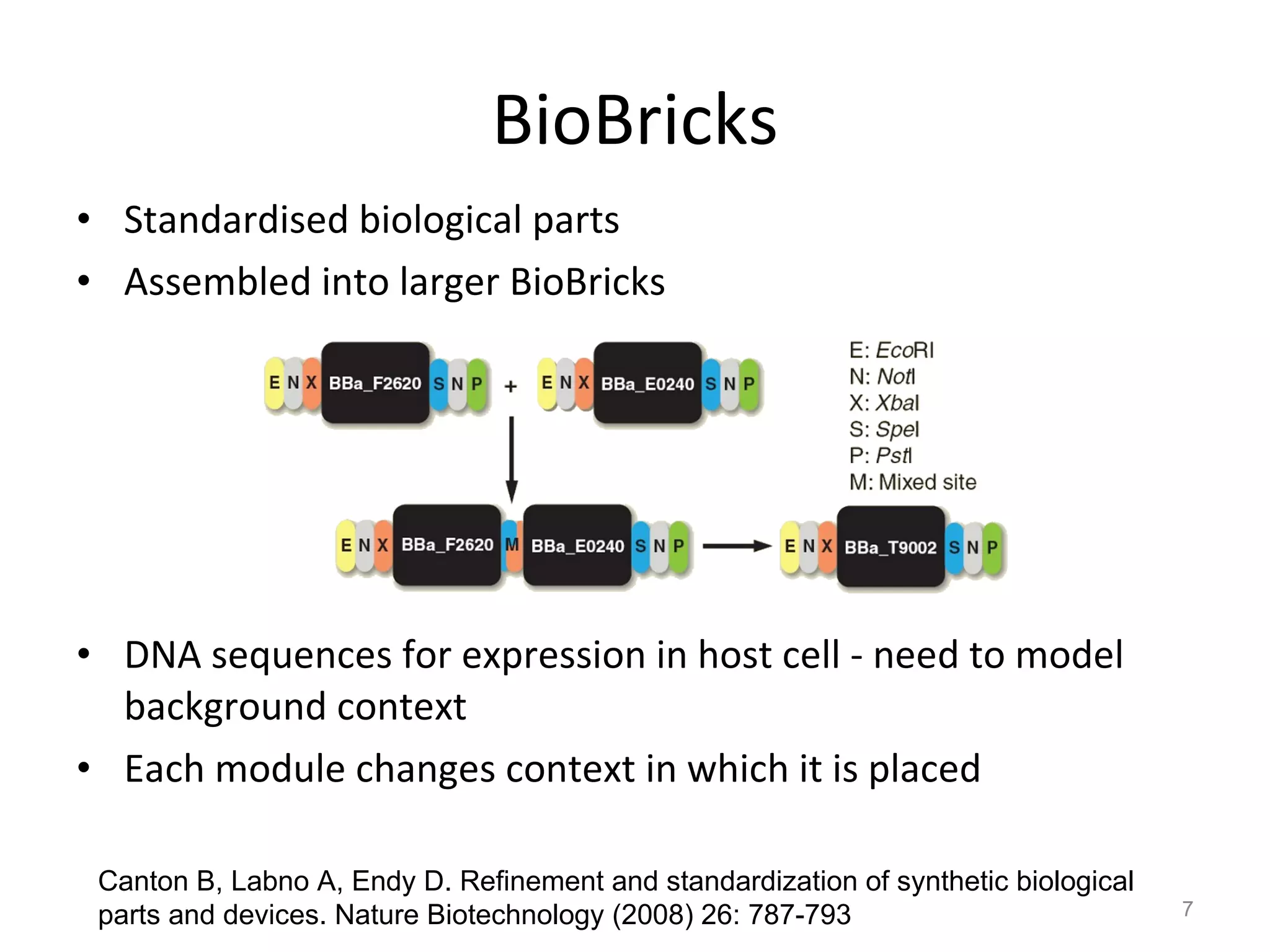
BioBricks Standardised biological parts Assembled into larger BioBricks DNA sequences for expression in host cell - need to model background context Each module changes context in which it is placed Canton B, Labno A, Endy D. Refinement and standardization of synthetic biological  parts and devices. Nature Biotechnology (2008) 26: 787-793
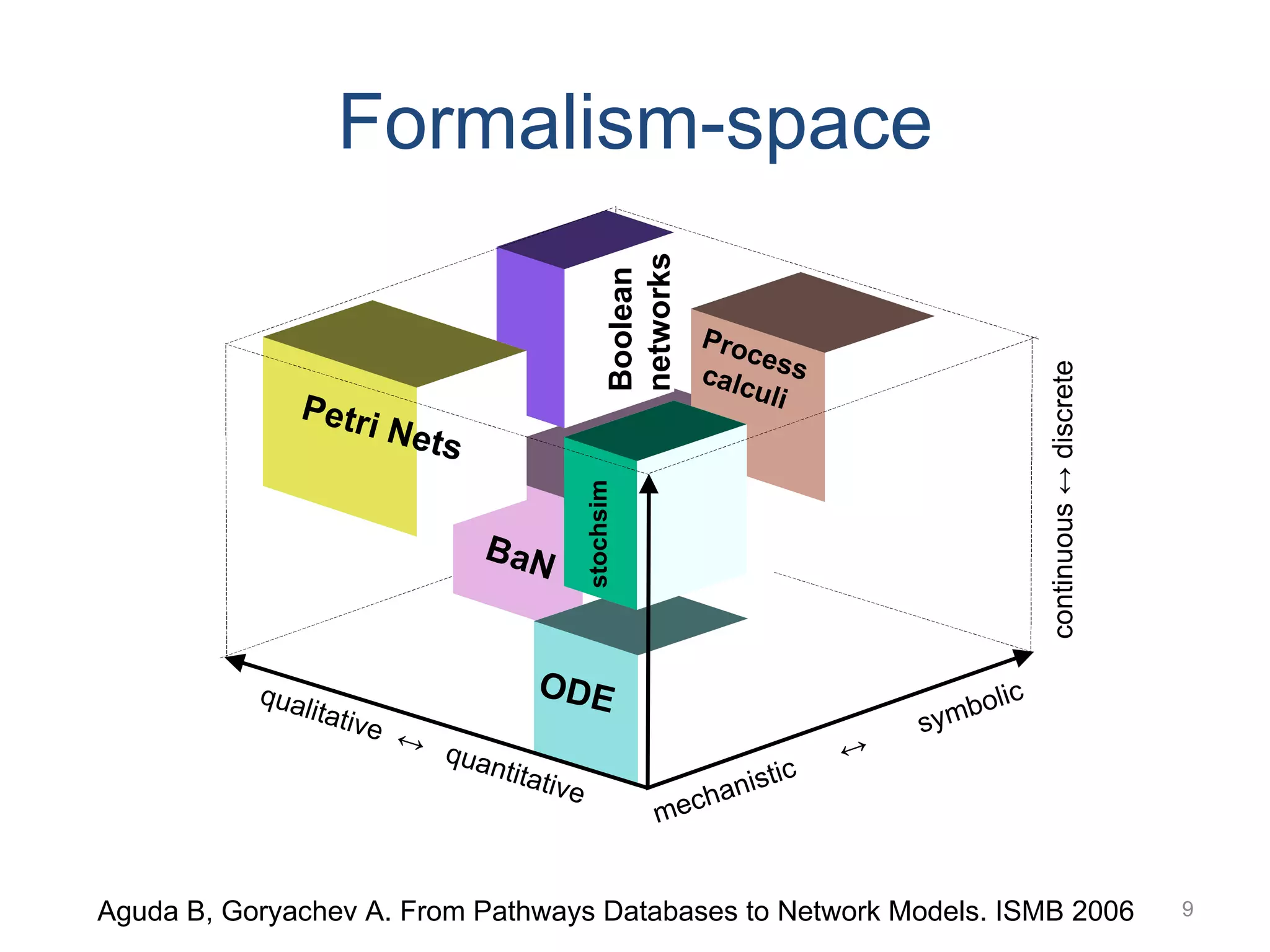
Modelling formalisms To run simulations we first need to make computer ‘understand’ gene synthesis and regulation, diffusion, cell division, movement and death. Modelling formalism need to be an unambiguous, formal description of cellular processes. Choice of formalism determines the systems that be modelled as well as the scale and realism of the models
Aguda B, Goryachev A. From Pathways Databases to Network Models. ISMB 2006 Formalism-space qualitative  ↔   quantitative continuous  ↔  discrete mechanistic  ↔   symbolic ODE  stochsim Petri Nets Boolean networks Process calculi BaN
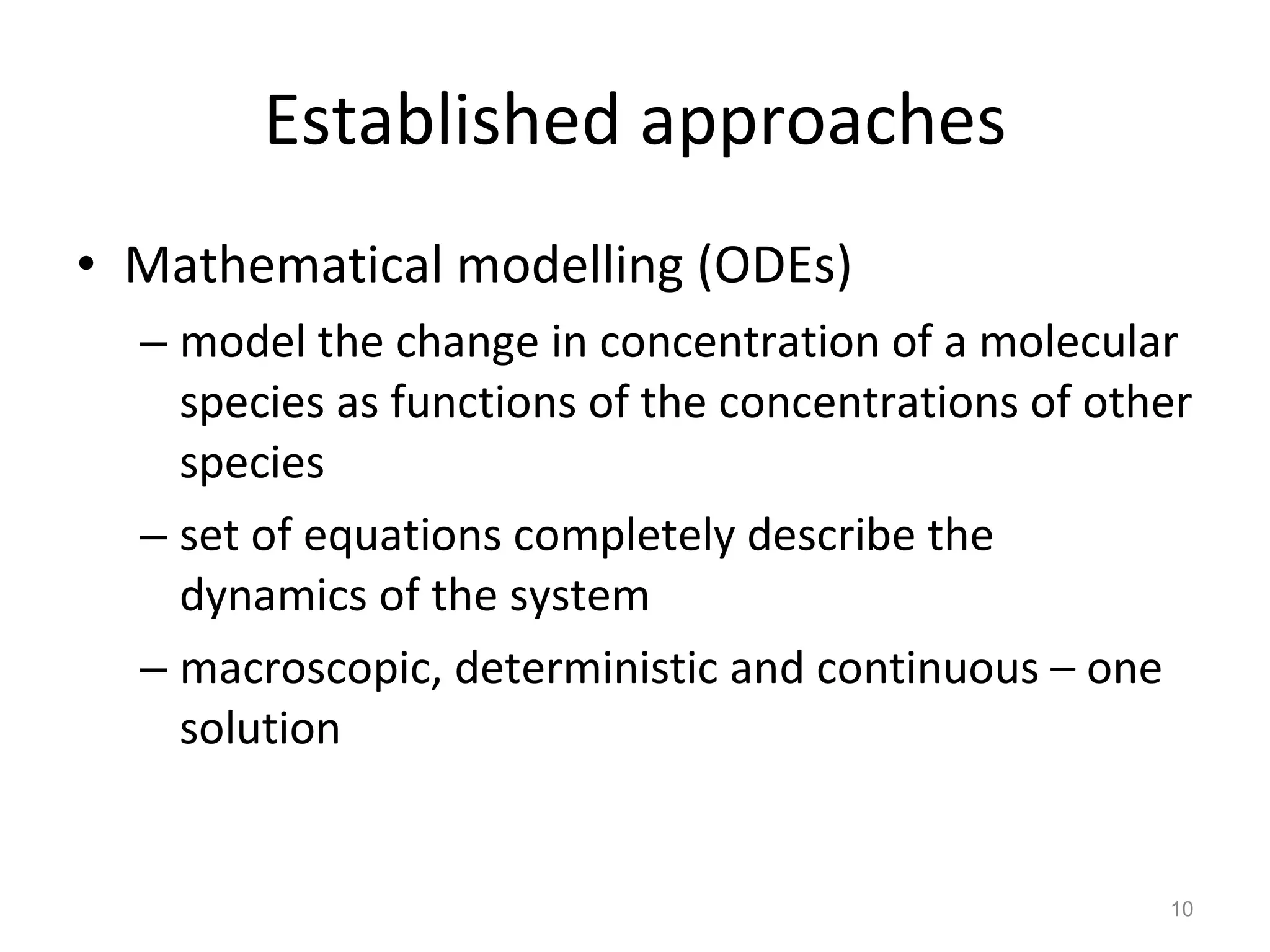
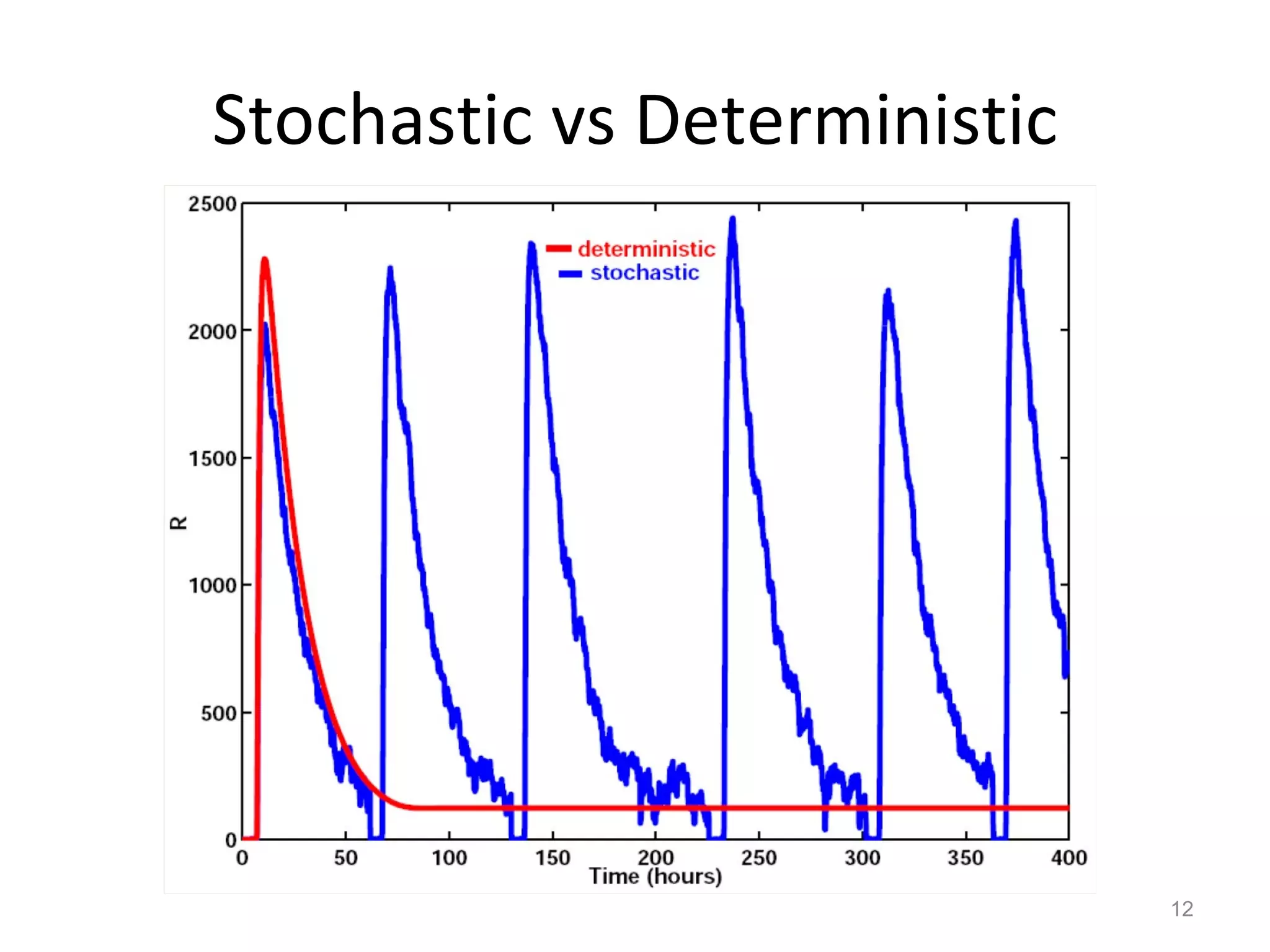
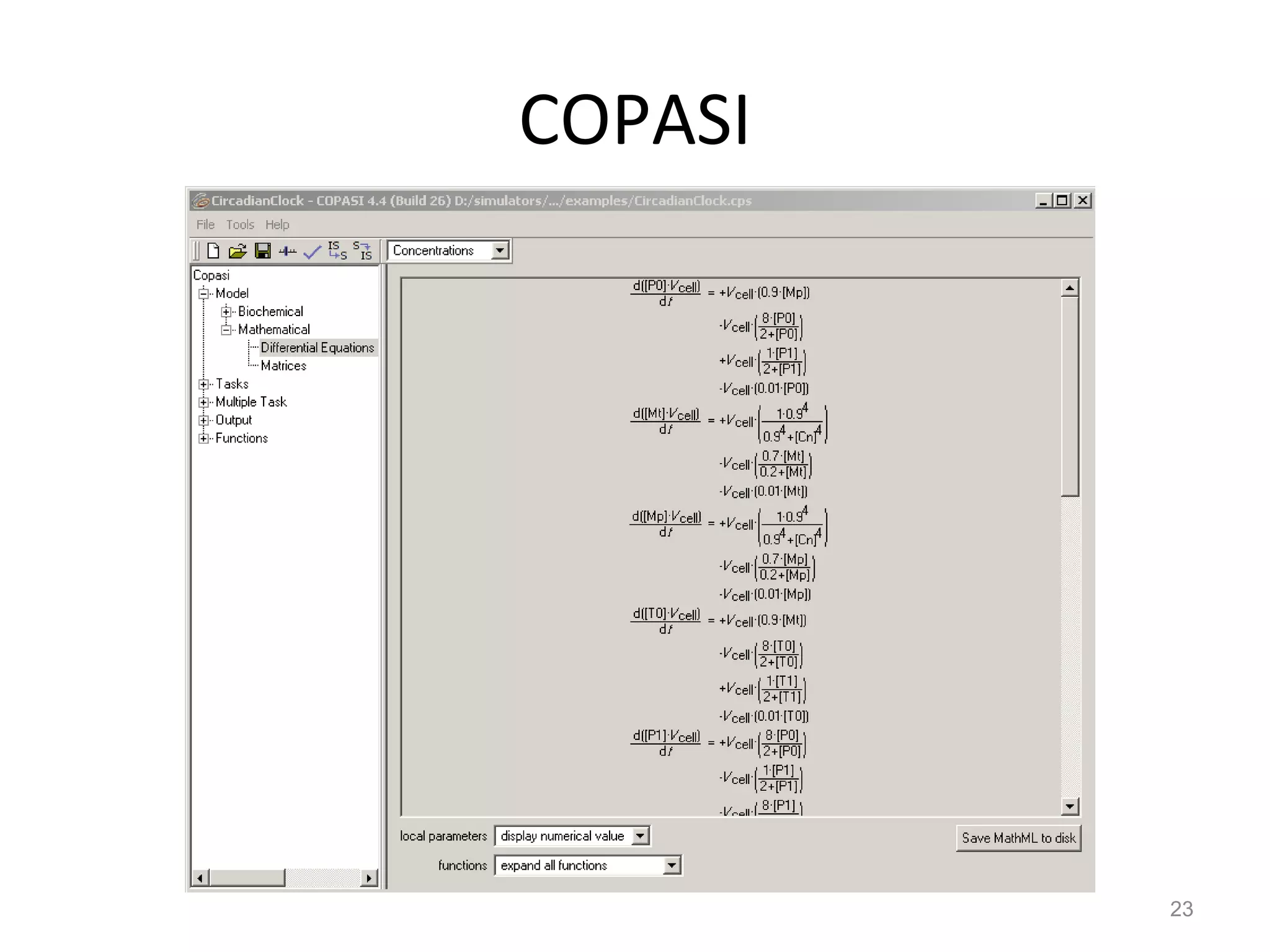
Established approaches Mathematical modelling (ODEs) model the change in concentration of a molecular species as functions of the concentrations of other species set of equations completely describe the dynamics of the system macroscopic, deterministic and continuous – one solution
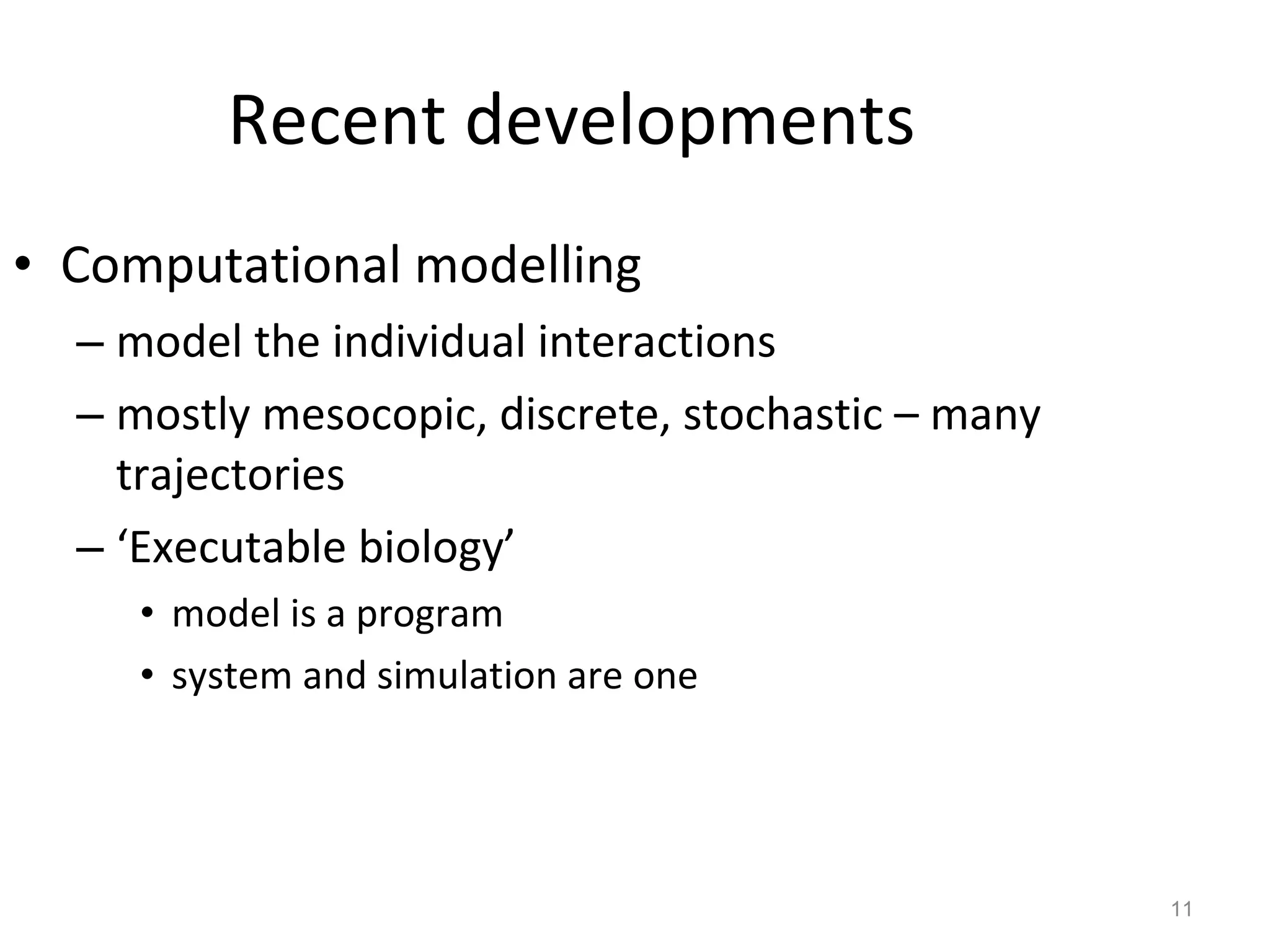
Recent developments Computational modelling model the individual interactions  mostly mesocopic, discrete, stochastic – many trajectories ‘ Executable biology’ model is a program system and simulation are one
Stochastic vs Deterministic 1 10 100
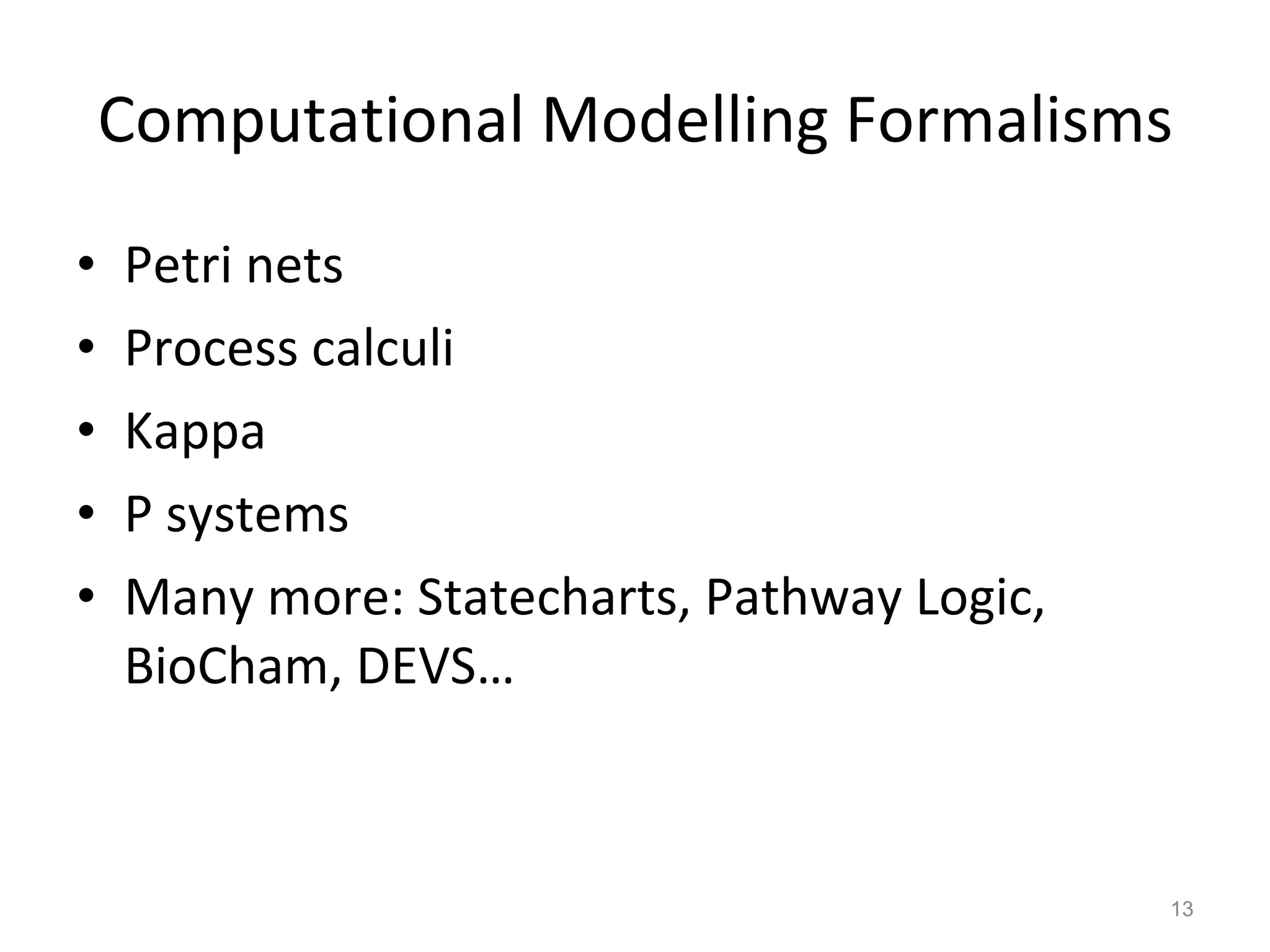
Computational Modelling Formalisms Petri nets Process calculi Kappa P systems Many more: Statecharts, Pathway Logic, BioCham, DEVS…
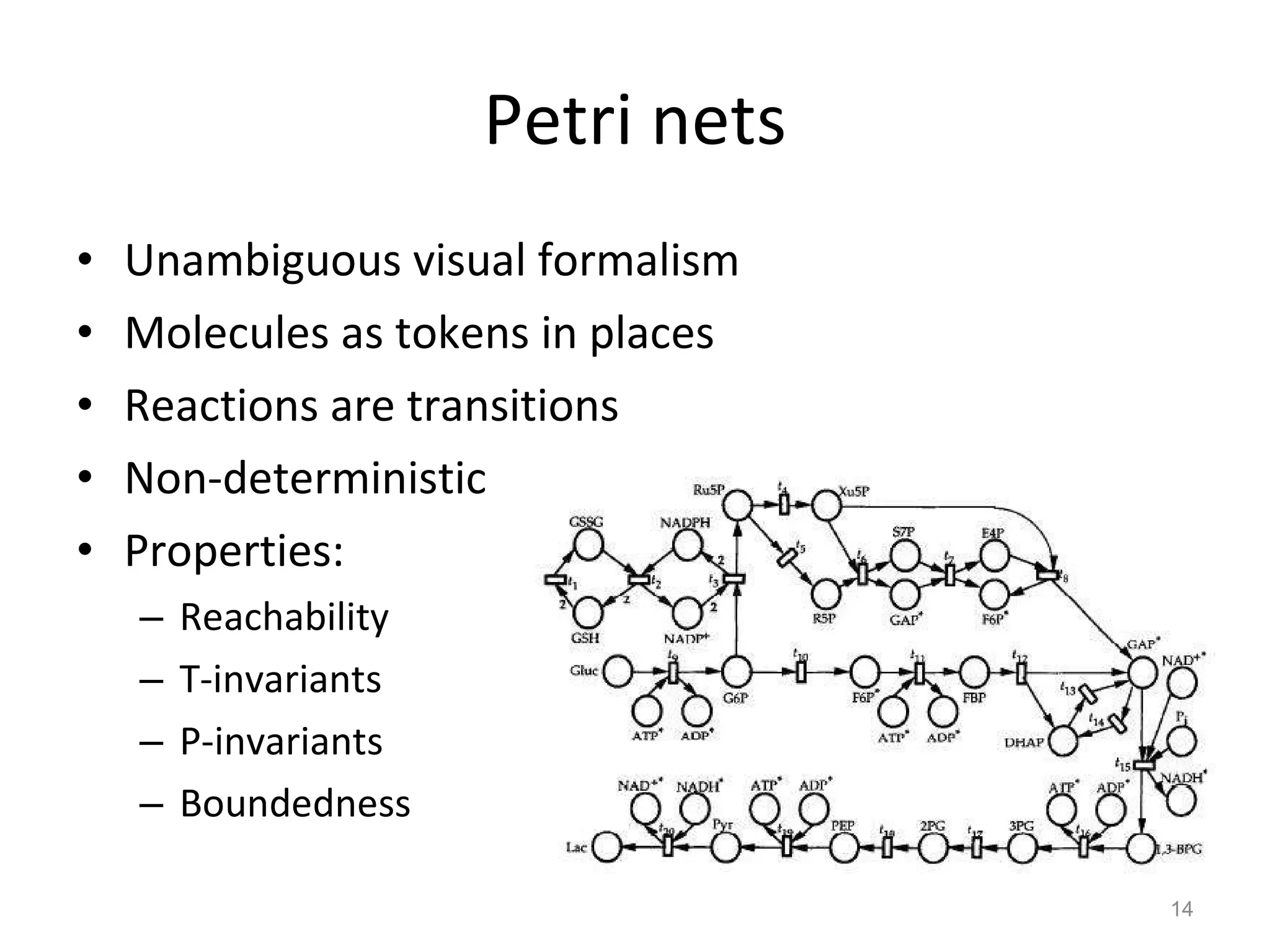
Petri nets Unambiguous visual formalism Molecules as tokens in places Reactions are transitions Non-deterministic Properties: Reachability T-invariants P-invariants Boundedness
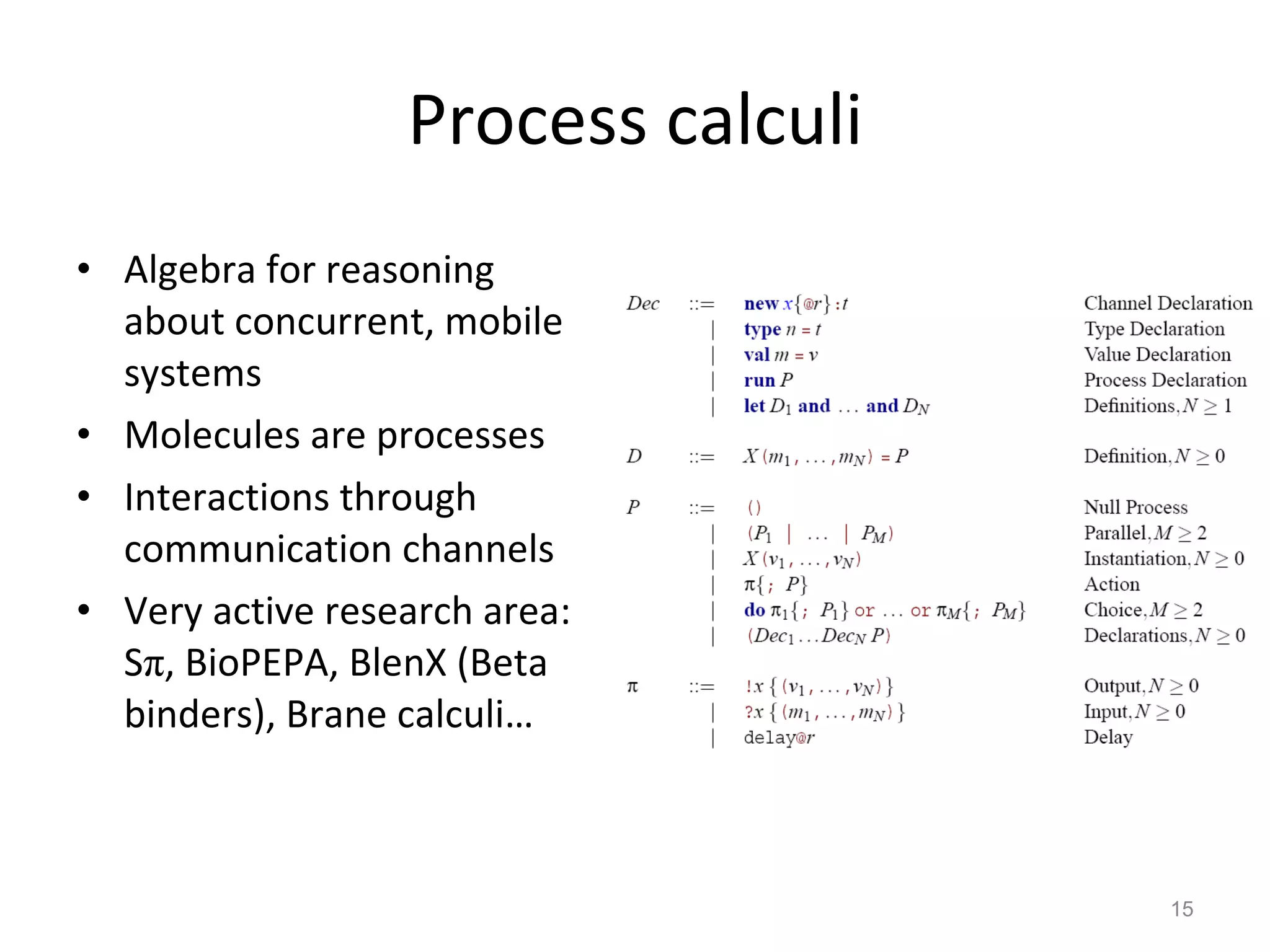
Process calculi Algebra for reasoning about concurrent, mobile systems Molecules are processes Interactions through communication channels Very active research area: S π , BioPEPA, BlenX (Beta binders), Brane calculi…
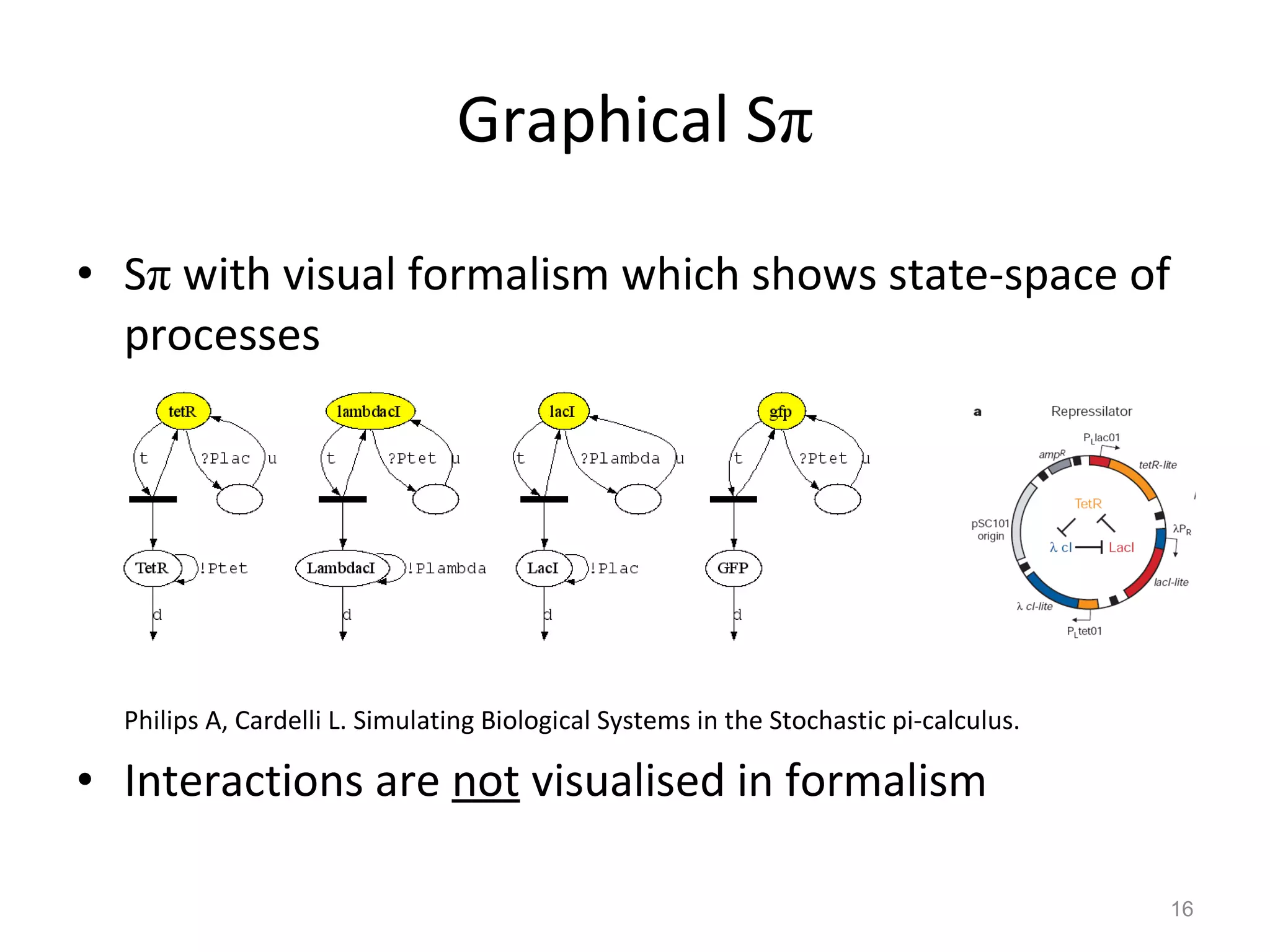
Graphical S π S π  with visual formalism which shows state-space of processes Philips A, Cardelli L. Simulating Biological Systems in the Stochastic pi-calculus. Interactions are  not  visualised in formalism
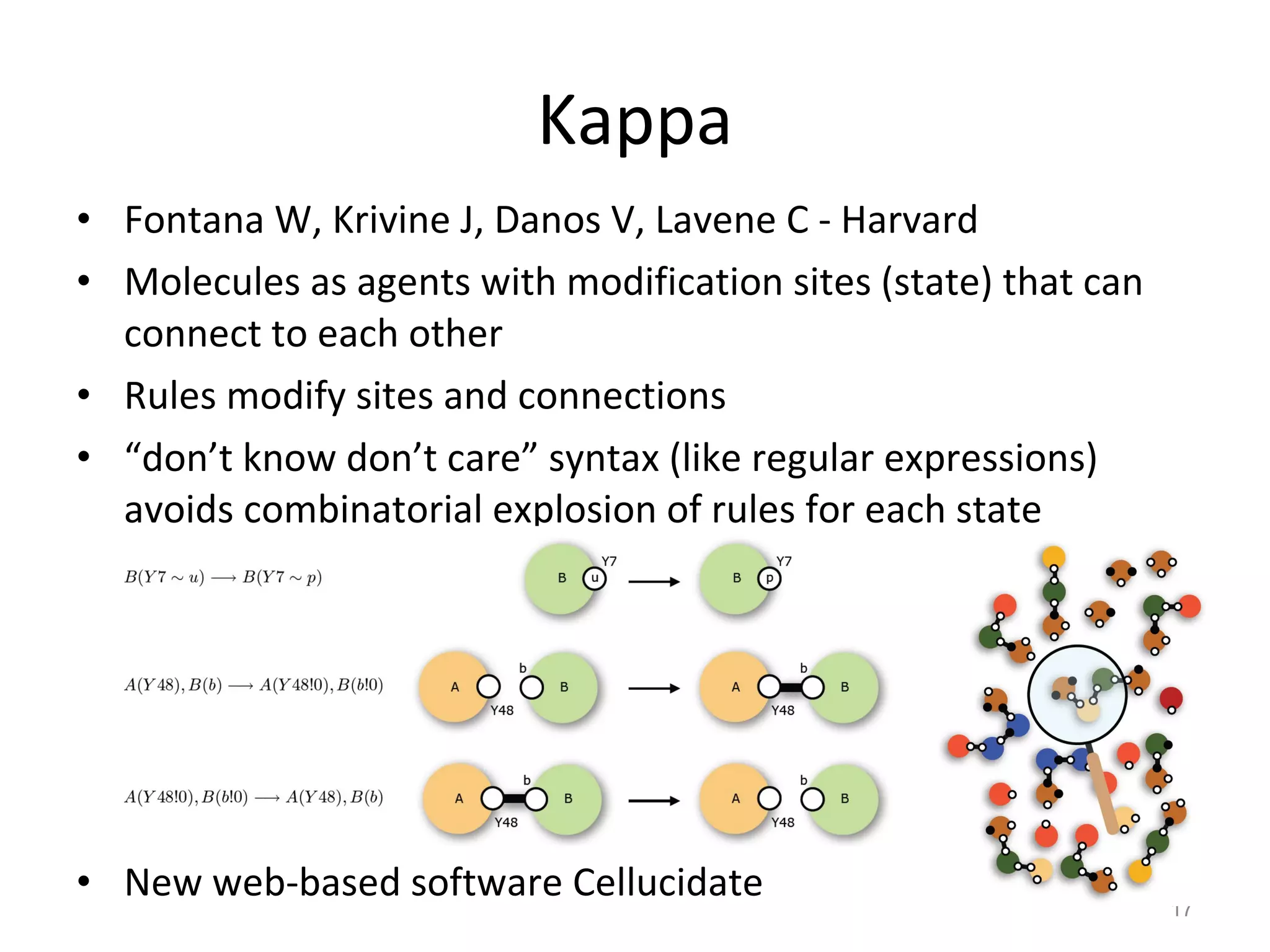
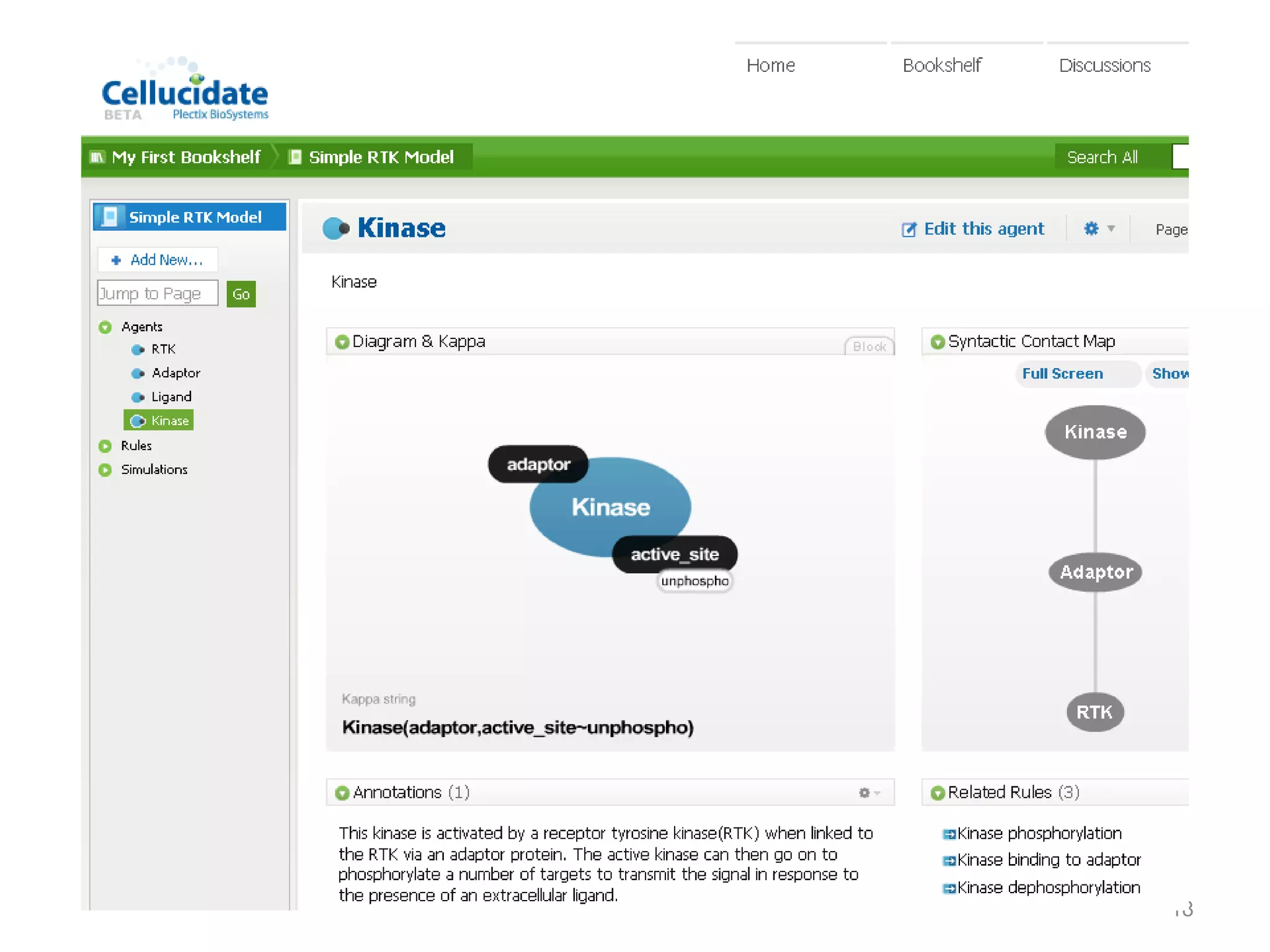
Kappa Fontana W, Krivine J, Danos V, Lavene C - Harvard Molecules as agents with modification sites (state) that can connect to each other Rules modify sites and connections “ don’t know don’t care” syntax (like regular expressions) avoids combinatorial explosion of rules for each state New web-based software Cellucidate
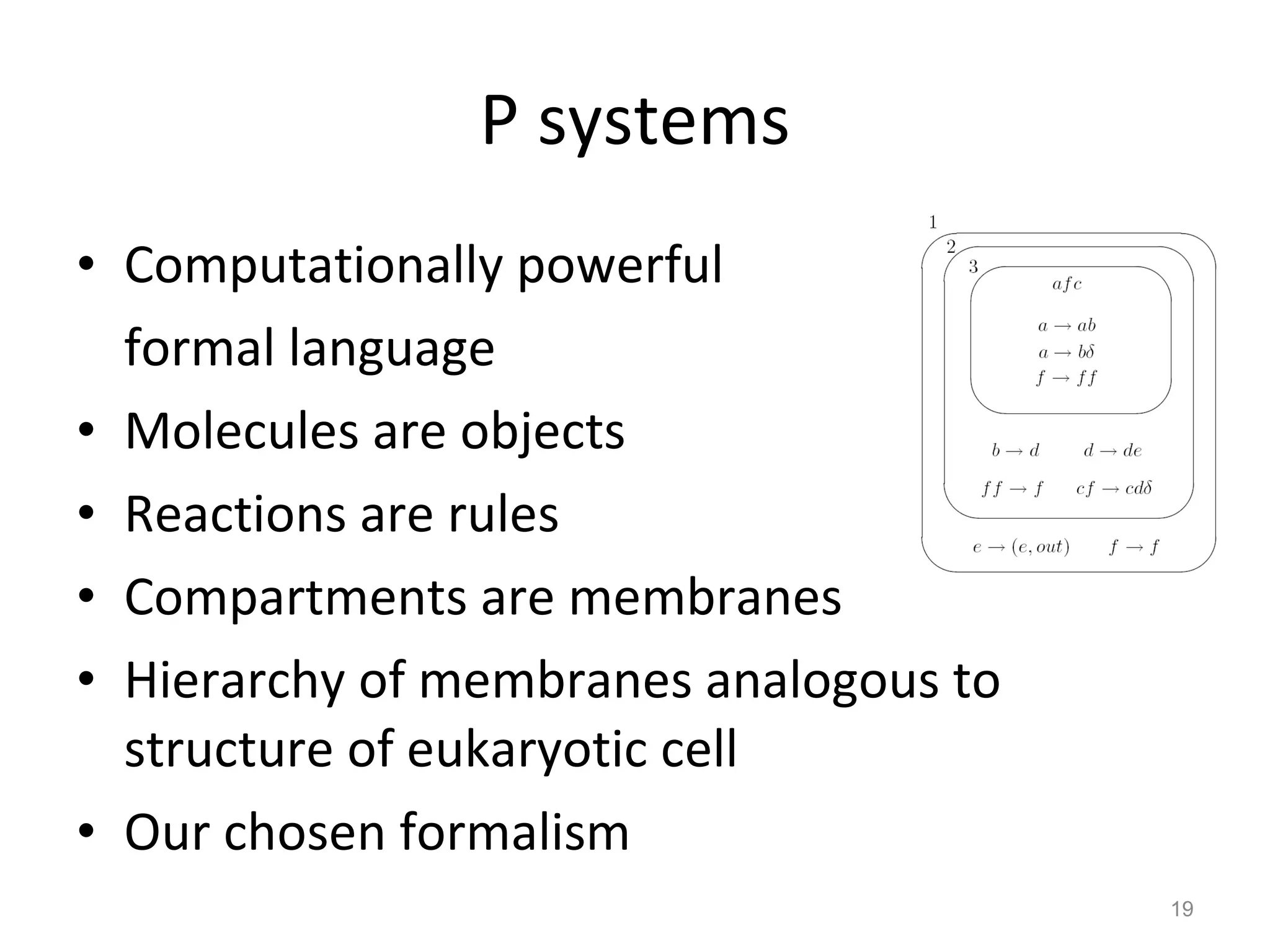
P systems Computationally powerful  formal language Molecules are objects Reactions are rules Compartments are membranes Hierarchy of membranes analogous to structure of eukaryotic cell Our chosen formalism
Cellular automata Well studied computational devices Simple rules lead to emergent phenomena Discrete notion of space Highly parallel
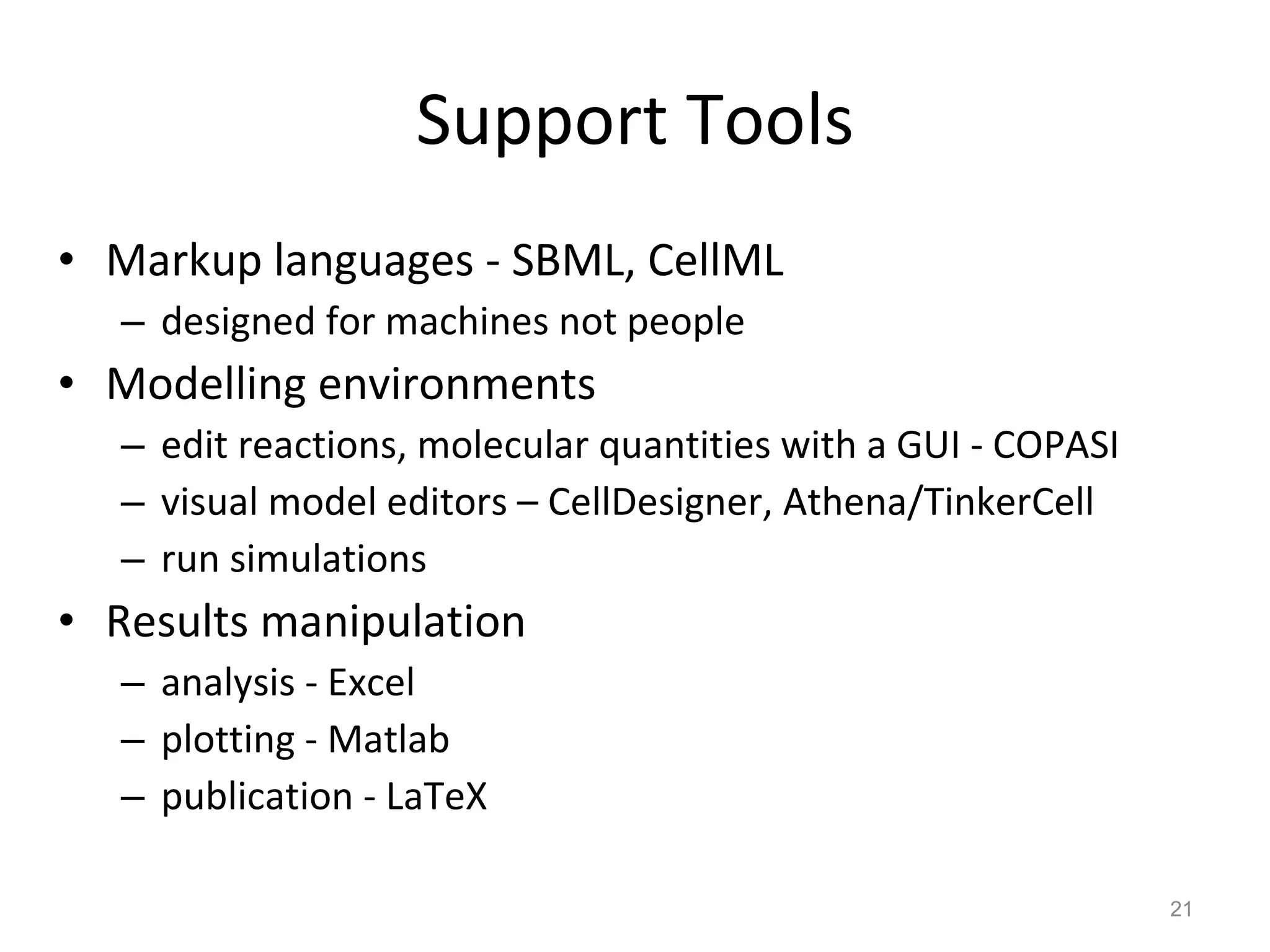
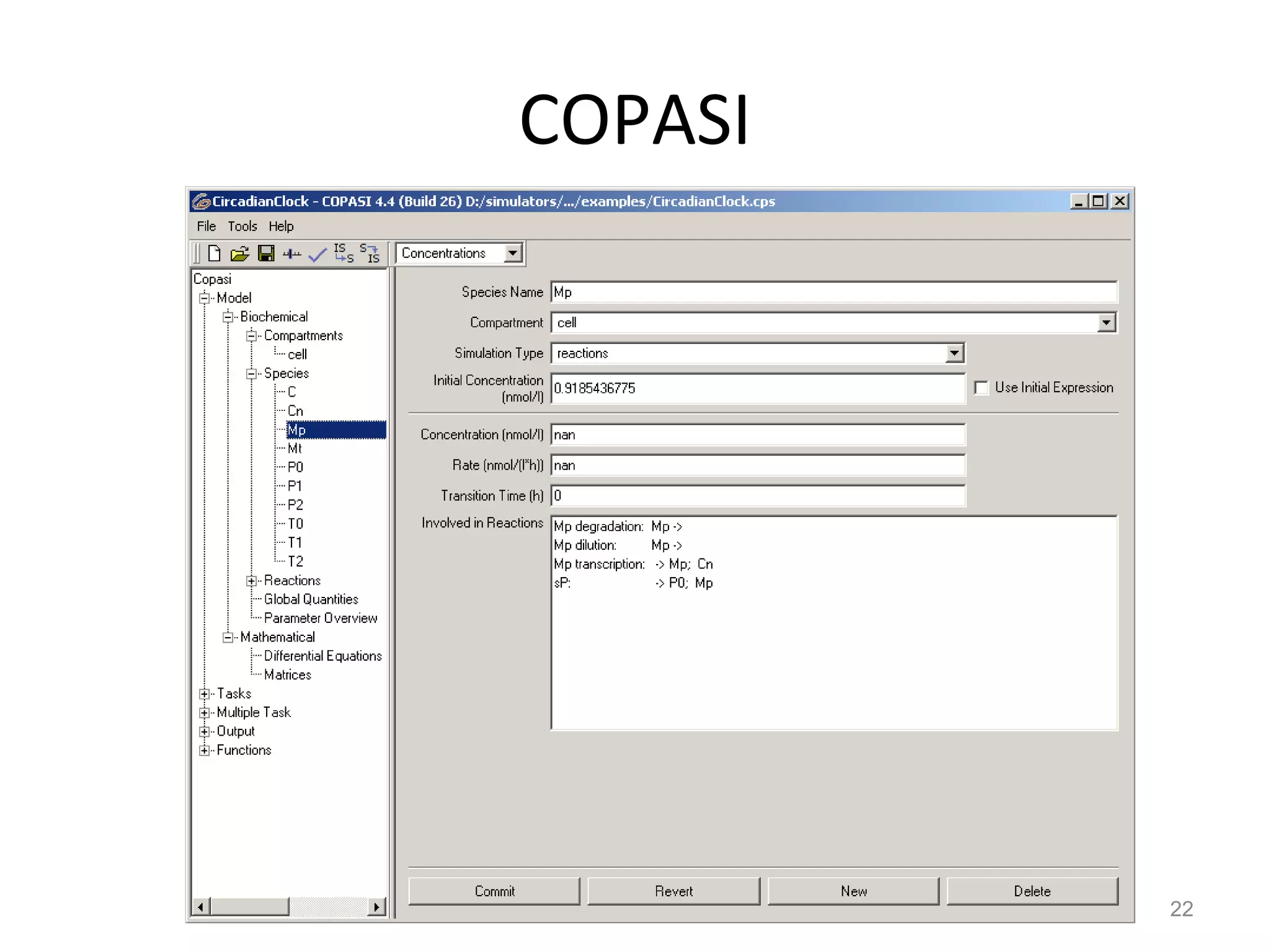
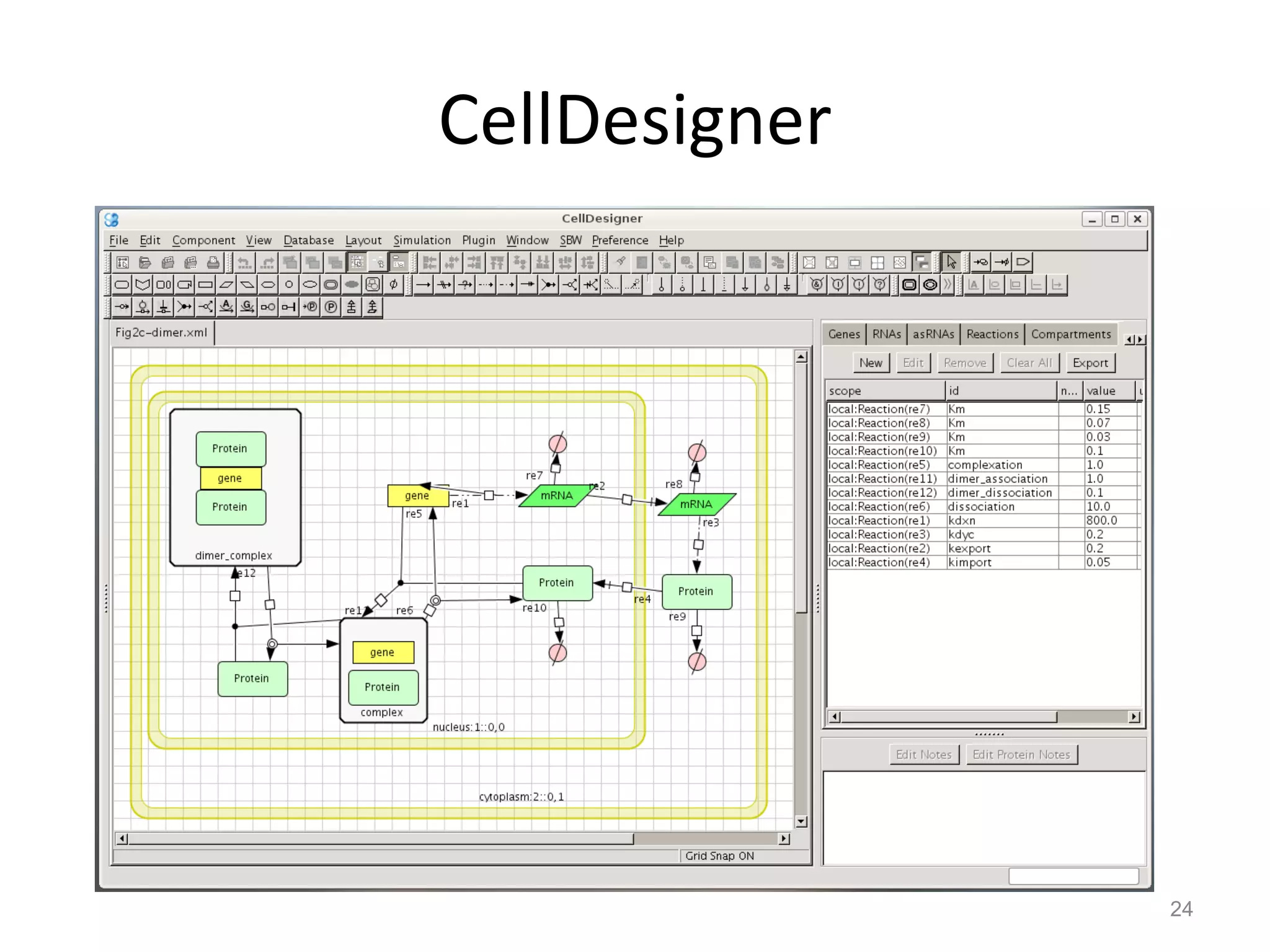
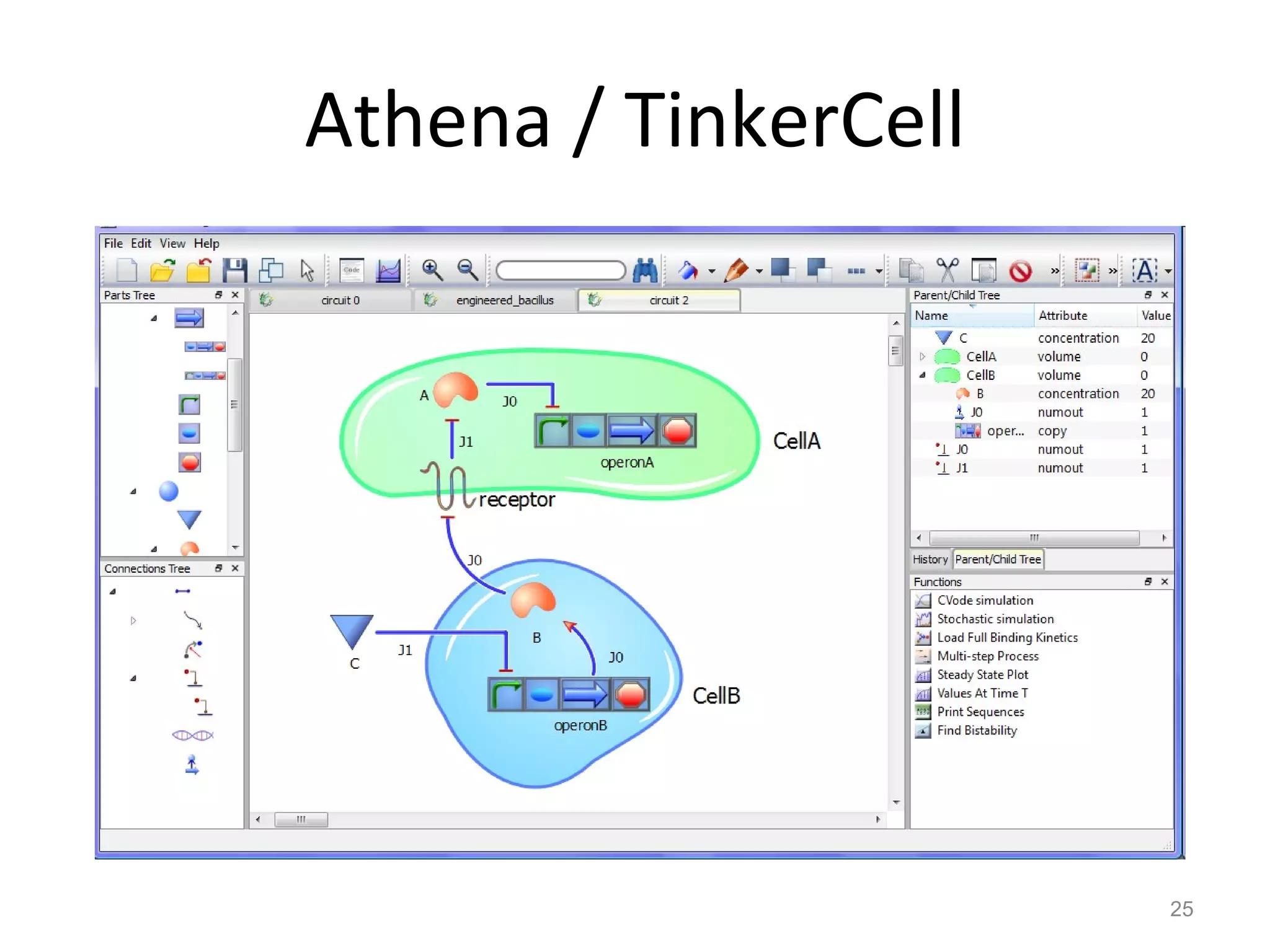
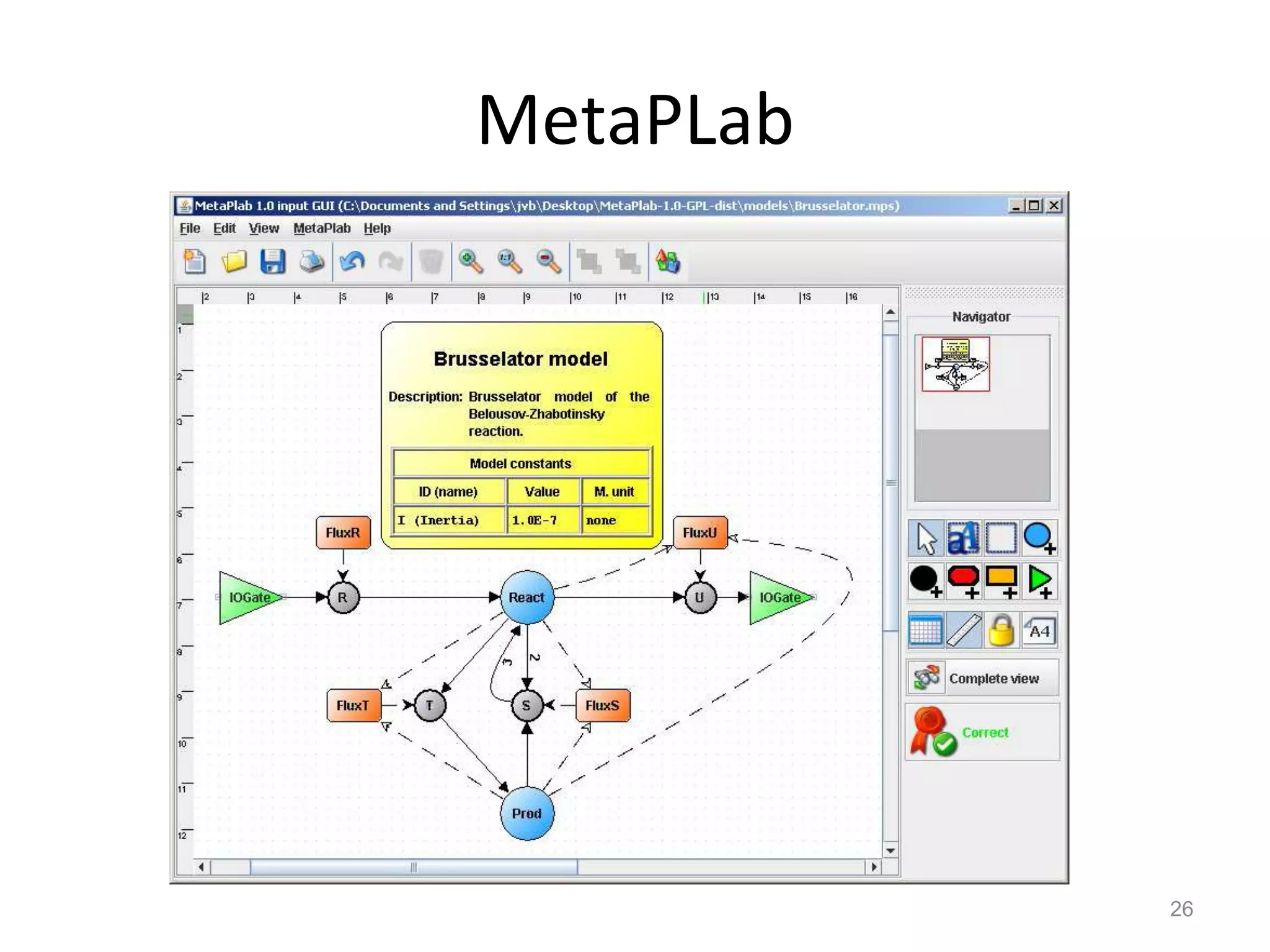
Support Tools Markup languages - SBML, CellML designed for machines not people Modelling environments edit reactions, molecular quantities with a GUI - COPASI visual model editors – CellDesigner, Athena/TinkerCell run simulations Results manipulation analysis - Excel plotting - Matlab publication - LaTeX
COPASI
COPASI
CellDesigner
Athena / TinkerCell
MetaPLab
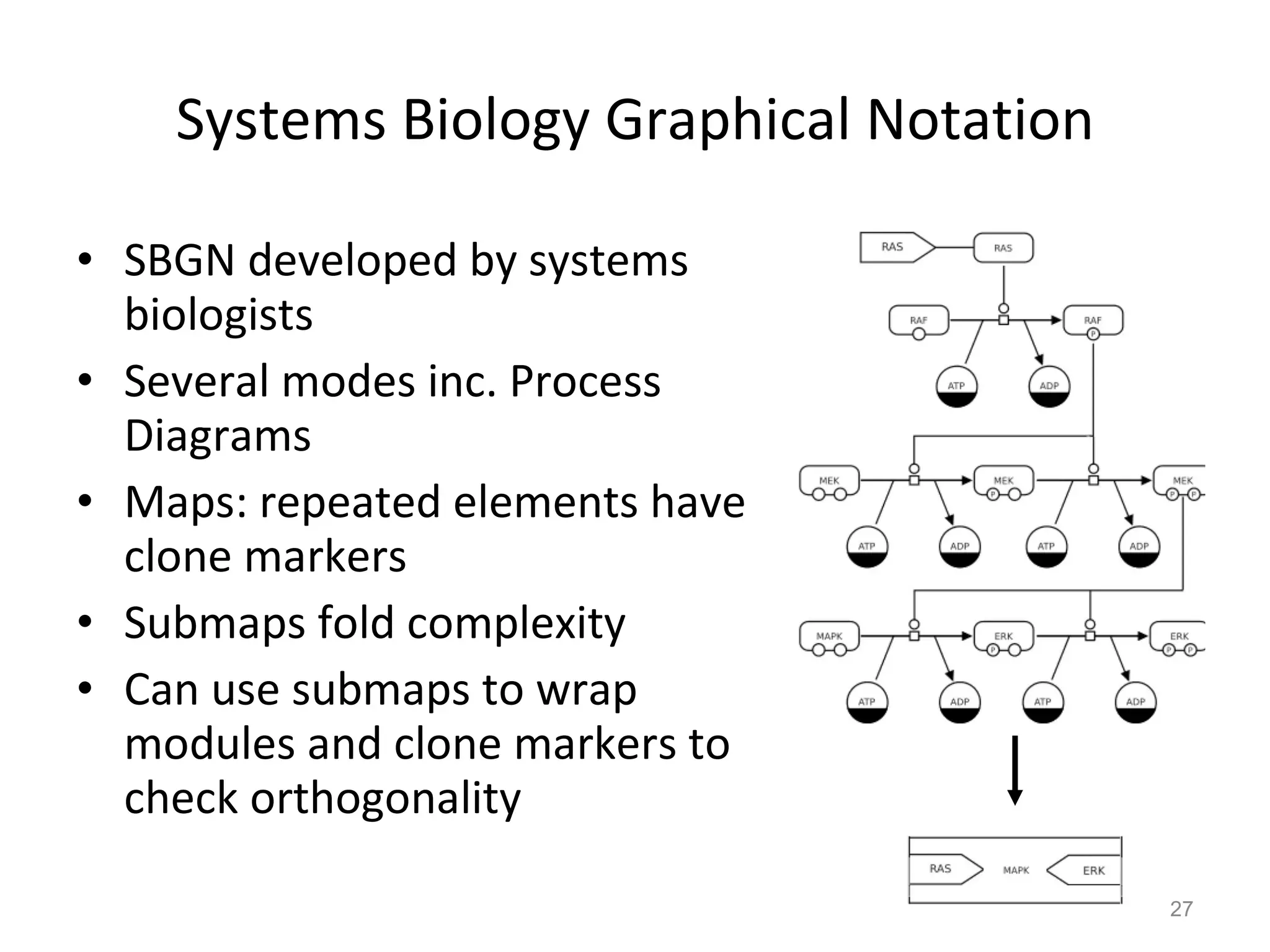
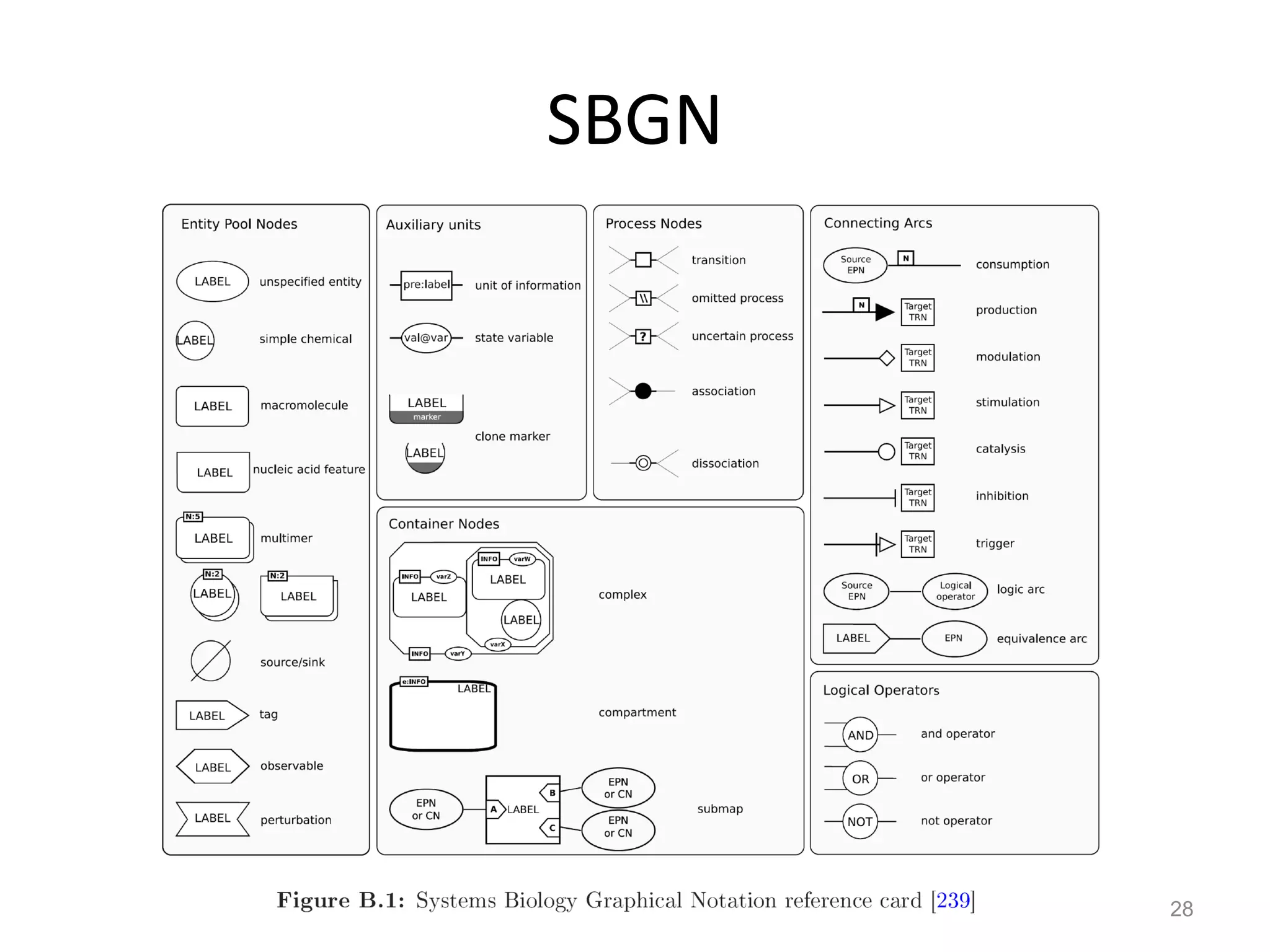
Systems Biology Graphical Notation SBGN developed by systems biologists Several modes inc. Process Diagrams Maps: repeated elements have clone markers Submaps fold complexity Can use submaps to wrap modules and clone markers to check orthogonality
SBGN
Goals for a new tool Layer of abstraction between modeller and formalism: SBGN editor  ↔ GUI editor -> P system Perform ‘experiments’ not just simulations Easy access to results Build other features around this Parameter optimisation Model checking Provide model background (minimal metabolism and expression machinery as proof of concept)
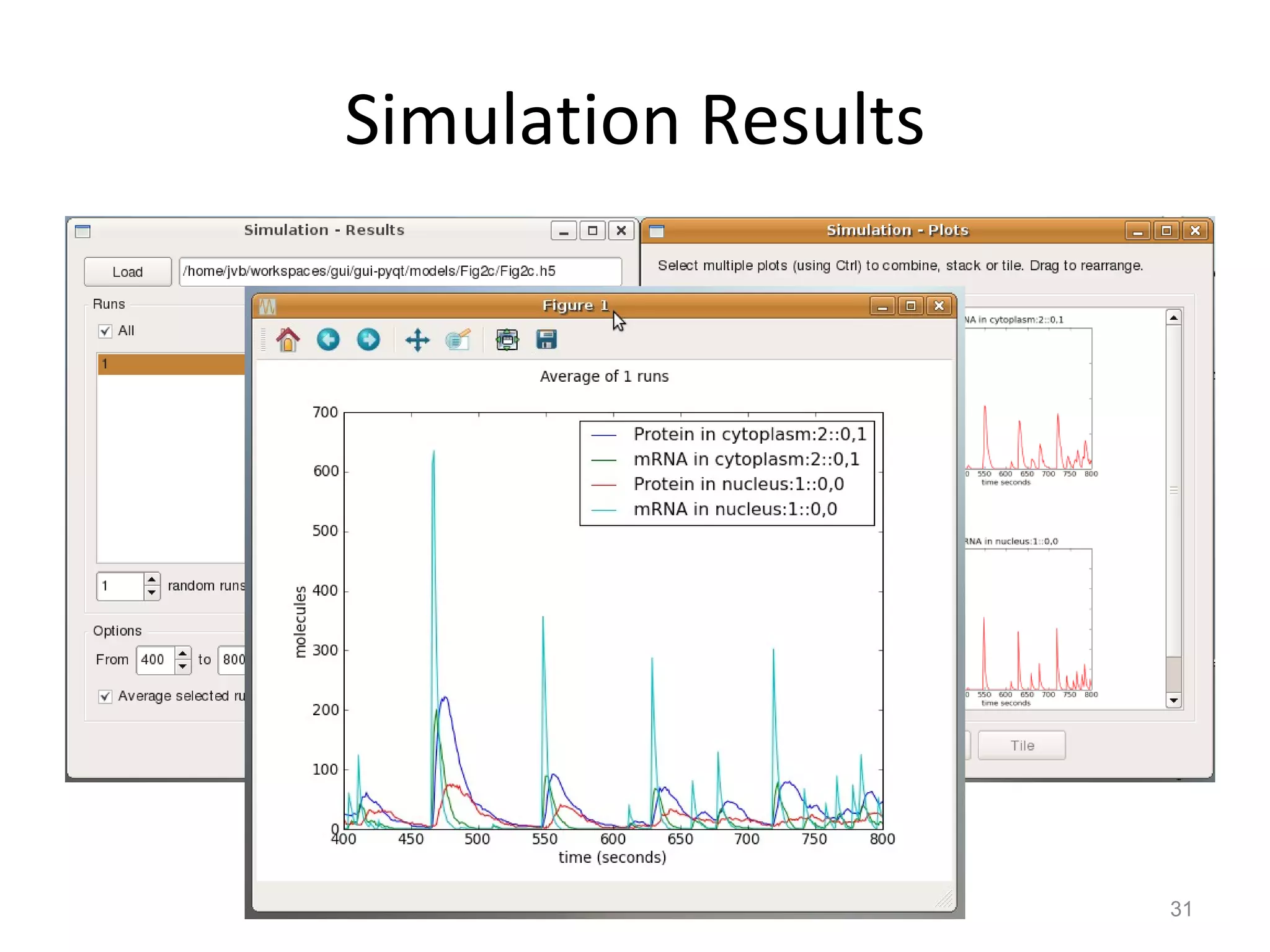
Implementation PyQt – Python bindings to C++ GUI framework Qt by Trolltech (Nokia) Matplotlib – plotting in Python PyTables – Python HDF5 interface JHotDraw – diagram editing framework by Design Pattern’s guru Erich Gamma
Simulation Results
Conclusions Modelling is part science and part art Models need rigorous foundation Modellers need helpful software Existing tools in various states of readiness Model building should be intrinsic to practice of biology in the laboratory Computer scientists job to faciliate biologists modelling
Acknowledgements Infobiotics team Dr. Natalio Krasnogor (supervisor) Dr. Francisco Romero Campero Dr. Hongqing Cao  Dr. Jamie Twycross Programmers James Smaldon Pawel Widera
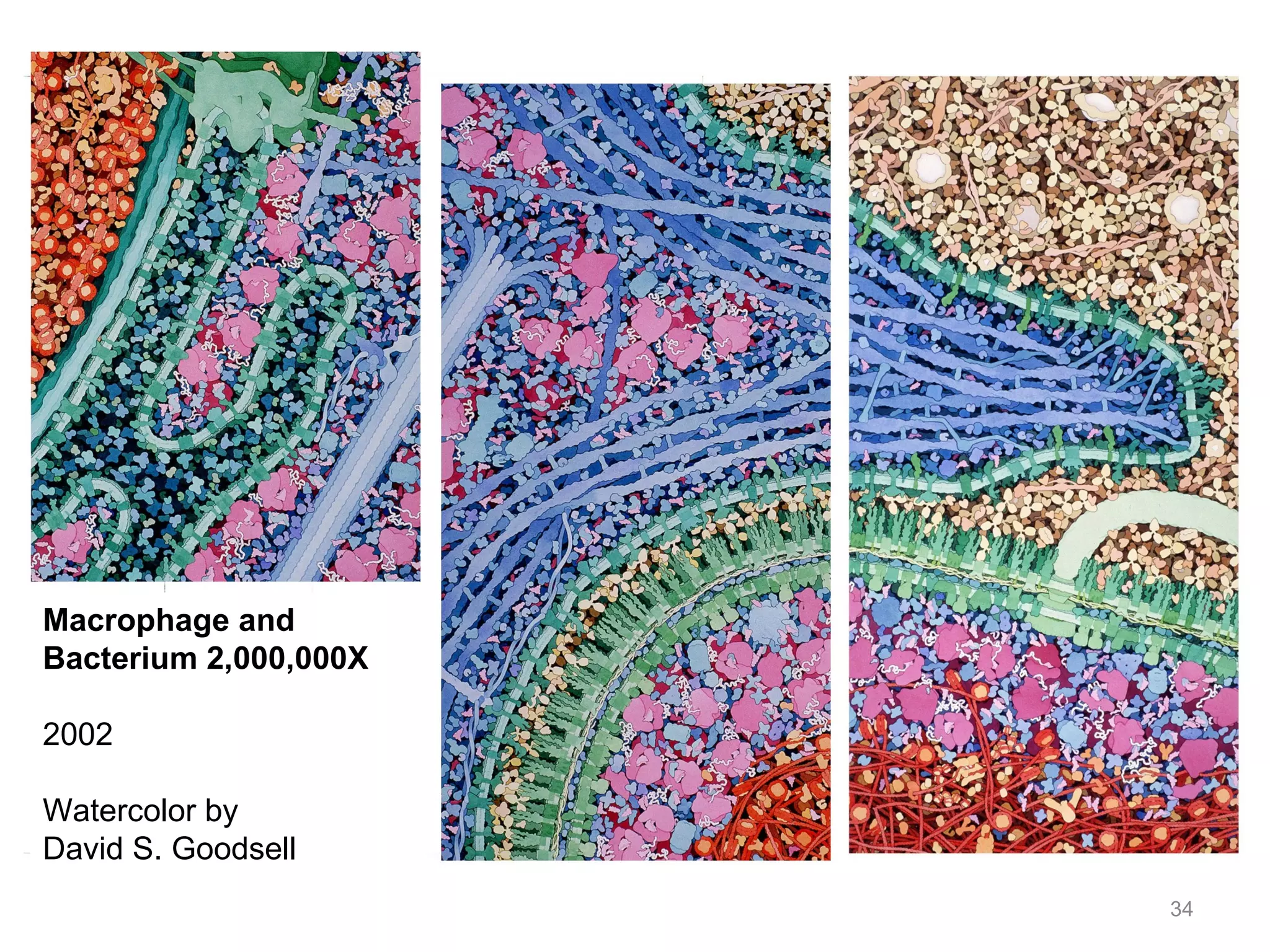
Macrophage and Bacterium 2,000,000X 2002 Watercolor by  David S. Goodsell

20090219 The case for another systems biology modelling environment

  • 1.
    The case for another systems biology modelling environment Jonathan Blakes 19/2/2009 ASAP seminar
  • 2.
    Abstract Systems biologyis a growing interdisciplinary field that aims understand the normal and abnormal functioning of organisms by modelling the relationships between molecular species in living cells. There is a large body of software, often developed in academia, to assist with the building and simulation of such models. This talk will give an overview of recent computational modelling approaches in systems biology and the associated software landscape. It presents the case for the development of a new modelling environment aims to improve the user experience of biologists by making models easier to build and to refine, while increasing the complexity of and scales over which models can be built.
  • 3.
    Outline Problem domainSystems Biology Synthetic Biology Modelling formalisms Existing software Room for improvement Implementation Conclusions
  • 4.
    Systems Biology Awealth of knowledge from molecular biology and Omics projects We know the components, their interactions and locations (partially) Desire to integrate this knowledge Networks of molecular interactions operate over large scales - picoseconds to days, nanometers to meters – to produce complex phenotypes Truly interdisciplinary field
  • 5.
    Systems Biology Simulatebiochemical reactions and observe dynamics in time and space Obtain results that are comparable with laboratory observations Look “under the hood” and trace individual molecules Test hypotheses quickly in silico
  • 6.
    Synthetic Biology Constructionof novel biological circuits from modules of co-opted genes and proteins (BioBricks ™ ) Need CAD software to design synthetic circuits Need models to check for unwanted side-effects Software needs to deal with modularity and orthogonality
  • 7.
    BioBricks Standardised biologicalparts Assembled into larger BioBricks DNA sequences for expression in host cell - need to model background context Each module changes context in which it is placed Canton B, Labno A, Endy D. Refinement and standardization of synthetic biological parts and devices. Nature Biotechnology (2008) 26: 787-793
  • 8.
    Modelling formalisms Torun simulations we first need to make computer ‘understand’ gene synthesis and regulation, diffusion, cell division, movement and death. Modelling formalism need to be an unambiguous, formal description of cellular processes. Choice of formalism determines the systems that be modelled as well as the scale and realism of the models
  • 9.
    Aguda B, GoryachevA. From Pathways Databases to Network Models. ISMB 2006 Formalism-space qualitative ↔ quantitative continuous ↔ discrete mechanistic ↔ symbolic ODE stochsim Petri Nets Boolean networks Process calculi BaN
  • 10.
    Established approaches Mathematicalmodelling (ODEs) model the change in concentration of a molecular species as functions of the concentrations of other species set of equations completely describe the dynamics of the system macroscopic, deterministic and continuous – one solution
  • 11.
    Recent developments Computationalmodelling model the individual interactions mostly mesocopic, discrete, stochastic – many trajectories ‘ Executable biology’ model is a program system and simulation are one
  • 12.
  • 13.
    Computational Modelling FormalismsPetri nets Process calculi Kappa P systems Many more: Statecharts, Pathway Logic, BioCham, DEVS…
  • 14.
    Petri nets Unambiguousvisual formalism Molecules as tokens in places Reactions are transitions Non-deterministic Properties: Reachability T-invariants P-invariants Boundedness
  • 15.
    Process calculi Algebrafor reasoning about concurrent, mobile systems Molecules are processes Interactions through communication channels Very active research area: S π , BioPEPA, BlenX (Beta binders), Brane calculi…
  • 16.
    Graphical S πS π with visual formalism which shows state-space of processes Philips A, Cardelli L. Simulating Biological Systems in the Stochastic pi-calculus. Interactions are not visualised in formalism
  • 17.
    Kappa Fontana W,Krivine J, Danos V, Lavene C - Harvard Molecules as agents with modification sites (state) that can connect to each other Rules modify sites and connections “ don’t know don’t care” syntax (like regular expressions) avoids combinatorial explosion of rules for each state New web-based software Cellucidate
  • 19.
    P systems Computationallypowerful formal language Molecules are objects Reactions are rules Compartments are membranes Hierarchy of membranes analogous to structure of eukaryotic cell Our chosen formalism
  • 20.
    Cellular automata Wellstudied computational devices Simple rules lead to emergent phenomena Discrete notion of space Highly parallel
  • 21.
    Support Tools Markuplanguages - SBML, CellML designed for machines not people Modelling environments edit reactions, molecular quantities with a GUI - COPASI visual model editors – CellDesigner, Athena/TinkerCell run simulations Results manipulation analysis - Excel plotting - Matlab publication - LaTeX
  • 22.
  • 23.
  • 24.
  • 25.
  • 26.
  • 27.
    Systems Biology GraphicalNotation SBGN developed by systems biologists Several modes inc. Process Diagrams Maps: repeated elements have clone markers Submaps fold complexity Can use submaps to wrap modules and clone markers to check orthogonality
  • 28.
  • 29.
    Goals for anew tool Layer of abstraction between modeller and formalism: SBGN editor ↔ GUI editor -> P system Perform ‘experiments’ not just simulations Easy access to results Build other features around this Parameter optimisation Model checking Provide model background (minimal metabolism and expression machinery as proof of concept)
  • 30.
    Implementation PyQt –Python bindings to C++ GUI framework Qt by Trolltech (Nokia) Matplotlib – plotting in Python PyTables – Python HDF5 interface JHotDraw – diagram editing framework by Design Pattern’s guru Erich Gamma
  • 31.
  • 32.
    Conclusions Modelling ispart science and part art Models need rigorous foundation Modellers need helpful software Existing tools in various states of readiness Model building should be intrinsic to practice of biology in the laboratory Computer scientists job to faciliate biologists modelling
  • 33.
    Acknowledgements Infobiotics teamDr. Natalio Krasnogor (supervisor) Dr. Francisco Romero Campero Dr. Hongqing Cao Dr. Jamie Twycross Programmers James Smaldon Pawel Widera
  • 34.
    Macrophage and Bacterium2,000,000X 2002 Watercolor by David S. Goodsell

Editor's Notes

  • #11 a set of equations that together completely describe the dynamics of the system small systems can be solved, larger systems simulated using Rutta-Kunge or other one output
  • #12 mescoscopic (a physics term), talking about individual molecules, not populations, but also not atoms
  • #21 mescoscopic (a physics term), talking about individual molecules, not populations, but also not atoms
  • #35 David S. Goodsell