Using Neural Networks and 3D sensors data to model 
LIBRAS gestures recognition 
Gabriel S. P Moreira - Gustavo R. Matuck - Osamu Saotome - Adilson M. da Cunha 
ITA – Brazilian Aeronautics Institute of Technology
Introduction 
 1,799,885 citizens in the country having great difficulty to hear 
(CENSUS 2010) 
 The Brazilian Signs Language (LIBRAS) is the sign language used 
by the majority of the deaf people 
 Second official language by the Brazilian courts, on laws 10.436 
(2002) and 5.626 (2005) 
 This research is an initial investigation of LIBRAS recognition 
using 3D sensors and neural networks
Related Research 
 Main approaches of hand tracking systems: 
 Data-glove-based - electromechanical gloves with sensors 
 Vision-based - continuous image frames from regular RGB or 3D sensors 
 Main machine learning techniques: 
 Artificial Neural Networks (ANN) 
 Hidden Markov Models (HMM) 
 Usage of HMM to recognize 47 Libras gestures types, captured with regular RGB 
cameras [Souza et al. 2007]. 
 3D hand and gesture recognition system using Microsoft Kinect sensor, for 
dynamic gestures, and HD color sensor, for static gestures recognition [Caputo et 
al. 2012] 
 A real-time system to recognize a set of Libras alphabet (only static gestures), 
using MS Kinect and neural networks [Anjo et al. 2012].
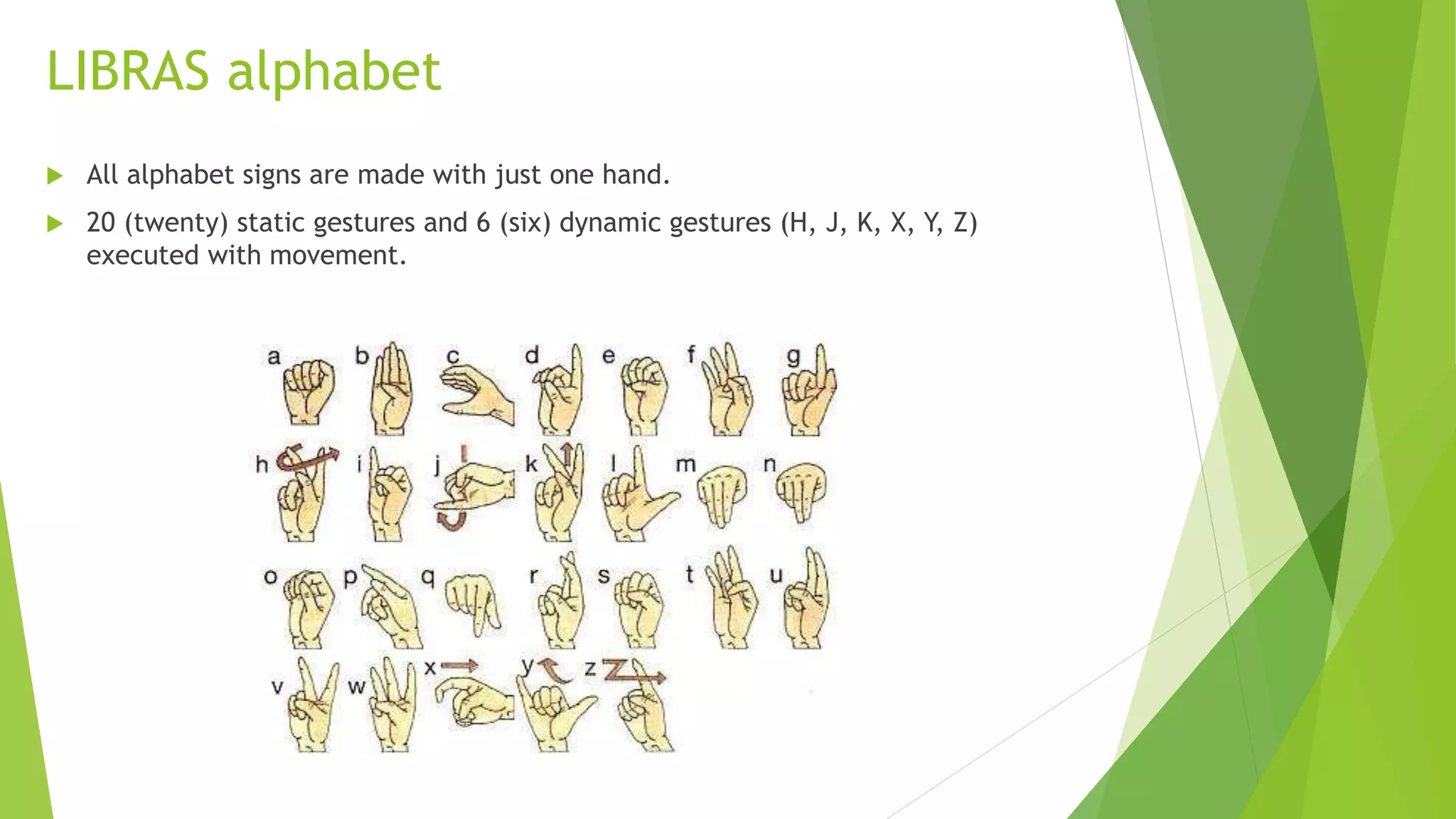
LIBRAS alphabet 
 All alphabet signs are made with just one hand. 
 20 (twenty) static gestures and 6 (six) dynamic gestures (H, J, K, X, Y, Z) 
executed with movement.
Case Study 
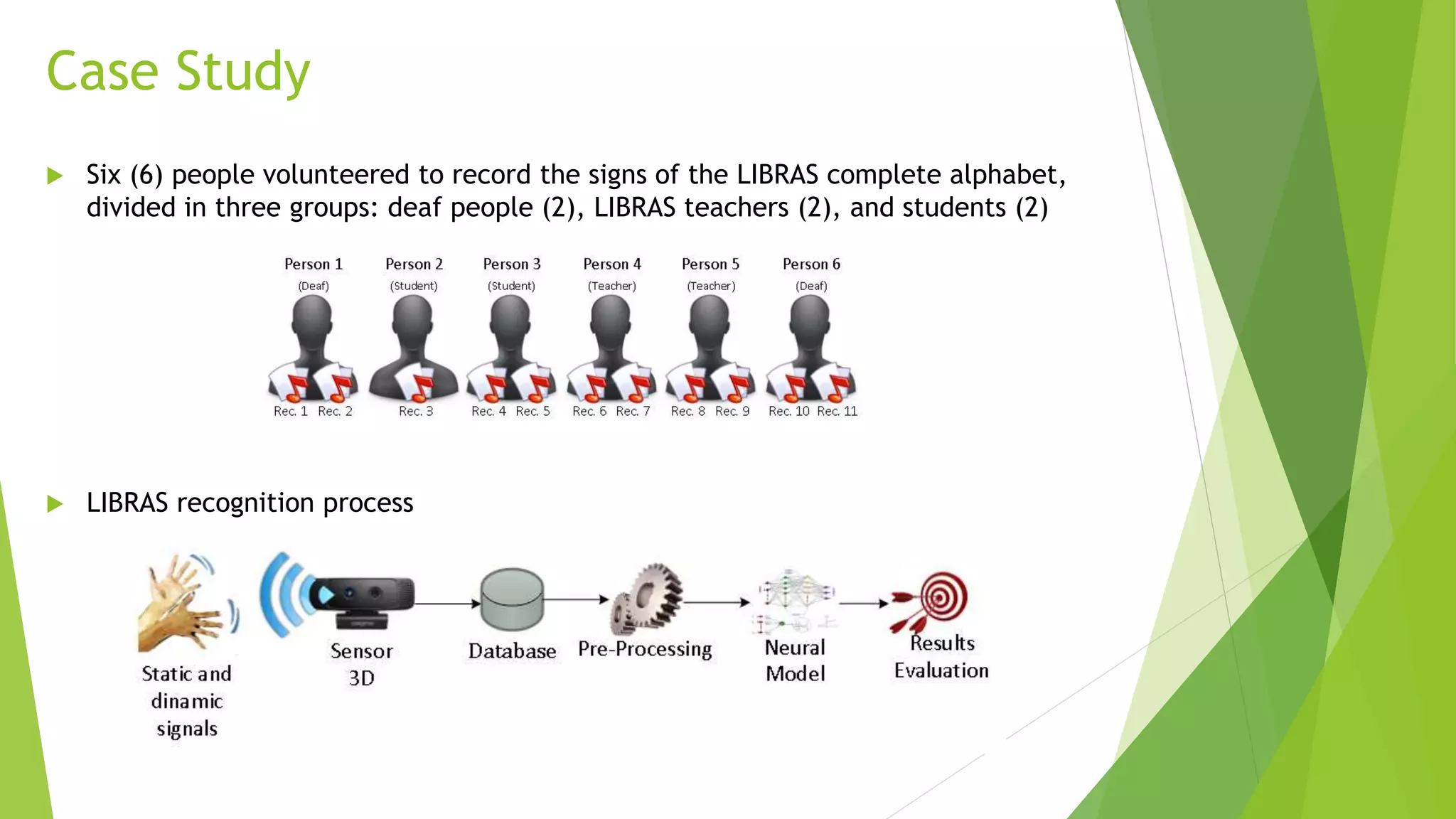
 Six (6) people volunteered to record the signs of the LIBRAS complete alphabet, 
divided in three groups: deaf people (2), LIBRAS teachers (2), and students (2) 
 LIBRAS recognition process
Case Study – Data Acquisition 
 Gestures recorded using: 
 COTS 3D sensor Creative Senz3D GestureCam™ [Creative 2013] 
 Intel® Skeletal Hand Tracking Library (Experimental Release) [Intel 2013] 
 In this investigation, for each frame, it was recorded the absolute 3D coordinates (X, 
Y, and Z) of 5 fingertips and the center of the hand palm, based on the sensor 
distance. That resulted in 18 attributes with continuous position of hand and fingers. 
Creative Senz3D GestureCam 
Hand Tracking
Case Study – Pre-Processing (1/2) 
 Normalization to Hand Relative Coordinates – Absolute 
fingertips coordinates converted to relative coordinates, in 
relation to hand’s center; 
 Training Samples Transformations - There were only 11 samples 
for each alphabet letter. Therefore, a strategy was created and 
implemented to generate new samples based on training 
samples, by rotation and scaling geometric transformations.
Case Study – Pre-Processing (2/2) 
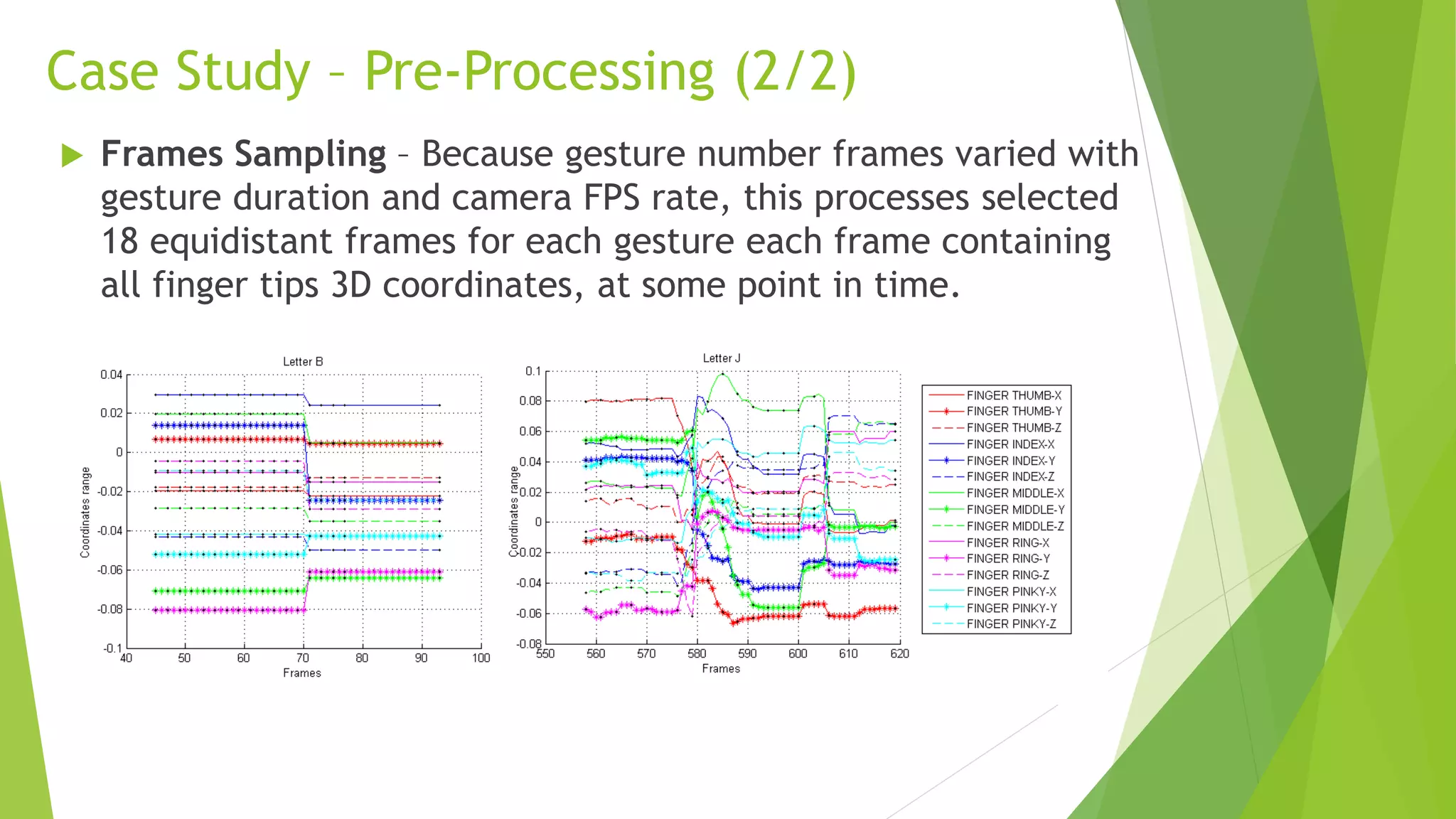
 Frames Sampling – Because gesture number frames varied with 
gesture duration and camera FPS rate, this processes selected 
18 equidistant frames for each gesture each frame containing 
all finger tips 3D coordinates, at some point in time.
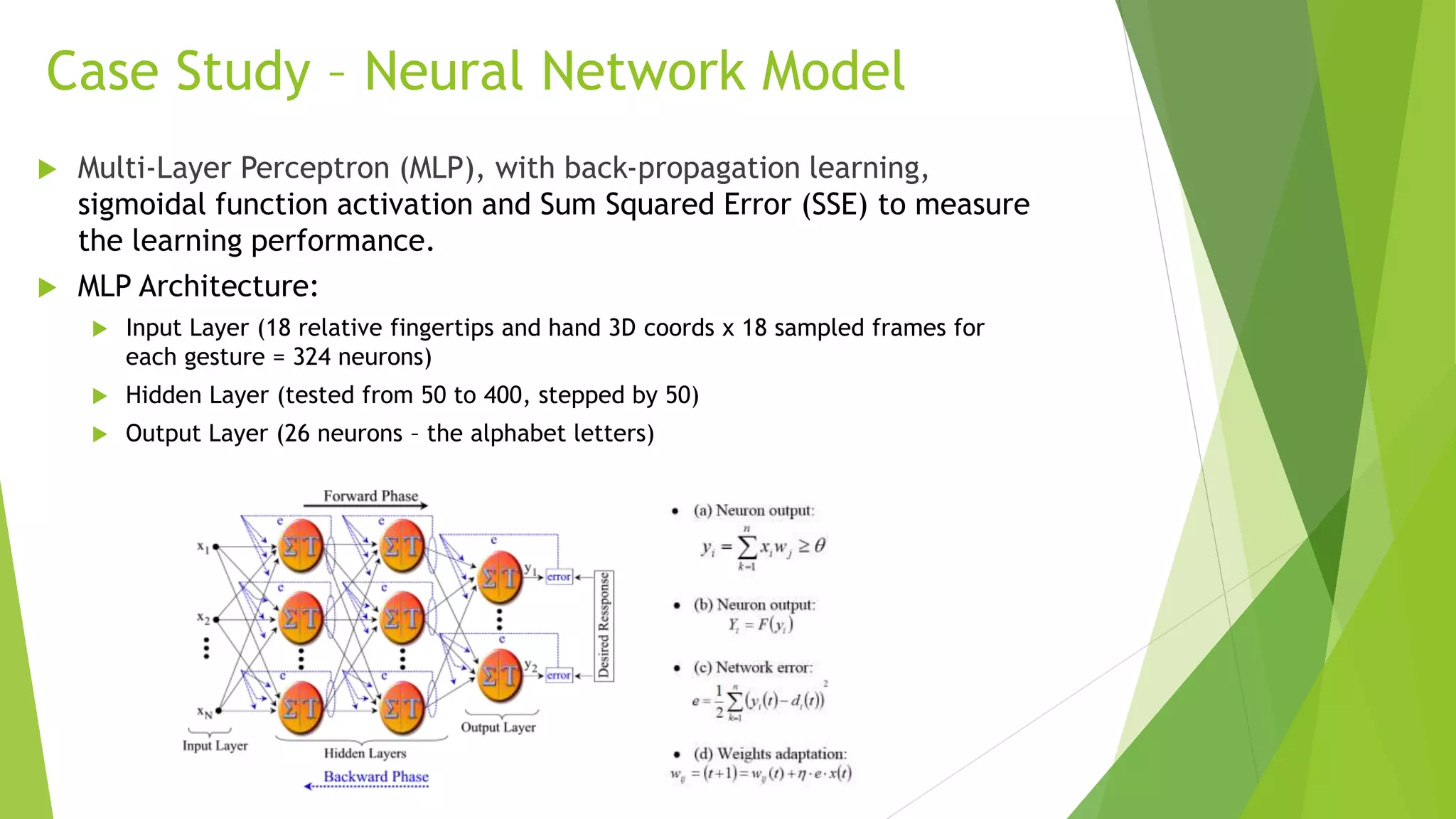
Case Study – Neural Network Model 
 Multi-Layer Perceptron (MLP), with back-propagation learning, 
sigmoidal function activation and Sum Squared Error (SSE) to measure 
the learning performance. 
 MLP Architecture: 
 Input Layer (18 relative fingertips and hand 3D coords x 18 sampled frames for 
each gesture = 324 neurons) 
 Hidden Layer (tested from 50 to 400, stepped by 50) 
 Output Layer (26 neurons – the alphabet letters)
Case Study – Results Analysis 
 Dataset split: Training (64%), Validation (18%), and test (18%) sets 
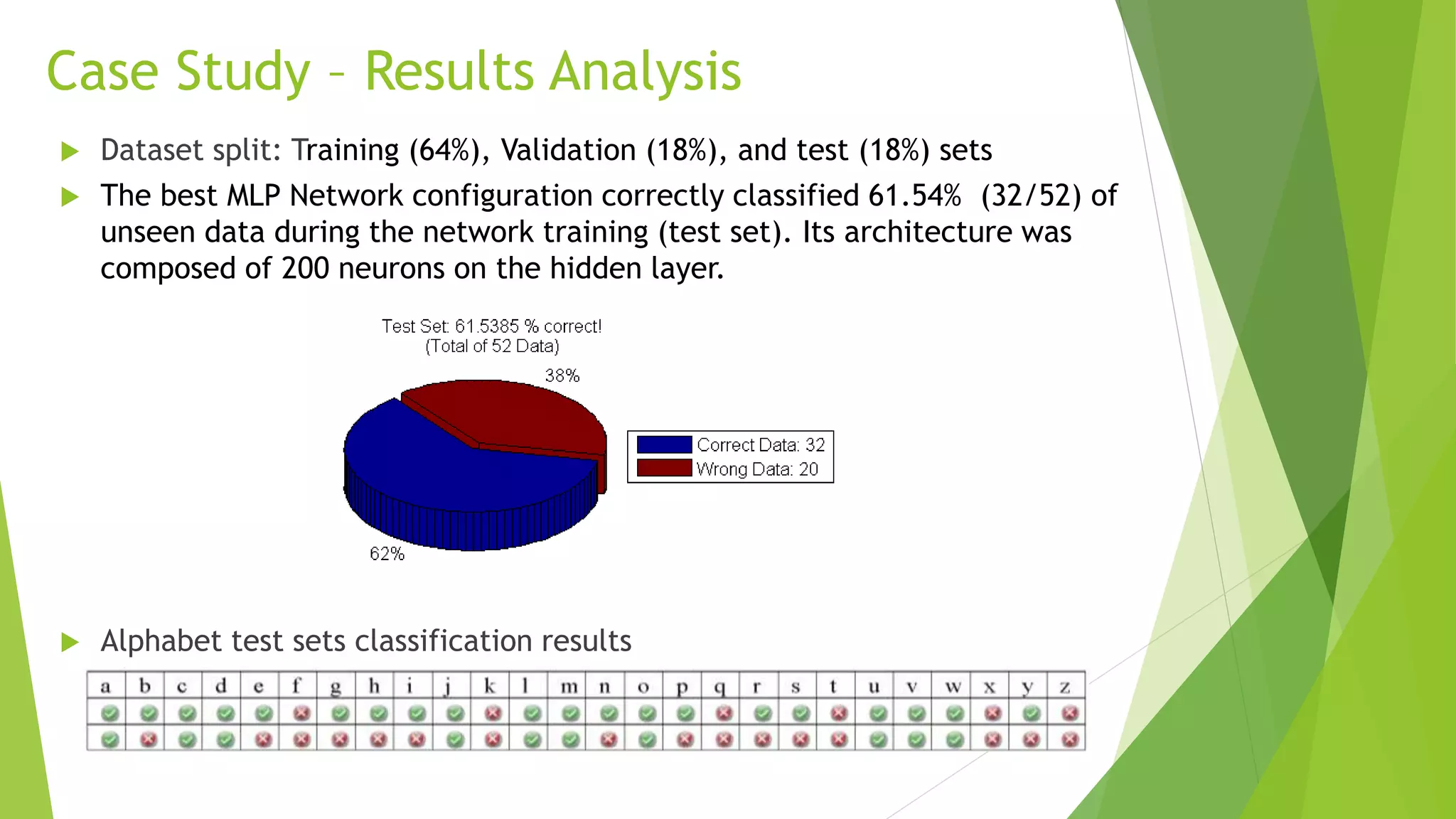
 The best MLP Network configuration correctly classified 61.54% (32/52) of 
unseen data during the network training (test set). Its architecture was 
composed of 200 neurons on the hidden layer. 
 Alphabet test sets classification results
Limitations 
 Difficulty was to find people capable of accurately 
recording LIBRAS gestures, especially deaf people and 
teachers 
 The chosen 3D sensor presented the following limitations 
 An instability of finger tracking on experimental library (Intel® 
Skeletal Hand Tracking Library) 
 The variability of frames per seconds rate may have introduced a 
bias when comparing samples, because of the temporality of 
gestures
Conclusion 
 Initial investigation of LIBRAS recognition, using 3D sensor data 
and Multi-Layer Perceptron. 
 Six LIBRAS teachers, students, and deaf people have volunteered 
for recording the alphabet gestures. 
 Some strategies were developed for pre-processing gestures 
data , to deal with temporality of gestures, normalizing 
coordinates, and geometric transformations (rotation and 
scaling). 
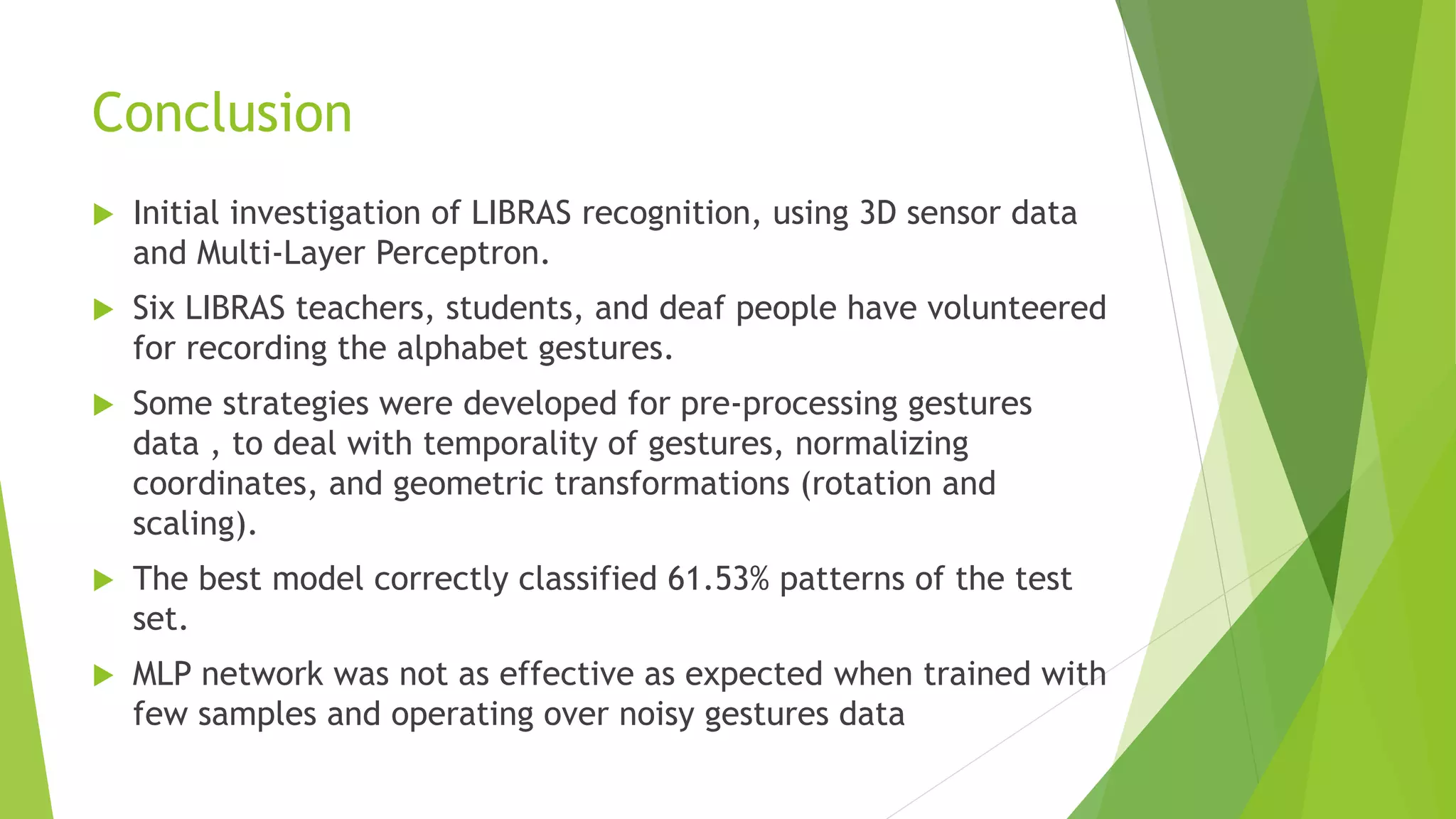
 The best model correctly classified 61.53% patterns of the test 
set. 
 MLP network was not as effective as expected when trained with 
few samples and operating over noisy gestures data
Recommendations and Sugestions 
 Improvements in classification models can be evaluated 
using more representative samples of gestures data. 
 As a natural continuation of this research, still on its 
beginning phase, the authors intend to explore other 3D 
sensors, pre-processing approaches, and learning models, 
like Support Vector Machines and Hidden Markov Models.
Thank you! 
Gabriel S. P Moreira - Gustavo R. Matuck - Osamu Saotome - Adilson M. da Cunha 
ITA – Brazilian Aeronautics Institute of Technology 
gspmoreira@gmail.com

Using Neural Networks and 3D sensors data to model LIBRAS gestures recognition - KDMile 2014

  • 1.
    Using Neural Networksand 3D sensors data to model LIBRAS gestures recognition Gabriel S. P Moreira - Gustavo R. Matuck - Osamu Saotome - Adilson M. da Cunha ITA – Brazilian Aeronautics Institute of Technology
  • 2.
    Introduction  1,799,885citizens in the country having great difficulty to hear (CENSUS 2010)  The Brazilian Signs Language (LIBRAS) is the sign language used by the majority of the deaf people  Second official language by the Brazilian courts, on laws 10.436 (2002) and 5.626 (2005)  This research is an initial investigation of LIBRAS recognition using 3D sensors and neural networks
  • 3.
    Related Research Main approaches of hand tracking systems:  Data-glove-based - electromechanical gloves with sensors  Vision-based - continuous image frames from regular RGB or 3D sensors  Main machine learning techniques:  Artificial Neural Networks (ANN)  Hidden Markov Models (HMM)  Usage of HMM to recognize 47 Libras gestures types, captured with regular RGB cameras [Souza et al. 2007].  3D hand and gesture recognition system using Microsoft Kinect sensor, for dynamic gestures, and HD color sensor, for static gestures recognition [Caputo et al. 2012]  A real-time system to recognize a set of Libras alphabet (only static gestures), using MS Kinect and neural networks [Anjo et al. 2012].
  • 4.
    LIBRAS alphabet All alphabet signs are made with just one hand.  20 (twenty) static gestures and 6 (six) dynamic gestures (H, J, K, X, Y, Z) executed with movement.
  • 5.
    Case Study Six (6) people volunteered to record the signs of the LIBRAS complete alphabet, divided in three groups: deaf people (2), LIBRAS teachers (2), and students (2)  LIBRAS recognition process
  • 6.
    Case Study –Data Acquisition  Gestures recorded using:  COTS 3D sensor Creative Senz3D GestureCam™ [Creative 2013]  Intel® Skeletal Hand Tracking Library (Experimental Release) [Intel 2013]  In this investigation, for each frame, it was recorded the absolute 3D coordinates (X, Y, and Z) of 5 fingertips and the center of the hand palm, based on the sensor distance. That resulted in 18 attributes with continuous position of hand and fingers. Creative Senz3D GestureCam Hand Tracking
  • 7.
    Case Study –Pre-Processing (1/2)  Normalization to Hand Relative Coordinates – Absolute fingertips coordinates converted to relative coordinates, in relation to hand’s center;  Training Samples Transformations - There were only 11 samples for each alphabet letter. Therefore, a strategy was created and implemented to generate new samples based on training samples, by rotation and scaling geometric transformations.
  • 8.
    Case Study –Pre-Processing (2/2)  Frames Sampling – Because gesture number frames varied with gesture duration and camera FPS rate, this processes selected 18 equidistant frames for each gesture each frame containing all finger tips 3D coordinates, at some point in time.
  • 9.
    Case Study –Neural Network Model  Multi-Layer Perceptron (MLP), with back-propagation learning, sigmoidal function activation and Sum Squared Error (SSE) to measure the learning performance.  MLP Architecture:  Input Layer (18 relative fingertips and hand 3D coords x 18 sampled frames for each gesture = 324 neurons)  Hidden Layer (tested from 50 to 400, stepped by 50)  Output Layer (26 neurons – the alphabet letters)
  • 10.
    Case Study –Results Analysis  Dataset split: Training (64%), Validation (18%), and test (18%) sets  The best MLP Network configuration correctly classified 61.54% (32/52) of unseen data during the network training (test set). Its architecture was composed of 200 neurons on the hidden layer.  Alphabet test sets classification results
  • 11.
    Limitations  Difficultywas to find people capable of accurately recording LIBRAS gestures, especially deaf people and teachers  The chosen 3D sensor presented the following limitations  An instability of finger tracking on experimental library (Intel® Skeletal Hand Tracking Library)  The variability of frames per seconds rate may have introduced a bias when comparing samples, because of the temporality of gestures
  • 12.
    Conclusion  Initialinvestigation of LIBRAS recognition, using 3D sensor data and Multi-Layer Perceptron.  Six LIBRAS teachers, students, and deaf people have volunteered for recording the alphabet gestures.  Some strategies were developed for pre-processing gestures data , to deal with temporality of gestures, normalizing coordinates, and geometric transformations (rotation and scaling).  The best model correctly classified 61.53% patterns of the test set.  MLP network was not as effective as expected when trained with few samples and operating over noisy gestures data
  • 13.
    Recommendations and Sugestions  Improvements in classification models can be evaluated using more representative samples of gestures data.  As a natural continuation of this research, still on its beginning phase, the authors intend to explore other 3D sensors, pre-processing approaches, and learning models, like Support Vector Machines and Hidden Markov Models.
  • 14.
    Thank you! GabrielS. P Moreira - Gustavo R. Matuck - Osamu Saotome - Adilson M. da Cunha ITA – Brazilian Aeronautics Institute of Technology gspmoreira@gmail.com

Editor's Notes

  • #4 The Brazilian 2010 Census depicted 1,799,885 citizens in the country having great difficulty to hear. Signs languages are the natural languages of deaf communities. The Brazilian Signs Language (Linguagem Brasileira de Sinais - LIBRAS) is the sign language used by the majority of the deaf people in the Brazilian urban regions, and was standardized and recognized as the second official language by the Brazilian courts, on laws 10.436 (2002) and 5.626 (2005) [Decree 2005]. For many deaf-and-dumb people in Brazil, LIBRAS is the only way they can communicate. But, unfortunately, very few hearing people are knowledgeable and skilled on LIBRAS. That leads difficulties for deaf people to be assisted on hospitals, schools and universities, and government services. This paper describes an investigation about the recognition of LIBRAS alphabet signs gestures, what would allow the spelling of Portuguese words. For the recognition, it was used a 3D sensor to capture hand and fingers coordinates, some pre-processing strategies, and neural networks to classify gestures. Section 2 presents a brief literature research. Section 3 describes the conducted investigation, including data collection, pre-processing, learning models training and result analysis, followed by limitations and conclusions, in sections 4 and 5.
  • #5 Many attempts have been made to recognize signs languages gestures, generally represented by hands postures and gestures, and translate them to spoken languages letters, words, and expressions. The two major classes of hand tracking systems are: (1) data-glove-based, which requires electromechanical gloves with sensors; and (2) vision-based, which works with continuous image frames [Pistori and Neto 2004], usually regular RGB cameras or 3D sensors (like Microsoft Kinect [Kulshreshth et al. 2005]). For recognition models, some studies have been using machine-learning techniques, mostly Neural Networks and Hidden Markov Models (HMM). In [Caputo et al. 2012], it is presented a 3D hand and gesture recognition system using Microsoft Kinect sensor, for dynamic gestures, and HD color sensor, for static gestures recognition. In [Kulshreshth et al. 2013], a real-time finger tracking technique was developed, using Kinect sensor signals, based on feature vectors calculation, using Fourier descriptors of equidistant points. Researches addressing the Brazilian Signs Language have been conducted in the last years. In [Anjo et al. 2012], it is presented a real-time system to recognize a set of Libras alphabet (only static gestures), using MS Kinect and neural networks. In [Souza et al. 2007], authors use HMM to recognize 47 Libras gestures types, captured with regular RGB cameras. In this article, we report the usage of vision based finger tracking, using Creative Senz3D GestureCam™ [Creative 2013], a set of pre-processing approaches, and neural network models to recognize all letters from Brazilian Signs Language (LIBRAS) alphabet, represented by static and dynamic gestures.
  • #6 The LIBRAS alphabet letters are represented by 20 (twenty) static gestures and 6 (six) dynamic gestures (H, J, K, X, Y, Z) executed with movement. All alphabet signs are made with just one hand. This investigation considers only one-hand's data for recording and recognition.
  • #7 Six (6) people volunteered to record LIBRAS alphabet signs, divided in three groups: deaf people (2), LIBRAS teachers (2), and students (2). For all of them, it was recorded two samples of all alphabets, except for one person, which had only one recorded sample. That resulted in 11 complete alphabet samples (268 letter gestures). The LIBRAS signs recognition process stages are Data Acquisition, Pre-processing, Models Training, and Results Analysis, as shown in Figure 1, as described in the following sections.
  • #8 In this stage, the gestures were recorded by using the COTS 3D sensor Creative Senz3D GestureCam™ [Creative 2013], and the Intel® Skeletal Hand Tracking Library (Experimental Release) [Intel 2013] for finger tracking, based on tracking approaches presented in [Melax et al. 2013]. In each frame, the library provided the full 6 Degrees Of Freedom (6-DOF) position and the orientation of 17 bones of a hand. The number of frames per second (fps) rate varied from 20-30 during recording. In this investigation, for each frame, it was recorded the absolute 3D coordinates (X, Y, and Z) of 5 fingertips and the center of the hand palm, based on the sensor distance, That resulted in 18 attributes with continuous position of hands and fingers.
  • #9 Normalization to Hand Relative Coordinates – Absolute fingertips coordinates converted to relative coordinates, in relation to hand’s center; Training Samples Transformations - There were only 11 samples for each alphabet letter. Therefore, a strategy was created and implemented to generate new samples based on training samples, by rotation and scaling geometric transformations; and Frames Sampling – where, for each gesture, it was recorded a different number of frames, because gesture time length varies, depending on alphabet letter and person style. The used sensors frames per second (fps) rate also varied, ranging from 20 to 30 fps. So, as the input for neural network model was fixed, it was necessary to normalize the input size, sampling a fixed number of frames for each gesture. This process selected 18 equidistant frames for each gesture  , each frame containing all finger tips 3D coordinates, at some point in time.
  • #10 Normalization to Hand Relative Coordinates – Absolute fingertips coordinates converted to relative coordinates, in relation to hand’s center; Training Samples Transformations - There were only 11 samples for each alphabet letter. Therefore, a strategy was created and implemented to generate new samples based on training samples, by rotation and scaling geometric transformations; and Frames Sampling – where, for each gesture, it was recorded a different number of frames, because gesture time length varies, depending on alphabet letter and person style. The used sensors frames per second (fps) rate also varied, ranging from 20 to 30 fps. So, as the input for neural network model was fixed, it was necessary to normalize the input size, sampling a fixed number of frames for each gesture. This process selected 18 equidistant frames for each gesture  , each frame containing all finger tips 3D coordinates, at some point in time.
  • #11 The neural network used in this investigation was the traditional Multi-Layer Perceptron (MLP), with the back-propagation learning algorithm [Montini 2013]. All neurons used in the hidden and output layers had sigmoidal function activation. The Sum Squared Error (SSE) parameter was used to measure the learning performance.   On this investigation, the MLP Network was composed by the input layer (where the processed data sensor were applied), one hidden layer (tested with 50 to 400 neurons, stepped by 50), and the output layer (with 26 neurons - the alphabet letters). Mathematically, only one hidden layer of neurons is enough to perform nonlinear mapping. In order to provide a better way to train the neural network, a cross-validation process and a momentum parameter were applied. All data obtained from gestures signals were divided into training (64%), validation   (18%), and test sets (18%). All range data used by the MLP Network is between [0,1]. Several simulations were performed   with different MLP Neural Networks configurations.  Mathematically, only one hidden layer of neurons is enough to perform nonlinear mapping The stimulus between the neurons and the input data is measured by equation (a). By the neuron output signal (Y) showed in equation (b), the sigmoidal function was applied on the hidden and output neurons. The network error and the weights adaptation were measured by equations (c) and (d), respectively.
  • #12 In order to provide a better way to train the neural network, a cross-validation process and a momentum parameter were applied. All data obtained from gestures signals were divided into training (64%), validation   (18%), and test sets (18%). All range data used by the MLP Network is between [0,1]. Several simulations were performed   with different MLP Neural Networks configurations.  Mathematically, only one hidden layer of neurons is enough to perform nonlinear mapping After many simulations , the best MLP Network configuration correctly classified 61.54%   (32/52) of unseen data during the network training (test set). Its architecture was composed of 200 neurons on the hidden layer. This MLP Network training process was conducted for 1,000 epochs, after then the learning model started overfitting the sample data. Learning rate chosen by authors started with the value of 0.2  , and decreased as epochs. The momentum parameter was used to improve the learning performance, avoiding local minima in the error surface. Table 1 shows the classification results for the test set (two samples of each letter), presenting the MLP Neural Network difficulties to recognize some letters like “f”, “k”, “t”, “x”, and “z”. On the other hand, the neural model correctly classified 10 letters with 100% of success (“a”, “c”, “d”, “j”, “l”, “m”, “o”, “u”, “v”, and “w”).  
  • #14 In this investigation, an initial research was described for recognizing the Brazilian signs language LIBRAS (LInguagem BRAsileira de Sinais) alphabet using Neural Networks over visual 3D sensor data. Six LIBRAS teachers, students, and deaf people have volunteered for recording the alphabet gestures. Some strategies were developed for pre-processing gestures data  , to deal with temporality of gestures (frames sampling), normalizing coordinates, and increasing training samples, using geometric transformations (rotation and scaling). Neural networks were assessed for gestures recognition, with different settings, training epochs, learning rates, and momentum  factor. The best model correctly classified 61.53% patterns of the test set. Analyzing the results from this investigation, it can be observed that the MLP network was not as effective as expected when operating over noisy gestures data. Improvements in recognition models can be evaluated using more representative samples of gestures data. As a natural continuation of this research, still on its beginning phase, the authors intend to explore other 3D sensors, pre-processing approaches, and learning models, like Support Vector Machines and Hidden Markov Models.  R1 - What kind of strategies were developed? The authors commented about fixing 18 frames but they did not justify this choice.  Já está escrito ao longo da frase a estratégia de pré-processamento dos dados.....  R1 - You did not comment anything about momentum factor
  • #15 Improvements in recognition models can be evaluated using more representative samples of gestures data. As a natural continuation of this research, still on its beginning phase, the authors intend to explore other 3D sensors, pre-processing approaches, and learning models, like Support Vector Machines and Hidden Markov Models.