KINDS OF TRUTH
If the question is whether the
truth or belief of a statement is
establish or arrived through
sense of experience.
• Empirical truth
• Rational truth
Empirical Truth (a
posteriori)
• Is derived by the use of our
senses.
• The sky is blue.
• It is hot.
Rational Truth (a priori)
• A knowledge that is already
established.
Example.
• The triangle has 3 sides.
• 1 plus 1 is 2.
If the question is whether or not
knowing the truth of a statement
or belief extends our knowledge
or not.
• Synthetic Truth
• Analytic Truth
Synthetic Truth
• It extends our knowledge about
the subject.
• The Table is color blue.
• The room has a broken
window.
Analytic Truth
• A knowledge that is already
established or it is base on its
definition.
Example.
• A circle has no side.
• A verb is an action word.
If the question is whether or
knowing the truth of a statement
or belief is true in all possible
situations.
• Contingent Truth
• Necessary Truth
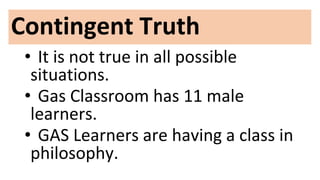
Contingent Truth
• It is not true in all possible
situations.
• Gas Classroom has 11 male
learners.
• GAS Learners are having a class in
philosophy.
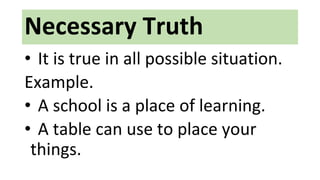
Necessary Truth
• It is true in all possible situation.
Example.
• A school is a place of learning.
• A table can use to place your
things.
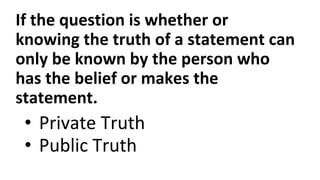
If the question is whether or
knowing the truth of a statement can
only be known by the person who
has the belief or makes the
statement.
• Private Truth
• Public Truth
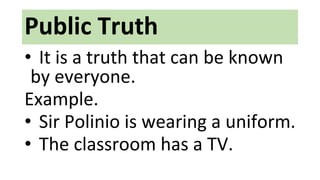
Public Truth
• It is a truth that can be known
by everyone.
Example.
• Sir Polinio is wearing a uniform.
• The classroom has a TV.
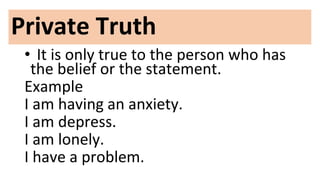
Private Truth
• It is only true to the person who has
the belief or the statement.
Example
I am having an anxiety.
I am depress.
I am lonely.
I have a problem.
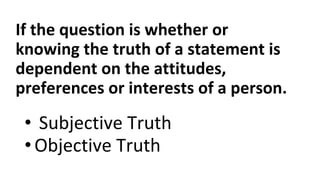
If the question is whether or
knowing the truth of a statement is
dependent on the attitudes,
preferences or interests of a person.
• Subjective Truth
• Objective Truth
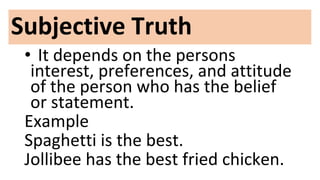
Subjective Truth
• It depends on the persons
interest, preferences, and attitude
of the person who has the belief
or statement.
Example
Spaghetti is the best.
Jollibee has the best fried chicken.
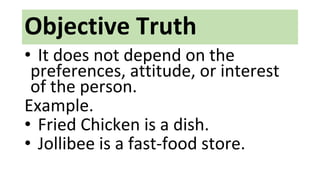
Objective Truth
• It does not depend on the
preferences, attitude, or interest
of the person.
Example.
• Fried Chicken is a dish.
• Jollibee is a fast-food store.
If the question is whether or
knowing the truth is
acknowdlege to be true by
everyone or only by some
people.
• Universal Truth
• Relative Truth
Relative Truth
• A truth acknowledge by some
group of people..
Example
Korean movie series is the best.
Marvel the avengers is the greatest
movie of all time.
Universal Truth
• a truth that is acknowledge to be
true by all.
Example.
• Avengers is a fictional movie.
• A school has a teacher and
student.
philosophy wk2 day 2.pptx

philosophy wk2 day 2.pptx

  • 1.
  • 2.
    If the questionis whether the truth or belief of a statement is establish or arrived through sense of experience. • Empirical truth • Rational truth
  • 3.
    Empirical Truth (a posteriori) •Is derived by the use of our senses. • The sky is blue. • It is hot.
  • 4.
    Rational Truth (apriori) • A knowledge that is already established. Example. • The triangle has 3 sides. • 1 plus 1 is 2.
  • 5.
    If the questionis whether or not knowing the truth of a statement or belief extends our knowledge or not. • Synthetic Truth • Analytic Truth
  • 6.
    Synthetic Truth • Itextends our knowledge about the subject. • The Table is color blue. • The room has a broken window.
  • 7.
    Analytic Truth • Aknowledge that is already established or it is base on its definition. Example. • A circle has no side. • A verb is an action word.
  • 8.
    If the questionis whether or knowing the truth of a statement or belief is true in all possible situations. • Contingent Truth • Necessary Truth
  • 9.
    Contingent Truth • Itis not true in all possible situations. • Gas Classroom has 11 male learners. • GAS Learners are having a class in philosophy.
  • 10.
    Necessary Truth • Itis true in all possible situation. Example. • A school is a place of learning. • A table can use to place your things.
  • 11.
    If the questionis whether or knowing the truth of a statement can only be known by the person who has the belief or makes the statement. • Private Truth • Public Truth
  • 12.
    Public Truth • Itis a truth that can be known by everyone. Example. • Sir Polinio is wearing a uniform. • The classroom has a TV.
  • 13.
    Private Truth • Itis only true to the person who has the belief or the statement. Example I am having an anxiety. I am depress. I am lonely. I have a problem.
  • 14.
    If the questionis whether or knowing the truth of a statement is dependent on the attitudes, preferences or interests of a person. • Subjective Truth • Objective Truth
  • 15.
    Subjective Truth • Itdepends on the persons interest, preferences, and attitude of the person who has the belief or statement. Example Spaghetti is the best. Jollibee has the best fried chicken.
  • 16.
    Objective Truth • Itdoes not depend on the preferences, attitude, or interest of the person. Example. • Fried Chicken is a dish. • Jollibee is a fast-food store.
  • 17.
    If the questionis whether or knowing the truth is acknowdlege to be true by everyone or only by some people. • Universal Truth • Relative Truth
  • 18.
    Relative Truth • Atruth acknowledge by some group of people.. Example Korean movie series is the best. Marvel the avengers is the greatest movie of all time.
  • 19.
    Universal Truth • atruth that is acknowledge to be true by all. Example. • Avengers is a fictional movie. • A school has a teacher and student.