HOBBES'
LEVIATHAN:
A Social
ContractZelney T. Andrada
BPE-SPE-3B
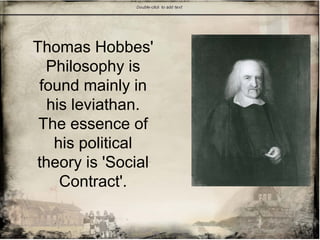
Thomas Hobbes'
Philosophy is
found mainly in
his leviathan.
The essence of
his political
theory is 'Social
Contract'.
Social Contract is a Democratic
organization in which participants are
considered equal, excepting the
sovereign, who enjoys a privileged
status. He is free to do what he wills and
further no power superior to his own
displace his sovereign position.
Hobbes adheres to a 'double truth' theory.
It is the belief that two contradictory ideas
may both be true simultaneously.
Ex. Belief in God and Atheism
His Philosophy of metaphysical
Materialism precludes the possibility of
any existent spiritual reality including
God, that is, what appears spiritual is
ultimately only a material body, or at
most, body in motion.
Man's Corrupt and
Belligerent Nature
Hobbes Based his political theory on his
concept of the nature of man whom he
depicts as a corrupt and untrustworthy
being by natural constitution.
He claims, because they too consider
man untrustworthy as is evidenced by
locking the doors of their houses; even
within the family circle, one is found
locking his private chest because of his
mistrust of family.
Not only is man corrupt and
untrustworthy by nature, but by
nature he has the perfect right,
provided he has the necessary
power, to take what he wants
from whoever he pleases. It is the
Nature's Law namely the law of
'Tooth and Claw'.
Man, a corrupt and belligerent creature
by nature, is entitled to the same laws
enjoyed by brute animals; "every man
has a right to every thing: even to
another's body." The most important
law is to keep from being destroyed,
and the second is to keep alive by
using whatever means is at one's
disposal
Within man's psychological constitution
exists three characteristics which
account for his belligerent tendency:
1. Competition - Creates within him an
insatiable hunger for gain.
2. Diffidence - drives him to seek security.
3. Glory - the lust for superiority, causes
him to build reputation
Natural Rights of
Man" The right of nature, or the jus naturale, is
the liberty each man has to use his own
power as he will himself for the
preservation of his own life; and
consequently, of doing anything which in
his own judgment and reason he shall
concieve to be the aptest means thereto."
To a 'natural right' there exists a
natural law as well, the first law
of man, namely , the law of Self-
preservation. Man is forbidden to
do anything destructive to his life
since there is nothing in this
world for which it is worth risking
one's life.
A Law of nature (Lex Naturalis) is
a precept, or general rule, found
out by reason, by which a man is
forbidden to do that which is
destructive of his life or take away
the means of preserving the
same; and to omit that by which
he thinks it may be best
preserved.
Societies, or the governments are built
due solely to the "fundamental law of
nature; which is to seek peace and follow
it," and "the second sum of the right of
nature; which is, by all means we can, to
defend ourselves." These two principles
are responsible for men engaging in a
social contract with one another.
Although man is entitled by nature
to whatever he can seize by
power, it would prove a futile and
vain effort since men in numbers
are equal.
For a strong man to attack a weak
brother would cause the weak to
unite with others who share his
predicament to ward off the
attacks of the strong, or possible
even to attack the strong by
invoking the principle: ' United we
stand, divided we fall.'
Nature Has made men so equal,
in the facilities of body and mind,
as that though there be found one
man sometimes manifestly
stronger in body, or of quicker
mind than other yet when all is
reckoned together
The difference between man and
man is not so considerable as
that one man can thereupon
claim to himself any benefit to
which another may not pretend
as well as he.
For as to strength of body , the
weakest has strength enough to
kill the strongest, either by
machination, or by confederacy
with others that are in the same
danger with himself
Eventually, men must sue for peace
since war is vain and obsolete. Men
insist on talking the matter over
around a conference table since this
recourse remains the only alternative
to total destruction and death. Men
are driven to agree upon a 'social
contract'.
The right of the stronger is no longer
exercisable when sizable numbers
are taken into consideration, for men
in groups are equal.
Technologically speaking, men of
whatever nation can be trained to do
whatever any other nation has been
doing.
The Social
ContractHobbes is right that nature has made
men so equal in faculties of body and
mind. That if a person is to survive in
a society, his only recourse is to enter
into a social compact.
The social contract consist essentially
in exchanging one's rights granted by
nature for moral or legal rights
provided by a compact.
Its basic principle is the surrender of
whatever liberties are presently
enjoyed by nature, for guarantee or
sake of survival.
In a sense, the social contract is the
'Golden Rule' negatively formulated.
"This is that law of the Gospel:
Whatever you require others should
do to you, that do ye to them . . ."
Essentially, it consists in the
transference or reciprocal
exchange of rights. "The mutual
transferring of right is that which
men call contract."
Laws of Nature
The Success of the social contract
form of government is due to the
operation within society of a number
of natural laws which are in essence
immutable and eternal. Justice is
adherence to these laws, injustice
their violation.
The laws of nature are as follows:
• "Seek peace and follow it" (law of self-
preservation)
• "That a man be willing when others are so
too, as far as for peace and defence of
himself he shal think it necessary, to lay
down this right to all things: and be content
with so much liberty against other men as he
would allow other men against himself"
• "That men perform their covenants made."
• "That a man which receives benefit from
another of mere grace, endeavor that he
which gives it has no reasonable cause to
repent of his good will."
• 'Compleasance' : "That every man strive to
accommodate himself to the rest."
• "That upon caution of future time, a man
ought to pardon the offenses past of them
that repenting desire it."
• "That in revenges, men look not at
the greatness of the evil past, but the
greatness of the good to follow."
• "That no man by deed, word,
countenance, or gesture, declare
hatred or contempt of another."
• "That every man acknowledge other
for his equal by nature." (pride)
• "That the entrance into conditions of peace, no
man require to reserve to himself any right which
he is not content should be reserved to everyone
of the rest."
• "If a man be trusted to judge between man and
man, it is a percept of the law of nature that he
deal equally between them."
• "That such things as cannot be divided, be
enjoyedin common, if it can be, and if the
quantity of the thing permit, without stint;
otherwise proportionally to the nember of them
that have right."
• the law of equity: "That the entire
right; or else, the first possession be
determined by lot."
• "That all men that mediate peace be
allowed safe conduct."
• "That they that are at controversy
submit their right to judgement of an
arbitrator."
The mentioned fifteen laws of
nature are reducible to one,
namely, the 'Golden Rule': "Do
not do that to other, which thou
wouldst not have done to
thyself."
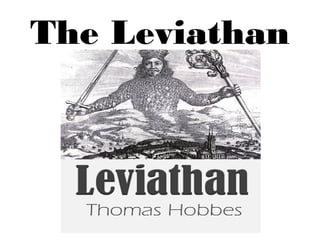
The Leviathan
The Leviathan
The Leviathan is more than a
monarch, he is a 'mortal god' who
is above the law and its restraints,
a man to whom all citizens are
subject and to whom their right of
nature and right of self-
government is surrendered.
The sovereign, leviathan, is a man's
guarantee that others will fulfill
there end of the contract;
accordingly, the monarch must be
suffeciently powerful to force his
subject to fulfill their promise made
in respect to the compact, or
undergo suitable punishment if they
refuse or fail.
Concluding Comments
Hobbes' Leviathan a social contract, a
Democracy, a Monarchy, or a dictatorship
is difficult to say in as much as there are
obvious rival or contradictory doctrines,
such as totalitarian power in a single
monarch, rivaling the doctrine of a social
contract of free and equal people
democratically organized.
Hobbes regards man as unsocial
being, yet his entire philosophy is
based upon man's social relations
with his fellowman.
He identifies man's instincts with
that of the wild animals of the
jungle, but such beasts are not
social beings.
Perhaps a more acceptable explanation
than Hobbes provided as to why men
ought to, and do, enter into social
contract with each other on a
democratic basis is: man's mutual
understanding, social concern, and
mutual enhancement of each other's
condition despite the fact that there are
many persons who are principally
motivated out of self-interest.

Philosophy report

  • 1.
  • 2.
    Thomas Hobbes' Philosophy is foundmainly in his leviathan. The essence of his political theory is 'Social Contract'.
  • 3.
    Social Contract isa Democratic organization in which participants are considered equal, excepting the sovereign, who enjoys a privileged status. He is free to do what he wills and further no power superior to his own displace his sovereign position.
  • 4.
    Hobbes adheres toa 'double truth' theory. It is the belief that two contradictory ideas may both be true simultaneously. Ex. Belief in God and Atheism
  • 5.
    His Philosophy ofmetaphysical Materialism precludes the possibility of any existent spiritual reality including God, that is, what appears spiritual is ultimately only a material body, or at most, body in motion.
  • 6.
    Man's Corrupt and BelligerentNature Hobbes Based his political theory on his concept of the nature of man whom he depicts as a corrupt and untrustworthy being by natural constitution.
  • 7.
    He claims, becausethey too consider man untrustworthy as is evidenced by locking the doors of their houses; even within the family circle, one is found locking his private chest because of his mistrust of family.
  • 8.
    Not only isman corrupt and untrustworthy by nature, but by nature he has the perfect right, provided he has the necessary power, to take what he wants from whoever he pleases. It is the Nature's Law namely the law of 'Tooth and Claw'.
  • 9.
    Man, a corruptand belligerent creature by nature, is entitled to the same laws enjoyed by brute animals; "every man has a right to every thing: even to another's body." The most important law is to keep from being destroyed, and the second is to keep alive by using whatever means is at one's disposal
  • 10.
    Within man's psychologicalconstitution exists three characteristics which account for his belligerent tendency: 1. Competition - Creates within him an insatiable hunger for gain. 2. Diffidence - drives him to seek security. 3. Glory - the lust for superiority, causes him to build reputation
  • 11.
    Natural Rights of Man"The right of nature, or the jus naturale, is the liberty each man has to use his own power as he will himself for the preservation of his own life; and consequently, of doing anything which in his own judgment and reason he shall concieve to be the aptest means thereto."
  • 12.
    To a 'naturalright' there exists a natural law as well, the first law of man, namely , the law of Self- preservation. Man is forbidden to do anything destructive to his life since there is nothing in this world for which it is worth risking one's life.
  • 13.
    A Law ofnature (Lex Naturalis) is a precept, or general rule, found out by reason, by which a man is forbidden to do that which is destructive of his life or take away the means of preserving the same; and to omit that by which he thinks it may be best preserved.
  • 14.
    Societies, or thegovernments are built due solely to the "fundamental law of nature; which is to seek peace and follow it," and "the second sum of the right of nature; which is, by all means we can, to defend ourselves." These two principles are responsible for men engaging in a social contract with one another.
  • 15.
    Although man isentitled by nature to whatever he can seize by power, it would prove a futile and vain effort since men in numbers are equal.
  • 16.
    For a strongman to attack a weak brother would cause the weak to unite with others who share his predicament to ward off the attacks of the strong, or possible even to attack the strong by invoking the principle: ' United we stand, divided we fall.'
  • 17.
    Nature Has mademen so equal, in the facilities of body and mind, as that though there be found one man sometimes manifestly stronger in body, or of quicker mind than other yet when all is reckoned together
  • 18.
    The difference betweenman and man is not so considerable as that one man can thereupon claim to himself any benefit to which another may not pretend as well as he.
  • 19.
    For as tostrength of body , the weakest has strength enough to kill the strongest, either by machination, or by confederacy with others that are in the same danger with himself
  • 20.
    Eventually, men mustsue for peace since war is vain and obsolete. Men insist on talking the matter over around a conference table since this recourse remains the only alternative to total destruction and death. Men are driven to agree upon a 'social contract'.
  • 21.
    The right ofthe stronger is no longer exercisable when sizable numbers are taken into consideration, for men in groups are equal. Technologically speaking, men of whatever nation can be trained to do whatever any other nation has been doing.
  • 22.
    The Social ContractHobbes isright that nature has made men so equal in faculties of body and mind. That if a person is to survive in a society, his only recourse is to enter into a social compact.
  • 23.
    The social contractconsist essentially in exchanging one's rights granted by nature for moral or legal rights provided by a compact. Its basic principle is the surrender of whatever liberties are presently enjoyed by nature, for guarantee or sake of survival.
  • 24.
    In a sense,the social contract is the 'Golden Rule' negatively formulated. "This is that law of the Gospel: Whatever you require others should do to you, that do ye to them . . ."
  • 25.
    Essentially, it consistsin the transference or reciprocal exchange of rights. "The mutual transferring of right is that which men call contract."
  • 26.
    Laws of Nature TheSuccess of the social contract form of government is due to the operation within society of a number of natural laws which are in essence immutable and eternal. Justice is adherence to these laws, injustice their violation.
  • 27.
    The laws ofnature are as follows: • "Seek peace and follow it" (law of self- preservation) • "That a man be willing when others are so too, as far as for peace and defence of himself he shal think it necessary, to lay down this right to all things: and be content with so much liberty against other men as he would allow other men against himself"
  • 28.
    • "That menperform their covenants made." • "That a man which receives benefit from another of mere grace, endeavor that he which gives it has no reasonable cause to repent of his good will." • 'Compleasance' : "That every man strive to accommodate himself to the rest." • "That upon caution of future time, a man ought to pardon the offenses past of them that repenting desire it."
  • 29.
    • "That inrevenges, men look not at the greatness of the evil past, but the greatness of the good to follow." • "That no man by deed, word, countenance, or gesture, declare hatred or contempt of another." • "That every man acknowledge other for his equal by nature." (pride)
  • 30.
    • "That theentrance into conditions of peace, no man require to reserve to himself any right which he is not content should be reserved to everyone of the rest." • "If a man be trusted to judge between man and man, it is a percept of the law of nature that he deal equally between them." • "That such things as cannot be divided, be enjoyedin common, if it can be, and if the quantity of the thing permit, without stint; otherwise proportionally to the nember of them that have right."
  • 31.
    • the lawof equity: "That the entire right; or else, the first possession be determined by lot." • "That all men that mediate peace be allowed safe conduct." • "That they that are at controversy submit their right to judgement of an arbitrator."
  • 32.
    The mentioned fifteenlaws of nature are reducible to one, namely, the 'Golden Rule': "Do not do that to other, which thou wouldst not have done to thyself."
  • 33.
  • 34.
    The Leviathan The Leviathanis more than a monarch, he is a 'mortal god' who is above the law and its restraints, a man to whom all citizens are subject and to whom their right of nature and right of self- government is surrendered.
  • 35.
    The sovereign, leviathan,is a man's guarantee that others will fulfill there end of the contract; accordingly, the monarch must be suffeciently powerful to force his subject to fulfill their promise made in respect to the compact, or undergo suitable punishment if they refuse or fail.
  • 36.
    Concluding Comments Hobbes' Leviathana social contract, a Democracy, a Monarchy, or a dictatorship is difficult to say in as much as there are obvious rival or contradictory doctrines, such as totalitarian power in a single monarch, rivaling the doctrine of a social contract of free and equal people democratically organized.
  • 37.
    Hobbes regards manas unsocial being, yet his entire philosophy is based upon man's social relations with his fellowman. He identifies man's instincts with that of the wild animals of the jungle, but such beasts are not social beings.
  • 38.
    Perhaps a moreacceptable explanation than Hobbes provided as to why men ought to, and do, enter into social contract with each other on a democratic basis is: man's mutual understanding, social concern, and mutual enhancement of each other's condition despite the fact that there are many persons who are principally motivated out of self-interest.