Freire's
Philosophical
Views on
Education
Background
Concepts
Views
Applications
Table
of
Conten
ts
01
02
03
04
Background
Concepts
Views
Applications
Table
of
Conten
ts
01
02
03
04
Background
1
Presented by:
Mitch Cyrel B. Peralta
1922-1977
FREIRE
PAULO
Who is Paulo
Freire?
was a Brazilian educator who has made a
profound impact not only in education but also in
the overall struggle for national development, in
the third world countries. The methodology he
developed for the education was considered to be
a threat for the established order for quite
sometimes and he was jailed for seventy days and
later on forced to leave Brazil for 20 years.
Who is Paulo
Freire?
He spent five years working with UNESCO and
the Children Institute for Agrarian reform in the
programs of adult education. He also worked at
various other institutions and received honorary
degrees from 29 universities in Europe and
North America.
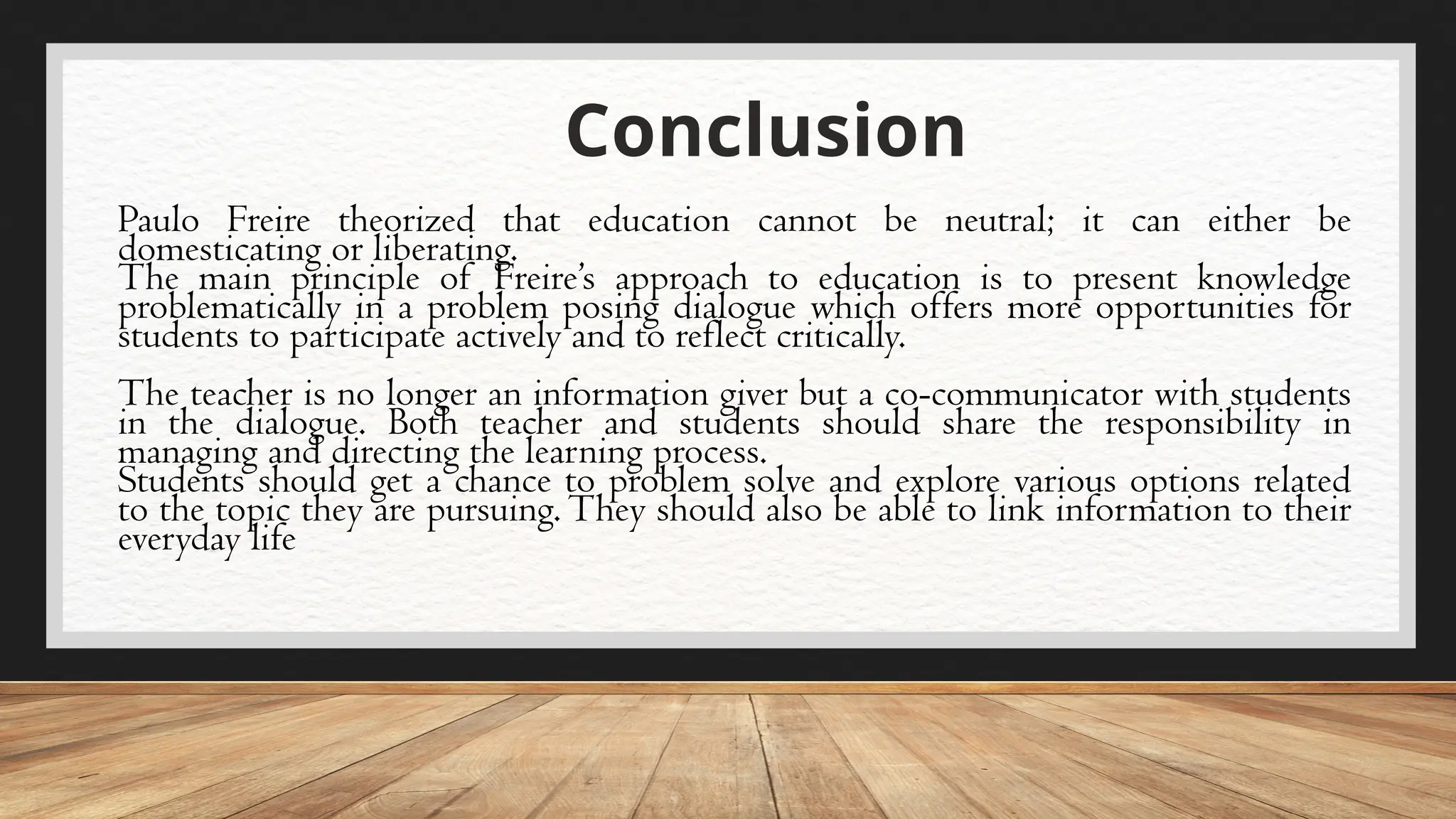
Freire wrote all together 20 books
which were translated in more than
18 languages, out of which
‘Pedagogy of the Oppressed is the
most famous written in 1970.
 For Freire, education must be centered upon
developing critically conscious, 'humanized',
learners who act to liberate themselves, and the
world, from injustice.
 Freire's goal was to eradicate illiteracy
among people from previously colonized
countries and continents.
Background
Concepts
Views
Applications
Table
of
Conten
ts
01
02
03
04
CONCEPTS
2
Key concepts……
 Conscientization - process of developing a critical
awareness of one’s social reality through reflection and
action. Action is fundamental because it is the process of
changing the reality.
 Codification - way of gathering information in order to
build up a picture (codify) around real situations and real
people.
Key concepts……
 Praxis (Action/Reflection) - act together upon their
environment in order critically to reflect upon their
reality and so transform it through further action and
critical reflection
 Generative Themes - characterized by a complex of
ideas, concepts, hopes, doubts, values and challenges in
dialectical interaction with their opposites striving
towards their fulfilment.
Key concepts……
 Easter Experience - those who authentically commit
themselves to the people must re-examine themselves
constantly.
 Dialogue - question what he or she knows and realize
that through dialogue existing thoughts will change and
new knowledge will be created.
Key concepts……
 Banking Education - Freire has introduced the new
terminology of ‘banking’ concept in education. In other
words the teacher turns the students into ‘containers’,
into ‘receptacles’ to be filled. Education thus becomes an
act of depositing, in which the students are the
depositories and the teacher is the depositor
Key concepts……
 Characteristics of Banking Education
•The teacher teaches and the students are taught
•The teacher knows everything and the student know nothing
•The teacher thinks and the students are thought about
•The teacher talks and the students listen
•The teacher disciplines and the students are disciplined
Key concepts……
 The teacher chooses and he enforces his choice, and the
students comply
 The teacher acts and the students have the illusion of acting
through the action of the teacher.
 The teacher confuses the authority of knowledge with his
own professional authority which he sets in opposition to
the freedom of the students.
 The teacher is the subject of the learning process.
Key concepts……
 the contrast between "banking" education (in which facts are deposited
into the minds of passive students) and problem-posing education;
 the educational process is never neutral. People can be passive
recipients of knowledge - whatever the content - or they can engage
in a ‘problem-posing’ approach in which they become active
participants.
 it is essential that people link knowledge to action so that they actively
work to change their societies at a local level and beyond.
What is the main point of
Pedagogy of the Oppressed by
Paulo Freire?
 It is to allow all individuals to become fully human so that no
oppression can exist. Freire states that once the oppressed
understand their own oppression and discovers their oppressors,
the next step is dialogue, or discussion with others to reach the
goal of humanization.
What is the main point of
Pedagogy of the Oppressed by
Paulo Freire?
 It is to allow all individuals to become fully human so that no
oppression can exist. Freire states that once the oppressed
understand their own oppression and discovers their oppressors,
the next step is dialogue, or discussion with others to reach the
goal of humanization.
Background
Concepts
Views
Applications
Table
of
Conten
ts
01
02
03
04
VIEWS
3
Freire’s views on
education
The education system must help learners to develop their
own ideas and capitalize on their abilities as being active
participants in changing their world.
Criticized the dominant in society and did not appreciate
the traditional method of the education (Banking
Education) in which knowledge is presented by the teacher
through a predetermined set of curriculum.
Freire’s views on
education
Dialogue between the teacher and learner was of
paramount importance as this encourages responsibility
and autonomy for both.
He encouraged teachers to make their class more
democratic - students become active learners while
maintaining mutual respect
Freire’s views on
education
Empowerment of the learner, encouraging people to be
masters of their own destiny.
Learners must work towards maximizing their skills and
abilities and see how they can change the world in which
they live.
Freire’s views on
education
Freire believed that the goal of education should be
freedom to speak, think and act in an authentic way.
Learners must work towards maximizing their skills and
abilities and see how they can change the world in which
they live.
Power Awareness
Freire believed that education is not neutral; it
either reinforces existing power structures or
challenges them. Through education, students
should become aware of how power operates in
their lives and communities, enabling them to
challenge oppression and inequality.
Critical Literacy
Freire emphasized the importance of "reading the
world," not just reading words. Education should
empower students to question and analyze the
underlying social, political, and economic messages in
texts and in their environment. This goes beyond basic
literacy and seeks to foster critical thinking about
societal structures.
Desocialization
Freire believed that education should help individuals
break free from the social conditioning that limits their
thinking and action. He called for a process of
"desocialization," where students unlearn the dominant
ideologies imposed by society that perpetuate inequality,
allowing them to think more freely and critically.
Self-Education
Freire saw education as a lifelong process where
individuals take charge of their own learning. Self-
education means empowering learners to become active
participants in their own educational journey, fostering
a sense of autonomy and responsibility for their
personal and social development.
 To him, learners must realize that their learning is
their duty and is of utmost importance for them to
properly integrate and function in this contemporary
time of the twenty-first century global technological
village we called the world.
Acquiring critical consciousness is
seen as a key facet in the
education process
Background
Concepts
Views
Applications
Table
of
Conten
ts
01
02
03
04
Applications
4
 Teachers should pose problems then allow students to come up
with answers. Instead of telling students to do, teachers can allow
them to think for themselves by allowing them to think of real
world experiences. For example a teacher teaching the concept of
clouds instead of telling students the characteristics of the clouds,
have them go outside and identify the clouds then tell how they
look, therefore they will define the characteristics of each types of
clouds for themselves.
Application of Freire’s Philosophy
in the Classroom
 The teacher-student and the students-teachers need to
work together to identify the themes to create the
program content or educational units of study.
Application
 Teachers should not be dictators, rather teachers and
students should work as a unit. Teachers should also be
opened minded to the fact that they too learn in the
process.
Application
 Encouragement of conversation, or dialogue as critical
thinking and dialogue are intimately linked. In order for
students to be able to solve problems, they must first
become.
Application
Conclusion
Paulo Freire theorized that education cannot be neutral; it can either be
domesticating or liberating.
The main principle of Freire’s approach to education is to present knowledge
problematically in a problem posing dialogue which offers more opportunities for
students to participate actively and to reflect critically.
The teacher is no longer an information giver but a co-communicator with students
in the dialogue. Both teacher and students should share the responsibility in
managing and directing the learning process.
Students should get a chance to problem solve and explore various options related
to the topic they are pursuing. They should also be able to link information to their
everyday life
Than
k
You!
Mitch Cyrel B.
Peralta
pmitchcyrel@gmail.com
Bayabas, Pico, La Trinidad, Benguet
mitchcyrel.peralta
+093-592-0655

PAULO-FREIRE-FINAL-REPORT presentation powerpoint

  • 1.
  • 2.
  • 3.
  • 4.
  • 5.
    Presented by: Mitch CyrelB. Peralta 1922-1977 FREIRE PAULO
  • 6.
    Who is Paulo Freire? wasa Brazilian educator who has made a profound impact not only in education but also in the overall struggle for national development, in the third world countries. The methodology he developed for the education was considered to be a threat for the established order for quite sometimes and he was jailed for seventy days and later on forced to leave Brazil for 20 years.
  • 7.
    Who is Paulo Freire? Hespent five years working with UNESCO and the Children Institute for Agrarian reform in the programs of adult education. He also worked at various other institutions and received honorary degrees from 29 universities in Europe and North America.
  • 8.
    Freire wrote alltogether 20 books which were translated in more than 18 languages, out of which ‘Pedagogy of the Oppressed is the most famous written in 1970.
  • 9.
     For Freire,education must be centered upon developing critically conscious, 'humanized', learners who act to liberate themselves, and the world, from injustice.  Freire's goal was to eradicate illiteracy among people from previously colonized countries and continents.
  • 10.
  • 11.
  • 12.
    Key concepts……  Conscientization- process of developing a critical awareness of one’s social reality through reflection and action. Action is fundamental because it is the process of changing the reality.  Codification - way of gathering information in order to build up a picture (codify) around real situations and real people.
  • 13.
    Key concepts……  Praxis(Action/Reflection) - act together upon their environment in order critically to reflect upon their reality and so transform it through further action and critical reflection  Generative Themes - characterized by a complex of ideas, concepts, hopes, doubts, values and challenges in dialectical interaction with their opposites striving towards their fulfilment.
  • 14.
    Key concepts……  EasterExperience - those who authentically commit themselves to the people must re-examine themselves constantly.  Dialogue - question what he or she knows and realize that through dialogue existing thoughts will change and new knowledge will be created.
  • 15.
    Key concepts……  BankingEducation - Freire has introduced the new terminology of ‘banking’ concept in education. In other words the teacher turns the students into ‘containers’, into ‘receptacles’ to be filled. Education thus becomes an act of depositing, in which the students are the depositories and the teacher is the depositor
  • 16.
    Key concepts……  Characteristicsof Banking Education •The teacher teaches and the students are taught •The teacher knows everything and the student know nothing •The teacher thinks and the students are thought about •The teacher talks and the students listen •The teacher disciplines and the students are disciplined
  • 17.
    Key concepts……  Theteacher chooses and he enforces his choice, and the students comply  The teacher acts and the students have the illusion of acting through the action of the teacher.  The teacher confuses the authority of knowledge with his own professional authority which he sets in opposition to the freedom of the students.  The teacher is the subject of the learning process.
  • 18.
    Key concepts……  thecontrast between "banking" education (in which facts are deposited into the minds of passive students) and problem-posing education;  the educational process is never neutral. People can be passive recipients of knowledge - whatever the content - or they can engage in a ‘problem-posing’ approach in which they become active participants.  it is essential that people link knowledge to action so that they actively work to change their societies at a local level and beyond.
  • 19.
    What is themain point of Pedagogy of the Oppressed by Paulo Freire?  It is to allow all individuals to become fully human so that no oppression can exist. Freire states that once the oppressed understand their own oppression and discovers their oppressors, the next step is dialogue, or discussion with others to reach the goal of humanization.
  • 20.
    What is themain point of Pedagogy of the Oppressed by Paulo Freire?  It is to allow all individuals to become fully human so that no oppression can exist. Freire states that once the oppressed understand their own oppression and discovers their oppressors, the next step is dialogue, or discussion with others to reach the goal of humanization.
  • 21.
  • 22.
  • 23.
    Freire’s views on education Theeducation system must help learners to develop their own ideas and capitalize on their abilities as being active participants in changing their world. Criticized the dominant in society and did not appreciate the traditional method of the education (Banking Education) in which knowledge is presented by the teacher through a predetermined set of curriculum.
  • 24.
    Freire’s views on education Dialoguebetween the teacher and learner was of paramount importance as this encourages responsibility and autonomy for both. He encouraged teachers to make their class more democratic - students become active learners while maintaining mutual respect
  • 25.
    Freire’s views on education Empowermentof the learner, encouraging people to be masters of their own destiny. Learners must work towards maximizing their skills and abilities and see how they can change the world in which they live.
  • 26.
    Freire’s views on education Freirebelieved that the goal of education should be freedom to speak, think and act in an authentic way. Learners must work towards maximizing their skills and abilities and see how they can change the world in which they live.
  • 27.
    Power Awareness Freire believedthat education is not neutral; it either reinforces existing power structures or challenges them. Through education, students should become aware of how power operates in their lives and communities, enabling them to challenge oppression and inequality.
  • 28.
    Critical Literacy Freire emphasizedthe importance of "reading the world," not just reading words. Education should empower students to question and analyze the underlying social, political, and economic messages in texts and in their environment. This goes beyond basic literacy and seeks to foster critical thinking about societal structures.
  • 29.
    Desocialization Freire believed thateducation should help individuals break free from the social conditioning that limits their thinking and action. He called for a process of "desocialization," where students unlearn the dominant ideologies imposed by society that perpetuate inequality, allowing them to think more freely and critically.
  • 30.
    Self-Education Freire saw educationas a lifelong process where individuals take charge of their own learning. Self- education means empowering learners to become active participants in their own educational journey, fostering a sense of autonomy and responsibility for their personal and social development.
  • 31.
     To him,learners must realize that their learning is their duty and is of utmost importance for them to properly integrate and function in this contemporary time of the twenty-first century global technological village we called the world. Acquiring critical consciousness is seen as a key facet in the education process
  • 32.
  • 33.
  • 34.
     Teachers shouldpose problems then allow students to come up with answers. Instead of telling students to do, teachers can allow them to think for themselves by allowing them to think of real world experiences. For example a teacher teaching the concept of clouds instead of telling students the characteristics of the clouds, have them go outside and identify the clouds then tell how they look, therefore they will define the characteristics of each types of clouds for themselves. Application of Freire’s Philosophy in the Classroom
  • 35.
     The teacher-studentand the students-teachers need to work together to identify the themes to create the program content or educational units of study. Application
  • 36.
     Teachers shouldnot be dictators, rather teachers and students should work as a unit. Teachers should also be opened minded to the fact that they too learn in the process. Application
  • 37.
     Encouragement ofconversation, or dialogue as critical thinking and dialogue are intimately linked. In order for students to be able to solve problems, they must first become. Application
  • 38.
    Conclusion Paulo Freire theorizedthat education cannot be neutral; it can either be domesticating or liberating. The main principle of Freire’s approach to education is to present knowledge problematically in a problem posing dialogue which offers more opportunities for students to participate actively and to reflect critically. The teacher is no longer an information giver but a co-communicator with students in the dialogue. Both teacher and students should share the responsibility in managing and directing the learning process. Students should get a chance to problem solve and explore various options related to the topic they are pursuing. They should also be able to link information to their everyday life
  • 39.
  • 40.
    Mitch Cyrel B. Peralta pmitchcyrel@gmail.com Bayabas,Pico, La Trinidad, Benguet mitchcyrel.peralta +093-592-0655