PhiloWeb panel
“Philosophy” of the Web
                       Larry Masinter
                       April 17, 2012

                       Some credentials:
              Chair, URI Working Group, IETF, 90’s
              Chair, HTTP working group, IETF, 90’s
   Chair, Scientific Advisory Board, RealNames Corporation
                            W3C TAG
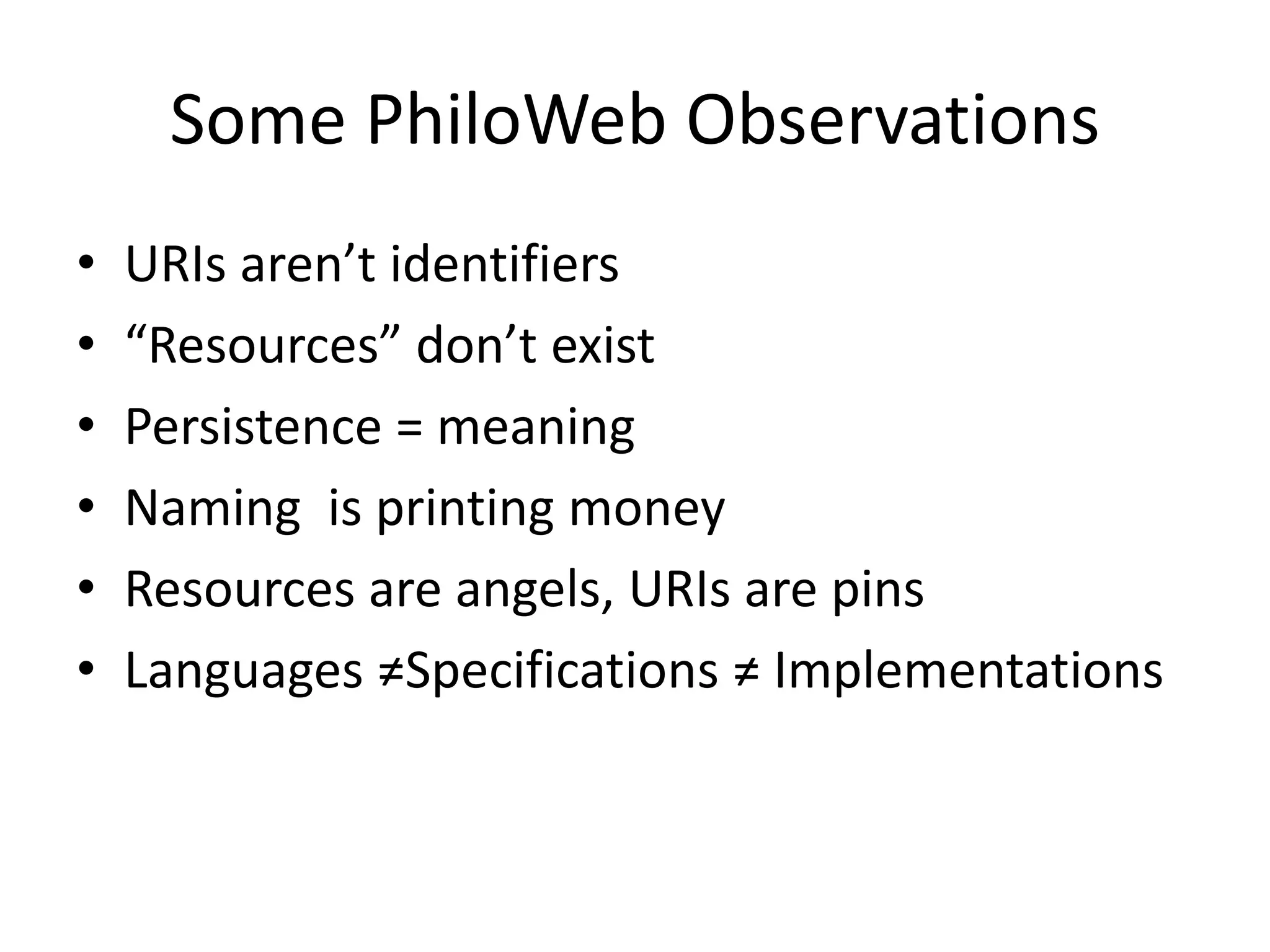
Some PhiloWeb Observations
•   URIs aren’t identifiers
•   “Resources” don’t exist
•   Persistence = meaning
•   Naming is printing money
•   Resources are angels, URIs are pins
•   Languages ≠Specifications ≠ Implementations
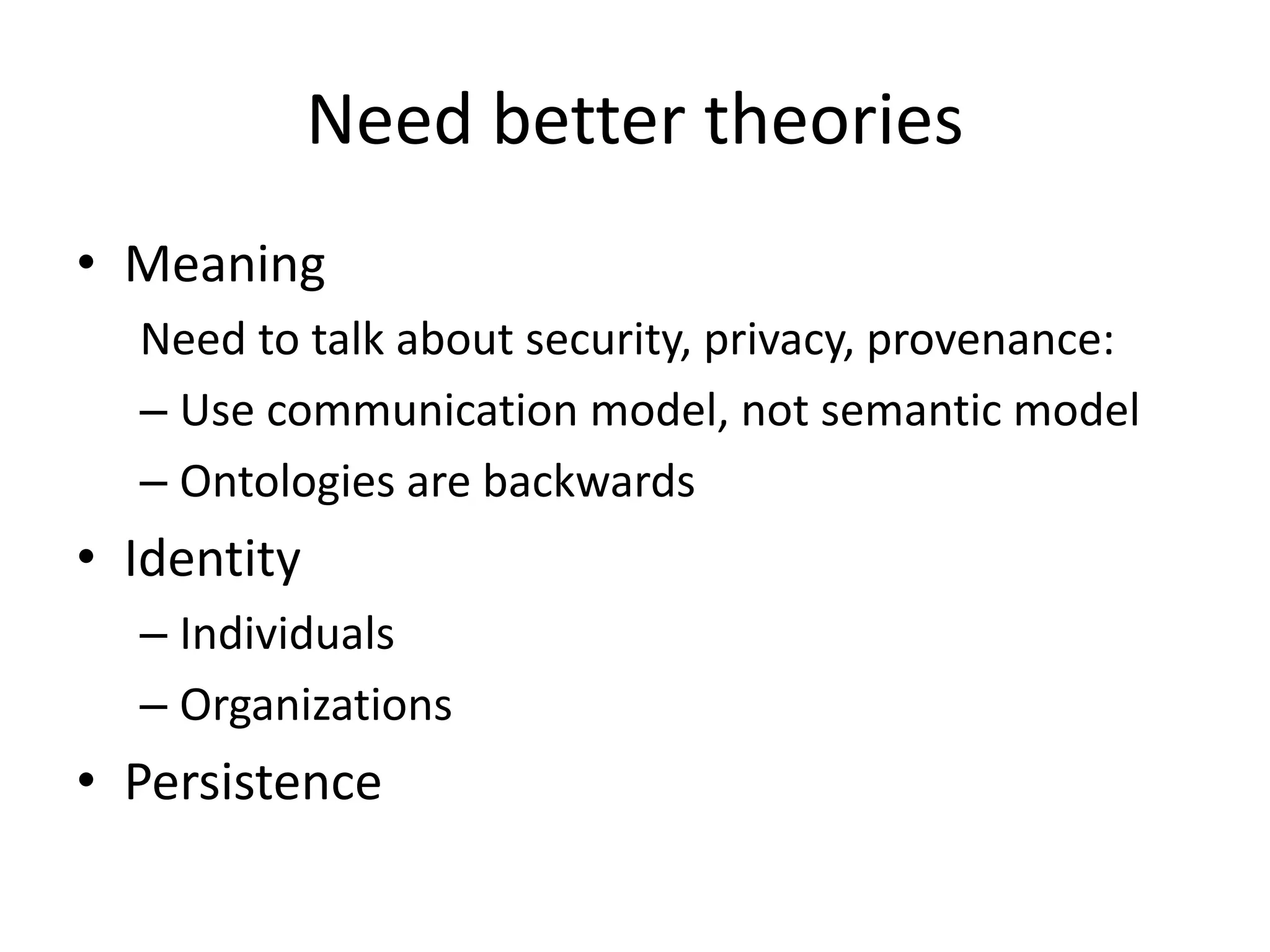
Need better theories
• Meaning
  Need to talk about security, privacy, provenance:
  – Use communication model, not semantic model
  – Ontologies are backwards
• Identity
  – Individuals
  – Organizations
• Persistence
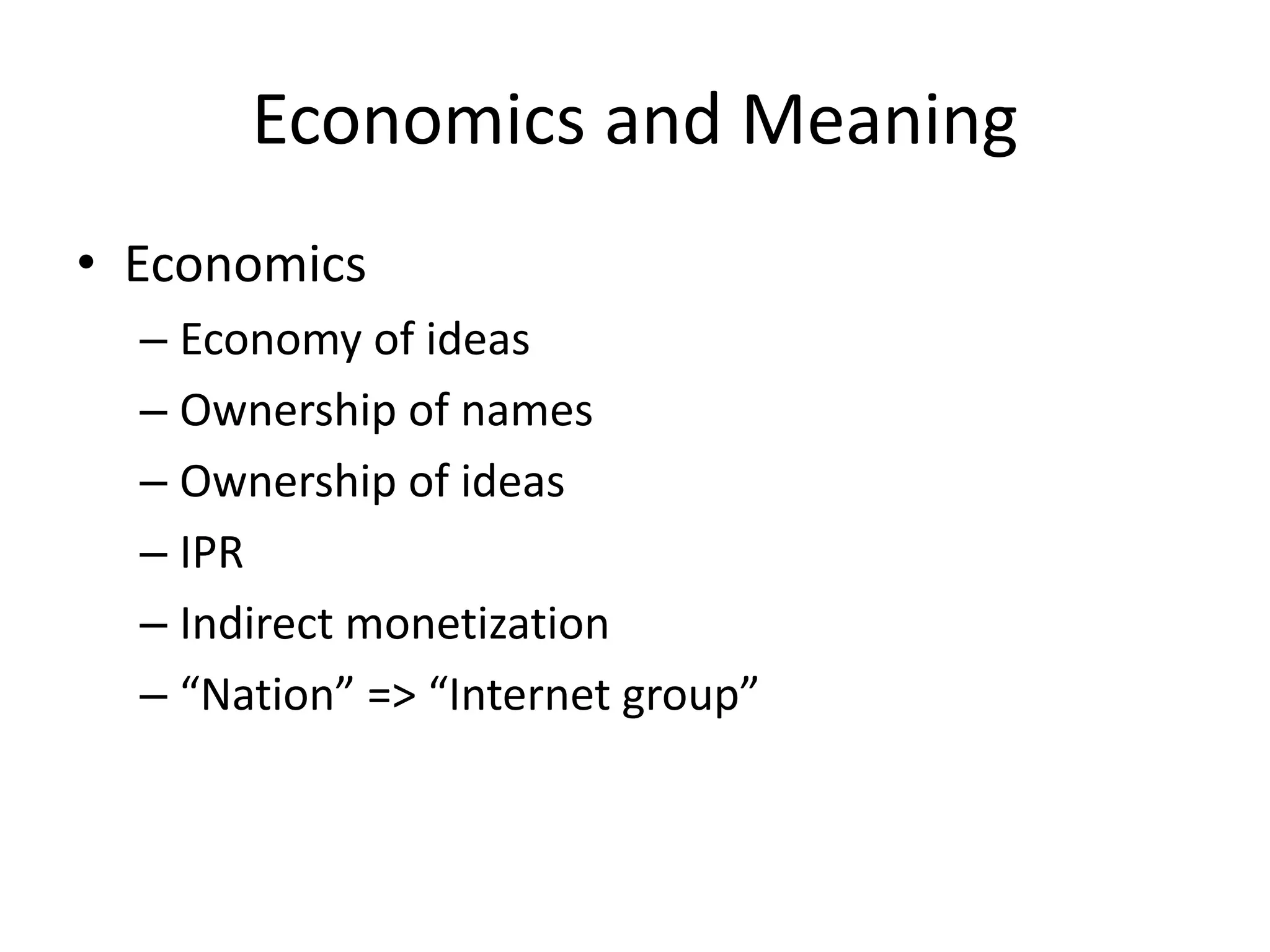
Economics and Meaning
• Economics
  – Economy of ideas
  – Ownership of names
  – Ownership of ideas
  – IPR
  – Indirect monetization
  – “Nation” => “Internet group”
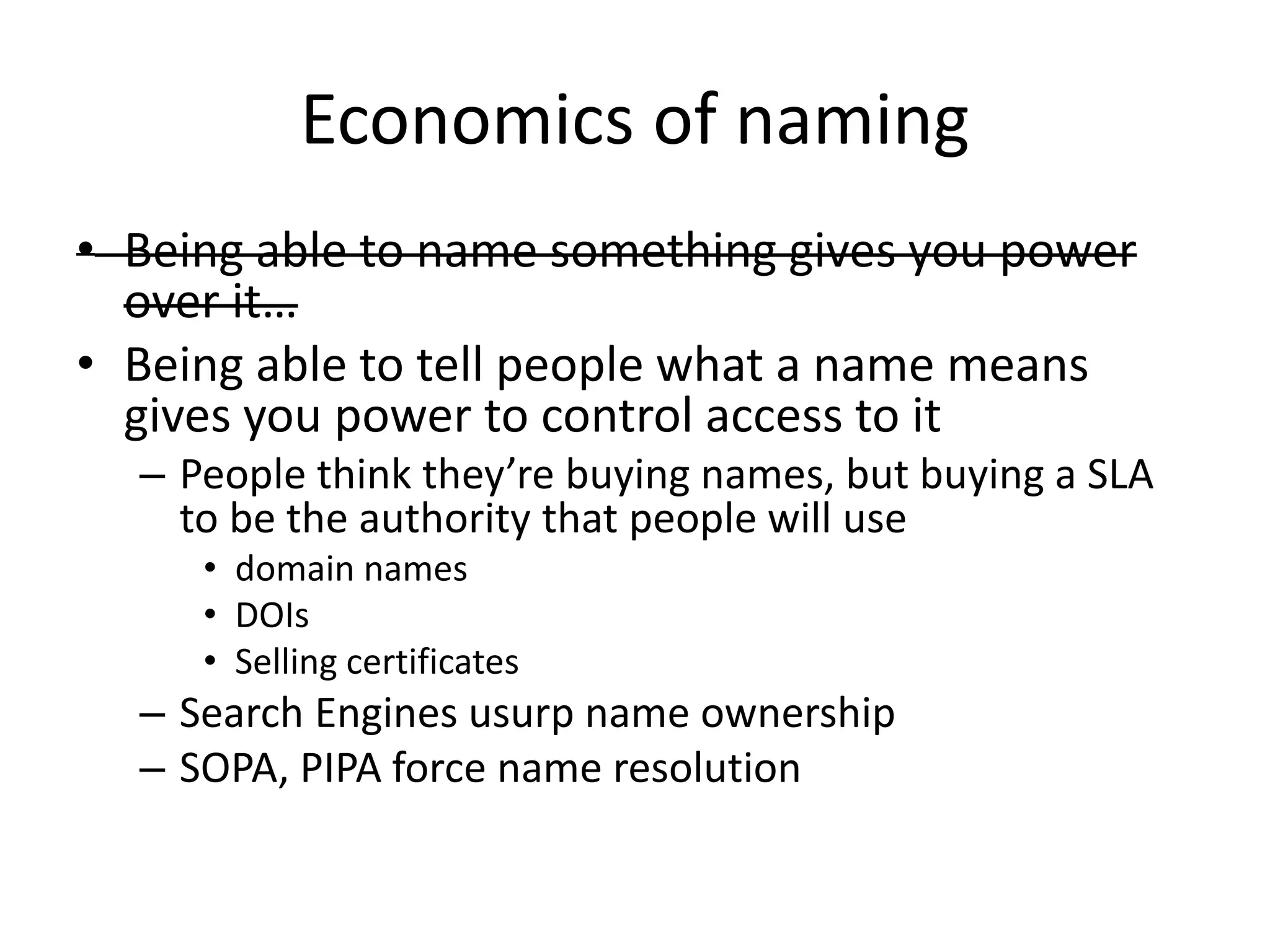
Economics of naming
• Being able to name something gives you power
  over it…
• Being able to tell people what a name means
  gives you power to control access to it
  – People think they’re buying names, but buying a SLA
    to be the authority that people will use
     • domain names
     • DOIs
     • Selling certificates
  – Search Engines usurp name ownership
  – SOPA, PIPA force name resolution
MIME gives the web:
  persistent names for languages
– “persistent”
– “name for”
– “language”
Language, File Format,
              Protocol, Interface
• A language is a way of giving meaning to data
  “Given some data, what does it mean?”
• “File format”: a kind of language
  (binary) languages
• Languages have syntax & vocabulary
• Languages usually use other languages
  – protocol element (a little language)
  – abstract language (defined in terms of structure)
  – layer (SVG on XML on Unicode)
• “URI” is a language, JavaScript, CSS are languages
What is a name?
  How does MIME name languages?
• A name is protocol element
  – with some structure
  – used in other languages, protocols, apis, interfaces
  – Which has some meaning
• Meaning of MIME types
  – “which language should be used to interpret this
    data”
Persistent names
• languages change: how can names be
  persistent?
• With no evolution, updates, extensions to
  languages used in the web: no problems

CORE
• How do languages change?
• What are problems with MIME during
  evolution?
Languages and Implementations
• Languages (as with protocols, protocol elements,
  file formats, APIs) are used between systems to
  communicate
• Systems using a language should mean the
  “same” thing
• Need agreement between the systems that are
  communicating

Interoperability is a property of implementations,
not specifications
Languages and Specifications
• Specifications are documents that describe a
  language and rules for implementations
  – How implementations should “understand” the
    language/API/protocol/protocol element’
Implementations to guide and validate single-
user
• Many specifications used to define a single
  language
• What happens as those evolve?
Standards for Languages
• Standards represent agreements among
  implementations (in the form of a
  specification)
Persistent names for languages
•   What is persistent about the name for a language?
•   What is it that the name of a language identifies?
•   How do languages evolve, grow, change over time?
•   How can the name be persistent when the meaning
    changes?
Persistence and Evolution
• When a language evolves, it keeps its name
• A new language, even if it isn’t very different,
  would get a different name
Wait…
• How do languages evolve?
• What happens to systems that use those
  names with evolving meaning?
“language” is over-simplification
• Languages (file formats, protocols, protocol
  elements) are defined in terms of others
• Complex structure of interrelationships
  between components
• Each component can evolve independently
Implementations evolve
•   The language is “as spoken”, not “as defined”
•   Concrete and abstract languages
•   References to other specification
•   Syntax and parsing
specifications describe Languages
• References in specifications: how do rules
  apply when referenced specification is
  updated
• Editions, version numbers
More complexities
• Content negotiation
  – Different “representations” for same “resource”
• Polyglot
  – Same content in multiple languages
• “multi-view”
  – Same content, different views, treated differently
Registry
• A way of naming something
  – Organization to manage registry
  – Key role of registry is to manage updates
     • When there are compatibility requirements
     • When there are requirements
• Ontology
  – A kind of dictionary / registry
  – Attempt to be proscriptive
Persistent name problems
• Forking (HTML)
• Versioning (javascript)
• References
• Compound languages (HTML + RDFa/lite + SVG +
  MathML)
• Layering

• Generalization: other “persistent names”:
    – Charset (addition of Euro)
    – Other web names (codes, URLs)
Content negotiation
  – Which languages do you understand?
  – Which languages can you speak to me?
• MIME types don’t help much
  – Wrong level of granularity
  – Ambition of reader implementers doesn’t match
    conservative requirements of senders
Persistent names and versions
• “version” parameter requires future proofing
• In-band version identifiers might be preferable
  – Except for “quirks mode” failure cases
• Users would like “version of language”
• Best a specification can give is “version of
  specification”
• Specifications and languages often don’t
  evolve in sync
Being able to name language =
         control over language
• Politics / Economics of standards

• “Owning” the standard
  – Keep others from disadvantaging your products
    or services
  – Perhaps allows you to advantage your products
    and services over others
Wealth of Nations
• Boundary of nations
  – Internet communities transcend
  – Social organizations over the Internet
  – Governance in a global community

PhiloWeb panel. "Philosophy" of the Web

  • 1.
    PhiloWeb panel “Philosophy” ofthe Web Larry Masinter April 17, 2012 Some credentials: Chair, URI Working Group, IETF, 90’s Chair, HTTP working group, IETF, 90’s Chair, Scientific Advisory Board, RealNames Corporation W3C TAG
  • 2.
    Some PhiloWeb Observations • URIs aren’t identifiers • “Resources” don’t exist • Persistence = meaning • Naming is printing money • Resources are angels, URIs are pins • Languages ≠Specifications ≠ Implementations
  • 3.
    Need better theories •Meaning Need to talk about security, privacy, provenance: – Use communication model, not semantic model – Ontologies are backwards • Identity – Individuals – Organizations • Persistence
  • 4.
    Economics and Meaning •Economics – Economy of ideas – Ownership of names – Ownership of ideas – IPR – Indirect monetization – “Nation” => “Internet group”
  • 5.
    Economics of naming •Being able to name something gives you power over it… • Being able to tell people what a name means gives you power to control access to it – People think they’re buying names, but buying a SLA to be the authority that people will use • domain names • DOIs • Selling certificates – Search Engines usurp name ownership – SOPA, PIPA force name resolution
  • 6.
    MIME gives theweb: persistent names for languages – “persistent” – “name for” – “language”
  • 7.
    Language, File Format, Protocol, Interface • A language is a way of giving meaning to data “Given some data, what does it mean?” • “File format”: a kind of language (binary) languages • Languages have syntax & vocabulary • Languages usually use other languages – protocol element (a little language) – abstract language (defined in terms of structure) – layer (SVG on XML on Unicode) • “URI” is a language, JavaScript, CSS are languages
  • 8.
    What is aname? How does MIME name languages? • A name is protocol element – with some structure – used in other languages, protocols, apis, interfaces – Which has some meaning • Meaning of MIME types – “which language should be used to interpret this data”
  • 9.
    Persistent names • languageschange: how can names be persistent? • With no evolution, updates, extensions to languages used in the web: no problems CORE • How do languages change? • What are problems with MIME during evolution?
  • 10.
    Languages and Implementations •Languages (as with protocols, protocol elements, file formats, APIs) are used between systems to communicate • Systems using a language should mean the “same” thing • Need agreement between the systems that are communicating Interoperability is a property of implementations, not specifications
  • 11.
    Languages and Specifications •Specifications are documents that describe a language and rules for implementations – How implementations should “understand” the language/API/protocol/protocol element’ Implementations to guide and validate single- user • Many specifications used to define a single language • What happens as those evolve?
  • 12.
    Standards for Languages •Standards represent agreements among implementations (in the form of a specification)
  • 13.
    Persistent names forlanguages • What is persistent about the name for a language? • What is it that the name of a language identifies? • How do languages evolve, grow, change over time? • How can the name be persistent when the meaning changes?
  • 14.
    Persistence and Evolution •When a language evolves, it keeps its name • A new language, even if it isn’t very different, would get a different name Wait… • How do languages evolve? • What happens to systems that use those names with evolving meaning?
  • 15.
    “language” is over-simplification •Languages (file formats, protocols, protocol elements) are defined in terms of others • Complex structure of interrelationships between components • Each component can evolve independently
  • 16.
    Implementations evolve • The language is “as spoken”, not “as defined” • Concrete and abstract languages • References to other specification • Syntax and parsing
  • 17.
    specifications describe Languages •References in specifications: how do rules apply when referenced specification is updated • Editions, version numbers
  • 18.
    More complexities • Contentnegotiation – Different “representations” for same “resource” • Polyglot – Same content in multiple languages • “multi-view” – Same content, different views, treated differently
  • 19.
    Registry • A wayof naming something – Organization to manage registry – Key role of registry is to manage updates • When there are compatibility requirements • When there are requirements • Ontology – A kind of dictionary / registry – Attempt to be proscriptive
  • 20.
    Persistent name problems •Forking (HTML) • Versioning (javascript) • References • Compound languages (HTML + RDFa/lite + SVG + MathML) • Layering • Generalization: other “persistent names”: – Charset (addition of Euro) – Other web names (codes, URLs)
  • 21.
    Content negotiation – Which languages do you understand? – Which languages can you speak to me? • MIME types don’t help much – Wrong level of granularity – Ambition of reader implementers doesn’t match conservative requirements of senders
  • 22.
    Persistent names andversions • “version” parameter requires future proofing • In-band version identifiers might be preferable – Except for “quirks mode” failure cases • Users would like “version of language” • Best a specification can give is “version of specification” • Specifications and languages often don’t evolve in sync
  • 23.
    Being able toname language = control over language • Politics / Economics of standards • “Owning” the standard – Keep others from disadvantaging your products or services – Perhaps allows you to advantage your products and services over others
  • 24.
    Wealth of Nations •Boundary of nations – Internet communities transcend – Social organizations over the Internet – Governance in a global community