Philippines
Health System and Financing
Karlo Paolo P. Paredes
karlo@snu.ac.kr
October 30, 2015
KSP – ADB Universal Health Coverage Regional Forum
Asian Development Bank, Manila, Philippines
Contents
•Introduction
•Strategic purchasing
• Benefit coverage
• Payment system for health providers
• Contractual relations with providers
• Review and assessment / quality of care
•Challenges and Policy Recommendations
KSP – ADB Universal Health Coverage Regional Forum
GDP and Health Expenditure
• The Philippines’ economy
enjoyed continuous growth
since 2009 and will continue to
do so in the coming year (ADB
projection at 6.3% in 2016).
• Health expenditure per capita
is also increasing but not at
the same pace as the
country’s GDP growth
KSP – ADB Universal Health Coverage Regional Forum
Leading Health Problems (1990-2013)
• The Philippines is in epidemiological transition;
Disease of both communicable and non-
communicable in cause are simultaneously
affecting the population.
• Communicable disease continues to decline but
non-communicable diseases are emerging;
• Lower respiratory infection decreased 68%
from 1990;
• 43% and 48% increases in ischemic heart
and cardio-vascular diseases were noted from
1990 data. (170% increase in diabetes)
KSP – ADB Universal Health Coverage Regional Forum
Leading causes of disability-adjuster life years in 2013
and percent change, 1990-2013
Source: http://www.healthdata.org/philippines
Key health reform milestones (1)
KSP – ADB Universal Health Coverage Regional Forum
Year Milestone
1979
Adoption of the primary health care (post alma ata convention on
PHC)
1987
Reorganization of the Ministry (later Department) of Health
through EO 119
1991 Devolution of health services (RA 7160 - Local Government Code)
1995
National Health Insurance Law creates the Philippine Health
Insurance Corporation (Philhealth) with a mandate to expand
health insurance coverage to all Filipinos
1999 The Health Sector Reform Agenda (HSRA) was initiated
2005
The FOURmula ONE (F1) for health was initiated; follow-up to the
reforms made after the HSRA
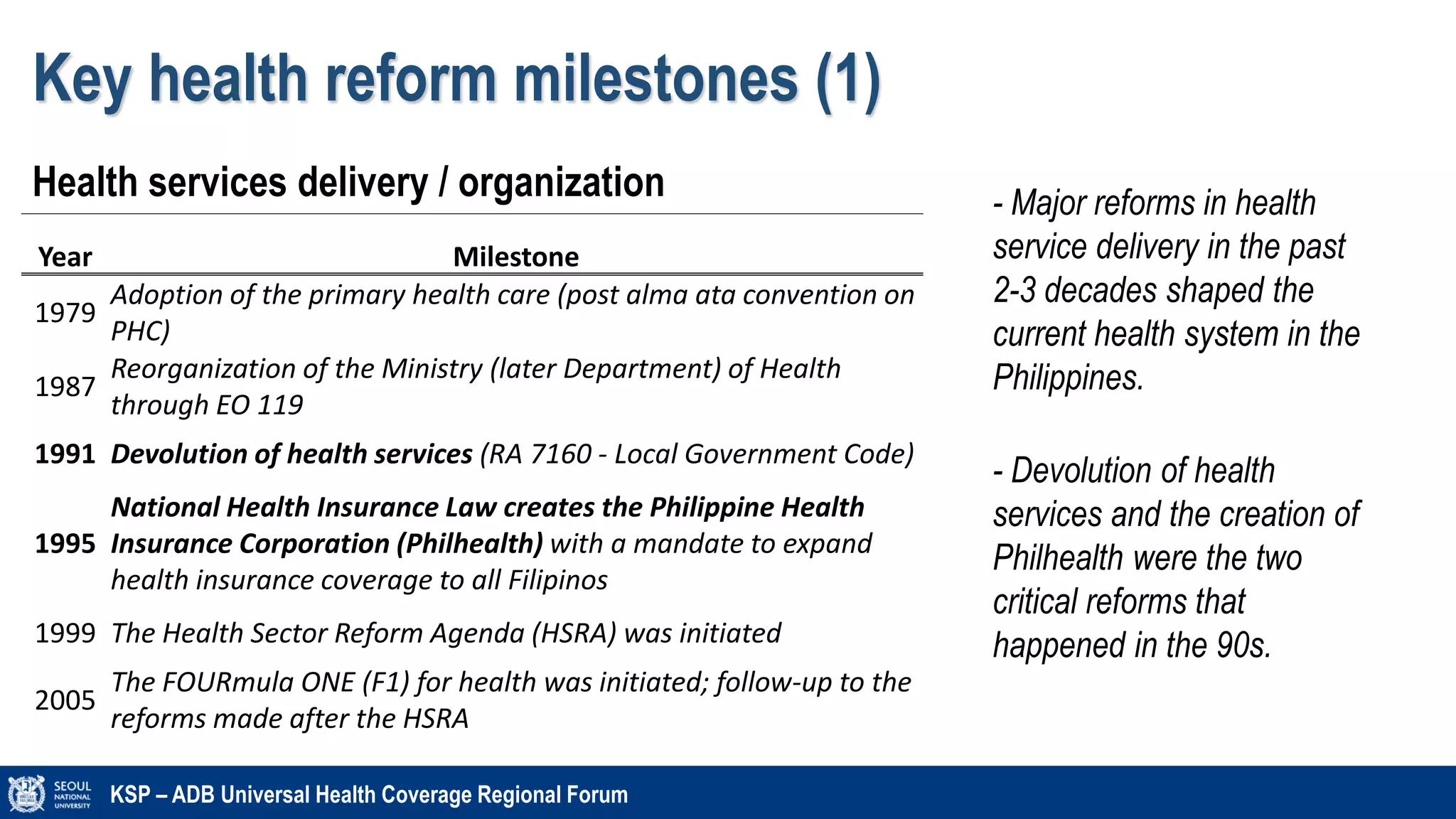
Health services delivery / organization - Major reforms in health
service delivery in the past
2-3 decades shaped the
current health system in the
Philippines.
- Devolution of health
services and the creation of
Philhealth were the two
critical reforms that
happened in the 90s.
Key health reform milestones (2)
KSP – ADB Universal Health Coverage Regional Forum
Year Milestone
2010
Universal Health Care restructures premium payments for the poorest
income quintiles comprising 40 percent population (UHC - Aquino Health
Agenda)
2011
Universal Health Coverage (locally: Kalusugan Pangkalahatan)
launched; DOH DO 2011-0188
2011
Universal Health Care restructures benefits through the No Balance
Billing Policy for designed case rates (initial 23 case rates)
2012
Sin Tax Law was enacted through RA 10351 restructuring the excise tax
on alcohol and tobacco products
2013
Second amendment of the National Health Insurance Act of 1995 through
RA 10606
2013 Philhealth shift of provider payment from FFS to Case-based payments
Health financing and UHC
- The country’s road to UHC
started to take form in 2010, with
the movement to insure the
poorest Filipinos (40%).
- Following the extensive attention
to UHC, the DOH’s KP/UHC policy
and the No Balance Billing (NBB)
policy was launched in 2011.
- Succeeding reforms include
additional financing for health (sin
tax), shift to case payments, etc.
Health system organization
KSP – ADB Universal Health Coverage Regional Forum
Region* BHS RHU Hospital Total
CordilleraAdministrative Region (CAR) 792 98 58 948
National Capital Region (NCR) 493 20 216 729
Region I (Ilocos Region) 1,158 150 125 1,433
Region II (Cagayan Valley) 1,336 97 97 1,530
Region III (Central Luzon) 1,858 290 218 2,366
Region IV-A (CALABARZON) 2,373 232 263 2,868
Region IV-B (MIMAROPA) 1,103 82 66 1,251
Region V (Bicol Region) 1,144 135 122 1,401
Region VI (Western Visayas) 1,878 147 95 2,120
Region VII (Central Visayas) 2,025 160 111 2,296
Region VIII (Eastern Visayas) 900 152 84 1,136
Region IX (Zamboanga Peninsula) 732 92 68 892
Region X (Nothern Mindanao) 1,304 122 110 1,536
Region XI (Davao Region) 1,118 69 114 1,301
Region XII (SOCCSKSARGEN) 1,095 53 107 1,255
Region XIII (CARAGA) 685 82 59 826
Autonomus Region in Muslim Mindanao (ARMM) 452 133 44 629
TOTAL 19,994 1,981 1,913 23,888
* Provinces of Negros Island Region still part of regions VI and VII (Established: May 21, 2015)
Source: National Health Facility Registry v2.0 (Accessed Sept. 30, 2015)
• Primary health facilities (BHSs & RHUs) are
maintained by Local Government Units
(LGUs).
 Primary health services (Immunization,
basic maternal and child health
programs, and others) are provided in
primary health facilities.
• 36% of Hospitals are located in 3 regions
alone. The remaining 64% are shared by the
other 14 regions.
 Less populated regions / rural areas may
have lower physical access to hospital
facilities.
Health Financing (1): Total Health Spending
KSP – ADB Universal Health Coverage Regional Forum
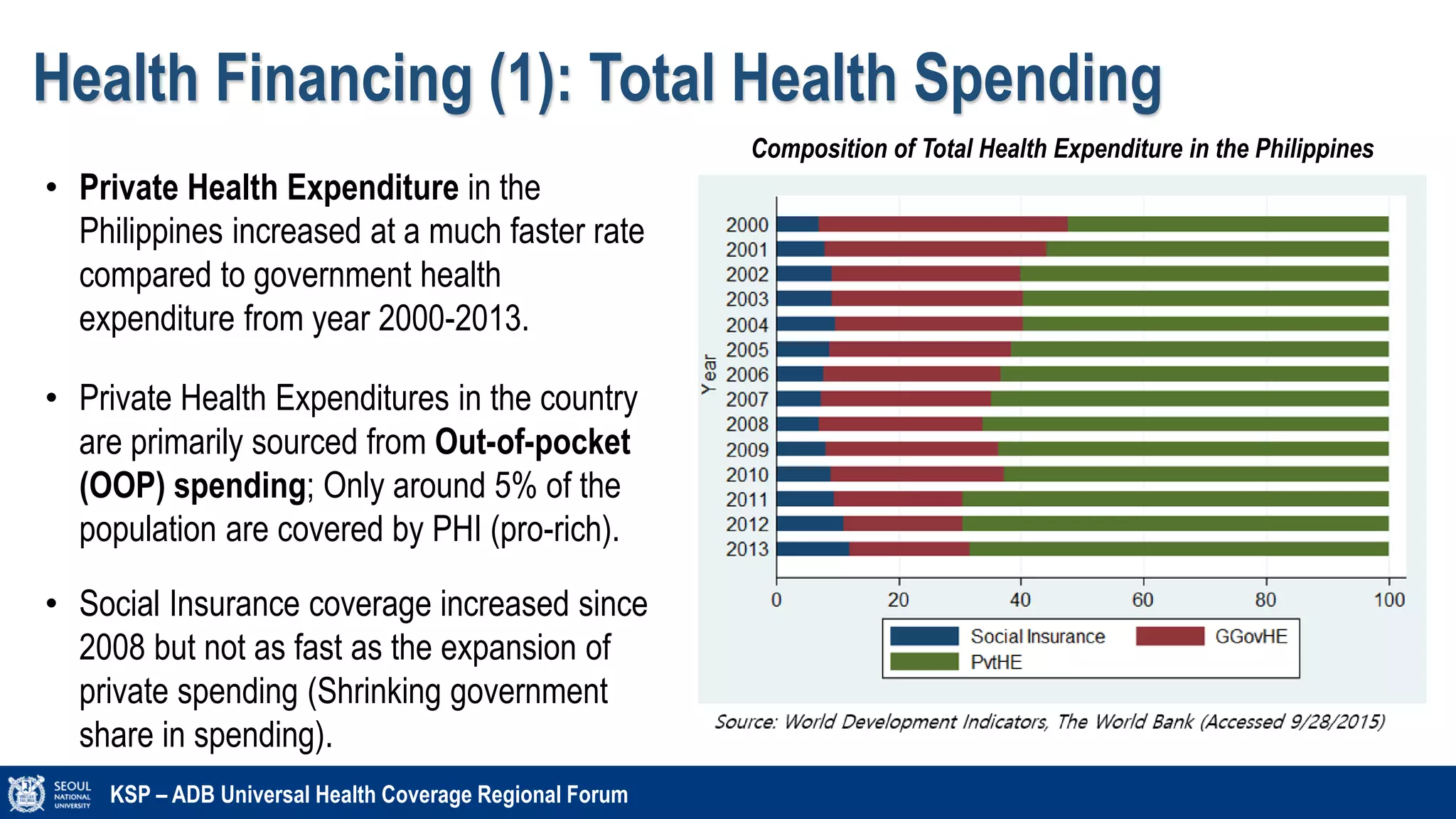
Composition of Total Health Expenditure in the Philippines
• Private Health Expenditure in the
Philippines increased at a much faster rate
compared to government health
expenditure from year 2000-2013.
• Private Health Expenditures in the country
are primarily sourced from Out-of-pocket
(OOP) spending; Only around 5% of the
population are covered by PHI (pro-rich).
• Social Insurance coverage increased since
2008 but not as fast as the expansion of
private spending (Shrinking government
share in spending).
Health Financing (2): OOP
KSP – ADB Universal Health Coverage Regional Forum
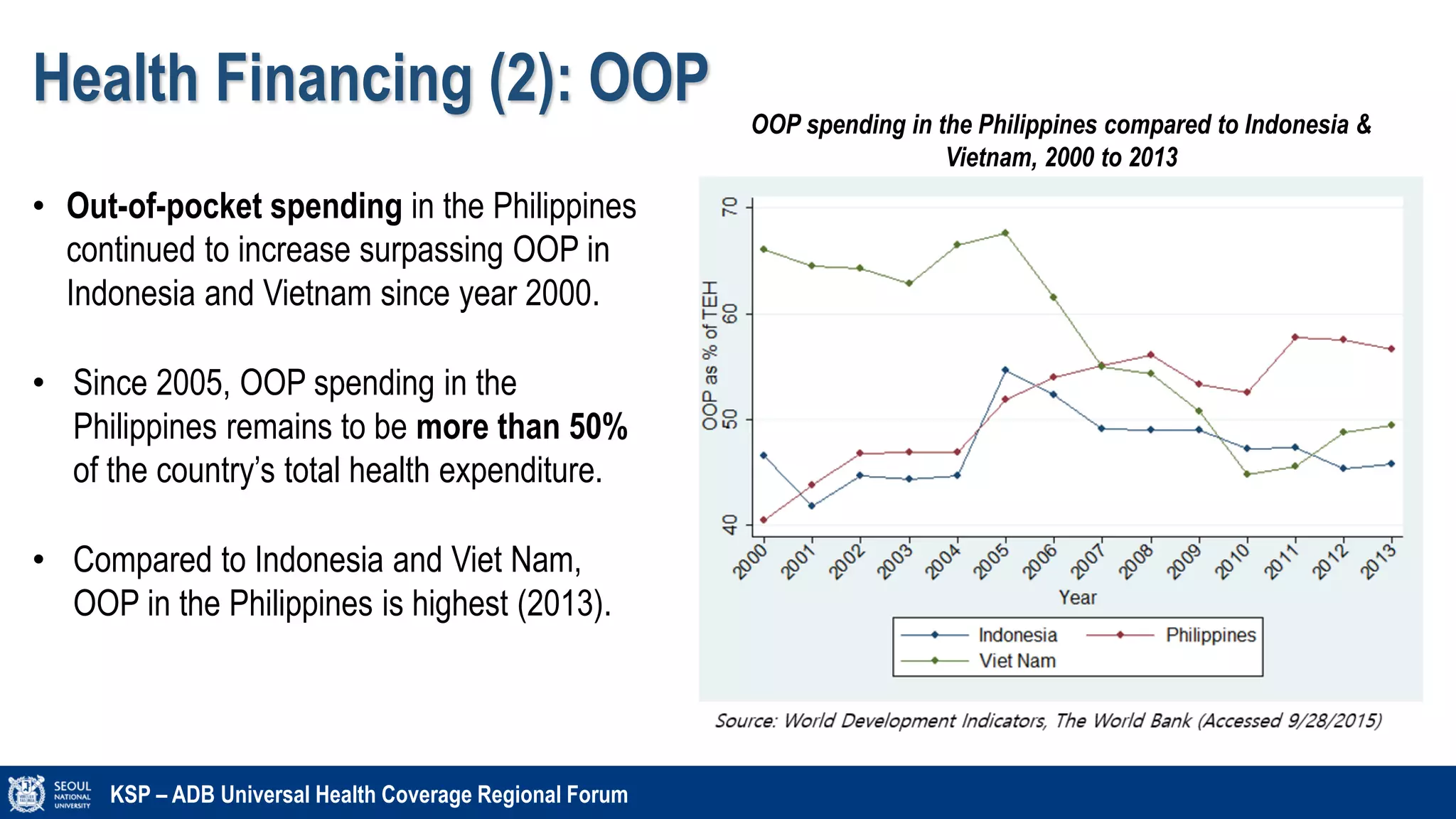
• Out-of-pocket spending in the Philippines
continued to increase surpassing OOP in
Indonesia and Vietnam since year 2000.
OOP spending in the Philippines compared to Indonesia &
Vietnam, 2000 to 2013
• Since 2005, OOP spending in the
Philippines remains to be more than 50%
of the country’s total health expenditure.
• Compared to Indonesia and Viet Nam,
OOP in the Philippines is highest (2013).
Health Financing (3): Population coverage
KSP – ADB Universal Health Coverage Regional Forum
• Members from the (1) Private Sector, (2)
Sponsored category continues to
increase from 2011-2015.
RegisteredMembers(Primary)
MembershipCategory 2011 2012 2013 2014 2015* Trend Remarks
FS- Private 8.85 9.61 10.3 11.00 11.33 Increased
FS - Government 2.01 2.03 2.07 1.95 1.98 Decreased
Sponsored** 9.57 8.29 9.61 19.08 20.59 Increased
IP- Informal*** 4.34 5.06 5.38 2.48 2.58 Decreased
Lifetime 0.57 0.66 0.77 0.93 0.96 Increased
OWP 2.57 2.84 3.14 0.96 1.09 Decreased
TOTAL 27.91 28.49 31.27 36.41 38.52
PhilhealthPopulation
Coverage
82% 84% 79% 87% 88%
Notes:
Source:2011-2015 Stats and Charts,http://www.philhealth.gov.ph/about_us/statsncharts/ (Accessed 10/01/2015)
*1stSemesterof 2015 (June30,2015)
**Sponsored for2014 & 2015:Total members fromIndigents,Sponsored Members & SeniorCitizens
***Informal for2014 & 2015:Total members fromInformal Sector,Household Help,Enterprise/ Driver,Self-Earning individuals,
Organized Groups
SeniorCitizen:Accounts for18.5%and 23.3%of total sponsored members in 2014 and 2015
• Members from the informal sector
(individually paying, household help,
drivers and organized group) and
government employees (formal sector)
decreased in 2014 and 2015.
Philhealth Members
• 88% of all primary members are from the
Formal Sector and the Poor (sponsored)
– Missing middle?
• Population coverage (Philhealth
computation): 88% in 2015
Health Financing (4): Population coverage (con’t)
KSP – ADB Universal Health Coverage Regional Forum
• Population coverage from household surveys
may also reflect household’s awareness of
their insurance status = more household are
aware of their insurance status in 2013.
Philhealth Coverage from National Household Surveys, 2008 & 2013
2008 2013
Lowest 19.60% 61.60% 42%
Second 28.60% 55.60% 27%
Middle 35.30% 52.20% 17%
Fourth 48.20% 59.40% 11%
Highest 57% 72.70% 16%
Note:
*Absolute increase = 2013 coverage - 2008 coverage
Source: NDHS 2008, 2013
Population Coverage
Income
quintile
Absolute increase*
in percentage
(Baseline 2011)
• Population coverage significantly
increased from 2008 to 2013 especially for
the lowest and second lowest quintile
(poorest and next poorest); This reflects
improvements Philhealth coverage for the
poor.
Strategic purchasing
KSP – ADB Universal Health Coverage Regional Forum
Benefit coverage | Payment system for health providers | Contractual
relations with providers | Review and assessment / quality of care
A. Benefit Coverage (1)
KSP – ADB Universal Health Coverage Regional Forum
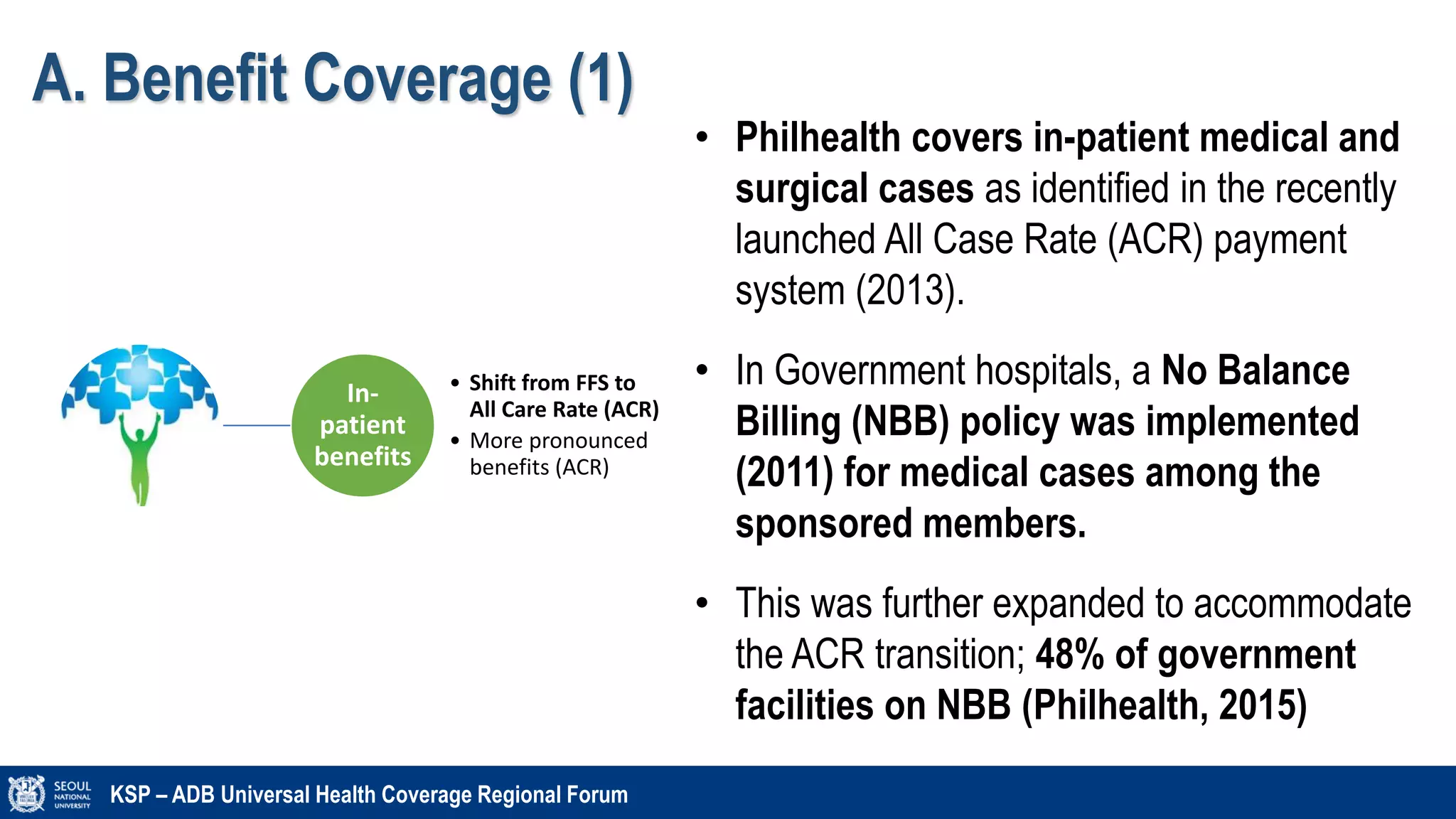
In-
patient
benefits
• Shift from FFS to
All Care Rate (ACR)
• More pronounced
benefits (ACR)
• Philhealth covers in-patient medical and
surgical cases as identified in the recently
launched All Case Rate (ACR) payment
system (2013).
• In Government hospitals, a No Balance
Billing (NBB) policy was implemented
(2011) for medical cases among the
sponsored members.
• This was further expanded to accommodate
the ACR transition; 48% of government
facilities on NBB (Philhealth, 2015)
A. Benefit Coverage (2)
KSP – ADB Universal Health Coverage Regional Forum
• Out-patient benefit packages are designed
per specific services provided in out-
patient facility. For example, RHUs can be
accredited in one or all of the PCB
(Tsekap), MCP, TB-DOTS, Malaria, etc.
In-
patient
benefits
• Shift from FFS to All
Care Rate (ACR)
• More pronounced
benefits (ACR)
Out-
patient
benefits
• Out-patient benefit
packages for RHUs/HCs
(OPB, MCP, TB-DOTS)
• Other OP benefits (ASC,
RT, OBT, DC)
• Other accredited out-patient services by
Philhealth includes (1) Ambulatory
Surgical Clinics (ACS) [private facilities],
(2) Dialysis centers (DC) [private & public];
Others: Outpatient blood centers and
Radiotherapy
A. Benefit Coverage (3)
KSP – ADB Universal Health Coverage Regional Forum
• Philhealth’s Z-Benefit package covers selected
medical cases (cardio-vascular diseases, cancers,
etc.) that have the potential to cause
catastrophic spending.
In-
patient
benefits
• Shift from FFS to All
Care Rate (ACR)
• More pronounced
benefits (ACR)
Out-
patient
benefits
• Out-patient benefit
packages for RHUs/HCs
(OPB, MCP, TB-DOTS)
• Other OP benefits
(ASC, RT, OBT, DC)
Z-
benefit
package
• Catastrophic care
packages
(Implemented in
selected Hospitals)
• Only available in selected accredited facilities;
which is still very limited (e.g. CABG Surgery
coverage is only covered in three hospitals in the
country – 1 each in NCR, Region VII and Region
XI)
• Z-benefit provides the most generous coverage
of Philhealth in selected accredited institutions
(e.g. single claim can reach 550,000 Php).
A. Benefit Coverage (4)
KSP – ADB Universal Health Coverage Regional Forum
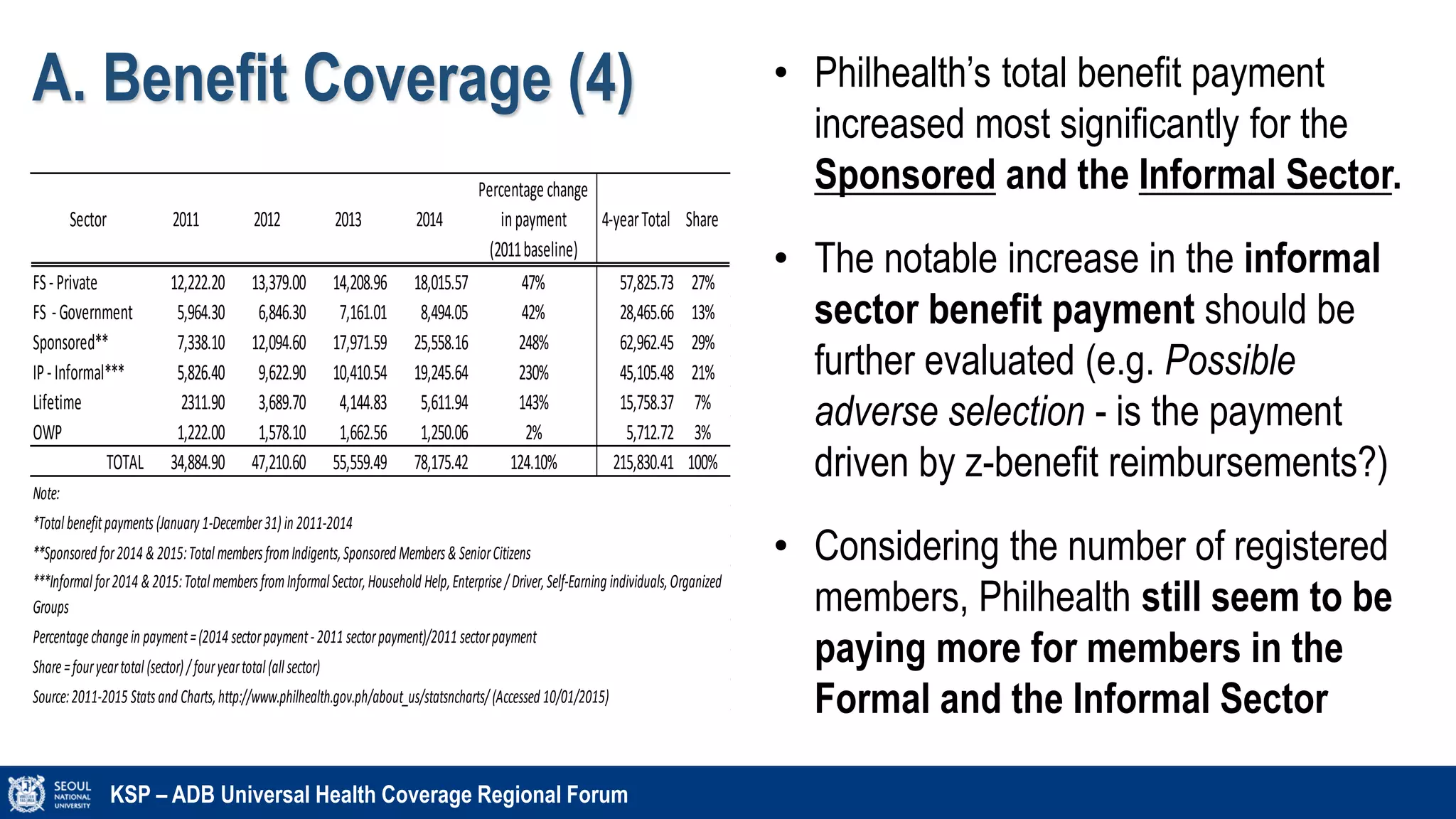
• Philhealth’s total benefit payment
increased most significantly for the
Sponsored and the Informal Sector.
• The notable increase in the informal
sector benefit payment should be
further evaluated (e.g. Possible
adverse selection - is the payment
driven by z-benefit reimbursements?)
• Considering the number of registered
members, Philhealth still seem to be
paying more for members in the
Formal and the Informal Sector
Sector 2011 2012 2013 2014
Percentagechange
inpayment
(2011baseline)
4-yearTotal Share
FS-Private 12,222.20 13,379.00 14,208.96 18,015.57 47% 57,825.73 27%
FS -Government 5,964.30 6,846.30 7,161.01 8,494.05 42% 28,465.66 13%
Sponsored** 7,338.10 12,094.60 17,971.59 25,558.16 248% 62,962.45 29%
IP-Informal*** 5,826.40 9,622.90 10,410.54 19,245.64 230% 45,105.48 21%
Lifetime 2311.90 3,689.70 4,144.83 5,611.94 143% 15,758.37 7%
OWP 1,222.00 1,578.10 1,662.56 1,250.06 2% 5,712.72 3%
TOTAL 34,884.90 47,210.60 55,559.49 78,175.42 124.10% 215,830.41 100%
Note:
*Totalbenefitpayments(January 1-December31)in 2011-2014
Percentagechangein payment=(2014 sectorpayment-2011 sectorpayment)/2011 sectorpayment
Share=fouryeartotal(sector)/fouryeartotal(allsector)
Source:2011-2015 Statsand Charts,http://www.philhealth.gov.ph/about_us/statsncharts/(Accessed 10/01/2015)
***Informalfor2014 &2015:TotalmembersfromInformalSector,Household Help,Enterprise/Driver,Self-Earning individuals,Organized
Groups
**Sponsored for2014 &2015:TotalmembersfromIndigents,Sponsored Members&SeniorCitizens
B. Payment system for health care providers (1)
KSP – ADB Universal Health Coverage Regional Forum
Government
Facilities
Private Facilities
Budget
PHI
Premium (Pro-Rich)
Philhealth
Premium
Government
Subsidized Group
Free
NBB?
BB
ACR
ACR
OOP
Philhealth
Payments
*NBB = No Balance Billing
BB = Balance Billing
B. Payment system for health care providers (2)
KSP – ADB Universal Health Coverage Regional Forum
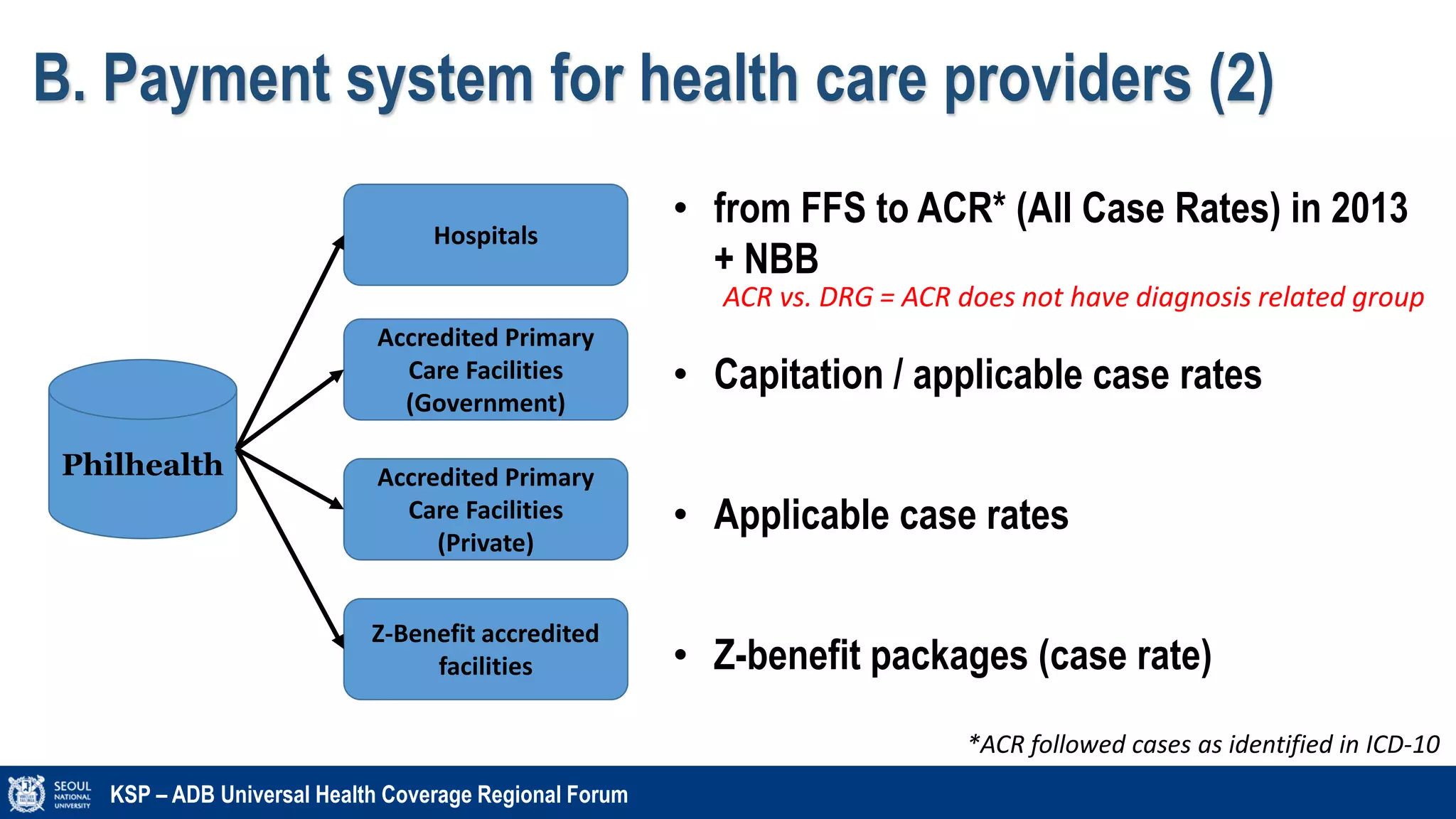
Philhealth
• from FFS to ACR* (All Case Rates) in 2013
+ NBB
Hospitals
Accredited Primary
Care Facilities
(Government)
Accredited Primary
Care Facilities
(Private)
Z-Benefit accredited
facilities
• Capitation / applicable case rates
• Applicable case rates
• Z-benefit packages (case rate)
*ACR followed cases as identified in ICD-10
ACR vs. DRG = ACR does not have diagnosis related group
C. Contractual relations with providers (1)
KSP – ADB Universal Health Coverage Regional Forum
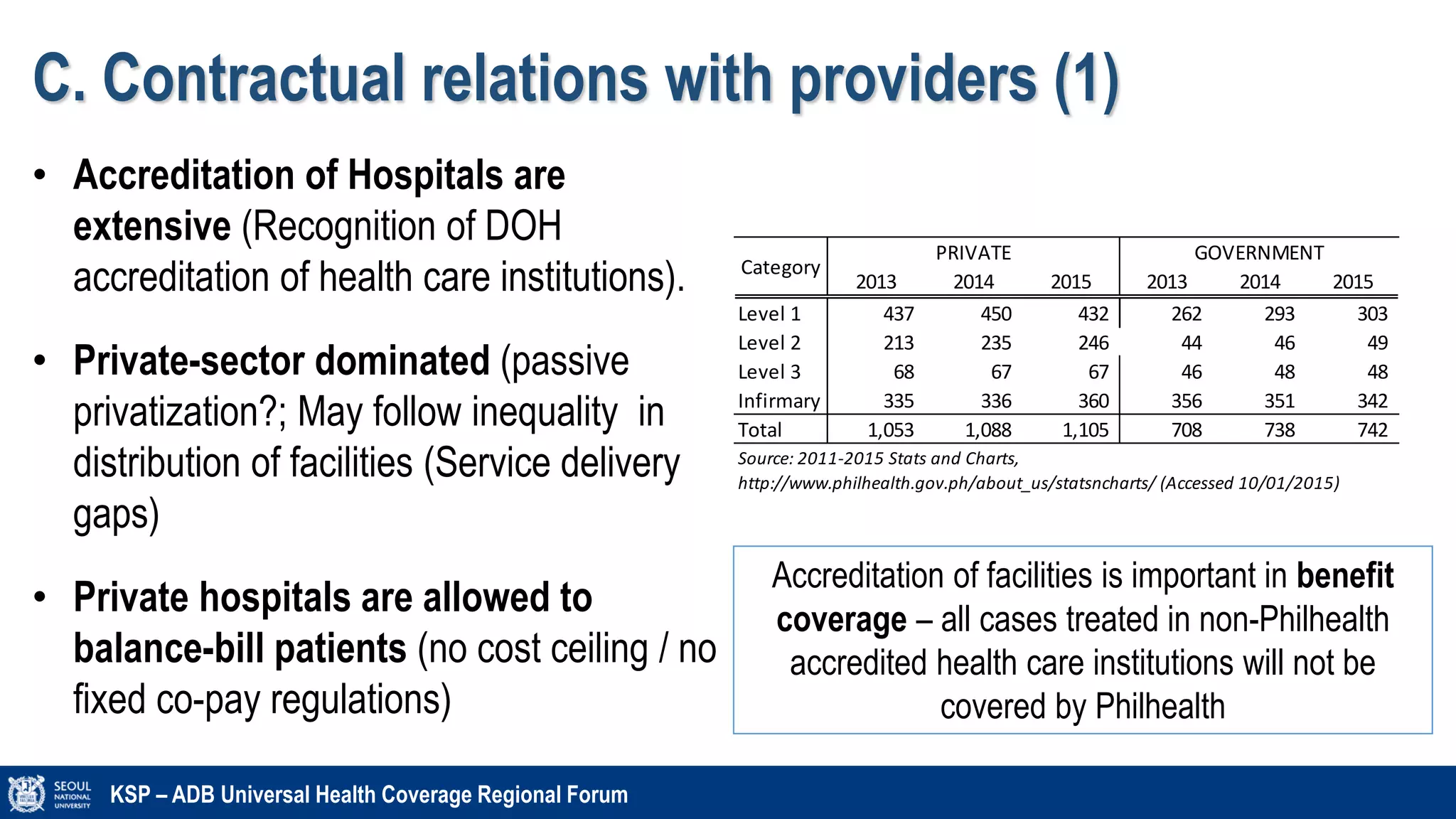
• Accreditation of Hospitals are
extensive (Recognition of DOH
accreditation of health care institutions).
• Private-sector dominated (passive
privatization?; May follow inequality in
distribution of facilities (Service delivery
gaps)
• Private hospitals are allowed to
balance-bill patients (no cost ceiling / no
fixed co-pay regulations)
2013 2014 2015 2013 2014 2015
Level 1 437 450 432 262 293 303
Level 2 213 235 246 44 46 49
Level 3 68 67 67 46 48 48
Infirmary 335 336 360 356 351 342
Total 1,053 1,088 1,105 708 738 742
Category
GOVERNMENT
Source: 2011-2015 Stats and Charts,
http://www.philhealth.gov.ph/about_us/statsncharts/ (Accessed 10/01/2015)
PRIVATE
Accreditation of facilities is important in benefit
coverage – all cases treated in non-Philhealth
accredited health care institutions will not be
covered by Philhealth
C. Contractual relations with providers (2)
KSP – ADB Universal Health Coverage Regional Forum
• PCB accreditation is relatively distributed
throughout the region (with limitations in
regions I, II and regions in Mindanao)
• TB-DOTS and MCP have relatively wide
distribution; MCP heavily participated by the
private sector (private lying-in clinics) but
problematic regions (low accreditation) still
exist.
• Other accreditation types (ASC and DC) is
heavily concentrated in Metro Manila; Few
accredited facilities in other regions.
Priv Govt Priv Govt Priv Govt Priv Govt Priv Govt
CordilleraAdministrative Region (CAR) 3 66 - 100 7 91 1 - 4 -
National Capital Region (NCR) 6 83 - 305 107 10 66 - 72 -
Region I (Ilocos Region) 2 13 - 8 ** ** 3 - 7 -
Region II (Cagayan Valley) 1 ** - 12 23 17 4 - 3 -
Region III (Central Luzon) 1 27 - 101 87 15 12 - 22 1
Region IV-A (CALABARZON) 2 29 - 150 69 23 10 - 19 -
Region IV-B(MIMAROPA) 1 38 - 59 6 35 - - 1 -
Region V (Bicol Region) 5 53 - 81 52 38 3 - 5 -
Region VI (Western Visayas) 4 73 - 70 36 38 4 - 6 -
Region VII (Central Visayas) 8 97 - 123 43 75 3 - 5 -
Region VIII (Eastern Visayas) 1 124 - 139 55 169 2 - 2 -
Region IX (ZamboangaPeninsula) 0 30 - 63 - 18 2 - 1 -
Region X (Nothern Mindanao) 1 2 ** ** ** ** 2 - 3 -
Region XI (Davao Region) 5 2 - 3 7 2 1 - 6 -
Region XII (SOCCSKSARGEN) 1 44 ** ** 10 12 3 - 2 -
Region XIII (CARAGA) 3 34 - 27 5 4 1 - 1 -
Autonomus Region in MuslimMindanao (ARMM) 0 63 - 70 19 61 - - - -
TOTAL 44 778 - 1,241 507 547 117 - 159 1
*Provinces of Negros Island Region still partof regions VI and VII (Established:May 21, 2015)
**No data reported
Source:Philhealth listof accredited providers as of March 20, 2015 (Accessed Sept. 30, 2015)
TB-DOTS =Tuberculosis DOTS;PCB =Primary Care Benefit;MCP =Maternity Care Package;ASC =Ambulatory Surgical Clinic;DC =Dialysis Center
TB-DOTS PCB MCP ASC
Region*
DC
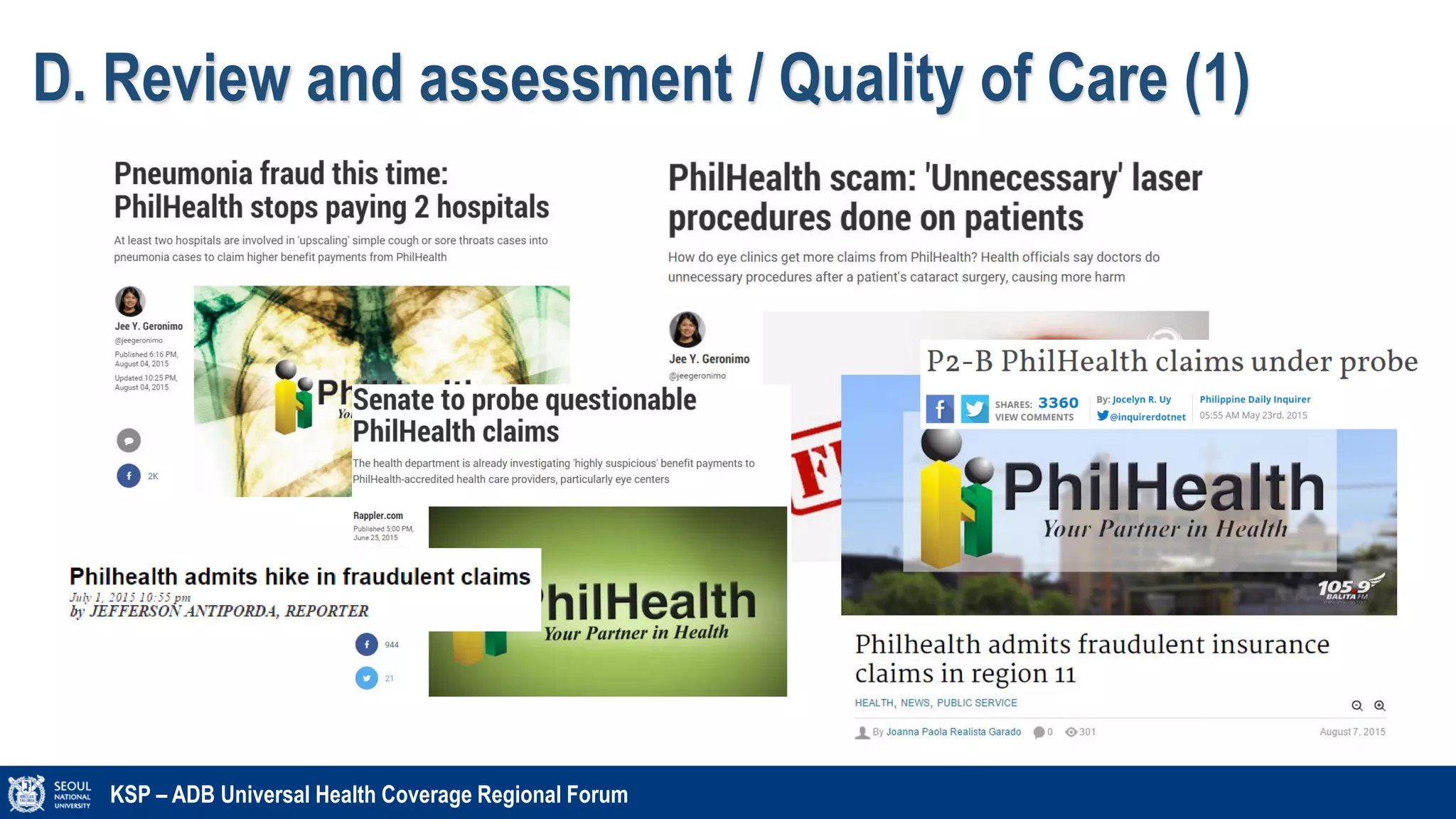
D. Review and assessment / Quality of Care (1)
KSP – ADB Universal Health Coverage Regional Forum
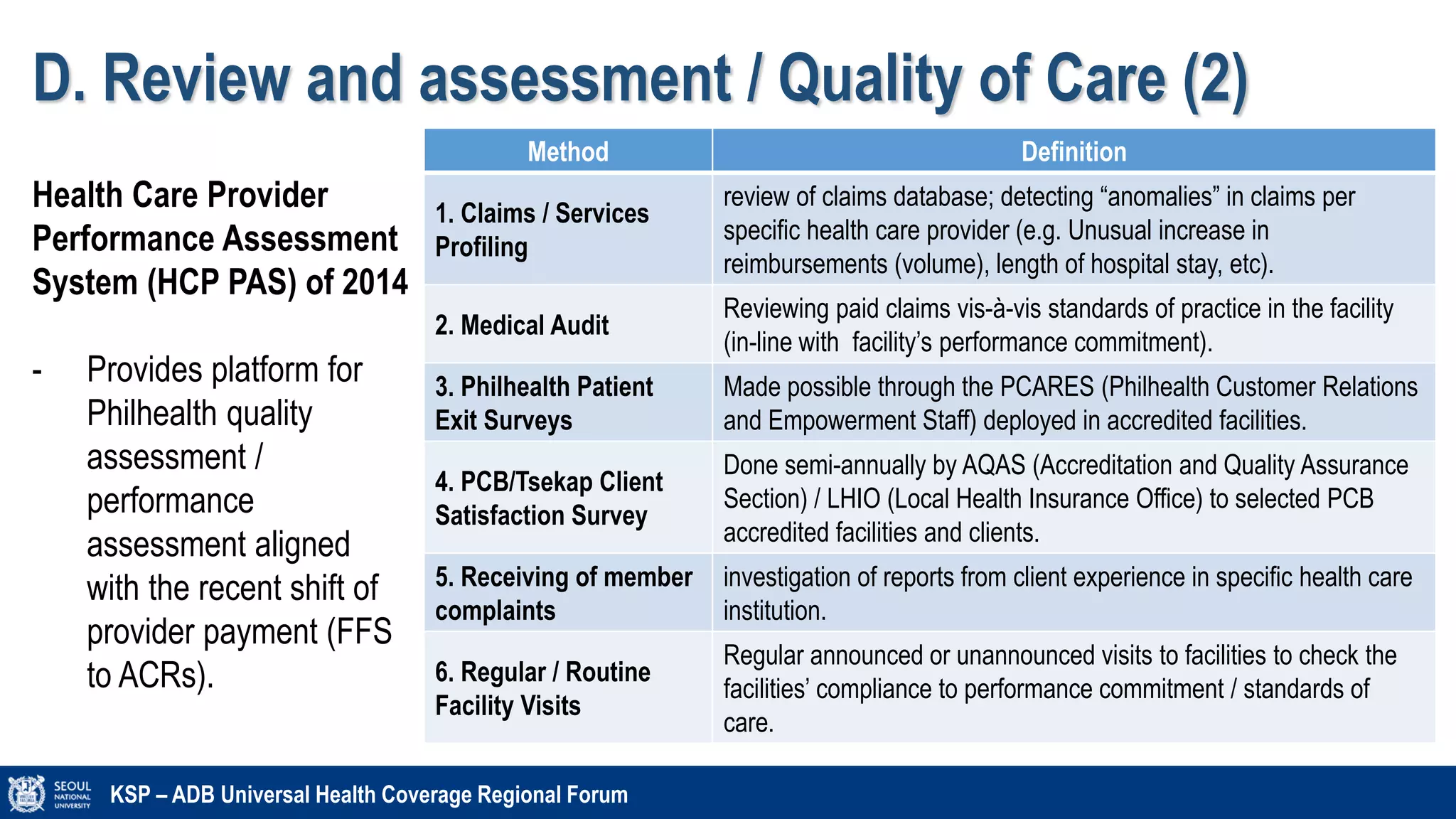
D. Review and assessment / Quality of Care (2)
KSP – ADB Universal Health Coverage Regional Forum
Health Care Provider
Performance Assessment
System (HCP PAS) of 2014
- Provides platform for
Philhealth quality
assessment /
performance
assessment aligned
with the recent shift of
provider payment (FFS
to ACRs).
Method Definition
1. Claims / Services
Profiling
review of claims database; detecting “anomalies” in claims per
specific health care provider (e.g. Unusual increase in
reimbursements (volume), length of hospital stay, etc).
2. Medical Audit
Reviewing paid claims vis-à-vis standards of practice in the facility
(in-line with facility’s performance commitment).
3. Philhealth Patient
Exit Surveys
Made possible through the PCARES (Philhealth Customer Relations
and Empowerment Staff) deployed in accredited facilities.
4. PCB/Tsekap Client
Satisfaction Survey
Done semi-annually by AQAS (Accreditation and Quality Assurance
Section) / LHIO (Local Health Insurance Office) to selected PCB
accredited facilities and clients.
5. Receiving of member
complaints
investigation of reports from client experience in specific health care
institution.
6. Regular / Routine
Facility Visits
Regular announced or unannounced visits to facilities to check the
facilities’ compliance to performance commitment / standards of
care.
Challenges and Policy Recommendations
KSP – ADB Universal Health Coverage Regional Forum
Challenges & policy recommendations
KSP – ADB Universal Health Coverage Regional Forum
1. DOH as steward to respond to supply-side challenges
Gaps in service delivery should be carefully assessed and resolved with the
local government units (DOH as a steward).
• The DOH’s leverage to upgrade facilities in the past years should well translate to:
a) Increase in Philhealth accreditation especially for out-patient benefit
packages - which remains unequally distributed in the country.
b) Improvements in accreditation practices and compliance of facilities that
will complement Philhealth policies (e.g. NBB policy).
Why is there a huge gap in Philhealth accreditation? What can we do about it?
Challenges & policy recommendations
KSP – ADB Universal Health Coverage Regional Forum
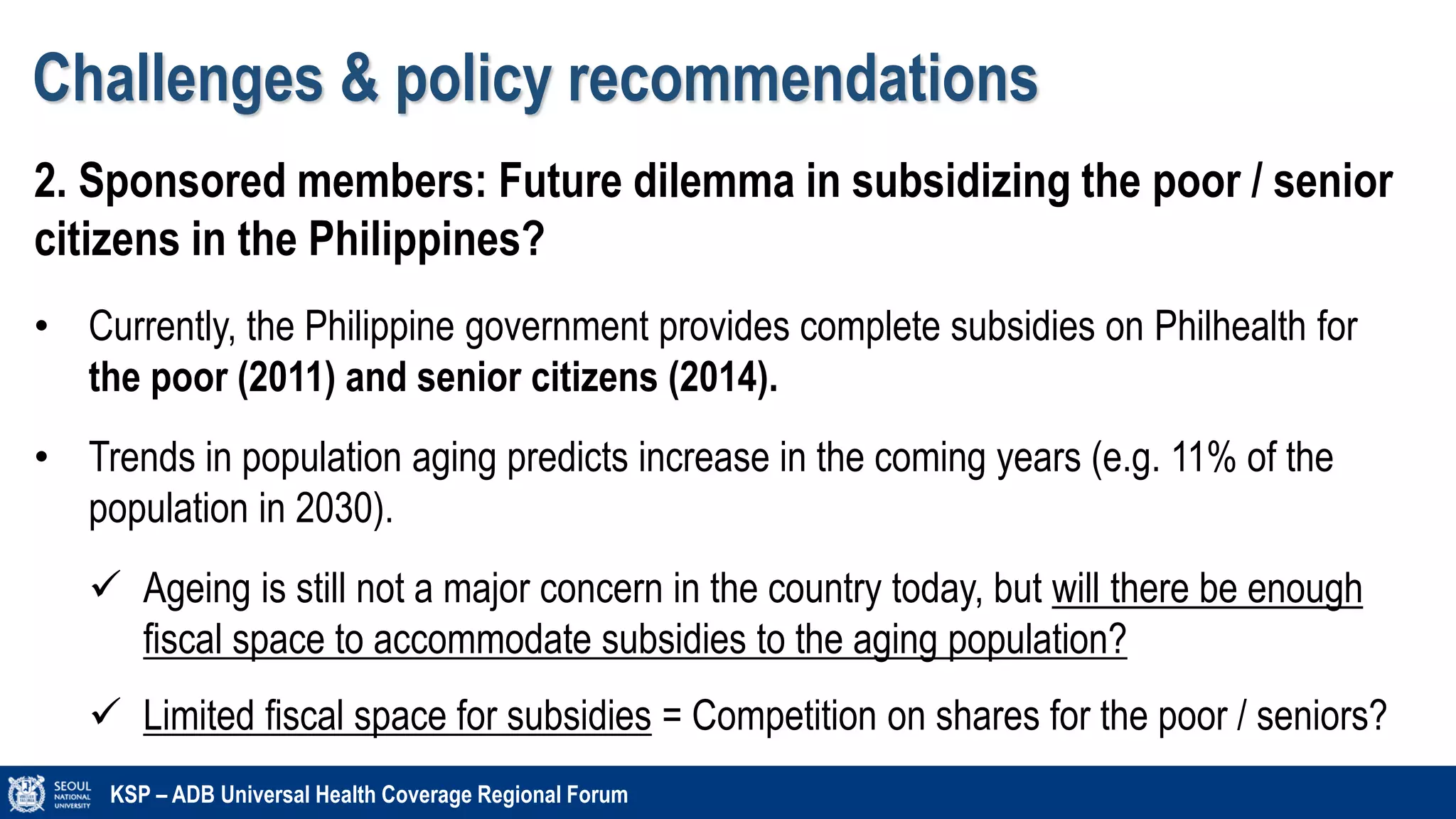
2. Sponsored members: Future dilemma in subsidizing the poor / senior
citizens in the Philippines?
• Currently, the Philippine government provides complete subsidies on Philhealth for
the poor (2011) and senior citizens (2014).
• Trends in population aging predicts increase in the coming years (e.g. 11% of the
population in 2030).
 Ageing is still not a major concern in the country today, but will there be enough
fiscal space to accommodate subsidies to the aging population?
 Limited fiscal space for subsidies = Competition on shares for the poor / seniors?
Challenges & policy recommendations
KSP – ADB Universal Health Coverage Regional Forum
3. Philhealth to move from a “passive” to an “active” purchaser
• The increasing reimbursements / payments from Philhealth does not necessarily
equate to the active role of the organization as a purchaser. There is a need to:
a) Move from just reimbursing claims from facilities to determining what
services should be reimbursed and how (Cost-effectiveness, Equity);
b) Stimulate increase in provider performance through effective purchasing
practices (e.g. Further evaluation and strengthening of provider payment
system; improvements in accreditation and reimbursement policies, etc.).
Challenges & policy recommendations
KSP – ADB Universal Health Coverage Regional Forum
4. Equity in financial risk protection
• Need to improve population coverage in the informal sector (Missing Middle).
• Philhealth is paying more in cases among the Formal and Informal Sector (smallest in
membership base); Potential adverse selection?
• Is the increase in payment driven by z-benefit reimbursements among the informal
sector (membership before utilization)? Effects of complementary PHI?
• Access of the poor and other Philhealth members to accredited facilities in
selected regions remains limited (Insurance payments concentrated in Metro
Manila / Other regions with more accredited providers?).
Challenges & policy recommendations
KSP – ADB Universal Health Coverage Regional Forum
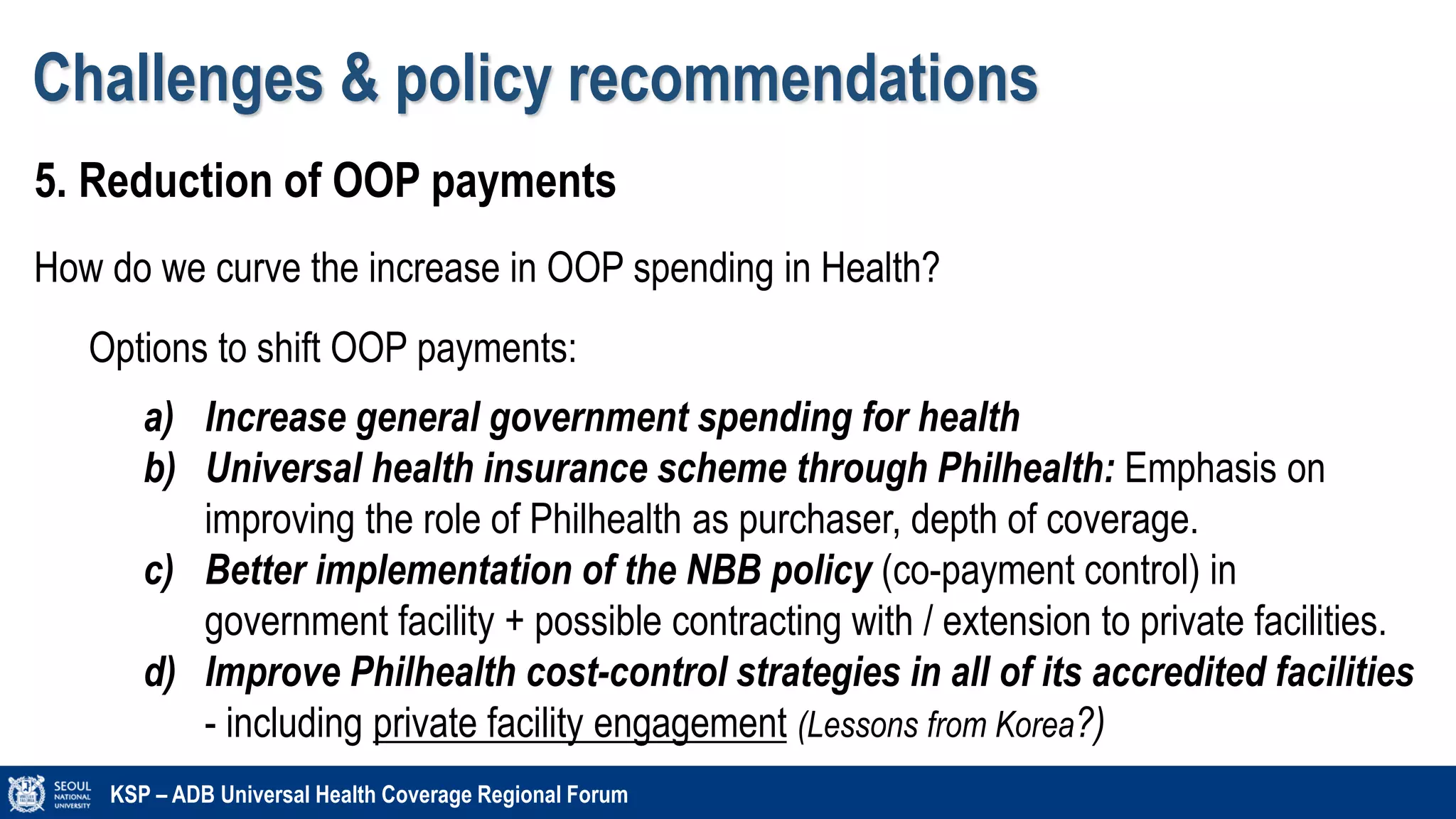
5. Reduction of OOP payments
How do we curve the increase in OOP spending in Health?
Options to shift OOP payments:
a) Increase general government spending for health
b) Universal health insurance scheme through Philhealth: Emphasis on
improving the role of Philhealth as purchaser, depth of coverage.
c) Better implementation of the NBB policy (co-payment control) in
government facility + possible contracting with / extension to private facilities.
d) Improve Philhealth cost-control strategies in all of its accredited facilities
- including private facility engagement (Lessons from Korea?)
Challenges & policy recommendations
KSP – ADB Universal Health Coverage Regional Forum
6. Further development of Philhealth’s provider payment system
• Philhealth's All Case Rate (ACR) provides more pronounced benefit packages with
a cost ceiling that is easier both for the facility to bill (reimbursements) and patients to
understand (how much is covered).
• However considering the number of cases (5000+), the ACR may be very similar to
FFS in terms of provider incentives (less incentive to reduce volume = more
claims, more income)
• A DRG-based payment scheme maybe considered – the transition maybe easier
from ACR to DRG as compared to FFS to DRG; should be aimed at reducing volume
+ cost (Pilot test?)
Thank You.
Karlo Paolo P. Paredes
karlo@snu.ac.kr
October 30, 2015
KSP – ADB Universal Health Coverage Regional Forum
Asian Development Bank, Manila, Philippines

Philippines' Health system and Financing (2015)

  • 1.
    Philippines Health System andFinancing Karlo Paolo P. Paredes karlo@snu.ac.kr October 30, 2015 KSP – ADB Universal Health Coverage Regional Forum Asian Development Bank, Manila, Philippines
  • 2.
    Contents •Introduction •Strategic purchasing • Benefitcoverage • Payment system for health providers • Contractual relations with providers • Review and assessment / quality of care •Challenges and Policy Recommendations KSP – ADB Universal Health Coverage Regional Forum
  • 3.
    GDP and HealthExpenditure • The Philippines’ economy enjoyed continuous growth since 2009 and will continue to do so in the coming year (ADB projection at 6.3% in 2016). • Health expenditure per capita is also increasing but not at the same pace as the country’s GDP growth KSP – ADB Universal Health Coverage Regional Forum
  • 4.
    Leading Health Problems(1990-2013) • The Philippines is in epidemiological transition; Disease of both communicable and non- communicable in cause are simultaneously affecting the population. • Communicable disease continues to decline but non-communicable diseases are emerging; • Lower respiratory infection decreased 68% from 1990; • 43% and 48% increases in ischemic heart and cardio-vascular diseases were noted from 1990 data. (170% increase in diabetes) KSP – ADB Universal Health Coverage Regional Forum Leading causes of disability-adjuster life years in 2013 and percent change, 1990-2013 Source: http://www.healthdata.org/philippines
  • 5.
    Key health reformmilestones (1) KSP – ADB Universal Health Coverage Regional Forum Year Milestone 1979 Adoption of the primary health care (post alma ata convention on PHC) 1987 Reorganization of the Ministry (later Department) of Health through EO 119 1991 Devolution of health services (RA 7160 - Local Government Code) 1995 National Health Insurance Law creates the Philippine Health Insurance Corporation (Philhealth) with a mandate to expand health insurance coverage to all Filipinos 1999 The Health Sector Reform Agenda (HSRA) was initiated 2005 The FOURmula ONE (F1) for health was initiated; follow-up to the reforms made after the HSRA Health services delivery / organization - Major reforms in health service delivery in the past 2-3 decades shaped the current health system in the Philippines. - Devolution of health services and the creation of Philhealth were the two critical reforms that happened in the 90s.
  • 6.
    Key health reformmilestones (2) KSP – ADB Universal Health Coverage Regional Forum Year Milestone 2010 Universal Health Care restructures premium payments for the poorest income quintiles comprising 40 percent population (UHC - Aquino Health Agenda) 2011 Universal Health Coverage (locally: Kalusugan Pangkalahatan) launched; DOH DO 2011-0188 2011 Universal Health Care restructures benefits through the No Balance Billing Policy for designed case rates (initial 23 case rates) 2012 Sin Tax Law was enacted through RA 10351 restructuring the excise tax on alcohol and tobacco products 2013 Second amendment of the National Health Insurance Act of 1995 through RA 10606 2013 Philhealth shift of provider payment from FFS to Case-based payments Health financing and UHC - The country’s road to UHC started to take form in 2010, with the movement to insure the poorest Filipinos (40%). - Following the extensive attention to UHC, the DOH’s KP/UHC policy and the No Balance Billing (NBB) policy was launched in 2011. - Succeeding reforms include additional financing for health (sin tax), shift to case payments, etc.
  • 7.
    Health system organization KSP– ADB Universal Health Coverage Regional Forum Region* BHS RHU Hospital Total CordilleraAdministrative Region (CAR) 792 98 58 948 National Capital Region (NCR) 493 20 216 729 Region I (Ilocos Region) 1,158 150 125 1,433 Region II (Cagayan Valley) 1,336 97 97 1,530 Region III (Central Luzon) 1,858 290 218 2,366 Region IV-A (CALABARZON) 2,373 232 263 2,868 Region IV-B (MIMAROPA) 1,103 82 66 1,251 Region V (Bicol Region) 1,144 135 122 1,401 Region VI (Western Visayas) 1,878 147 95 2,120 Region VII (Central Visayas) 2,025 160 111 2,296 Region VIII (Eastern Visayas) 900 152 84 1,136 Region IX (Zamboanga Peninsula) 732 92 68 892 Region X (Nothern Mindanao) 1,304 122 110 1,536 Region XI (Davao Region) 1,118 69 114 1,301 Region XII (SOCCSKSARGEN) 1,095 53 107 1,255 Region XIII (CARAGA) 685 82 59 826 Autonomus Region in Muslim Mindanao (ARMM) 452 133 44 629 TOTAL 19,994 1,981 1,913 23,888 * Provinces of Negros Island Region still part of regions VI and VII (Established: May 21, 2015) Source: National Health Facility Registry v2.0 (Accessed Sept. 30, 2015) • Primary health facilities (BHSs & RHUs) are maintained by Local Government Units (LGUs).  Primary health services (Immunization, basic maternal and child health programs, and others) are provided in primary health facilities. • 36% of Hospitals are located in 3 regions alone. The remaining 64% are shared by the other 14 regions.  Less populated regions / rural areas may have lower physical access to hospital facilities.
  • 8.
    Health Financing (1):Total Health Spending KSP – ADB Universal Health Coverage Regional Forum Composition of Total Health Expenditure in the Philippines • Private Health Expenditure in the Philippines increased at a much faster rate compared to government health expenditure from year 2000-2013. • Private Health Expenditures in the country are primarily sourced from Out-of-pocket (OOP) spending; Only around 5% of the population are covered by PHI (pro-rich). • Social Insurance coverage increased since 2008 but not as fast as the expansion of private spending (Shrinking government share in spending).
  • 9.
    Health Financing (2):OOP KSP – ADB Universal Health Coverage Regional Forum • Out-of-pocket spending in the Philippines continued to increase surpassing OOP in Indonesia and Vietnam since year 2000. OOP spending in the Philippines compared to Indonesia & Vietnam, 2000 to 2013 • Since 2005, OOP spending in the Philippines remains to be more than 50% of the country’s total health expenditure. • Compared to Indonesia and Viet Nam, OOP in the Philippines is highest (2013).
  • 10.
    Health Financing (3):Population coverage KSP – ADB Universal Health Coverage Regional Forum • Members from the (1) Private Sector, (2) Sponsored category continues to increase from 2011-2015. RegisteredMembers(Primary) MembershipCategory 2011 2012 2013 2014 2015* Trend Remarks FS- Private 8.85 9.61 10.3 11.00 11.33 Increased FS - Government 2.01 2.03 2.07 1.95 1.98 Decreased Sponsored** 9.57 8.29 9.61 19.08 20.59 Increased IP- Informal*** 4.34 5.06 5.38 2.48 2.58 Decreased Lifetime 0.57 0.66 0.77 0.93 0.96 Increased OWP 2.57 2.84 3.14 0.96 1.09 Decreased TOTAL 27.91 28.49 31.27 36.41 38.52 PhilhealthPopulation Coverage 82% 84% 79% 87% 88% Notes: Source:2011-2015 Stats and Charts,http://www.philhealth.gov.ph/about_us/statsncharts/ (Accessed 10/01/2015) *1stSemesterof 2015 (June30,2015) **Sponsored for2014 & 2015:Total members fromIndigents,Sponsored Members & SeniorCitizens ***Informal for2014 & 2015:Total members fromInformal Sector,Household Help,Enterprise/ Driver,Self-Earning individuals, Organized Groups SeniorCitizen:Accounts for18.5%and 23.3%of total sponsored members in 2014 and 2015 • Members from the informal sector (individually paying, household help, drivers and organized group) and government employees (formal sector) decreased in 2014 and 2015. Philhealth Members • 88% of all primary members are from the Formal Sector and the Poor (sponsored) – Missing middle? • Population coverage (Philhealth computation): 88% in 2015
  • 11.
    Health Financing (4):Population coverage (con’t) KSP – ADB Universal Health Coverage Regional Forum • Population coverage from household surveys may also reflect household’s awareness of their insurance status = more household are aware of their insurance status in 2013. Philhealth Coverage from National Household Surveys, 2008 & 2013 2008 2013 Lowest 19.60% 61.60% 42% Second 28.60% 55.60% 27% Middle 35.30% 52.20% 17% Fourth 48.20% 59.40% 11% Highest 57% 72.70% 16% Note: *Absolute increase = 2013 coverage - 2008 coverage Source: NDHS 2008, 2013 Population Coverage Income quintile Absolute increase* in percentage (Baseline 2011) • Population coverage significantly increased from 2008 to 2013 especially for the lowest and second lowest quintile (poorest and next poorest); This reflects improvements Philhealth coverage for the poor.
  • 12.
    Strategic purchasing KSP –ADB Universal Health Coverage Regional Forum Benefit coverage | Payment system for health providers | Contractual relations with providers | Review and assessment / quality of care
  • 13.
    A. Benefit Coverage(1) KSP – ADB Universal Health Coverage Regional Forum In- patient benefits • Shift from FFS to All Care Rate (ACR) • More pronounced benefits (ACR) • Philhealth covers in-patient medical and surgical cases as identified in the recently launched All Case Rate (ACR) payment system (2013). • In Government hospitals, a No Balance Billing (NBB) policy was implemented (2011) for medical cases among the sponsored members. • This was further expanded to accommodate the ACR transition; 48% of government facilities on NBB (Philhealth, 2015)
  • 14.
    A. Benefit Coverage(2) KSP – ADB Universal Health Coverage Regional Forum • Out-patient benefit packages are designed per specific services provided in out- patient facility. For example, RHUs can be accredited in one or all of the PCB (Tsekap), MCP, TB-DOTS, Malaria, etc. In- patient benefits • Shift from FFS to All Care Rate (ACR) • More pronounced benefits (ACR) Out- patient benefits • Out-patient benefit packages for RHUs/HCs (OPB, MCP, TB-DOTS) • Other OP benefits (ASC, RT, OBT, DC) • Other accredited out-patient services by Philhealth includes (1) Ambulatory Surgical Clinics (ACS) [private facilities], (2) Dialysis centers (DC) [private & public]; Others: Outpatient blood centers and Radiotherapy
  • 15.
    A. Benefit Coverage(3) KSP – ADB Universal Health Coverage Regional Forum • Philhealth’s Z-Benefit package covers selected medical cases (cardio-vascular diseases, cancers, etc.) that have the potential to cause catastrophic spending. In- patient benefits • Shift from FFS to All Care Rate (ACR) • More pronounced benefits (ACR) Out- patient benefits • Out-patient benefit packages for RHUs/HCs (OPB, MCP, TB-DOTS) • Other OP benefits (ASC, RT, OBT, DC) Z- benefit package • Catastrophic care packages (Implemented in selected Hospitals) • Only available in selected accredited facilities; which is still very limited (e.g. CABG Surgery coverage is only covered in three hospitals in the country – 1 each in NCR, Region VII and Region XI) • Z-benefit provides the most generous coverage of Philhealth in selected accredited institutions (e.g. single claim can reach 550,000 Php).
  • 16.
    A. Benefit Coverage(4) KSP – ADB Universal Health Coverage Regional Forum • Philhealth’s total benefit payment increased most significantly for the Sponsored and the Informal Sector. • The notable increase in the informal sector benefit payment should be further evaluated (e.g. Possible adverse selection - is the payment driven by z-benefit reimbursements?) • Considering the number of registered members, Philhealth still seem to be paying more for members in the Formal and the Informal Sector Sector 2011 2012 2013 2014 Percentagechange inpayment (2011baseline) 4-yearTotal Share FS-Private 12,222.20 13,379.00 14,208.96 18,015.57 47% 57,825.73 27% FS -Government 5,964.30 6,846.30 7,161.01 8,494.05 42% 28,465.66 13% Sponsored** 7,338.10 12,094.60 17,971.59 25,558.16 248% 62,962.45 29% IP-Informal*** 5,826.40 9,622.90 10,410.54 19,245.64 230% 45,105.48 21% Lifetime 2311.90 3,689.70 4,144.83 5,611.94 143% 15,758.37 7% OWP 1,222.00 1,578.10 1,662.56 1,250.06 2% 5,712.72 3% TOTAL 34,884.90 47,210.60 55,559.49 78,175.42 124.10% 215,830.41 100% Note: *Totalbenefitpayments(January 1-December31)in 2011-2014 Percentagechangein payment=(2014 sectorpayment-2011 sectorpayment)/2011 sectorpayment Share=fouryeartotal(sector)/fouryeartotal(allsector) Source:2011-2015 Statsand Charts,http://www.philhealth.gov.ph/about_us/statsncharts/(Accessed 10/01/2015) ***Informalfor2014 &2015:TotalmembersfromInformalSector,Household Help,Enterprise/Driver,Self-Earning individuals,Organized Groups **Sponsored for2014 &2015:TotalmembersfromIndigents,Sponsored Members&SeniorCitizens
  • 17.
    B. Payment systemfor health care providers (1) KSP – ADB Universal Health Coverage Regional Forum Government Facilities Private Facilities Budget PHI Premium (Pro-Rich) Philhealth Premium Government Subsidized Group Free NBB? BB ACR ACR OOP Philhealth Payments *NBB = No Balance Billing BB = Balance Billing
  • 18.
    B. Payment systemfor health care providers (2) KSP – ADB Universal Health Coverage Regional Forum Philhealth • from FFS to ACR* (All Case Rates) in 2013 + NBB Hospitals Accredited Primary Care Facilities (Government) Accredited Primary Care Facilities (Private) Z-Benefit accredited facilities • Capitation / applicable case rates • Applicable case rates • Z-benefit packages (case rate) *ACR followed cases as identified in ICD-10 ACR vs. DRG = ACR does not have diagnosis related group
  • 19.
    C. Contractual relationswith providers (1) KSP – ADB Universal Health Coverage Regional Forum • Accreditation of Hospitals are extensive (Recognition of DOH accreditation of health care institutions). • Private-sector dominated (passive privatization?; May follow inequality in distribution of facilities (Service delivery gaps) • Private hospitals are allowed to balance-bill patients (no cost ceiling / no fixed co-pay regulations) 2013 2014 2015 2013 2014 2015 Level 1 437 450 432 262 293 303 Level 2 213 235 246 44 46 49 Level 3 68 67 67 46 48 48 Infirmary 335 336 360 356 351 342 Total 1,053 1,088 1,105 708 738 742 Category GOVERNMENT Source: 2011-2015 Stats and Charts, http://www.philhealth.gov.ph/about_us/statsncharts/ (Accessed 10/01/2015) PRIVATE Accreditation of facilities is important in benefit coverage – all cases treated in non-Philhealth accredited health care institutions will not be covered by Philhealth
  • 20.
    C. Contractual relationswith providers (2) KSP – ADB Universal Health Coverage Regional Forum • PCB accreditation is relatively distributed throughout the region (with limitations in regions I, II and regions in Mindanao) • TB-DOTS and MCP have relatively wide distribution; MCP heavily participated by the private sector (private lying-in clinics) but problematic regions (low accreditation) still exist. • Other accreditation types (ASC and DC) is heavily concentrated in Metro Manila; Few accredited facilities in other regions. Priv Govt Priv Govt Priv Govt Priv Govt Priv Govt CordilleraAdministrative Region (CAR) 3 66 - 100 7 91 1 - 4 - National Capital Region (NCR) 6 83 - 305 107 10 66 - 72 - Region I (Ilocos Region) 2 13 - 8 ** ** 3 - 7 - Region II (Cagayan Valley) 1 ** - 12 23 17 4 - 3 - Region III (Central Luzon) 1 27 - 101 87 15 12 - 22 1 Region IV-A (CALABARZON) 2 29 - 150 69 23 10 - 19 - Region IV-B(MIMAROPA) 1 38 - 59 6 35 - - 1 - Region V (Bicol Region) 5 53 - 81 52 38 3 - 5 - Region VI (Western Visayas) 4 73 - 70 36 38 4 - 6 - Region VII (Central Visayas) 8 97 - 123 43 75 3 - 5 - Region VIII (Eastern Visayas) 1 124 - 139 55 169 2 - 2 - Region IX (ZamboangaPeninsula) 0 30 - 63 - 18 2 - 1 - Region X (Nothern Mindanao) 1 2 ** ** ** ** 2 - 3 - Region XI (Davao Region) 5 2 - 3 7 2 1 - 6 - Region XII (SOCCSKSARGEN) 1 44 ** ** 10 12 3 - 2 - Region XIII (CARAGA) 3 34 - 27 5 4 1 - 1 - Autonomus Region in MuslimMindanao (ARMM) 0 63 - 70 19 61 - - - - TOTAL 44 778 - 1,241 507 547 117 - 159 1 *Provinces of Negros Island Region still partof regions VI and VII (Established:May 21, 2015) **No data reported Source:Philhealth listof accredited providers as of March 20, 2015 (Accessed Sept. 30, 2015) TB-DOTS =Tuberculosis DOTS;PCB =Primary Care Benefit;MCP =Maternity Care Package;ASC =Ambulatory Surgical Clinic;DC =Dialysis Center TB-DOTS PCB MCP ASC Region* DC
  • 21.
    D. Review andassessment / Quality of Care (1) KSP – ADB Universal Health Coverage Regional Forum
  • 22.
    D. Review andassessment / Quality of Care (2) KSP – ADB Universal Health Coverage Regional Forum Health Care Provider Performance Assessment System (HCP PAS) of 2014 - Provides platform for Philhealth quality assessment / performance assessment aligned with the recent shift of provider payment (FFS to ACRs). Method Definition 1. Claims / Services Profiling review of claims database; detecting “anomalies” in claims per specific health care provider (e.g. Unusual increase in reimbursements (volume), length of hospital stay, etc). 2. Medical Audit Reviewing paid claims vis-à-vis standards of practice in the facility (in-line with facility’s performance commitment). 3. Philhealth Patient Exit Surveys Made possible through the PCARES (Philhealth Customer Relations and Empowerment Staff) deployed in accredited facilities. 4. PCB/Tsekap Client Satisfaction Survey Done semi-annually by AQAS (Accreditation and Quality Assurance Section) / LHIO (Local Health Insurance Office) to selected PCB accredited facilities and clients. 5. Receiving of member complaints investigation of reports from client experience in specific health care institution. 6. Regular / Routine Facility Visits Regular announced or unannounced visits to facilities to check the facilities’ compliance to performance commitment / standards of care.
  • 23.
    Challenges and PolicyRecommendations KSP – ADB Universal Health Coverage Regional Forum
  • 24.
    Challenges & policyrecommendations KSP – ADB Universal Health Coverage Regional Forum 1. DOH as steward to respond to supply-side challenges Gaps in service delivery should be carefully assessed and resolved with the local government units (DOH as a steward). • The DOH’s leverage to upgrade facilities in the past years should well translate to: a) Increase in Philhealth accreditation especially for out-patient benefit packages - which remains unequally distributed in the country. b) Improvements in accreditation practices and compliance of facilities that will complement Philhealth policies (e.g. NBB policy). Why is there a huge gap in Philhealth accreditation? What can we do about it?
  • 25.
    Challenges & policyrecommendations KSP – ADB Universal Health Coverage Regional Forum 2. Sponsored members: Future dilemma in subsidizing the poor / senior citizens in the Philippines? • Currently, the Philippine government provides complete subsidies on Philhealth for the poor (2011) and senior citizens (2014). • Trends in population aging predicts increase in the coming years (e.g. 11% of the population in 2030).  Ageing is still not a major concern in the country today, but will there be enough fiscal space to accommodate subsidies to the aging population?  Limited fiscal space for subsidies = Competition on shares for the poor / seniors?
  • 26.
    Challenges & policyrecommendations KSP – ADB Universal Health Coverage Regional Forum 3. Philhealth to move from a “passive” to an “active” purchaser • The increasing reimbursements / payments from Philhealth does not necessarily equate to the active role of the organization as a purchaser. There is a need to: a) Move from just reimbursing claims from facilities to determining what services should be reimbursed and how (Cost-effectiveness, Equity); b) Stimulate increase in provider performance through effective purchasing practices (e.g. Further evaluation and strengthening of provider payment system; improvements in accreditation and reimbursement policies, etc.).
  • 27.
    Challenges & policyrecommendations KSP – ADB Universal Health Coverage Regional Forum 4. Equity in financial risk protection • Need to improve population coverage in the informal sector (Missing Middle). • Philhealth is paying more in cases among the Formal and Informal Sector (smallest in membership base); Potential adverse selection? • Is the increase in payment driven by z-benefit reimbursements among the informal sector (membership before utilization)? Effects of complementary PHI? • Access of the poor and other Philhealth members to accredited facilities in selected regions remains limited (Insurance payments concentrated in Metro Manila / Other regions with more accredited providers?).
  • 28.
    Challenges & policyrecommendations KSP – ADB Universal Health Coverage Regional Forum 5. Reduction of OOP payments How do we curve the increase in OOP spending in Health? Options to shift OOP payments: a) Increase general government spending for health b) Universal health insurance scheme through Philhealth: Emphasis on improving the role of Philhealth as purchaser, depth of coverage. c) Better implementation of the NBB policy (co-payment control) in government facility + possible contracting with / extension to private facilities. d) Improve Philhealth cost-control strategies in all of its accredited facilities - including private facility engagement (Lessons from Korea?)
  • 29.
    Challenges & policyrecommendations KSP – ADB Universal Health Coverage Regional Forum 6. Further development of Philhealth’s provider payment system • Philhealth's All Case Rate (ACR) provides more pronounced benefit packages with a cost ceiling that is easier both for the facility to bill (reimbursements) and patients to understand (how much is covered). • However considering the number of cases (5000+), the ACR may be very similar to FFS in terms of provider incentives (less incentive to reduce volume = more claims, more income) • A DRG-based payment scheme maybe considered – the transition maybe easier from ACR to DRG as compared to FFS to DRG; should be aimed at reducing volume + cost (Pilot test?)
  • 30.
    Thank You. Karlo PaoloP. Paredes karlo@snu.ac.kr October 30, 2015 KSP – ADB Universal Health Coverage Regional Forum Asian Development Bank, Manila, Philippines