Human Becoming Theory
Rosemarie Rizzo Parse
This page was last updated on October 27, 2011
INTRODUCTION
The Parse theory of human becoming guides nurses
In their practice to focus on quality of life as it is
described and lived (Karen & Melnechenko, 1995).
The human becoming theory of nursing presents an
alternative to both the conventional bio-medical
approach and the bio-psycho-social-spiritual (but still
normative) approach of most other theories of
nursing.(ICPS)
The human becoming theory posits quality of life
from each person's own perspective as the goal of
nursing practice.(ICPS)
Rosemarie Rizzo Parse first published the theory in
1981 as the "Man-living-health" theory (ICPS)
The name was officially changed to "the human
becoming theory" in 1992 to remove the term "man,"
after the change in the dictionary definition of the
word from its former meaning of "humankind."
ABOUT THE THEORIST
Educated at Duquesne University, Pittsburgh
MSN and Ph.D. from University of Pittsburgh
Published her theory of nursing, Man-Living-Health
in 1981
Name changed to Theory of Human Becoming in
1992
Editor and Founder, Nursing Science Quarterly
Has published eight books and hundreds of articles
about Human Becoming Theory
Professor and Niehoff Chair at Loyola University,
Chicago
THEORY DEVELOPMENT
The human becoming theory was developed as a
human science nursing theory in the tradition of
Dilthey, Heidegger, Sartre, Merleau-Ponty, and
Gadamer and Science of Unitary Human Beings by
Martha Rogers .
The assumptions underpinning the theory were
synthesized from works by the European
philosophers, Heidegger, Sartre, and Merleau-Ponty,
along with works by the pioneer American nurse
theorist, Martha Rogers.
The theory is structured around three abiding themes:
meaning, rhythmicity, and transcendence.
ASSUMPTIONS
About man
The human is coexisting while coconstituting
rhythmical patterns with the universe.
The human is open, freely choosing meaning in
situation, bearing responsibility for decisions.
The human is unitary, continuously coconstituting
patterns of relating.
The human is transcending multidimensionally with
the possibles
About Becoming
Becoming is unitary human-living-health.
Becoming is a rhythmically coconstituting humanuniverse process.
Becoming is the human’s patterns of relating value
priorities.
Becoming is an intersubjective process of
transcending with the possibles.
Becoming is unitary human’s emerging
Three Major Assumptions of Human Becoming
Meaning
o Human Becoming is freely choosing personal
meaning in situations in the intersubjective
process of living value priorities.
o Man’s reality is given meaning through lived
experiences
o Man and environment cocreate
Rhythmicity
o Human Becoming is cocreating rhythmical
patterns of relating in mutual process with the
universe.
o Man and environment cocreate ( imaging,
valuing, languaging) in rhythmical patterns
Transcendence
o
o
o

Human Becoming is cotranscending
multidimensionally with emerging possibles.
Refers to reaching out and beyond the limits
that a person sets
One constantly transforms

SUMMARY OF THE THEORY
Human Becoming Theory includes Totality
Paradigm
o Man is a combination of biological,
psychological, sociological and spiritual
factors
Simultaneity Paradigm
o Man is a unitary being in continuous, mutual
interaction with environment
Originally Man-Living-Health Theory
NURSING PARADIGMS AND PARSE'S THEORY
Person
o

Open being who is more than and different
from the sum of the parts
Environment
o Everything in the person and his experiences
o Inseparable, complimentary to and evolving
with
Health
o Open process of being and becoming.
Involves synthesis of values
Nursing
o A human science and art that uses an abstract
body of knowledge to serve people
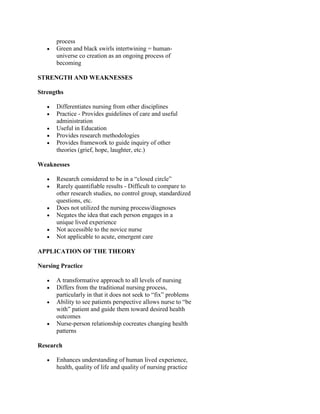
SYMBOL OF HUMAN BECOMING THEORY

Black and white = opposite paradox significant to
ontology of human becoming and green is hope
Center joined =co created mutual human universe
process at the ontological level & nurse-person
process
Green and black swirls intertwining = humanuniverse co creation as an ongoing process of
becoming
STRENGTH AND WEAKNESSES
Strengths
Differentiates nursing from other disciplines
Practice - Provides guidelines of care and useful
administration
Useful in Education
Provides research methodologies
Provides framework to guide inquiry of other
theories (grief, hope, laughter, etc.)
Weaknesses
Research considered to be in a “closed circle”
Rarely quantifiable results - Difficult to compare to
other research studies, no control group, standardized
questions, etc.
Does not utilized the nursing process/diagnoses
Negates the idea that each person engages in a
unique lived experience
Not accessible to the novice nurse
Not applicable to acute, emergent care
APPLICATION OF THE THEORY
Nursing Practice
A transformative approach to all levels of nursing
Differs from the traditional nursing process,
particularly in that it does not seek to “fix” problems
Ability to see patients perspective allows nurse to “be
with” patient and guide them toward desired health
outcomes
Nurse-person relationship cocreates changing health
patterns
Research
Enhances understanding of human lived experience,
health, quality of life and quality of nursing practice
Expands the theory of human becoming
Builds new nursing knowledge about universal lived
experiences which may ultimately contribute to
health and quality of life
CRITIQUE
Congruence with personal values
o Nurse must subscribe to this world view to
truly use it
Congruence with other professional values
o Complements and competes with other health
care professionals’ values
o Exoteric foundations
o Esoteric utility
Congruence with social values
o Fulfills society’s expectations of nursing role
Social Significance
o Makes a substantial difference in the lives of
clients and nurses
RESEARCH ON PARSE'S THEORY
1. Nursing practice in human becoming: the "Parse
nurse" in French Switzerland
2. The lived experience of suffering: a parse research
method study
3. On joy-sorrow: a paradoxical pattern of human
becoming
4. Human becoming criticism--a critique of Florczak's
study on the lived experience of sacrificing
something important
5. A Human Becoming perspective on quality of life
6. Feeling respected: a Parse method study
REFERENCES

Human becoming theory

  • 1.
    Human Becoming Theory RosemarieRizzo Parse This page was last updated on October 27, 2011 INTRODUCTION The Parse theory of human becoming guides nurses In their practice to focus on quality of life as it is described and lived (Karen & Melnechenko, 1995). The human becoming theory of nursing presents an alternative to both the conventional bio-medical approach and the bio-psycho-social-spiritual (but still normative) approach of most other theories of nursing.(ICPS) The human becoming theory posits quality of life from each person's own perspective as the goal of nursing practice.(ICPS) Rosemarie Rizzo Parse first published the theory in 1981 as the "Man-living-health" theory (ICPS) The name was officially changed to "the human becoming theory" in 1992 to remove the term "man," after the change in the dictionary definition of the word from its former meaning of "humankind." ABOUT THE THEORIST Educated at Duquesne University, Pittsburgh MSN and Ph.D. from University of Pittsburgh Published her theory of nursing, Man-Living-Health in 1981 Name changed to Theory of Human Becoming in 1992 Editor and Founder, Nursing Science Quarterly Has published eight books and hundreds of articles about Human Becoming Theory Professor and Niehoff Chair at Loyola University, Chicago THEORY DEVELOPMENT The human becoming theory was developed as a human science nursing theory in the tradition of Dilthey, Heidegger, Sartre, Merleau-Ponty, and Gadamer and Science of Unitary Human Beings by Martha Rogers . The assumptions underpinning the theory were synthesized from works by the European
  • 2.
    philosophers, Heidegger, Sartre,and Merleau-Ponty, along with works by the pioneer American nurse theorist, Martha Rogers. The theory is structured around three abiding themes: meaning, rhythmicity, and transcendence. ASSUMPTIONS About man The human is coexisting while coconstituting rhythmical patterns with the universe. The human is open, freely choosing meaning in situation, bearing responsibility for decisions. The human is unitary, continuously coconstituting patterns of relating. The human is transcending multidimensionally with the possibles About Becoming Becoming is unitary human-living-health. Becoming is a rhythmically coconstituting humanuniverse process. Becoming is the human’s patterns of relating value priorities. Becoming is an intersubjective process of transcending with the possibles. Becoming is unitary human’s emerging Three Major Assumptions of Human Becoming Meaning o Human Becoming is freely choosing personal meaning in situations in the intersubjective process of living value priorities. o Man’s reality is given meaning through lived experiences o Man and environment cocreate Rhythmicity o Human Becoming is cocreating rhythmical patterns of relating in mutual process with the universe. o Man and environment cocreate ( imaging, valuing, languaging) in rhythmical patterns Transcendence
  • 3.
    o o o Human Becoming iscotranscending multidimensionally with emerging possibles. Refers to reaching out and beyond the limits that a person sets One constantly transforms SUMMARY OF THE THEORY Human Becoming Theory includes Totality Paradigm o Man is a combination of biological, psychological, sociological and spiritual factors Simultaneity Paradigm o Man is a unitary being in continuous, mutual interaction with environment Originally Man-Living-Health Theory NURSING PARADIGMS AND PARSE'S THEORY Person o Open being who is more than and different from the sum of the parts Environment o Everything in the person and his experiences o Inseparable, complimentary to and evolving with Health o Open process of being and becoming. Involves synthesis of values Nursing o A human science and art that uses an abstract body of knowledge to serve people SYMBOL OF HUMAN BECOMING THEORY Black and white = opposite paradox significant to ontology of human becoming and green is hope Center joined =co created mutual human universe process at the ontological level & nurse-person
  • 4.
    process Green and blackswirls intertwining = humanuniverse co creation as an ongoing process of becoming STRENGTH AND WEAKNESSES Strengths Differentiates nursing from other disciplines Practice - Provides guidelines of care and useful administration Useful in Education Provides research methodologies Provides framework to guide inquiry of other theories (grief, hope, laughter, etc.) Weaknesses Research considered to be in a “closed circle” Rarely quantifiable results - Difficult to compare to other research studies, no control group, standardized questions, etc. Does not utilized the nursing process/diagnoses Negates the idea that each person engages in a unique lived experience Not accessible to the novice nurse Not applicable to acute, emergent care APPLICATION OF THE THEORY Nursing Practice A transformative approach to all levels of nursing Differs from the traditional nursing process, particularly in that it does not seek to “fix” problems Ability to see patients perspective allows nurse to “be with” patient and guide them toward desired health outcomes Nurse-person relationship cocreates changing health patterns Research Enhances understanding of human lived experience, health, quality of life and quality of nursing practice
  • 5.
    Expands the theoryof human becoming Builds new nursing knowledge about universal lived experiences which may ultimately contribute to health and quality of life CRITIQUE Congruence with personal values o Nurse must subscribe to this world view to truly use it Congruence with other professional values o Complements and competes with other health care professionals’ values o Exoteric foundations o Esoteric utility Congruence with social values o Fulfills society’s expectations of nursing role Social Significance o Makes a substantial difference in the lives of clients and nurses RESEARCH ON PARSE'S THEORY 1. Nursing practice in human becoming: the "Parse nurse" in French Switzerland 2. The lived experience of suffering: a parse research method study 3. On joy-sorrow: a paradoxical pattern of human becoming 4. Human becoming criticism--a critique of Florczak's study on the lived experience of sacrificing something important 5. A Human Becoming perspective on quality of life 6. Feeling respected: a Parse method study REFERENCES