Health Care System
REFERENCES:
HTTPS://WWW.SLIDESHARE.NET/LOPAOMD/AN -INTRODUCTION-TO-HEALTH-SYSTEMS-AN-OVERVIEW-
OF-THE-PHILIPPINE-HEALTH-CARE-SYSTEM-AND-HEALTH-SYSTEMS-THINKING
HTTPS://WWW.SLIDESHARE.NET/SHARINA11/HEALTH -CARE-DELIVERY-SYSTEM-IN-THE-PHILIPPINES
Objectives:
• Define Health Care System
• Discuss factors affecting Health Care System
• Provide overview of Philippine Health Care Delivery System
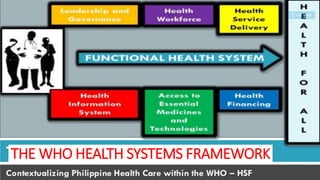
THE WHO HEALTH SYSTEMS FRAMEWORK
Definition of Terms
HEALTH CARE SYSTEM - an organized plan of health services
(Miller-Keane, 1987)
HEALTH CARE DELIVERY -rendering health care services to
the people (Williams-Tungpalan, 1981).
HEALTH CARE DELIVERY SYSTEM (Williams-Tungpalan, 1981)
-the network of health facilities and personnel which carries
out the task of rendering health care to the people.
PHILIPPINE HEALTH CARE SYSTEM - is a complex set of
organizations interacting to provide an array of health
services (Dizon, 1977).
Health System Basics (WHO, 2007)
Health System (def.)
- Consists of all organization, people and
actions whose primary intent is to
restore or maintain health.
- Includes efforts to influence
determinants of health as well as more
direct health-improving activities
- It is MORE than the pyramid of publicly
owned facilities that deliver personal
services.
Guiding values and principles
- Values and goals enshrined in the Alma
Ata declaration
- WHO’s commitment to gender and
human rights.
- World Health Report of 2000
HEALTH SYSTEM (TINIO, 2008)
• A health system comprises all organizations, institutions and
resources devoted to producing actions whose primary intent is to
improve health.
• The four essential functions of a health system have been defined as:
service provision,
resource generation,
financing
stewardship
Health System Goals:
Overall Outcomes (World Health
Report 2000):
- Improving health and health
equity through ways that are: (1)
Responsive, (2) Financially fair, (3)
Best or most efficient use of
available resources
Intermediate Goals:
- Greater access to and coverage for
effective health interventions
- Provider quality and safety are not
compromised
HEALTH CARE SYSTEM MODELS (TINIO, 2008)
Private enterprise health care
Social security health model
Publicly funded health care model
Social health insurance
1. PRIVATE ENTERPRISE HEALTH CARE MODEL
Purely private enterprise health care systems are comparatively rare.
When they exist, it is usually for a comparatively well-off
subpopulation in a poorer country with a poorer standard of health
care. for instance, private clinics for a small, wealthy expatriate
population in an otherwise poor country
But there are countries with a majority-private health care system
with residual public service
2. SOCIAL SECURITY HEALTH MODEL
 Where workers and their families are insured by the state
 refers to social welfare service concerned with social protection, or
protection against socially recognized conditions, including poverty,
old age, disability, unemployment and others
Social security may refer to:
social insurance, where people receive benefits or services in
recognition of contributions to an insurance scheme. These services
typically include provision for retirement pensions, disability
insurance, survivor benefits and unemployment insurance.
income maintenance mainly the distribution of cash in the event of
interruption of employment, including retirement, disability and
unemployment
 services provided by administrations responsible for social security.
In different countries this may include medical care,
aspects of social work and even industrial relations.
3. PUBLICLY FUNDED HEALTH CARE MODEL
Where the residents of the country are insured by the state
 Health care that is financed entirely or in majority part by
citizens' tax payments instead of through private payments
made to insurance companies or directly to health care
providers
4. SOCIAL HEALTH INSURANCE
 where the whole population or most of the population is a
member of a sickness insurance company
 (SHI) is a method for financing health care costs through a
social insurance program based on the collection of funds
contributed by individuals, employers, and sometimes
government subsidies
characterized by the presence of sickness funds which
usually receive a proportional contribution of their
members' wages.
 With this insurance contributions these funds pay medical
costs of their members
 Affiliation to such funds is usually based on professional,
geographic, religious/political and/or non-partisan criteria
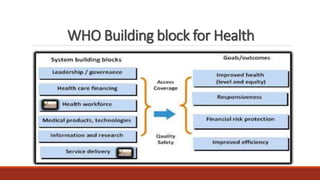
WHO Building block for Health
System building blocks  Access Coverage and Quality Safety
 Goals/Outcomes
System Building Blocks
1.Leadership/Governance
2.Health Care Financing
3.Health Workforce
4.Medical products,
technologies
5.Information and Research
6.Service Delivery
Goals/Outcomes
1.Improved health (level
and quality)
2.Responsiveness
3.Financial Risk Protection
4.Improved Efficiency
1. LEADERSHIP AND GOVERNANCE
1.Leadership and Governance
Ensuring the existence of strategic
policy frameworks combined with:
- Effective oversight
- Coalition-building
- Provision of appropriate
regulations and incentives
- Attention to system design
- Accountability
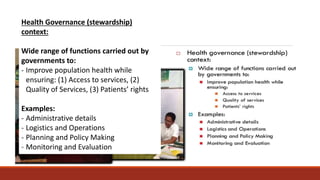
Health Governance (stewardship)
context:
Wide range of functions carried out by
governments to:
- Improve population health while
ensuring: (1) Access to services, (2)
Quality of Services, (3) Patients’ rights
Examples:
- Administrative details
- Logistics and Operations
- Planning and Policy Making
- Monitoring and Evaluation
Governance:
Roles, responsibilities and
relationships (Interplay) of:
- Public sector
- Private sector
- AND Voluntary sectors (including
civil society)
In pursuit of national health goals
- Ensure clarity AND actualization of
health system vision-mission
In the Philippines
IN THE PHILIPPINES
Mandate (E.O. No. 119, Sec 3):
- The Department of Health (DOH) shall be responsible for the following: formulation
and development of national health policies, guidelines, standards and manual of
operations for health services and programs, issuances of rules and regulations,
licenses and accreditations; promulgation of national health standards, goals,
priorities and indicators; development of special health programs and projects and
advocacy for legislation on health policies and programs. The primary function of the
Department of Health is the promotion, protection, preservation or restoration of
the health of the people through the provision and delivery of health services and
through the regulation and encouragement of providers of health goods and
services.
- THE DOH IS THE LEAD AGENCY FOR PHILIPPINE HEALTH CARE.
VISION
Filipinos are among the healthiest people in Southeast Asia by 2022,
and Asia by 2040
MISSION
To lead the country in the development of a productive, resilient,
equitable and people-centered health system
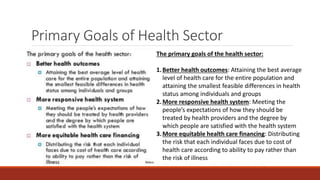
Primary Goals of Health Sector
The primary goals of the health sector:
1.Better health outcomes: Attaining the best average
level of health care for the entire population and
attaining the smallest feasible differences in health
status among individuals and groups
2.More responsive health system: Meeting the
people’s expectations of how they should be
treated by health providers and the degree by
which people are satisfied with the health system
3.More equitable health care financing: Distributing
the risk that each individual faces due to cost of
health care according to ability to pay rather than
the risk of illness
DEVOLUTION
- RA 7160 (Local Government Code of
1991)
- The act by which the Philippine
Government “devolved” basic
services (health services, agriculture
extension, livelihood development,
forest management, barangay roads
and social welfare) to Local
Government Units (barangay,
municipality/city, province)
Implementation of Devolution in 1992:
Management and delivery of
health services
-From DOH to locally elected
provincial, city and municipal
governments
4 Essential Health System
Functions
-Service provision
-Resource generation
-Financing
-Stewardship
Devolution in ARMM:
•Retained
centralized
character of its
health system
•DOH ARMM
directly runs its
provincial and
municipal health
facilities
(hospitals, RHUs)
Interlocal Health Zones (ILHZs)
• Inspired by WHO District Health System
• Pseudo legal entities
• (Ideally) AN integrated health management and delivery
system based on defined administrative and geographical area
- District Hospital + surrounding/covered municipalities
• Usually composed of adjacent municipalities with similar health
needs
- Resource sharing
- Common health goals
- Mutual planning, policy formulations, health operations
implementation and monitoring and evaluation
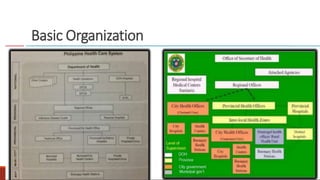
Basic Organization
2. Health/ Health Care Financing
• Good Health Financing
Two Main Characteristics
- Raises adequate funds for health to
ensure that people get to use needed
services
- People who use health services are
shielded from financial catastrophe or
impoverishment associated with having
to pay for them
Health and Health Care are major political and
economic issues
• Health financing impacts the analysis of:
- Health policies
- Fund sources
- Effectiveness and efficiency of health services for
populations
• Health Financing Goals:
- Raising sufficient funds for health
- Ensure adequate spending on health
- Effective allocation of finite financial resources to
different types of public and personal health services
- Pooling financial resources across population groups
and sharing financial risks
- Using funds for health efficiently and equitably
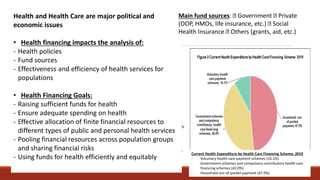
Main fund sources: Government Private
(OOP, HMOs, life insurance, etc.) Social
Health Insurance Others (grants, aid, etc.)
Current Health Expenditure by Health Care Financing Scheme: 2019
- Voluntary health care payment schemes (10.1%)
- Government schemes and compulsory contributory health care
financing schemes (42.0%)
- Household out-of-pocket payment (47.9%)
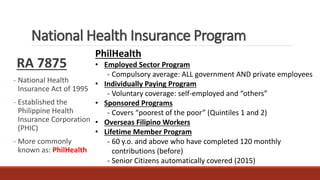
National Health Insurance Program
RA 7875
- National Health
Insurance Act of 1995
- Established the
Philippine Health
Insurance Corporation
(PHIC)
- More commonly
known as: PhilHealth
PhilHealth
• Employed Sector Program
- Compulsory average: ALL government AND private employees
• Individually Paying Program
- Voluntary coverage: self-employed and “others”
• Sponsored Programs
- Covers “poorest of the poor” (Quintiles 1 and 2)
• Overseas Filipino Workers
• Lifetime Member Program
- 60 y.o. and above who have completed 120 monthly
contributions (before)
- Senior Citizens automatically covered (2015)
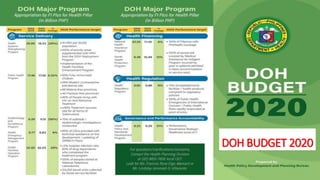
DOH BUDGET 2020
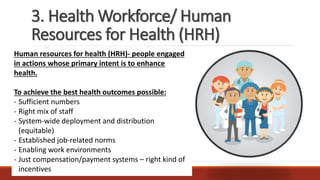
3. Health Workforce/ Human
Resources for Health (HRH)
Human resources for health (HRH)- people engaged
in actions whose primary intent is to enhance
health.
To achieve the best health outcomes possible:
- Sufficient numbers
- Right mix of staff
- System-wide deployment and distribution
(equitable)
- Established job-related norms
- Enabling work environments
- Just compensation/payment systems – right kind of
incentives
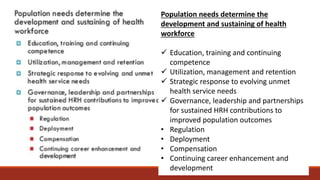
Population needs determine the
development and sustaining of health
workforce
 Education, training and continuing
competence
 Utilization, management and retention
 Strategic response to evolving unmet
health service needs
 Governance, leadership and partnerships
for sustained HRH contributions to
improved population outcomes
• Regulation
• Deployment
• Compensation
• Continuing career enhancement and
development
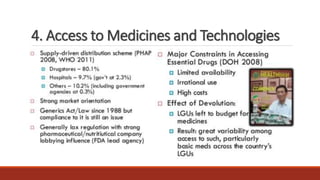
4. Access to Medicines and Technologies
Supply-driven distribution scheme (PHAP 2008,
WHO 2011)
- Drugstores: 80.1%
- Hospitals: 9.7% (gov’t at 2.3%)
- Others: 10.2% (including government agencies at
0.3%)
Strong market orientation
Generics Act/Law since 1988 but compliance to it
is still an issue
Generally lax regulation with strong
pharmaceutical/nutritional company lobbying
influence (FDA lead agency)
Major Constraints in Accessing Essential
Drugs (DOH 2008)
- Limited availability
- Irrational use
- High costs
Effect of Devolution:
- LGUs left to budget for medicines
- Result: great variability among access
to such, particularly basic meds across
the country’s LGUs
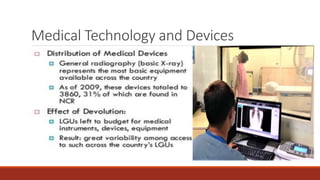
Medical Technology and Devices
Distribution of Medical Devices
- General radiography (basic X-ray) represents the most basic
equipment available across the country
- As of 2009, these devices totaled to 3860, 31% of which are found in
NCR
Effect of Devolution:
- LGUs left to budget for medical instruments, devices, equipment
- Result: great variability among access to such across the country’s
LGUs
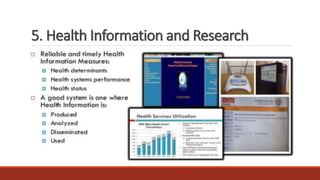
5. Health Information and Research
Reliable and timely Health
Information Measures:
-Health determinants
-Health systems performance
-Health status
A good system is one where
Health Information is:
-Produced
-Analyzed
-Disseminated
-Used
Health information is a national asset
and used by many:
- policy-makers
- Planners
- Health care providers
- Development partners
- The general public
Uses:
- Track health system performance
- Support better health policies
- Make effective health-related
decisions
Health Information in the Philippines
Poor integration and weak
governance of national and local
health information systems (Marcelo,
2002)
Telecom infrastructure mostly
concentrated in urban centers
Unclear considerations for the role
of IT in primary health care in the
Philippines
Lack of IT governance structures
(standards, etc.)
Existing DOH Information Gathering
Systems
- Allegedly computerized but still
highly reliant on outdated paper and
pen systems in the frontlines
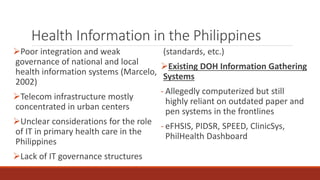
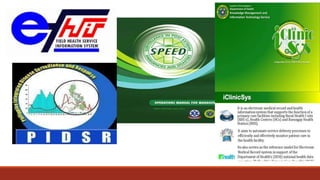
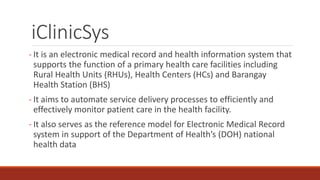
- eFHSIS, PIDSR, SPEED, ClinicSys,
PhilHealth Dashboard
iClinicSys
- It is an electronic medical record and health information system that
supports the function of a primary health care facilities including
Rural Health Units (RHUs), Health Centers (HCs) and Barangay
Health Station (BHS)
- It aims to automate service delivery processes to efficiently and
effectively monitor patient care in the health facility.
- It also serves as the reference model for Electronic Medical Record
system in support of the Department of Health’s (DOH) national
health data
The National Telehealth Service Program
(NTSP), a joint project of the Department of
Health and the National Telehealth Center, is a
5-year program aimed at expanding
Telemedicine in 4th to 6th class municipalities
nationwide. NTSP facilitates consults between
primary care physicians in geographically
isolated and disadvantaged areas (GIDA) and
clinical specialists of the Philippine General
Hospital (PGH) using a mobile and internet-
based interface and triaging system.
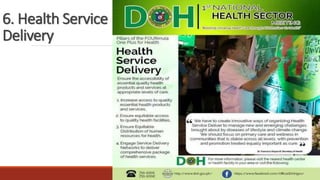
6. Health Service
Delivery
6. Health Service Delivery
Pillars of the FOURmula
One Plus for Health
Health Service Delivery
Ensure the accessibility of essential quality
health products and services at appropriate
levels of care.
1.Increase access to quality essential health
products and services
2.Ensure equitable access to quality health
facilities
3.Ensure Equitable Distribution of human
resources for health
4.Engage Service Delivery Networks to deliver
comprehensive package of health services.
“We have to create innovative ways of
organizing Health Service Delivery to manage
new and emerging challenges brought about
by diseases of lifestyle and climate change.
We should focus on primary care and
wellness in communities that is stable across
all levels., with prevention and promotion
treated equally important as cure.”
2 Health Care System.pptx

2 Health Care System.pptx

  • 1.
    Health Care System REFERENCES: HTTPS://WWW.SLIDESHARE.NET/LOPAOMD/AN-INTRODUCTION-TO-HEALTH-SYSTEMS-AN-OVERVIEW- OF-THE-PHILIPPINE-HEALTH-CARE-SYSTEM-AND-HEALTH-SYSTEMS-THINKING HTTPS://WWW.SLIDESHARE.NET/SHARINA11/HEALTH -CARE-DELIVERY-SYSTEM-IN-THE-PHILIPPINES
  • 2.
    Objectives: • Define HealthCare System • Discuss factors affecting Health Care System • Provide overview of Philippine Health Care Delivery System
  • 3.
    THE WHO HEALTHSYSTEMS FRAMEWORK
  • 4.
    Definition of Terms HEALTHCARE SYSTEM - an organized plan of health services (Miller-Keane, 1987) HEALTH CARE DELIVERY -rendering health care services to the people (Williams-Tungpalan, 1981).
  • 5.
    HEALTH CARE DELIVERYSYSTEM (Williams-Tungpalan, 1981) -the network of health facilities and personnel which carries out the task of rendering health care to the people. PHILIPPINE HEALTH CARE SYSTEM - is a complex set of organizations interacting to provide an array of health services (Dizon, 1977).
  • 6.
  • 7.
    Health System Basics(WHO, 2007) Health System (def.) - Consists of all organization, people and actions whose primary intent is to restore or maintain health. - Includes efforts to influence determinants of health as well as more direct health-improving activities - It is MORE than the pyramid of publicly owned facilities that deliver personal services. Guiding values and principles - Values and goals enshrined in the Alma Ata declaration - WHO’s commitment to gender and human rights. - World Health Report of 2000
  • 8.
    HEALTH SYSTEM (TINIO,2008) • A health system comprises all organizations, institutions and resources devoted to producing actions whose primary intent is to improve health. • The four essential functions of a health system have been defined as: service provision, resource generation, financing stewardship
  • 9.
    Health System Goals: OverallOutcomes (World Health Report 2000): - Improving health and health equity through ways that are: (1) Responsive, (2) Financially fair, (3) Best or most efficient use of available resources Intermediate Goals: - Greater access to and coverage for effective health interventions - Provider quality and safety are not compromised
  • 10.
    HEALTH CARE SYSTEMMODELS (TINIO, 2008) Private enterprise health care Social security health model Publicly funded health care model Social health insurance
  • 11.
    1. PRIVATE ENTERPRISEHEALTH CARE MODEL Purely private enterprise health care systems are comparatively rare. When they exist, it is usually for a comparatively well-off subpopulation in a poorer country with a poorer standard of health care. for instance, private clinics for a small, wealthy expatriate population in an otherwise poor country But there are countries with a majority-private health care system with residual public service
  • 12.
    2. SOCIAL SECURITYHEALTH MODEL  Where workers and their families are insured by the state  refers to social welfare service concerned with social protection, or protection against socially recognized conditions, including poverty, old age, disability, unemployment and others
  • 13.
    Social security mayrefer to: social insurance, where people receive benefits or services in recognition of contributions to an insurance scheme. These services typically include provision for retirement pensions, disability insurance, survivor benefits and unemployment insurance. income maintenance mainly the distribution of cash in the event of interruption of employment, including retirement, disability and unemployment  services provided by administrations responsible for social security. In different countries this may include medical care, aspects of social work and even industrial relations.
  • 14.
    3. PUBLICLY FUNDEDHEALTH CARE MODEL Where the residents of the country are insured by the state  Health care that is financed entirely or in majority part by citizens' tax payments instead of through private payments made to insurance companies or directly to health care providers
  • 15.
    4. SOCIAL HEALTHINSURANCE  where the whole population or most of the population is a member of a sickness insurance company  (SHI) is a method for financing health care costs through a social insurance program based on the collection of funds contributed by individuals, employers, and sometimes government subsidies
  • 16.
    characterized by thepresence of sickness funds which usually receive a proportional contribution of their members' wages.  With this insurance contributions these funds pay medical costs of their members  Affiliation to such funds is usually based on professional, geographic, religious/political and/or non-partisan criteria
  • 17.
  • 18.
    WHO Building blockfor Health System building blocks  Access Coverage and Quality Safety  Goals/Outcomes System Building Blocks 1.Leadership/Governance 2.Health Care Financing 3.Health Workforce 4.Medical products, technologies 5.Information and Research 6.Service Delivery Goals/Outcomes 1.Improved health (level and quality) 2.Responsiveness 3.Financial Risk Protection 4.Improved Efficiency
  • 19.
    1. LEADERSHIP ANDGOVERNANCE 1.Leadership and Governance Ensuring the existence of strategic policy frameworks combined with: - Effective oversight - Coalition-building - Provision of appropriate regulations and incentives - Attention to system design - Accountability
  • 20.
    Health Governance (stewardship) context: Widerange of functions carried out by governments to: - Improve population health while ensuring: (1) Access to services, (2) Quality of Services, (3) Patients’ rights Examples: - Administrative details - Logistics and Operations - Planning and Policy Making - Monitoring and Evaluation
  • 21.
    Governance: Roles, responsibilities and relationships(Interplay) of: - Public sector - Private sector - AND Voluntary sectors (including civil society) In pursuit of national health goals - Ensure clarity AND actualization of health system vision-mission
  • 22.
  • 23.
    IN THE PHILIPPINES Mandate(E.O. No. 119, Sec 3): - The Department of Health (DOH) shall be responsible for the following: formulation and development of national health policies, guidelines, standards and manual of operations for health services and programs, issuances of rules and regulations, licenses and accreditations; promulgation of national health standards, goals, priorities and indicators; development of special health programs and projects and advocacy for legislation on health policies and programs. The primary function of the Department of Health is the promotion, protection, preservation or restoration of the health of the people through the provision and delivery of health services and through the regulation and encouragement of providers of health goods and services. - THE DOH IS THE LEAD AGENCY FOR PHILIPPINE HEALTH CARE.
  • 24.
    VISION Filipinos are amongthe healthiest people in Southeast Asia by 2022, and Asia by 2040 MISSION To lead the country in the development of a productive, resilient, equitable and people-centered health system
  • 25.
    Primary Goals ofHealth Sector The primary goals of the health sector: 1.Better health outcomes: Attaining the best average level of health care for the entire population and attaining the smallest feasible differences in health status among individuals and groups 2.More responsive health system: Meeting the people’s expectations of how they should be treated by health providers and the degree by which people are satisfied with the health system 3.More equitable health care financing: Distributing the risk that each individual faces due to cost of health care according to ability to pay rather than the risk of illness
  • 26.
    DEVOLUTION - RA 7160(Local Government Code of 1991) - The act by which the Philippine Government “devolved” basic services (health services, agriculture extension, livelihood development, forest management, barangay roads and social welfare) to Local Government Units (barangay, municipality/city, province)
  • 28.
    Implementation of Devolutionin 1992: Management and delivery of health services -From DOH to locally elected provincial, city and municipal governments 4 Essential Health System Functions -Service provision -Resource generation -Financing -Stewardship
  • 30.
    Devolution in ARMM: •Retained centralized characterof its health system •DOH ARMM directly runs its provincial and municipal health facilities (hospitals, RHUs) Interlocal Health Zones (ILHZs) • Inspired by WHO District Health System • Pseudo legal entities • (Ideally) AN integrated health management and delivery system based on defined administrative and geographical area - District Hospital + surrounding/covered municipalities • Usually composed of adjacent municipalities with similar health needs - Resource sharing - Common health goals - Mutual planning, policy formulations, health operations implementation and monitoring and evaluation
  • 31.
  • 32.
    2. Health/ HealthCare Financing • Good Health Financing Two Main Characteristics - Raises adequate funds for health to ensure that people get to use needed services - People who use health services are shielded from financial catastrophe or impoverishment associated with having to pay for them
  • 33.
    Health and HealthCare are major political and economic issues • Health financing impacts the analysis of: - Health policies - Fund sources - Effectiveness and efficiency of health services for populations • Health Financing Goals: - Raising sufficient funds for health - Ensure adequate spending on health - Effective allocation of finite financial resources to different types of public and personal health services - Pooling financial resources across population groups and sharing financial risks - Using funds for health efficiently and equitably Main fund sources: Government Private (OOP, HMOs, life insurance, etc.) Social Health Insurance Others (grants, aid, etc.) Current Health Expenditure by Health Care Financing Scheme: 2019 - Voluntary health care payment schemes (10.1%) - Government schemes and compulsory contributory health care financing schemes (42.0%) - Household out-of-pocket payment (47.9%)
  • 34.
  • 35.
    National Health InsuranceProgram RA 7875 - National Health Insurance Act of 1995 - Established the Philippine Health Insurance Corporation (PHIC) - More commonly known as: PhilHealth PhilHealth • Employed Sector Program - Compulsory average: ALL government AND private employees • Individually Paying Program - Voluntary coverage: self-employed and “others” • Sponsored Programs - Covers “poorest of the poor” (Quintiles 1 and 2) • Overseas Filipino Workers • Lifetime Member Program - 60 y.o. and above who have completed 120 monthly contributions (before) - Senior Citizens automatically covered (2015)
  • 36.
  • 37.
    3. Health Workforce/Human Resources for Health (HRH) Human resources for health (HRH)- people engaged in actions whose primary intent is to enhance health. To achieve the best health outcomes possible: - Sufficient numbers - Right mix of staff - System-wide deployment and distribution (equitable) - Established job-related norms - Enabling work environments - Just compensation/payment systems – right kind of incentives
  • 38.
    Population needs determinethe development and sustaining of health workforce  Education, training and continuing competence  Utilization, management and retention  Strategic response to evolving unmet health service needs  Governance, leadership and partnerships for sustained HRH contributions to improved population outcomes • Regulation • Deployment • Compensation • Continuing career enhancement and development
  • 40.
    4. Access toMedicines and Technologies
  • 41.
    4. Access toMedicines and Technologies Supply-driven distribution scheme (PHAP 2008, WHO 2011) - Drugstores: 80.1% - Hospitals: 9.7% (gov’t at 2.3%) - Others: 10.2% (including government agencies at 0.3%) Strong market orientation Generics Act/Law since 1988 but compliance to it is still an issue Generally lax regulation with strong pharmaceutical/nutritional company lobbying influence (FDA lead agency) Major Constraints in Accessing Essential Drugs (DOH 2008) - Limited availability - Irrational use - High costs Effect of Devolution: - LGUs left to budget for medicines - Result: great variability among access to such, particularly basic meds across the country’s LGUs
  • 42.
  • 43.
    Medical Technology andDevices Distribution of Medical Devices - General radiography (basic X-ray) represents the most basic equipment available across the country - As of 2009, these devices totaled to 3860, 31% of which are found in NCR Effect of Devolution: - LGUs left to budget for medical instruments, devices, equipment - Result: great variability among access to such across the country’s LGUs
  • 44.
  • 45.
    5. Health Informationand Research Reliable and timely Health Information Measures: -Health determinants -Health systems performance -Health status A good system is one where Health Information is: -Produced -Analyzed -Disseminated -Used
  • 46.
    Health information isa national asset and used by many: - policy-makers - Planners - Health care providers - Development partners - The general public Uses: - Track health system performance - Support better health policies - Make effective health-related decisions
  • 47.
    Health Information inthe Philippines
  • 48.
    Health Information inthe Philippines Poor integration and weak governance of national and local health information systems (Marcelo, 2002) Telecom infrastructure mostly concentrated in urban centers Unclear considerations for the role of IT in primary health care in the Philippines Lack of IT governance structures (standards, etc.) Existing DOH Information Gathering Systems - Allegedly computerized but still highly reliant on outdated paper and pen systems in the frontlines - eFHSIS, PIDSR, SPEED, ClinicSys, PhilHealth Dashboard
  • 50.
    iClinicSys - It isan electronic medical record and health information system that supports the function of a primary health care facilities including Rural Health Units (RHUs), Health Centers (HCs) and Barangay Health Station (BHS) - It aims to automate service delivery processes to efficiently and effectively monitor patient care in the health facility. - It also serves as the reference model for Electronic Medical Record system in support of the Department of Health’s (DOH) national health data
  • 51.
    The National TelehealthService Program (NTSP), a joint project of the Department of Health and the National Telehealth Center, is a 5-year program aimed at expanding Telemedicine in 4th to 6th class municipalities nationwide. NTSP facilitates consults between primary care physicians in geographically isolated and disadvantaged areas (GIDA) and clinical specialists of the Philippine General Hospital (PGH) using a mobile and internet- based interface and triaging system.
  • 52.
  • 53.
    6. Health ServiceDelivery Pillars of the FOURmula One Plus for Health Health Service Delivery Ensure the accessibility of essential quality health products and services at appropriate levels of care. 1.Increase access to quality essential health products and services 2.Ensure equitable access to quality health facilities 3.Ensure Equitable Distribution of human resources for health 4.Engage Service Delivery Networks to deliver comprehensive package of health services. “We have to create innovative ways of organizing Health Service Delivery to manage new and emerging challenges brought about by diseases of lifestyle and climate change. We should focus on primary care and wellness in communities that is stable across all levels., with prevention and promotion treated equally important as cure.”

Editor's Notes

  • #7 Health System Basics (WHO, 2007) Health System (def.) Consists of all organization, people and actions whose primary intent is to restore or maintain health. Includes efforts to influence determinants of health as well as more direct health-improving activities It is MORE than the pyramid of publicly owned facilities that deliver personal services. Guiding values and principles Values and goals enshrined in the Alma Ata declaration WHO’s commitment to gender and human rights. World Health Report of 2000
  • #10 Health System Goals: Overall Outcomes (World Health Report 2000): Improving health and health equity through ways that are: (1) Responsive, (2) Financially fair, (3) Best or most efficient use of available resources Intermediate Goals: Greater access to and coverage for effective health interventions Provider quality and safety are not compromised
  • #14 In different countries this may include medical care, aspects of social work and even industrial relations.
  • #18 System Building Blocks Leadership/Governance Health Care Financing Health Workforce Medical products, technologies Information and Research Service Delivery System building blocks  Access Coverage and Quality Safety  Goals/Outcomes Goals/Outcomes Improved health (level and quality) Responsiveness Financial Risk Protection Improved Efficiency
  • #20 Leadership and Governance Ensuring the existence of strategic policy frameworks combined with: Effective oversight Coalition-building Provision of appropriate regulations and incentives Attention to system design Accountability
  • #21 Health Governance (stewardship) context: Wide range of functions carried out by governments to: Improve population health while ensuring: (1) Access to services, (2) Quality of Services, (3) Patients’ rights Examples: Administrative details Logistics and Operations Planning and Policy Making Monitoring and Evaluation
  • #22 Governance: Roles, responsibilities and relationships (Interplay) of: Public sector Private sector AND Voluntary sectors (including civil society) In pursuit of national health goals - Ensure clarity AND actualization of health system vision-mission
  • #23 Mandate (E.O. No. 119, Sec 3): The Department of Health (DOH) shall be responsible for the following: formulation and development of national health policies, guidelines, standards and manual of operations for health services and programs, issuances of rules and regulations, licenses and accreditations; promulgation of national health standards, goals, priorities and indicators; development of special health programs and projects and advocacy for legislation on health policies and programs. The primary function of the Department of Health is the promotion, protection, preservation or restoration of the health of the people through the provision and delivery of health services and through the regulation and encouragement of providers of health goods and services. THE DOH IS THE LEAD AGENCY FOR PHILIPPINE HEALTH CARE.
  • #26 The primary goals of the health sector: Better health outcomes: Attaining the best average level of health care for the entire population and attaining the smallest feasible differences in health status among individuals and groups More responsive health system: Meeting the people’s expectations of how they should be treated by health providers and the degree by which people are satisfied with the health system More equitable health care financing: Distributing the risk that each individual faces due to cost of health care according to ability to pay rather than the risk of illness
  • #27 Devolution RA 7160 (Local Government Code16 of 1991) The act by which the Philippine Government “devolved” basic services (health services, agriculture extension, livelihood development, forest management, barangay roads and social welfare) to Local Government Units (barangay, municipality/city, province)
  • #28 Implementation of Devolution in 1992: Management and delivery of health services From DOH to locally elected provincial, city and municipal governments 4 Essential Health System Functions Service provision Resource generation Financing Stewardshipe
  • #30 Devolution in ARMM: Retained centralized character of its health system DOH ARMM directly runs its provincial and municipal health facilities (hospitals, RHUs) Interlocal Health Zones (ILHZs) Inspired by WHO District Health System Pseudo legal entities (Ideally) AN integrated health management and delivery system based on defined administrative and geographical area District Hospital + surrounding/covered municipalities Usually composed of adjacent municipalities with similar health needs Resource sharing Common health goals Mutual planning, policy formulations, health operations implementation and monitoring and evaluation
  • #33 Good Health Financing Two Main Characteristics Raises adequate funds for health to ensure that people get to use needed services People who use health services are shielded from financial catastrophe or impoverishment associated with having to pay for them
  • #34 Main fund sources:  Government  Private (OOP, HMOs, life insurance, etc.)  Social Health Insurance  Others (grants, aid, etc.)  Health and Health Care are major political and economic issues Health financing impacts the analysis of: Health policies Fund sources Effectiveness and efficiency of health services for populations Health Financing Goals: Raising sufficient funds for health Ensure adequate spending on health Effective allocation of finite financial resources to different types of public and personal health services Pooling financial resources across population groups and sharing financial risks Using funds for health efficiently and equitably
  • #35 RA 7875 National Health Insurance Act of 1995 Established the Philippine Health Insurance Corporation (PHIC) More commonly known as: PhilHealth PhilHealth Employed Sector Program Compulsory average: ALL government AND private employees Individually Paying Program Voluntary coverage: self-employed and “others” Sponsored Programs Covers “poorest of the poor” (Quintiles 1 and 2) Overseas Filipino Workers Lifetime Member Program 60 y.o. and above who have completed 120 monthly contributions (before) Senior Citizens automatically covered (2015)
  • #38 Human resources for health (HRH)- people engaged in actions whose primary intent is to enhance health. To achieve the best health outcomes possible: Sufficient numbers Right mix of staff System-wide deployment and distribution (equitable) Established job-related norms Enabling work environments Just compensation/payment systems – right kind of incentives
  • #39 Population needs determine the development and sustaining of health workforce Education, training and continuing competence Utilization, management and retention Strategic response to evolving unmet health service needs Governance, leadership and partnerships for sustained HRH contributions to improved population outcomes Regulation Deployment Compensation Continuing career enhancement and development
  • #41 Essential medicine Supply-driven distribution scheme (PHAP 2008, WHO 2011) Drugstores: 80.1% Hospitals: 9.7% (gov’t at 2.3%) Others: 10.2% (including government agencies at 0.3%) Strong market orientation Generics Act/Law since 1988 but compliance to it is still an issue Generally lax regulation with strong pharmaceutical/nutritional company lobbying influence (FDA lead agency) Major Constraints in Accessing Essential Drugs (DOH 2008) Limited availability Irrational use High costs Effect of Devolution: LGUs left to budget for medicines Result: great variability among access to such, particularly basic meds across the country’s LGUs
  • #43 Distribution of Medical Devices General radiography (basic X-ray) represents the most basic equipment available across the country As of 2009, these devices totaled to 3860, 31% of which are found in NCR Effect of Devolution: LGUs left to budget for medical instruments, devices, equipment Result: great variability among access to such across the country’s LGUs
  • #45 Reliable and timely Health Information Measures: Health determinants Health systems performance Health status A good system is one where Health Information is: Produced Analyzed Disseminated Used
  • #47 Health information is a national asset and used by many: policy-makers Planners Health care providers Development partners The general public Uses: Track health system performance Support better health policies Make effective health-related decisions
  • #48 Poor integration and weak governance of national and local health information systems (Marcelo, 2002) Telecom infrastructure mostly concentrated in urban centers Unclear considerations for the role of IT in primary health care in the Philippines Lack of IT governance structures (standards, etc.) Existing DOH Information Gathering Systems Allegedly computerized but still highly reliant on outdated paper and pen systems in the frontlines eFHSIS, PIDSR, SPEED, ClinicSys, PhilHealth Dashboard
  • #50 iClinicSys It is an electronic medical record and health information system that supports the function of a primary health care facilities including Rural Health Units (RHUs), Health Centers (HCs) and Barangay Health Station (BHS) It aims to automate service delivery processes to efficiently and effectively monitor patient care in the health facility. It also serves as the reference model for Electronic Medical Record system in support of the Department of Health’s (DOH) national health data
  • #53 Pillars of the FOURmula One Plus for Health Health Service Delivery Ensure the accessibility of essential quality health products and services at appropriate levels of care. Increase access to quality essential health products and services Ensure equitable access to quality health facilities Ensure Equitable Distribution of human resources for health Engage Service Delivery Networks to deliver comprehensive package of health services. “We have to create innovative ways of organizing Health Service Delivery to manage new and emerging challenges brought about by diseases of lifestyle and climate change. We should focus on primary care and wellness in communities that is stable across all levels., with prevention and promotion treated equally important as cure.”