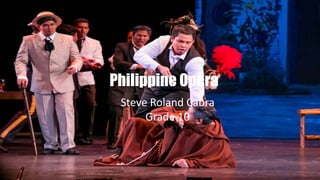
Philippine Opera
S
Steve Roland Cabra
Grade 10
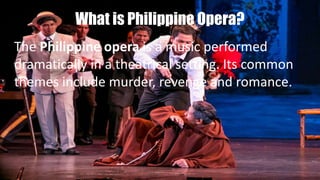
What is Philippine Opera?
The Philippine opera is a music performed
dramatically in a theatrical setting. Its common
themes include murder, revenge and romance.
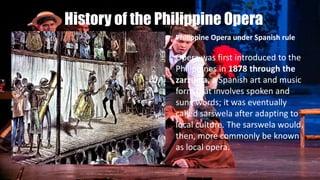
History of the Philippine Opera
Philippine Opera under Spanish rule
Opera was first introduced to the
Philippines in 1878 through the
zarzuela, a Spanish art and music
form that involves spoken and
sung words; it was eventually
called sarswela after adapting to
local culture. The sarswela would,
then, more commonly be known
as local opera.
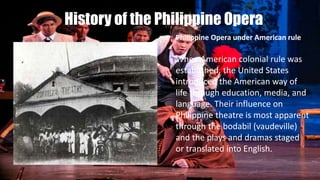
History of the Philippine Opera
Philippine Opera under American rule
When American colonial rule was
established, the United States
introduced the American way of
life through education, media, and
language. Their influence on
Philippine theatre is most apparent
through the bodabil (vaudeville)
and the plays and dramas staged
or translated into English.
History of the Philippine Opera
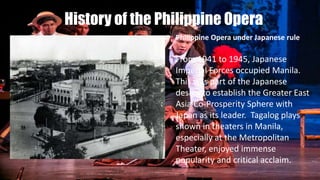
Philippine Opera under Japanese rule
From 1941 to 1945, Japanese
Imperial Forces occupied Manila.
This was part of the Japanese
design to establish the Greater East
Asia Co-Prosperity Sphere with
Japan as its leader. Tagalog plays
shown in theaters in Manila,
especially at the Metropolitan
Theater, enjoyed immense
popularity and critical acclaim.
History of the Philippine Opera
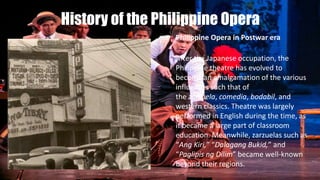
Philippine Opera in Postwar era
After the Japanese occupation, the
Philippine theatre has evolved to
become an amalgamation of the various
influences such that of
the zarzuela, comedia, bodabil, and
western classics. Theatre was largely
performed in English during the time, as
it became a large part of classroom
education. Meanwhile, zarzuelas such as
“Ang Kiri,” “Dalagang Bukid,” and
“Paglipis ng Dilim” became well-known
beyond their regions.
History of the Philippine Opera
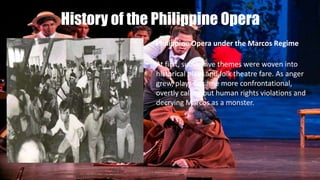
Philippine Opera under the Marcos Regime
At first, subversive themes were woven into
historical plays and folk theatre fare. As anger
grew, plays became more confrontational,
overtly calling out human rights violations and
decrying Marcos as a monster.
History of the Philippine Opera
Philippine Opera in Contemporary Era
Through the years, Philippine theatre
groups have staged numerous plays
in both English and Filipino, be it
written by a Western or local
playwright. Spanish culture and
traditions largely influence performing
arts in the Philippines, but the
contemporary style is borrowed from
the Americans. Classic shows such
as The Westside Story and Sound of
Music made waves in recent years
when it took the local stage.
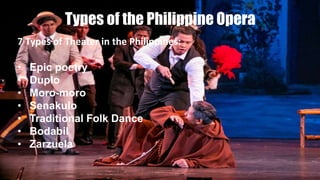
Types of the Philippine Opera
7 Types of Theater in the Philippines:
• Epic poetry
• Duplo
• Moro-moro
• Senakulo
• Traditional Folk Dance
• Bodabil
• Zarzuela
Types of the Philippine Opera
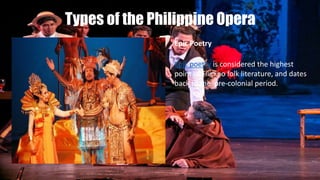
Epic Poetry
Epic poetry is considered the highest
point of Filipino folk literature, and dates
back to the pre-colonial period.
Types of the Philippine Opera
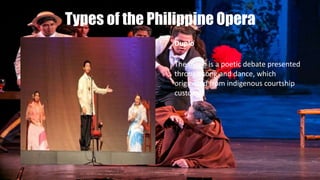
Duplo
The duplo is a poetic debate presented
through song and dance, which
originated from indigenous courtship
customs.
Types of the Philippine Opera
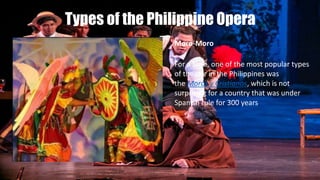
Moro-Moro
For a time, one of the most popular types
of theater in the Philippines was
the Moros y Cristianos, which is not
surprising for a country that was under
Spanish rule for 300 years.
Types of the Philippine Opera
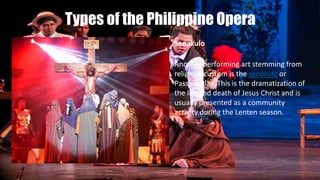
Senakulo
Another performing art stemming from
religious custom is the senakulo or
Passion Play. This is the dramatization of
the life and death of Jesus Christ and is
usually presented as a community
activity during the Lenten season.
Types of the Philippine Opera
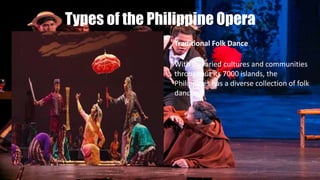
Traditional Folk Dance
With its varied cultures and communities
throughout its 7000 islands, the
Philippines has a diverse collection of folk
dances..
Types of the Philippine Opera
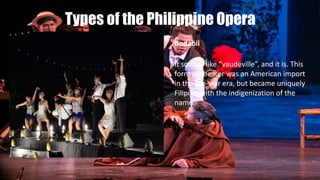
Bodabil
It sounds like “vaudeville”, and it is. This
form of theater was an American import
in the pre-war era, but became uniquely
Filipino with the indigenization of the
name.
Types of the Philippine Opera
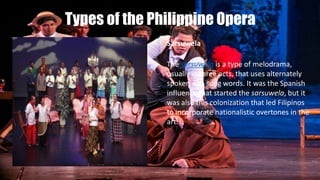
Sarsuwela
The sarsuwela is a type of melodrama,
usually in three acts, that uses alternately
spoken and sung words. It was the Spanish
influence that started the sarsuwela, but it
was also this colonization that led Filipinos
to incorporate nationalistic overtones in the
art.

Philippine Opera

  • 1.
  • 2.
    What is PhilippineOpera? The Philippine opera is a music performed dramatically in a theatrical setting. Its common themes include murder, revenge and romance.
  • 3.
    History of thePhilippine Opera Philippine Opera under Spanish rule Opera was first introduced to the Philippines in 1878 through the zarzuela, a Spanish art and music form that involves spoken and sung words; it was eventually called sarswela after adapting to local culture. The sarswela would, then, more commonly be known as local opera.
  • 4.
    History of thePhilippine Opera Philippine Opera under American rule When American colonial rule was established, the United States introduced the American way of life through education, media, and language. Their influence on Philippine theatre is most apparent through the bodabil (vaudeville) and the plays and dramas staged or translated into English.
  • 5.
    History of thePhilippine Opera Philippine Opera under Japanese rule From 1941 to 1945, Japanese Imperial Forces occupied Manila. This was part of the Japanese design to establish the Greater East Asia Co-Prosperity Sphere with Japan as its leader. Tagalog plays shown in theaters in Manila, especially at the Metropolitan Theater, enjoyed immense popularity and critical acclaim.
  • 6.
    History of thePhilippine Opera Philippine Opera in Postwar era After the Japanese occupation, the Philippine theatre has evolved to become an amalgamation of the various influences such that of the zarzuela, comedia, bodabil, and western classics. Theatre was largely performed in English during the time, as it became a large part of classroom education. Meanwhile, zarzuelas such as “Ang Kiri,” “Dalagang Bukid,” and “Paglipis ng Dilim” became well-known beyond their regions.
  • 7.
    History of thePhilippine Opera Philippine Opera under the Marcos Regime At first, subversive themes were woven into historical plays and folk theatre fare. As anger grew, plays became more confrontational, overtly calling out human rights violations and decrying Marcos as a monster.
  • 8.
    History of thePhilippine Opera Philippine Opera in Contemporary Era Through the years, Philippine theatre groups have staged numerous plays in both English and Filipino, be it written by a Western or local playwright. Spanish culture and traditions largely influence performing arts in the Philippines, but the contemporary style is borrowed from the Americans. Classic shows such as The Westside Story and Sound of Music made waves in recent years when it took the local stage.
  • 9.
    Types of thePhilippine Opera 7 Types of Theater in the Philippines: • Epic poetry • Duplo • Moro-moro • Senakulo • Traditional Folk Dance • Bodabil • Zarzuela
  • 10.
    Types of thePhilippine Opera Epic Poetry Epic poetry is considered the highest point of Filipino folk literature, and dates back to the pre-colonial period.
  • 11.
    Types of thePhilippine Opera Duplo The duplo is a poetic debate presented through song and dance, which originated from indigenous courtship customs.
  • 12.
    Types of thePhilippine Opera Moro-Moro For a time, one of the most popular types of theater in the Philippines was the Moros y Cristianos, which is not surprising for a country that was under Spanish rule for 300 years.
  • 13.
    Types of thePhilippine Opera Senakulo Another performing art stemming from religious custom is the senakulo or Passion Play. This is the dramatization of the life and death of Jesus Christ and is usually presented as a community activity during the Lenten season.
  • 14.
    Types of thePhilippine Opera Traditional Folk Dance With its varied cultures and communities throughout its 7000 islands, the Philippines has a diverse collection of folk dances..
  • 15.
    Types of thePhilippine Opera Bodabil It sounds like “vaudeville”, and it is. This form of theater was an American import in the pre-war era, but became uniquely Filipino with the indigenization of the name.
  • 16.
    Types of thePhilippine Opera Sarsuwela The sarsuwela is a type of melodrama, usually in three acts, that uses alternately spoken and sung words. It was the Spanish influence that started the sarsuwela, but it was also this colonization that led Filipinos to incorporate nationalistic overtones in the art.