History of Philippine Opera
Quarter 4: 20th and 21th Century Multimedia Forms
(Opera in the Philippines)
Arellano High School
Music 10
Group 1
10-Hertz
Mr. Janer
MAPEH Teacher
Group 1 (10-hertz)
1. Castro, 6. Del Rosario
2. Cayetano, 7. Espinosa
3. Cunanan, 8. Fabroa
4. Dapula, 9. Gonzaga
5. De Guzman 10. Guasis
Opera in the Philippines
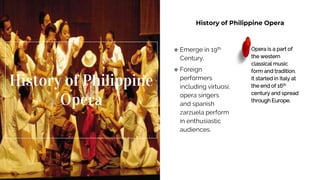
History of Philippine Opera
 Opera is a part of
the western
classical music
form and tradition.
It started in Italy at
the end of 16th
century and spread
through Europe.
History of Philippine
Opera
 Emerge in 19th
Century.
 Foreign
performers
including virtuosi,
opera singers
and spanish
zarzuela perform
in enthusiastic
audiences.
Local Theaters and Early Philippine Opera
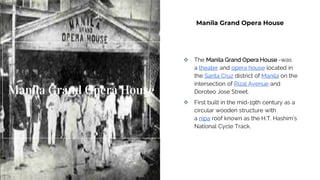
Manila Grand Opera House
 The Manila Grand Opera House -was
a theater and opera house located in
the Santa Cruz district of Manila on the
intersection of Rizal Avenue and
Doroteo Jose Street.
 First built in the mid-19th century as a
circular wooden structure with
a nipa roof known as the H.T. Hashim’s
National Cycle Track.
Manila Grand Opera House
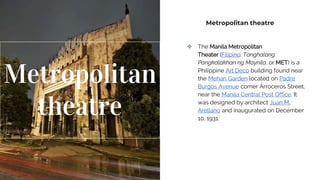
Metropolitan theatre
 The Manila Metropolitan
Theater (Filipino: Tanghalang
Pangkalakhan ng Maynila, or MET) is a
Philippine Art Deco building found near
the Mehan Garden located on Padre
Burgos Avenue corner Arroceros Street,
near the Manila Central Post Office. It
was designed by architect Juan M.
Arellano and inaugurated on December
10, 1931.
Metropolitan
theatre
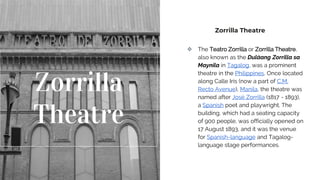
Zorrilla Theatre
 The Teatro Zorrilla or Zorrilla Theatre,
also known as the Duláang Zorrilla sa
Maynila in Tagalog, was a prominent
theatre in the Philippines. Once located
along Calle Iris (now a part of C.M.
Recto Avenue), Manila, the theatre was
named after José Zorrilla (1817 - 1893),
a Spanish poet and playwright. The
building, which had a seating capacity
of 900 people, was officially opened on
17 August 1893, and it was the venue
for Spanish-language and Tagalog-
language stage performances.
Zorrilla
Theatre
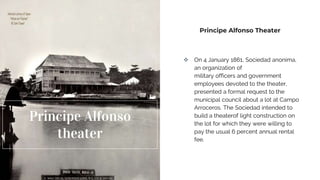
Principe Alfonso Theater
 On 4 January 1861, Sociedad anonima,
an organization of
military officers and government
employees devoted to the theater,
presented a formal request to the
municipal council about a lot at Campo
Arroceros. The Sociedad intended to
build a theaterof light construction on
the lot for which they were willing to
pay the usual 6 percent annual rental
fee.
Principe Alfonso
theater
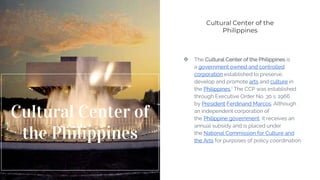
Cultural Center of the
Philippines
 The Cultural Center of the Philippines is
a government owned and controlled
corporation established to preserve,
develop and promote arts and culture in
the Philippines.[ The CCP was established
through Executive Order No. 30 s. 1966
by President Ferdinand Marcos. Although
an independent corporation of
the Philippine government, it receives an
annual subsidy and is placed under
the National Commission for Culture and
the Arts for purposes of policy coordination
Cultural Center of
the Philippines
Philippine Opera
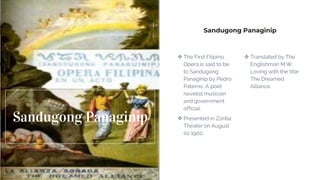
 The First Filipino
Opera is said to be
to Sandugong
Panaginip by Pedro
Paterno, A poet
novelist musician
and government
official.
 Presented in Zorilla
Theater on August
02 1902.
Sandugong Panaginip
 Translated by The
Englishman M.W.
Loving with the title
The Dreamed
Alliance.
Sandugong Panaginip
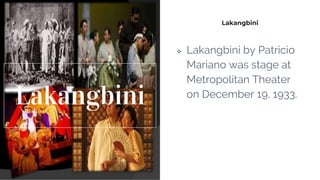
Lakangbini
 Lakangbini by Patricio
Mariano was stage at
Metropolitan Theater
on December 19, 1933.
Lakangbini
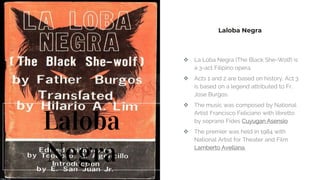
Laloba Negra
 La Loba Negra (The Black She-Wolf) is
a 3-act Filipino opera.
 Acts 1 and 2 are based on history. Act 3
is based on a legend attributed to Fr.
Jose Burgos.
 The music was composed by National
Artist Francisco Feliciano with libretto
by soprano Fides Cuyugan Asensio
 The premier was held in 1984 with
National Artist for Theater and Film
Lamberto Avellana.
Laloba
Negra
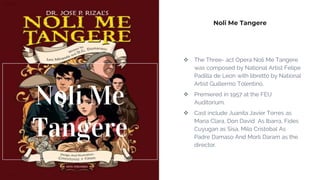
Noli Me Tangere
 The Three- act Opera Noli Me Tangere
was composed by National Artist Felipe
Padilla de Leon with libretto by National
Artist Guillermo Tolentino.
 Premiered in 1957 at the FEU
Auditorium.
 Cast include Juanita Javier Torres as
Maria Clara, Don David As Ibarra, Fides
Cuyugan as Sisa, Milo Cristobal As
Padre Damaso And Morli Daram as the
director.
Noli Me
Tangere
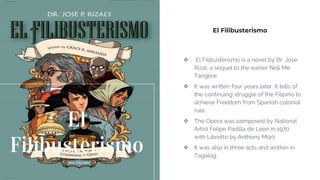
El Filibusterismo
 El Filibusterismo is a novel by Dr. Jose
Rizal, a sequel to the earlier Noli Me
Tangere.
 It was written four years later. It tells of
the continuing struggle of the Filipino to
achieve Freedom from Spanish colonial
rule.
 The Opera was composed by National
Artist Felipe Padilla de Leon in 1970
with Libretto by Anthony Morli
 It was also in three acts and written in
Tagalog.
El
Filibusterismo

10 hertz g1operainph

  • 1.
    History of PhilippineOpera Quarter 4: 20th and 21th Century Multimedia Forms (Opera in the Philippines) Arellano High School Music 10 Group 1 10-Hertz Mr. Janer MAPEH Teacher
  • 2.
    Group 1 (10-hertz) 1.Castro, 6. Del Rosario 2. Cayetano, 7. Espinosa 3. Cunanan, 8. Fabroa 4. Dapula, 9. Gonzaga 5. De Guzman 10. Guasis
  • 3.
    Opera in thePhilippines
  • 4.
    History of PhilippineOpera  Opera is a part of the western classical music form and tradition. It started in Italy at the end of 16th century and spread through Europe. History of Philippine Opera  Emerge in 19th Century.  Foreign performers including virtuosi, opera singers and spanish zarzuela perform in enthusiastic audiences.
  • 5.
    Local Theaters andEarly Philippine Opera
  • 6.
    Manila Grand OperaHouse  The Manila Grand Opera House -was a theater and opera house located in the Santa Cruz district of Manila on the intersection of Rizal Avenue and Doroteo Jose Street.  First built in the mid-19th century as a circular wooden structure with a nipa roof known as the H.T. Hashim’s National Cycle Track. Manila Grand Opera House
  • 7.
    Metropolitan theatre  TheManila Metropolitan Theater (Filipino: Tanghalang Pangkalakhan ng Maynila, or MET) is a Philippine Art Deco building found near the Mehan Garden located on Padre Burgos Avenue corner Arroceros Street, near the Manila Central Post Office. It was designed by architect Juan M. Arellano and inaugurated on December 10, 1931. Metropolitan theatre
  • 8.
    Zorrilla Theatre  TheTeatro Zorrilla or Zorrilla Theatre, also known as the Duláang Zorrilla sa Maynila in Tagalog, was a prominent theatre in the Philippines. Once located along Calle Iris (now a part of C.M. Recto Avenue), Manila, the theatre was named after José Zorrilla (1817 - 1893), a Spanish poet and playwright. The building, which had a seating capacity of 900 people, was officially opened on 17 August 1893, and it was the venue for Spanish-language and Tagalog- language stage performances. Zorrilla Theatre
  • 9.
    Principe Alfonso Theater On 4 January 1861, Sociedad anonima, an organization of military officers and government employees devoted to the theater, presented a formal request to the municipal council about a lot at Campo Arroceros. The Sociedad intended to build a theaterof light construction on the lot for which they were willing to pay the usual 6 percent annual rental fee. Principe Alfonso theater
  • 10.
    Cultural Center ofthe Philippines  The Cultural Center of the Philippines is a government owned and controlled corporation established to preserve, develop and promote arts and culture in the Philippines.[ The CCP was established through Executive Order No. 30 s. 1966 by President Ferdinand Marcos. Although an independent corporation of the Philippine government, it receives an annual subsidy and is placed under the National Commission for Culture and the Arts for purposes of policy coordination Cultural Center of the Philippines
  • 11.
  • 12.
     The FirstFilipino Opera is said to be to Sandugong Panaginip by Pedro Paterno, A poet novelist musician and government official.  Presented in Zorilla Theater on August 02 1902. Sandugong Panaginip  Translated by The Englishman M.W. Loving with the title The Dreamed Alliance. Sandugong Panaginip
  • 13.
    Lakangbini  Lakangbini byPatricio Mariano was stage at Metropolitan Theater on December 19, 1933. Lakangbini
  • 14.
    Laloba Negra  LaLoba Negra (The Black She-Wolf) is a 3-act Filipino opera.  Acts 1 and 2 are based on history. Act 3 is based on a legend attributed to Fr. Jose Burgos.  The music was composed by National Artist Francisco Feliciano with libretto by soprano Fides Cuyugan Asensio  The premier was held in 1984 with National Artist for Theater and Film Lamberto Avellana. Laloba Negra
  • 15.
    Noli Me Tangere The Three- act Opera Noli Me Tangere was composed by National Artist Felipe Padilla de Leon with libretto by National Artist Guillermo Tolentino.  Premiered in 1957 at the FEU Auditorium.  Cast include Juanita Javier Torres as Maria Clara, Don David As Ibarra, Fides Cuyugan as Sisa, Milo Cristobal As Padre Damaso And Morli Daram as the director. Noli Me Tangere
  • 16.
    El Filibusterismo  ElFilibusterismo is a novel by Dr. Jose Rizal, a sequel to the earlier Noli Me Tangere.  It was written four years later. It tells of the continuing struggle of the Filipino to achieve Freedom from Spanish colonial rule.  The Opera was composed by National Artist Felipe Padilla de Leon in 1970 with Libretto by Anthony Morli  It was also in three acts and written in Tagalog. El Filibusterismo