Prepared by: Sonny Mark Cabang

Comes from the word “litera” which means
letter.
Any printed matters written within a book, a
magazine or pamphlet.
As a faithful reproduction of man manifold
expression.
Deals with ideas, thought and emotions of man,
literature can be said to be the story of man.
What is Literature?

Appreciate
Understand
Realized
Truly love and take pride in our own
culture
Why we need to study Philippine
Literature?

They are closely related
LITERATURE – maybe fragment of the imagination
or events devoid of truth that has been written down.
HISTORY – is made up of events that really happen.
Literature vs History

Literary Composition that
Influence the World

 this has became the basis of
Christianity originating from
Palestine and Greece.
1. The BIBLE or The SACRED
WRITINGS

 the Muslim Bible. Originates from
Arabia.
2. KORAN

These have been source of myths
and legends of Greece.
They were written by Homer
3. The Iliad and the
Odyssey

 the longest epic in the world.
 Contains the history and
religion in India
4. The Mahab-harata

 It depics the religion and
customs of the English in the
early days.
This was originated from
England.
It was written by Chaucer
5. Canterburry Tales

 written by Harriet Beecher
Stowe of U.S.
 this depicted the sad fate of
slaves; this became the basis of
democracy later on
6. Uncle Tom’s Cabin

 by Dante of England
 this shows the religion and
customs of early Italians.
7. The Devine Comedy

 this shows the cultural
characteristics of the Spaniards
and their national history
8. El Cid Compeador

 this includes Doce Pares and
Roncesvalles of France.
 it tells about the golden age of
Christianity in France
9. The Song of Roland

 this includes the cult or Osiris
and the mythology and theology
of Egypt.
10. The Book of the Dead

 this was written by confucious
of China.
 this became the basis of the
Christian Religion.
11. The Book of the
Days

 from Arab and Persia (Iran).
 it shows the ways of
Government of industries and the
society of the Arab and Persian.
12. One thousand and One
Night or The Arabian Night

General Types of
Literature

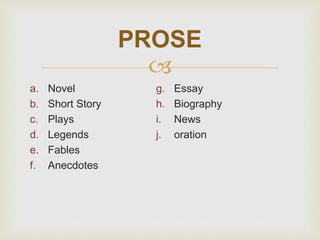
a. Novel
b. Short Story
c. Plays
d. Legends
e. Fables
f. Anecdotes
g. Essay
h. Biography
i. News
j. oration
PROSE

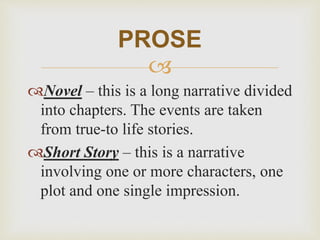
Novel – this is a long narrative divided
into chapters. The events are taken
from true-to life stories.
Short Story – this is a narrative
involving one or more characters, one
plot and one single impression.
PROSE

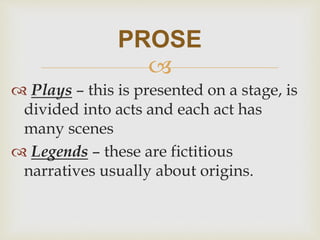
 Plays – this is presented on a stage, is
divided into acts and each act has
many scenes
 Legends – these are fictitious
narratives usually about origins.
PROSE

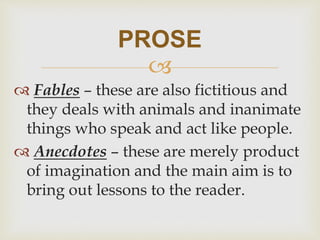
 Fables – these are also fictitious and
they deals with animals and inanimate
things who speak and act like people.
 Anecdotes – these are merely product
of imagination and the main aim is to
bring out lessons to the reader.
PROSE

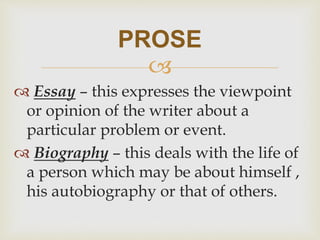
 Essay – this expresses the viewpoint
or opinion of the writer about a
particular problem or event.
 Biography – this deals with the life of
a person which may be about himself ,
his autobiography or that of others.
PROSE

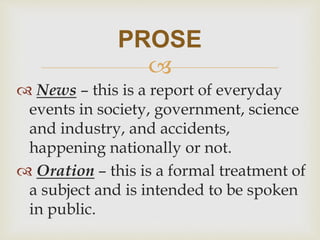
 News – this is a report of everyday
events in society, government, science
and industry, and accidents,
happening nationally or not.
 Oration – this is a formal treatment of
a subject and is intended to be spoken
in public.
PROSE

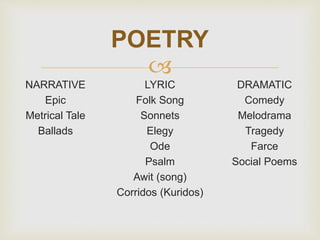
NARRATIVE
Epic
Metrical Tale
Ballads
LYRIC
Folk Song
Sonnets
Elegy
Ode
Psalm
Awit (song)
Corridos (Kuridos)
DRAMATIC
Comedy
Melodrama
Tragedy
Farce
Social Poems
POETRY

 Legends
 are a form of prose the common theme which is
about the origin of a thing, place, location or
name.
 Folk Tales
 are made up of stories about life, adventure, love,
horror and humor where one can derive lessons
about life.
Pre-Spanish Literature

 Riddles (Bugtong or Palaisipan)
 these are made up one or more measured lines
with rhyme and may consist of four to twelve
syllables.
 Chants (Bulong)
 Used in witchcraft or enchantment
 Proverbs and Sayings
 Often used in teasing or to comment on a person’s
actuations

Philippine literature

  • 1.
    Prepared by: SonnyMark Cabang
  • 2.
     Comes from theword “litera” which means letter. Any printed matters written within a book, a magazine or pamphlet. As a faithful reproduction of man manifold expression. Deals with ideas, thought and emotions of man, literature can be said to be the story of man. What is Literature?
  • 3.
     Appreciate Understand Realized Truly love andtake pride in our own culture Why we need to study Philippine Literature?
  • 4.
     They are closelyrelated LITERATURE – maybe fragment of the imagination or events devoid of truth that has been written down. HISTORY – is made up of events that really happen. Literature vs History
  • 5.
  • 6.
      this hasbecame the basis of Christianity originating from Palestine and Greece. 1. The BIBLE or The SACRED WRITINGS
  • 7.
      the MuslimBible. Originates from Arabia. 2. KORAN
  • 8.
     These have beensource of myths and legends of Greece. They were written by Homer 3. The Iliad and the Odyssey
  • 9.
      the longestepic in the world.  Contains the history and religion in India 4. The Mahab-harata
  • 10.
      It depicsthe religion and customs of the English in the early days. This was originated from England. It was written by Chaucer 5. Canterburry Tales
  • 11.
      written byHarriet Beecher Stowe of U.S.  this depicted the sad fate of slaves; this became the basis of democracy later on 6. Uncle Tom’s Cabin
  • 12.
      by Danteof England  this shows the religion and customs of early Italians. 7. The Devine Comedy
  • 13.
      this showsthe cultural characteristics of the Spaniards and their national history 8. El Cid Compeador
  • 14.
      this includesDoce Pares and Roncesvalles of France.  it tells about the golden age of Christianity in France 9. The Song of Roland
  • 15.
      this includesthe cult or Osiris and the mythology and theology of Egypt. 10. The Book of the Dead
  • 16.
      this waswritten by confucious of China.  this became the basis of the Christian Religion. 11. The Book of the Days
  • 17.
      from Araband Persia (Iran).  it shows the ways of Government of industries and the society of the Arab and Persian. 12. One thousand and One Night or The Arabian Night
  • 18.
  • 19.
     a. Novel b. ShortStory c. Plays d. Legends e. Fables f. Anecdotes g. Essay h. Biography i. News j. oration PROSE
  • 20.
     Novel – thisis a long narrative divided into chapters. The events are taken from true-to life stories. Short Story – this is a narrative involving one or more characters, one plot and one single impression. PROSE
  • 21.
      Plays –this is presented on a stage, is divided into acts and each act has many scenes  Legends – these are fictitious narratives usually about origins. PROSE
  • 22.
      Fables –these are also fictitious and they deals with animals and inanimate things who speak and act like people.  Anecdotes – these are merely product of imagination and the main aim is to bring out lessons to the reader. PROSE
  • 23.
      Essay –this expresses the viewpoint or opinion of the writer about a particular problem or event.  Biography – this deals with the life of a person which may be about himself , his autobiography or that of others. PROSE
  • 24.
      News –this is a report of everyday events in society, government, science and industry, and accidents, happening nationally or not.  Oration – this is a formal treatment of a subject and is intended to be spoken in public. PROSE
  • 25.
     NARRATIVE Epic Metrical Tale Ballads LYRIC Folk Song Sonnets Elegy Ode Psalm Awit(song) Corridos (Kuridos) DRAMATIC Comedy Melodrama Tragedy Farce Social Poems POETRY
  • 26.
      Legends  area form of prose the common theme which is about the origin of a thing, place, location or name.  Folk Tales  are made up of stories about life, adventure, love, horror and humor where one can derive lessons about life. Pre-Spanish Literature
  • 27.
      Riddles (Bugtongor Palaisipan)  these are made up one or more measured lines with rhyme and may consist of four to twelve syllables.  Chants (Bulong)  Used in witchcraft or enchantment  Proverbs and Sayings  Often used in teasing or to comment on a person’s actuations