RYAN PAUL L. CRUZ
LITERATURE
 Derived from the Latin term litera which means letter
that deals with ideas, thoughts and emotions of man
thus it can be said as the story of man (Kahayon)
 Comes from the French phrase “belles-letters,” means
beautiful writing (Baritugo)
 Literature in its broadest sense, is everything that has
ever been written.
 The best way to understand human nature fully and to
know a nation completely is to study literature.
 We learn the innermost feelings and thoughts of
people- the most real part of themselves, thus we gain
an understanding not only of others, but more
importantly, of ourselves and of life itself.
 Literature is our life’s story including its struggles,
ideals, failures, sacrifices and happiness.
Why we need to study
Literature?
To better appreciate our literary
heritage. Through literature, we
can trace the rich heritage of ideas
handed down to us from our
forefathers. Then we can
understand ourselves better and
take pride in being a Filipino.
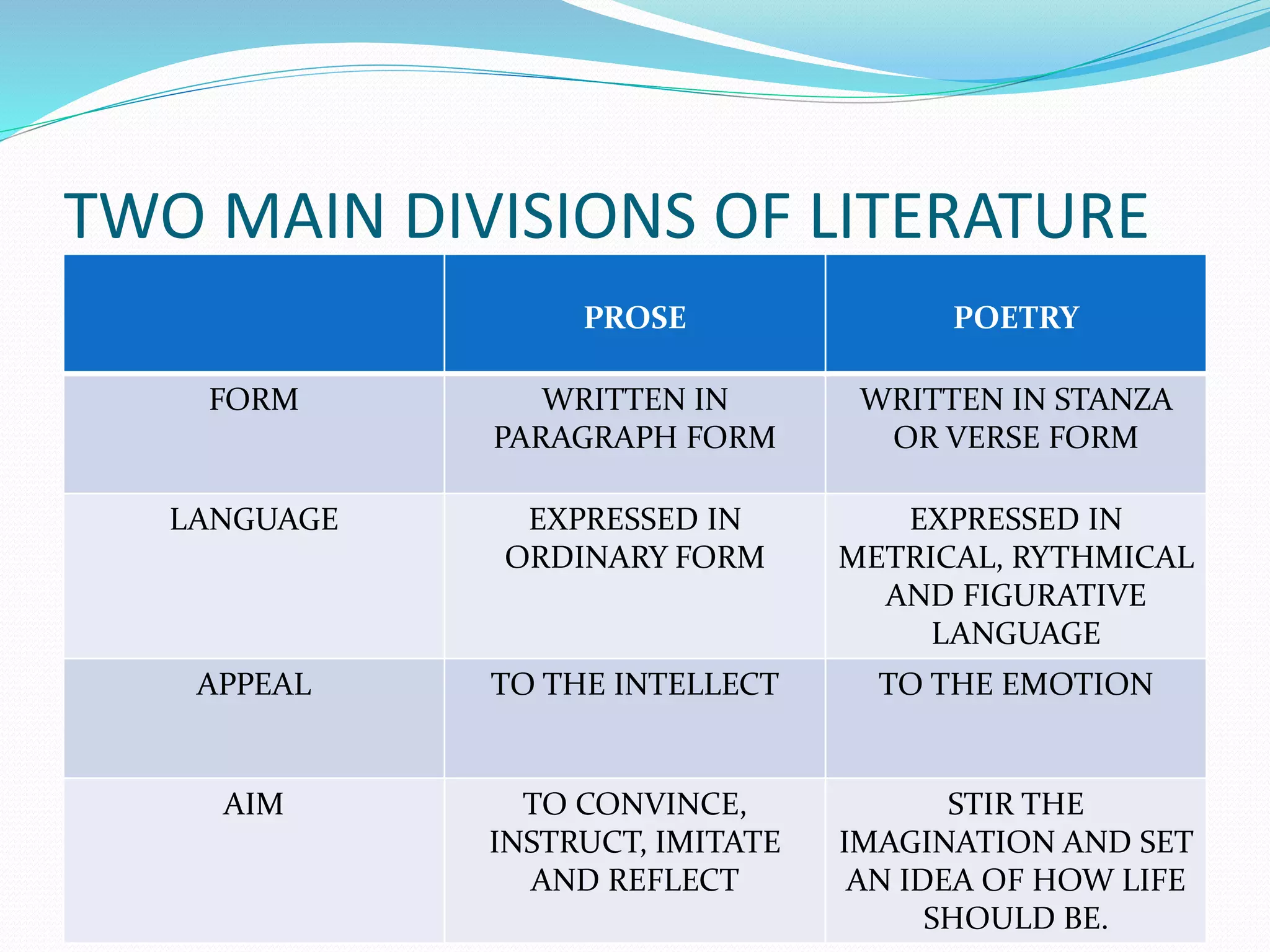
TWO MAIN DIVISIONS OF LITERATURE
PROSE POETRY
FORM WRITTEN IN
PARAGRAPH FORM
WRITTEN IN STANZA
OR VERSE FORM
LANGUAGE EXPRESSED IN
ORDINARY FORM
EXPRESSED IN
METRICAL, RYTHMICAL
AND FIGURATIVE
LANGUAGE
APPEAL TO THE INTELLECT TO THE EMOTION
AIM TO CONVINCE,
INSTRUCT, IMITATE
AND REFLECT
STIR THE
IMAGINATION AND SET
AN IDEA OF HOW LIFE
SHOULD BE.
PROSE
 1. PROSE DRAMA – a drama in prose form. It consists
entirely of dialogues in prose, and is meant to be acted
on stage. (Tragedy, Comedy and Tragicomedy)
 2. ESSAY – a short literary composition which is
expository in nature. The author shares some of his
thoughts, feelings, experiences or observations on
some aspects of life.
 Ex. “Where Is The Patis?” – Carmen Guerrero Nakpil
 3. PROSE FICTION – something invented, imagined
or feigned to be true.
 a. novel – a long fictitious narrative with a complicated
plot. Characters and actions representative of the real
life of past or present times are portrayed in a plot. It is
made up of chapters. Without Seeing the Dawn by
Estevan Javellana
 B. short story – a fictitious narrative compressed into
one unit of time, place and action. It deals with a single
character interest, a single emotion or series of
emotions called forth by a single situation. Dead
Stars by Paz Benitez
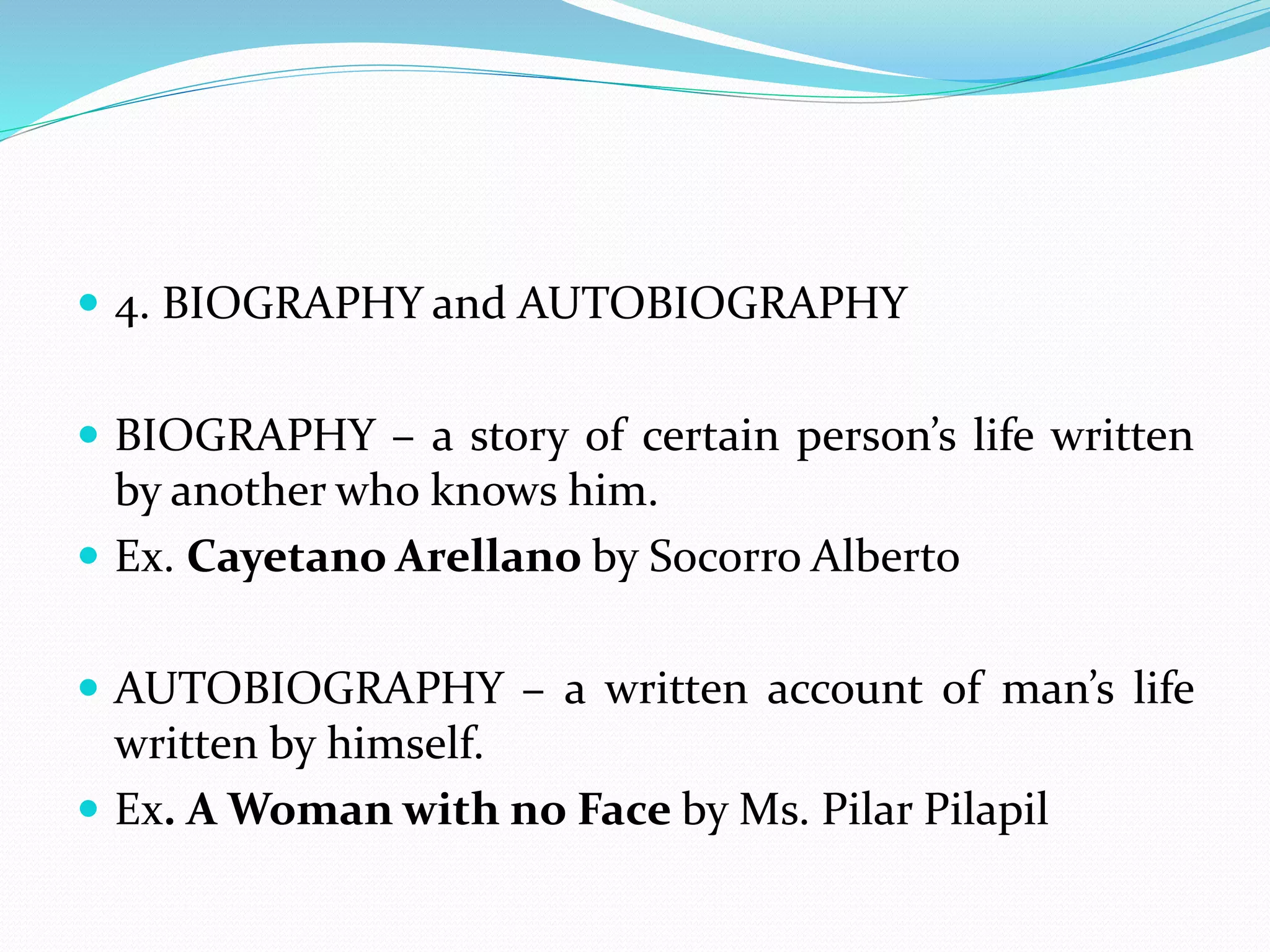
 4. BIOGRAPHY and AUTOBIOGRAPHY
 BIOGRAPHY – a story of certain person’s life written
by another who knows him.
 Ex. Cayetano Arellano by Socorro Alberto
 AUTOBIOGRAPHY – a written account of man’s life
written by himself.
 Ex. A Woman with no Face by Ms. Pilar Pilapil
 5. LETTER – written message displays aspects of an
author’s physiological make-up not immediately
apparent in his more public writings.
 6. DIARY – a daily written record of account of the
writer’s own experiences, thoughts activities or
observations.
 7. JOURNAL – a magazine or periodical especially of a
serious or learned nature.
POETRY
 Derived from the Greek word poesis meaning “making
or creating”.
 Five things about poetry:
 1. Poetry is a concentrated thought
 2. Poetry is a kind of word-music
 3. Poetry expresses all the senses.
 4. Poetry answers our demand for rhythm.
 5. Poetry is observation plus imagination.
Types of Poetry
 NARARATIVE POETRY – a poem that tells a story.
 A. EPIC – a tale centering about a hero concerning the
beginning, continuance, and the end of events of great
significance.
 Ex. Biag-ni-Lam-Ang by Pedro Bukaneg
 B. METRICAL ROMANCE – a narrative poem that tells
a story of adventure and love. The typical hero is a
knight on a quest.
 C. METRICAL TALE – a narrative poem consisting
usually of a single series of connective events that are
simple, and generally do not form a plot.
 D. BALLAD – simplest type of narrative poetry. It is
intended to be sung.
 E. METRICAL ALLEGORY – an extended narrative
that carries a second meaning along with the surface
story. Things and actions are symbolic.
 LYRIC POETRY – a poem that is very personal in
nature. It expresses the author’s own thoughts,
feelings, moods and reflections in musical language. It
derived its name from the musical instrument, the
lyre.
 A. ODE- a lyric poem of some length, serious in
subject and dignified in style.
 Ex. Ode to the West Wind by Percy Shelley
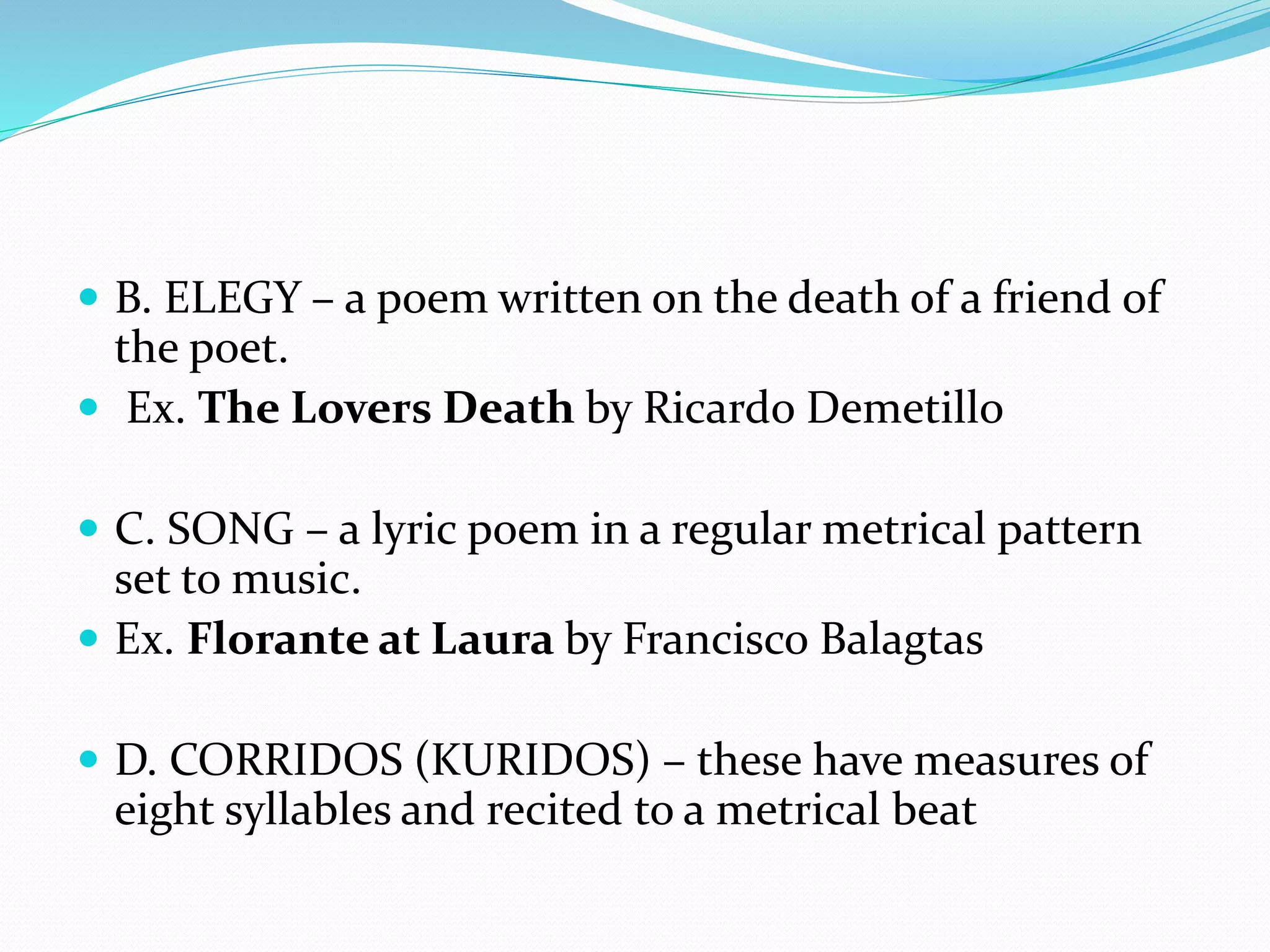
 B. ELEGY – a poem written on the death of a friend of
the poet.
 Ex. The Lovers Death by Ricardo Demetillo
 C. SONG – a lyric poem in a regular metrical pattern
set to music.
 Ex. Florante at Laura by Francisco Balagtas
 D. CORRIDOS (KURIDOS) – these have measures of
eight syllables and recited to a metrical beat
 E. SONNET – a lyric poem containing four iambic
pentameter lines, and a complicated rhyme.
 Ex. Santang Buds by Alfonso P. Santos
QUIZ 1
 1. Literature is derived from the Latin term ____________.
 2. The Latin term of Literature means ___________.
 3-4. The two main divisions of Literature .
 5. This is a drama in prose form and meant to be acted on
stage.
 6. A written account of man’s life written by himself is
called ___________.
 7. Poetry is derived from the Greek word __________.
 8. A tale centering about a hero an example is Biag ni Lam-
Ang is called _______.
 9. A poem written on the death of a friend is called
___________.
 10. A lyric poem of some length, serious in subject and
dignified in style is ___________.
Why do we need to study
LITERATURE?
What is the difference of PROSE and
POETRY?

Philippine literature, 11

  • 1.
  • 2.
    LITERATURE  Derived fromthe Latin term litera which means letter that deals with ideas, thoughts and emotions of man thus it can be said as the story of man (Kahayon)  Comes from the French phrase “belles-letters,” means beautiful writing (Baritugo)  Literature in its broadest sense, is everything that has ever been written.
  • 3.
     The bestway to understand human nature fully and to know a nation completely is to study literature.  We learn the innermost feelings and thoughts of people- the most real part of themselves, thus we gain an understanding not only of others, but more importantly, of ourselves and of life itself.  Literature is our life’s story including its struggles, ideals, failures, sacrifices and happiness.
  • 4.
    Why we needto study Literature?
  • 5.
    To better appreciateour literary heritage. Through literature, we can trace the rich heritage of ideas handed down to us from our forefathers. Then we can understand ourselves better and take pride in being a Filipino.
  • 6.
    TWO MAIN DIVISIONSOF LITERATURE PROSE POETRY FORM WRITTEN IN PARAGRAPH FORM WRITTEN IN STANZA OR VERSE FORM LANGUAGE EXPRESSED IN ORDINARY FORM EXPRESSED IN METRICAL, RYTHMICAL AND FIGURATIVE LANGUAGE APPEAL TO THE INTELLECT TO THE EMOTION AIM TO CONVINCE, INSTRUCT, IMITATE AND REFLECT STIR THE IMAGINATION AND SET AN IDEA OF HOW LIFE SHOULD BE.
  • 7.
    PROSE  1. PROSEDRAMA – a drama in prose form. It consists entirely of dialogues in prose, and is meant to be acted on stage. (Tragedy, Comedy and Tragicomedy)  2. ESSAY – a short literary composition which is expository in nature. The author shares some of his thoughts, feelings, experiences or observations on some aspects of life.  Ex. “Where Is The Patis?” – Carmen Guerrero Nakpil
  • 8.
     3. PROSEFICTION – something invented, imagined or feigned to be true.  a. novel – a long fictitious narrative with a complicated plot. Characters and actions representative of the real life of past or present times are portrayed in a plot. It is made up of chapters. Without Seeing the Dawn by Estevan Javellana  B. short story – a fictitious narrative compressed into one unit of time, place and action. It deals with a single character interest, a single emotion or series of emotions called forth by a single situation. Dead Stars by Paz Benitez
  • 9.
     4. BIOGRAPHYand AUTOBIOGRAPHY  BIOGRAPHY – a story of certain person’s life written by another who knows him.  Ex. Cayetano Arellano by Socorro Alberto  AUTOBIOGRAPHY – a written account of man’s life written by himself.  Ex. A Woman with no Face by Ms. Pilar Pilapil
  • 10.
     5. LETTER– written message displays aspects of an author’s physiological make-up not immediately apparent in his more public writings.  6. DIARY – a daily written record of account of the writer’s own experiences, thoughts activities or observations.  7. JOURNAL – a magazine or periodical especially of a serious or learned nature.
  • 11.
    POETRY  Derived fromthe Greek word poesis meaning “making or creating”.  Five things about poetry:  1. Poetry is a concentrated thought  2. Poetry is a kind of word-music  3. Poetry expresses all the senses.  4. Poetry answers our demand for rhythm.  5. Poetry is observation plus imagination.
  • 12.
    Types of Poetry NARARATIVE POETRY – a poem that tells a story.  A. EPIC – a tale centering about a hero concerning the beginning, continuance, and the end of events of great significance.  Ex. Biag-ni-Lam-Ang by Pedro Bukaneg  B. METRICAL ROMANCE – a narrative poem that tells a story of adventure and love. The typical hero is a knight on a quest.
  • 13.
     C. METRICALTALE – a narrative poem consisting usually of a single series of connective events that are simple, and generally do not form a plot.  D. BALLAD – simplest type of narrative poetry. It is intended to be sung.  E. METRICAL ALLEGORY – an extended narrative that carries a second meaning along with the surface story. Things and actions are symbolic.
  • 14.
     LYRIC POETRY– a poem that is very personal in nature. It expresses the author’s own thoughts, feelings, moods and reflections in musical language. It derived its name from the musical instrument, the lyre.  A. ODE- a lyric poem of some length, serious in subject and dignified in style.  Ex. Ode to the West Wind by Percy Shelley
  • 15.
     B. ELEGY– a poem written on the death of a friend of the poet.  Ex. The Lovers Death by Ricardo Demetillo  C. SONG – a lyric poem in a regular metrical pattern set to music.  Ex. Florante at Laura by Francisco Balagtas  D. CORRIDOS (KURIDOS) – these have measures of eight syllables and recited to a metrical beat
  • 16.
     E. SONNET– a lyric poem containing four iambic pentameter lines, and a complicated rhyme.  Ex. Santang Buds by Alfonso P. Santos
  • 17.
  • 18.
     1. Literatureis derived from the Latin term ____________.  2. The Latin term of Literature means ___________.  3-4. The two main divisions of Literature .  5. This is a drama in prose form and meant to be acted on stage.  6. A written account of man’s life written by himself is called ___________.  7. Poetry is derived from the Greek word __________.  8. A tale centering about a hero an example is Biag ni Lam- Ang is called _______.  9. A poem written on the death of a friend is called ___________.  10. A lyric poem of some length, serious in subject and dignified in style is ___________.
  • 19.
    Why do weneed to study LITERATURE? What is the difference of PROSE and POETRY?