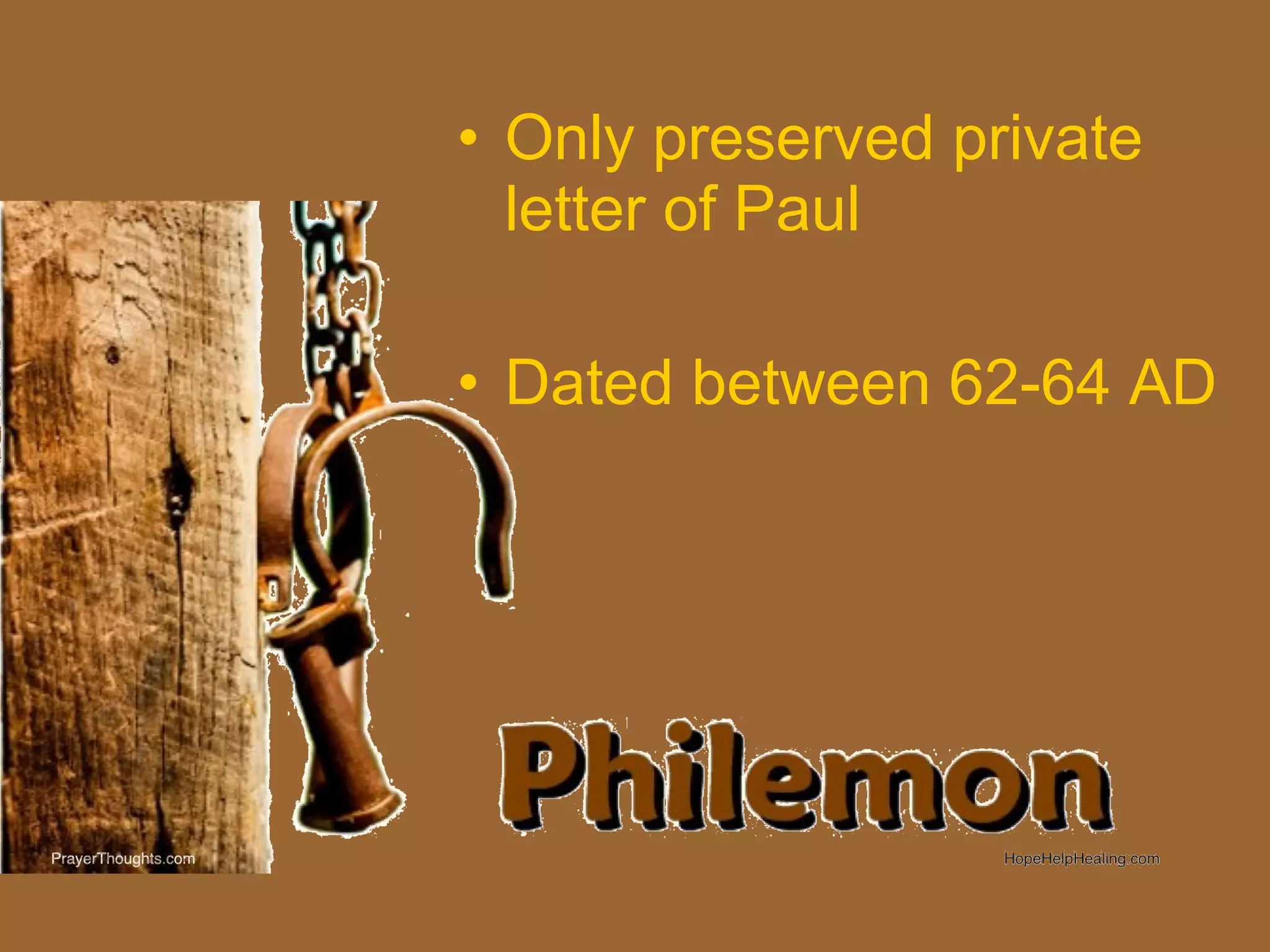
• Only preserved private
letter of Paul
• Dated between 62-64 AD
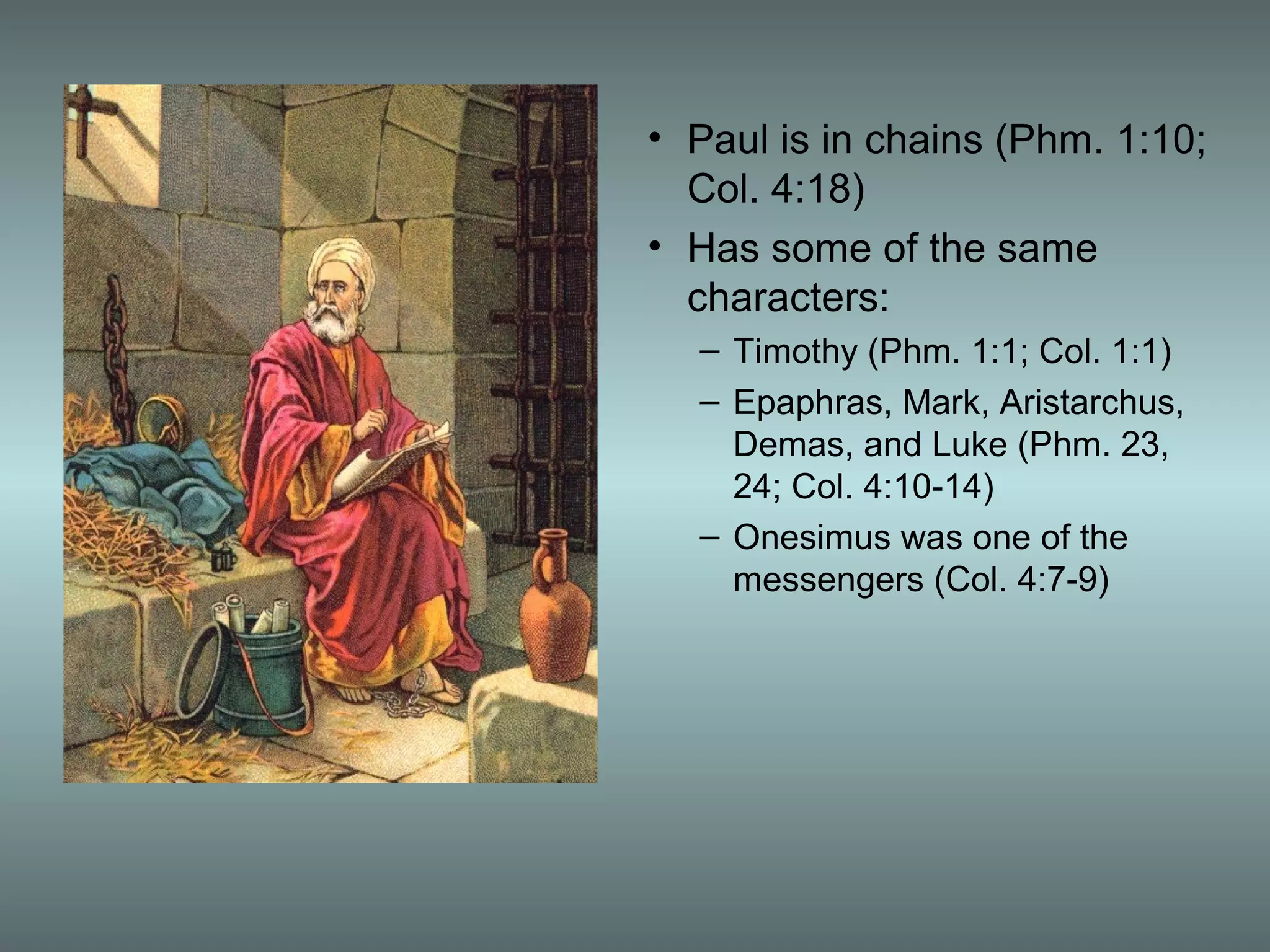
• Paul is in chains (Phm. 1:10;
Col. 4:18)
• Has some of the same
characters:
– Timothy (Phm. 1:1; Col. 1:1)
– Epaphras, Mark, Aristarchus,
Demas, and Luke (Phm. 23,
24; Col. 4:10-14)
– Onesimus was one of the
messengers (Col. 4:7-9)
The Man, Philemon
• Philemon was known for his generosity (v. 5).
• More than likely he supported Paul as he is
noted as a fellow-laborer.
• Philemon’s house was the church house. (Rom.
16:5; Col. 4:15).
• Philemon’s family is mentioned, his wife Apphia
and Archippus his son.
Purpose of LetterPurpose of Letter
To initiate a positive relationship between a masterTo initiate a positive relationship between a master
and his run away slave.and his run away slave.
• The average price of a slave was 500 denarii.
• The slave had no rights.
• The testimony of a slave could not be accepted in a
court of law unless the slave was tortured.
• Pollio, in the time of Augustus, ordered a slave to be
thrown into a pond of voracious lampreys. Augustus
interfered, but afterward ordered a slave of his own to
be crucified on the mast of a ship for eating a favorite
quail. Juvenal describes a profligate woman ordering
a slave to be crucified stating, “it was her pleasure.”
Martial records an instance of a master cutting out a
slave's tongue.
Purpose of LetterPurpose of Letter
• The old Roman legislation imposed death for killing a
plough-ox; but the murderer of a slave was not called to
account. Tracking fugitive slaves was a trade. RecoveredRecovered
slaves were branded on the forehead, condemned toslaves were branded on the forehead, condemned to
double labordouble labor, and sometimes thrown to the beasts in the
amphitheater.
• The slave population was enormous. According to
Herodotus, slaves numbered 7 to 1 to the free manslaves numbered 7 to 1 to the free man.
Some proprietors had as many as twenty thousand.
• Just think, Onesimus had to hand deliver this letter toJust think, Onesimus had to hand deliver this letter to
his master. How terrified he must have been and yet,his master. How terrified he must have been and yet,
how fortunate he was to have someone as persuasivehow fortunate he was to have someone as persuasive
as Paul to defend his rights as a person free in Christ.as Paul to defend his rights as a person free in Christ.
Some General LessonsSome General Lessons
• All Christians, regardless of their lot in life are on absolute
equality in Christ.
• Christianity does not alter civil status or obligation. A slave does
not become free by baptism just as a murderer after baptism is
obligated to suffer for his crime.
• Apostolic example bids us to seek out all men to be saved
regardless their position in life.
• Restitution is a principle involved in repentance and love should
prompt one to aid the offender.
• We should be willing to forgive those who wronged us especially
those who seek it and wear the name of Christ.
• We all should be in the restoration business. Being a friend
means seeking what is best in every situation.
• The saint is not excused from proclaiming the message while in
chains, as a matter of fact, those who offend can become
profitable again if properly approached.
• The ethics of one person can change the way business is done.
Paul didn’t challenge the established order, he challenged the
way we treat those who are obligated to us.
Living Lesson on ForgivenessLiving Lesson on Forgiveness
• Setting the Stage 1-3
• Characteristics of Forgiveness 4-7
• The actions of One who Forgives 8-18
• The Motives of One Who Forgives 19-25
A Living Lesson on Forgiveness
Setting The Stage: vs. 1-3Setting The Stage: vs. 1-3
• Paul begins his letter by reminding Philemon who he is – a
slave of Christ.
• Paul discussed real slavery in Romans 6:15-23
• For one to act as an ambassador (Phile. 1:9) he has to lay
all the facts out on the table. Paul set the stage by laying
out that he was a slave and retrospectively, all who are in
Christ Jesus are slaves including Philemon.
• May we ask this question, “In the first three verses, who is
watching for Onesimus’ return?”
• Church can become like an employer/employee
relationship – “well he’s gone – good riddance!” Everyone
who has run away (for whatever reason) needs an
ambassador so they may have opportunity to return to
their rightful position.
A Living Lesson on Forgiveness
Characteristics of Forgiveness 4-7Characteristics of Forgiveness 4-7
CompassionCompassion
RighteousnessRighteousness
EncouragementEncouragement
A Living Lesson on Forgiveness
Characteristics of Forgiveness 4-7Characteristics of Forgiveness 4-7
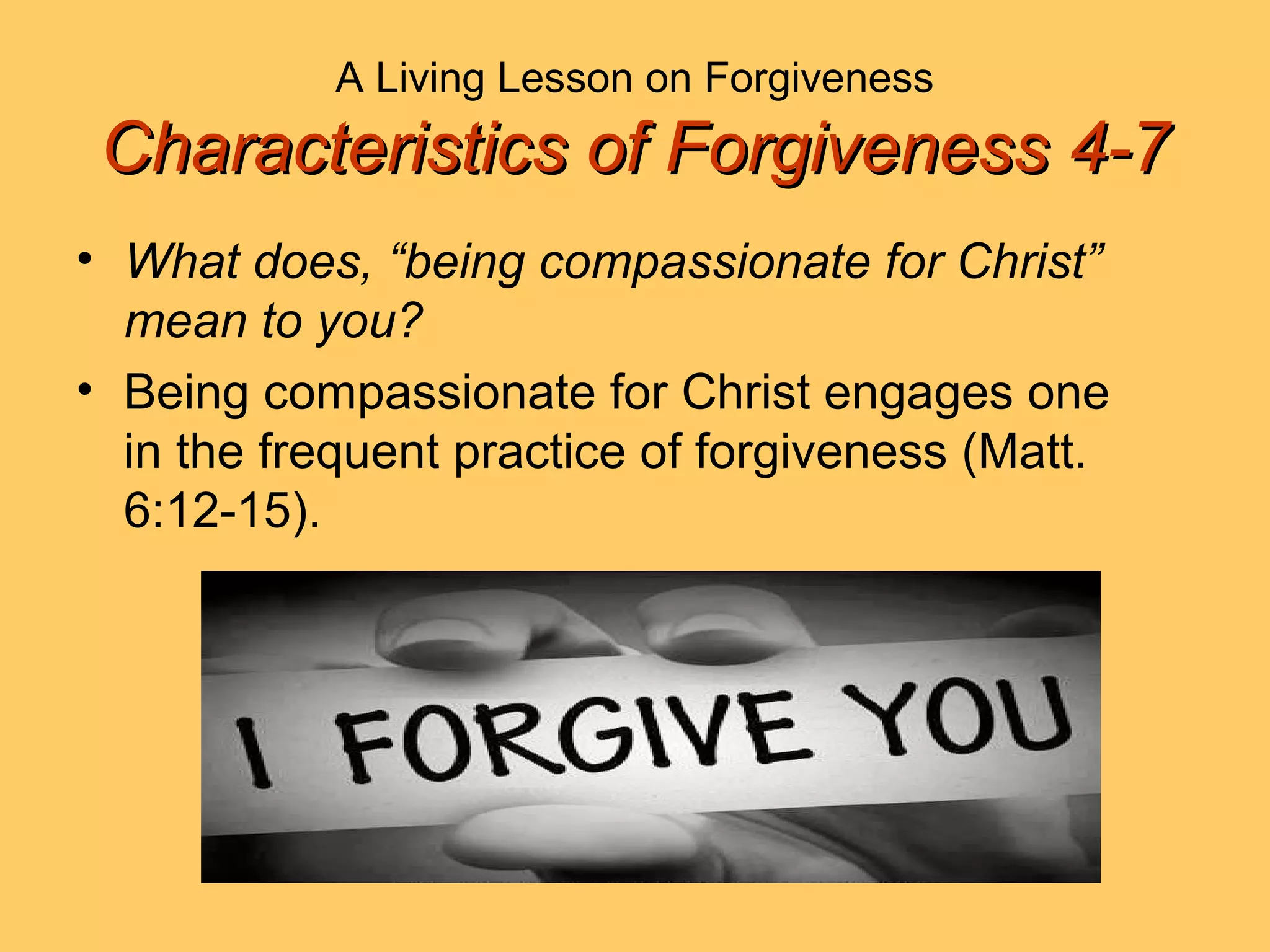
• What does, “being compassionate for Christ”
mean to you?
• Being compassionate for Christ engages one
in the frequent practice of forgiveness (Matt.
6:12-15).
A Living Lesson on Forgiveness
Characteristics of Forgiveness 4-7Characteristics of Forgiveness 4-7
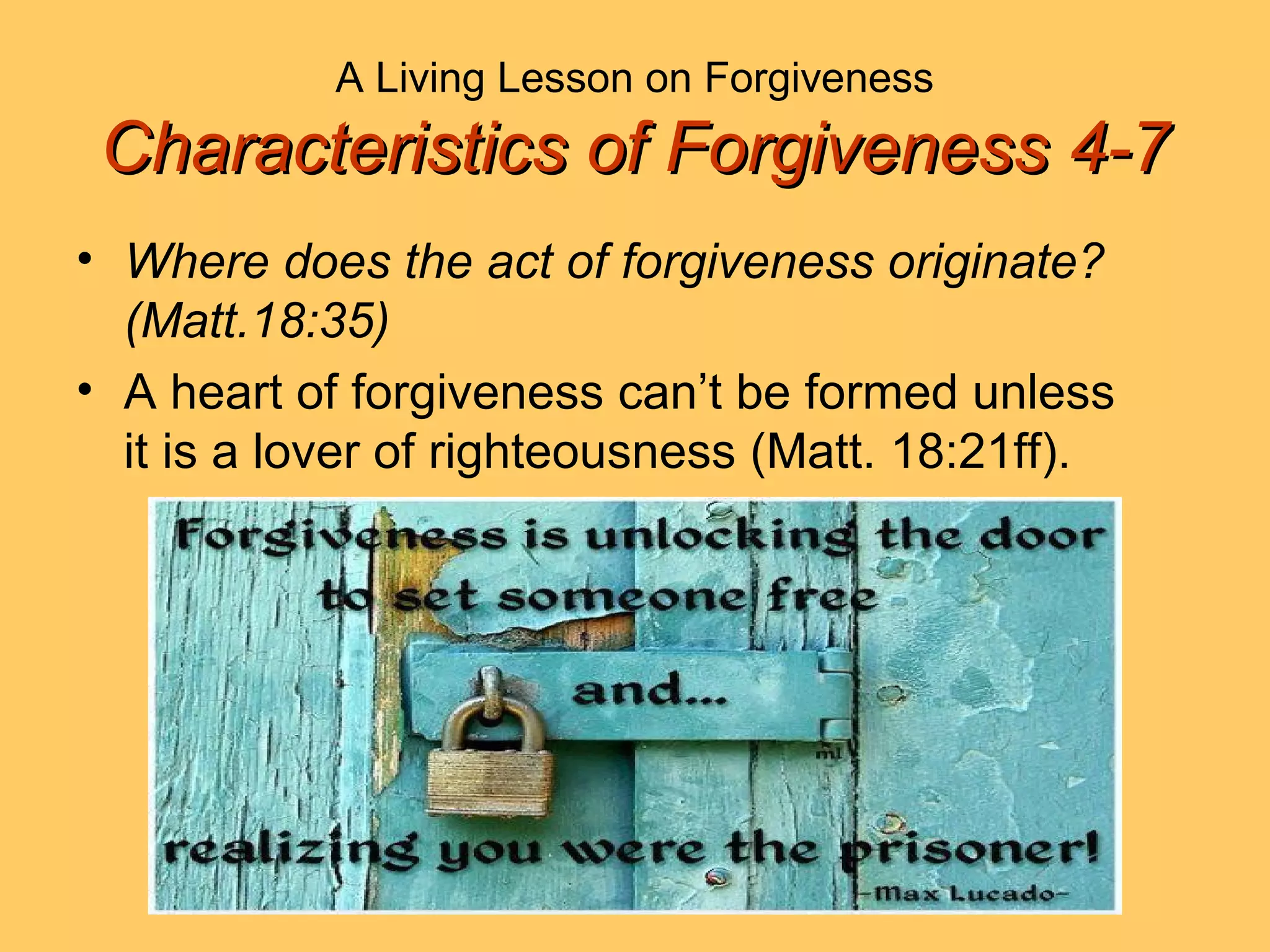
• Where does the act of forgiveness originate?
(Matt.18:35)
• A heart of forgiveness can’t be formed unless
it is a lover of righteousness (Matt. 18:21ff).
A Living Lesson on Forgiveness
Characteristics of Forgiveness 4-7Characteristics of Forgiveness 4-7
• It takes an optimistic heart if one is known to be
an encourager (Acts 15:36-39).
• Fools are quick to accuse, righteous peopleFools are quick to accuse, righteous people
look beyond the offense and see what islook beyond the offense and see what is
needed. The act of forgiveness is optimismneeded. The act of forgiveness is optimism
multiplied by 10.multiplied by 10.
• V. 6 Let’s note the phrase, “the sharing of yourthe sharing of your
faith may become effectivefaith may become effective.”
A Living Lesson on Forgiveness
The Actions of One Who Forgives 8-18The Actions of One Who Forgives 8-18
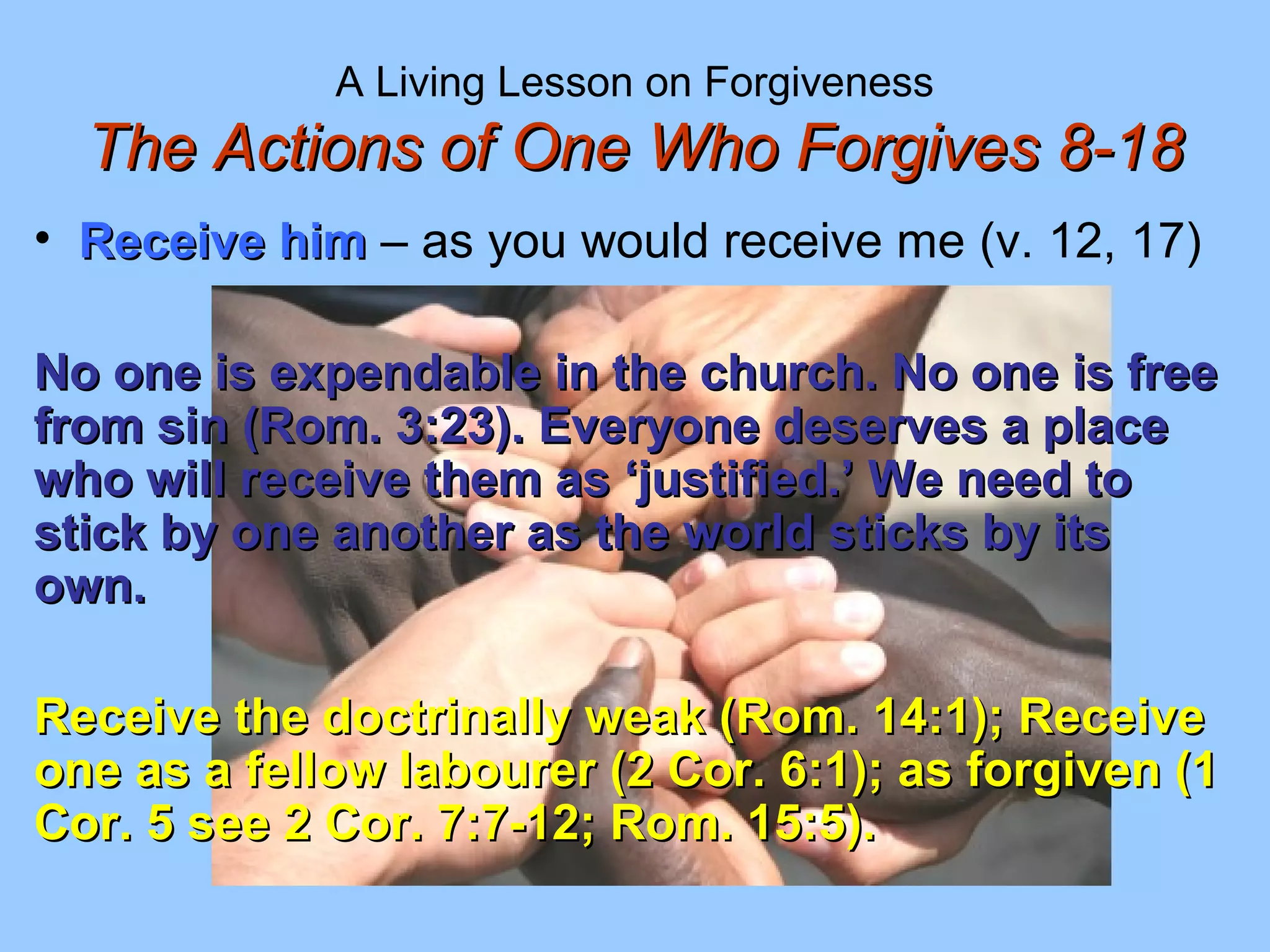
• Receive himReceive him – as you would receive me (v. 12, 17)
No one is expendable in the church. No one is freeNo one is expendable in the church. No one is free
from sin (Rom. 3:23). Everyone deserves a placefrom sin (Rom. 3:23). Everyone deserves a place
who will receive them as ‘justified.’ We need towho will receive them as ‘justified.’ We need to
stick by one another as the world sticks by itsstick by one another as the world sticks by its
own.own.
Receive the doctrinally weak (Rom. 14:1); ReceiveReceive the doctrinally weak (Rom. 14:1); Receive
one as a fellow labourer (2 Cor. 6:1); as forgiven (1one as a fellow labourer (2 Cor. 6:1); as forgiven (1
Cor. 5 see 2 Cor. 7:7-12; Rom. 15:5).Cor. 5 see 2 Cor. 7:7-12; Rom. 15:5).
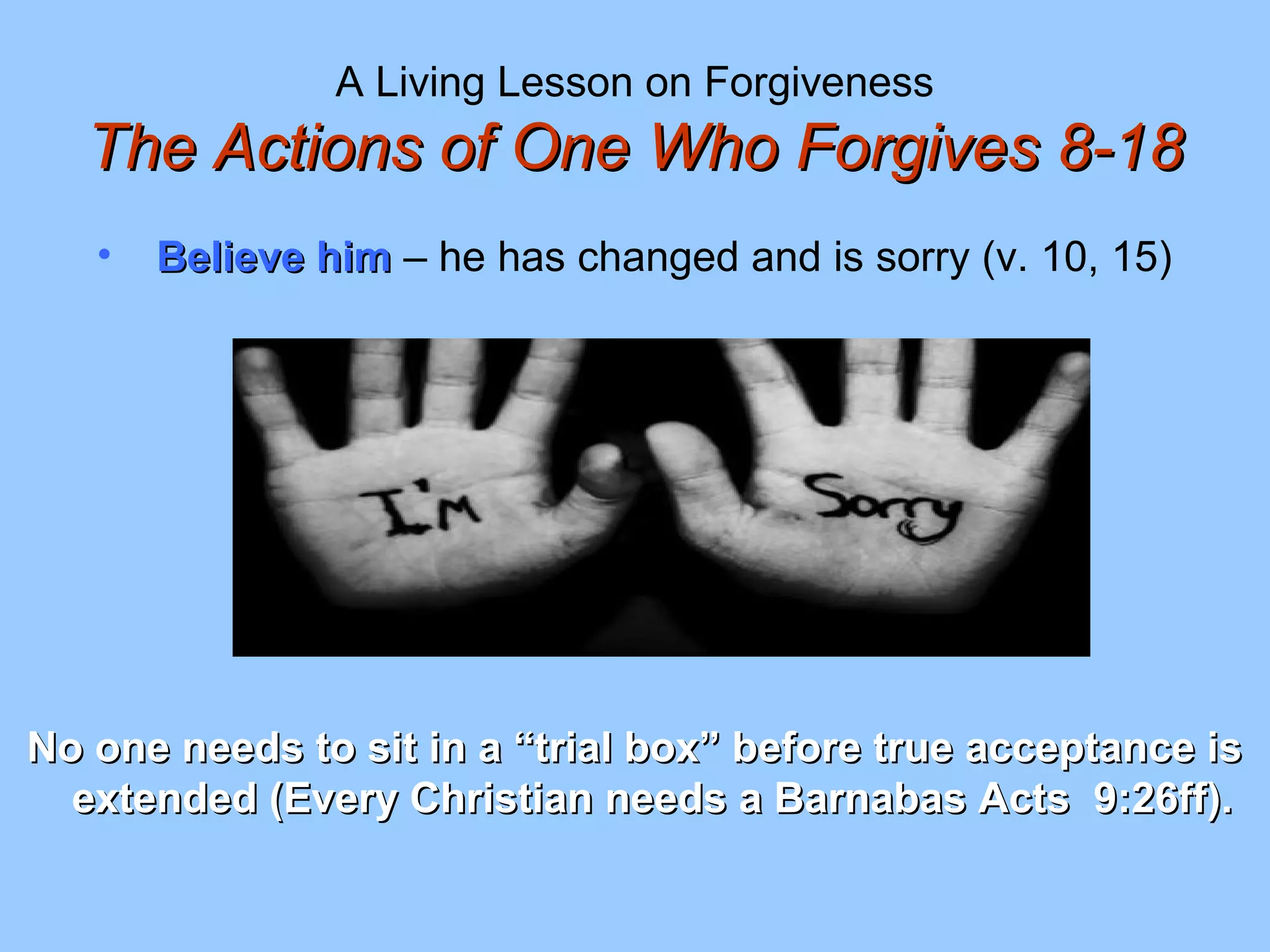
• Believe himBelieve him – he has changed and is sorry (v. 10, 15)
No one needs to sit in a “trial box” before true acceptance isNo one needs to sit in a “trial box” before true acceptance is
extended (Every Christian needs a Barnabas Acts 9:26ff).extended (Every Christian needs a Barnabas Acts 9:26ff).
A Living Lesson on Forgiveness
The Actions of One Who Forgives 8-18The Actions of One Who Forgives 8-18
A Living Lesson on Forgiveness
The Actions of One Who Forgives 8-18The Actions of One Who Forgives 8-18
• Trust himTrust him – put him to work (11, 16)
Take that renewed commitment and put them in
the master’s field (Again Barnabas serves as
example (Acts 15:36ff).
A Living Lesson on Forgiveness
The Motives of One Who Forgives 19-25The Motives of One Who Forgives 19-25
• Forgiveness is a promise, a promise never to
take revenge. Certainly forgiveness is bold.
Certainly forgiveness is brave. Certainly
forgiveness is heroic. But at the same time it
should be NORMALNORMAL for a humble Christian.
• The recognition that I owe a debt I can’t payI owe a debt I can’t pay..
Paul took up the pen and wrote a personal IOU to
Philemon. Onesimus owes Philemon a material
debt. Philemon owes Paul a spiritual debt.Philemon owes Paul a spiritual debt.
A Living Lesson on Forgiveness
The Motives of One Who Forgives 19-25The Motives of One Who Forgives 19-25
• The recognition that I can become aI can become a
blessing to others.blessing to others.
• Paul is making a play on words for the
very name of Onesimus, means
beneficial or useful.
• Is the church benefited, is the gospel
more readily received when people
exercise the blessing of forgiveness?
A Living Lesson on Forgiveness
The Motives of One Who Forgives 19-25The Motives of One Who Forgives 19-25
• The recognition that I am called toI am called to
be obedient to the Lord (v. 21).be obedient to the Lord (v. 21).
• Forgiveness is not a suggestion it is
a command. To withhold this act of
grace is demonic on our behalf.
A Living Lesson on Forgiveness
The Motives of One Who Forgives 19-25The Motives of One Who Forgives 19-25
The recognition that II
am accountable to godly leaders.am accountable to godly leaders.
• How can an eldership operate successfully with
a hate mongering, unforgiving body?
• Christians are under charge to obey
those that have our back (Heb. 13:7).

Philemon

  • 1.
    • Only preservedprivate letter of Paul • Dated between 62-64 AD
  • 2.
    • Paul isin chains (Phm. 1:10; Col. 4:18) • Has some of the same characters: – Timothy (Phm. 1:1; Col. 1:1) – Epaphras, Mark, Aristarchus, Demas, and Luke (Phm. 23, 24; Col. 4:10-14) – Onesimus was one of the messengers (Col. 4:7-9)
  • 3.
    The Man, Philemon •Philemon was known for his generosity (v. 5). • More than likely he supported Paul as he is noted as a fellow-laborer. • Philemon’s house was the church house. (Rom. 16:5; Col. 4:15). • Philemon’s family is mentioned, his wife Apphia and Archippus his son.
  • 4.
    Purpose of LetterPurposeof Letter To initiate a positive relationship between a masterTo initiate a positive relationship between a master and his run away slave.and his run away slave. • The average price of a slave was 500 denarii. • The slave had no rights. • The testimony of a slave could not be accepted in a court of law unless the slave was tortured. • Pollio, in the time of Augustus, ordered a slave to be thrown into a pond of voracious lampreys. Augustus interfered, but afterward ordered a slave of his own to be crucified on the mast of a ship for eating a favorite quail. Juvenal describes a profligate woman ordering a slave to be crucified stating, “it was her pleasure.” Martial records an instance of a master cutting out a slave's tongue.
  • 5.
    Purpose of LetterPurposeof Letter • The old Roman legislation imposed death for killing a plough-ox; but the murderer of a slave was not called to account. Tracking fugitive slaves was a trade. RecoveredRecovered slaves were branded on the forehead, condemned toslaves were branded on the forehead, condemned to double labordouble labor, and sometimes thrown to the beasts in the amphitheater. • The slave population was enormous. According to Herodotus, slaves numbered 7 to 1 to the free manslaves numbered 7 to 1 to the free man. Some proprietors had as many as twenty thousand. • Just think, Onesimus had to hand deliver this letter toJust think, Onesimus had to hand deliver this letter to his master. How terrified he must have been and yet,his master. How terrified he must have been and yet, how fortunate he was to have someone as persuasivehow fortunate he was to have someone as persuasive as Paul to defend his rights as a person free in Christ.as Paul to defend his rights as a person free in Christ.
  • 6.
    Some General LessonsSomeGeneral Lessons • All Christians, regardless of their lot in life are on absolute equality in Christ. • Christianity does not alter civil status or obligation. A slave does not become free by baptism just as a murderer after baptism is obligated to suffer for his crime. • Apostolic example bids us to seek out all men to be saved regardless their position in life. • Restitution is a principle involved in repentance and love should prompt one to aid the offender. • We should be willing to forgive those who wronged us especially those who seek it and wear the name of Christ. • We all should be in the restoration business. Being a friend means seeking what is best in every situation. • The saint is not excused from proclaiming the message while in chains, as a matter of fact, those who offend can become profitable again if properly approached. • The ethics of one person can change the way business is done. Paul didn’t challenge the established order, he challenged the way we treat those who are obligated to us.
  • 7.
    Living Lesson onForgivenessLiving Lesson on Forgiveness • Setting the Stage 1-3 • Characteristics of Forgiveness 4-7 • The actions of One who Forgives 8-18 • The Motives of One Who Forgives 19-25
  • 8.
    A Living Lessonon Forgiveness Setting The Stage: vs. 1-3Setting The Stage: vs. 1-3 • Paul begins his letter by reminding Philemon who he is – a slave of Christ. • Paul discussed real slavery in Romans 6:15-23 • For one to act as an ambassador (Phile. 1:9) he has to lay all the facts out on the table. Paul set the stage by laying out that he was a slave and retrospectively, all who are in Christ Jesus are slaves including Philemon. • May we ask this question, “In the first three verses, who is watching for Onesimus’ return?” • Church can become like an employer/employee relationship – “well he’s gone – good riddance!” Everyone who has run away (for whatever reason) needs an ambassador so they may have opportunity to return to their rightful position.
  • 9.
    A Living Lessonon Forgiveness Characteristics of Forgiveness 4-7Characteristics of Forgiveness 4-7 CompassionCompassion RighteousnessRighteousness EncouragementEncouragement
  • 10.
    A Living Lessonon Forgiveness Characteristics of Forgiveness 4-7Characteristics of Forgiveness 4-7 • What does, “being compassionate for Christ” mean to you? • Being compassionate for Christ engages one in the frequent practice of forgiveness (Matt. 6:12-15).
  • 11.
    A Living Lessonon Forgiveness Characteristics of Forgiveness 4-7Characteristics of Forgiveness 4-7 • Where does the act of forgiveness originate? (Matt.18:35) • A heart of forgiveness can’t be formed unless it is a lover of righteousness (Matt. 18:21ff).
  • 12.
    A Living Lessonon Forgiveness Characteristics of Forgiveness 4-7Characteristics of Forgiveness 4-7 • It takes an optimistic heart if one is known to be an encourager (Acts 15:36-39). • Fools are quick to accuse, righteous peopleFools are quick to accuse, righteous people look beyond the offense and see what islook beyond the offense and see what is needed. The act of forgiveness is optimismneeded. The act of forgiveness is optimism multiplied by 10.multiplied by 10. • V. 6 Let’s note the phrase, “the sharing of yourthe sharing of your faith may become effectivefaith may become effective.”
  • 13.
    A Living Lessonon Forgiveness The Actions of One Who Forgives 8-18The Actions of One Who Forgives 8-18 • Receive himReceive him – as you would receive me (v. 12, 17) No one is expendable in the church. No one is freeNo one is expendable in the church. No one is free from sin (Rom. 3:23). Everyone deserves a placefrom sin (Rom. 3:23). Everyone deserves a place who will receive them as ‘justified.’ We need towho will receive them as ‘justified.’ We need to stick by one another as the world sticks by itsstick by one another as the world sticks by its own.own. Receive the doctrinally weak (Rom. 14:1); ReceiveReceive the doctrinally weak (Rom. 14:1); Receive one as a fellow labourer (2 Cor. 6:1); as forgiven (1one as a fellow labourer (2 Cor. 6:1); as forgiven (1 Cor. 5 see 2 Cor. 7:7-12; Rom. 15:5).Cor. 5 see 2 Cor. 7:7-12; Rom. 15:5).
  • 14.
    • Believe himBelievehim – he has changed and is sorry (v. 10, 15) No one needs to sit in a “trial box” before true acceptance isNo one needs to sit in a “trial box” before true acceptance is extended (Every Christian needs a Barnabas Acts 9:26ff).extended (Every Christian needs a Barnabas Acts 9:26ff). A Living Lesson on Forgiveness The Actions of One Who Forgives 8-18The Actions of One Who Forgives 8-18
  • 15.
    A Living Lessonon Forgiveness The Actions of One Who Forgives 8-18The Actions of One Who Forgives 8-18 • Trust himTrust him – put him to work (11, 16) Take that renewed commitment and put them in the master’s field (Again Barnabas serves as example (Acts 15:36ff).
  • 16.
    A Living Lessonon Forgiveness The Motives of One Who Forgives 19-25The Motives of One Who Forgives 19-25 • Forgiveness is a promise, a promise never to take revenge. Certainly forgiveness is bold. Certainly forgiveness is brave. Certainly forgiveness is heroic. But at the same time it should be NORMALNORMAL for a humble Christian. • The recognition that I owe a debt I can’t payI owe a debt I can’t pay.. Paul took up the pen and wrote a personal IOU to Philemon. Onesimus owes Philemon a material debt. Philemon owes Paul a spiritual debt.Philemon owes Paul a spiritual debt.
  • 17.
    A Living Lessonon Forgiveness The Motives of One Who Forgives 19-25The Motives of One Who Forgives 19-25 • The recognition that I can become aI can become a blessing to others.blessing to others. • Paul is making a play on words for the very name of Onesimus, means beneficial or useful. • Is the church benefited, is the gospel more readily received when people exercise the blessing of forgiveness?
  • 18.
    A Living Lessonon Forgiveness The Motives of One Who Forgives 19-25The Motives of One Who Forgives 19-25 • The recognition that I am called toI am called to be obedient to the Lord (v. 21).be obedient to the Lord (v. 21). • Forgiveness is not a suggestion it is a command. To withhold this act of grace is demonic on our behalf.
  • 19.
    A Living Lessonon Forgiveness The Motives of One Who Forgives 19-25The Motives of One Who Forgives 19-25 The recognition that II am accountable to godly leaders.am accountable to godly leaders. • How can an eldership operate successfully with a hate mongering, unforgiving body? • Christians are under charge to obey those that have our back (Heb. 13:7).