Daniel 10 - introDuctionDaniel 10 - introDuction
• This chapter is an introduction to theThis chapter is an introduction to the
prophecies contained in the two followingprophecies contained in the two following
chapters;chapters;
• Daniel's mourning and fasting,Daniel's mourning and fasting,
• The appearance of the man by the river.The appearance of the man by the river.
• It appears that chapters 10-12 more fullyIt appears that chapters 10-12 more fully
describe the vision found indescribe the vision found in Daniel 8Daniel 8..
• One may consider the tenth chapter is theOne may consider the tenth chapter is the
prologue; the eleventh, the prophecy itself;prologue; the eleventh, the prophecy itself;
and the twelfth, the epilogue.and the twelfth, the epilogue.
the unseen spiritual WorlD
• The tenth chapter unfolds the
spiritual world as the
background of the historical
world (Job 1:7; Job 2:1, etc.;
Zechariah 3:1-2) where angels
are described as the ministers
of God's government of men.
• This is why Paul, in the
gospel age could attest that,
"the powers that be are
ordained of God" (Rom.
13:1) and then turn and say
in the spiritual context, "For
we wrestle not against flesh
and blood, but against
principalities, against
powers, against the rulers of
the darkness of this world,
against wicked spirits in
heavenly places" (Eph. 6:12).
pulling back the curtain
• Angels counteract, by God's will, much of
the evil and misery caused by Satan.
• An angel troubled the waters of Bethesda so
as to give them medicinal power, John 5:4;
• The angel would not allow the four angels let
loose the four destructive winds on the
earth, the sea, and the trees, until he had
first sealed the servants of God in their
foreheads, Revelation 7:1-3.
• Michael the champion of Israel, has done
battle with angel of an opposing force. The
aim for the reader is to realize God's will in
the pagan world is constantly resisted even
in the spirit world (Revelation 12:7, "There
was war in heaven: Michael and his angels
fought against the dragon; and the dragon
fought and his angels, and prevailed not;
neither was their place found anymore in
heaven").
• These struggles are not merely symbolical,
but real (so "the evil spirit from the Lord
troubled Saul," when "the Spirit of the Lord
had departed from him;" whereas "the Spirit
of the Lord came upon David," 1 Samuel
16:13-15; "a lying spirit" also was "in the
mouth of the prophets of Ahab," 1 Kings
Daniel Fasts insteaD oF
Feasting
• Mourning
• No pleasant bread
• No anointing
at the river
• Hiddekel; the same
with the Tigris, called
by both names from
the swiftness and
rapidity of its motion,
"hiddekel" signifying
both sharp and swift;
and Tigris, in the
Persian language, a
dart. Here, Daniel
was met by an
awesome visitor.
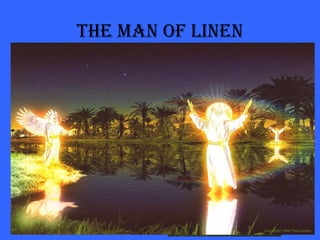
the man of Linen
1. Linen
2. Golden Girdle
3. Body of Beryl
4. Face like Lightening
5. Eyes like Fire
6. Feet like Brass
man of metaL vs. man of Linen
• Varying precious metals.
• Sleepless nights and troubled spirits
• Spoke not a word
• Represented physical kingdoms
• Highest order of metals to the basest o
minerals.
• Vanquished to the wind by a little stone
• Heavenly glory not earthly vanity.
• Most righteous overwhelmed and
pass out.
• Voice of multitudes or as the
crashing of the thunderous sea.
• Became more awesome and
powerful the more he was
described.
• The man of linen represented
eternity; one who would not be
gone with the wind for he is the
Rock.
• He is the man of linen because he
is the author of righteousness,
which is like fine linen, clean and
white, Revelation 19:8.
man of metaL vs man of Linenman of metaL vs man of Linen
an overwheLmed danieL
• No strength
• Comeliness was turned in
me into corruption;
• I retained no strength;
• Jehosaphat said, O LORD
God of our fathers, art not
thou God in heaven? and
rulest not thou over all the
kingdoms of the heathen? and
in thine hand is there
not power and might, so that
none is able to withstand
thee? 2 Chron. 20:6.
• In a deep sleep on face, and
my face toward the ground;
Could we say, he passed out?
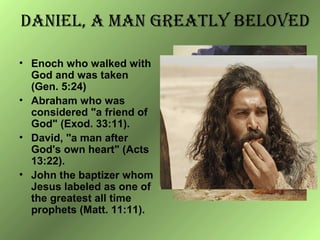
danieL, a man greatLy beLoved
• Enoch who walked with
God and was taken
(Gen. 5:24)
• Abraham who was
considered "a friend of
God" (Exod. 33:11).
• David, "a man after
God's own heart" (Acts
13:22).
• John the baptizer whom
Jesus labeled as one of
the greatest all time
prophets (Matt. 11:11).
Michael the Archangel Jesus?Michael the Archangel Jesus?
• Hebrews 1:5-8 draws a clear distinction betweenHebrews 1:5-8 draws a clear distinction between
Jesus and the angels:Jesus and the angels:
• The angels are called sons of God (Job 1:6; 2:1; 38:7),The angels are called sons of God (Job 1:6; 2:1; 38:7),
but Jesus is THE Son of God (Heb. 1:8; Matthew 4:3-but Jesus is THE Son of God (Heb. 1:8; Matthew 4:3-
6).6).
• Michael the archangel is perhaps the highest of all theMichael the archangel is perhaps the highest of all the
angels. Michael is the only angel in the Bible who isangels. Michael is the only angel in the Bible who is
designated “the archangel” (Jude verse 9).designated “the archangel” (Jude verse 9).
• The clear distinction in the power and authority ofThe clear distinction in the power and authority of
Michael and Jesus can be seen in comparing MatthewMichael and Jesus can be seen in comparing Matthew
4:10 where Jesus rebukes Satan, and Jude verse 9,4:10 where Jesus rebukes Satan, and Jude verse 9,
where Michael the archangel “dared not bring awhere Michael the archangel “dared not bring a
judgment of blasphemy” against Satan and calls onjudgment of blasphemy” against Satan and calls on
the Lord to rebuke him. Jesus is God incarnate (Johnthe Lord to rebuke him. Jesus is God incarnate (John
1:1,14). Michael the archangel is a powerful angel, but1:1,14). Michael the archangel is a powerful angel, but
still only an angelstill only an angel
In the “Latter Days”In the “Latter Days”
• First the phrase may mean the end of Judaism as theFirst the phrase may mean the end of Judaism as the
church was establishedchurch was established (Dan. 2:44; Isa. 2:2-4; Acts 2:28)(Dan. 2:44; Isa. 2:2-4; Acts 2:28)
• Or when the changing of listening to Moses switchedOr when the changing of listening to Moses switched
to listening to Jesusto listening to Jesus (Deut. 18:15ff; Jerm. 31:31ff; Heb. 8:6ff; Heb. 1:1).(Deut. 18:15ff; Jerm. 31:31ff; Heb. 8:6ff; Heb. 1:1).
• It is applied when speaking of impending doom asIt is applied when speaking of impending doom as
Jesus prophesied about the destruction of JerusalemJesus prophesied about the destruction of Jerusalem
(Matt. 11:37; 24:3-35).(Matt. 11:37; 24:3-35).
• It is a term used when speaking of coming apostasiesIt is a term used when speaking of coming apostasies
of the first century (2 Tim. 3:1; 2 Pet. 3:3).of the first century (2 Tim. 3:1; 2 Pet. 3:3).
• And finally, it accommodates the principal idea thatAnd finally, it accommodates the principal idea that
there is coming a final day on earth and thethere is coming a final day on earth and the
resurrection (Jn. 5:28, 29; 2 Pet. 3:10ff).resurrection (Jn. 5:28, 29; 2 Pet. 3:10ff).
• Since the context of chapter 11 elaborates more onSince the context of chapter 11 elaborates more on
the persecution of the Jews during the time ofthe persecution of the Jews during the time of
Antiochus where the daily sacrifice was removed, itAntiochus where the daily sacrifice was removed, it
would follow to look at this phrase primarily in thatwould follow to look at this phrase primarily in that
light.light.
UnworthyUnworthy
• Face toward the ground;
became dumb
• My sorrows are turned upon
me; my joints are dissolved;
• Remained no strength in me;
can’t breath
• For how can the servantFor how can the servant
of this my lord talk withof this my lord talk with
this my lordthis my lord??
• Habakkuk: "I heard, and my
body trembled, My lips
trembled at the voice;
Rottenness entered into my
bones, and I tremble in my
place" (Habakkuk 3:16).
empowerment – hIs way
He still touchesHe still touches
Rom. 16:16; 1 Cor. 12Rom. 16:16; 1 Cor. 12
He still speaksHe still speaks
Heb. 1:1; 1 Thess. 3:2; 4:18; 5:11, 14Heb. 1:1; 1 Thess. 3:2; 4:18; 5:11, 14
He always says the right thingsHe always says the right things
Josh. 1:5, 6, 9, 18Josh. 1:5, 6, 9, 18
If our Lord Jesus Christ himself as man, neededIf our Lord Jesus Christ himself as man, needed
the strength of angels to bear his cross who dothe strength of angels to bear his cross who do
we think that God makes one bear ours withoutwe think that God makes one bear ours without
his peace resting upon ushis peace resting upon us (Luke 22:43)?(Luke 22:43)?
some FUnctIon oF angeLs
1. They bear away the souls of the
righteous in death (Luke 16:22).
2. Watch over little children (Matt. 18:11).
3. Are engaged in the service of those
who shall inherit salvation (Heb. 1:14).
4. Providentially aid in bringing sinners
in contact with the gospel (Acts 8:26).
5. They execute the sentence of God in
the destruction of sinners whose
importance justifies their immediate
removal from the earth (Acts 12:23).
6. The Rainbow Angel of Revelation 10
has charge of maintaining an open
Bible, "the little book," "until time shall
be no more."
7. Special encouragement to inform, to
prophesy, and to encourage (Acts
27:23). This last would appear to
have been a special thing upon
behalf of the apostles.
(4) As the angel raised Daniel again to a standing posture
(Daniel 10:9-10), and told him not to fear (Daniel 10:11-
12) so the truth is able to make one to stand. The child of
God may for a time give way to the impulses of his old
fleshly infirmity; but he has no real and lasting cause for
fear. Every believer is "a man greatly beloved" of God,
as was Daniel; and his heavenly Father would have him
not to tremble, as do the demons (James 2:19), but to
have toward Him that perfect love which casteth out
slavish and tormenting fear (1 John 4:18).
(3) When sinful, and therefore weak and fearful, man is
brought into close contact with truth, his instinctive
feeling is that of alarm, and a desire to flee away through
fright. The men who were with Daniel, at the first sight of
things they did not understand were affected with a great
quaking, and fled to hide themselves (Daniel 10:7). Even
the prophet himself lost all strength, and waxed deadly
pale (Daniel 10:8), and fell with his "face toward the
ground" (Daniel 10:9). This instinct of man is a sad
testimony to the reality of the fall.
(2) In many of God's revelations to His people it may be said, as in the case
of the revelation to Daniel (Daniel 10:1), "The thing is true, but the time
appointed is long." It is the Lord's all-wise way to keep his people
waiting, in order to test and to discipline their faith, their patience, and
their hope unto the end. Meanwhile, like Daniel, we cannot but "mourn"
at times for the trials and depressed state of the Church of Christ. While
fasting (Daniel 10:2-3) is not compulsory, nor necessary generally for
Christians, yet doubtless, if it can be made to consist of that abstinence
whereby the flesh is subdued to the spirit, it becomes a mean of
devotion, humiliation, and spiritual-mindedness. In all cases the child of
God should not suffer his spirit to be over-powered by the dainties of
sense and the pleasures of the appetite.
Spiritual application
(1) There is a spiritual world unseen, which is closely connected with the world of
sense that meets our eyes. This chapter draws aside the veil, and gives us a
glimpse into the spirit-world, where we see the hidden springs which govern
the movements adverse to the people of God in our world, and also the
counteracting agency of the loving angels, who, by God's commission, defend
His Church on earth. How solemn is the thought that we are not only a
"spectacle to angels" (1 Corinthians 4:9), but are a subject of the liveliest and
most personal interest to them! If angels of darkness, far more powerful than
we, are against us, blessed be God, angels of light, more than able to thwart
their sinister designs, are our spiritual champions arrayed on our side, and
shall foil all the adversary's designs against us, if indeed we be the people of
the Lord!
(5) From the first day that Daniel did set his heart to understand, and to chasten himself
before his God, his words were heard (Daniel 10:12). How comforting it is to us who pray,
and are kept seemingly long waiting for the answer, to know that real prayer, resting on
the promise of God, is heard at once, and from the very first, though the angel of God's
presence may delay for a time in making known to us the answer of peace from God!
Prayer delayed is not prayer denied. Nay more, prayer is more effectually answered by
being deferred until God's time, and by being granted in God's way, than if it were
answered in our time and our way. Therefore, though the answer "tarry, wait for it;
because it will surely come, it will not tarry" (Habakkuk 2:3). Angels of darkness may,
for wise purposes of God, be allowed to retard the manifestation of deliverance to God's
people, but they cannot prevent it. At last the cause of the saints shall triumph; because
their "help" is laid on one that is mighty (Daniel 10:13; Psalms 89:19). From the first day
that we turn to God in prayer, He turns to us in grace.
(6) While slavish fear should be put away from us in our approaches to God, we ought
never to lose sight of the majesty of God, and the deep humility and profound
reverence which become us as worms of the dust addressing the Lord of glory. As
Daniel set his face toward the ground and became dumb (Daniel 10:15), so ought we,
when we kneel in the attitude of suppliants, to be dumb in respect to all words of self-
justification before Him, overwhelmed with a sense of our own nothingness, and with
awe because of His unspeakable holiness Then, as in the case of Daniel, the same
glorious God who has made us mute will give us spiritual "utterance," so as "that we
may open our mouth boldly as we ought to speak" (Ephesians 6:19-20). And as our
weakness, needs a continually fresh supply of spiritual strength, the same God who
strengthened Daniel with a touch a second time (Daniel 10:18) will enable those who
wait on Him to go on "from strength to strength" until, our earthly pilgrimage having
been past, we shall in the heavenly Zion appear before God (Psalms 84:7 ).
(7) Every child of God may be encouraged by taking to
himself the words addressed to Daniel, "Fear not:
peace be unto thee; be strong, yea, be strong."
Being justified by faith, he has peace with God
through our Lord Jesus Christ; and this peace,
accompanied with "joy in God," is the secret of
spiritual "strength" (Nehemiah 8:10; Romans 5:1;
Romans 5:11).
(8) When one trial to the Church passes away another succeeds.
When the difficulties arising from Satanic influences acting
through the Persian court against Israel had been
counteracted by the ministry of angels sent from God, a new
enemy started up in the person of the prince of Grecia, who
also was a weapon in Satan's hand, wielded against the
people of God. But the new enemy, too, must finally give way
to the mighty power wielded by Israel's tutelary angel-prince,
Michael in defense of Israel (Daniel 10:20-21). In this evil
world the saints must expect tribulation, because Satan their
enemy is its prince. But though none else "holds with" them
on earth, they have on their side the count less heavenly
hosts of the Lord God of Sabaoth: above all, they have Christ
Himself, who saith, "Be of good cheer, I have overcome the
world" (John 16:33). Therefore let us take courage,
remembering that "the scripture of truth" (Daniel 10:21) hath
said, "If God be for us, who can be againt us?" (Romans
8:31.)
Send request for written text to
dregfilter@comcast.net

Daniel Chapter 10 K. Sno

  • 1.
    Daniel 10 -introDuctionDaniel 10 - introDuction • This chapter is an introduction to theThis chapter is an introduction to the prophecies contained in the two followingprophecies contained in the two following chapters;chapters; • Daniel's mourning and fasting,Daniel's mourning and fasting, • The appearance of the man by the river.The appearance of the man by the river. • It appears that chapters 10-12 more fullyIt appears that chapters 10-12 more fully describe the vision found indescribe the vision found in Daniel 8Daniel 8.. • One may consider the tenth chapter is theOne may consider the tenth chapter is the prologue; the eleventh, the prophecy itself;prologue; the eleventh, the prophecy itself; and the twelfth, the epilogue.and the twelfth, the epilogue.
  • 2.
    the unseen spiritualWorlD • The tenth chapter unfolds the spiritual world as the background of the historical world (Job 1:7; Job 2:1, etc.; Zechariah 3:1-2) where angels are described as the ministers of God's government of men. • This is why Paul, in the gospel age could attest that, "the powers that be are ordained of God" (Rom. 13:1) and then turn and say in the spiritual context, "For we wrestle not against flesh and blood, but against principalities, against powers, against the rulers of the darkness of this world, against wicked spirits in heavenly places" (Eph. 6:12).
  • 3.
    pulling back thecurtain • Angels counteract, by God's will, much of the evil and misery caused by Satan. • An angel troubled the waters of Bethesda so as to give them medicinal power, John 5:4; • The angel would not allow the four angels let loose the four destructive winds on the earth, the sea, and the trees, until he had first sealed the servants of God in their foreheads, Revelation 7:1-3. • Michael the champion of Israel, has done battle with angel of an opposing force. The aim for the reader is to realize God's will in the pagan world is constantly resisted even in the spirit world (Revelation 12:7, "There was war in heaven: Michael and his angels fought against the dragon; and the dragon fought and his angels, and prevailed not; neither was their place found anymore in heaven"). • These struggles are not merely symbolical, but real (so "the evil spirit from the Lord troubled Saul," when "the Spirit of the Lord had departed from him;" whereas "the Spirit of the Lord came upon David," 1 Samuel 16:13-15; "a lying spirit" also was "in the mouth of the prophets of Ahab," 1 Kings
  • 4.
    Daniel Fasts insteaDoF Feasting • Mourning • No pleasant bread • No anointing
  • 5.
    at the river •Hiddekel; the same with the Tigris, called by both names from the swiftness and rapidity of its motion, "hiddekel" signifying both sharp and swift; and Tigris, in the Persian language, a dart. Here, Daniel was met by an awesome visitor.
  • 6.
    the man ofLinen 1. Linen 2. Golden Girdle 3. Body of Beryl 4. Face like Lightening 5. Eyes like Fire 6. Feet like Brass
  • 7.
    man of metaLvs. man of Linen • Varying precious metals. • Sleepless nights and troubled spirits • Spoke not a word • Represented physical kingdoms • Highest order of metals to the basest o minerals. • Vanquished to the wind by a little stone
  • 8.
    • Heavenly glorynot earthly vanity. • Most righteous overwhelmed and pass out. • Voice of multitudes or as the crashing of the thunderous sea. • Became more awesome and powerful the more he was described. • The man of linen represented eternity; one who would not be gone with the wind for he is the Rock. • He is the man of linen because he is the author of righteousness, which is like fine linen, clean and white, Revelation 19:8. man of metaL vs man of Linenman of metaL vs man of Linen
  • 9.
    an overwheLmed danieL •No strength • Comeliness was turned in me into corruption; • I retained no strength; • Jehosaphat said, O LORD God of our fathers, art not thou God in heaven? and rulest not thou over all the kingdoms of the heathen? and in thine hand is there not power and might, so that none is able to withstand thee? 2 Chron. 20:6. • In a deep sleep on face, and my face toward the ground; Could we say, he passed out?
  • 10.
    danieL, a mangreatLy beLoved • Enoch who walked with God and was taken (Gen. 5:24) • Abraham who was considered "a friend of God" (Exod. 33:11). • David, "a man after God's own heart" (Acts 13:22). • John the baptizer whom Jesus labeled as one of the greatest all time prophets (Matt. 11:11).
  • 11.
    Michael the ArchangelJesus?Michael the Archangel Jesus? • Hebrews 1:5-8 draws a clear distinction betweenHebrews 1:5-8 draws a clear distinction between Jesus and the angels:Jesus and the angels: • The angels are called sons of God (Job 1:6; 2:1; 38:7),The angels are called sons of God (Job 1:6; 2:1; 38:7), but Jesus is THE Son of God (Heb. 1:8; Matthew 4:3-but Jesus is THE Son of God (Heb. 1:8; Matthew 4:3- 6).6). • Michael the archangel is perhaps the highest of all theMichael the archangel is perhaps the highest of all the angels. Michael is the only angel in the Bible who isangels. Michael is the only angel in the Bible who is designated “the archangel” (Jude verse 9).designated “the archangel” (Jude verse 9). • The clear distinction in the power and authority ofThe clear distinction in the power and authority of Michael and Jesus can be seen in comparing MatthewMichael and Jesus can be seen in comparing Matthew 4:10 where Jesus rebukes Satan, and Jude verse 9,4:10 where Jesus rebukes Satan, and Jude verse 9, where Michael the archangel “dared not bring awhere Michael the archangel “dared not bring a judgment of blasphemy” against Satan and calls onjudgment of blasphemy” against Satan and calls on the Lord to rebuke him. Jesus is God incarnate (Johnthe Lord to rebuke him. Jesus is God incarnate (John 1:1,14). Michael the archangel is a powerful angel, but1:1,14). Michael the archangel is a powerful angel, but still only an angelstill only an angel
  • 12.
    In the “LatterDays”In the “Latter Days” • First the phrase may mean the end of Judaism as theFirst the phrase may mean the end of Judaism as the church was establishedchurch was established (Dan. 2:44; Isa. 2:2-4; Acts 2:28)(Dan. 2:44; Isa. 2:2-4; Acts 2:28) • Or when the changing of listening to Moses switchedOr when the changing of listening to Moses switched to listening to Jesusto listening to Jesus (Deut. 18:15ff; Jerm. 31:31ff; Heb. 8:6ff; Heb. 1:1).(Deut. 18:15ff; Jerm. 31:31ff; Heb. 8:6ff; Heb. 1:1). • It is applied when speaking of impending doom asIt is applied when speaking of impending doom as Jesus prophesied about the destruction of JerusalemJesus prophesied about the destruction of Jerusalem (Matt. 11:37; 24:3-35).(Matt. 11:37; 24:3-35). • It is a term used when speaking of coming apostasiesIt is a term used when speaking of coming apostasies of the first century (2 Tim. 3:1; 2 Pet. 3:3).of the first century (2 Tim. 3:1; 2 Pet. 3:3). • And finally, it accommodates the principal idea thatAnd finally, it accommodates the principal idea that there is coming a final day on earth and thethere is coming a final day on earth and the resurrection (Jn. 5:28, 29; 2 Pet. 3:10ff).resurrection (Jn. 5:28, 29; 2 Pet. 3:10ff). • Since the context of chapter 11 elaborates more onSince the context of chapter 11 elaborates more on the persecution of the Jews during the time ofthe persecution of the Jews during the time of Antiochus where the daily sacrifice was removed, itAntiochus where the daily sacrifice was removed, it would follow to look at this phrase primarily in thatwould follow to look at this phrase primarily in that light.light.
  • 13.
    UnworthyUnworthy • Face towardthe ground; became dumb • My sorrows are turned upon me; my joints are dissolved; • Remained no strength in me; can’t breath • For how can the servantFor how can the servant of this my lord talk withof this my lord talk with this my lordthis my lord?? • Habakkuk: "I heard, and my body trembled, My lips trembled at the voice; Rottenness entered into my bones, and I tremble in my place" (Habakkuk 3:16).
  • 14.
    empowerment – hIsway He still touchesHe still touches Rom. 16:16; 1 Cor. 12Rom. 16:16; 1 Cor. 12 He still speaksHe still speaks Heb. 1:1; 1 Thess. 3:2; 4:18; 5:11, 14Heb. 1:1; 1 Thess. 3:2; 4:18; 5:11, 14 He always says the right thingsHe always says the right things Josh. 1:5, 6, 9, 18Josh. 1:5, 6, 9, 18 If our Lord Jesus Christ himself as man, neededIf our Lord Jesus Christ himself as man, needed the strength of angels to bear his cross who dothe strength of angels to bear his cross who do we think that God makes one bear ours withoutwe think that God makes one bear ours without his peace resting upon ushis peace resting upon us (Luke 22:43)?(Luke 22:43)?
  • 15.
    some FUnctIon oFangeLs 1. They bear away the souls of the righteous in death (Luke 16:22). 2. Watch over little children (Matt. 18:11). 3. Are engaged in the service of those who shall inherit salvation (Heb. 1:14). 4. Providentially aid in bringing sinners in contact with the gospel (Acts 8:26). 5. They execute the sentence of God in the destruction of sinners whose importance justifies their immediate removal from the earth (Acts 12:23). 6. The Rainbow Angel of Revelation 10 has charge of maintaining an open Bible, "the little book," "until time shall be no more." 7. Special encouragement to inform, to prophesy, and to encourage (Acts 27:23). This last would appear to have been a special thing upon behalf of the apostles.
  • 16.
    (4) As theangel raised Daniel again to a standing posture (Daniel 10:9-10), and told him not to fear (Daniel 10:11- 12) so the truth is able to make one to stand. The child of God may for a time give way to the impulses of his old fleshly infirmity; but he has no real and lasting cause for fear. Every believer is "a man greatly beloved" of God, as was Daniel; and his heavenly Father would have him not to tremble, as do the demons (James 2:19), but to have toward Him that perfect love which casteth out slavish and tormenting fear (1 John 4:18). (3) When sinful, and therefore weak and fearful, man is brought into close contact with truth, his instinctive feeling is that of alarm, and a desire to flee away through fright. The men who were with Daniel, at the first sight of things they did not understand were affected with a great quaking, and fled to hide themselves (Daniel 10:7). Even the prophet himself lost all strength, and waxed deadly pale (Daniel 10:8), and fell with his "face toward the ground" (Daniel 10:9). This instinct of man is a sad testimony to the reality of the fall. (2) In many of God's revelations to His people it may be said, as in the case of the revelation to Daniel (Daniel 10:1), "The thing is true, but the time appointed is long." It is the Lord's all-wise way to keep his people waiting, in order to test and to discipline their faith, their patience, and their hope unto the end. Meanwhile, like Daniel, we cannot but "mourn" at times for the trials and depressed state of the Church of Christ. While fasting (Daniel 10:2-3) is not compulsory, nor necessary generally for Christians, yet doubtless, if it can be made to consist of that abstinence whereby the flesh is subdued to the spirit, it becomes a mean of devotion, humiliation, and spiritual-mindedness. In all cases the child of God should not suffer his spirit to be over-powered by the dainties of sense and the pleasures of the appetite. Spiritual application (1) There is a spiritual world unseen, which is closely connected with the world of sense that meets our eyes. This chapter draws aside the veil, and gives us a glimpse into the spirit-world, where we see the hidden springs which govern the movements adverse to the people of God in our world, and also the counteracting agency of the loving angels, who, by God's commission, defend His Church on earth. How solemn is the thought that we are not only a "spectacle to angels" (1 Corinthians 4:9), but are a subject of the liveliest and most personal interest to them! If angels of darkness, far more powerful than we, are against us, blessed be God, angels of light, more than able to thwart their sinister designs, are our spiritual champions arrayed on our side, and shall foil all the adversary's designs against us, if indeed we be the people of the Lord! (5) From the first day that Daniel did set his heart to understand, and to chasten himself before his God, his words were heard (Daniel 10:12). How comforting it is to us who pray, and are kept seemingly long waiting for the answer, to know that real prayer, resting on the promise of God, is heard at once, and from the very first, though the angel of God's presence may delay for a time in making known to us the answer of peace from God! Prayer delayed is not prayer denied. Nay more, prayer is more effectually answered by being deferred until God's time, and by being granted in God's way, than if it were answered in our time and our way. Therefore, though the answer "tarry, wait for it; because it will surely come, it will not tarry" (Habakkuk 2:3). Angels of darkness may, for wise purposes of God, be allowed to retard the manifestation of deliverance to God's people, but they cannot prevent it. At last the cause of the saints shall triumph; because their "help" is laid on one that is mighty (Daniel 10:13; Psalms 89:19). From the first day that we turn to God in prayer, He turns to us in grace. (6) While slavish fear should be put away from us in our approaches to God, we ought never to lose sight of the majesty of God, and the deep humility and profound reverence which become us as worms of the dust addressing the Lord of glory. As Daniel set his face toward the ground and became dumb (Daniel 10:15), so ought we, when we kneel in the attitude of suppliants, to be dumb in respect to all words of self- justification before Him, overwhelmed with a sense of our own nothingness, and with awe because of His unspeakable holiness Then, as in the case of Daniel, the same glorious God who has made us mute will give us spiritual "utterance," so as "that we may open our mouth boldly as we ought to speak" (Ephesians 6:19-20). And as our weakness, needs a continually fresh supply of spiritual strength, the same God who strengthened Daniel with a touch a second time (Daniel 10:18) will enable those who wait on Him to go on "from strength to strength" until, our earthly pilgrimage having been past, we shall in the heavenly Zion appear before God (Psalms 84:7 ). (7) Every child of God may be encouraged by taking to himself the words addressed to Daniel, "Fear not: peace be unto thee; be strong, yea, be strong." Being justified by faith, he has peace with God through our Lord Jesus Christ; and this peace, accompanied with "joy in God," is the secret of spiritual "strength" (Nehemiah 8:10; Romans 5:1; Romans 5:11). (8) When one trial to the Church passes away another succeeds. When the difficulties arising from Satanic influences acting through the Persian court against Israel had been counteracted by the ministry of angels sent from God, a new enemy started up in the person of the prince of Grecia, who also was a weapon in Satan's hand, wielded against the people of God. But the new enemy, too, must finally give way to the mighty power wielded by Israel's tutelary angel-prince, Michael in defense of Israel (Daniel 10:20-21). In this evil world the saints must expect tribulation, because Satan their enemy is its prince. But though none else "holds with" them on earth, they have on their side the count less heavenly hosts of the Lord God of Sabaoth: above all, they have Christ Himself, who saith, "Be of good cheer, I have overcome the world" (John 16:33). Therefore let us take courage, remembering that "the scripture of truth" (Daniel 10:21) hath said, "If God be for us, who can be againt us?" (Romans 8:31.)
  • 17.
    Send request forwritten text to dregfilter@comcast.net