THE MA IN
   CRITICAL
   THEORY
                                                                                                             2
   AND
   CREATIVE
   RESEARCH
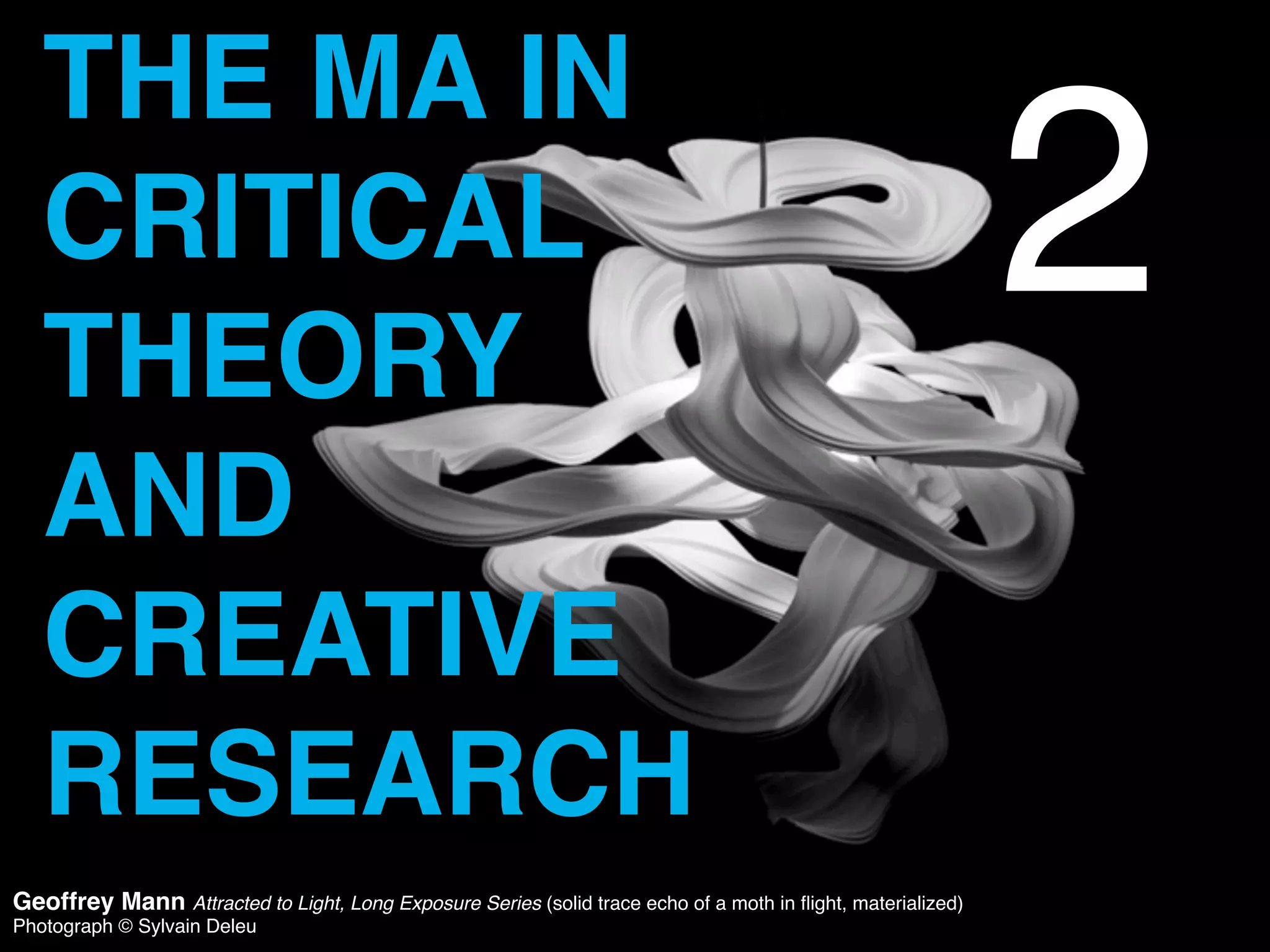
Geoffrey Mann Attracted to Light, Long Exposure Series (solid trace echo of a moth in flight, materialized)
Photograph © Sylvain Deleu
EPIGRAPHS
“Every image of the past that is not recognized by
the present as one of its own concerns threatens to
disappear irretrievably.”


   —Walter Benjamin,


   “Theses on the Philosophy of History”
“What is a piece of ‘research’?                                          To find out, we need some idea of
what a ‘result’ might be. What does one find? What does one want to find? What is missing? In which
axiomatic field will the phenomenon be isolated, the meaning revealed, the statistical discovery placed?”

         —Roland Barthes, “Writers, Intellectuals,                       Teachers,” The Rustle of
                                                                                       Language
“Design quality grows from intellectual                         quality.”
	
   	
     —Edward R. Tufte, Visual and Statistical Thinking: Displays of Evidence for Making Decisions
“The immediate source of the art work is the human
capacity for thought, as man’s ‘propensity to truck and barter’ is the source of exchange objects,
and as his ability to use is the source of use-things. These are capacities of man and not mere attributes of the human
animal like feelings, wants, and needs, to which they are related and which often constitute their content. . . . Thought is
related to feeling and transforms its mute and inarticulate despondency, as exchange transforms the naked greed of desire
and usage transforms the desperate longing of needs—until they all are fit to enter the world and to be transformed into
things, to become reified. In each instance, a human capacity which by its very nature is world-
open and communicative transcends and releases into the world a passionate intensity from
its imprisonment within the self.”

	
         —Hannah Arendt, “The Permanence of the 	
                                                          World
and the Work of Art,” The Human Condition
“You know that poesis is more than a single
thing. For of anything whatever that passes
from not being into being the whole cause is
composing or poetry; for that the productions
of all arts are kinds of poetry, and their
craftsmen are all poets.”


   —Plato, Symposium
“Here it becomes evident that the    hallmark of the new type of
researcher is not the eye for the ‘all-encompassing whole’ or the eye for the
‘comprehensive context’ (which mediocrity has claimed for itself), but rather the capacity to
be at home in marginal domains. The men whose work is contained in this yearbook
represent the most rigorous of this new type of researcher.   They are the
hope of their field of study.”


       —  Walter Benjamin, “The Rigorous Study of Art”
“This type of study stands to gain from the insight that the more
crucial the works are, the more inconspicuously and intimately their meaning-content
[Bedeutungsgehalt] is bound up with their material content [Sachgehalt]. It is concerned
with the correlation that gives rise to reciprocal illumination between, on the one hand, the
historical process and radical change and, on the other hand, the accidental, external, and
even strange aspects of the artwork. For if the most meaningful works prove
to be precisely those whose life is most deeply embedded in their
material contents . . . then over the course of their historical
duration these material contents present themselves to the
researcher all the more clearly the more they have disappeared
from the world.”


       — Walter Benjamin, “The Rigorous Study of Art”
“It is the very productions of science, technology and social relations
which will drift towards aesthetic paradigms. . . . Today our societies have
their backs up against the wall; to survive they will have to
develop research, innovation and creation still further--the
very dimensions which imply an awareness of the strictly            aesthetic
techniques of rupture and suture.”
	
     	
     —Felix Guattari, “Chaosmosis: An Ethico-Aesthetic Paradigm”
"Theory is the connecting force of intra-human
relationships, to which we owe the production of information. The
political wolves shred this information into pieces, and the economic
sheep consume it, but in a theoretical space they will always be
dialogically threaded anew.”


      —Vilém Flusser, Writings
"The dichotomy between seeing the truth in solitude and remoteness and being
caught in the relationships and relativities of human affairs became
authoritative for the tradition of political thought. It is expressed most forcefully
in Plato's parable of the cave, and one is therefore somehow tempted to see its
origin in the Platonic doctrine of ideas. Historically, however, it was not
dependent upon an acceptance of this doctrine, but depended much more upon
an attitude which Plato expressed only once, almost casually in a random
remark, and which Aristotle later quoted in a famous sentence of Metaphysics
almost verbatim, namely that the beginning of all philosophy is thaumasein,
the wonder at everything that is as it is.                     More than
anything else, Greek 'theory' is the prolongation and Greek philosophy the
articulation and conceptualization of this initial wonder. To be capable
                                                      of
it is what separates the few from the many, and
to remain devoted to it is what alienates them from the
affairs of men.”


        —Hannah Arendt, "What Is Authority?"
“In the end, our society will be defined not only by what we create,      but by
what we refuse to destroy.”
	
     —John C. Sawhill, epigraph to E.O. Wilson’s   The Future of Life
"Images are not to be studied in pieces. An image is, in
fact, an integrating force. It converges the most diverse
impressions, impressions arising from all of the senses.
Only under these conditions does an image acquire the
stamp of sincerity and        carry one's whole being
along with it.”

	
    —Gaston Bachelard, "Preface (For Two Volumes):
	
    The Imagination in Matter and in Word," Earth and Reveries of Will
“[T]he sense of an object for me goes only so far as my senses go (has only
sense for a sense corresponding to that object)—for this reason the senses of
the social man are other senses than those of the non-social man. . . .

The forming of the five senses is
a labor of the entire history of the
world down to the present.”
	
      	
      —Karl Marx, Economic and Philosophic Manuscripts of 1844
“Two thousand years after Plato wrote it seems as if not only the
gods but the wise have abandoned us, and left us alone with our partial knowledge and our ignorance. What is left to us in
the place of the wise is their writings, in their glinting brilliance and their increasing obscurity. They still lay in more or less
accessible editions; they can still be read, if only one knew why one should bother. It is their fate—to stand in silent
bookshelves, like posted letters no longer collected, sent to us by authors, of whom we no longer knew whether or not they
could be our friends. . . .


Perhaps it occasionally happens that in such researches in the dead cellars of culture the long-ignored texts begin to
                                                     Everything
glimpse as if a distant light flickers over them. Can the archives also come into the Clearing?

suggests that archivists have become the successors of the
humanists. For the few who still peer around in those archives, the
realization is dawning that our lives are the confused answer to
questions which were asked in places we have forgotten.”

	
          —Peter Sloterdijk, “Rules for the Human Zoo:                                                            A
	
          Response to the Letter on Humanism,” Environment and
	
          Planning D: Society and Space

2. Epigraphs

  • 1.
    THE MA IN CRITICAL THEORY 2 AND CREATIVE RESEARCH Geoffrey Mann Attracted to Light, Long Exposure Series (solid trace echo of a moth in flight, materialized) Photograph © Sylvain Deleu
  • 2.
  • 3.
    “Every image ofthe past that is not recognized by the present as one of its own concerns threatens to disappear irretrievably.” —Walter Benjamin, “Theses on the Philosophy of History”
  • 4.
    “What is apiece of ‘research’? To find out, we need some idea of what a ‘result’ might be. What does one find? What does one want to find? What is missing? In which axiomatic field will the phenomenon be isolated, the meaning revealed, the statistical discovery placed?” —Roland Barthes, “Writers, Intellectuals, Teachers,” The Rustle of Language
  • 5.
    “Design quality growsfrom intellectual quality.” —Edward R. Tufte, Visual and Statistical Thinking: Displays of Evidence for Making Decisions
  • 6.
    “The immediate sourceof the art work is the human capacity for thought, as man’s ‘propensity to truck and barter’ is the source of exchange objects, and as his ability to use is the source of use-things. These are capacities of man and not mere attributes of the human animal like feelings, wants, and needs, to which they are related and which often constitute their content. . . . Thought is related to feeling and transforms its mute and inarticulate despondency, as exchange transforms the naked greed of desire and usage transforms the desperate longing of needs—until they all are fit to enter the world and to be transformed into things, to become reified. In each instance, a human capacity which by its very nature is world- open and communicative transcends and releases into the world a passionate intensity from its imprisonment within the self.” —Hannah Arendt, “The Permanence of the World and the Work of Art,” The Human Condition
  • 7.
    “You know thatpoesis is more than a single thing. For of anything whatever that passes from not being into being the whole cause is composing or poetry; for that the productions of all arts are kinds of poetry, and their craftsmen are all poets.” —Plato, Symposium
  • 8.
    “Here it becomesevident that the hallmark of the new type of researcher is not the eye for the ‘all-encompassing whole’ or the eye for the ‘comprehensive context’ (which mediocrity has claimed for itself), but rather the capacity to be at home in marginal domains. The men whose work is contained in this yearbook represent the most rigorous of this new type of researcher. They are the hope of their field of study.” — Walter Benjamin, “The Rigorous Study of Art”
  • 9.
    “This type ofstudy stands to gain from the insight that the more crucial the works are, the more inconspicuously and intimately their meaning-content [Bedeutungsgehalt] is bound up with their material content [Sachgehalt]. It is concerned with the correlation that gives rise to reciprocal illumination between, on the one hand, the historical process and radical change and, on the other hand, the accidental, external, and even strange aspects of the artwork. For if the most meaningful works prove to be precisely those whose life is most deeply embedded in their material contents . . . then over the course of their historical duration these material contents present themselves to the researcher all the more clearly the more they have disappeared from the world.” — Walter Benjamin, “The Rigorous Study of Art”
  • 10.
    “It is thevery productions of science, technology and social relations which will drift towards aesthetic paradigms. . . . Today our societies have their backs up against the wall; to survive they will have to develop research, innovation and creation still further--the very dimensions which imply an awareness of the strictly aesthetic techniques of rupture and suture.” —Felix Guattari, “Chaosmosis: An Ethico-Aesthetic Paradigm”
  • 11.
    "Theory is theconnecting force of intra-human relationships, to which we owe the production of information. The political wolves shred this information into pieces, and the economic sheep consume it, but in a theoretical space they will always be dialogically threaded anew.” —Vilém Flusser, Writings
  • 12.
    "The dichotomy betweenseeing the truth in solitude and remoteness and being caught in the relationships and relativities of human affairs became authoritative for the tradition of political thought. It is expressed most forcefully in Plato's parable of the cave, and one is therefore somehow tempted to see its origin in the Platonic doctrine of ideas. Historically, however, it was not dependent upon an acceptance of this doctrine, but depended much more upon an attitude which Plato expressed only once, almost casually in a random remark, and which Aristotle later quoted in a famous sentence of Metaphysics almost verbatim, namely that the beginning of all philosophy is thaumasein, the wonder at everything that is as it is. More than anything else, Greek 'theory' is the prolongation and Greek philosophy the articulation and conceptualization of this initial wonder. To be capable of it is what separates the few from the many, and to remain devoted to it is what alienates them from the affairs of men.” —Hannah Arendt, "What Is Authority?"
  • 13.
    “In the end,our society will be defined not only by what we create, but by what we refuse to destroy.” —John C. Sawhill, epigraph to E.O. Wilson’s The Future of Life
  • 14.
    "Images are notto be studied in pieces. An image is, in fact, an integrating force. It converges the most diverse impressions, impressions arising from all of the senses. Only under these conditions does an image acquire the stamp of sincerity and carry one's whole being along with it.” —Gaston Bachelard, "Preface (For Two Volumes): The Imagination in Matter and in Word," Earth and Reveries of Will
  • 15.
    “[T]he sense ofan object for me goes only so far as my senses go (has only sense for a sense corresponding to that object)—for this reason the senses of the social man are other senses than those of the non-social man. . . . The forming of the five senses is a labor of the entire history of the world down to the present.” —Karl Marx, Economic and Philosophic Manuscripts of 1844
  • 16.
    “Two thousand yearsafter Plato wrote it seems as if not only the gods but the wise have abandoned us, and left us alone with our partial knowledge and our ignorance. What is left to us in the place of the wise is their writings, in their glinting brilliance and their increasing obscurity. They still lay in more or less accessible editions; they can still be read, if only one knew why one should bother. It is their fate—to stand in silent bookshelves, like posted letters no longer collected, sent to us by authors, of whom we no longer knew whether or not they could be our friends. . . . Perhaps it occasionally happens that in such researches in the dead cellars of culture the long-ignored texts begin to Everything glimpse as if a distant light flickers over them. Can the archives also come into the Clearing? suggests that archivists have become the successors of the humanists. For the few who still peer around in those archives, the realization is dawning that our lives are the confused answer to questions which were asked in places we have forgotten.” —Peter Sloterdijk, “Rules for the Human Zoo: A Response to the Letter on Humanism,” Environment and Planning D: Society and Space