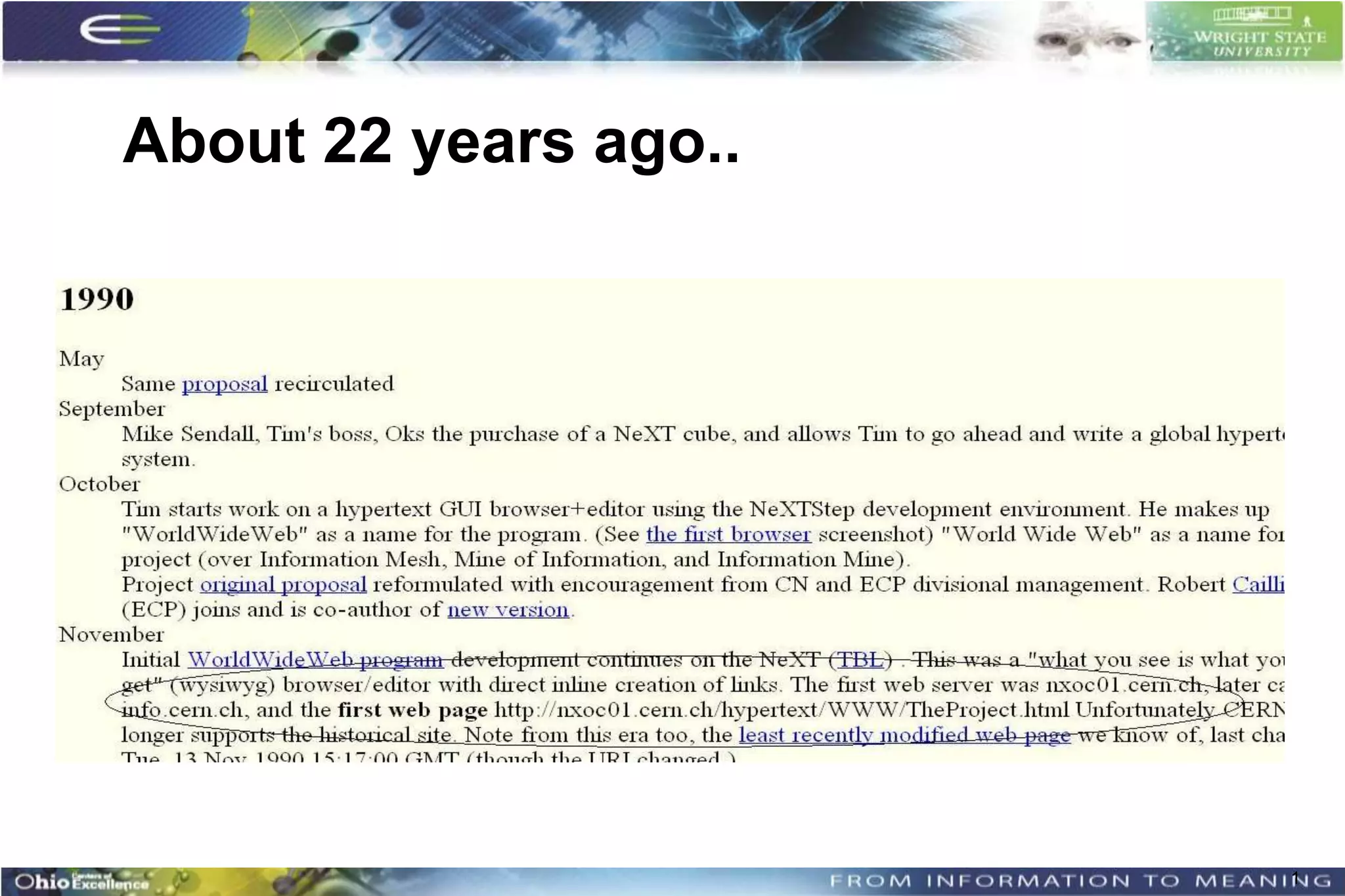
About 22 years ago..


                       1
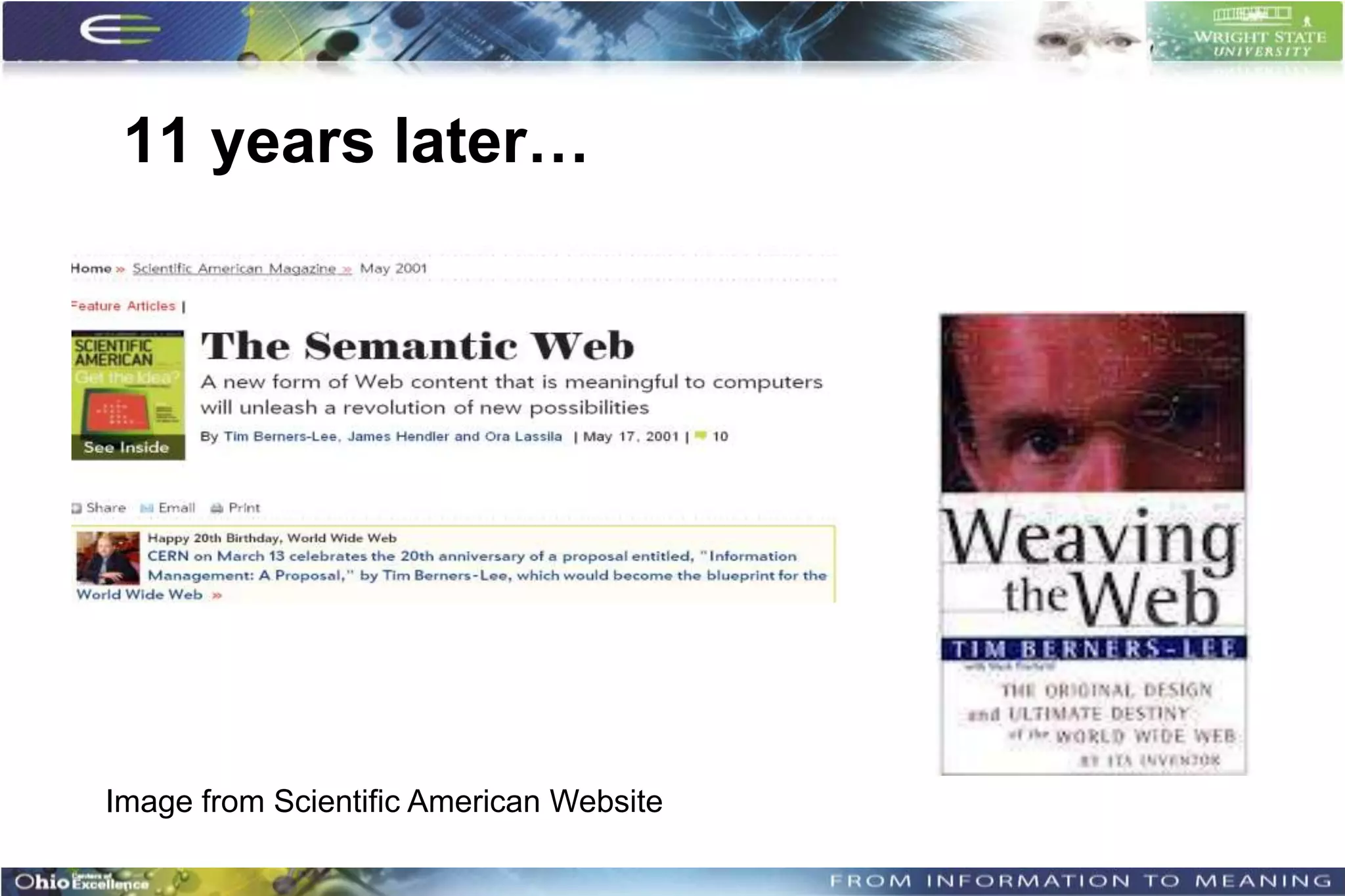
11 years later…


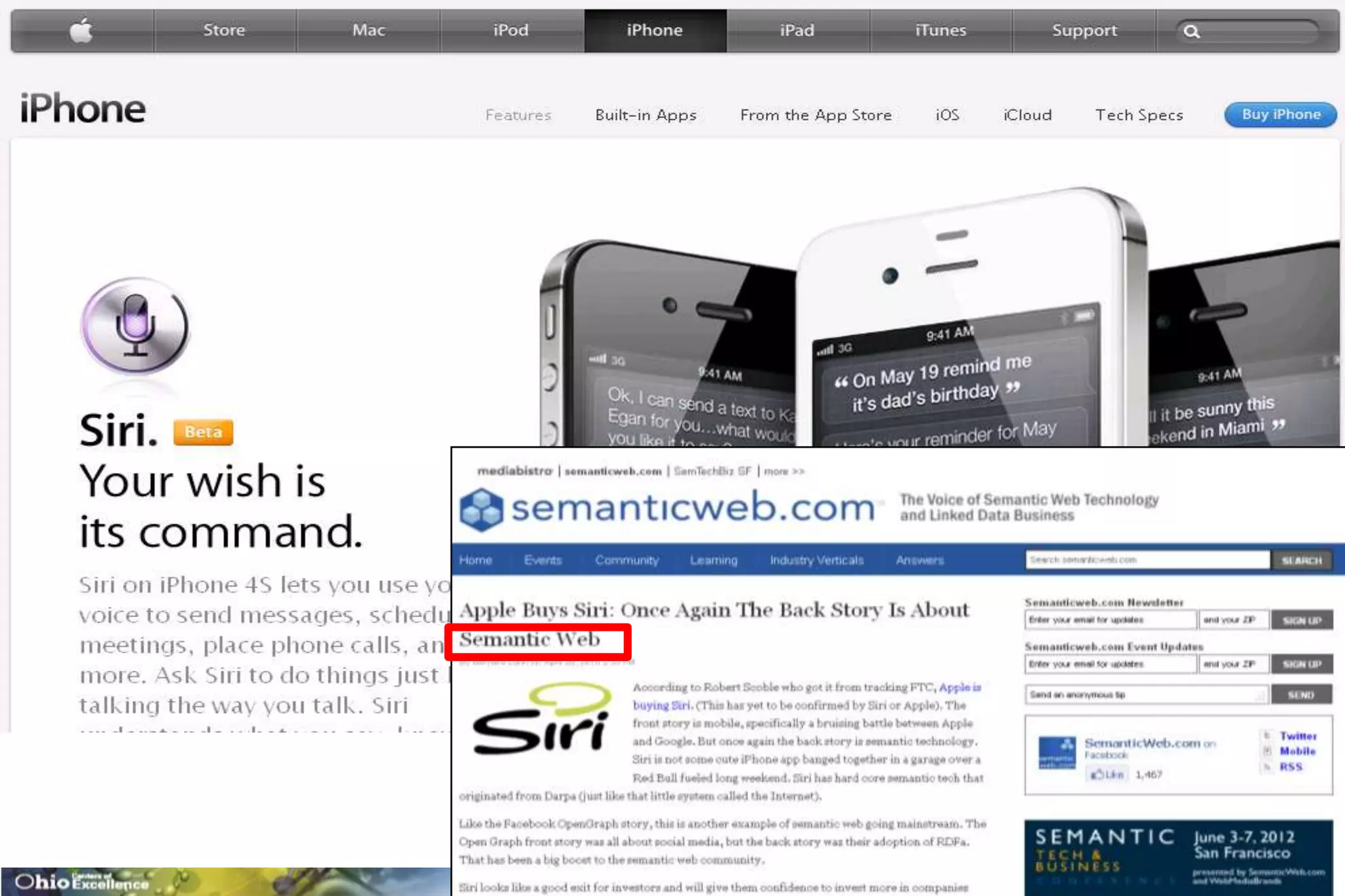
Image from Scientific American Website
3
4
5
Tim Berners-Lee 2006
1. Use URIs as names for things
2. Use HTTP URIs so that people can look up those names.
3. When someone looks up a URI, provide useful
   information, using the standards (RDF*, SPARQL)

4. Include links to other URIs. so that they can discover more
   things.


                                                                 6
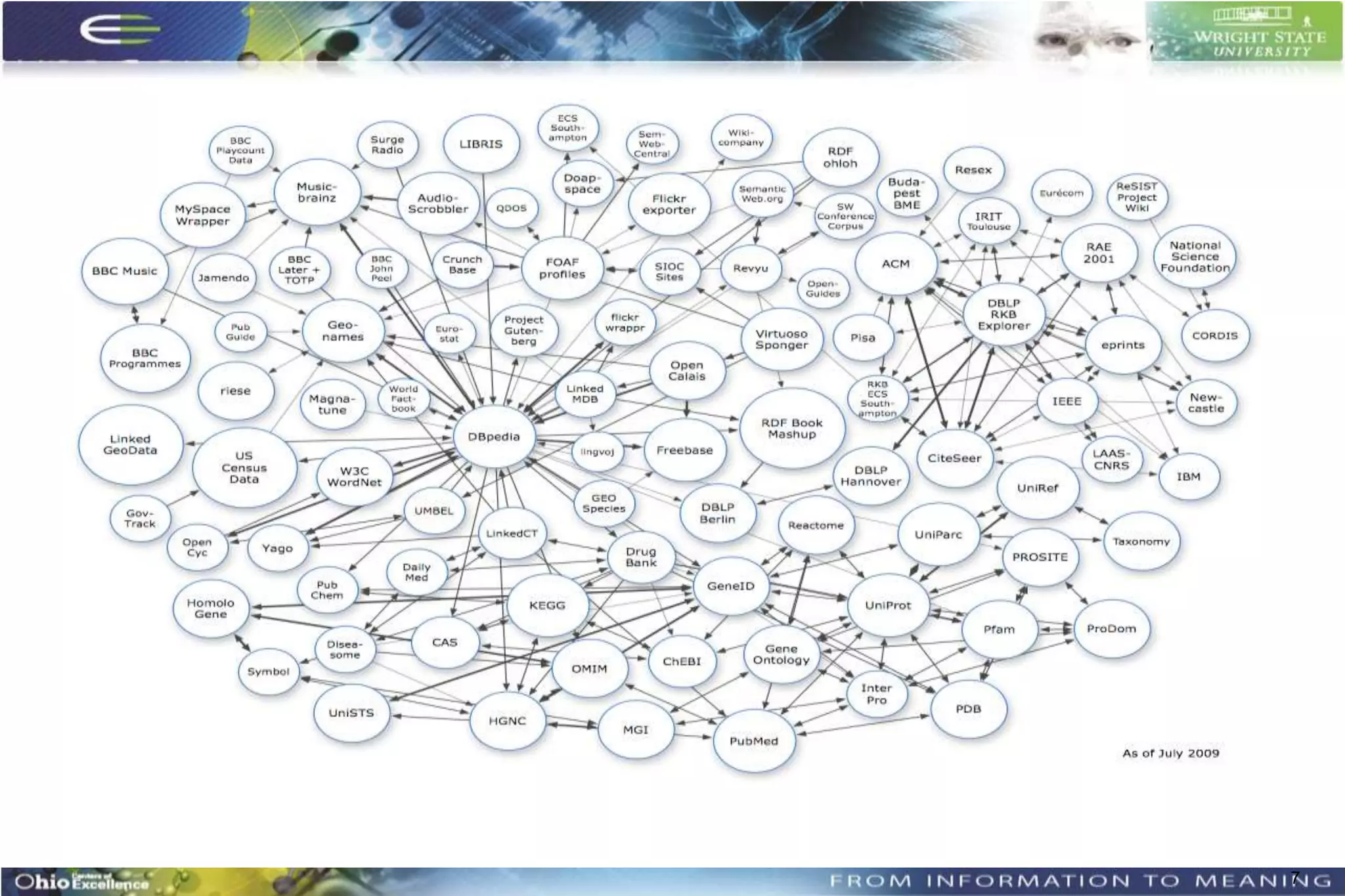
In 2006 Web of Data


                      7
Linked Open Data
       • Massive collection of instance data
       • Primarily connected via owl:sameAs relationship
       • Excellent source of information for background
           knowledge

       • Labeled as mainstream Semantic Web
7/2/2012                                                       8
                                                           8
Is it really mainstream Semantic Web?
• What is the relationship between the models
 whose instances are being linked?

• How to do querying on LOD without knowing
 individual datasets?

• How to perform schema level reasoning over
 LOD cloud?

                                                9
What can be done?
• Relationships are at the heart of Semantics
• LOD primarily consists of owl:sameAs links
• LOD captures instance level relationships, but lacks
  class level relationships.
   o Superclass
   o Subclass
   o Equivalence


• How to find these relationships?
   o Perform a matching of the LOD Ontology’s using state of the art ontology matching tools.


                                                                                                10
Linked Data Alignment
   and Enrichment
 Proposal Defense June 11th, 2012

           Prateek Jain
         Kno.e.sis Center
Wright State University, Dayton, OH
Agenda
      •     Motivation and Significance of this research
      •     Research questions and proposed solutions
      •     State of the current research and planned
            work

      •     Questions and comments


14th February 2012                                         12
Linked Open Data
      •     A set of best practices for publishing and
           connecting structured data on the Web

      • Practices have been adopted by an increasing
           number of data providers in the past 5 years

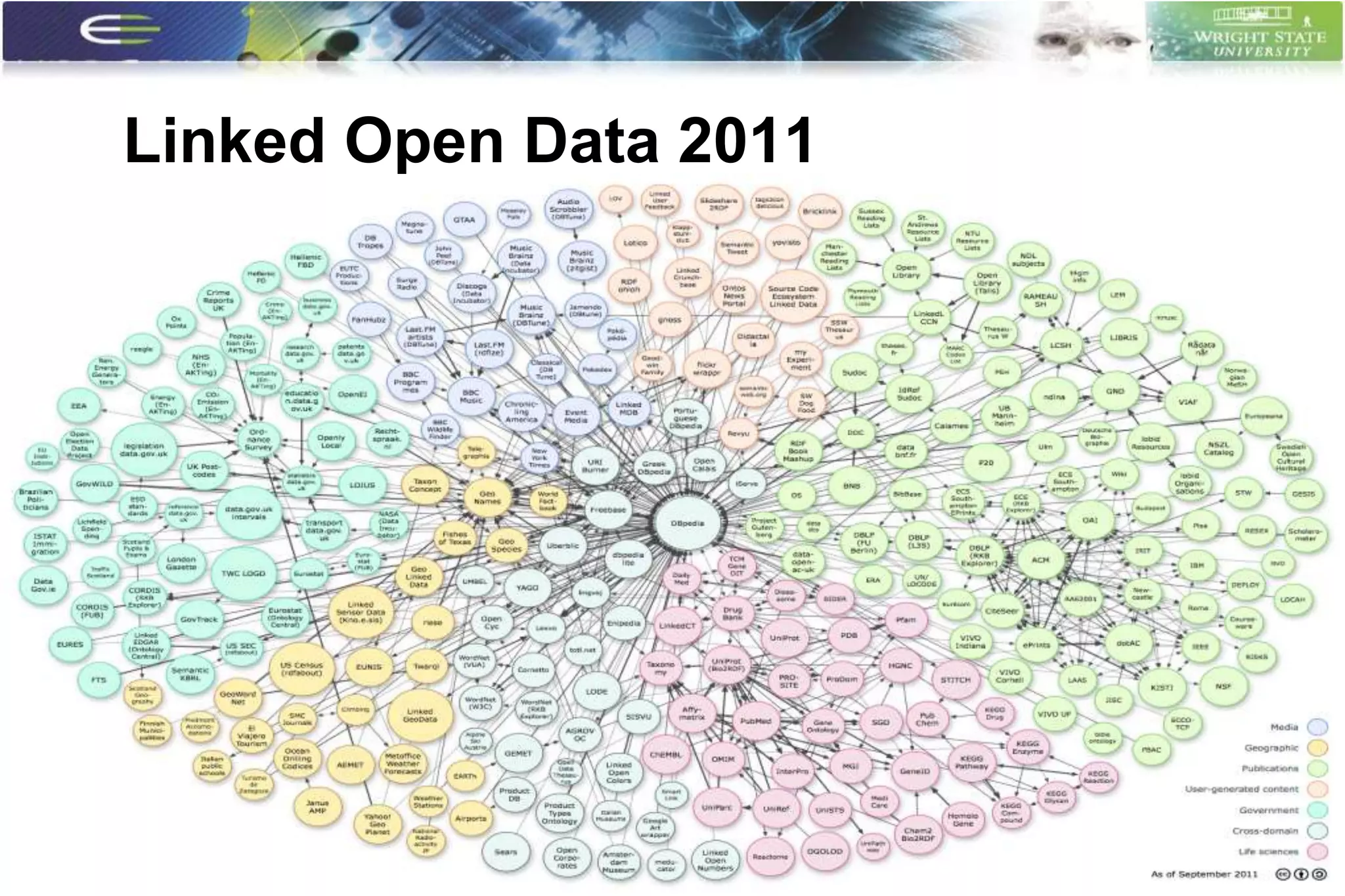
      • Latest count is at 295 datasets with over 50
           Billion triples (approx)
14th February 2012                                        13
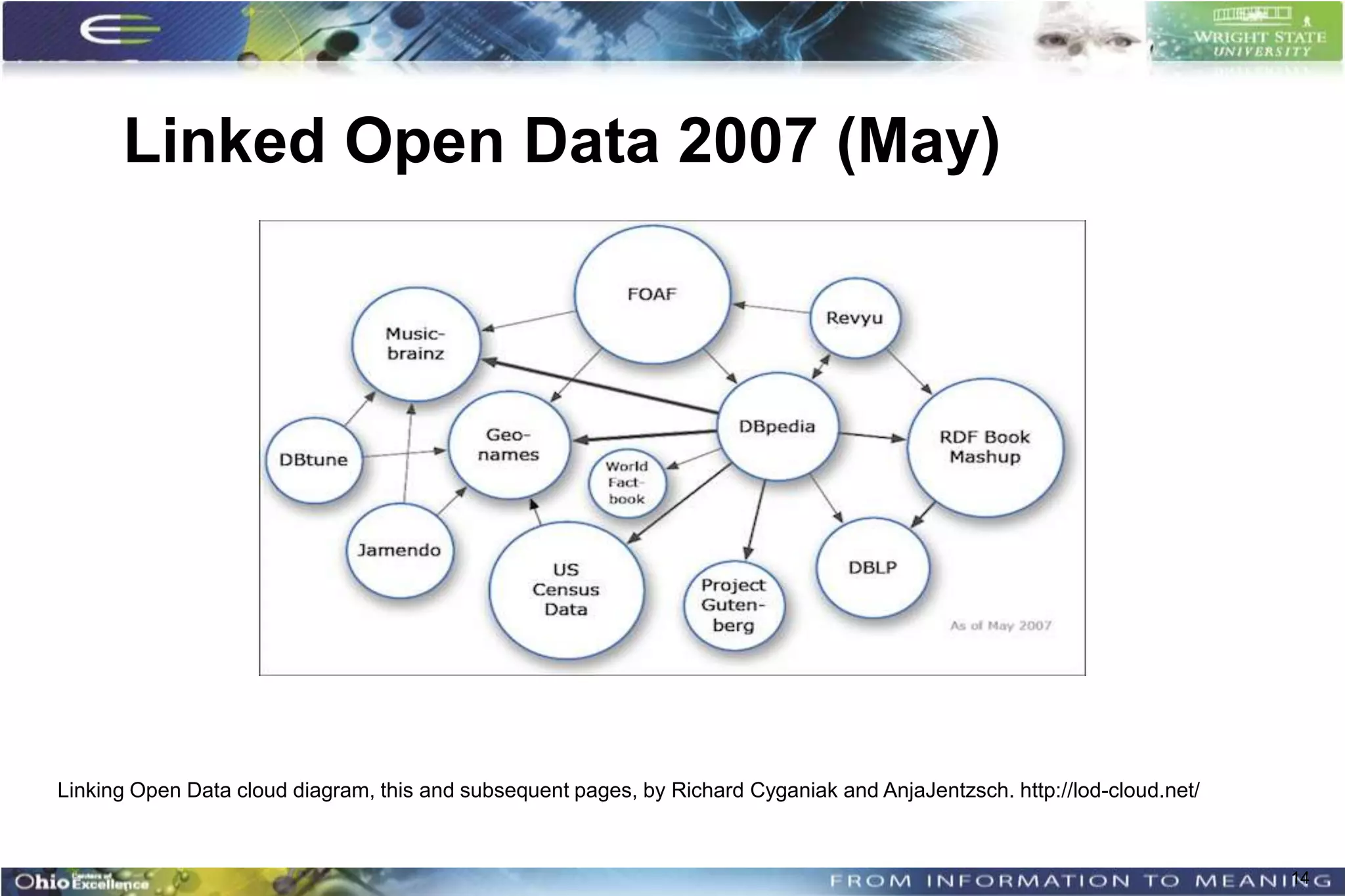
Linked Open Data 2007 (May)


Linking Open Data cloud diagram, this and subsequent pages, by Richard Cyganiak and AnjaJentzsch. http://lod-cloud.net/


                                                                                                                          14
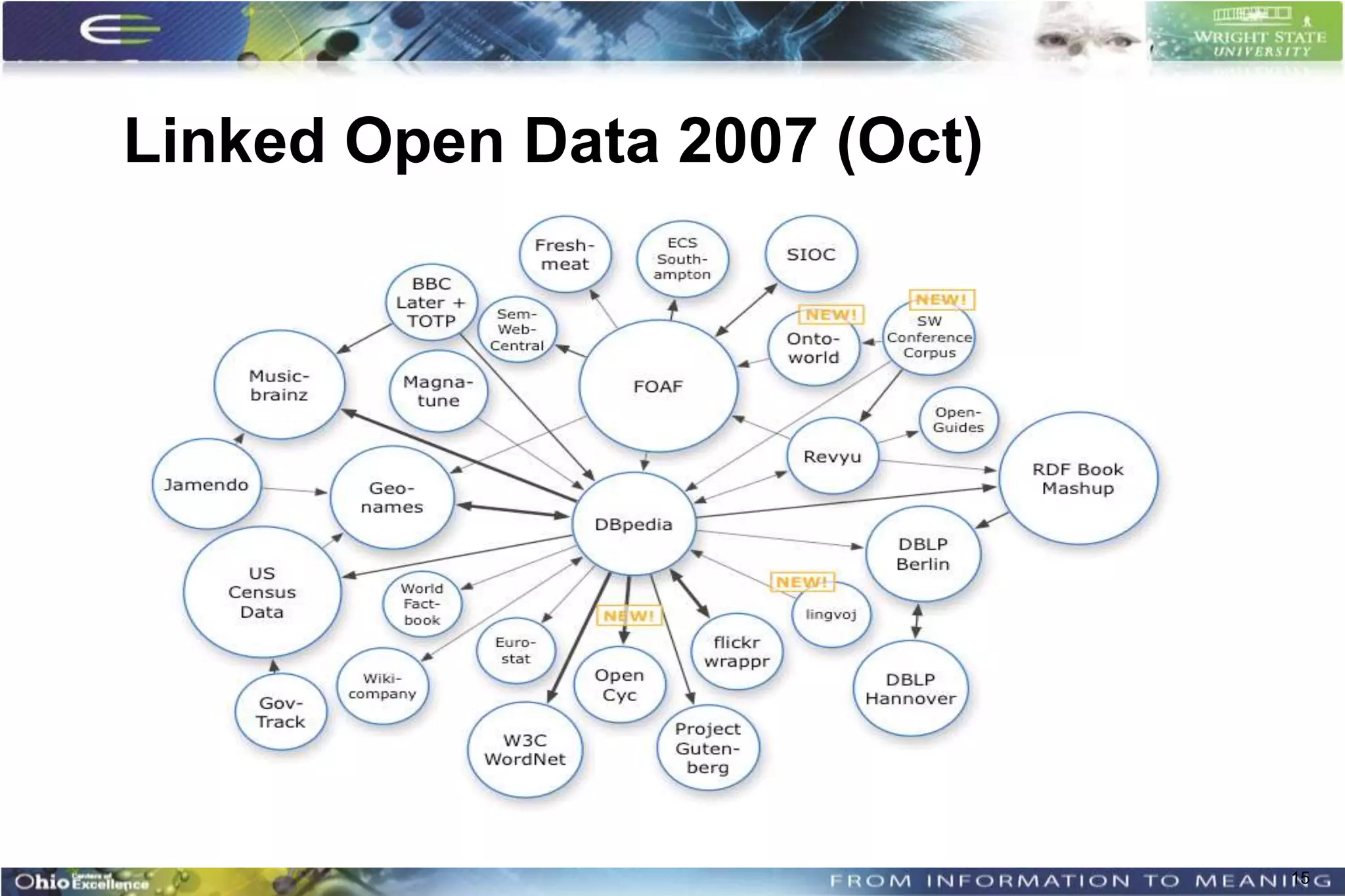
Linked Open Data 2007 (Oct)


                              15
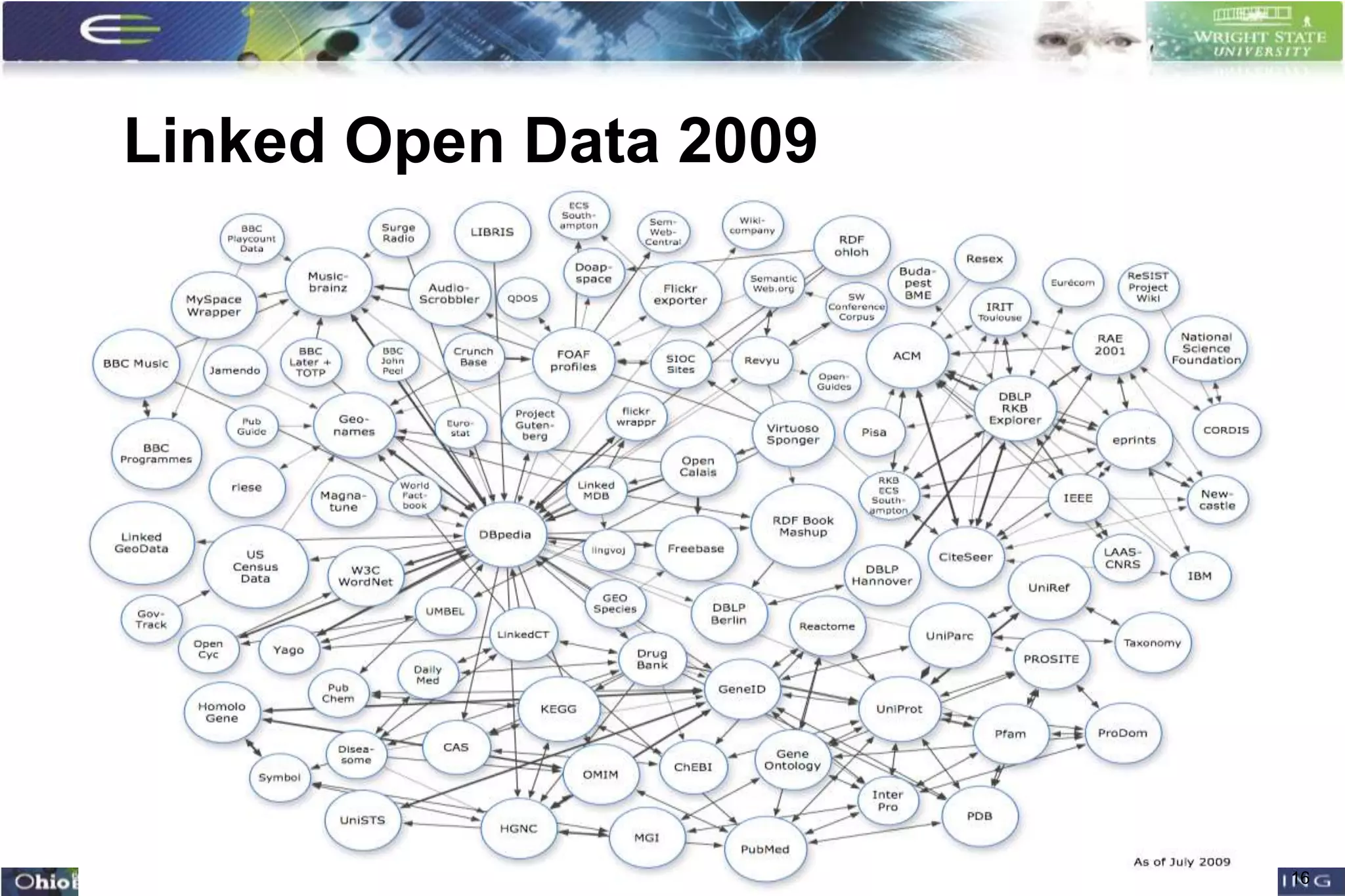
Linked Open Data 2009


                        16
Linked Open Data 2011


                        17
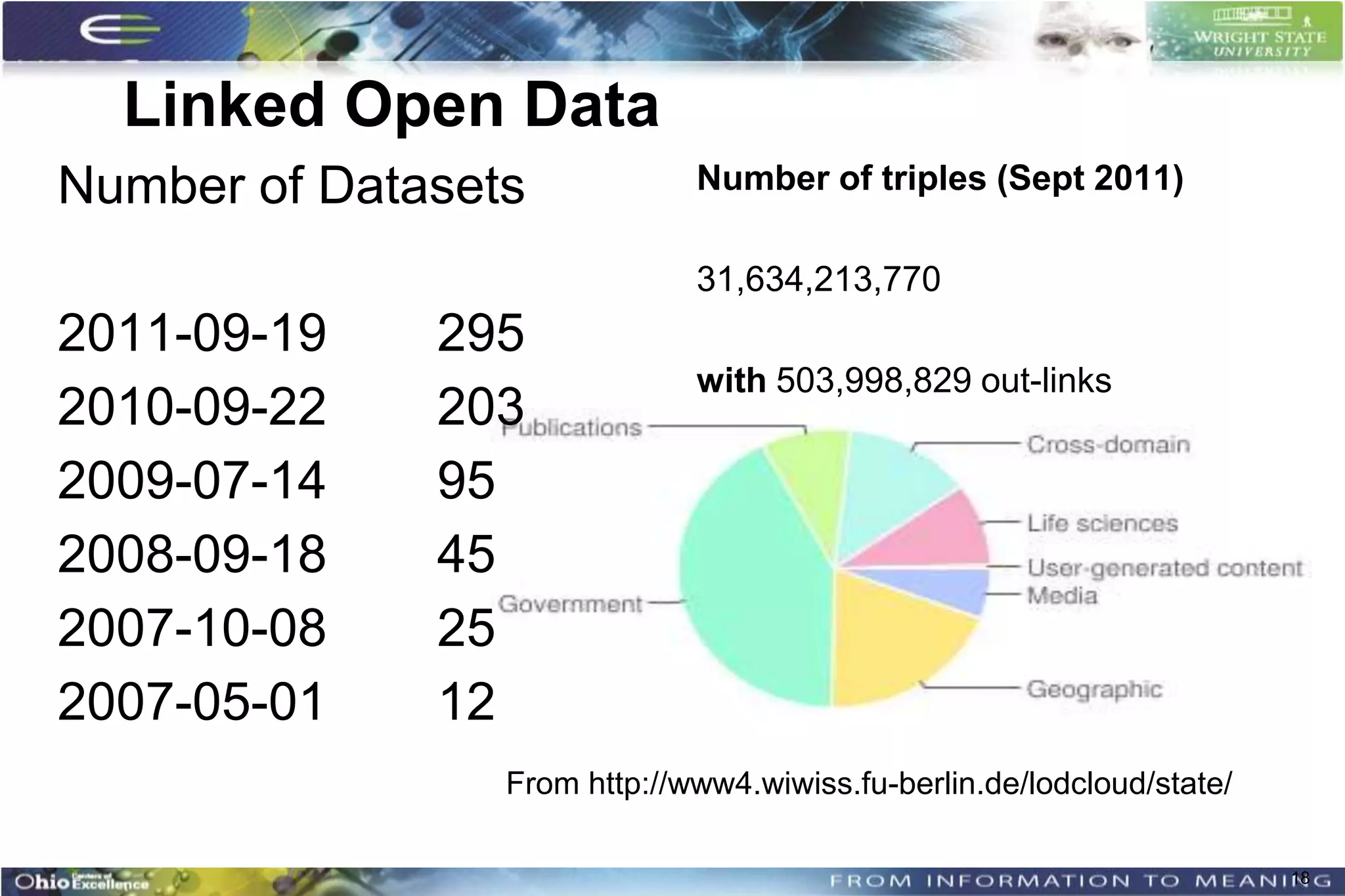
Linked Open Data
Number of Datasets            Number of triples (Sept 2011)

                              31,634,213,770
2011-09-19    295
                              with 503,998,829 out-links
2010-09-22    203
2009-07-14    95
2008-09-18    45
2007-10-08    25
2007-05-01    12
                 From http://www4.wiwiss.fu-berlin.de/lodcloud/state/

                                                                        18
6 years of existence how
           many applications come to
                  your mind?


7/2/2012                               19
20
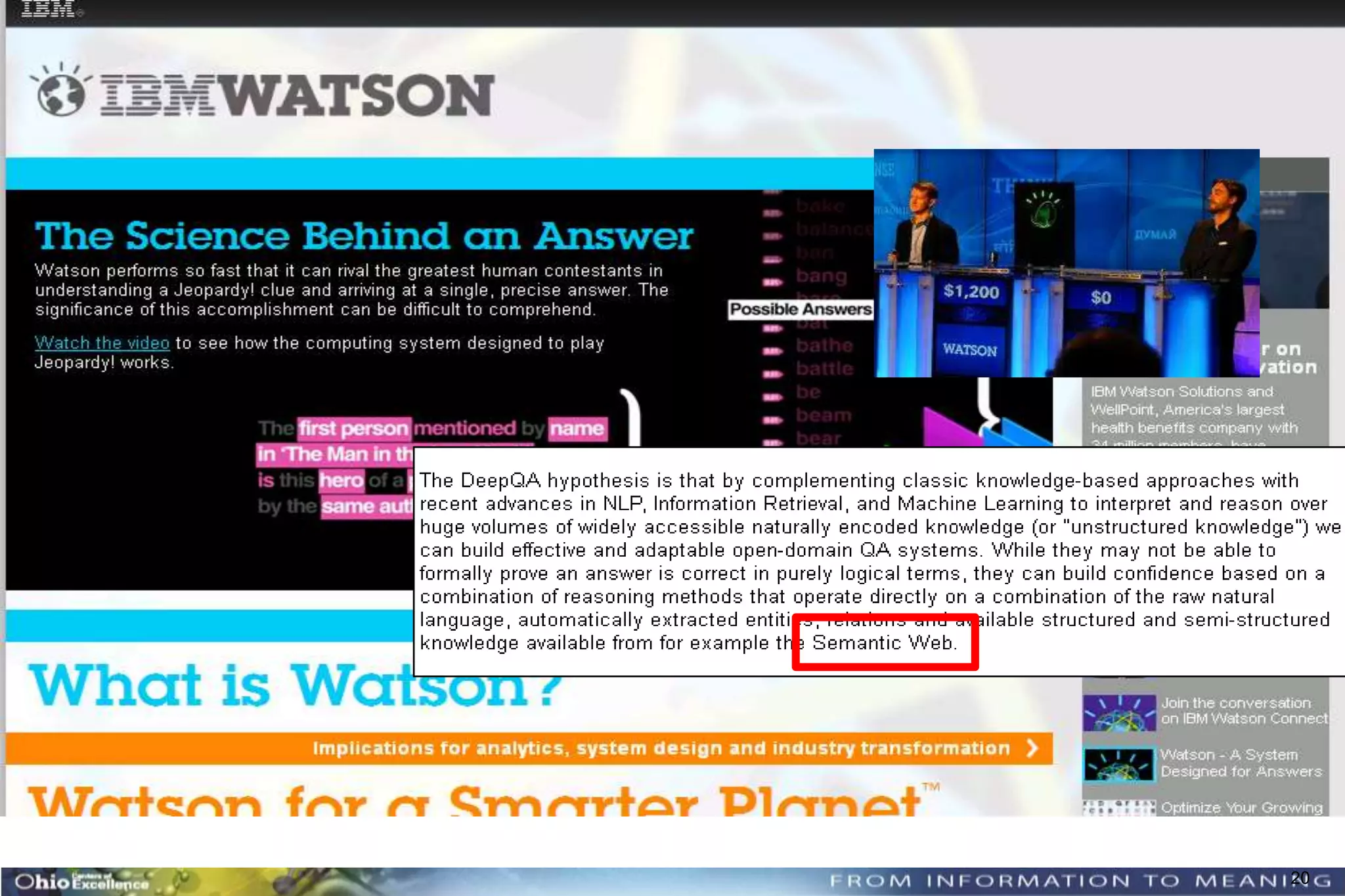
Reality…
       • “We DID NOT use the entire Dbpedia or LOD.
           The only component of LOD which helped us
           with Watson was YAGO class hierarchy present
           in DBpedia. We had strict information gain
           requirements and other components honestly
           did not help much“
           – Researcher with the Watson Team


7/2/2012                                                   21
                                                          21
Why?
A simple query..
“Identify congress members, who have voted “No”
   on pro environmental legislation in the past four
   years, with
   high-pollution industry in their congressional
   districts.”


But even with LOD we cannot answer this query.

                                                       23
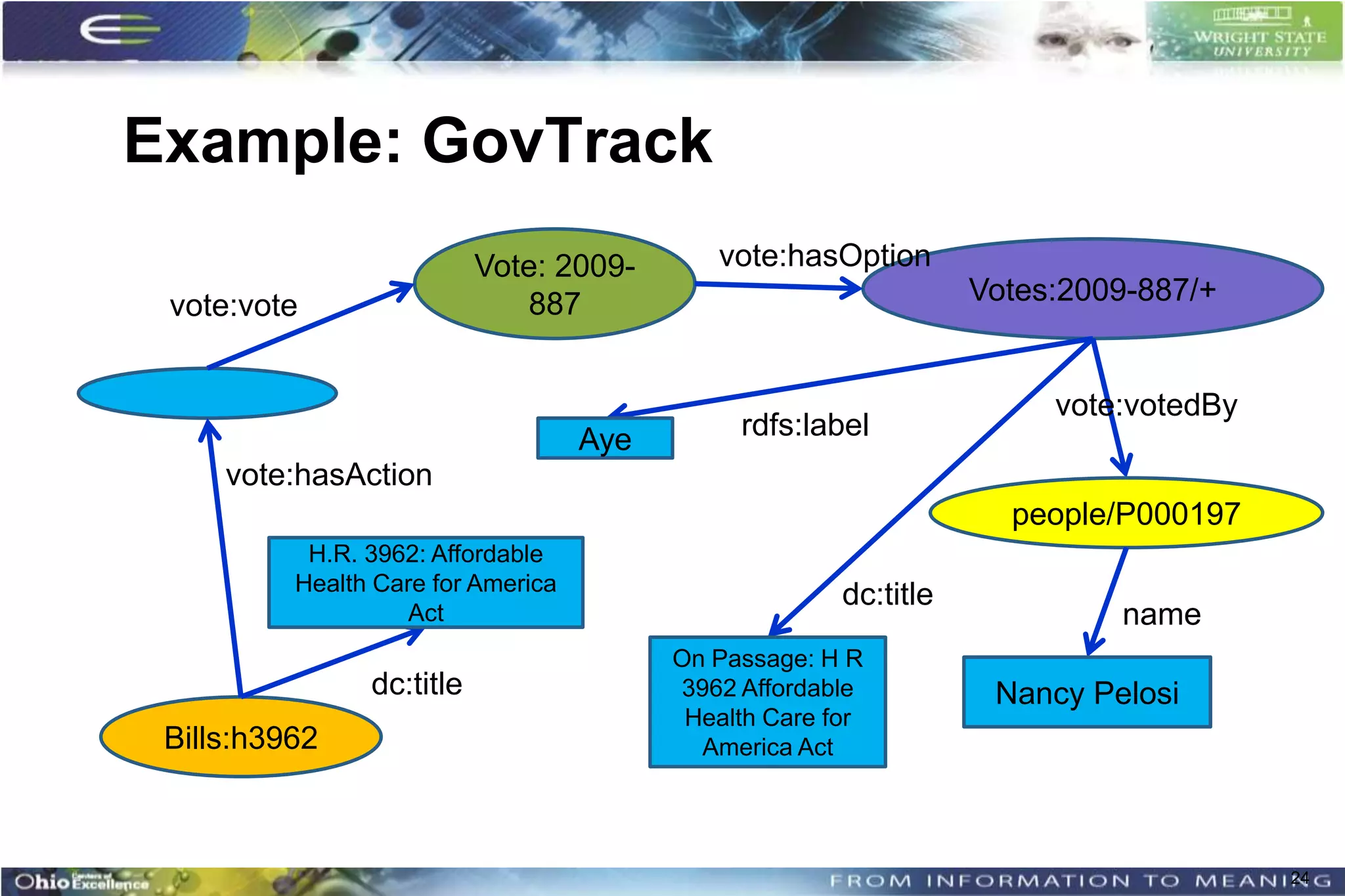
Example: GovTrack
                           Vote: 2009-       vote:hasOption
 vote:vote                    887                                  Votes:2009-887/+


                                                                        vote:votedBy
                                    Aye        rdfs:label
     vote:hasAction
                                                                     people/P000197
           H.R. 3962: Affordable
          Health Care for America
                                                        dc:title
                   Act                                                      name
                                          On Passage: H R
                dc:title                  3962 Affordable           Nancy Pelosi
                                           Health Care for
 Bills:h3962                                America Act


                                                                                       24
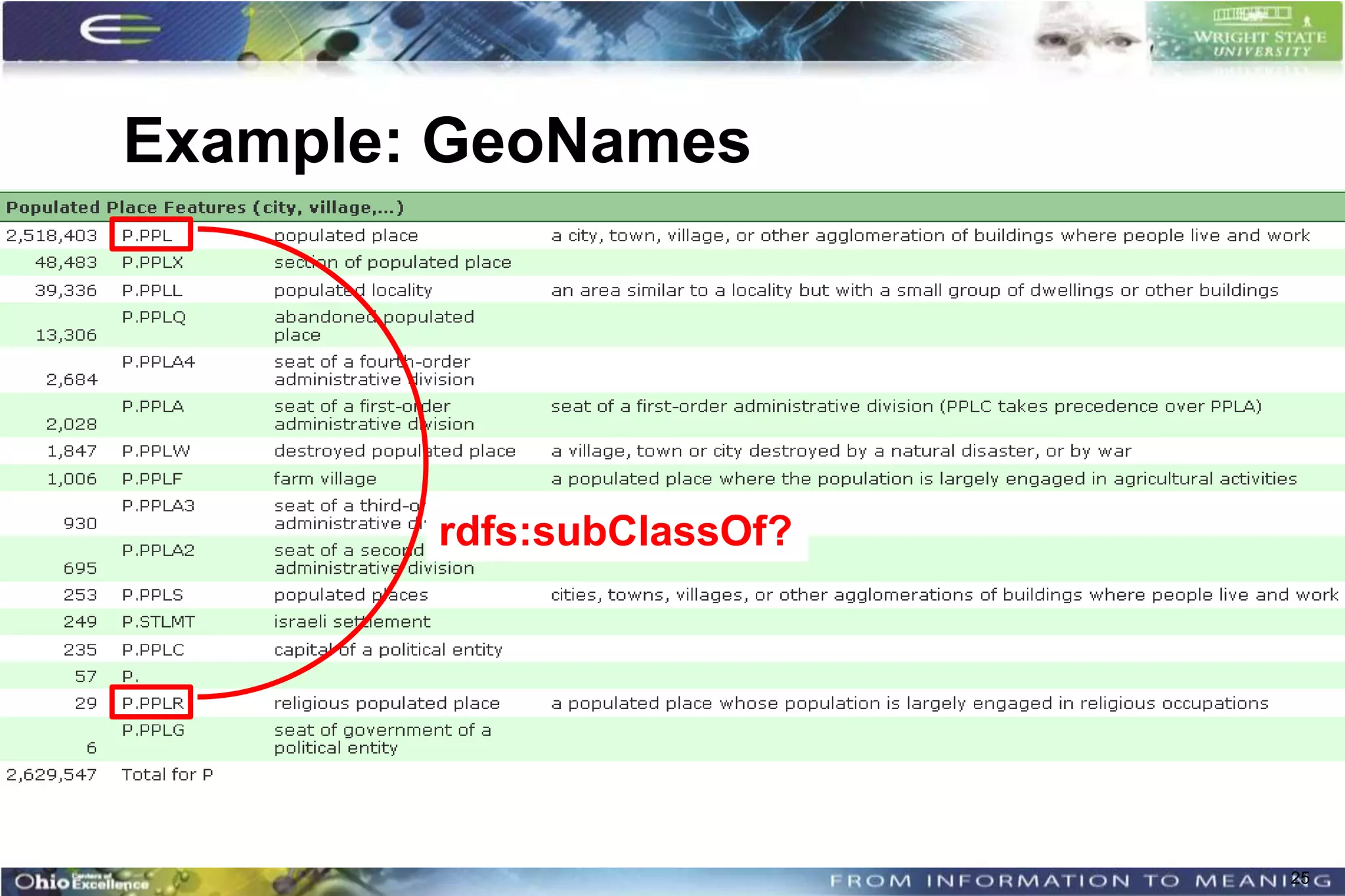
Example: GeoNames


        rdfs:subClassOf?


                           25
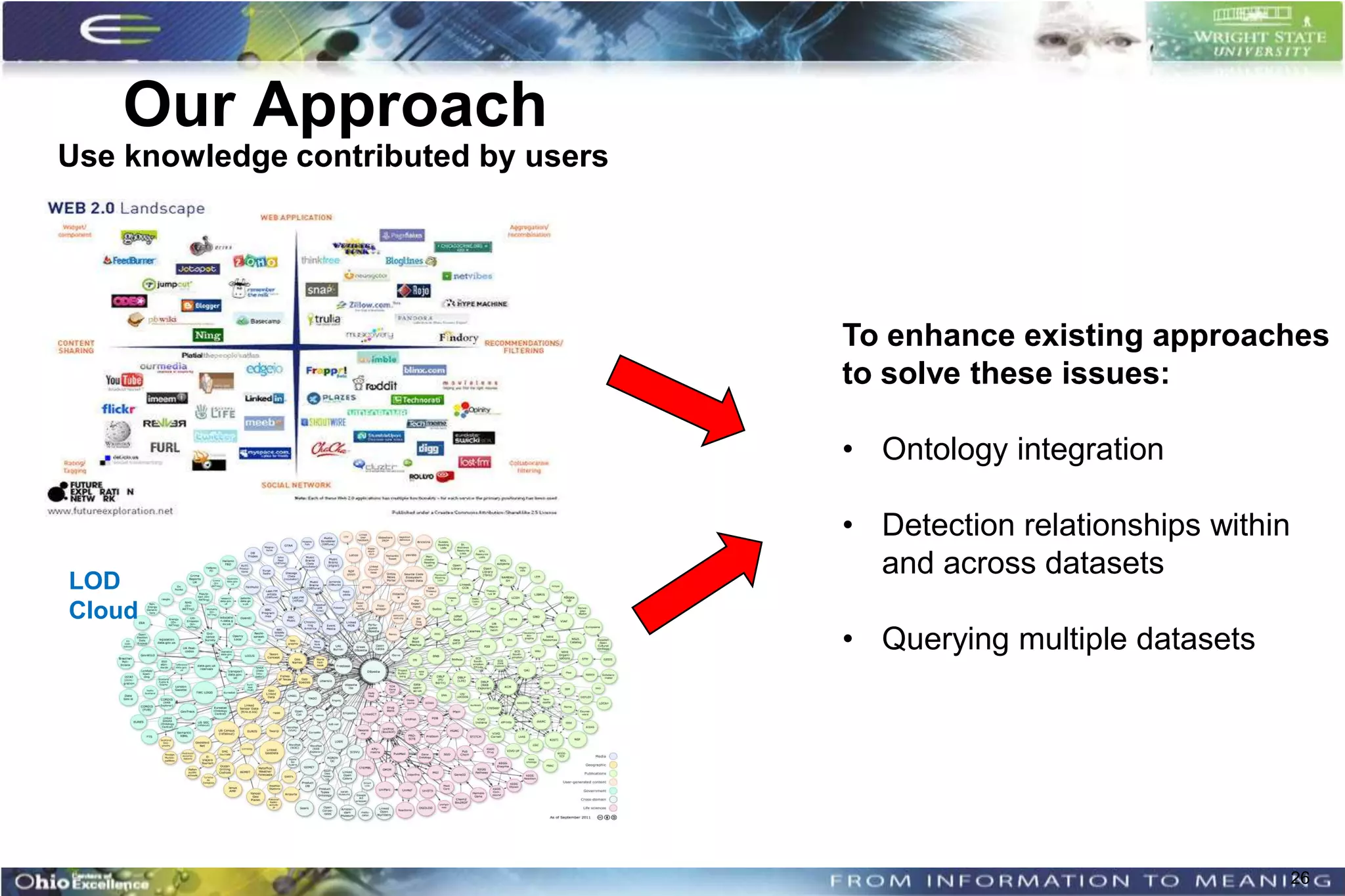
Our Approach
Use knowledge contributed by users


                                     To enhance existing approaches
                                     to solve these issues:

                                     • Ontology integration

                                     • Detection relationships within
LOD
                                       and across datasets
Cloud
                                     • Querying multiple datasets


                                                                        26
Circling Back


       • LOD captures instance level relationships, but
           lacks class level relationships.
            o Superclass
            o Subclass
            o Equivalence


7/2/2012                                                   28
                                                          28
BLOOMS – Bootstrapping …
• BLOOMS - Bootstrapping-based Linked Open
  Data Ontology Matching System

• Developed specifically for LOD Ontologies
• Identifies schema level links between different
  LOD datasets

• Aligns ontologies belonging to diverse domains
  using diverse data sources
                                                    30
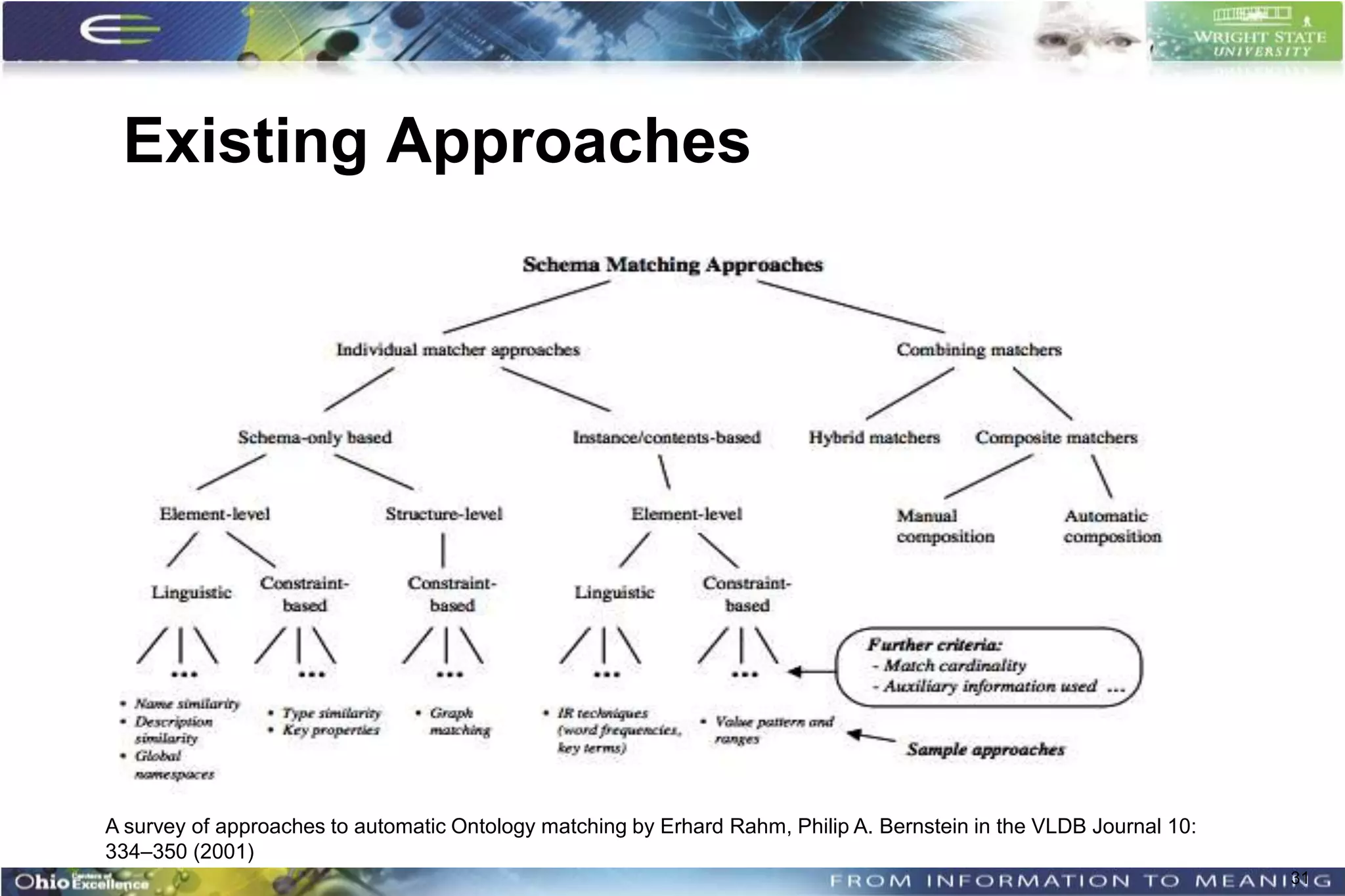
Existing Approaches


A survey of approaches to automatic Ontology matching by Erhard Rahm, Philip A. Bernstein in the VLDB Journal 10:
334–350 (2001)
                                                                                                                    31
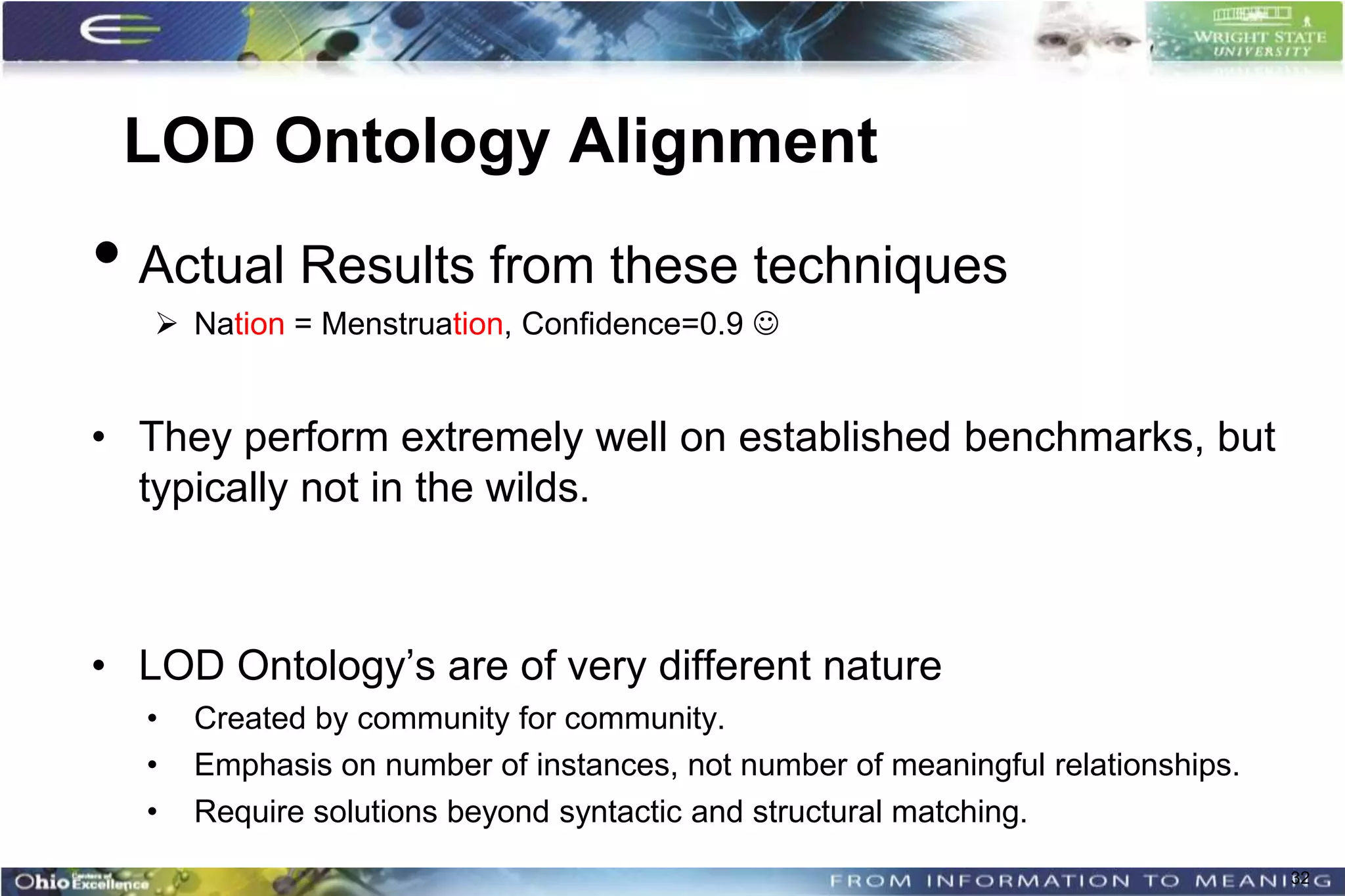
LOD Ontology Alignment
• Actual Results from these techniques
    Nation = Menstruation, Confidence=0.9 


• They perform extremely well on established benchmarks, but
  typically not in the wilds.


• LOD Ontology’s are of very different nature
  •   Created by community for community.
  •   Emphasis on number of instances, not number of meaningful relationships.
  •   Require solutions beyond syntactic and structural matching.
                                                                                 32
Rabbit out of a hat?
• Traditional auxiliary data sources
  (WordNet, Upper Level Ontologies) have limited
  coverage.

• Community generated is noisy, but is rich in
  •   Content
  •   Structure
  •   Has a “self healing property”


• Problems like Ontology Matching have a
  dimension of context associated with them.
                                                   33
Wikipedia
• The English version alone has more than 2.9
  million articles

• Continually expanded by approx. 100,000 active
  volunteer editors

• Multiple points of view are mentioned with
  proper contexts

• Article creation/correction is an ongoing activity   34
Ontology Matching using Wikipedia
• On Wikipedia, categories are used to organize
  the entire project.

• Wikipedia's category system consists of
  overlapping trees.

• Simple rules for categorization

                                                  35
BLOOMS Approach – Step 1


• Pre-process the input ontology
     Remove property restrictions
     Remove individuals, properties


• Tokenize the class names
     Remove underscores, hyphens and other delimiters
     Breakdown complex class names
       •  example: SemanticWeb => Semantic Web


                                                         36
BLOOMS Approach – Step 2
• Identify article in Wikipedia corresponding to the concept.
   o Each article related to the concept indicates a sense of the usage of the
     word.


• For each article found in the previous step
   o Identify the Wikipedia category to which it belongs.
   o For each category found, find its parent categories till level 4.


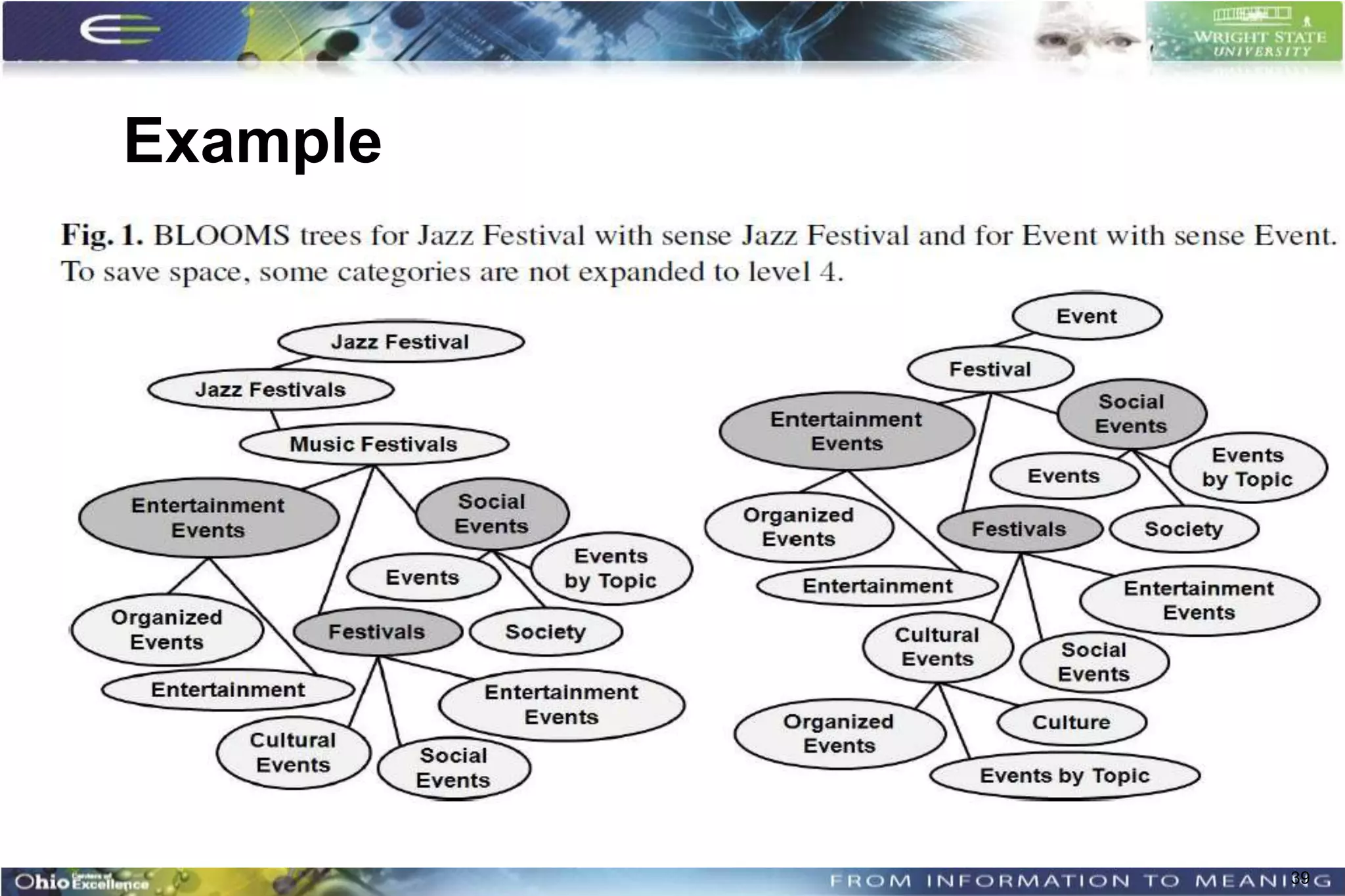
• Once the “BLOOMS tree” for each of the sense of the source
  concept is created (Ts), utilize it for comparison with the
  “BLOOMS tree” of the target concepts (Tt).

                                                                                 37
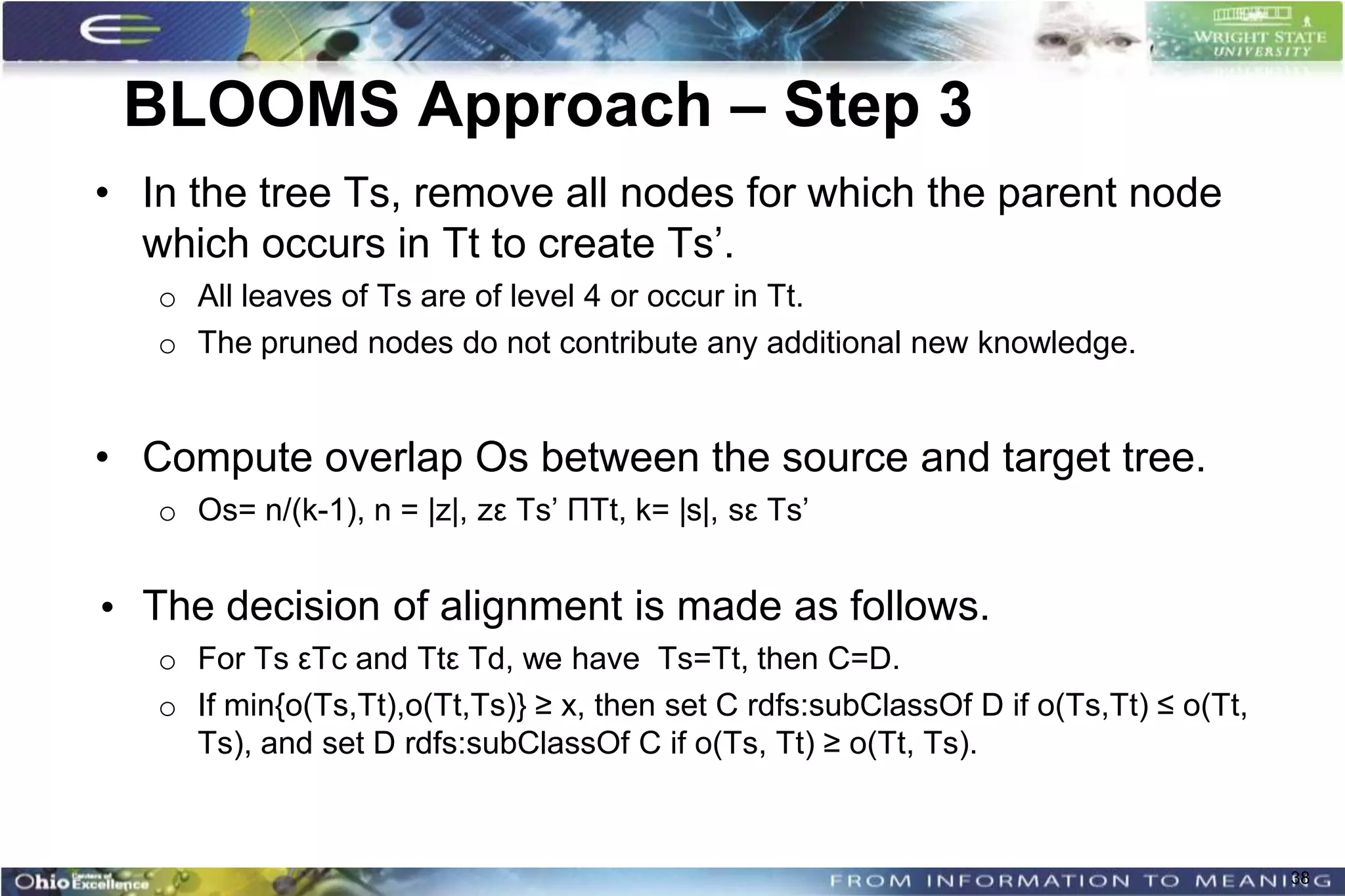
BLOOMS Approach – Step 3
• In the tree Ts, remove all nodes for which the parent node
  which occurs in Tt to create Ts’.
   o All leaves of Ts are of level 4 or occur in Tt.
   o The pruned nodes do not contribute any additional new knowledge.


• Compute overlap Os between the source and target tree.
   o Os= n/(k-1), n = |z|, zε Ts’ ΠTt, k= |s|, sε Ts’


• The decision of alignment is made as follows.
   o For Ts εTc and Ttε Td, we have Ts=Tt, then C=D.
   o If min{o(Ts,Tt),o(Tt,Ts)} ≥ x, then set C rdfs:subClassOf D if o(Ts,Tt) ≤ o(Tt,
     Ts), and set D rdfs:subClassOf C if o(Ts, Tt) ≥ o(Tt, Ts).


                                                                                       38
Example


          39
Evaluation Objectives

 • To examine BLOOMS as a tool for the purpose of LOD
   ontology matching.


 • To examine the ability of BLOOMS to serve as a general
   purpose ontology matching system.


                                                            40
Circling Back


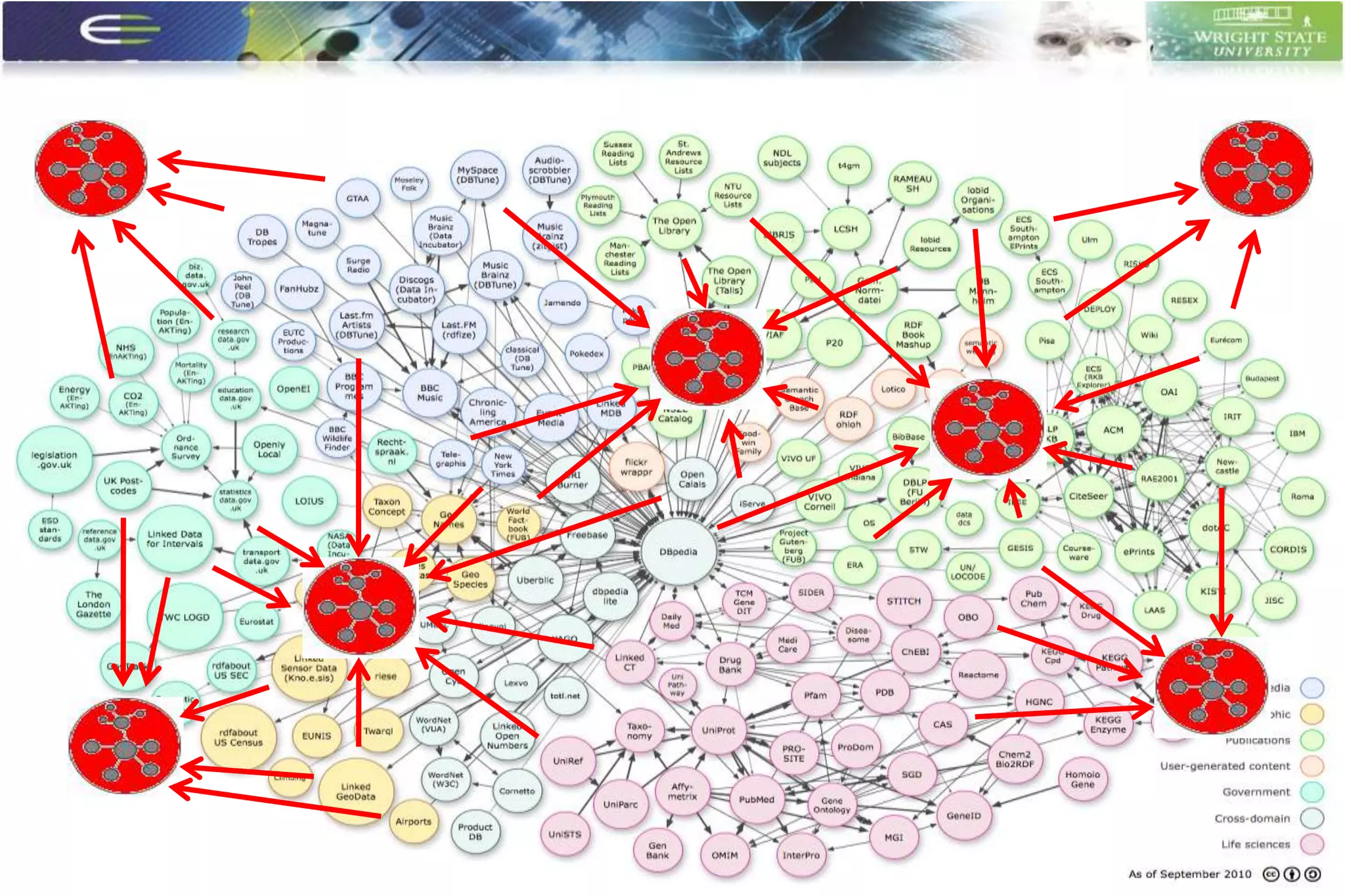
       • LOD primarily consists of owl:sameAs links


7/2/2012                                               41
                                                      41
Part of Relationship
  Identification
Partonomy Identification
•   Currently entities across datasets are linked using primarily the
    owl:sameAs relationship


•   Relationships such as partonomy (part-of), and causality can
    allow creating even more intelligent applications such as Watson


•   Approach PLATO (Part-Of relation finder on Linked Open DAta
    Tool)


                                                                        43
PLATO Approach


• PLATO generates all possible partonomically
  linked pairs between the entities in the dataset.
  o Utilize “strongly” associated entities


• Identify the type of each entity in the pair using
  WordNet.
  o Use Class Names
  o Gives the lexicographer files for the synsets
    corresponding to these entities
                                                       44
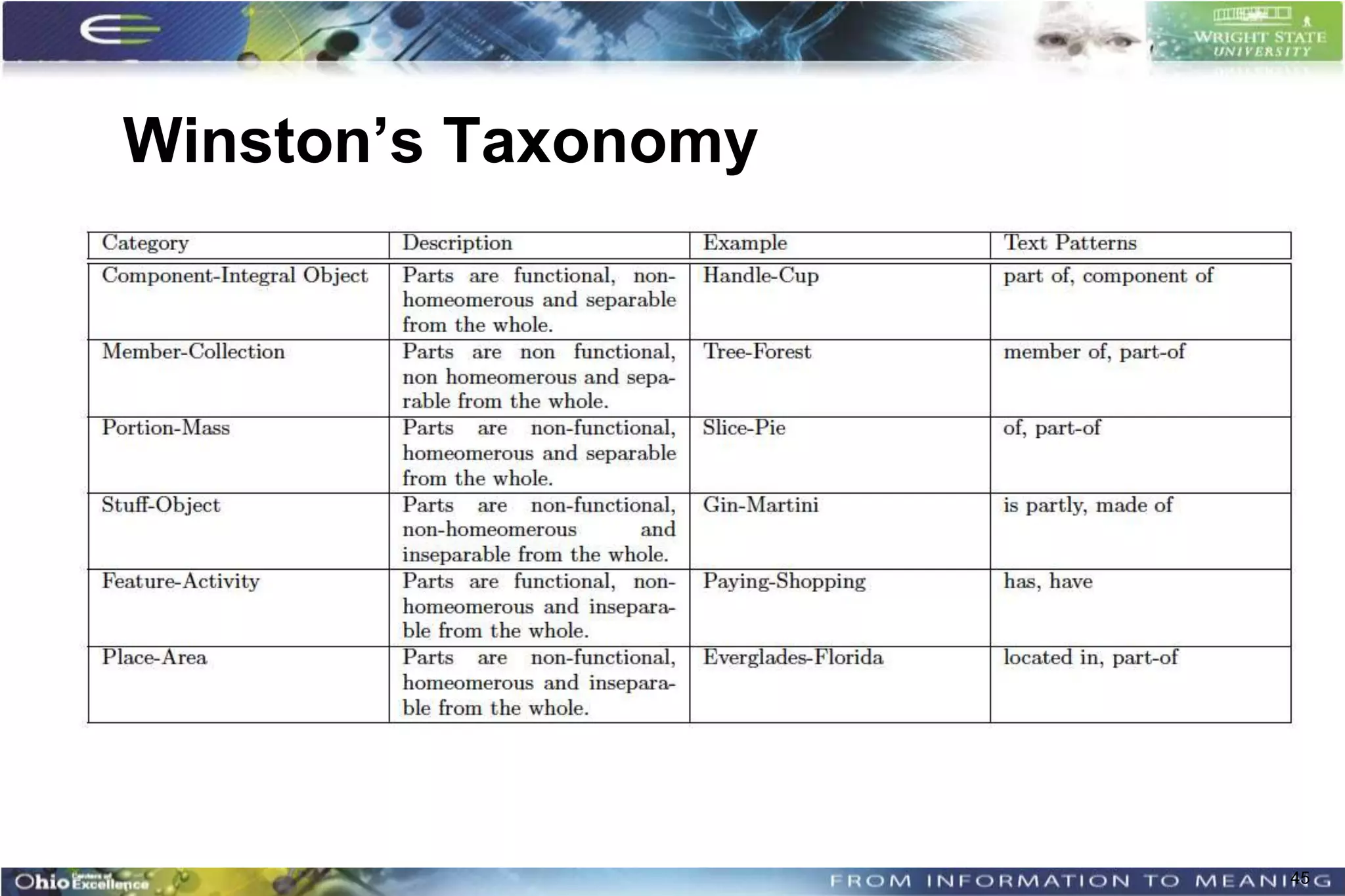
Winston’s Taxonomy


                     45
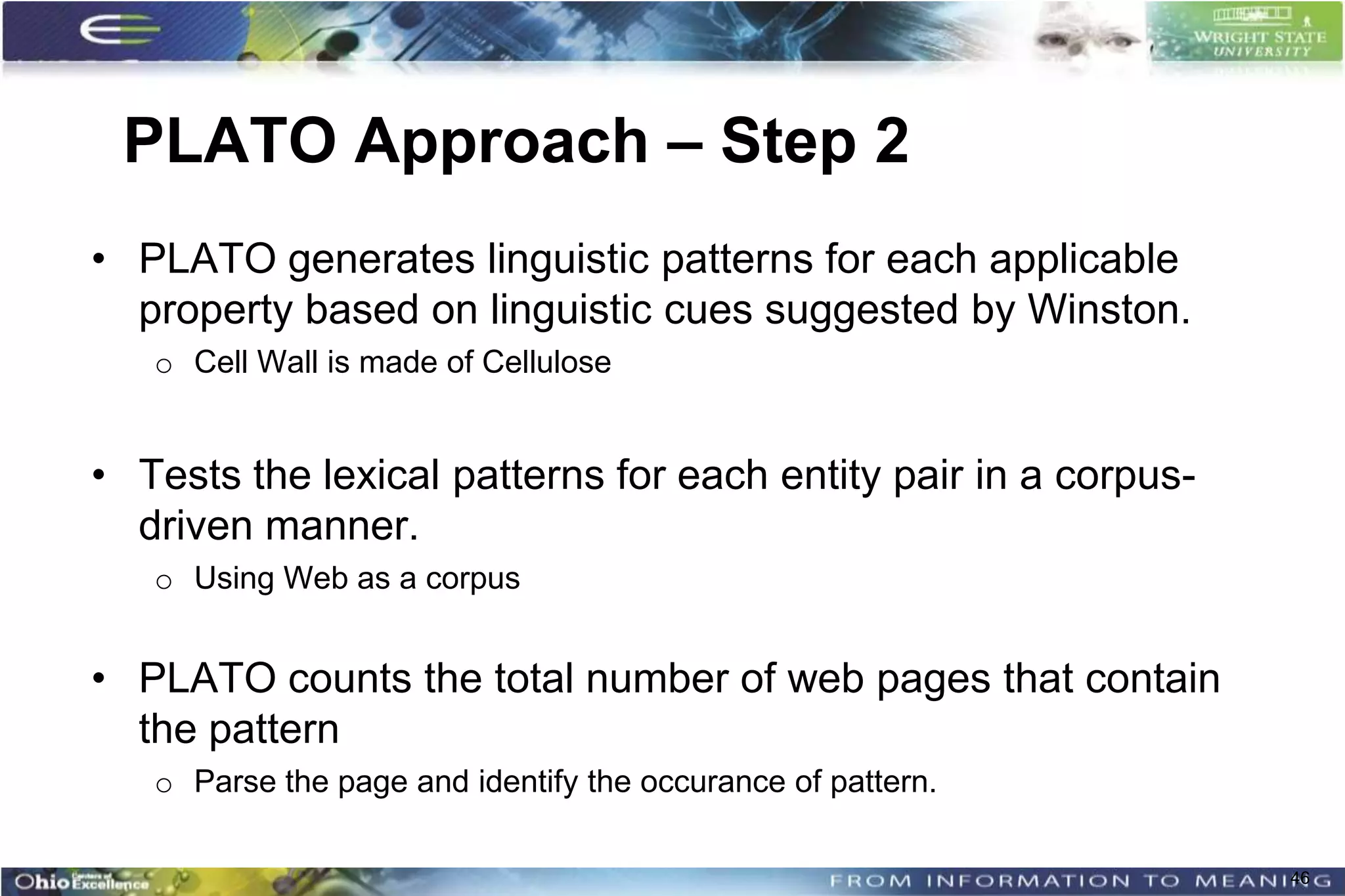
PLATO Approach – Step 2
• PLATO generates linguistic patterns for each applicable
  property based on linguistic cues suggested by Winston.
   o Cell Wall is made of Cellulose


• Tests the lexical patterns for each entity pair in a corpus-
  driven manner.
   o Using Web as a corpus


• PLATO counts the total number of web pages that contain
  the pattern
   o Parse the page and identify the occurance of pattern.

                                                                 46
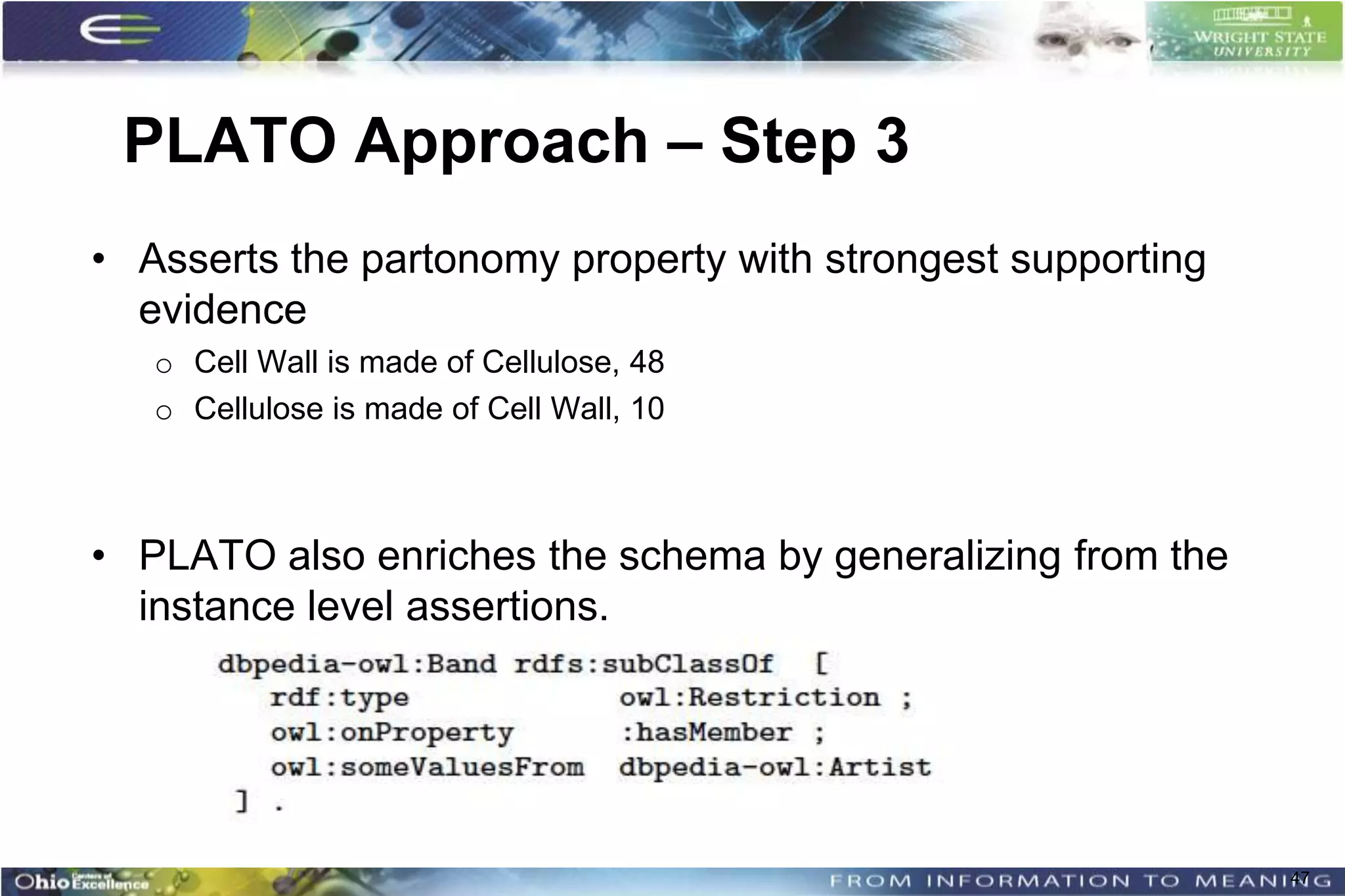
PLATO Approach – Step 3
• Asserts the partonomy property with strongest supporting
  evidence
   o Cell Wall is made of Cellulose, 48
   o Cellulose is made of Cell Wall, 10


• PLATO also enriches the schema by generalizing from the
  instance level assertions.


                                                             47
Evaluation Objectives

 • To examine PLATO as a tool for finding different kinds of
   part-of relation.

 • To examine PLATO as a tool for finding part-of relation
   within a dataset

 • To examine PLATO as a tool for finding part-of relation
   across dataset


                                                               48
49
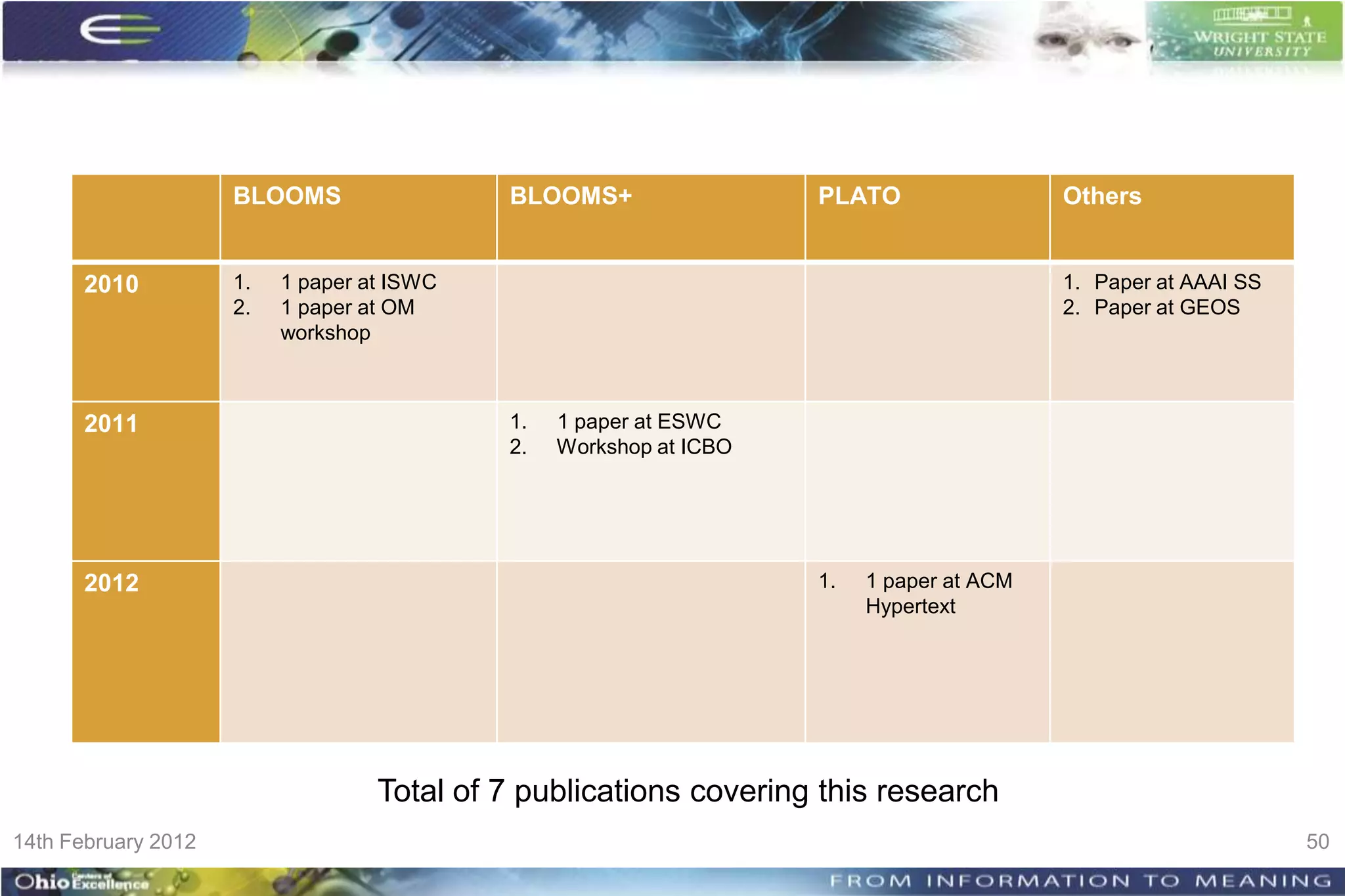
BLOOMS                 BLOOMS+                 PLATO                 Others


       2010          1.   1 paper at ISWC                                                 1. Paper at AAAI SS
                     2.   1 paper at OM                                                   2. Paper at GEOS
                          workshop


       2011                                 1.   1 paper at ESWC
                                            2.   Workshop at ICBO


       2012                                                         1.   1 paper at ACM
                                                                         Hypertext


                                   Total of 7 publications covering this research
14th February 2012                                                                                              50
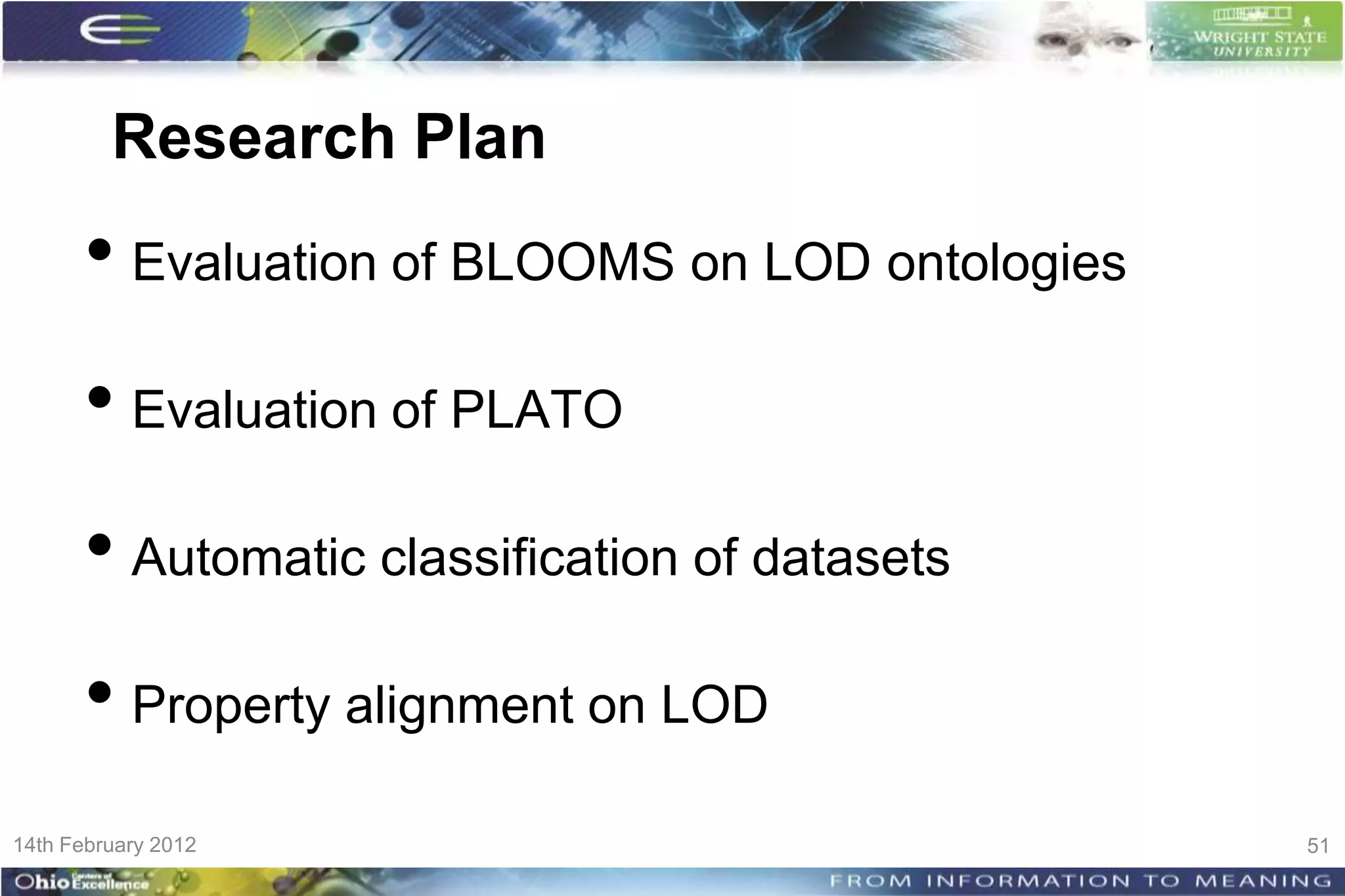
Research Plan
      • Evaluation of BLOOMS on LOD ontologies
      • Evaluation of PLATO
      • Automatic classification of datasets
      • Property alignment on LOD
14th February 2012                               51
Questions?

PhD Proposal Defense - Prateek Jain

  • 1.
  • 2.
    11 years later… Imagefrom Scientific American Website
  • 3.
  • 4.
  • 5.
  • 6.
    Tim Berners-Lee 2006 1.Use URIs as names for things 2. Use HTTP URIs so that people can look up those names. 3. When someone looks up a URI, provide useful information, using the standards (RDF*, SPARQL) 4. Include links to other URIs. so that they can discover more things. 6
  • 7.
    In 2006 Webof Data 7
  • 8.
    Linked Open Data • Massive collection of instance data • Primarily connected via owl:sameAs relationship • Excellent source of information for background knowledge • Labeled as mainstream Semantic Web 7/2/2012 8 8
  • 9.
    Is it reallymainstream Semantic Web? • What is the relationship between the models whose instances are being linked? • How to do querying on LOD without knowing individual datasets? • How to perform schema level reasoning over LOD cloud? 9
  • 10.
    What can bedone? • Relationships are at the heart of Semantics • LOD primarily consists of owl:sameAs links • LOD captures instance level relationships, but lacks class level relationships. o Superclass o Subclass o Equivalence • How to find these relationships? o Perform a matching of the LOD Ontology’s using state of the art ontology matching tools. 10
  • 11.
    Linked Data Alignment and Enrichment Proposal Defense June 11th, 2012 Prateek Jain Kno.e.sis Center Wright State University, Dayton, OH
  • 12.
    Agenda • Motivation and Significance of this research • Research questions and proposed solutions • State of the current research and planned work • Questions and comments 14th February 2012 12
  • 13.
    Linked Open Data • A set of best practices for publishing and connecting structured data on the Web • Practices have been adopted by an increasing number of data providers in the past 5 years • Latest count is at 295 datasets with over 50 Billion triples (approx) 14th February 2012 13
  • 14.
    Linked Open Data2007 (May) Linking Open Data cloud diagram, this and subsequent pages, by Richard Cyganiak and AnjaJentzsch. http://lod-cloud.net/ 14
  • 15.
    Linked Open Data2007 (Oct) 15
  • 16.
  • 17.
  • 18.
    Linked Open Data Numberof Datasets Number of triples (Sept 2011) 31,634,213,770 2011-09-19 295 with 503,998,829 out-links 2010-09-22 203 2009-07-14 95 2008-09-18 45 2007-10-08 25 2007-05-01 12 From http://www4.wiwiss.fu-berlin.de/lodcloud/state/ 18
  • 19.
    6 years ofexistence how many applications come to your mind? 7/2/2012 19
  • 20.
  • 21.
    Reality… • “We DID NOT use the entire Dbpedia or LOD. The only component of LOD which helped us with Watson was YAGO class hierarchy present in DBpedia. We had strict information gain requirements and other components honestly did not help much“ – Researcher with the Watson Team 7/2/2012 21 21
  • 22.
  • 23.
    A simple query.. “Identifycongress members, who have voted “No” on pro environmental legislation in the past four years, with high-pollution industry in their congressional districts.” But even with LOD we cannot answer this query. 23
  • 24.
    Example: GovTrack Vote: 2009- vote:hasOption vote:vote 887 Votes:2009-887/+ vote:votedBy Aye rdfs:label vote:hasAction people/P000197 H.R. 3962: Affordable Health Care for America dc:title Act name On Passage: H R dc:title 3962 Affordable Nancy Pelosi Health Care for Bills:h3962 America Act 24
  • 25.
    Example: GeoNames rdfs:subClassOf? 25
  • 26.
    Our Approach Use knowledgecontributed by users To enhance existing approaches to solve these issues: • Ontology integration • Detection relationships within LOD and across datasets Cloud • Querying multiple datasets 26
  • 27.
    Circling Back • LOD captures instance level relationships, but lacks class level relationships. o Superclass o Subclass o Equivalence 7/2/2012 28 28
  • 28.
  • 29.
    • BLOOMS -Bootstrapping-based Linked Open Data Ontology Matching System • Developed specifically for LOD Ontologies • Identifies schema level links between different LOD datasets • Aligns ontologies belonging to diverse domains using diverse data sources 30
  • 30.
    Existing Approaches A surveyof approaches to automatic Ontology matching by Erhard Rahm, Philip A. Bernstein in the VLDB Journal 10: 334–350 (2001) 31
  • 31.
    LOD Ontology Alignment •Actual Results from these techniques  Nation = Menstruation, Confidence=0.9  • They perform extremely well on established benchmarks, but typically not in the wilds. • LOD Ontology’s are of very different nature • Created by community for community. • Emphasis on number of instances, not number of meaningful relationships. • Require solutions beyond syntactic and structural matching. 32
  • 32.
    Rabbit out ofa hat? • Traditional auxiliary data sources (WordNet, Upper Level Ontologies) have limited coverage. • Community generated is noisy, but is rich in • Content • Structure • Has a “self healing property” • Problems like Ontology Matching have a dimension of context associated with them. 33
  • 33.
    Wikipedia • The Englishversion alone has more than 2.9 million articles • Continually expanded by approx. 100,000 active volunteer editors • Multiple points of view are mentioned with proper contexts • Article creation/correction is an ongoing activity 34
  • 34.
    Ontology Matching usingWikipedia • On Wikipedia, categories are used to organize the entire project. • Wikipedia's category system consists of overlapping trees. • Simple rules for categorization 35
  • 35.
    BLOOMS Approach –Step 1 • Pre-process the input ontology  Remove property restrictions  Remove individuals, properties • Tokenize the class names  Remove underscores, hyphens and other delimiters  Breakdown complex class names • example: SemanticWeb => Semantic Web 36
  • 36.
    BLOOMS Approach –Step 2 • Identify article in Wikipedia corresponding to the concept. o Each article related to the concept indicates a sense of the usage of the word. • For each article found in the previous step o Identify the Wikipedia category to which it belongs. o For each category found, find its parent categories till level 4. • Once the “BLOOMS tree” for each of the sense of the source concept is created (Ts), utilize it for comparison with the “BLOOMS tree” of the target concepts (Tt). 37
  • 37.
    BLOOMS Approach –Step 3 • In the tree Ts, remove all nodes for which the parent node which occurs in Tt to create Ts’. o All leaves of Ts are of level 4 or occur in Tt. o The pruned nodes do not contribute any additional new knowledge. • Compute overlap Os between the source and target tree. o Os= n/(k-1), n = |z|, zε Ts’ ΠTt, k= |s|, sε Ts’ • The decision of alignment is made as follows. o For Ts εTc and Ttε Td, we have Ts=Tt, then C=D. o If min{o(Ts,Tt),o(Tt,Ts)} ≥ x, then set C rdfs:subClassOf D if o(Ts,Tt) ≤ o(Tt, Ts), and set D rdfs:subClassOf C if o(Ts, Tt) ≥ o(Tt, Ts). 38
  • 38.
  • 39.
    Evaluation Objectives •To examine BLOOMS as a tool for the purpose of LOD ontology matching. • To examine the ability of BLOOMS to serve as a general purpose ontology matching system. 40
  • 40.
    Circling Back • LOD primarily consists of owl:sameAs links 7/2/2012 41 41
  • 41.
    Part of Relationship Identification
  • 42.
    Partonomy Identification • Currently entities across datasets are linked using primarily the owl:sameAs relationship • Relationships such as partonomy (part-of), and causality can allow creating even more intelligent applications such as Watson • Approach PLATO (Part-Of relation finder on Linked Open DAta Tool) 43
  • 43.
    PLATO Approach • PLATOgenerates all possible partonomically linked pairs between the entities in the dataset. o Utilize “strongly” associated entities • Identify the type of each entity in the pair using WordNet. o Use Class Names o Gives the lexicographer files for the synsets corresponding to these entities 44
  • 44.
  • 45.
    PLATO Approach –Step 2 • PLATO generates linguistic patterns for each applicable property based on linguistic cues suggested by Winston. o Cell Wall is made of Cellulose • Tests the lexical patterns for each entity pair in a corpus- driven manner. o Using Web as a corpus • PLATO counts the total number of web pages that contain the pattern o Parse the page and identify the occurance of pattern. 46
  • 46.
    PLATO Approach –Step 3 • Asserts the partonomy property with strongest supporting evidence o Cell Wall is made of Cellulose, 48 o Cellulose is made of Cell Wall, 10 • PLATO also enriches the schema by generalizing from the instance level assertions. 47
  • 47.
    Evaluation Objectives •To examine PLATO as a tool for finding different kinds of part-of relation. • To examine PLATO as a tool for finding part-of relation within a dataset • To examine PLATO as a tool for finding part-of relation across dataset 48
  • 48.
  • 49.
    BLOOMS BLOOMS+ PLATO Others 2010 1. 1 paper at ISWC 1. Paper at AAAI SS 2. 1 paper at OM 2. Paper at GEOS workshop 2011 1. 1 paper at ESWC 2. Workshop at ICBO 2012 1. 1 paper at ACM Hypertext Total of 7 publications covering this research 14th February 2012 50
  • 50.
    Research Plan • Evaluation of BLOOMS on LOD ontologies • Evaluation of PLATO • Automatic classification of datasets • Property alignment on LOD 14th February 2012 51
  • 51.

Editor's Notes

  • #28 both as a knowledge source and test bed
  • #36 “If logical membership of one category implies logical membership of a second, then the first category should be made a subcategory”“Pages are not placed directly into every possible category, only into the most specific one in any branch”“Every Wikipedia article should belong to at least one category.”